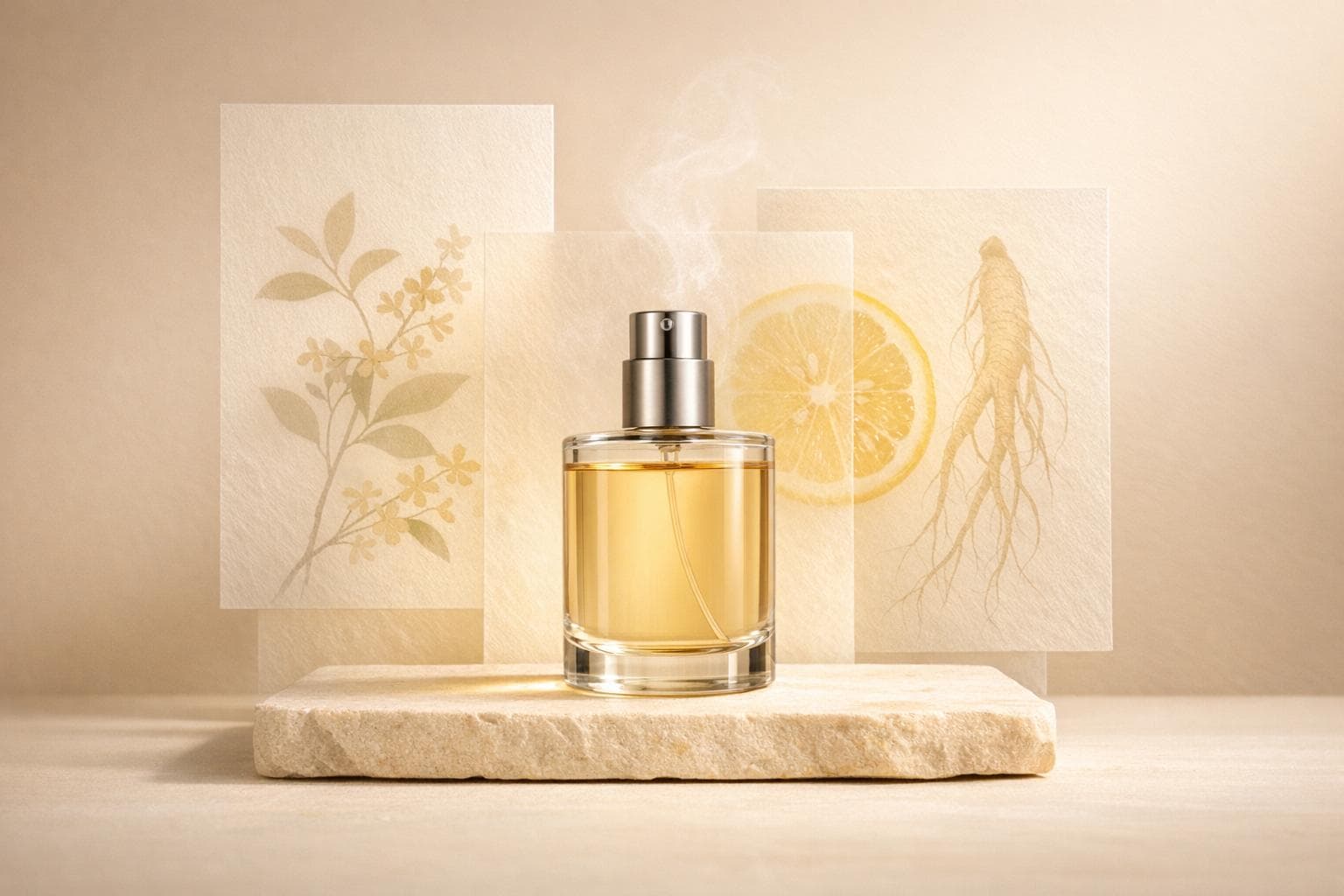
East Asian fragrance houses are transforming the perfume industry by combining centuries-old scent traditions with modern Western techniques. This approach integrates regional ingredients like osmanthus, bamboo, and green tea with familiar Western notes such as bergamot and vanilla. Each country in the region contributes distinct styles:
- China: Bold scents featuring amber, sandalwood, and incense. The market is growing fast, expected to hit $7.2 billion by 2029.
- Japan: Subtle, nature-inspired perfumes using green tea, yuzu, and hinoki wood. Focuses on "ma", the concept of negative space.
- Korea: Light, memory-evoking fragrances with ingredients like rice milk and Korean pear. The global rise of K-beauty supports its growth.
East Asian brands are also leveraging partnerships with Western perfumers and luxury marketing strategies, creating a new standard in perfumery that balances heritage with modern appeal.
1. Chinese Fragrance Houses
Chinese perfumers are blending ancient scent traditions with modern techniques, creating a unique bridge between heritage and contemporary perfumery. Materials like agarwood, sandalwood, osmanthus, and jasmine - once central to ceremonial incense known as xiang gao - are now being reimagined into perfumes produced with Western methods.
Brands like Tobba are leading this transformation. While manufacturing fragrances in France to align with Western standards, they incorporate distinctly Asian elements. Co-founder Jasper Li captures this ethos:
"I wanted to make something with our own cultural ingredients and memories, but in a modern way".
One standout example is Tobba’s Higher Self fragrance, which combines unconventional notes like Tiger Balm and "Florida Water" - a traditional Chinese cologne featuring citrus, lavender, and neroli - within Western fragrance styles such as Fougere and Gourmand.
This approach addresses a gap in the market. Lishi Ni, founder of Melt Season, highlights the disconnect between Western luxury brands and Chinese consumers:
"have rarely taken Chinese people’s customs and traditions into account and have failed to meet their emotional needs".
Chinese consumers are embracing this shift. A striking 64.2% report using perfume daily, often as a source of pleasure or emotional comfort. High-end local brands such as Melt Season, Documents, and Qi Cun Jiu, with prices exceeding ¥1,000 (approximately $123), are now competing directly with international niche houses.
The numbers tell a compelling story. China’s perfume market is on track to hit $6.4 billion by 2028, growing at an impressive 14% annually, despite overall market penetration remaining below 5%. Major global players like L’Oréal and Estée Lauder are investing in top Chinese brands, such as Documents and To Summer, to help them expand internationally.
This fusion of local traditions with Western techniques has not only reshaped the Chinese fragrance industry but also set the stage for the distinct approaches seen in Japanese perfumery. Meanwhile, consumer preferences are evolving, with woody notes like cedarwood leading 2024 trends. Interestingly, more women are moving away from traditional florals, favoring drier, unisex profiles instead.
2. Japanese Fragrance Houses
Japanese perfumers masterfully combine traditional botanicals with Western techniques, guided by the principle of wa (harmony). The result? Scents that are understated yet deeply evocative, designed to linger softly rather than announce themselves boldly.
Native woods like Hinoki, Hiba, and Kusunoki often serve as foundational notes in Japanese fragrances. These are carefully blended with other accords to create unique compositions. As Mr. Hiroyuki Hoshina of KITOWA explains:
"we integrate traditional Japanese woods with complementary scents to craft a unique fragrance."
To balance these traditional elements, Japanese fragrance houses frequently incorporate Western-style citrus notes like bergamot and verbena, or familiar florals such as rose and cassis. This thoughtful pairing creates a depth that resonates with both domestic and international audiences, showcasing Japan’s distinctive approach to fragrance design.
In line with local preferences, cream perfumes are popular for their skin-close application and moisturizing properties, offering a subtle alternative to alcohol-based sprays. Additionally, Eau de Toilette (EDT) formulations are favored over heavier Eau de Parfum (EDP), as their lighter, fresher profiles align with the Japanese preference for understated scents.
Perfumer SARI from ametsuchi captures this philosophy perfectly:
"I leave space in my fragrances to embrace nature’s subtlety and evoke personal interpretation."
This approach, inspired by Zen concepts like ma (space) and seijaku (stillness), ensures the fragrances enhance the wearer without overwhelming others - an especially practical consideration in Japan’s densely populated urban areas.
As the second-largest cosmetics market globally, after the US, Japan leans toward crisp, delicate scents. Notes like peonies, lychee-infused roses, and musky-woody accords reflect Shinto ideals of purity, further emphasizing the country’s refined and thoughtful approach to fragrance.
Your Personal Fragrance Expert Awaits
Take our quick scent quiz to discover authentic designer and niche fragrances matched to your taste — explore them as 2ml, 5ml, 8ml & 30ml decants and samples, so you can try each one before committing to a full bottle.
Find Your Scent3. Korean Fragrance Houses
Korean perfumers are leading the "K-perfume" movement, a fresh approach that blends traditional Korean ingredients with Western perfumery techniques. Unlike the boldness often associated with Western fragrances, Korean brands focus on what Deacoutre founder Vicky Jung describes as "poetic subtlety" - delicate, memory-evoking scents that whisper rather than shout.
In November 2025, the Korean-inspired, New York-based brand ELOREA introduced its "Resonance" collection. This line, crafted in collaboration with Western master perfumers Rodrigo Flores — Roux and Shyamala Maisondieu, reimagines distinctly Korean ingredients. Highlights include "Bae Frais", featuring Korean pear; "Cloud Daze", which incorporates makgeolli (traditional rice wine) and dalgona; and "Royal Resin", showcasing chimhyang namu - an oud historically used in Korean palaces - paired with Korean birch. The collection is priced at $240 for a 3.4 oz bottle, with 0.07 oz samples available for $10. This collaboration reflects a seamless blend of heritage and contemporary refinement.
This East-meets — West philosophy also shapes the way Korean brands structure their fragrances. They often adopt Western formats like Fougère and Gourmand but enrich them with local ingredients. The result is fragrances that align with Asian preferences for "skin scents" - soft, light fragrances ideal for humid climates and cultural values that favor subtlety. Jasper Li of Tobba explains:
"In Asia, like Hong Kong, Japan, people like more gentle, more light, even the skin scents due to the weather or the cultural aspects".
South Korea’s cosmetics industry is thriving, with exports reaching a record $10.2 billion in 2024, representing 76.1% of the country’s production. Brands like Tamburins are leveraging the global influence of K-pop, featuring stars such as Jennie from Blackpink, to expand into markets like Tokyo, Shanghai, and Bangkok. While their packaging often reflects minimalist Western aesthetics, the essence of these products remains deeply tied to Korean history and natural elements.
Summing up this vision, Jung highlights the potential of Korean fragrances:
"K-beauty succeeded not only because of product quality, but because it became a cultural symbol. That same potential exists in fragrance".
Modern Korean fragrance houses are also embracing global trends with genderless, vegan, and clean formulations, positioning themselves as the next major players in the luxury fragrance market.
Strengths and Weaknesses
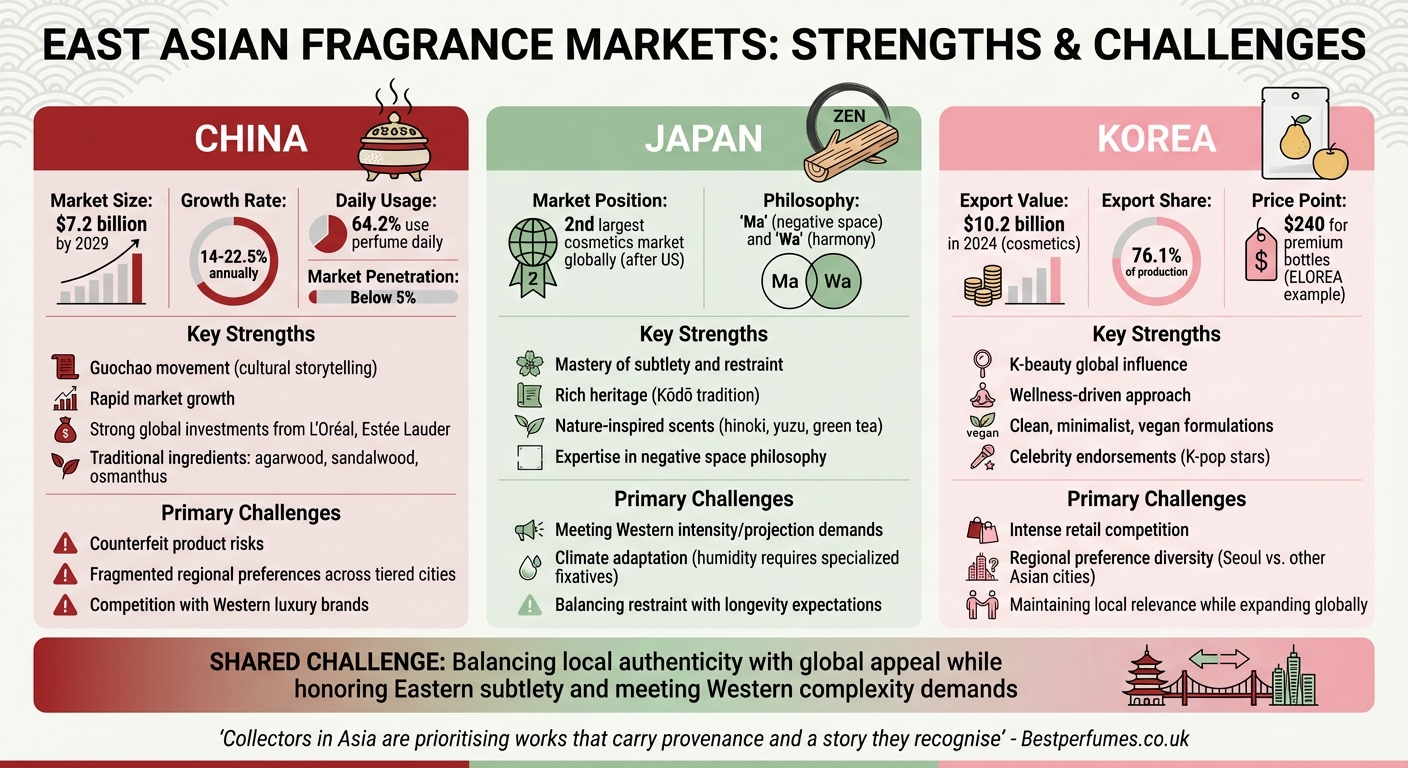
East Asian Fragrance Markets Comparison: China, Japan, and Korea
This section dives into the distinct advantages and hurdles faced by fragrance markets in China, Japan, and Korea, offering a comparative look at their unique dynamics.
Chinese fragrance houses draw strength from the guochao movement, blending traditional elements with modern influences to create scents that celebrate local heritage. This approach resonates deeply with domestic consumers. However, the market is not without its challenges. Intense competition and the prevalence of counterfeit products require costly measures like NFC authentication to ensure authenticity. The sector’s rapid expansion - expected to hit around $7.2 billion by 2029 - has sparked significant global interest but also led to fragmentation, as scent preferences vary widely across tiered cities.
Japanese perfumery stands out for its mastery of subtlety and the philosophy of "ma" (negative space), crafting serene, nature-inspired fragrances that reflect harmony and restraint. This unique style sets Japanese brands apart globally. Yet, navigating Western expectations for stronger projection and longevity presents a challenge, as these preferences can clash with Japan’s cultural emphasis on subtlety. Additionally, Japan’s humid climate necessitates specialized fixatives to maintain scent performance in such conditions.
Korean fragrance brands benefit from the global rise of K-beauty and a focus on wellness, positioning themselves as modern, accessible, and sophisticated. They excel at creating minimalist, skin-friendly scents with transparent formulations, adapting Western trends to local tastes. However, Korea’s retail landscape is fiercely competitive. For instance, L’Oréal’s decision to pull Valentino Beauty from the Korean market in early 2026 highlights the difficulty of sustaining success in this environment. Furthermore, Korean brands must navigate regional diversity, as Seoul leans toward transparent florals while other Asian cities prefer bolder fragrances.
| Region | Key Strengths | Primary Challenges |
|---|---|---|
| China | Guochao storytelling; rapid market growth; strong global investments | Counterfeit risks; fragmented regional preferences; competition with Western luxury brands |
| Japan | Expertise in subtlety and "ma"; rich heritage (Kōdō); nature-inspired scents | Meeting Western intensity demands; climate adaptation; balancing restraint with projection |
| Korea | K-beauty influence; wellness-driven; clean, minimalist formulations | Intense retail competition; keeping relevance locally; addressing varied regional preferences |
The shared challenge across these regions is achieving a balance between local authenticity and global appeal. As Unknown, Senior Editor at Bestperfumes.co.uk, aptly observed:
"Collectors in Asia are prioritising works - and by extension products - that carry provenance and a story they recognise".
Fragrance houses must skillfully navigate this fine line, honoring Eastern values of subtlety while meeting Western desires for complexity. This balancing act underscores the need for strategic ingenuity to thrive in these diverse markets.
Conclusion
East Asian fragrance houses are reshaping the global perfume landscape by blending centuries-old traditions with contemporary Western techniques. This unique fusion has introduced a distinctive olfactory palette - featuring notes like osmanthus, oolong tea, Sichuan pepper, and bamboo - that offers a striking contrast to the more familiar Western focus on florals and musks.
China’s fragrance market, once a modest 2.5% of global sales, is now expanding at an impressive pace. Projections estimate it will reach $7.2 billion by 2029, growing 22.5% annually. Major players like L’Oréal, Estée Lauder, and Puig are making significant investments to capitalize on this momentum.
What stands out is the rise of the "affordable niche" approach. Unlike Western brands that often price full bottles above $300, East Asian brands like Documents and Melt Season are delivering comparable artistry at more accessible price points, typically between $100 and $250. This strategy has made high-quality luxury fragrances attainable for urban professionals.
East Asian perfumers are also collaborating with renowned Western experts such as Jerome Epinette and Frank Voelkl, while incorporating minimalist Zen-inspired aesthetics into their packaging and retail spaces. Shen Li, founder of To Summer, encapsulates this movement, stating:
"My vision is creating a ‘roadmap for Eastern fragrance’ on a global scale".
This vision is already leaving its mark on global luxury brands, which are now introducing exclusive collections featuring traditional ingredients like lotus, hinoki, and shiso to appeal to regional preferences.
Together, these trends highlight the profound influence of East Asian creativity on global perfumery. By championing subtlety, nature-inspired compositions, and spiritual narratives, these houses are not just competing with but often surpassing the bold intensity and grandeur of Western fragrances. This cultural exchange offers fragrance enthusiasts a deeper, more personal connection to heritage and identity.
FAQs
What makes East Asian perfumes distinct from Western ones?
East Asian perfumes are notable for their deep connection to tradition and their distinctive use of ingredients. They frequently incorporate warm, spicy, and resinous notes, drawing inspiration from age-old practices that add a sense of depth and complexity. On the other hand, Western perfumes often lean towards fresher profiles, with lighter floral or citrus scents that prioritize brightness and a more straightforward appeal. These contrasting styles mirror the differing historical and aesthetic values of each region, with East Asian fragrances offering a more layered and nuanced experience.
How do Chinese, Japanese, and Korean scent styles differ day to day?
Chinese, Japanese, and Korean fragrance traditions are deeply rooted in subtlety and the use of natural ingredients, reflecting their rich cultural heritage. Chinese fragrances often highlight aromatic woods such as aloeswood, a key element in meditation practices and the serene Kōdō incense ceremonies. In Japan, the focus lies on achieving a refined balance and understated elegance, with incense playing a prominent role in their scent compositions. Meanwhile, Korean preferences tend to lean toward floral and herbal notes, ideal for everyday wear. Together, these styles emphasize delicate and sophisticated scents, offering a striking contrast to the often bolder profiles found in Western fragrances.
How can I try these subtle “skin scent” styles without buying a full bottle?
You can try out these understated “skin scent” fragrances by opting for smaller samples, like decants. Platforms such as Scento provide 8ml discovery bottles, allowing you to enjoy genuine designer perfumes without the need to purchase a full-sized bottle. It’s an ideal way to find scents that align with your personal taste.

