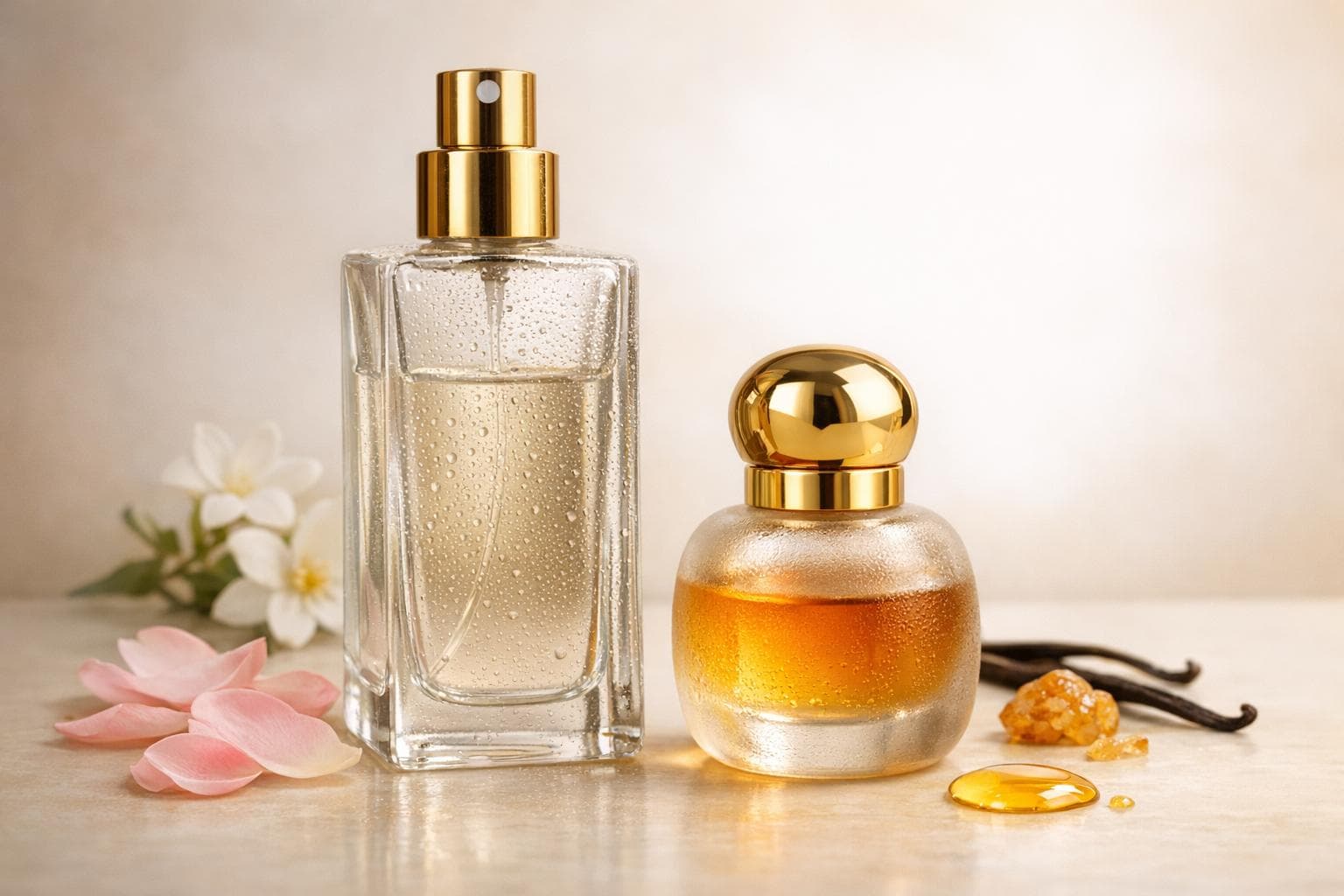
Όταν αποφασίζετε ανάμεσα σε αρωματικά έλαια και αρώματα με βάση την αλκοόλη, η επιλογή εξαρτάται από τον τύπο της επιδερμίδας σας, τον τρόπο ζωής σας και τις προτιμήσεις σας. Τα αρωματικά έλαια προσφέρουν μια διακριτική, μακράς διάρκειας και ενυδατική εμπειρία αρώματος, ενώ τα αρώματα με βάση την αλκοόλη χαρίζουν έντονη προβολή και άμεσο αρωματικό αποτύπωμα. Ακολουθεί μια σύντομη ανάλυση:
-
Αρωματικά Έλαια:
- Μεγάλη διάρκεια (10–14 ώρες)
- Απαλά για ευαίσθητη ή ξηρή επιδερμίδα
- Διακριτικό άρωμα, κοντά στην επιδερμίδα
- Ιδανικά για οικείες περιστάσεις ή ξηρά κλίματα
-
Αρώματα με Βάση την Αλκοόλη:
- Ισχυρή προβολή και εντυπωσιακή πρώτη εντύπωση
- Διαρκούν 6–10 ώρες
- Ενδέχεται να ερεθίσουν την ευαίσθητη επιδερμίδα
- Ιδανικά για κοινωνικές εκδηλώσεις ή ζεστό καιρό
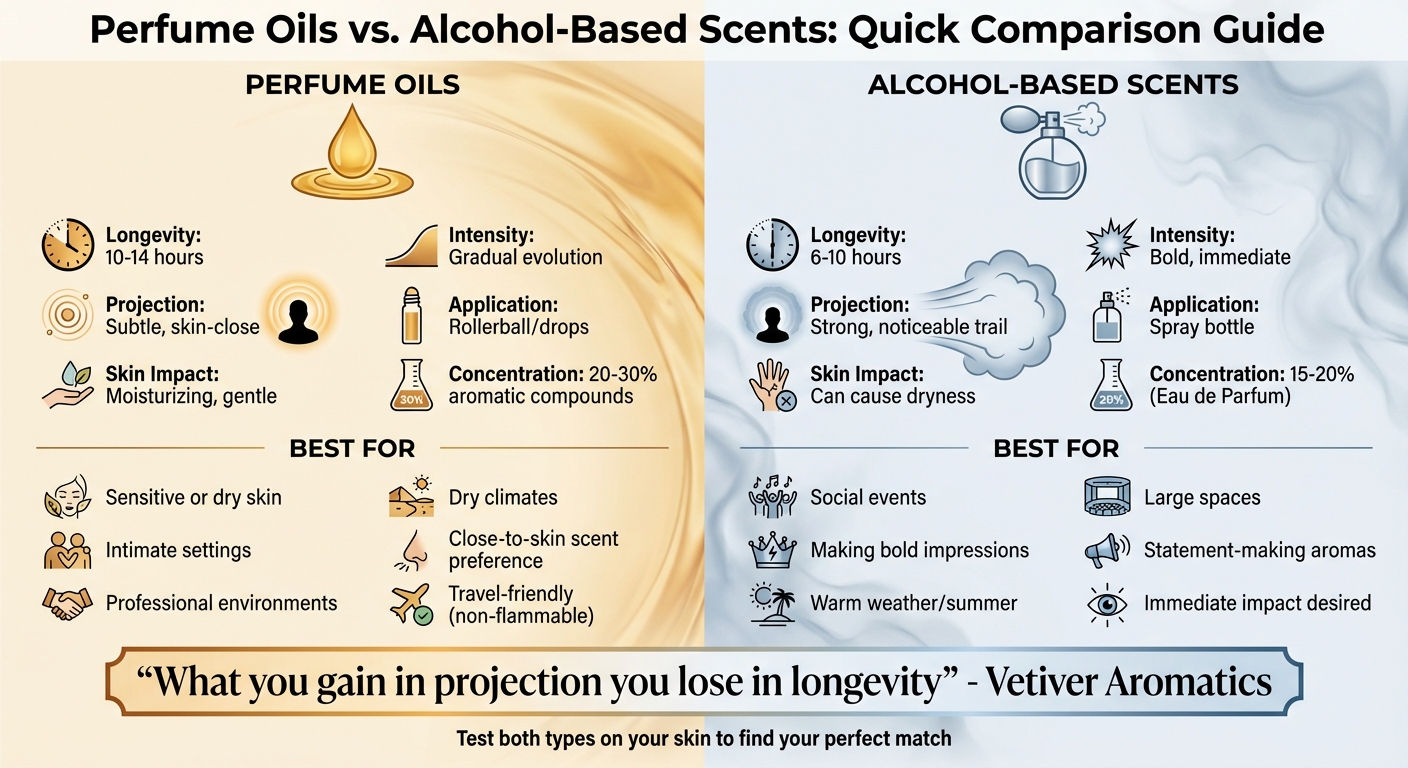
Σύντομη σύγκριση
| Χαρακτηριστικό | Αρωματικά Έλαια | Αρώματα με Βάση την Αλκοόλη |
|---|---|---|
| Διάρκεια | 10–14 ώρες | 6–10 ώρες |
| Προβολή | Διακριτική, κοντά στην επιδερμίδα | Ισχυρή, αισθητό αρωματικό ίχνος |
| Επίδραση στην επιδερμίδα | Ενυδατική, απαλή | Μπορεί να προκαλέσει ξηρότητα |
| Ένταση | Σταδιακή εξέλιξη | Τολμηρή, άμεση |
| Εφαρμογή | Rollerball/σταγόνες | Φιάλη σπρέι |
Τα αρωματικά έλαια ταιριάζουν σε όσους προτιμούν ένα διακριτικό, ενυδατικό άρωμα, ενώ τα αρώματα με βάση την αλκοόλη είναι καλύτερα για τολμηρά, εντυπωσιακά αρωματικά αποτυπώματα. Δοκιμάστε και τους δύο τύπους στην επιδερμίδα σας για να βρείτε το ιδανικό σας ταίρι.
Αρωματικά Έλαια vs Αρώματα με Βάση την Αλκοόλη: Πλήρης Οδηγός Σύγκρισης
What Are Perfume Oils?
Τα αρωματικά έλαια είναι ιδιαίτερα συμπυκνωμένα αρωματικά μείγματα που παρακάμπτουν πλήρως τη χρήση αλκοόλης. Αντί να βασίζονται στην αιθυλική αλκοόλη ως φορέα, αυτά τα έλαια χρησιμοποιούν βάσεις όπως jojoba, κλασματοποιημένη καρύδα, argan ή έλαιο γλυκού αμυγδάλου. Αυτή η αλλαγή στη σύνθεση μεταβάλλει τον τρόπο με τον οποίο το άρωμα αλληλεπιδρά με την επιδερμίδα σας.
Με συγκεντρώσεις συνήθως μεταξύ 15% και 30% - υψηλότερες από το 12%–18% που συναντάται στα περισσότερα Eau de Parfums - τα αρωματικά έλαια απελευθερώνουν το άρωμά τους αργά, ενεργοποιούμενα από τη θερμότητα του σώματός σας. Όπως το θέτει ο συγγραφέας Andres Jimenez:
Τα συμπυκνωμένα αρωματικά έλαια ξεχωρίζουν επειδή δεν περιέχουν αλκοόλη, προσφέροντας μια πιο καθαρή και πιο έντονη εμπειρία αρώματος.
Αυτή η σταδιακή απελευθέρωση δημιουργεί ένα «οικείο» sillage, πράγμα που σημαίνει ότι το άρωμα παραμένει κοντά στην επιδερμίδα σας αντί να γεμίζει τον χώρο. Δεν θα αφήσετε πίσω σας ένα έντονο ίχνος, όμως όσοι βρίσκονται κοντά σας θα αντιληφθούν το άρωμα. Επιπλέον, τα αρωματικά έλαια εξελίσσονται με μη γραμμικό τρόπο, με τις νότες να μεταμορφώνονται και να αλλάζουν με την πάροδο του χρόνου καθώς το έλαιο απορροφάται από την επιδερμίδα σας. Αυτά τα μοναδικά χαρακτηριστικά καθιστούν τα αρωματικά έλαια μια ξεχωριστή επιλογή για τους λάτρεις των αρωμάτων.
Κύρια χαρακτηριστικά των αρωματικών ελαίων
Τα αρωματικά έλαια είναι γνωστά για την εντυπωσιακή τους διάρκεια, καθώς συχνά παραμένουν 10 έως 14 ώρες στην επιδερμίδα. Αυτό συμβαίνει επειδή τα έλαια προσκολλώνται στο δέρμα αντί να εξατμίζονται όπως τα σπρέι με βάση την αλκοόλη.
Ένα ακόμη βασικό πλεονέκτημα είναι οι ενυδατικές τους ιδιότητες. Τα έλαια-φορείς, πλούσια σε λιπαρά οξέα, όχι μόνο συγκρατούν το άρωμα αλλά επίσης ενυδατώνουν και προστατεύουν την επιδερμίδα σας. Όπως εξηγεί η Amorphous Perfume:
Τα αρώματα με βάση το έλαιο είναι από τη φύση τους ενυδατικά και μπορούν να μαλακώσουν την επιδερμίδα, πέρα από την απόδοσή τους ως άρωμα.
Η διαδικασία εφαρμογής των αρωματικών ελαίων είναι επίσης ιδιαίτερη. Τα περισσότερα διατίθενται σε rollerballs ή σταγονόμετρα, απαιτώντας μόνο μικρή ποσότητα - συνήθως μερικές σταγόνες ή ένα μόνο πέρασμα - στα σημεία παλμού, όπως οι καρποί, ο λαιμός, πίσω από τα αυτιά ή το εσωτερικό των αγκώνων. Για καλύτερα αποτελέσματα, εφαρμόστε αμέσως μετά το ντους, όταν η επιδερμίδα σας είναι ζεστή και οι πόροι ανοιχτοί, επιτρέποντας στο έλαιο να απορροφηθεί πιο αποτελεσματικά. Αποφύγετε απλώς να τρίβετε τους καρπούς σας μεταξύ τους, καθώς αυτό μπορεί να διασπάσει τα μόρια του αρώματος και να αλλοιώσει την οσμή.
Ποιοι πρέπει να χρησιμοποιούν αρωματικά έλαια;
Τα αρωματικά έλαια αποτελούν εξαιρετική επιλογή για άτομα με ευαίσθητη επιδερμίδα, έκζεμα ή δερματίτιδα. Η σύνθεση χωρίς αλκοόλη αποφεύγει την ξηρότητα και τον ερεθισμό που συχνά προκαλούνται από τα παραδοσιακά σπρέι. Όπως σημειώνει η Jasmine Perfumes:
Η σύνθεση χωρίς αλκοόλη εξαλείφει πλήρως την πιθανότητα ερεθισμού ή ξηρότητας της επιδερμίδας, καθιστώντας αυτά τα αρώματα μια ασφαλή και προσωπική επιλογή για όσους αντιμετωπίζουν θέματα ευαισθησίας.
Είναι επίσης ιδανικά αν προτιμάτε ένα διακριτικό άρωμα που παραμένει κοντά στην επιδερμίδα αντί για ένα άρωμα με ευρεία προβολή. Αυτό τα καθιστά ιδιαίτερα κατάλληλα για κοντινά περιβάλλοντα όπου εκτιμάται ένα πιο απαλό άρωμα. Επιπλέον, η ενυδατική φύση των αρωματικών ελαίων είναι ιδιαίτερα ευεργετική σε ξηρά κλίματα, προσφέροντας ενυδάτωση μαζί με άρωμα μεγάλης διάρκειας.
Ένα πρακτικό πλεονέκτημα: τα αρωματικά έλαια είναι μη εύφλεκτα, καθιστώντας τα ασφαλέστερα στην αποθήκευση και ευκολότερα στη διεθνή αποστολή. Αν ταξιδεύετε συχνά ή θέλετε να αποφύγετε τους περιορισμούς υγρών στα αεροδρόμια για τα σπρέι με βάση την αλκοόλη, τα αρωματικά έλαια αποτελούν μια άνετη εναλλακτική.
Τι είναι τα αρώματα με βάση την αλκοόλη;
Τα αρώματα με βάση την αλκοόλη βασίζονται στην αιθανόλη ως κύριο διαλύτη τους, μεταφέροντας τις αρωματικές ενώσεις με τρόπο ασφαλή για εφαρμογή στην επιδερμίδα. Σε αντίθεση με τα έλαια, η αλκοόλη διαλύει αποτελεσματικά ισχυρά συστατικά, καθιστώντας την ένα αξιόπιστο μέσο για τους αρωματοποιούς.
Ένα από τα βασικά χαρακτηριστικά των αρωμάτων με βάση την αλκοόλη είναι η γρήγορη εξάτμισή τους. Αυτή η διαδικασία βοηθά στην ταχεία απελευθέρωση των αρωματικών μορίων, δημιουργώντας άμεσο αρωματικό αντίκτυπο. Η αρωματοποιός Marissa Zappas αναδεικνύει αυτή τη δυναμική: ο συνδυασμός αλκοόλης και ψεκαστήρα ενισχύει τον όγκο και το sillage ενός αρώματος. Αυτή η γρήγορη διάχυση σχηματίζει το εμβληματικό «αρωματικό σύννεφο», όπου οι τολμηρές νότες κορυφής λάμπουν από την πρώτη στιγμή, αποκαλύπτοντας σταδιακά την πλήρη σύνθεση του αρώματος.
Συνήθως, αυτά τα αρώματα συσκευάζονται σε φιάλες σπρέι με ψεκαστήρες. Κατηγοριοποιούνται ανάλογα με τα επίπεδα συγκέντρωσής τους: Eau de Toilette (EDT) στο 8–12%, Eau de Parfum (EDP) στο 12–18% και Parfum/Extrait στο 20–30%. Αυτές οι διακρίσεις επηρεάζουν την ένταση και τη διάρκειά τους, προσφέροντας ποικιλία επιλογών για διαφορετικές προτιμήσεις.
Κύρια χαρακτηριστικά των αρωμάτων με βάση την αλκοόλη
Ένα ξεχωριστό χαρακτηριστικό των αρωμάτων με βάση την αλκοόλη είναι η ισχυρή τους προβολή. Όπως εξηγεί η Vetiver Aromatics:
Η αλκοόλη ανυψώνει ένα άρωμα. Καθώς η αλκοόλη εξατμίζεται, το άρωμα ακτινοβολεί προς τα έξω, τυλίγοντάς σας σε ένα σύννεφο αρώματος.
Αυτή η ταχεία εξάτμιση τονίζει τις νότες κορυφής, καρδιάς και βάσης του αρώματος, προσφέροντας μια άμεση και έντονη οσφρητική εμπειρία. Ωστόσο, αυτό το τολμηρό άνοιγμα συνοδεύεται από έναν συμβιβασμό: η διάρκεια του αρώματος μπορεί να είναι μικρότερη σε σύγκριση με τα αρώματα με βάση το έλαιο.
Ένα ακόμη πλεονέκτημα είναι η ευελιξία τους. Η ελαφρύτερη υφή της αλκοόλης επιτρέπει στους αρωματοποιούς να εξερευνούν ένα ευρύτερο φάσμα νοτών, από δροσερά εσπεριδοειδή έως πλούσιες ξυλώδεις συμφωνίες. Για παρατεταμένη διάρκεια, δοκιμάστε να ψεκάσετε το άρωμα στα ρούχα ή στα μαλλιά σας. Επειδή η αλκοόλη εξατμίζεται πιο αργά σε αυτές τις επιφάνειες, το άρωμα τείνει να παραμένει περισσότερο. Να θυμάστε, ωστόσο, ότι τα αρώματα με βάση την αλκοόλη είναι εύφλεκτα και συχνά ταξινομούνται ως επικίνδυνα υλικά, γεγονός που μπορεί να δυσκολέψει τη διεθνή αποστολή.
Ποιοι πρέπει να χρησιμοποιούν αρώματα με βάση την αλκοόλη;
Τα αρώματα με βάση την αλκοόλη είναι ιδανικά για όποιον θέλει να δημιουργήσει μια τολμηρή, αισθητή εντύπωση. Όπως το θέτει η Amorphous Perfume:
Για ένα άρωμα που δημιουργεί δραματικό, αισθητό αντίκτυπο, θα θελήσετε να επιλέξετε ένα άρωμα με βάση την αλκοόλη.
Αυτά τα αρώματα λάμπουν σε κοινωνικά περιβάλλοντα, επίσημες εκδηλώσεις ή οπουδήποτε θέλετε το άρωμά σας να αφήνει μια διαρκή εντύπωση από απόσταση.
Είναι επίσης κατάλληλα για ζεστό καιρό ή τους καλοκαιρινούς μήνες. Η γρήγορη εξάτμιση δημιουργεί μια αίσθηση δροσιάς στην επιδερμίδα, καθιστώντας τα άνετα στη χρήση στη ζέστη. Ωστόσο, όσοι έχουν ευαίσθητη επιδερμίδα ενδέχεται να εμφανίσουν ξηρότητα ή ερεθισμό λόγω της περιεκτικότητας σε αιθανόλη. Για να το περιορίσετε, μπορείτε να εφαρμόσετε μια άοσμη λοσιόν ως φραγμό ή να επικεντρωθείτε στον ψεκασμό του αρώματος στα ρούχα ή στα μαλλιά σας αντί απευθείας στην επιδερμίδα.
Αρωματικά έλαια vs. αρώματα με βάση την αλκοόλη: Κύριες διαφορές
Όταν πρόκειται να επιλέξετε ανάμεσα σε αρωματικά έλαια και αρώματα με βάση την αλκοόλη, υπάρχουν αρκετοί βασικοί παράγοντες που πρέπει να λάβετε υπόψη: διάρκεια, προβολή, επίδραση στην επιδερμίδα, ένταση και κόστος.
Η διάρκεια είναι ένα από τα πιο χαρακτηριστικά πλεονεκτήματα των αρωματικών ελαίων. Μπορούν να παραμείνουν στην επιδερμίδα από 10 έως 14 ώρες, ξεπερνώντας κατά πολύ τα Eau de Parfums με βάση την αλκοόλη, τα οποία συνήθως διαρκούν 6 έως 10 ώρες. Ο λόγος βρίσκεται στη σύνθεσή τους - η αλκοόλη εξατμίζεται γρήγορα, μειώνοντας τη διάρκεια του αρώματος, ενώ τα έλαια δεσμεύονται με τα φυσικά λιπίδια της επιδερμίδας, εξασφαλίζοντας παρατεταμένη χρήση.
Η προβολή, δηλαδή το πόσο μακριά ταξιδεύει ένα άρωμα, διαφέρει σημαντικά. Όπως σημειώνει εύστοχα η Vetiver Aromatics:
"Ό,τι κερδίζετε σε προβολή, το χάνετε σε διάρκεια." – Vetiver Aromatics
Τα αρώματα με βάση την αλκοόλη είναι γνωστά για την τολμηρή τους προβολή, δημιουργώντας ένα αισθητό αρωματικό ίχνος που αναγγέλλει την παρουσία σας. Αντίθετα, τα αρωματικά έλαια προσφέρουν μια πιο οικεία εμπειρία, σχηματίζοντας μια διακριτική αύρα που γίνεται αντιληπτή μόνο από όσους βρίσκονται κοντά σας.
Η επίδραση στην επιδερμίδα είναι ένας ακόμη τομέας όπου τα αρωματικά έλαια υπερέχουν. Τείνουν να ενυδατώνουν την επιδερμίδα και είναι αρκετά απαλά για ευαίσθητους τύπους. Τα αρώματα με βάση την αλκοόλη, από την άλλη πλευρά, μπορεί μερικές φορές να προκαλέσουν ξηρότητα ή ερεθισμό λόγω της υψηλότερης περιεκτικότητάς τους σε αλκοόλη.
Όσον αφορά την ένταση, τα αρώματα με βάση την αλκοόλη κάνουν άμεση δήλωση με τις τολμηρές νότες ανοίγματός τους. Τα αρωματικά έλαια, ωστόσο, εξελίσσονται πιο σταδιακά, συχνά χρειάζονται περίπου 30 λεπτά για να φτάσουν στην πλήρη πολυπλοκότητά τους.
Το κόστος είναι μια πιο σύνθετη παράμετρος. Η αρωματοποιός Marissa Zappas εξηγεί:
"Το έλαιο είναι πολύ πιο ακριβό από την αλκοόλη, επομένως τα αρώματα σε υψηλότερη συγκέντρωση γενικά κοστίζουν περισσότερο."
Ενώ τα αρωματικά έλαια είναι ακριβότερα ανά όγκο και συνήθως πωλούνται σε μικρότερα rollerballs, απαιτούν μόνο μερικές σταγόνες για εφαρμογή. Τα αρώματα με βάση την αλκοόλη, που συνήθως πωλούνται σε φιάλες σπρέι, μπορεί να φαίνονται πιο οικονομικά, αλλά συχνά απαιτούν πολλαπλούς ψεκασμούς για το ίδιο αποτέλεσμα.
Συνοψίζοντας, και οι δύο μορφές έχουν τα δυνατά τους σημεία, και η επιλογή εξαρτάται τελικά από το τι εκτιμάτε περισσότερο σε ένα άρωμα. Ο παρακάτω πίνακας αναδεικνύει τις βασικές διαφορές:
Πίνακας σύγκρισης
| Χαρακτηριστικό | Αρωματικά Έλαια | Αρώματα με Βάση την Αλκοόλη |
|---|---|---|
| Διάρκεια | 10–14 ώρες | 6–10 ώρες |
| Sillage | Οικείο· κοντά στην επιδερμίδα | Ισχυρό· ακτινοβολεί προς τα έξω |
| Επίδραση στην επιδερμίδα | Ενυδατική· απαλή για ευαίσθητη επιδερμίδα | Μπορεί να προκαλέσει ξηρότητα ή ερεθισμό |
| Ένταση | Σταδιακή εξέλιξη σε 30 λεπτά | Τολμηρή, άμεση εντύπωση |
| Συγκέντρωση | 20–30% αρωματικές ενώσεις | 15–20% (Eau de Parfum) |
| Τιμή ανά όγκο | Υψηλότερη· πωλούνται σε μικρά rollerballs | Χαμηλότερη· διατίθενται σε φιάλες σπρέι |
sbb-itb-fb213bc
Τι να λάβετε υπόψη κατά την επιλογή
Όταν επιλέγετε ένα άρωμα, παράγοντες όπως ο τύπος επιδερμίδας, ο τρόπος ζωής και οι αρωματικές προτιμήσεις μπορούν να επηρεάσουν σημαντικά το πώς αποδίδει και πώς αισθάνεται ένα άρωμα. Αυτά τα στοιχεία λειτουργούν μαζί για να δημιουργήσουν μια εμπειρία αρώματος που εναρμονίζεται με τις προσωπικές σας ανάγκες και το περιβάλλον σας. Ας δούμε πώς παίζει ρόλο καθένα από αυτά.
Τύπος επιδερμίδας
Η φυσική χημεία της επιδερμίδας σας μπορεί να επηρεάσει το πώς αναπτύσσεται και πόσο διαρκεί ένα άρωμα.
Λιπαρή επιδερμίδα:
Αν έχετε λιπαρή επιδερμίδα, τα αρώματα τείνουν να διαρκούν περισσότερο, επειδή τα φυσικά έλαια βοηθούν να συγκρατούνται τα αρωματικά μόρια στη θέση τους. Ωστόσο, ορισμένες νότες, όπως οι γλυκές, μπορεί να γίνουν υπερβολικά έντονες. Ο Michael Donovan, Ιδρυτής και Δημιουργικός Διευθυντής της St Giles, εξηγεί:
"Ο γενικός κανόνας είναι ότι η λιπαρή επιδερμίδα κάνει τα αρώματα να αναδεικνύονται. Οι γλυκές νότες, όπως έχω διαπιστώσει, μπορεί να γίνουν κατακλυστικές και σχεδόν δυσάρεστες στις λιπαρές επιδερμίδες."
Ξηρή επιδερμίδα:
Η ξηρή επιδερμίδα, από την άλλη πλευρά, μπορεί να κάνει τα αρώματα να ξεθωριάζουν γρήγορα, καθώς απορροφά ή εξατμίζει το άρωμα πιο γρήγορα. Ο Donovan προτείνει ότι αρώματα με ισχυρές νότες βάσης, όπως orientals, chypres, μπαχαρικά ή πιο πλούσια λουλουδάτα όπως η τουμπερόζα, είναι πιο κατάλληλα για ξηρή επιδερμίδα. Τα αρωματικά έλαια είναι επίσης μια εξαιρετική επιλογή - αποφεύγουν τις σκληρές αλκοόλες και συχνά περιλαμβάνουν θρεπτικά έλαια-φορείς, βοηθώντας τόσο την επιδερμίδα όσο και το άρωμα να διαρκέσουν περισσότερο.
Ευαίσθητη επιδερμίδα:
Για την ευαίσθητη επιδερμίδα, τα αρώματα με βάση την αλκοόλη μπορεί μερικές φορές να οδηγήσουν σε ερεθισμό ή ξηρότητα. Τα αρωματικά έλαια είναι μια πιο απαλή εναλλακτική, καθώς δεν περιέχουν αλκοόλη και συχνά είναι εμπλουτισμένα με ενυδατικά συστατικά. Αυτό τα καθιστά μια καταπραϋντική επιλογή για όσους είναι επιρρεπείς σε ερυθρότητα ή ερεθισμό.
Τρόπος ζωής και κλίμα
Το πού και το πώς σκοπεύετε να φορέσετε το άρωμά σας μπορεί επίσης να επηρεάσει την επιλογή σας.
- Τα αρώματα με βάση την αλκοόλη είναι ιδανικά για κοινωνικά περιβάλλοντα ή μεγαλύτερους χώρους όπου θέλετε το άρωμά σας να ξεχωρίζει. Η γρήγορη εξάτμισή τους δημιουργεί μια ελαφριά, αναζωογονητική αίσθηση, καθιστώντας τα ιδιαίτερα κατάλληλα για ζεστά ή υγρά περιβάλλοντα.
- Τα αρωματικά έλαια λάμπουν σε οικείες ή επαγγελματικές περιστάσεις όπου ένα διακριτικό άρωμα, κοντά στην επιδερμίδα, είναι πιο κατάλληλο. Η σύνθεσή τους βοηθά να «κλειδώνει» η υγρασία, κάτι ιδιαίτερα ωφέλιμο σε ξηρά κλίματα. Επιπλέον, τα πλούσια και συμπυκνωμένα προφίλ τους ταιριάζουν άριστα στον πιο κρύο καιρό, προσφέροντας μια ζεστή και περιβάλλουσα αρωματική εμπειρία.
Για όσους επιθυμούν τόσο τόλμη όσο και διάρκεια, η διαστρωμάτωση ενός αρωματικού ελαίου με ένα άρωμα με βάση την αλκοόλη μπορεί να ενισχύσει την προβολή, διατηρώντας παράλληλα μια μακρά παρουσία.
Αρωματικές προτιμήσεις
Το αρωματικό σας ταξίδι εξαρτάται σε μεγάλο βαθμό από το πώς απολαμβάνετε να βιώνετε τα αρώματα.
- Τα αρώματα με βάση την αλκοόλη προσφέρουν μια άμεση έκρηξη αρώματος, τονίζοντας τις νότες κορυφής για μια τολμηρή και αισθητή πρώτη εντύπωση. Αυτό δημιουργεί ένα «αρωματικό σύννεφο» που σας περιβάλλει και κάνει μια δραματική δήλωση.
- Τα αρωματικά έλαια, αντίθετα, αναπτύσσονται πιο αργά. Εστιάζουν στις νότες καρδιάς και βάσης, δημιουργώντας μια πολυεπίπεδη και οικεία αρωματική εμπειρία. Αυτά τα έλαια συχνά χρειάζονται περίπου 30 λεπτά για να αποκαλύψουν πλήρως τον χαρακτήρα τους, καθιστώντας τα ιδανικά για όσους προτιμούν τη λεπτότητα και την πολυπλοκότητα.
Αν σας ελκύουν τα αρώματα με άμεσο αντίκτυπο και τολμηρή προβολή, οι επιλογές με βάση την αλκοόλη πιθανότατα σας ταιριάζουν καλύτερα. Αν όμως εκτιμάτε ένα άρωμα που ξεδιπλώνεται σταδιακά και παραμένει κοντά στην επιδερμίδα σας, τα αρωματικά έλαια είναι μια εξαιρετική επιλογή. Για να εφαρμόσετε αρωματικά έλαια, χρησιμοποιήστε μόνο μερικές σταγόνες στα σημεία παλμού, όπως οι καρποί, πίσω από τα αυτιά ή το εσωτερικό των αγκώνων, για ένα εκλεπτυσμένο αποτέλεσμα μεγάλης διάρκειας.
Πώς να δοκιμάσετε και να πάρετε την απόφασή σας
Η απόφαση ανάμεσα σε αρωματικά έλαια και αρώματα με βάση την αλκοόλη εξαρτάται από το πώς αποδίδουν στην επιδερμίδα σας και πώς ταιριάζουν στις προτιμήσεις σας. Ακολουθεί ένας πρακτικός τρόπος για να δοκιμάσετε και τους δύο τύπους και να κάνετε μια ενημερωμένη επιλογή.
Βήμα 1: Αξιολογήστε τη διάρκεια και τη συμβατότητα με την επιδερμίδα
Ξεκινήστε εφαρμόζοντας μια μικρή ποσότητα από κάθε τύπο - αρωματικό έλαιο και σπρέι με βάση την αλκοόλη - στα σημεία παλμού αμέσως μετά το ντους. Παρατηρήστε πώς εξελίσσεται το άρωμα σε διαστήματα: 30 λεπτά, 2 ώρες και 5 ώρες. Θυμηθείτε, τα αρώματα με βάση την αλκοόλη τείνουν να δημιουργούν μια τολμηρή πρώτη εντύπωση, ενώ τα αρωματικά έλαια συχνά χρειάζονται περίπου 30 λεπτά για να αναπτύξουν πλήρως τον χαρακτήρα τους. Αποφύγετε να τρίβετε τους καρπούς σας, καθώς αυτό μπορεί να διαταράξει τα αρωματικά στρώματα.
Αν έχετε ευαίσθητη επιδερμίδα, σκεφτείτε να εφαρμόσετε μια άοσμη λοσιόν πριν δοκιμάσετε ένα σπρέι με βάση την αλκοόλη ή ψεκάστε το στα ρούχα σας για να αποφύγετε τον ερεθισμό.
Βήμα 2: Προσδιορίστε τις προτιμήσεις σας ως προς την προβολή
Αφού αξιολογήσετε πώς αλληλεπιδρά κάθε άρωμα με την επιδερμίδα σας, σκεφτείτε πώς σκοπεύετε να το φορέσετε. Αναζητάτε ένα άρωμα που κάνει δήλωση σε κοινωνικές συγκεντρώσεις ή κάτι πιο διακριτικό για την εργασία ή τις καθημερινές περιστάσεις;
Τα αρώματα με βάση την αλκοόλη είναι γνωστά για την τολμηρή τους προβολή, καθιστώντας τα ιδανικά για εκδηλώσεις όπου θέλετε να ξεχωρίζετε. Από την άλλη πλευρά, τα αρωματικά έλαια προσφέρουν ένα πιο οικείο άρωμα, κοντά στην επιδερμίδα, ιδανικό για πιο ήσυχες, καθημερινές στιγμές. Δοκιμάστε κάθε επιλογή σε πραγματικές συνθήκες - ένα αρωματικό έλαιο κατά τη διάρκεια μιας εργάσιμης ημέρας και ένα σπρέι με βάση την αλκοόλη σε μια κοινωνική εκδήλωση. Δώστε προσοχή στο πώς αποδίδει το άρωμα και αν ταιριάζει με τη διάθεση ή την περίσταση.
Βήμα 3: Χρησιμοποιήστε decants για να οριστικοποιήσετε την επιλογή σας
Πριν δεσμευτείτε σε μια πλήρη φιάλη, δοκιμάστε decants για να βεβαιωθείτε ότι το άρωμα συνεργάζεται όμορφα με την επιδερμίδα και τον τρόπο ζωής σας. Τα αρώματα μπορούν να συμπεριφέρονται διαφορετικά ανάλογα με τη χημεία του κάθε σώματος, επομένως είναι απαραίτητο να τα δοκιμάσετε διεξοδικά.
Τα decants είναι ένας εύκολος τρόπος να εξερευνήσετε αρώματα υψηλής αισθητικής, designer και niche αρώματα, χωρίς μεγάλη αρχική επένδυση. Για παράδειγμα, το Scento προσφέρει decants σε μεγέθη όπως φιαλίδια 2 ml, 5 ml και 8 ml, καθώς και μπουκάλι decant 30 ml για τα περισσότερα αρώματα. Ένα decant 8ml παρέχει περίπου 120 ψεκασμούς, δίνοντάς σας πολλές ευκαιρίες να δοκιμάσετε το άρωμα σε διαφορετικά σενάρια. Αυτή η μέθοδος σας βοηθά να κάνετε μια επιλογή με αυτοπεποίθηση.
Όπως μοιράστηκε ο Alex, επαληθευμένος πελάτης:
Έχω ξοδέψει τόσα πολλά σε κολόνιες που είτε δεν μου αρέσει πια η μυρωδιά τους είτε για κάποιον άλλο γελοίο λόγο... το να έχω μικρές ποσότητες από οποιοδήποτε άρωμα επιλέγω είναι απολύτως τέλειο!
Αφιερώστε χρόνο για να δοκιμάσετε τόσο τις εκδοχές σε έλαιο όσο και τις εκδοχές με βάση την αλκοόλη των αρωμάτων που εξετάζετε. Αυτή η πρακτική προσέγγιση εξαλείφει τις εικασίες και διασφαλίζει ότι θα βρείτε ένα άρωμα που εναρμονίζεται με την επιδερμίδα, τον τρόπο ζωής και τις προσωπικές σας προτιμήσεις.
Συμπέρασμα
Η απόφαση ανάμεσα σε αρωματικά έλαια και αρώματα με βάση την αλκοόλη συνοψίζεται στην ευθυγράμμιση του αρώματος με την επιδερμίδα, τον τρόπο ζωής και τις προσωπικές σας προτιμήσεις. Αν αναζητάτε ένα άρωμα που τραβά την προσοχή και γεμίζει έναν χώρο, οι επιλογές με βάση την αλκοόλη είναι η κατάλληλη λύση χάρη στην άμεση και τολμηρή τους προβολή. Από την άλλη πλευρά, αν προτιμάτε ένα άρωμα που παραμένει κοντά στην επιδερμίδα σας και εξελίσσεται απαλά μέσα στην ημέρα, τα αρωματικά έλαια προσφέρουν μια πιο οικεία, προσωπική εμπειρία.
Ο τύπος επιδερμίδας σας μπορεί να αποτελέσει σημαντικό παράγοντα σε αυτή την επιλογή. Όσοι έχουν ευαίσθητη ή ξηρή επιδερμίδα συχνά στρέφονται στα αρωματικά έλαια για τις ενυδατικές τους ιδιότητες, ενώ τα αρώματα με βάση την αλκοόλη τείνουν να γοητεύουν όσους απολαμβάνουν μια πιο ελαφριά, αναζωογονητική αίσθηση που δεν ερεθίζει.
Πέρα από τον τύπο επιδερμίδας, λάβετε υπόψη το περιβάλλον και την καθημερινή σας ρουτίνα. Τα σπρέι με βάση την αλκοόλη είναι ιδανικά για κοινωνικές συγκεντρώσεις ή ζεστά κλίματα όπου εκτιμάται ένα ζωντανό άρωμα. Αντίθετα, τα αρωματικά έλαια είναι κατάλληλα για επαγγελματικά περιβάλλοντα, ταξίδια ή στιγμές όπου προτιμάται ένα πιο διακριτικό άρωμα. Όπως εύστοχα το θέτει η αρωματοποιός Marissa Zappas:
Τι θέλετε εσείς, ως φορέας, να επιτύχει το άρωμα; Είναι σημαντική η διάρκεια; Είναι σημαντική η διακριτικότητα;
Ο καλύτερος τρόπος να βρείτε το ταίρι σας είναι να δοκιμάσετε πριν δεσμευτείτε. Πλατφόρμες όπως το Scento το κάνουν εύκολο, προσφέροντας decants σε μεγέθη που ξεκινούν από φιαλίδια 2 ml, 5 ml και 8 ml, καθώς και μπουκάλι decant 30 ml για τα περισσότερα αρώματα. Αυτά σας επιτρέπουν να δοκιμάσετε τόσο designer όσο και niche αρώματα σε διάφορες πραγματικές συνθήκες. Ένα decant 8ml, ειδικότερα, σας δίνει πολλές ευκαιρίες να αξιολογήσετε πώς φοριέται, πώς προβάλλει και πώς αλληλεπιδρά ένα άρωμα με την επιδερμίδα σας.
Συχνές ερωτήσεις
Ποια είναι η διαφορά ανάμεσα στα αρωματικά έλαια και τα αρώματα με βάση την αλκοόλη για διαφορετικούς τύπους επιδερμίδας;
Τα αρωματικά έλαια και τα αρώματα με βάση την αλκοόλη αλληλεπιδρούν με μοναδικό τρόπο με διαφορετικούς τύπους επιδερμίδας, καθιστώντας την επιλογή σας σημαντικό παράγοντα τόσο για την άνεση όσο και για τη διάρκεια του αρώματος.
Τα αρωματικά έλαια, δημιουργημένα με έλαια-φορείς όπως jojoba ή γλυκό αμύγδαλο, είναι ιδιαίτερα κατάλληλα για ξηρή ή ευαίσθητη επιδερμίδα. Αυτά τα έλαια δημιουργούν έναν ενυδατικό φραγμό, ανακουφίζοντας την ξηρότητα και μειώνοντας την πιθανότητα ερεθισμού. Για όσους έχουν λιπαρή επιδερμίδα, τα αρωματικά έλαια αναμειγνύονται άψογα με τα φυσικά έλαια του δέρματος, επιτρέποντας στο άρωμα να ξεδιπλώνεται αργά και να διαρκεί περισσότερο.
Από την άλλη πλευρά, τα αρώματα με βάση την αλκοόλη, τα οποία χρησιμοποιούν αιθανόλη ως βάση, προσφέρουν ένα τολμηρό, άμεσο άρωμα με ευρύτερη προβολή. Ωστόσο, μπορούν να ξηράνουν την επιδερμίδα, καθιστώντας τα λιγότερο ιδανικά για ευαίσθητους ή πολύ ξηρούς τύπους επιδερμίδας. Για τη λιπαρή επιδερμίδα, η γρήγορη εξάτμιση της αλκοόλης μπορεί να μειώσει ελαφρώς τη διάρκεια του αρώματος.
Το Scento προσφέρει τόσο decants αρωματικών ελαίων όσο και σπρέι με βάση την αλκοόλη, δίνοντάς σας την ευελιξία να επιλέξετε αυτό που ταιριάζει καλύτερα στην επιδερμίδα και το προσωπικό σας στυλ.
Μπορείτε να συνδυάσετε αρωματικά έλαια και αρώματα με βάση την αλκοόλη για να δημιουργήσετε ένα εξατομικευμένο άρωμα;
Ναι, μπορείτε να συνδυάσετε αρωματικά έλαια και αρώματα με βάση την αλκοόλη για να δημιουργήσετε ένα άρωμα απόλυτα δικό σας. Τα αρωματικά έλαια λειτουργούν ως πλούσια, ενυδατική βάση με εντυπωσιακή διάρκεια, ενώ τα αρώματα με βάση την αλκοόλη προσθέτουν φωτεινές, αέρινες νότες κορυφής που διαχέονται πιο μακριά. Ξεκινήστε εφαρμόζοντας το έλαιο απευθείας στην επιδερμίδα σας, αφήνοντας τις βαθύτερες νότες του να σταθεροποιηθούν. Στη συνέχεια, προσθέστε ένα ελαφρύ πέπλο από άρωμα με βάση την αλκοόλη για να εισαγάγετε φρέσκες πινελιές και να ενισχύσετε την εμβέλεια του αρώματος.
Αυτή η τεχνική layering ανοίγει αμέτρητες δυνατότητες για τη δημιουργία μοναδικών αρωματικών προφίλ, ακόμη και όταν συνδυάζετε προϊόντα με διαφορετικές βάσεις. Με τα μεγέθη decant της Scento - διαθέσιμα σε φιαλίδια 2 ml, 5 ml και 8 ml, καθώς και σε μπουκάλι decant 30 ml για τα περισσότερα αρώματα - μπορείτε εύκολα να πειραματιστείτε και με τους δύο τύπους αρωμάτων για να ανακαλύψετε συνδυασμούς που ταιριάζουν ιδανικά στις προτιμήσεις και τη χημεία της επιδερμίδας σας.
Ποιος είναι ο καλύτερος τρόπος εφαρμογής των αρωματικών ελαίων για άρωμα μεγάλης διάρκειας;
Για να αξιοποιήσετε στο έπακρο το αρωματικό σας έλαιο, ο σωστός χρόνος και η τεχνική είναι καθοριστικά. Εφαρμόστε το αμέσως μετά το ντους ή το μπάνιο, όταν η επιδερμίδα σας είναι καθαρή, ελαφρώς νωπή και οι πόροι σας ανοιχτοί. Αυτό δημιουργεί την ιδανική βάση για να προσκολληθεί το άρωμα. Για ακόμη μεγαλύτερη διάρκεια, συνδυάστε το με μια άοσμη λοσιόν σώματος ή μια ενυδατική κρέμα που συμπληρώνει το άρωμα. Η ενυδατωμένη επιδερμίδα συγκρατεί το άρωμα πολύ καλύτερα από την ξηρή.
Κατά την εφαρμογή, εστιάστε στα σημεία παλμού, όπως οι καρποί, το εσωτερικό των αγκώνων, ο λαιμός, πίσω από τα αυτιά και το πίσω μέρος των γονάτων. Αυτές οι περιοχές εκπέμπουν φυσικά θερμότητα, βοηθώντας το άρωμα να ξεδιπλώνεται όμορφα με την πάροδο του χρόνου. Να είστε απαλοί - ταμπονάρετε το έλαιο στην επιδερμίδα αντί να το τρίβετε. Το τρίψιμο μπορεί να διασπάσει τα μόρια του αρώματος, αποδυναμώνοντας την οσμή. Αν έχετε ξηρή επιδερμίδα, μια λεπτή στρώση βαζελίνης σε αυτά τα σημεία παλμού πριν την εφαρμογή του ελαίου μπορεί να λειτουργήσει ως φραγμός, κλειδώνοντας το άρωμα για περισσότερο χρόνο.
Για να διατηρήσετε την ποιότητα του αρωματικού σας ελαίου, φυλάξτε το σε δροσερό, σκοτεινό μέρος, μακριά από άμεσο ηλιακό φως ή θερμότητα. Αυτά τα μικρά, προσεκτικά βήματα θα διασφαλίσουν ότι το άρωμά σας παραμένει ζωντανό και διαρκεί καθ’ όλη τη διάρκεια της ημέρας.

