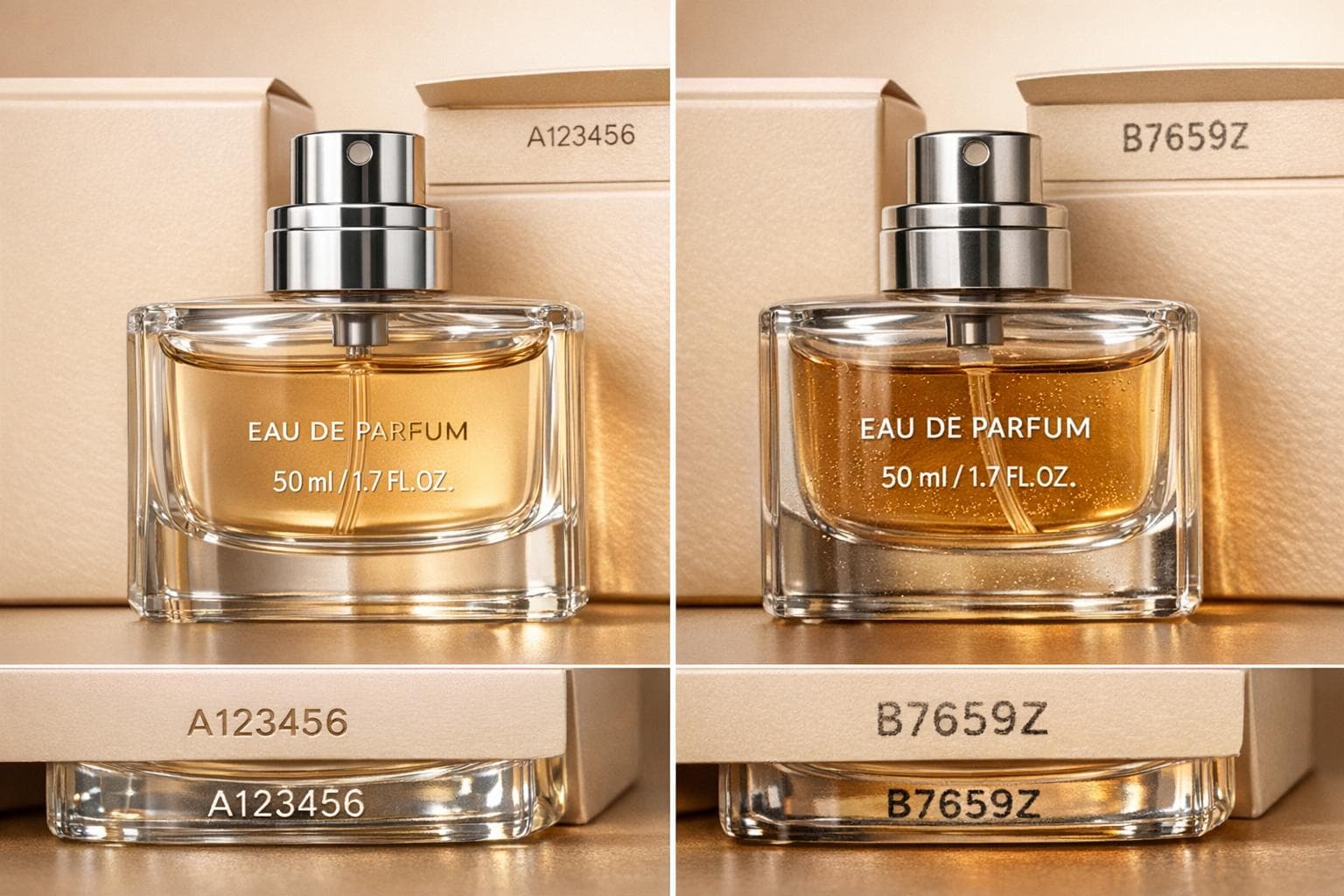
Όταν πρόκειται για αρώματα, το να διακρίνετε τη διαφορά ανάμεσα σε ένα πλαστό και ένα αυθεντικό μπορεί να σας εξοικονομήσει χρήματα, να προστατεύσει την υγεία σας και να διασφαλίσει ότι δεν στηρίζετε παράνομες πρακτικές. Τα παραποιημένα αρώματα βρίσκονται παντού, συχνά σε τιμές που μοιάζουν υπερβολικά καλές για να είναι αληθινές. Όμως δεν είναι απλώς φθηνές απομιμήσεις - μπορούν επίσης να ενέχουν σοβαρούς κινδύνους για την υγεία, λόγω επιβλαβών συστατικών όπως η αιθυλενογλυκόλη και μη ελεγχόμενων χημικών ουσιών.
Δείτε τι πρέπει να γνωρίζετε:
- Συσκευασία: Τα αυθεντικά αρώματα διαθέτουν άψογο περιτύλιγμα, χαρτόνι υψηλής ποιότητας και ακριβή εκτύπωση. Τα πλαστά συχνά εμφανίζουν πρόχειρες ενώσεις, αδύναμα κουτιά και θολό κείμενο.
- Σχεδιασμός φιάλης: Οι γνήσιες φιάλες κατασκευάζονται από βαρύ, λείο γυαλί με καθαρό φινίρισμα. Οι απομιμήσεις μπορεί να δείχνουν ελαφριές, να παρουσιάζουν ατέλειες στο γυαλί ή να έχουν καπάκια που δεν εφαρμόζουν σωστά.
- Άρωμα και διάρκεια: Τα αυθεντικά αρώματα εξελίσσονται με νότες κορυφής, καρδιάς και βάσης και διαρκούν 6–12 ώρες. Τα πλαστά συνήθως μυρίζουν επίπεδα, υπερβολικά γλυκά και ξεθυμαίνουν σε 1–2 ώρες.
- Τιμή: Τα πολυτελή αρώματα σπάνια έχουν έκπτωση άνω του 30%. Ένα άρωμα των 200 € που πωλείται 20 € είναι σχεδόν σίγουρα πλαστό.
- Κίνδυνοι για την υγεία: Οι απομιμήσεις μπορεί να περιέχουν τοξικές ουσίες όπως μεθανόλη ή βαρέα μέταλλα, οδηγώντας σε ερεθισμούς του δέρματος, αναπνευστικά προβλήματα ή και χειρότερα.
Γρήγορη συμβουλή: Ελέγχετε πάντα τον κωδικό παρτίδας στη φιάλη και στο κουτί - πρέπει να ταιριάζουν. Χρησιμοποιήστε εργαλεία όπως το CheckFresh.com για να επαληθεύσετε τους κωδικούς. Αγοράζετε μόνο από αξιόπιστους λιανοπωλητές, ώστε να διασφαλίζετε ασφάλεια και ποιότητα.
Η κατανόηση αυτών των σημείων μπορεί να σας βοηθήσει να αποφύγετε τις απομιμήσεις και να απολαύσετε την πλήρη εμπειρία ενός γνήσιου αρώματος.
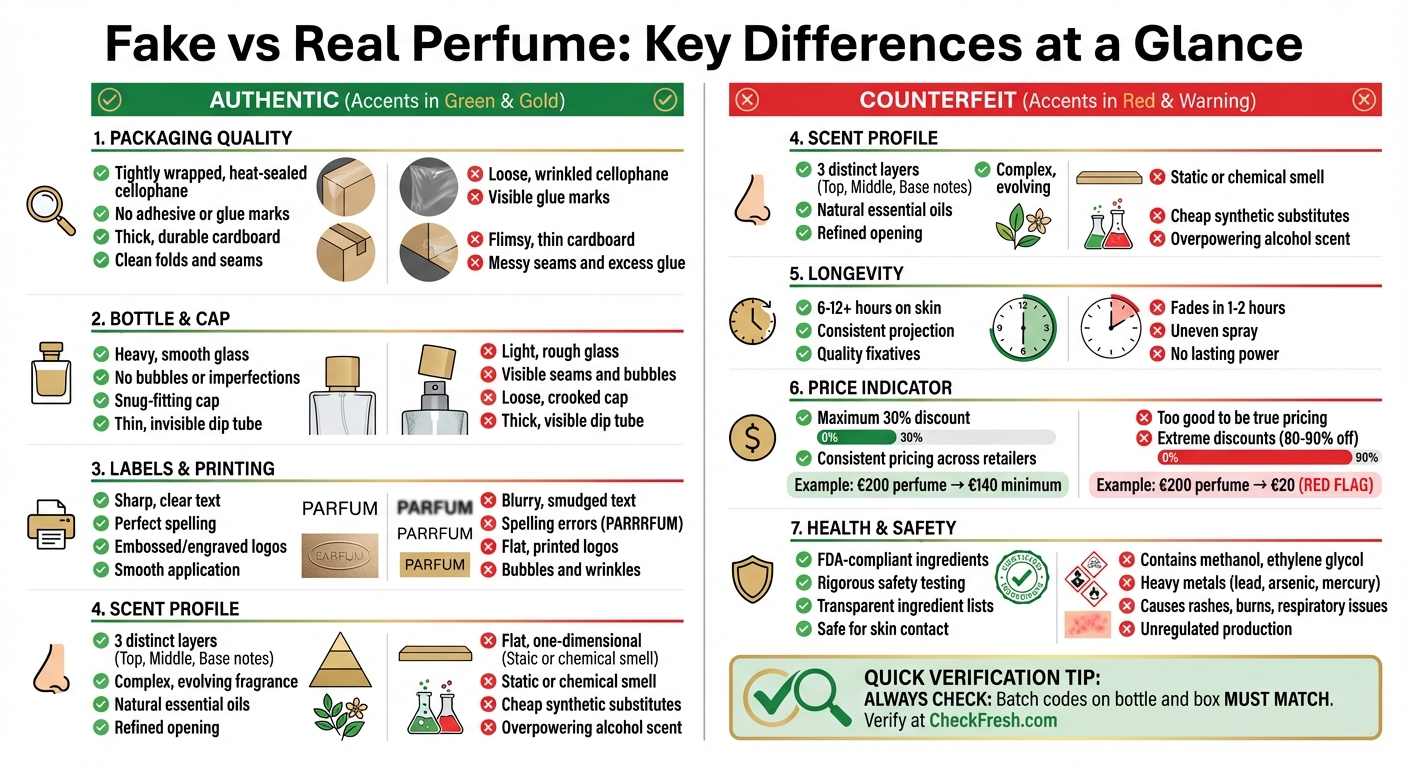
Πλαστό vs Αυθεντικό Άρωμα: Οπτικός Οδηγός Σύγκρισης
Packaging Quality Differences
Όταν προσπαθείτε να εντοπίσετε παραποιημένα αρώματα, η συσκευασία είναι συχνά το πρώτο στοιχείο που τα προδίδει. Οι πολυτελείς οίκοι δίνουν προτεραιότητα στην ακρίβεια και τη συνέπεια στη συσκευασία τους, επομένως οποιοδήποτε εμφανές ελάττωμα θα πρέπει αμέσως να σας κινήσει υποψίες.
Το περιτύλιγμα από σελοφάν είναι μια βασική λεπτομέρεια που πρέπει να εξετάσετε. Τα γνήσια αρώματα διαθέτουν σφιχτά τυλιγμένο, θερμοσφραγισμένο σελοφάν χωρίς ίχνη κόλλας. Αντίθετα, το περιτύλιγμα των απομιμήσεων είναι συχνά χαλαρό, ζαρωμένο ή σφραγισμένο με ορατή κόλλα. Δώστε προσοχή στις ενώσεις - οι ακατάστατες πτυχώσεις ή η περίσσεια κόλλας αποτελούν σαφή σημάδια πλαστού προϊόντος.
Η ποιότητα του χαρτονιού είναι ακόμη ένας αποκαλυπτικός παράγοντας. Τα αυθεντικά κουτιά κατασκευάζονται από χοντρό, ανθεκτικό χαρτόνι, σχεδιασμένο να προστατεύει τη φιάλη. Ένα πλαστό κουτί, από την άλλη, μπορεί να μοιάζει εύθραυστο και να έχει υπολείμματα κόλλας στις άκρες. Ανακινήστε ελαφρά το κουτί· αν η φιάλη κροταλίζει ή μετακινείται στο εσωτερικό, η εσωτερική κατασκευή είναι πιθανότατα κακής ποιότητας.
Η ακρίβεια της εκτύπωσης και της ετικέτας επίσης ξεχωρίζει την αυθεντική συσκευασία. Τα γνήσια κουτιά διαθέτουν ευκρινές, καθαρό κείμενο και απόλυτα κεντραρισμένες ετικέτες, ενώ οι απομιμήσεις συχνά έχουν θολή εκτύπωση, κακοευθυγραμμισμένες γραμματοσειρές ή ακόμη και ορθογραφικά λάθη. Συγκρίνετε πάντα τη συσκευασία με τις επίσημες εικόνες από την ιστοσελίδα του οίκου. Επιπλέον, οι αυθεντικές φιάλες συχνά περιλαμβάνουν ανάγλυπα ή χαραγμένα λογότυπα που μπορείτε να αισθανθείτε στην αφή, σε αντίθεση με τα επίπεδα, τυπωμένα λογότυπα που συναντώνται συνήθως στις απομιμήσεις.
Κατασκευή κουτιού και περιτύλιγμα
Η εξωτερική συσκευασία αποτελεί ισχυρό δείκτη ποιότητας. Οι πολυτελείς οίκοι χρησιμοποιούν προηγμένα μηχανήματα για να εξασφαλίσουν καθαρές πτυχώσεις και άψογο, θερμοσφραγισμένο σελοφάν. Αντίθετα, οι παραχαράκτες συχνά βασίζονται σε χειροκίνητες μεθόδους και φθηνότερα υλικά, με αποτέλεσμα ανομοιόμορφες ενώσεις και ορατά σημάδια κόλλας.
Εξετάστε προσεκτικά τις ενώσεις του σελοφάν - το αυθεντικό περιτύλιγμα δεν θα έχει χαλαρές άκρες ή υπολείμματα κόλλας.
Η κατασκευή του χαρτονιού είναι εξίσου σημαντική. Τα αυθεντικά κουτιά κατασκευάζονται με συγκεκριμένα βάρη και υφές χαρτιού που είναι δύσκολο να αντιγραφούν. Αναζητήστε καθαρές ακμές και στιβαρές γωνίες, καθώς τα πλαστά κουτιά συχνά έχουν ανομοιόμορφες πτυχώσεις ή μαλακές, ξεφτισμένες άκρες. Η θέση του barcode είναι ακόμη ένα στοιχείο· πρέπει πάντα να εμφανίζεται στο κάτω-πίσω μέρος του κουτιού, όχι στα πλαϊνά.
Υλικό και σχεδιασμός φιάλης
Η ίδια η φιάλη του αρώματος προσφέρει σαφή στοιχεία αυθεντικότητας. Οι γνήσιες φιάλες κατασκευάζονται από αψεγάδιαστο, υψηλής ποιότητας γυαλί που έχει βάρος και λεία αίσθηση. Όπως σημειώνει το Wikiparfum:
"Συνήθως, η φιάλη ενός πλαστού αρώματος δεν είναι καλά φινιρισμένη. Πιθανότατα θα δείτε τις ενώσεις στο γυαλί που χρησιμοποιούνται για τη σφράγισή του, ενώ ο σωλήνας ψεκασμού θα είναι πιο ορατός και φαρδύτερος από εκείνον ενός αυθεντικού αρώματος."
Η ποιότητα του γυαλιού αποτελεί βασικό διαφοροποιητικό στοιχείο. Οι αυθεντικές φιάλες έχουν στιβαρή αίσθηση, χωρίς ορατές φυσαλίδες, σπασίματα ή τραχιές υφές. Οι πλαστές φιάλες, αντίθετα, συχνά μοιάζουν ελαφρύτερες και μπορεί να εμφανίζουν ατέλειες, όπως ενώσεις από τη διαδικασία χύτευσης.
Ο σωλήνας άντλησης στο εσωτερικό της φιάλης είναι ακόμη μια λεπτομέρεια που πρέπει να ελέγξετε. Οι γνήσιες φιάλες διαθέτουν λεπτό, ίσιο και σχεδόν αόρατο σωλήνα, ενώ οι απομιμήσεις συχνά έχουν έναν πιο παχύ, πιο εμφανή σωλήνα που μπορεί ακόμη και να καμπυλώνει στο κάτω μέρος λόγω λανθασμένου μεγέθους.
Η ποιότητα του καπακιού είναι εξίσου σημαντική. Τα αυθεντικά καπάκια κατασκευάζονται από υλικά υψηλής ποιότητας, όπως βαρύ μέταλλο ή ρητίνη, και εφαρμόζουν σφιχτά, ευθυγραμμιζόμενα τέλεια με τη φιάλη. Τα πλαστά καπάκια, αντίθετα, είναι συχνά από φθηνό πλαστικό και μπορεί να είναι χαλαρά ή να κάθονται στραβά. Ένα ασφαλές καπάκι πρέπει να παραμένει στη θέση του ακόμη και όταν σηκώνετε τη φιάλη κρατώντας την από αυτό.
Για έναν επιπλέον έλεγχο, ανακινήστε απαλά τη φιάλη. Τα αυθεντικά αρώματα με βάση το αλκοόλ παράγουν ελάχιστο αφρό που διαλύεται γρήγορα, ενώ τα πλαστά υγρά συχνά δημιουργούν υπερβολικό αφρό που παραμένει - ένδειξη χαμηλότερης ποιότητας συστατικών ή λανθασμένης περιεκτικότητας σε αλκοόλ.
Ποιότητα ετικέτας και ακρίβεια γραμματοσειράς
Οι ετικέτες στα αυθεντικά αρώματα είναι ακόμη ένα σημείο στο οποίο οι απομιμήσεις συχνά υστερούν. Οι πολυτελείς οίκοι διατηρούν αυστηρά πρότυπα τυπογραφίας και τοποθέτησης ετικετών, επομένως οποιαδήποτε ασυνέπεια μπορεί να αποτελεί προειδοποιητικό σημάδι.
Η ευκρίνεια του κειμένου είναι κρίσιμη λεπτομέρεια. Οι αυθεντικές ετικέτες εμφανίζουν καθαρό, ευκρινές κείμενο που παραμένει ευανάγνωστο ακόμη και σε μικρή γραμματοσειρά. Οι πλαστές ετικέτες, από την άλλη, συχνά φαίνονται θολές ή μουτζουρωμένες.
Δώστε μεγάλη προσοχή στην ορθογραφία και τη γραμματική. Οι κορυφαίοι οίκοι διασφαλίζουν ότι κάθε λέξη είναι σωστή, επομένως ακόμη και ένα μικρό τυπογραφικό λάθος πρέπει να σας προβληματίσει.
Η εκτέλεση του λογότυπου είναι ακόμη ένας βασικός παράγοντας. Τα γνήσια λογότυπα είναι συνήθως ανάγλυφα ή χαραγμένα, δημιουργώντας μια υφή που αισθάνεστε όταν περνάτε τα δάχτυλά σας από πάνω τους. Τα πλαστά λογότυπα είναι συνήθως επίπεδα και τυπωμένα, χωρίς καμία τρισδιάστατη λεπτομέρεια.
Τέλος, αξιολογήστε την εφαρμογή της ετικέτας. Οι αυθεντικές ετικέτες εφαρμόζονται ομαλά, χωρίς φυσαλίδες, ζάρες ή κακή ευθυγράμμιση. Οι πλαστές ετικέτες μπορεί να παρουσιάζουν υπολείμματα κόλλας, στραβή τοποθέτηση ή άκρες που ξεκολλούν. Ελέγξτε το κάτω αυτοκόλλητο ή τη χάραξη για σωστή ευθυγράμμιση και βεβαιωθείτε ότι ο κωδικός παρτίδας ταιριάζει με εκείνον στο κουτί.
| Χαρακτηριστικό | Αυθεντικές ετικέτες | Πλαστές ετικέτες |
|---|---|---|
| Ευκρίνεια κειμένου | Καθαρό, κοφτερό και ευανάγνωστο | Θολές, μουτζουρωμένες ή ασαφείς άκρες |
| Ορθογραφία | Άψογη, χωρίς λάθη | Περιέχει τυπογραφικά ή ορθογραφικά λάθη |
| Ευθυγράμμιση | Απόλυτα κεντραρισμένη και ίσια | Εκτός κέντρου ή κακοευθυγραμμισμένη |
| Υφή λογότυπου | Ανάγλυφο, χαραγμένο ή υπερυψωμένο | Επίπεδο, τυπωμένο ή κακής εκτέλεσης |
| Πρόσφυση | Ομαλή, άψογη εφαρμογή | Εμφανίζει φυσαλίδες, ζάρες ή ξεφλούδισμα |
Σύγκριση αρωματικού προφίλ και διάρκειας
Η πιο αποκαλυπτική διαφορά ανάμεσα στα πλαστά και τα αυθεντικά αρώματα βρίσκεται στο αρωματικό τους προφίλ και στην απόδοσή τους. Ενώ οι παραχαράκτες μπορούν να αντιγράψουν τη συσκευασία, σπάνια καταφέρνουν να μιμηθούν την περίτεχνη χημεία ενός γνήσιου αρώματος. Αυτές οι αρωματικές λεπτομέρειες συμβαδίζουν με τα στοιχεία της συσκευασίας που αναφέρθηκαν προηγουμένως.
Νότες κορυφής, καρδιάς και βάσης
Τα αυθεντικά αρώματα δημιουργούνται σαν συμφωνία, αποκαλύπτοντας τρεις διακριτές στρώσεις καθώς εξελίσσονται με τον χρόνο. Οι νότες κορυφής είναι η αρχική έκρηξη - ανάλαφρα και φρέσκα αρώματα που διαρκούν περίπου 15 λεπτά. Έπειτα, οι νότες καρδιάς παίρνουν τη σκυτάλη, αναδύονται από τα 15 λεπτά έως τις 2 ώρες και διαμορφώνουν τον βασικό χαρακτήρα του αρώματος. Τέλος, οι νότες βάσης εγκαθίστανται μετά τις 2 ώρες, αφήνοντας πίσω ζεστές, βαθιές αποχρώσεις όπως κεχριμπάρι, μόσχο ή σανδαλόξυλο, που παραμένουν για ώρες.
Τα πλαστά αρώματα συχνά μιμούνται μόνο τις νότες κορυφής για να περάσουν ένα γρήγορο τεστ όσφρησης, αλλά στερούνται το βάθος και την εξέλιξη των αυθεντικών. Όπως εξηγεί ο Alain Ferro, Ειδικός Αρωμάτων και Διευθυντής του Grasse Institute of Perfumery:
"Τα αυθεντικά αρώματα διαθέτουν τρία επίπεδα οσμών που αποκαλύπτονται με την πάροδο του χρόνου, αποτελούμενα από νότες κορυφής, καρδιάς και βάσης. Αυτή η πολυπλοκότητα διασφαλίζει ότι το άρωμα είναι ποικιλόμορφο και πολυδιάστατο."
Όταν φοριούνται, τα πλαστά αρώματα μυρίζουν επίπεδα και στερούνται τις πλούσιες στρώσεις ενός γνήσιου αρώματος. Συχνά διαθέτουν έντονη μυρωδιά αλκοόλ που υπερισχύει όλων των άλλων. Τα αυθεντικά αρώματα, αντίθετα, παρασκευάζονται με υψηλής ποιότητας αιθέρια έλαια που προέρχονται από λουλούδια, ξύλα και μπαχαρικά, ενώ οι απομιμήσεις βασίζονται σε φθηνά συνθετικά συστατικά που μπορεί να μυρίζουν υπερβολικά γλυκά ή χημικά. Ρόλο παίζει και η διαδικασία ωρίμανσης - τα γνήσια αρώματα ωριμάζουν προσεκτικά για εβδομάδες ή μήνες, ενώ τα πλαστά προωθούνται βιαστικά στην αγορά χωρίς σωστή σταθεροποίηση.
Διάρκεια και προβολή
Η τέχνη ενός αρώματος βρίσκεται στις στρώσεις του, όμως η αντοχή του είναι η απόλυτη δοκιμή αυθεντικότητας. Ένα γνήσιο Eau de Parfum διαρκεί συνήθως 6 έως 12 ώρες, ενώ ένα Eau de Toilette κρατά 3 έως 5 ώρες. Τα πλαστά αρώματα, ωστόσο, ξεθυμαίνουν μέσα σε 1 έως 2 ώρες λόγω της απουσίας ποιοτικών σταθεροποιητών.
Οι σταθεροποιητές - όπως ο μόσχος, το κεχριμπάρι και οι ρητίνες - είναι απαραίτητοι για να επιβραδύνουν την εξάτμιση και να βοηθήσουν το άρωμα να προσκολληθεί στο δέρμα. Τα αυθεντικά αρώματα επενδύουν σε αυτά τα συστατικά, ενώ τα πλαστά τα παραλείπουν για εξοικονόμηση κόστους. Επιπλέον, οι γνήσιες φιάλες διαθέτουν ψεκαστήρες ακριβείας που προσφέρουν λεπτό, ομοιόμορφο νέφος, εξασφαλίζοντας ιδανική προβολή. Οι ψεκαστήρες των απομιμήσεων, αντίθετα, συχνά παράγουν ανομοιόμορφες σταγόνες ή ροές, οδηγώντας σε κακή κατανομή του αρώματος.
Ένα απλό τεστ: εφαρμόστε το άρωμα, περιμένετε δύο ώρες και δείτε πώς κρατά. Αν το άρωμα εξαφανιστεί εντελώς ή μετατραπεί σε έντονη χημική οσμή, πιθανότατα είναι πλαστό.
Πίνακας σύγκρισης: Άρωμα και διάρκεια
| Χαρακτηριστικό | Αυθεντικό άρωμα | Πλαστό άρωμα |
|---|---|---|
| Πολυπλοκότητα αρώματος | Πολυδιάστατο με νότες κορυφής, καρδιάς και βάσης | Επίπεδο ή υπερβολικά χημικό |
| Διάρκεια | 6–12+ ώρες στο δέρμα | Ξεθυμαίνει μέσα σε 1–2 ώρες |
| Αρχική εντύπωση | Εκλεπτυσμένο άνοιγμα | Κατακλυσμιαίο αρχικό άρωμα |
| Εξέλιξη | Αλλάζει και αναπτύσσεται με τον χρόνο | Παραμένει στατικό ή αποκτά δυσάρεστες υπονότες |
| Συστατικά | Φυσικά αιθέρια έλαια και ποιοτικοί σταθεροποιητές | Φθηνά συνθετικά υποκατάστατα με υψηλή περιεκτικότητα σε αλκοόλ |
| Προβολή | Σταθερό λεπτό νέφος με ομοιόμορφο sillage | Ανομοιόμορφος ψεκασμός με μεγάλες σταγόνες |
| Διάρκεια ζωής | 6–18 μήνες μετά το άνοιγμα | Λίγες εβδομάδες έως 2 μήνες |
Τιμή και αξιοπιστία πωλητή
Ρεαλιστικές προσδοκίες τιμολόγησης
Όταν μιλάμε για πολυτελή αρώματα, η τιμή συχνά λέει πολλά για την αυθεντικότητα. Τα γνήσια αρώματα υψηλής ποιότητας, όπως το Tom Ford Tobacco Vanille, διατηρούν σταθερή τιμολόγηση στους εξουσιοδοτημένους λιανοπωλητές. Αν το βρείτε κάτω από $20, οι πιθανότητες να πρόκειται για απομίμηση είναι μεγάλες. Όπως εύστοχα δηλώνει η Kate Browne, ερευνήτρια δημοσιογράφος στο CHOICE:
"Αν η τιμή φαίνεται υπερβολικά καλή για να είναι αληθινή, πιθανότατα είναι".
Ακόμη και κατά τη διάρκεια μεγάλων εκπτώσεων, τα designer αρώματα σπάνια πέφτουν πάνω από 30% κάτω από την κανονική τιμή λιανικής τους. Για να προστατευθείτε, ελέγχετε πάντα τις βασικές τιμές από αξιόπιστους λιανοπωλητές. Αυτό σας δίνει ένα σαφές σημείο αναφοράς - οτιδήποτε σημαντικά φθηνότερο θα πρέπει αμέσως να σας κινήσει υποψίες.
Τα πλαστά αρώματα συχνά μειώνουν το κόστος με συνθετικά υποκατάστατα και δυνητικά επιβλαβή πρόσθετα. Ενώ νόμιμες διαδικτυακές πλατφόρμες εκπτώσεων μπορεί να προσφέρουν εξοικονόμηση έως 60% σε σύγκριση με το παραδοσιακό λιανεμπόριο, οι υπερβολικά ακραίες προσφορές, ειδικά σε prestige brands, σπάνια είναι γνήσιες. Για παράδειγμα, ένα άρωμα Tom Ford πλήρους μεγέθους που εμφανίζεται στα $25 στο eBay αποτελεί κραυγαλέα ένδειξη πλαστού.
Η κατανόηση αυτών των μοτίβων τιμολόγησης θέτει τη βάση για την αξιολόγηση της αξιοπιστίας του πωλητή.
Επαλήθευση νομιμότητας πωλητή
Μόλις η τιμή εγείρει ερωτήματα, η διερεύνηση της αξιοπιστίας του πωλητή γίνεται απαραίτητη. Αγοράζετε πάντα από εξουσιοδοτημένους λιανοπωλητές που παρέχουν επαληθεύσιμα στοιχεία επικοινωνίας, φυσικές διευθύνσεις και σαφείς πολιτικές επιστροφών. Αποφύγετε υπαίθριες αγορές, ανταλλακτικά παζάρια, πλανόδιους πωλητές ή μη επαληθευμένους πωλητές σε πλατφόρμες κοινωνικής δικτύωσης. Αν ψωνίζετε σε διαδικτυακή αγορά, δώστε προτεραιότητα σε πωλητές επαληθευμένους από το PayPal που μοιράζονται τα στοιχεία επικοινωνίας τους - αυτό προσθέτει ένα επίπεδο λογοδοσίας.
Οι αξιόπιστοι πωλητές πρέπει να είναι πρόθυμοι να απαντήσουν σε ερωτήσεις σχετικά με τους αριθμούς παρτίδας και να παρέχουν επιπλέον φωτογραφίες της συσκευασίας και των ετικετών. Να είστε προσεκτικοί με καταχωρίσεις γεμάτες κακή γραμματική, ορθογραφικά λάθη ή γενικές stock φωτογραφίες, καθώς αυτά συχνά σηματοδοτούν μη αυθεντικότητα. Πλατφόρμες όπως το Scento διασφαλίζουν την αυθεντικότητα προμηθευόμενες προϊόντα απευθείας από εξουσιοδοτημένους διανομείς. Αν υποψιάζεστε ότι μια αγορά είναι πλαστή, επικοινωνήστε αμέσως με τον πάροχο πληρωμών σας για να αμφισβητήσετε τη συναλλαγή.
Ο προσωπικός σας ειδικός αρωμάτων σας περιμένει
Κάντε το σύντομο κουίζ αρώματος και ανακαλύψτε αυθεντικά αρώματα designer και niche, επιλεγμένα στα μέτρα σας – εξερευνήστε τα σε decant και δείγματα των 2, 5, 8 και 30 ml, ώστε να δοκιμάσετε το καθένα πριν επιλέξετε ολόκληρο μπουκάλι.
Βρείτε το άρωμά σαςΜέθοδοι επαλήθευσης κωδικού παρτίδας
Εντοπισμός κωδικών παρτίδας
Οι κωδικοί παρτίδας είναι καθοριστικοί για την επαλήθευση της αυθεντικότητας ενός αρώματος. Αυτά τα αλφαριθμητικά αναγνωριστικά βοηθούν τους κατασκευαστές να παρακολουθούν την ημερομηνία και τον τόπο παραγωγής ενός αρώματος. Ο χρυσός κανόνας; Ο κωδικός παρτίδας στη φιάλη πρέπει να ταιριάζει με εκείνον στο εξωτερικό κουτί. Αν δεν ταιριάζουν, είναι σχεδόν σίγουρα απομίμηση.
Για να εντοπίσετε τον κωδικό, ελέγξτε το κάτω μέρος της φιάλης - μπορεί να είναι χαραγμένος, εκτυπωμένος με λέιζερ ή σε ένα μικρό αυτοκόλλητο. Στη συσκευασία, ο κωδικός βρίσκεται συνήθως στο κάτω ή πίσω μέρος του κουτιού, συχνά εκτυπωμένος με inkjet, ανάγλυφος ή ελαφρά πιεσμένος στο χαρτόνι. Ψωνίζετε online; Ζητάτε πάντα καθαρές φωτογραφίες που δείχνουν και τους δύο κωδικούς πριν δεσμευτείτε για αγορά.
Ορισμένοι οίκοι υψηλής κατηγορίας περιλαμβάνουν πλέον QR codes ή ψηφιακή επαλήθευση μέσω εφαρμογής, όμως οι παραδοσιακοί κωδικοί παρτίδας παραμένουν το πρότυπο της βιομηχανίας. Μόλις εντοπίσετε τους κωδικούς, το επόμενο βήμα είναι να τους επαληθεύσετε με ψηφιακά εργαλεία.
Διαδικτυακά εργαλεία επαλήθευσης
Με τον κωδικό παρτίδας στα χέρια σας, μπορείτε να χρησιμοποιήσετε διαδικτυακά εργαλεία όπως το CheckFresh.com ή το CheckCosmetic.net για να τον αποκωδικοποιήσετε. Αυτές οι πλατφόρμες αποκαλύπτουν την ημερομηνία κατασκευής και επιβεβαιώνουν αν ο κωδικός ευθυγραμμίζεται με τη λογική παραγωγής του οίκου. Αν λάβετε αποτέλεσμα "invalid" ή "error", πρόκειται για σοβαρό προειδοποιητικό σημάδι.
Ωστόσο, ακόμη και έγκυροι κωδικοί μπορούν να αντιγραφούν από έμπειρους παραχαράκτες. Όπως προειδοποιεί το Databazaar:
"Αν ο κωδικός στο κουτί και ο κωδικός στη φιάλη δεν ταιριάζουν, βλέπετε ένα πλαστό προϊόν. Χωρίς εξαιρέσεις. Είναι μία από τις πιο ξεκάθαρες ενδείξεις κινδύνου που μπορείτε να βρείτε".
Αν τα διαδικτυακά εργαλεία εγείρουν αμφιβολίες ή αν εξακολουθείτε να μην είστε βέβαιοι, επικοινωνήστε απευθείας με τον κατασκευαστή για επιβεβαίωση. Κάθε οίκος έχει τη δική του συγκεκριμένη μορφή - για παράδειγμα, η Guerlain μπορεί να χρησιμοποιεί "5X02", ενώ άλλοι μπορεί να χρησιμοποιούν ένα μοτίβο όπως "N0J01." Η εξοικείωση με αυτές τις μορφές μπορεί να σας βοηθήσει να εντοπίζετε πλαστούς κωδικούς που δεν ακολουθούν τη σωστή δομή.
Κίνδυνοι υγείας και ασφάλειας από τα πλαστά αρώματα
Πέρα από τις διαφορές στη συσκευασία και στο άρωμα, τα πλαστά αρώματα δημιουργούν σοβαρές ανησυχίες για την υγεία και την ασφάλεια, που τα ξεχωρίζουν από τα αυθεντικά προϊόντα.
Τοξικά συστατικά στις απομιμήσεις
Τα πλαστά αρώματα συχνά περιέχουν επιβλαβείς ουσίες που μπορούν να θέσουν σε κίνδυνο την υγεία σας. Αυτές περιλαμβάνουν βιομηχανική μεθανόλη, αιθυλενογλυκόλη (που βρίσκεται συχνά στα αντιψυκτικά), βαρέα μέταλλα όπως μόλυβδο, αρσενικό και υδράργυρο, καθώς και καρκινογόνες ουσίες όπως το βενζόλιο. Η έκθεση σε αυτά τα συστατικά μπορεί να προκαλέσει άμεσα συμπτώματα όπως ζάλη και ναυτία, και σε σοβαρές περιπτώσεις ακόμη και τύφλωση.
Το FBI έχει επίσης εντοπίσει DEHP σε παραποιημένα αρώματα - μια χημική ουσία που ταξινομείται από την Environmental Protection Agency ως πιθανό καρκινογόνο για τον άνθρωπο. Προσθέτοντας στους κινδύνους, αυτά τα προϊόντα συνήθως παρασκευάζονται σε ανθυγιεινά, μη ελεγχόμενα περιβάλλοντα, γεγονός που τα καθιστά επιρρεπή σε μόλυνση από βακτήρια και μούχλα.
Οι χρήστες πλαστών αρωμάτων αναφέρουν συχνά ανεπιθύμητες αντιδράσεις όπως δερματικά εξανθήματα, χημικά εγκαύματα, ακμή και ψωρίαση. Η εισπνοή των πτητικών οργανικών ενώσεων (VOCs) που βρίσκονται σε αυτές τις απομιμήσεις μπορεί να οδηγήσει σε πονοκεφάλους, ημικρανίες, κρίσεις άσθματος και αναπνευστική δυσχέρεια. Η παρατεταμένη έκθεση σε τέτοιες τοξίνες μπορεί ακόμη και να προκαλέσει βλάβες σε όργανα και να διαταράξει την ορμονική ισορροπία.
Αν παρατηρήσετε συμπτώματα όπως ερυθρότητα του δέρματος, αίσθημα καύσου ή δυσκολία στην αναπνοή μετά τη χρήση ενός αρώματος, σταματήστε αμέσως τη χρήση του. Και μην επιχειρήσετε να χρησιμοποιήσετε ένα ύποπτο πλαστό προϊόν ως αρωματικό χώρου - αυτά τα VOCs μπορούν ακόμη να αποτελέσουν σοβαρό κίνδυνο για την υγεία όταν εισπνέονται.
Τα αυθεντικά αρώματα, από την άλλη, υπόκεινται σε αυστηρά πρότυπα ασφάλειας που προστατεύουν τους καταναλωτές.
Πρότυπα ασφάλειας για αυθεντικά αρώματα
Σε αντίθεση με τα παραποιημένα προϊόντα, τα γνήσια αρώματα παρασκευάζονται υπό αυστηρούς κανονισμούς ασφάλειας. Στις ΗΠΑ, τα αυθεντικά αρώματα πρέπει να συμμορφώνονται με τα πρότυπα καλλυντικών του FDA, περνώντας από ενδελεχείς ελέγχους ασφάλειας, σταθερότητας και υγιεινής πριν φτάσουν στην αγορά. Οι αξιόπιστοι οίκοι διασφαλίζουν επίσης διαφάνεια στα συστατικά και ακολουθούν ηθικές πρακτικές προμήθειας.
Όπως επισημαίνει η Aliesha από το Beautinow:
"Τα πλαστά αρώματα περιέχουν συχνά επικίνδυνες ουσίες όπως μεθανόλη, αντιψυκτικό, ακόμη και ούρα. Αυτά τα επιβλαβή συστατικά μπορούν να προκαλέσουν σοβαρές δερματικές αντιδράσεις, αναπνευστικά προβλήματα και μακροπρόθεσμες επιπλοκές στην υγεία".
Για να προστατευθείτε, αγοράζετε πάντα από εξουσιοδοτημένους λιανοπωλητές όπως Sephora, Ulta, Nordstrom ή από τις επίσημες ιστοσελίδες των οίκων. Αυτοί οι πωλητές εγγυώνται ότι τα προϊόντα πληρούν όλα τα απαιτούμενα πρότυπα ασφάλειας. Επιπλέον, ελέγξτε ότι οι κωδικοί παρτίδας στη φιάλη ταιριάζουν με εκείνους στη συσκευασία - αυτό το απλό βήμα μπορεί να επιβεβαιώσει την αυθεντικότητα του προϊόντος.
Συνοψίζοντας
Το χάσμα ανάμεσα στα πλαστά και τα γνήσια αρώματα είναι κάτι περισσότερο από ζήτημα κόστους. Τα αυθεντικά αρώματα προσφέρουν ένα πλούσιο, εξελισσόμενο αρωματικό προφίλ, ενώ οι απομιμήσεις τείνουν να είναι επίπεδες και να ξεθυμαίνουν γρήγορα . Επιπλέον, η συσκευασία των γνήσιων αρωμάτων αντανακλά ποιότητα, σε αντίθεση με τα κατώτερα υλικά που χρησιμοποιούνται στις απομιμήσεις .
Οι δοκιμές έχουν δείξει ότι τα πλαστά αρώματα συχνά περιέχουν επιβλαβείς τοξίνες, δημιουργώντας σοβαρούς κινδύνους για την υγεία. Αντίθετα, τα αυθεντικά αρώματα συμμορφώνονται με αυστηρά πρότυπα ασφάλειας, διασφαλίζοντας ότι είναι ασφαλή στη χρήση . Αυτό καθιστά απαραίτητο να εξετάζετε κάθε λεπτομέρεια όταν πραγματοποιείτε μια αγορά.
Για να αποφύγετε τις απομιμήσεις, ελέγχετε πάντα ότι οι κωδικοί παρτίδας στη φιάλη και στο κουτί ταιριάζουν και επιλέγετε να αγοράζετε από εξουσιοδοτημένους λιανοπωλητές. Όπως σοφά επισημαίνει η Kate Browne, αν η τιμή φαίνεται υπερβολικά καλή για να είναι αληθινή, πιθανότατα είναι .
Συχνές ερωτήσεις
Πώς μπορώ να καταλάβω αν η συσκευασία ενός αρώματος είναι πλαστή;
Για να αναγνωρίσετε μια πλαστή συσκευασία αρώματος, εστιάστε στην ποιότητα και στις μικρές λεπτομέρειες. Τα γνήσια αρώματα συσκευάζονται με ευκρινή εκτύπωση υψηλής ποιότητας, συνεπή branding και ακριβείς γραμματοσειρές. Να είστε προσεκτικοί με ανορθόγραφες λέξεις, θολές εικόνες ή στραβές ετικέτες - αυτά είναι κλασικά προειδοποιητικά σημάδια απομίμησης.
Η αυθεντική συσκευασία κατασκευάζεται συνήθως από στιβαρά, πιο χοντρά υλικά και περιλαμβάνει κατάλληλες σφραγίδες ασφαλείας που δείχνουν τυχόν παραβίαση. Μια ακόμη βασική λεπτομέρεια που πρέπει να ελέγξετε είναι ο κωδικός παρτίδας στη φιάλη ή στο κουτί, ο οποίος συχνά μπορεί να επαληθευτεί για να επιβεβαιωθεί η αυθεντικότητα. Η πλαστή συσκευασία μπορεί να μοιάζει φθηνή, να στερείται αυτούς τους κωδικούς ή να εμφανίζει λάθη σε λογότυπα και branding.
Για μεγαλύτερη σιγουριά, επιλέγετε να αγοράζετε αρώματα από αξιόπιστους λιανοπωλητές, ώστε να αποφύγετε τα πλαστά.
Ποιοι κίνδυνοι για την υγεία συνδέονται με τα πλαστά αρώματα;
Τα πλαστά αρώματα δεν είναι απλώς μια απομίμηση της αγαπημένης σας μυρωδιάς - μπορούν να είναι επιβλαβή για την υγεία σας. Αυτές οι απομιμήσεις συχνά περιέχουν μη ελεγχόμενα και μη ασφαλή συστατικά, συμπεριλαμβανομένων τοξικών χημικών όπως αντιψυκτικό, επιβλαβών βακτηρίων, ακόμη και σοκαριστικών ουσιών όπως ούρα. Όταν εφαρμόζονται στο δέρμα, ειδικά σε ευαίσθητες περιοχές όπως ο λαιμός και οι καρποί, μπορούν να προκαλέσουν ερεθισμό, ερυθρότητα, αλλεργικές αντιδράσεις και φλεγμονή.
Ακόμη πιο ανησυχητικό είναι ότι ορισμένα πλαστά αρώματα περιλαμβάνουν επικίνδυνες ενώσεις όπως το DEHP, μια χημική ουσία που συνδέεται με σοβαρούς μακροπρόθεσμους κινδύνους για την υγεία, συμπεριλαμβανομένου του καρκίνου και δερματικών διαταραχών. Αυτές οι επιβλαβείς ουσίες μπορούν να απορροφηθούν από το δέρμα σας, ενδεχομένως οδηγώντας με την πάροδο του χρόνου σε πιο σοβαρά προβλήματα υγείας. Η επιλογή αυθεντικών, υψηλής ποιότητας αρωμάτων δεν αφορά μόνο την απόλαυση μιας πολυτελούς ευωδιάς - αφορά την προστασία της ευεξίας σας.
Γιατί τα αυθεντικά αρώματα διαρκούν περισσότερο από τα πλαστά;
Τα αυθεντικά αρώματα ξεχωρίζουν για τη μακράς διάρκειας απόδοσή τους, χάρη στη χρήση premium συστατικών και σχολαστικά δημιουργημένων αρωματικών συνθέσεων. Αυτά τα μείγματα είναι ειδικά σχεδιασμένα ώστε να διατηρούν το αρωματικό τους προφίλ και τη σταθερότητά τους, εξασφαλίζοντας ένα συνεπές και διαρκές άρωμα καθ’ όλη τη διάρκεια της ημέρας.
Από την άλλη, τα πλαστά αρώματα υστερούν λόγω της εξάρτησής τους από κατώτερα υλικά και της έλλειψης εξειδικευμένης σύνθεσης. Το αποτέλεσμα; Ένα πιο αδύναμο άρωμα που εξατμίζεται γρήγορα, αδυνατώντας να προσφέρει το ίδιο παρατεταμένο αποτέλεσμα ή την ίδια ποιότητα με τα γνήσια αρώματα.

