Όταν επιλέγετε ένα άρωμα, δύο βασικοί παράγοντες που αξίζει να λάβετε υπόψη είναι η διάρκεια και το sillage - οι πυλώνες της απόδοσης ενός αρώματος. Δείτε τι χρειάζεται να γνωρίζετε:
- Διάρκεια μετρά πόσο χρόνο παραμένει ένα άρωμα στο δέρμα ή στα ρούχα σας. Ένα άρωμα με διάρκεια 6–8 ωρών θεωρείται πολύ καλό, ενώ οτιδήποτε ξεπερνά τις 8 ώρες ξεχωρίζει.
- Sillage αναφέρεται στο αρωματικό ίχνος που αφήνετε πίσω σας καθώς κινείστε σε έναν χώρο. Αφορά το πόσο αισθητό είναι το άρωμά σας στους άλλους.
Βασικά σημεία:
- Η διάρκεια είναι ιδανική για μεγάλες εργάσιμες ημέρες ή για περιστάσεις όπου η επαναφορά του αρώματος δεν είναι πρακτική.
- Το έντονο sillage είναι ιδανικό για εκδηλώσεις όπου θέλετε να εντυπωσιάσετε, αλλά μπορεί να φανεί υπερβολικό σε κλειστούς χώρους όπως τα γραφεία.
- Παράγοντες όπως η συγκέντρωση (π.χ. Eau de Parfum έναντι Eau de Toilette), ο τύπος δέρματος και οι περιβαλλοντικές συνθήκες επηρεάζουν τόσο τη διάρκεια όσο και το sillage.
- Η δοκιμή ενός αρώματος στο δέρμα σας και σε διαφορετικά περιβάλλοντα σας βοηθά να κατανοήσετε την απόδοσή του.
Η ισορροπία ανάμεσα σε αυτά τα δύο χαρακτηριστικά διασφαλίζει ότι το άρωμά σας εναρμονίζεται με τον τρόπο ζωής σας και την περίσταση. Είτε αναζητάτε άρωμα που διαρκεί όλη μέρα είτε μια τολμηρή δήλωση παρουσίας, η κατανόηση της διάρκειας και του sillage θα σας οδηγήσει στη σωστή επιλογή.
What is Longevity?
Η διάρκεια αναφέρεται στο πόσο καιρό ένα άρωμα παραμένει αισθητό στο δέρμα ή στο ύφασμα μετά την εφαρμογή. Ουσιαστικά πρόκειται για τη «δύναμη παραμονής» του αρώματος - πόσο χρόνο χρειάζεται για να περάσει από τις αρχικές νότες κορυφής στις πιο βαθιές νότες βάσης. Σημαντικό είναι ότι η διάρκεια αφορά τον χρόνο, όχι την ένταση ή την απόσταση. Ενώ το projection μετρά πόσο μακριά ακτινοβολεί ένα άρωμα, η διάρκεια εστιάζει αποκλειστικά στο πόσο καιρό παραμένει.
Αυτή η διάκριση βοηθά να γίνει σαφές πώς η διάρκεια διαφέρει από άλλα χαρακτηριστικά ενός αρώματος. Για παράδειγμα, το sillage περιγράφει το αρωματικό ίχνος που αφήνετε καθώς κινείστε σε έναν χώρο. Ένα άρωμα μπορεί να έχει έντονο projection για μία ώρα αλλά να σβήνει γρήγορα, ή να μένει κοντά στο δέρμα και παρ’ όλα αυτά να παραμένει ανιχνεύσιμο για 12 ώρες. Η διάρκεια, ωστόσο, αφορά μόνο τη χρονική του παραμονή.
Πώς Μετριέται η Διάρκεια
Η μέτρηση της διάρκειας απαιτεί λίγη υπομονή. Εφαρμόστε το άρωμα σε σημεία παλμού, όπως οι καρποί ή το εσωτερικό των αγκώνων, και ελέγχετε σε τακτά χρονικά διαστήματα αν το άρωμα εξακολουθεί να είναι παρόν. Οι αξιολογητές συνήθως αναλύουν τρία στάδια: Ποιότητα Ανοίγματος (οι ζωηρές νότες κορυφής), Εξέλιξη Καρδιάς (η μεσαία φάση που ξεδιπλώνεται μετά από 30–60 λεπτά) και Ακεραιότητα Βάσης (οι νότες που παραμένουν 4–6 ώρες αργότερα).
Γενικά, ένα άρωμα που διαρκεί 6–8 ώρες θεωρείται ότι έχει καλή διάρκεια, ενώ οτιδήποτε ξεπερνά τις 8 ώρες είναι εξαιρετικό. Ωστόσο, να έχετε υπόψη την οσφρητική προσαρμογή, όπου η όσφρησή σας προσαρμόζεται και σας κάνει να πιστεύετε ότι το άρωμα έχει εξαφανιστεί, ενώ μπορεί να παραμένει αισθητό στους άλλους ή στα ρούχα σας.
Παράγοντες που Επηρεάζουν τη Διάρκεια
Αρκετοί παράγοντες μπορούν να επηρεάσουν το πόσο διαρκεί ένα άρωμα. Η συγκέντρωση είναι από τους σημαντικότερους. Το Eau de Parfum (EDP), με 15–20% αρωματικά έλαια, συνήθως διαρκεί περισσότερο από το Eau de Toilette (EDT), το οποίο περιέχει 5–15%. Ο τύπος του δέρματος παίζει επίσης ρόλο - το ενυδατωμένο ή πιο λιπαρό δέρμα τείνει να συγκρατεί το άρωμα περισσότερο, ενώ το ξηρό δέρμα το απορροφά ταχύτερα.
Τα ίδια τα συστατικά αποτελούν έναν ακόμη καθοριστικό παράγοντα. Οι νότες κορυφής όπως τα εσπεριδοειδή και τα βότανα εξατμίζονται γρήγορα, συχνά μέσα σε 15–60 λεπτά, ενώ οι νότες βάσης όπως το musk, το amber και οι ρητίνες μπορούν να παραμείνουν για 6–24 ώρες. Τα αρώματα με φυσικά συστατικά μπορεί να εξελίσσονται αισθητά μέσα σε 1–4 ώρες, ενώ εκείνα με συνθετικά στοιχεία σχεδιασμένα για σταθερότητα μπορούν να διαρκέσουν 6–12+ ώρες. Επιπλέον, περιβαλλοντικοί παράγοντες όπως η ζέστη, η υγρασία, ακόμη και ο τύπος του υφάσματος που φοράτε (φυσικό ή συνθετικό) μπορούν να επηρεάσουν το πόσο διαρκεί ένα άρωμα.
Γιατί η Διάρκεια Έχει Σημασία
Η διάρκεια δεν αφορά μόνο την ευκολία - μπορεί επίσης να προσφέρει πρακτική αξία. Ένα άρωμα που διαρκεί όλη μέρα σημαίνει λιγότερες επαναλήψεις εφαρμογής, γεγονός που καθιστά ακόμη και ένα πολυτελές μπουκάλι των 200 € πιο συμφέρον σε σύγκριση με μια φθηνότερη επιλογή που ξεθωριάζει γρήγορα. Επιπλέον, σας απαλλάσσει από την ανάγκη να έχετε μαζί σας το μπουκάλι για ανανέωση κατά τη διάρκεια της ημέρας, είτε βρίσκεστε στη δουλειά, είτε κάνετε δουλειές, είτε παρευρίσκεστε σε συναντήσεις. Παρ’ όλα αυτά, ορισμένα πολυτελή αρώματα δημιουργούνται ώστε να λειτουργούν ως διακριτικά skin scents, προσφέροντας μια εκλεπτυσμένη εμπειρία που μένει κοντά στο δέρμα. Το κλειδί είναι να επιλέξετε ένα άρωμα με διάρκεια που να ταιριάζει στον τρόπο ζωής σας και στην περίσταση.
Τι Είναι το Sillage;
Το sillage (προφέρεται «σιγιάζ») είναι το αρωματικό ίχνος που αφήνει ένα άρωμα πίσω του καθώς κινείστε σε έναν χώρο. Η λέξη προέρχεται από τον γαλλικό όρο για το «ίχνος πλεύσης», όπως οι κυματισμοί που αφήνει μια βάρκα στο νερό. Σκεφτείτε το ως τη διακριτική παρουσία του αρώματός σας στον αέρα αφού έχετε περάσει ή έχετε φύγει από ένα δωμάτιο. Ενώ η διάρκεια μετρά πόσο παραμένει ένα άρωμα στο δέρμα σας, το sillage εστιάζει στο πώς αυτό το άρωμα διαχέεται στο περιβάλλον γύρω σας.
Σε αντίθεση με το projection, που περιγράφει την άμεση αύα ενός αρώματος ή το πόσο μακριά ακτινοβολεί από το σώμα σας, το sillage αφορά το άρωμα που σας ακολουθεί στο πέρασμά σας.
"Το sillage αναφέρεται στο αρωματικό αποτύπωμα που αφήνετε πίσω σας καθώς κινείστε. Είναι το άρωμα που παραμένει στον αέρα ακόμη και αφού περάσετε δίπλα από κάποιον." — Ajmal Perfumes
Η κατανόηση του sillage μπορεί να σας βοηθήσει να επιλέγετε αρώματα που ανταποκρίνονται στις προθέσεις σας. Ένα τολμηρό αρωματικό ίχνος μπορεί να δημιουργήσει αξέχαστη εντύπωση σε κοινωνικές εκδηλώσεις, ενώ ένα πιο απαλό μπορεί να είναι καταλληλότερο για επαγγελματικά ή οικεία περιβάλλοντα. Η παρατήρηση και ο πειραματισμός με διαφορετικά αρώματα είναι ο καλύτερος τρόπος για να κατανοήσετε αυτή την έννοια.
Πώς Μετριέται το Sillage
Το sillage δεν μετριέται με χρονόμετρο ή χάρακα· αφορά περισσότερο την αντίληψη. Για να το δοκιμάσετε, ψεκάστε το άρωμά σας σε ένα blotter ή σε ένα σημείο παλμού, έπειτα απομακρυνθείτε και παρατηρήστε αν το άρωμα παραμένει στον αέρα. Σε αντίθεση με τη διάρκεια, που είναι πιο ποσοτικοποιήσιμη, το sillage είναι μια αισθητηριακή εμπειρία που μεταβάλλεται ανάλογα με το άρωμα και το περιβάλλον.
Παράγοντες που Επηρεάζουν το Sillage
Αρκετά στοιχεία επηρεάζουν το πώς ένα άρωμα αφήνει το ίχνος του:
- Συγκέντρωση: Αρώματα με υψηλότερη συγκέντρωση ελαίων, όπως τα Eau de Parfum (EDP) ή τα Extraits, δημιουργούν συνήθως πιο έντονο αρωματικό ίχνος σε σύγκριση με πιο ανάλαφρες συνθέσεις όπως το Eau de Toilette (EDT).
- Σύνθεση: Αρώματα πλούσια σε βαρύτερες νότες βάσης - όπως musk, σανδαλόξυλο, amber ή patchouli - τείνουν να έχουν πιο αισθητό sillage. Για παράδειγμα, το Mugler Alien είναι γνωστό για το έντονο sillage του, χάρη στο μείγμα γιασεμιού, cashmere wood και λευκού amber.
- Εφαρμογή και Χημεία του Δέρματος: Η εφαρμογή του αρώματος σε σημεία παλμού (όπως ο λαιμός, οι καρποί ή πίσω από τα αυτιά) επιτρέπει στη θερμότητα του σώματος να ενισχύσει το άρωμα. Επιπλέον, το καλά ενυδατωμένο ή φυσικά λιπαρό δέρμα συγκρατεί καλύτερα τα αρωματικά μόρια, ενισχύοντας τόσο το sillage όσο και τη διάρκεια. Περιβαλλοντικοί παράγοντες, όπως η υγρασία και η ροή του αέρα, παίζουν επίσης ρόλο.
Γιατί το Sillage Έχει Σημασία
Το sillage καθορίζει πώς αλληλεπιδρά ένα άρωμα με τον κόσμο γύρω σας. Σε κοινωνικά περιβάλλοντα, όπως πάρτι ή υπαίθριες συγκεντρώσεις, ένα άρωμα με έντονο sillage μπορεί να αφήσει αξέχαστη εντύπωση. Αντίθετα, σε επαγγελματικούς χώρους όπως γραφεία ή μέσα μαζικής μεταφοράς, ένα πιο διακριτικό sillage είναι συχνά προτιμότερο ώστε να μην επιβαρύνει τους άλλους.
Η τέχνη του sillage βρίσκεται στην ισορροπία. Ένα προσεκτικά δημιουργημένο άρωμα αφήνει ένα ίχνος που μοιάζει ελκυστικό χωρίς να γίνεται υπερβολικό, αναδεικνύοντας τη δεξιοτεχνία του αρωματοποιού καθώς το άρωμα εξελίσσεται στον χρόνο. Όπως και με τη διάρκεια, η κατανόηση και η εκτίμηση του sillage προσθέτουν μια βαθύτερη διάσταση στην εμπειρία της χρήσης ενός αρώματος.
Ο προσωπικός σας ειδικός αρωμάτων σας περιμένει
Κάντε το σύντομο κουίζ αρώματος και ανακαλύψτε αυθεντικά αρώματα designer και niche, επιλεγμένα στα μέτρα σας – εξερευνήστε τα σε decant και δείγματα των 2, 5, 8 και 30 ml, ώστε να δοκιμάσετε το καθένα πριν επιλέξετε ολόκληρο μπουκάλι.
Βρείτε το άρωμά σαςΒασικές Διαφορές Μεταξύ Διάρκειας και Sillage
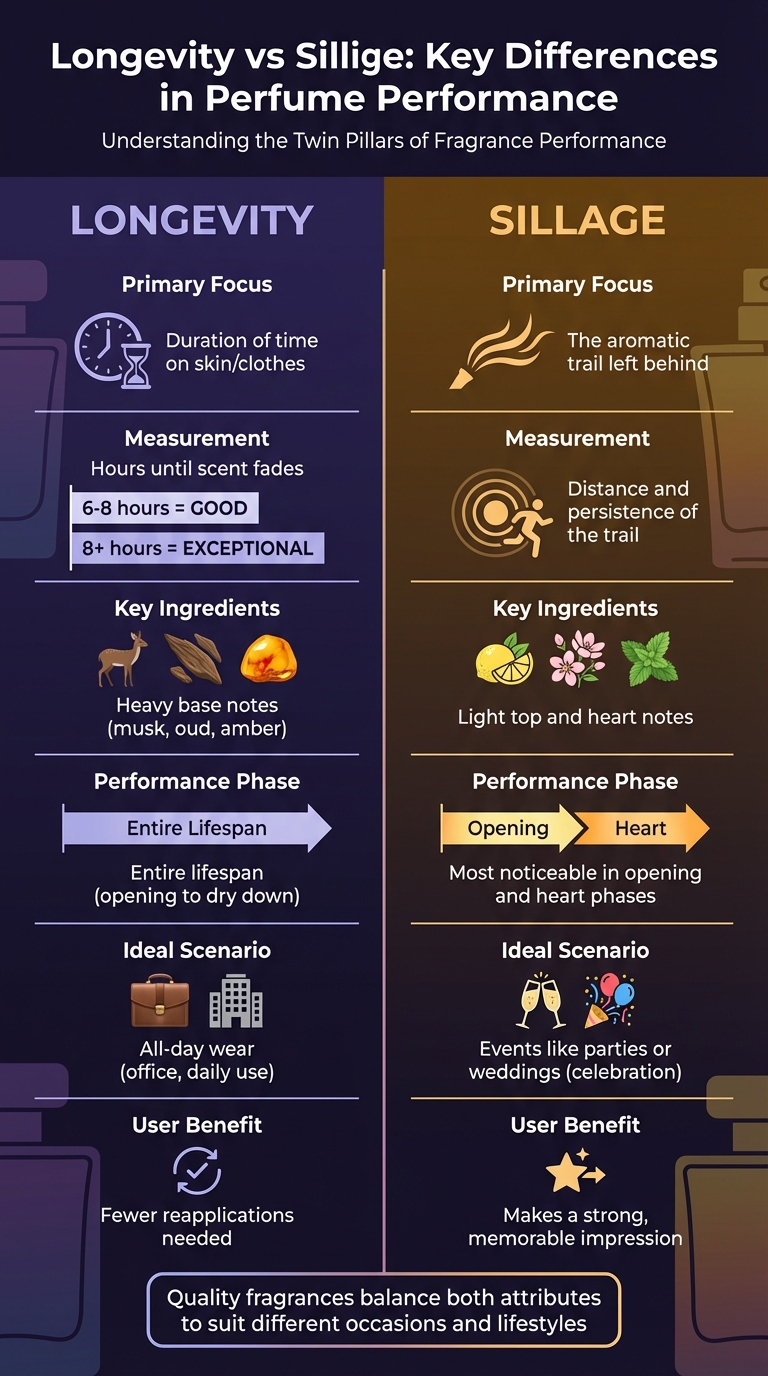
Διάρκεια vs Sillage: Βασικές Διαφορές στην Απόδοση ενός Αρώματος
Η διάρκεια και το sillage είναι δύο διαφορετικά μέτρα της απόδοσης ενός αρώματος. Η διάρκεια αναφέρεται στο πόσο καιρό παραμένει ένα άρωμα στο δέρμα ή στα ρούχα σας, ενώ το sillage αφορά το αρωματικό ίχνος που αφήνει πίσω του καθώς κινείστε.
Ένα άρωμα μπορεί να διαρκεί για ώρες αλλά να μένει κοντά στο δέρμα, ή να γεμίζει έναν χώρο και να σβήνει γρήγορα. Το καθένα εξυπηρετεί διαφορετικό σκοπό, επομένως η κατανόηση αυτών των διαφορών μπορεί να σας βοηθήσει να επιλέξετε το κατάλληλο άρωμα για τις ανάγκες σας.
Πίνακας Σύγκρισης: Διάρκεια vs. Sillage
Ακολουθεί μια σύντομη ανάλυση του πώς διαφέρουν αυτά τα δύο χαρακτηριστικά:
| Χαρακτηριστικό | Διάρκεια | Sillage |
|---|---|---|
| Κύρια Εστίαση | Χρονική διάρκεια στο δέρμα/στα ρούχα | Το αρωματικό ίχνος που αφήνεται πίσω |
| Μέτρηση | Ώρες μέχρι να ξεθωριάσει το άρωμα | Απόσταση και παραμονή του ίχνους |
| Βασικά Συστατικά | Βαριές νότες βάσης (π.χ. musk, oud, amber) | Ελαφριές νότες κορυφής και καρδιάς |
| Φάση Απόδοσης | Ολόκληρη η διάρκεια ζωής (από το άνοιγμα έως το dry down) | Πιο αισθητό στις φάσεις ανοίγματος και καρδιάς |
| Ιδανικό Σενάριο | Χρήση όλη την ημέρα | Εκδηλώσεις όπως πάρτι ή γάμοι |
| Όφελος για τον Χρήστη | Χρειάζονται λιγότερες επαναλήψεις εφαρμογής | Δημιουργεί έντονη, αξέχαστη εντύπωση |
Αυτές οι διαφορές δεν επηρεάζουν μόνο την απόδοση ενός αρώματος, αλλά αναδεικνύουν και την καλλιτεχνία που κρύβεται στη δημιουργία του.
Πότε να Δώσετε Προτεραιότητα στη Διάρκεια ή στο Sillage
Η επιλογή ανάμεσα στη διάρκεια και το sillage εξαρτάται από την περίσταση και τις προσωπικές σας προτιμήσεις.
Προτιμήστε τη διάρκεια όταν χρειάζεστε ένα άρωμα που διαρκεί όλη μέρα χωρίς την ταλαιπωρία της επανάληψης εφαρμογής. Αυτό είναι ιδιαίτερα χρήσιμο σε επαγγελματικά περιβάλλοντα, σε πολύωρες βάρδιες ή σε κάθε περίπτωση όπου η πρακτικότητα έχει σημασία. Ένα άρωμα με διάρκεια 6–8 ωρών θεωρείται γενικά αξιόπιστο για καθημερινή χρήση και προσφέρει εξαιρετική σχέση ποιότητας-τιμής.
Επιλέξτε sillage όταν το να κάνετε εντύπωση είναι καθοριστικό. Τολμηρά, εντυπωσιακά αρώματα λειτουργούν καλύτερα σε βραδινές εκδηλώσεις, υπαίθριες συγκεντρώσεις ή γιορτές όπου θέλετε η παρουσία σας να γίνεται αισθητή. Ωστόσο, σε περιορισμένους χώρους όπως ασανσέρ ή κοινόχρηστα γραφεία, ένα πιο διακριτικό sillage είναι ευγενικό και ενδεδειγμένο.
Ισορροπώντας τη Διάρκεια και το Sillage σε Ποιοτικά Αρώματα
Πώς οι Αρωματοποιοί Ισορροπούν τη Διάρκεια και το Sillage
Η δημιουργία ενός ισορροπημένου αρώματος δεν είναι απλή υπόθεση - απαιτεί ακρίβεια και βαθιά κατανόηση της χημείας. Οι αρωματοποιοί ρυθμίζουν προσεκτικά τη συγκέντρωση των αρωματικών ελαίων ώστε να επιτύχουν την επιθυμητή απόδοση. Για παράδειγμα, το Eau de Parfum (EDP) προσφέρει συνήθως 4–6+ ώρες διάρκειας χάρη στην υψηλότερη περιεκτικότητά του σε έλαια, ενώ το Eau de Toilette (EDT) προσφέρει μια πιο ανάλαφρη εμπειρία, με διάρκεια περίπου 3–4 ωρών.
Η επιλογή του μοριακού βάρους είναι ένας ακόμη κρίσιμος παράγοντας. Τα βαρύτερα μόρια, όπως το amber, το musk και οι ρητίνες, τείνουν να προσκολλώνται στο δέρμα, εξασφαλίζοντας μεγαλύτερη διάρκεια. Αντίθετα, τα ελαφρύτερα μόρια όπως τα εσπεριδοειδή, οι πράσινες νότες και οι aquatic accords εξατμίζονται γρήγορα, προσφέροντας εκείνη την εντυπωσιακή αρχική προβολή. Η τέχνη βρίσκεται στην εξεύρεση μιας ισορροπίας που διατηρεί την παρουσία χωρίς να κατακλύζει τον χρήστη ή τους γύρω του.
Τα fixatives είναι ουσιώδη σε αυτή τη διαδικασία. Νότες βάσης όπως το σανδαλόξυλο, το patchouli και η βανίλια βοηθούν να αγκυρωθούν οι πιο ανάλαφρες νότες κορυφής, ώστε να μην εξαφανίζονται πολύ γρήγορα. Επιπλέον, φυσικά συστατικά όπως τα αιθέρια έλαια και τα absolutes συχνά υπερέχουν των συνθετικών τόσο σε διάρκεια όσο και σε διάχυση του αρώματος, ενισχύοντας τη συνολική ποιότητα της σύνθεσης.
Αφού διαμορφωθεί η φόρμουλα, οι αρωματοποιοί πραγματοποιούν αυστηρές δοκιμές ώστε να διασφαλίσουν ότι το άρωμα ανταποκρίνεται στις προσδοκίες απόδοσης.
Δοκιμή Αρωμάτων για Διάρκεια και Sillage
Πριν επενδύσετε σε ένα μπουκάλι κανονικού μεγέθους, είναι σοφό να δοκιμάσετε πώς αποδίδει ένα άρωμα στο δέρμα σας και σε διάφορα περιβάλλοντα. Μικρά δείγματα ή decants των 8ml είναι ιδανικά γι’ αυτό - σας επιτρέπουν να βιώσετε το άρωμα για αρκετές ημέρες και σε διαφορετικές συνθήκες, όπως στη δουλειά, σε βραδινές εξόδους ή τόσο σε ζεστούς όσο και σε κλιματιζόμενους χώρους.
Για να δοκιμάσετε το sillage και το projection, ψεκάστε το άρωμα σε ένα σημείο παλμού, έπειτα κουνήστε το χέρι σας και μείνετε ακίνητοι. Αν το άρωμα διαχέεται χωρίς άμεση επαφή, αυτό δείχνει ισχυρό projection. Για τη διάρκεια, ελέγχετε το δέρμα και τα ρούχα σας κάθε λίγες ώρες για να δείτε αν οι νότες βάσης παραμένουν ανιχνεύσιμες.
Αυτή η πρακτική δοκιμή διασφαλίζει ότι το άρωμα ανταποκρίνεται στις προσδοκίες σας τόσο ως προς τη διάρκεια όσο και ως προς το sillage.
Συμβουλές για να Μεγιστοποιήσετε τη Διάρκεια και το Sillage
Αφού επιλέξετε ένα άρωμα, αυτές οι συμβουλές εφαρμογής μπορούν να σας βοηθήσουν να αξιοποιήσετε στο έπακρο την απόδοσή του:
- Ενυδατώστε το δέρμα σας πριν από την εφαρμογή: Το άρωμα διαρκεί περισσότερο σε λιπαρό ή καλά ενυδατωμένο δέρμα. Χρησιμοποιήστε μια λοσιόν χωρίς άρωμα για να δημιουργήσετε μια βάση που βοηθά στην παγίδευση των αρωματικών μορίων.
- Εστιάστε στα σημεία παλμού: Περιοχές όπως ο λαιμός, οι καρποί, πίσω από τα αυτιά, το εσωτερικό των αγκώνων και πίσω από τα γόνατα παράγουν θερμότητα, η οποία ενισχύει τη διάχυση. Ωστόσο, αποφύγετε να τρίβετε τους καρπούς σας μεταξύ τους μετά την εφαρμογή - αυτό βλάπτει τη δομή του αρώματος και κάνει τις νότες κορυφής να ξεθωριάζουν ταχύτερα.
- Ψεκάστε ελαφρά τα ρούχα: Το ύφασμα συγκρατεί το άρωμα περισσότερο από το δέρμα, αν και η διάχυση θα είναι πιο σταθερή.
Να έχετε υπόψη ότι περιβαλλοντικοί παράγοντες, όπως η υγρασία και η θερμοκρασία, μπορούν να επηρεάσουν την απόδοση ενός αρώματος. Η υψηλή υγρασία ή η ζέστη μπορεί να ενισχύσουν προσωρινά το projection, αλλά ενδέχεται επίσης να επιταχύνουν την εξάτμιση, μειώνοντας τη συνολική διάρκεια.
Συμπέρασμα
Η διάρκεια και το sillage είναι οι δίδυμοι πυλώνες της απόδοσης ενός αρώματος - το ένα καθορίζει πόσο καιρό το άρωμα παραμένει στο δέρμα σας, ενώ το άλλο μετρά το ίχνος που αφήνει στον αέρα. Ένα άρωμα μπορεί να υπερέχει σε έναν τομέα ενώ να είναι πιο συγκρατημένο στον άλλον, ανάλογα με τη σύνθεσή του. Το κλειδί είναι να ταιριάξετε την επιλογή σας με τον τρόπο ζωής σας και το περιβάλλον όπου θα το φορέσετε.
Για παράδειγμα, το έντονο sillage είναι ιδανικό για υπαίθριες συγκεντρώσεις ή βραδινές περιστάσεις, αλλά μπορεί να φανεί υπερβολικό σε πιο ήσυχα περιβάλλοντα όπως τα γραφεία ή τα νοσοκομεία. Από την άλλη πλευρά, η προτεραιότητα στη διάρκεια εξασφαλίζει ότι το άρωμά σας θα σας συνοδεύει σε πολύωρες εργάσιμες ημέρες χωρίς συχνή επανάληψη εφαρμογής, καθιστώντας το πρακτική επιλογή για απαιτητικά προγράμματα. Αξίζει να θυμάστε ότι η ποιότητα δεν ταυτίζεται πάντα με την ένταση - τα καλύτερα αρώματα είναι εκείνα που ανταποκρίνονται στις δικές σας ανάγκες και στο πλαίσιο μέσα στο οποίο τα φοράτε.
Ωστόσο, η αξιολόγηση της διάρκειας και του sillage μπορεί να είναι δύσκολη εξαιτίας της οσφρητικής προσαρμογής, ενός φαινομένου κατά το οποίο η δική σας όσφρηση απευαισθητοποιείται σε ένα άρωμα με την πάροδο του χρόνου. Αυτό δυσκολεύει την ακριβή εκτίμηση της απόδοσης μόνοι σας. Η δοκιμή ενός αρώματος σε διάφορα περιβάλλοντα επί αρκετές ημέρες δίνει σαφέστερη εικόνα του πώς πραγματικά αποδίδει.
Τα επιλεγμένα decants είναι ένας έξυπνος τρόπος να εξερευνήσετε τον πλήρη χαρακτήρα ενός αρώματος προτού δεσμευτείτε σε ένα μπουκάλι κανονικού μεγέθους. Αυτή η προσέγγιση εξαλείφει τον κίνδυνο να ξοδέψετε χρήματα για ένα μπουκάλι άνω των 300 € που ίσως τελικά δεν σας ταιριάζει. Η Scento είναι κατάστημα λιανικής με decants και δείγματα αρωμάτων, και κάθε προϊόν διατίθεται για εφάπαξ αγορά, χωρίς καμία συνδρομή. Το Scento+ είναι η προαιρετική συνδρομή μελών της Scento: το μηνιαίο κόστος επιστρέφει εξ ολοκλήρου ως πίστωση καταστήματος, την οποία ξοδεύετε σε όποιο άρωμα θέλετε, τα μέλη έχουν 10% έκπτωση, ένα δωρεάν δείγμα σε κάθε παραγγελία, ένα δωρεάν άρωμα κάθε έξι μήνες και ένα δώρο γενεθλίων, ενώ μπορείτε να κάνετε παύση όποτε θέλετε και, για ακύρωση, να επικοινωνήσετε με την ομάδα μας. Με πάνω από 1.000 επώνυμα αρώματα για να επιλέξετε, μπορείτε να πειραματιστείτε σε βάθος και να δημιουργήσετε μια συλλογή που ισορροπεί τη διάρκεια και το sillage βάσει πραγματικής εμπειρίας, όχι εικασιών.
Συχνές Ερωτήσεις
Μπορεί ένα άρωμα να έχει εξαιρετική διάρκεια αλλά αδύναμο sillage;
Ναι, ένα άρωμα μπορεί να παραμένει στο δέρμα για ώρες (δείχνοντας εξαιρετική διάρκεια) ενώ να έχει ελάχιστο sillage, πράγμα που σημαίνει ότι δεν διαχέεται πολύ στον περιβάλλοντα αέρα. Αυτά τα δύο χαρακτηριστικά - η διάρκεια και το sillage - είναι ξεχωριστές ιδιότητες. Ένα άρωμα μπορεί να αποδίδει έντονα στον έναν τομέα ενώ να παραμένει διακριτικό στον άλλον.
Πώς μπορώ να καταλάβω αν έχω συνηθίσει τόσο το άρωμά μου ώστε να μην το αντιλαμβάνομαι;
Η οσφρητική προσαρμογή συμβαίνει όταν σταματάτε να αντιλαμβάνεστε το δικό σας άρωμα, παρόλο που οι γύρω σας εξακολουθούν να το μυρίζουν. Αυτό συμβαίνει επειδή ο εγκέφαλός σας προσαρμόζεται στις οσμές στις οποίες εκτίθεστε συχνά ή για μεγάλα χρονικά διαστήματα. Με την πάροδο του χρόνου, τα οικεία αρώματα περνούν στο παρασκήνιο, με αποτέλεσμα να γίνονται λιγότερο αισθητά σε εσάς.
Πόσους ψεκασμούς πρέπει να χρησιμοποιώ για το γραφείο σε σχέση με ένα πάρτι;
Για το γραφείο, μείνετε στους 1–2 ψεκασμούς ώστε να διατηρείτε μια διακριτική, εκλεπτυσμένη παρουσία που μένει κοντά στο δέρμα - ιδανική για επαγγελματικά περιβάλλοντα. Πηγαίνετε σε πάρτι ή κοινωνική εκδήλωση; Επιλέξτε 3–4 ψεκασμούς για να ενισχύσετε το sillage και το projection του αρώματος, ώστε να αφήνει αξέχαστη εντύπωση. Προσαρμόστε τον αριθμό των ψεκασμών ανάλογα με τη συγκέντρωση του αρώματος και το προσωπικό σας γούστο, αλλά επιδιώξτε ισορροπία: διακριτικό για τη δουλειά, πιο εκφραστικό για κοινωνικές περιστάσεις.

