Η βιομηχανία αρωμάτων, με ετήσια αξία που ξεπερνά τα €58 δισεκατομμύρια, αντιμετωπίζει μια σημαντική πρόκληση: τις υψηλές εκπομπές άνθρακα. Ένα εντυπωσιακό 95% αυτών των εκπομπών προέρχεται από τις πρώτες ύλες και την παραγωγή συστατικών, ενώ η ανάμειξη και η συσκευασία συνεισφέρουν πολύ λιγότερο. Ακολουθεί μια σύντομη ανάλυση των βασικών ζητημάτων και λύσεων:
- Πρώτες Ύλες: Τα φυσικά συστατικά απαιτούν συχνά ενεργοβόρες διαδικασίες όπως η απόσταξη με ατμό, ενώ τα συνθετικά υλικά βασίζονται σε ορυκτά καύσιμα όπως ο άνθρακας και το φυσικό αέριο.
- Παραγωγή Αιθανόλης: Η παραδοσιακή αιθανόλη, που προέρχεται από καλλιέργειες όπως το ζαχαροκάλαμο, συμβάλλει στην αποψίλωση των δασών και στις εκπομπές από τη γεωργία. Νέες μέθοδοι, όπως η αιθανόλη από δεσμευμένο άνθρακα, αναδύονται αλλά παραμένουν απαιτητικές σε πόρους.
- Συσκευασία: Τα γυάλινα μπουκάλια και οι ψεκαστήρες αυξάνουν τις εκπομπές, αν και τα επαναγεμιζόμενα συστήματα και τα ανακυκλωμένα υλικά κερδίζουν έδαφος.
Οι προσπάθειες για τη μείωση των εκπομπών περιλαμβάνουν τη χρήση παραπροϊόντων για την παραγωγή συστατικών, την ανάπτυξη αιθανόλης χαμηλού άνθρακα και την υιοθέτηση επαναγεμιζόμενων συσκευασιών. Επωνυμίες όπως η Coty και η Gucci πρωτοστατούν με καινοτομίες όπως το αλκοόλ από δεσμευμένο άνθρακα και βιώσιμες πρακτικές. Ωστόσο, οι προκλήσεις επιμένουν λόγω του κατακερματισμού της εφοδιαστικής αλυσίδας, των αναποτελεσματικοτήτων στα συστατικά και του υψηλού κόστους υποδομών.
Οι καταναλωτές μπορούν να βοηθήσουν επιλέγοντας επαναγεμιζόμενα μπουκάλια, στηρίζοντας μάρκες με διαφανή προέλευση πρώτων υλών και προτιμώντας μικρότερες συσκευασίες όπως τα decants 8ml της Scento, που μειώνουν τα απόβλητα και την κατανάλωση ενέργειας.
Κύριες Πηγές Εκπομπών Άνθρακα στην Παραγωγή Αρωμάτων
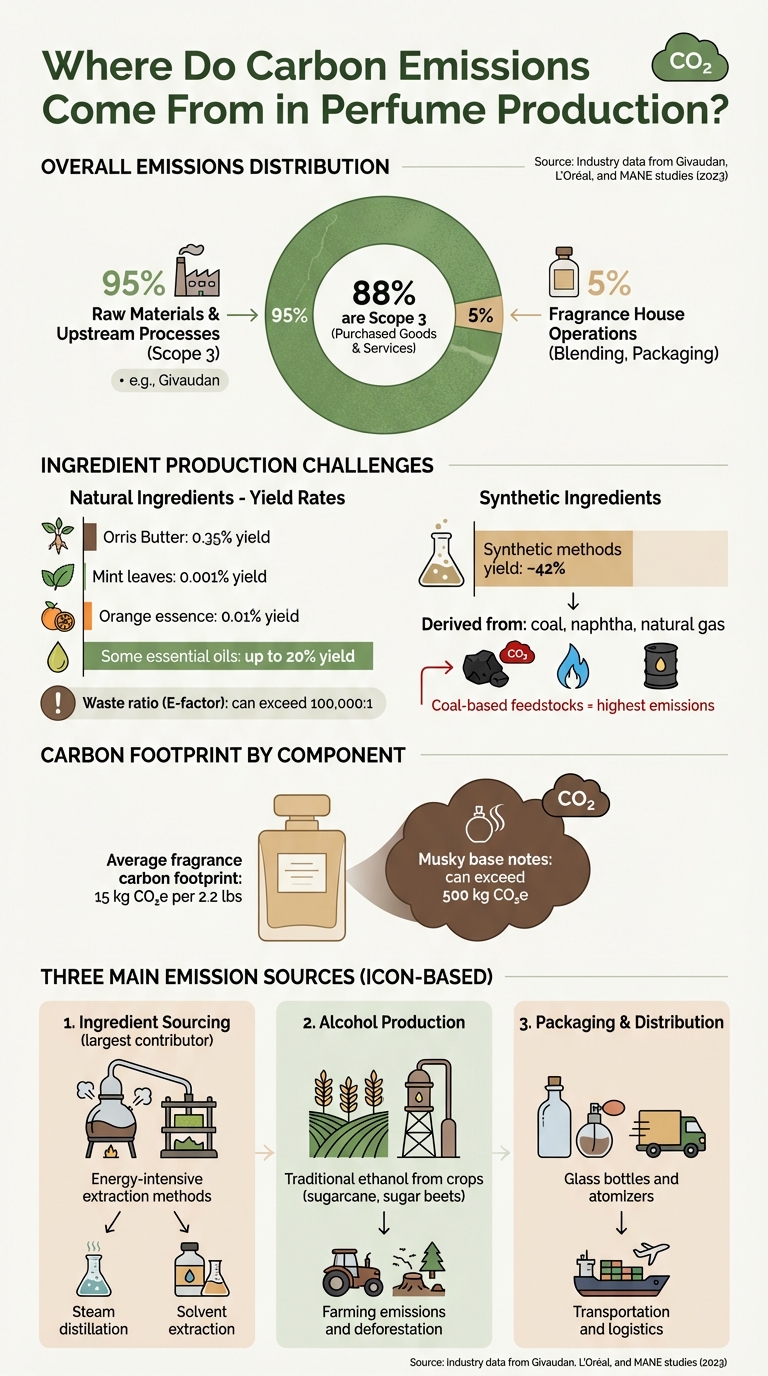
Ανάλυση Εκπομπών Άνθρακα στην Παραγωγή Αρωμάτων ανά Πηγή
Για να αντιμετωπιστούν οι εκπομπές άνθρακα στην παραγωγή αρωμάτων, είναι ουσιώδες να κατανοήσουμε από πού προέρχονται. Η περιβαλλοντική επίδραση εκτείνεται σε τρεις βασικούς τομείς: την προμήθεια συστατικών, την παραγωγή αλκοόλης και τη δημιουργία συσκευασίας.
Προμήθεια Συστατικών
Η διαδικασία προμήθειας συστατικών είναι ένας από τους μεγαλύτερους παράγοντες που συμβάλλουν στο ανθρακικό αποτύπωμα ενός αρώματος. Για μεγάλες εταιρείες αρωμάτων όπως η Givaudan, περίπου το 88% των εκπομπών κατατάσσεται στο Scope 3, το οποίο περιλαμβάνει κυρίως εκπομπές από αγορασθέντα αγαθά και υπηρεσίες.
Τα φυσικά και τα συνθετικά συστατικά συνοδεύονται από τις δικές τους περιβαλλοντικές προκλήσεις. Τα φυσικά εκχυλίσματα απαιτούν συχνά ενεργοβόρες μεθόδους όπως η απόσταξη με ατμό ή η εκχύλιση με διαλύτες. Αυτές οι διαδικασίες μπορεί να οδηγούν σε χαμηλές αποδόσεις και σημαντικά απόβλητα. Για παράδειγμα, το Orris Butter έχει απόδοση μόλις περίπου 0,35%, ενώ ορισμένα αιθέρια έλαια μπορούν να φτάσουν έως και το 20%. Σε ορισμένες περιπτώσεις, ο λόγος αποβλήτων (E-factor) μπορεί να ξεπεράσει το εντυπωσιακό 100.000 προς 1.
Από την άλλη πλευρά, τα συνθετικά συστατικά προέρχονται συνήθως από άνθρακα, νάφθα ή φυσικό αέριο. Οι πρώτες ύλες με βάση τον άνθρακα, ειδικότερα, συνδέονται με υψηλότερες εκπομπές. Η παραγωγή συνθετικών αρωματικών μορίων περιλαμβάνει πολλαπλά στάδια, καθένα από τα οποία απαιτεί σημαντική θερμική ενέργεια, η οποία συχνά παρέχεται με τη μορφή ατμού. Η απανθρακοποίηση της παραγωγής ατμού είναι αισθητά πιο σύνθετη και δαπανηρή από τη μετάβαση σε ανανεώσιμη ηλεκτρική ενέργεια.
Αυτές οι προκλήσεις στην προμήθεια συστατικών οδηγούν φυσικά στον επόμενο σημαντικό παράγοντα: την παραγωγή αιθανόλης.
Παραγωγή Αλκοόλης και Περιβαλλοντικές Επιπτώσεις
Η αιθανόλη λειτουργεί ως φορέας για τα αρωματικά έλαια, εξατμιζόμενη κατά την εφαρμογή. Ωστόσο, η παραδοσιακή παραγωγή αιθανόλης βασίζεται σε μεγάλο βαθμό σε γεωργικές καλλιέργειες όπως το ζαχαροκάλαμο και τα ζαχαρότευτλα. Αυτή η εξάρτηση συμβάλλει στις εκπομπές μέσω των γεωργικών πρακτικών, της χρήσης γης και ακόμη και της αποψίλωσης των δασών, ιδιαίτερα σε οικολογικά ευαίσθητες περιοχές όπως το Ατλαντικό Δάσος της Βραζιλίας.
Οι αναδυόμενες τεχνολογίες σημειώνουν πρόοδο στη μείωση αυτών των επιπτώσεων. Για παράδειγμα, τον Ιανουάριο του 2022, η Coty Inc. ξεκίνησε να χρησιμοποιεί αιθανόλη που παράγεται μέσω τεχνολογίας δέσμευσης άνθρακα από τη LanzaTech. Τον Απρίλιο του 2023, η Gucci παρουσίασε το "Where My Heart Beats", το πρώτο παγκοσμίως διαθέσιμο άρωμα που παρασκευάστηκε εξ ολοκλήρου με αλκοόλη προερχόμενη από ανακυκλωμένες εκπομπές άνθρακα που δεσμεύτηκαν από χαλυβουργεία.
Παρά αυτές τις εξελίξεις, οι προκλήσεις παραμένουν. Όπως επισημαίνει ο Martin Mulvihill, συνιδρυτής της Safer Made:
"Επειδή το CO2 έχει μόνο έναν άνθρακα, το να το ενώσεις και στη συνέχεια να το μειώσεις σε αλκοόλη είναι μια εξαιρετικά δύσκολη διαδικασία. Είναι ενεργοβόρα και απαιτητική σε πόρους".
Πέρα από την αιθανόλη και τα συστατικά, η περιβαλλοντική επίδραση επεκτείνεται και στη συσκευασία και τη διανομή.
Συσκευασία και Διανομή
Η συσκευασία, συμπεριλαμβανομένων των γυάλινων μπουκαλιών, των ψεκαστήρων και άλλων υλικών, προσθέτει σημαντικά στο ανθρακικό αποτύπωμα. Οι εταιρείες αρχίζουν να καινοτομούν σε αυτόν τον τομέα. Για παράδειγμα, τον Ιούλιο του 2021, η L’Oréal παρουσίασε το πρώτο της καλλυντικό μπουκάλι κατασκευασμένο από βιομηχανικές εκπομπές άνθρακα, το οποίο αναπτύχθηκε σε συνεργασία με τη LanzaTech και την TotalEnergies - μια συνεργασία που ξεκίνησε το 2016.
Η διανομή παίζει επίσης ρόλο, με εκπομπές που προέρχονται από τη μεταφορά, την αποθήκευση και τα παγκόσμια logistics αποστολών. Η κατακερματισμένη φύση του κλάδου, με πολλές μικρές και μεσαίες επιχειρήσεις, περιπλέκει την υιοθέτηση ενιαίων, βιώσιμων πρακτικών logistics. Πρωτοβουλίες όπως οι στρατηγικές αντίστροφης εφοδιαστικής αλυσίδας, που εστιάζουν στην ανακύκλωση μπουκαλιών και ψεκαστήρων και στη διαχείριση επιστρεφόμενων προϊόντων, κερδίζουν έδαφος αλλά εξακολουθούν να εφαρμόζονται ανομοιόμορφα σε όλο τον τομέα.
Νέες Μέθοδοι για τη Μείωση των Εκπομπών Άνθρακα
Η βιομηχανία αρωμάτων υιοθετεί τεχνολογίες αιχμής για να αντιμετωπίσει τις εκπομπές που συνδέονται με την παραγωγή. Από τη μετατροπή βιομηχανικών αποβλήτων σε αλκοόλη ποιότητας αρωματοποιίας έως τον επανασχεδιασμό των φιαλών και την πιο υπεύθυνη προμήθεια υλικών, αυτές οι προσπάθειες αναδεικνύουν πρακτικούς τρόπους μείωσης του περιβαλλοντικού αποτυπώματος της παραγωγής.
Τεχνολογία Αλκοόλης από Δεσμευμένο Άνθρακα
Η τεχνολογία CarbonSmart της LanzaTech δημιουργεί αίσθηση μετατρέποντας απόβλητα αέρια από χαλυβουργεία σε αιθανόλη υψηλής καθαρότητας μέσω ζύμωσης. Η Coty Inc. υιοθέτησε αυτή τη διαδικασία τον Ιανουάριο του 2022, ενσωματώνοντας αιθανόλη από δεσμευμένο άνθρακα στην παραγωγή της. Μέχρι τον Απρίλιο του 2023, αυτή η καινοτομία κορυφώθηκε με την κυκλοφορία του "Gucci Where My Heart Beats", του πρώτου παγκοσμίως διαθέσιμου αρώματος που παρασκευάστηκε με 100% αλκοόλη προερχόμενη από ανακυκλωμένες εκπομπές άνθρακα.
Η Δρ. Shimei Fan, Chief Scientific and Sustainability Officer της Coty, σχολίασε αυτό το επίτευγμα:
"Πέρα από την επιστήμη, υπάρχει κάτι μαγικό στο upcycling βιομηχανικών εκπομπών σε αλκοόλη αρκετά καθαρή για χρήση στην υψηλή αρωματοποιία".
Η Coty έχει θέσει έναν φιλόδοξο στόχο να μειώσει τις απόλυτες εκπομπές CO₂ κατά 30% έως το 2030.
Επαναγεμιζόμενη και Οικολογική Συσκευασία
Το 2023, η Coty κατοχύρωσε με δίπλωμα ευρεσιτεχνίας ένα μηχάνημα επαναπλήρωσης εντός καταστήματος, επιτρέποντας στους πελάτες να ξαναγεμίζουν τα άδεια μπουκάλια αρώματός τους απευθείας στα σημεία λιανικής. Αυτή η καινοτομία συνάδει με τη δέσμευσή της να εξαλείψει τα εξαρτήματα μίας χρήσης σε μάρκες όπως η Marc Jacobs και η Calvin Klein.
Υπεύθυνα Προερχόμενα Αρωματικά Υλικά
Οι προσπάθειες για τη μείωση της περιβαλλοντικής επίδρασης επεκτείνονται και στην προμήθεια συστατικών. Πολλοί κατασκευαστές χρησιμοποιούν πλέον παραπροϊόντα από άλλες βιομηχανίες ως πρώτες ύλες. Για παράδειγμα, το Orange Essence, παραπροϊόν της βιομηχανίας χυμών, και το Myrcene, που προέρχεται από ροκανίδια ξύλου, προσφέρουν πιο βιώσιμες εναλλακτικές σε σχέση με συστατικά που συλλέγονται χειρωνακτικά, όπως το Orris Butter. Μια μελέτη του Ιουλίου 2023 από τη L’Oréal και τη MANE, υπό την καθοδήγηση των Patricia Martz και Tony Phan, ανέλυσε 27 αρωματικά συστατικά σε 14 κατηγορίες περιβαλλοντικών επιπτώσεων, αναδεικνύοντας αυτές τις επιλογές χαμηλότερου αντίκτυπου.
Ο κλάδος προοδεύει επίσης στη βιοτεχνολογία. Διαδικασίες ζύμωσης με τη χρήση μικροοργανισμών παράγουν πλέον αρωματικά συστατικά όπως το Antillone και το Tropicalone, τα οποία είναι λιγότερο ανθρακικά απαιτητικά σε σύγκριση με την παραδοσιακή χημική σύνθεση.
Αυτές οι καινοτομίες ανοίγουν τον δρόμο για πιο βιώσιμες πρακτικές παραγωγής, αντιμετωπίζοντας βασικές προκλήσεις στη διαδικασία κατασκευής αρωμάτων.
Ο προσωπικός σας ειδικός αρωμάτων σας περιμένει
Κάντε το σύντομο κουίζ αρώματος και ανακαλύψτε αυθεντικά αρώματα designer και niche, επιλεγμένα στα μέτρα σας – εξερευνήστε τα σε decant και δείγματα των 2–8ml, ώστε να δοκιμάσετε το καθένα πριν επιλέξετε ολόκληρο μπουκάλι.
Βρείτε το άρωμά σαςΕμπόδια για την Επίτευξη Χαμηλότερων Εκπομπών Άνθρακα
Παρά την πρόοδο, η βιομηχανία αρωμάτων αντιμετωπίζει σημαντικά εμπόδια στη μείωση των εκπομπών άνθρακα, κυρίως λόγω της περίπλοκης φύσης των συνθέσεων και του κατακερματισμένου χαρακτήρα των παγκόσμιων εφοδιαστικών αλυσίδων. Αυτά τα ζητήματα αναδεικνύουν την ανάγκη για βαθύτερη εμβάθυνση στην προμήθεια συστατικών και στις λειτουργίες της εφοδιαστικής αλυσίδας.
Φυσικά έναντι Συνθετικών Συστατικών
Η χρήση φυσικών εκχυλισμάτων όπως το cis-3 — Hexenol ή το orange essence οδηγεί συχνά σε σημαντικά απόβλητα. Για παράδειγμα, τα φύλλα μέντας αποδίδουν μόλις περίπου 0,001%, και το orange essence προσφέρει μόνο 0,01% εκχυλίσματος, ενώ οι συνθετικές μέθοδοι μπορούν να επιτύχουν αποδόσεις περίπου 42%. Αυτή η έντονη αντίθεση υπογραμμίζει το χάσμα αποδοτικότητας μεταξύ φυσικής και συνθετικής παραγωγής.
Η Anne Dussourt, αρωματοποιός στη Symrise, ρίχνει φως στις πολυδιάστατες προκλήσεις:
"Αντιμετωπίζουμε μια πρόκληση σε πολλά επίπεδα: τα αρώματα πρέπει να συνεχίσουν να μυρίζουν εξίσου όμορφα όπως πριν, να λειτουργούν στις εφαρμογές, να συμμορφώνονται με τους κανονισμούς και να είναι συγκρίσιμα ως προς την τιμή."
Οι μόσχινες νότες βάσης, απαραίτητες για τη δημιουργία αρωμάτων μεγάλης διάρκειας, είναι ιδιαίτερα προβληματικές. Αυτά τα συστατικά μπορούν να αυξήσουν σημαντικά το ανθρακικό αποτύπωμα ενός αρώματος, το οποίο ανέρχεται κατά μέσο όρο σε περίπου 15 kg CO₂e ανά 2,2 lbs, με ορισμένα συστατικά να ξεπερνούν τα 500 kg CO₂e. Τέτοιες προκλήσεις στην επιλογή συστατικών περιπλέκονται ακόμη περισσότερο από τις αναποτελεσματικότητες της ευρύτερης εφοδιαστικής αλυσίδας.
Προβλήματα Εφοδιαστικής Αλυσίδας και Κλίμακας Παραγωγής
Η κατακερματισμένη φύση της εφοδιαστικής αλυσίδας αποτελεί ένα ακόμη μεγάλο εμπόδιο. Οι μικρότεροι προμηθευτές πρώτων υλών, που συχνά δεν διαθέτουν τους πόρους και τη διαπραγματευτική ισχύ των μεγαλύτερων κατασκευαστών, δυσκολεύονται να εφαρμόσουν βιώσιμες πρακτικές με ενιαίο τρόπο. Αυτή η ανισότητα επιβραδύνει την πρόοδο σε ολόκληρο τον κλάδο.
Ένα εντυπωσιακό 95% των εκπομπών αερίων του θερμοκηπίου που σχετίζονται με την παραγωγή αρωμάτων προέρχεται από τις πρώτες ύλες και τις ανάντη διεργασίες, και όχι από τις λειτουργίες των ίδιων των αρωματοποιιών. Για την αντιμετώπιση αυτού του ζητήματος, η BASF και η Givaudan εγκαινίασαν μια κοινή πρωτοβουλία τον Σεπτέμβριο του 2025, παρουσιάζοντας ένα χαρτοφυλάκιο αρωματικών συστατικών σχεδιασμένων να μειώνουν το ανθρακικό αποτύπωμα των προϊόντων. Η προσπάθεια αυτή στόχευε στις εκπομπές Scope 3 της Givaudan, οι οποίες αντιστοιχούν στο 88% του συνολικού της αποτυπώματος, και πέτυχε μείωση 10–15% στο ανθρακικό αποτύπωμα των προϊόντων μέσω μιας προσέγγισης mass balance.
Ωστόσο, η αυστηρή εμπιστευτικότητα που περιβάλλει τις συνθέσεις αρωμάτων καθιστά δύσκολες τις ολοκληρωμένες αξιολογήσεις κύκλου ζωής, περιπλέκοντας περαιτέρω τις προσπάθειες βιωσιμότητας. Ενώ η μετάβαση σε ανανεώσιμη ηλεκτρική ενέργεια είναι σχετικά απλή, άλλες αλλαγές, όπως η μετάβαση από θερμότητα ατμού σε βιομάζα ή ηλεκτρικούς λέβητες, απαιτούν σημαντικές επενδύσεις και χρόνο. Αυτές οι αναβαθμίσεις υποδομών είναι απαραίτητες, αλλά αντιπροσωπεύουν μια δαπανηρή και μακροπρόθεσμη δέσμευση για τον κλάδο.
Το Επόμενο Βήμα για την Παραγωγή Αρωμάτων με Χαμηλότερο Άνθρακα
Η βιομηχανία αρωμάτων κινείται προς πιο βιώσιμες πρακτικές, υιοθετώντας αιθανόλη από δεσμευμένο άνθρακα και ανανεώσιμες πρώτες ύλες ως εναλλακτικές στα υλικά ορυκτής προέλευσης. Ένα χαρακτηριστικό παράδειγμα είναι η Coty Inc., η οποία, τον Μάρτιο του 2021, άρχισε να ενσωματώνει αιθανόλη υψηλής καθαρότητας προερχόμενη από δεσμευμένες εκπομπές στη γκάμα των προϊόντων της. Αυτή η πρωτοβουλία στηρίζει τον στόχο της Coty να μειώσει τις απόλυτες εκπομπές CO₂ κατά 30% έως το 2030.
Οι αρωματοποιοί έχουν πλέον πρόσβαση σε προηγμένα εργαλεία οικολογικού σχεδιασμού που τους βοηθούν να αξιολογούν και να μειώνουν την ανθρακική επίδραση στα αρχικά στάδια της σύνθεσης. Το 2023, η Symrise ανέφερε μείωση 20% στο ανθρακικό αποτύπωμα προϊόντων όπως σαμπουάν και αποσμητικά, αντικαθιστώντας συστατικά υψηλών εκπομπών με πιο βιώσιμες επιλογές. Εργαλεία όπως το GREEN MOTION™ της MANE και το SPOT της L’Oréal είναι επίσης καθοριστικά για την αξιολόγηση και τη βελτίωση των περιβαλλοντικών αποτελεσμάτων.
Πώς Μπορούν να Βοηθήσουν οι Καταναλωτές
Ενώ οι κατασκευαστές καινοτομούν, οι καταναλωτές διαδραματίζουν καίριο ρόλο στη στήριξη αυτών των προσπαθειών. Οι προσεκτικές επιλογές - όπως η αγορά επαναγεμιζόμενων μπουκαλιών, η υποστήριξη μαρκών που δίνουν προτεραιότητα στη διαφανή προμήθεια και στα συστατικά από δεσμευμένο άνθρακα, και η προτίμηση σε συμπυκνωμένες μορφές προϊόντων - μπορούν να μειώσουν σημαντικά τα απορρίμματα συσκευασίας και να ενισχύσουν τη ζήτηση για παραγωγή χαμηλότερου άνθρακα.
Scento: Η Προσέγγιση στη Μείωση Αποβλήτων
Η Scento ευθυγραμμίζεται με αυτές τις προσπάθειες βιωσιμότητας εστιάζοντας στη μείωση αποβλήτων και στην περιβαλλοντική συνείδηση. Προσφέροντας decants 8ml (περίπου 0,27 fl oz), η Scento επιτρέπει στους λάτρεις των αρωμάτων να εξερευνούν νέες ευωδιές χωρίς να δεσμεύονται σε φιάλες πλήρους μεγέθους. Αυτή η μικρότερη μορφή όχι μόνο ελαχιστοποιεί την ανάγκη για περισσότερη παραγωγή γυαλιού και πλαστικού, αλλά μειώνει και την κατανάλωση ενέργειας, συμβάλλοντας σε μια πιο κυκλική οικονομία.
Συχνές Ερωτήσεις
Τι είναι η αιθανόλη από δεσμευμένο άνθρακα και πώς συμβάλλει στη μείωση των εκπομπών στην παραγωγή αρωμάτων;
Η αιθανόλη από δεσμευμένο άνθρακα δημιουργείται μέσω ζύμωσης διοξειδίου του άνθρακα (CO₂) που εξάγεται από βιομηχανικές εκπομπές. Σε αντίθεση με την παραδοσιακή αιθανόλη, η οποία προέρχεται από καλλιέργειες και απαιτεί γεωργική γη, μεγάλες ποσότητες νερού και εκλύει ορυκτά καύσιμα κατά την παραγωγή, αυτή η μέθοδος προσφέρει μια καθαρότερη εναλλακτική.
Για τους δημιουργούς αρωμάτων, η μετάβαση σε αιθανόλη από δεσμευμένο άνθρακα μπορεί να μειώσει δραστικά την περιβαλλοντική τους επίδραση. Παρακάμπτοντας τις οικολογικές προκλήσεις που συνδέονται με τη συμβατική αιθανόλη, αυτή η προσέγγιση σηματοδοτεί ένα διορατικό βήμα προς μια πιο πράσινη παραγωγή αρωμάτων.
Πώς επηρεάζουν τα φυσικά και τα συνθετικά συστατικά αρωμάτων τις εκπομπές άνθρακα;
Η διαδικασία δημιουργίας αρώματος, είτε με φυσικά είτε με συνθετικά συστατικά, συνοδεύεται από τις δικές της περιβαλλοντικές προκλήσεις. Τα φυσικά στοιχεία όπως τα αιθέρια έλαια και τα βοτανικά εκχυλίσματα προέρχονται από γεωργικές πρακτικές που απαιτούν γη, νερό και ενέργεια. Για παράδειγμα, η καλλιέργεια λουλουδιών, η συλλογή ξύλων ή η εκχύλιση ρητινών μπορεί να δημιουργήσει αξιοσημείωτες εκπομπές, ιδιαίτερα όταν εφαρμόζονται εντατικές γεωργικές μέθοδοι.
Από την άλλη πλευρά, τα συνθετικά συστατικά προέρχονται κυρίως από ορυκτά καύσιμα μέσω ενεργοβόρων βιομηχανικών διαδικασιών. Αν και προσφέρουν συνέπεια και αξιόπιστη απόδοση στα αρώματα, η παραγωγή τους παραμένει συνδεδεμένη με μη ανανεώσιμους πόρους, κάτι που αυξάνει σημαντικά το ανθρακικό αποτύπωμα ενός αρώματος.
Η συνολική περιβαλλοντική επίδραση ενός αρώματος εξαρτάται από την ισορροπία μεταξύ αυτών των δύο τύπων συστατικών. Ενώ τα φυσικά εκχυλίσματα μπορούν να μειώσουν την εξάρτηση από τα ορυκτά καύσιμα, συχνά συνοδεύονται από απαιτητικές σε πόρους γεωργικές ανάγκες. Τα συνθετικά, αν και αποδοτικά από ορισμένες απόψεις, επιφέρουν υψηλότερο ενεργειακό κόστος. Η εύρεση της σωστής ισορροπίας μεταξύ αυτών των στοιχείων είναι ουσιώδης για την ελαχιστοποίηση των εκπομπών στη βιομηχανία αρωμάτων.
Πώς μπορώ να μειώσω την περιβαλλοντική επίδραση των αρωμάτων που χρησιμοποιώ;
Μπορείτε να κάνετε τις συνήθειές σας γύρω από το άρωμα πιο φιλικές προς τον πλανήτη, επιλέγοντας συνειδητά τι αγοράζετε και στηρίζοντας μάρκες που δίνουν προτεραιότητα στη βιωσιμότητα. Ένα εξαιρετικό σημείο εκκίνησης; Αγοράστε μόνο ό,τι πραγματικά θα χρησιμοποιήσετε. Έτσι αποφεύγονται τα περιττά απόβλητα και διασφαλίζεται ότι τα αρώματά σας δεν μένουν αχρησιμοποίητα. Οι μικρότερες επιλογές, όπως οι travel-size φιάλες ή τα decants, είναι επίσης μια έξυπνη επιλογή - μειώνουν την υπερβολική συσκευασία και τα απόβλητα από την παραγωγή.
Αναζητήστε αρώματα που έχουν δημιουργηθεί με φυτικά ή ανανεώσιμα συστατικά για να συμβάλετε στη μείωση των εκπομπών άνθρακα. Πολλές μάρκες πλέον αναδεικνύουν οικολογικά στοιχεία, όπως ανανεώσιμη αιθανόλη ή ανακυκλωμένες πηγές άνθρακα, απευθείας στις ετικέτες τους. Η επιλογή εταιρειών που μοιράζονται ανοιχτά το ανθρακικό τους αποτύπωμα ή εργάζονται ενεργά προς πιο πράσινες πρακτικές ωθεί επίσης τη βιομηχανία αρωμάτων προς μια καλύτερη κατεύθυνση.
Μένοντας σε ό,τι πραγματικά χρειάζεστε και στηρίζοντας μάρκες που νοιάζονται για τη βιωσιμότητα, μπορείτε να απολαμβάνετε τις αγαπημένες σας ευωδιές ενώ παράλληλα συμβάλλετε στη δημιουργία ενός καθαρότερου, πιο πράσινου μέλλοντος.