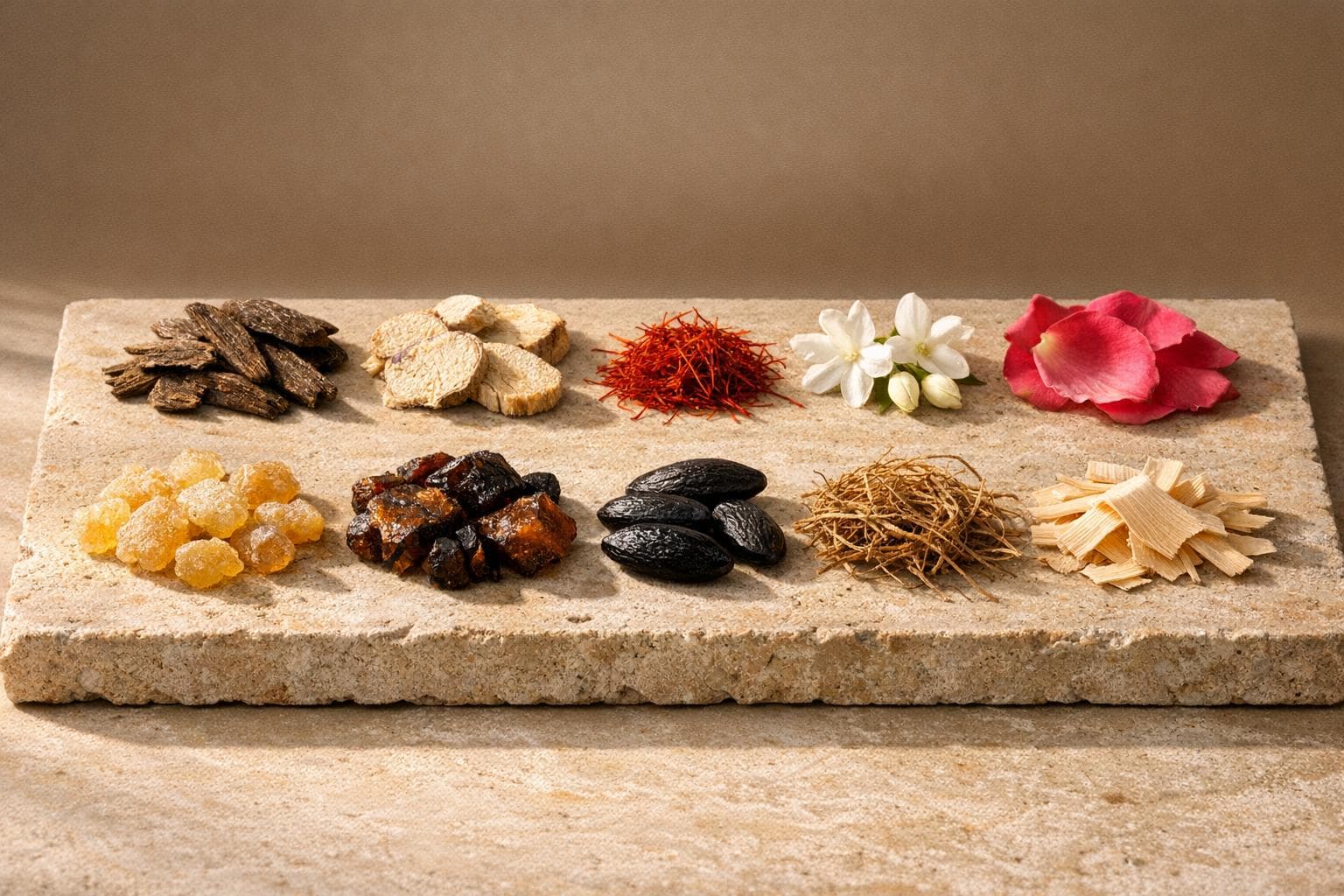
Τα χειροποίητα αρώματα ξεχωρίζουν χάρη στη χρήση σπάνιων, φυσικών συστατικών, που συλλέγονται με επίπονες και διαχρονικά τιμημένες μεθόδους. Αυτά τα στοιχεία δεν είναι μόνο δύσκολο να αποκτηθούν, αλλά προσδίδουν επίσης απαράμιλλο βάθος και πολυπλοκότητα στις ευωδιές. Ακολουθεί μια σύντομη επισκόπηση των σπάνιων συστατικών που παρουσιάζονται:
- Ρίζα Ίριδας: Συλλέγεται μετά από 4 χρόνια, με τιμή που υπερβαίνει τα €54,000/kg.
- Σαφράν: Απαιτεί 150,000 άνθη για 1 kg, με τιμή άνω των €11,000 ανά λίβρα.
- Oud (Assam): "Υγρός χρυσός" που δημιουργείται υπό μοναδικές συνθήκες, με ελάχιστη απόδοση.
- Άμβρα: Ωριμάζει στους ωκεανούς για δεκαετίες, με τιμή €10,000-€30,000/kg.
- Civet: Ζωώδης μόσχος, πλέον σε μεγάλο βαθμό αντικατεστημένος από ηθικά συνθετικά υποκατάστατα.
- Θαλάσσιος Μάραθος: Συλλέγεται από τις ακτές της Ιρλανδίας, προσφέροντας ένα πράσινο, ωκεάνιο άρωμα.
- Λάβδανο: Προέρχεται από την Κρήτη, χρησιμοποιείται σε άμβρινες συμφωνίες, με περιορισμένη ετήσια παραγωγή.
- Άνθος Tiaré: Πολυνησιακό σύμβολο που επεξεργάζεται αμέσως μετά τη συγκομιδή για το τροπικό του άρωμα.
- Αίμα του Δράκου: Κατακόκκινη ρητίνη που εξάγεται με προσοχή, προσφέροντας γήινη γλυκύτητα.
- Βετιβέρ (Αγγλία): Επαναπροσδιορισμένο από Βρετανούς αρωματοποιούς για ένα ζωηρό, εκλεπτυσμένο προφίλ.
Αυτά τα συστατικά απαιτούν σχολαστική προμήθεια και προετοιμασία, καθιστώντας τα χειροποίητα αρώματα μια πολυτελή και ιδιαίτερα περιζήτητη τέχνη. Κάθε άρωμα αφηγείται μια ιστορία αφοσίωσης, κληρονομιάς και δεξιοτεχνίας.
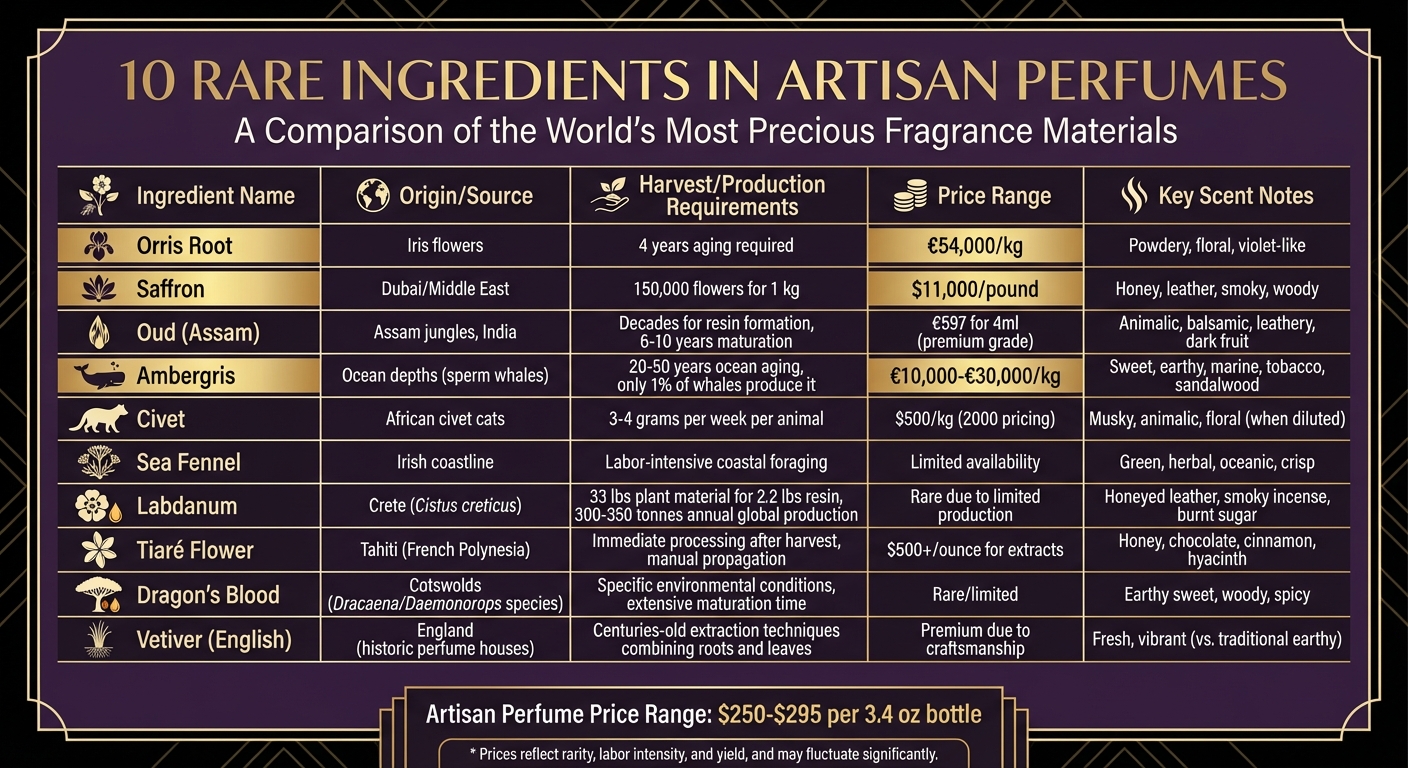
10 Σπάνια Συστατικά Αρωμάτων: Τιμές, Απαιτήσεις Συγκομιδής και Προελεύσεις
1. Σαφράν από το Ντουμπάι
Γιατί Είναι Τόσο Σπάνιο
Γνωστό ως "κόκκινος χρυσός", το σαφράν υμνείται για τη σπανιότητά του και την απαιτητική, χειρωνακτική διαδικασία συγκομιδής του. Κάθε άνθος Crocus sativus παράγει μόλις τρία μικροσκοπικά στίγματα, τα οποία πρέπει να συλλεχθούν προσεκτικά με το χέρι κατά τη σύντομη περίοδο συγκομιδής του φθινοπώρου. Για την παραγωγή μίας λίβρας σαφράν απαιτούνται περίπου 75,000 άνθη, ενώ ένα πλήρες κιλό χρειάζεται περίπου 150,000 άνθη. Αυτή η επίπονη διαδικασία, σε συνδυασμό με την περιορισμένη διαθεσιμότητά του, εκτοξεύει την τιμή του σαφράν πάνω από $11,000 ανά λίβρα - καθιστώντας το ακόμη ακριβότερο από τον χρυσό κατά βάρος. Η αποκλειστικότητά του συμβάλλει επίσης στο πλούσιο και σύνθετο άρωμά του, ιδιαίτερα περιζήτητο στην πολυτελή αρωματοποιία.
Η Αρωματική Υπογραφή
Το άρωμα του σαφράν είναι ένα συναρπαστικό μείγμα θερμότητας και πολυπλοκότητας. Φέρει νύξεις μεταλλικών νοτών, πλεγμένες με μελένια γλυκύτητα, δερμάτινο βάθος και καπνιστές, ξυλώδεις αποχρώσεις, όλα ισορροπημένα από μια ελαφρά πικράδα. Αυτό το πολυδιάστατο προφίλ καθιστά το σαφράν ανεκτίμητο για τους αρωματοποιούς, οι οποίοι το χρησιμοποιούν για να ενώσουν αρμονικά ανθικές και ξυλώδεις πτυχές, εμποτίζοντας τις συνθέσεις με εξωτικό και επιβλητικά πολυτελή χαρακτήρα.
"Στην αρωματοποιία, το σαφράν προσθέτει μια δερμάτινη, καπνιστή, θερμή νότα που συνδυάζεται υπέροχα με oud, άμβρα και αρώματα βασισμένα σε μπαχαρικά." — Ajmal Perfumes India
Οι Προκλήσεις της Προμήθειας
Η διαδικασία προμήθειας του σαφράν είναι τόσο λεπτεπίλεπτη όσο και το ίδιο το μπαχαρικό. Οι συλλέκτες πρέπει να μαζεύουν τα στίγματα νωρίς το πρωί, ακόμη πριν ανοίξουν πλήρως τα άνθη, ώστε να τα προστατεύσουν από τη φθορά του ήλιου. Η άμεση ξήρανση είναι απαραίτητη για να διατηρηθεί το χαρακτηριστικό άρωμα του σαφράν. Αυτά τα σχολαστικά βήματα, σε συνδυασμό με το περιορισμένο παράθυρο συγκομιδής του, καθιστούν το σαφράν ένα σπάνιο και πολύτιμο συστατικό για τους δημιουργούς χειροποίητων αρωμάτων.
2. Oud από τις Ζούγκλες του Assam
Σπανιότητα του Συστατικού
Το oud από το Assam αποκαλείται συχνά "υγρός χρυσός" στον κόσμο της αρωματοποιίας, και όχι άδικα - είναι ένα από τα πιο σπάνια και περιζήτητα υλικά. Η σπανιότητα ξεκινά από τη βιολογία των δέντρων Aquilaria malaccensis. Μόνο εκείνα που υφίστανται μια συγκεκριμένη μυκητιακή λοίμωξη, προκαλούμενη από ακραίο στρες όπως οι μουσωνικοί κύκλοι και οι επιθέσεις εντόμων, παράγουν το ρητινώδες εγκάρδιο ξύλο που γίνεται oud. Αυτές οι μοναδικές συνθήκες συνδέονται με το όξινο κόκκινο έδαφος του Assam.
Χρειάζονται δεκαετίες για να παράγουν ρητίνη τα άγρια δέντρα, ενώ τα αποσταγμένα έλαια απαιτούν άλλα 6 έως 10 χρόνια για να ωριμάσουν πλήρως. Η απόδοση είναι ελάχιστη - μόνο το μολυσμένο εγκάρδιο ξύλο ώριμων δέντρων μπορεί να χρησιμοποιηθεί. Προσθέτοντας στην πρόκληση, η αγορά συχνά κατακλύζεται από πλαστά μείγματα από περιοχές όπως η Ταϊλάνδη ή η Ινδονησία, που φέρουν ψευδώς την ετικέτα "Assam." Ενδεικτικά, ένα φιαλίδιο 4ml του Oud Assafi™ της Firmenich, που θεωρείται ανάμεσα στα κορυφαία oud παγκοσμίως, κοστίζει €597.00.
Αυτή η περίπλοκη και χρονοβόρα διαδικασία οδηγεί σε ένα αρωματικό προφίλ που παραμένει αξεπέραστο.
Αρωματικό Προφίλ
Το Assam oud προσφέρει ένα οσφρητικό ταξίδι που δεν μοιάζει με καμία άλλη τοπική ποικιλία. Ενώ τα περισσότερα oud ξεδιπλώνονται σε τρία στάδια, το άγριο Assam oud αποκαλύπτει πέντε έως επτά διακριτά στρώματα. Ανοίγει με τολμηρές, ζωώδεις νότες που συχνά περιγράφονται ως "αχυρώνας" ή "θειούχο μπλε τυρί" - έντονες και προκλητικές. Καθώς εξελίσσεται, μεταβαίνει σε πλούσια, κρεμώδη βαλσαμικά και δερμάτινα βάθη, διαπλεγμένα με αποχρώσεις σκούρων φρούτων και ζυμωμένου καπνού [8,9].
"Το ινδικό oud δεν είναι απλώς μια πρώτη ύλη - είναι μια δοκιμασία δεξιοτεχνίας. Δεν αναμειγνύεται· ενορχηστρώνει. Δεν ψιθυρίζει· ψάλλει." – Muhammad Imran Malik, Αρωματοποιός
Προκλήσεις Προμήθειας
Η εξασφάλιση αυθεντικού Assam oud δεν είναι μικρό επίτευγμα. Παραδοσιακές χειροτεχνικές μέθοδοι, όπως η τεχνική "Degh — Bhapka", εξακολουθούν να χρησιμοποιούνται. Αυτή περιλαμβάνει χάλκινα δοχεία μονωμένα με πηλό και θερμαινόμενα με ξύλα ή κοπριά βουβαλιού, ώστε να διατηρηθούν οι λεπτές, πτητικές νότες του ελαίου. Η διαδικασία ζύμωσης του ξύλου διαρκεί 10 έως 25 ημέρες, ενώ η φήμη της περιοχής ως ιστορικής κοιτίδας του oud εκτείνεται σε περισσότερα από 3,000 χρόνια [7,9].
Οι προσπάθειες για διασφάλιση της βιωσιμότητας έχουν οδηγήσει σε ηθικές πρακτικές, όπως η φύτευση είκοσι νέων δέντρων για κάθε ένα που συλλέγεται. Αυτά τα μέτρα αποσκοπούν στη διασφάλιση της μελλοντικής διαθεσιμότητας αυτού του εξαιρετικού υλικού για τις επόμενες γενιές.
3. Άμβρα από τα Βάθη των Ωκεανών
Σπανιότητα του Συστατικού
Η άμβρα είναι ένα από τα πιο σπάνια και περιζήτητα υλικά στην αρωματοποιία. Αυτή η κηρώδης ουσία σχηματίζεται μέσα στις φάλαινες φυσητήρες ως αμυντικός μηχανισμός απέναντι στα άπεπτα ράμφη των καλαμαριών. Ενδιαφέρον είναι ότι μόνο περίπου το 1% των φαλαινών φυσητήρων παράγει άμβρα, γεγονός που την καθιστά εξαιρετικά σπάνια.
Όταν αποβάλλεται πρόσφατα, η άμβρα φέρει μια έντονη κοπρώδη οσμή και είναι πρακτικά άνευ αξίας. Η πραγματική της μεταμόρφωση συμβαίνει μέσα σε δεκαετίες - 20 έως 50 χρόνια - καθώς παρασύρεται στον ωκεανό. Κατά τη διάρκεια αυτού του χρόνου, η έκθεση στο ηλιακό φως και το αλμυρό νερό οξειδώνει το βασικό της μόριο, ambrein, σε ambroxide και ambrinol, τα οποία χαρίζουν στην παλαιωμένη άμβρα το χαρακτηριστικό της άρωμα. Ένα αξιοσημείωτο παράδειγμα της αξίας της σημειώθηκε τον Ιούνιο του 2021, όταν 35 ψαράδες στον Κόλπο του Άντεν βρήκαν ένα κομμάτι άμβρας 280 λιβρών σε κουφάρι φάλαινας φυσητήρα, αποτιμημένο σε περίπου $1.5 εκατομμύρια. Αυτή η μακρά διαδικασία ωρίμανσης όχι μόνο εξευγενίζει το άρωμά της, αλλά και ανυψώνει το κύρος της ως ένα από τα πιο σύνθετα και πολυτελή αρωματικά συστατικά της φύσης.
Αρωματικό Προφίλ
Η παλαιωμένη άμβρα αναπτύσσει ένα περίτεχνο άρωμα που συνδυάζει γλυκές, γήινες, θαλασσινές νότες με καπνό και σανταλόξυλο. Ο Herman Melville αποτύπωσε περίφημα τη παράδοξη γοητεία της:
"Ποιος θα φανταζόταν, λοιπόν, ότι τέτοιες εκλεπτυσμένες κυρίες και κύριοι θα ευφραίνονταν με μια ουσία που βρίσκεται στα άδοξα σπλάχνα μιας άρρωστης φάλαινας! Κι όμως έτσι είναι".
Πέρα από το άρωμά της, η άμβρα εκτιμάται για τις εξαιρετικές σταθεροποιητικές της ιδιότητες. Βοηθά τα αρωματικά μόρια να προσκολλώνται στο δέρμα, ενισχύοντας τόσο τη διάρκεια όσο και την προβολή τους. Θρυλικά αρώματα όπως το Guerlain‘s Jicky (1889) και Mitsouko (1919) βασίστηκαν σε βάμματα άμβρας για να επιτύχουν τη χαρακτηριστική τους θερμότητα και διάρκεια.
Προκλήσεις Προμήθειας
Η απόκτηση αυθεντικής άμβρας είναι ζήτημα τύχης και επιμονής. Η άμβρα που προέρχεται από ηθικές πηγές αποβάλλεται φυσικά από τις φάλαινες φυσητήρες και αργότερα ανακτάται από παραλίες ή θαλάσσια ύδατα. Σύμφωνα με τους κανονισμούς CITES, αυτό το φυσικά αποβαλλόμενο υλικό ταξινομείται ως απόβλητο, καθιστώντας το εμπόριό του επιτρεπτό σε χώρες όπως το Ηνωμένο Βασίλειο και η Γαλλία. Ωστόσο, χώρες όπως οι Ηνωμένες Πολιτείες, η Αυστραλία και η Ινδία επιβάλλουν αυστηρές απαγορεύσεις στο εμπόριό του.
Για να διασφαλιστεί η αυθεντικότητα, η άμβρα υποβάλλεται σε εγκληματολογικές δοκιμές, συμπεριλαμβανομένης της Αέριας Χρωματογραφίας–Φασματομετρίας Μάζας, ώστε να επιβεβαιωθεί η παρουσία ambrein και συγγενών ενώσεων. Η σπανιότητά της εκτοξεύει την τιμή της στα ύψη. Η πιστοποιημένη γκρι άμβρα πωλείται συνήθως από €10,000 έως €30,000 ανά κιλό, ενώ η σπανιότερη λευκή άμβρα μπορεί να φτάσει από €100 έως πάνω από €2,000 ανά γραμμάριο, αντανακλώντας την εξαιρετική της αξία.
4. Civet από Αφρικανικές Μοσχογαλή
Ιστορική Σημασία
Το civet έχει συναρπάσει τους αρωματοποιούς για πάνω από χίλια χρόνια, με τη χρήση του να καταγράφεται για πρώτη φορά από τον ιστορικό του 10ου αιώνα al — Masudi. Μέχρι τον 19ο αιώνα, είχε γίνει ακρογωνιαίος λίθος της γαλλικής αρωματοποιίας, εμφανιζόμενο σε κλασικά αρώματα όπως το Jicky και το Mouchoir de Monsieur της Guerlain. Η ίδια η λέξη "civet" έχει τις ρίζες της στον αραβικό όρο ‘zabād,’ ο οποίος εξελίχθηκε μέσω της παλαιάς ιταλικής (‘zibetto’) και της μέσης γαλλικής (‘civette’) πριν περάσει στην αγγλική.
Αρωματικό Προφίλ
Στην ακατέργαστη μορφή του, το civet έχει ένα ισχυρό, ζωώδες άρωμα που μπορεί να είναι κατακλυσμικό. Ωστόσο, όταν αραιωθεί στο 10-20%, μεταμορφώνεται σε μια πλούσια, μοσχώδη και ελαφρώς ανθική νότα. Αυτή η πολυπλοκότητα προέρχεται από την civetone, η οποία βρίσκεται σε συγκεντρώσεις 2.5% έως 3.4%, μαζί με μικρότερες ποσότητες - περίπου 1% η καθεμία - ινδόλης και σκατόλης, που προσθέτουν βάθος και ίντριγκα.
"Το civet προσθέτει μια μοσχώδη, ζωώδη νότα που χαρίζει σφρίγος και δύναμη στη βάση ενός αρώματος." — Jesse E., Pureluxes
Σπανιότητα του Συστατικού
Οι αφρικανικές μοσχογαλή (Civettictis civetta) παράγουν μόνο 3 έως 4 γραμμάρια έκκρισης civet την εβδομάδα. Το 2000, το φυσικό civet κόστιζε περίπου $500 ανά κιλό. Η σημερινή σπανιότητά του οφείλεται λιγότερο στην περιορισμένη προσφορά και περισσότερο σε ηθικές ανησυχίες και αυστηρούς κανονισμούς. Για παράδειγμα, οι Ηνωμένες Πολιτείες απαγορεύουν την εισαγωγή ζωντανών μοσχογαλών λόγω φόβων μετάδοσης SARS, αν και το επεξεργασμένο έλαιο civet που δεν ενέχει κίνδυνο για την υγεία εξακολουθεί να επιτρέπεται.
Προκλήσεις Προμήθειας
Ιστορικά, το civet λαμβανόταν από αιχμάλωτα ζώα σε αφρικανικές φάρμες, μια πρακτική που προκάλεσε σοβαρά ζητήματα ευζωίας των ζώων. Οι σύγχρονοι αρωματοποιoί έχουν σε μεγάλο βαθμό στραφεί σε συνθετικές εναλλακτικές όπως το Ambretone, που μιμούνται το άρωμα αποφεύγοντας τα ηθικά διλήμματα. Ωστόσο, ακόμη και τα καλύτερα συνθετικά υποκατάστατα δυσκολεύονται να αναπαράγουν τη δυναμική, εξελισσόμενη ποιότητα του αυθεντικού civet. Αυτές οι προκλήσεις προμήθειας και η στροφή προς ηθικές πρακτικές αναδεικνύουν τη διαρκή γοητεία του civet στη χειροποίητη αρωματοποιία, όπου η πολυπλοκότητά του συνεχίζει να μαγνητίζει.
5. Θαλάσσιος Μάραθος από την Ιρλανδική Ακτογραμμή
Αρωματικό Προφίλ
Ο θαλάσσιος μάραθος προσφέρει ένα φρέσκο και πράσινο άρωμα, συνδυάζοντας μια κοφτερή, φυτική αιχμή με βοτανικές αποχρώσεις και μια καθαρή, ωκεάνια αύρα. Αυτό το μείγμα δημιουργεί μια παράκτια φρεσκάδα που μοιάζει ταυτόχρονα αναζωογονητική και εκλεπτυσμένη, καθιστώντας τον περιζήτητη επιλογή για χειροποίητα αρώματα.
Σπανιότητα του Συστατικού
Συλλεγμένος από τις άγριες ακτές της Ιρλανδίας, ο θαλάσσιος μάραθος αποτελεί ένα σπάνιο εύρημα. Η ανάπτυξή του περιορίζεται σε συγκεκριμένες παράκτιες περιοχές, και η συλλογή του απαιτεί μια επίπονη διαδικασία. Ο συνδυασμός του περιορισμένου οικοτόπου του και της σχολαστικής προσπάθειας που απαιτείται για τη συγκομιδή του οδηγεί σε φυσικά χαμηλές αποδόσεις. Αυτή η αποκλειστικότητα τον έχει καταστήσει πολύτιμο στοιχείο στον κόσμο των χειροποίητων αρωμάτων.
Προκλήσεις Προμήθειας
Η απόκτηση θαλάσσιου μάραθου δεν είναι εύκολη υπόθεση. Οι συλλέκτες πρέπει να διασχίσουν απαιτητικά παράκτια τοπία για να τον συλλέξουν, ενώ η διαδικασία εκχύλισης απαιτεί ακρίβεια για να διατηρηθεί το λεπτεπίλεπτο αρωματικό του προφίλ. Καθώς οι συνθετικές εναλλακτικές γίνονται όλο και πιο κοινές στη μαζική αρωματοποιία, η διαθεσιμότητα του φυσικού θαλάσσιου μάραθου έχει μειωθεί περαιτέρω, εδραιώνοντας τη φήμη του ως σπάνιου και πολυτελούς συστατικού.
6. Λάβδανο από την Κρήτη
Ιστορική Σημασία
Το λάβδανο τιμάται εδώ και αιώνες, λατρεμένο από αρχαίους πολιτισμούς για το χαρακτηριστικό του άρωμα και τις πρακτικές του χρήσεις. Συχνά συνδεδεμένη με το "Βάλσαμο της Γαλαάδ" που αναφέρεται στη Γένεση, αυτή η ρητίνη διαδραμάτισε βασικό ρόλο σε βιβλικές και αιγυπτιακές παραδόσεις. Οι Αιγύπτιοι φαραώ το χρησιμοποιούσαν ακόμη και για τη δημιουργία τελετουργικών ψεύτικων γενειάδων, μπερδεύοντας τρίχες κατσίκας με τη ρητίνη. Η σημασία του στην αρωματοποιία και τις τελετές έχει τεκμηριωθεί καλά σε ιστορικά κείμενα, αναδεικνύοντας τη διαχρονική του έλξη.
Αρωματικό Προφίλ
Το άρωμα του λάβδανου είναι ένα σαγηνευτικό μείγμα μελένιου δέρματος, καπνιστού θυμιάματος, καμένης ζάχαρης και μιας ξηρής, ορυκτής θερμότητας. Η ποικιλία από την Κρήτη, που προέρχεται από το Cistus creticus, εκτιμάται ιδιαίτερα για τις πιο ανάλαφρες, βοτανικές της νότες και μια μελένια πολυπλοκότητα που την ξεχωρίζει από τους πλουσιότερους, βαλσαμικούς ισπανικούς τύπους. Στη χειροποίητη αρωματοποιία, το λάβδανο αποτελεί θεμέλιο λίθο για τη δημιουργία άμβρινων συμφωνιών, προσφέροντας μια θερμότητα που θυμίζει δέρμα και ένα λεπτό ζωώδες βάθος που τα συνθετικά υποκατάστατα αδυνατούν να μιμηθούν.
Σπανιότητα του Συστατικού
Η Ισπανία κυριαρχεί στην παγκόσμια παραγωγή παραγώγων Cistus, αντιπροσωπεύοντας περίπου το 80%, όμως το κρητικό λάβδανο παραμένει ένα σπάνιο κόσμημα. Το μοναδικό αρωματικό του προφίλ, που αποδίδεται σε υψηλότερη συγκέντρωση manoyloxides, το καθιστά ιδιαίτερα περιζήτητο. Η ίδια η διαδικασία παραγωγής υπογραμμίζει τη σπανιότητά του: απαιτούνται περίπου 33 λίβρες φρέσκου φυτικού υλικού για την εξαγωγή μόλις 2.2 λιβρών ρητίνης. Με την ετήσια παγκόσμια παραγωγή ακατέργαστης κόμμεως λάβδανου να εκτιμάται μόλις στους 300–350 τόνους, η σπανιότητά του είναι αδιαμφισβήτητη.
Προκλήσεις Προμήθειας
Η διαδικασία συγκομιδής λάβδανου στην Κρήτη είναι τόσο απαιτητική όσο και παραδοσιακή. Οι συλλέκτες εργάζονται στην κορύφωση του καλοκαιριού, αψηφώντας την έντονη ζέστη για να συλλέξουν τη ρητίνη όταν ρέει πιο ελεύθερα. Στο χωριό Σίσες, οι τεχνίτες χρησιμοποιούν μια ξύλινη τσουγκράνα με δερμάτινους ιμάντες για να ξύσουν τη ρητίνη από τους θάμνους κίστος. Αυτή η επίπονη, χειρωνακτική μέθοδος, σε συνδυασμό με τις συγκεκριμένες γεωγραφικές απαιτήσεις για την ανάπτυξη του φυτού, περιορίζει τη διαθεσιμότητα του κρητικού λάβδανου. Στέκει ως μαρτυρία της αφοσίωσης των τεχνιτών που διατηρούν αυτές τις διαχρονικές τεχνικές απέναντι στις σύγχρονες απαιτήσεις.
Ο προσωπικός σας ειδικός αρωμάτων σας περιμένει
Κάντε το σύντομο κουίζ αρώματος και ανακαλύψτε αυθεντικά αρώματα designer και niche, επιλεγμένα στα μέτρα σας – εξερευνήστε τα σε decant και δείγματα των 2, 5, 8 και 30 ml, ώστε να δοκιμάσετε το καθένα πριν επιλέξετε ολόκληρο μπουκάλι.
Βρείτε το άρωμά σας7. Άνθος Tiaré από την Ταϊτή
Ιστορική Σημασία
Το άνθος Tiaré, ή Gardenia tahitensis, κατέχει ξεχωριστή θέση ως σύμβολο της Γαλλικής Πολυνησίας, βαθιά ριζωμένο στις παραδόσεις της περιοχής. Στην πολυνησιακή κουλτούρα, οι γυναίκες φορούσαν περιδέραια Tiaré, αφήνοντας τα πέταλα να απελευθερώσουν φυσικά το άρωμά τους πριν τα ενσωματώσουν σε έλαια μασάζ. Η πρακτική αυτή θεωρούνταν ότι ενίσχυε τους ρομαντικούς δεσμούς. Πέρα από τον συμβολικό του ρόλο, το φυτό εκτιμάται εδώ και καιρό για ιατρικούς σκοπούς: τα φύλλα χρησιμοποιούνταν για να καταπραΰνουν εγκαύματα από τον ήλιο και σπασμούς, οι οφθαλμοί βοηθούσαν στην ανακούφιση από κόπωση και τραύματα, ενώ τα ώριμα άνθη λειτουργούσαν ως απολυμαντικά και βοηθήματα για την αναπνοή. Ενδιαφέρον είναι ότι, ενώ το Tiaré είναι πλέον συνώνυμο της Ταϊτής, αρχικά προήλθε από τη Μικρονησία, φερμένο στην Πολυνησία από τους πρώτους εποίκους. Η φροντίδα και ο σεβασμός που αποδίδονται σε αυτό το άνθος αντικατοπτρίζουν τις ίδιες παραδόσεις που συναντώνται και σε άλλα περιζήτητα συστατικά αρωματοποιίας, ενισχύοντας ακόμη περισσότερο τη γοητεία του.
Αρωματικό Προφίλ
"Κάπου ανάμεσα στο ylang-ylang και τη βανίλια, το άρωμά του ξυπνά οράματα από τιρκουάζ νερά και λευκές αμμώδεις παραλίες." – Miss Monoi
Το άρωμα του Tiaré είναι τόσο πολυεπίπεδο όσο και η ιστορία του. Συνδυάζει νότες μελιού, σοκολάτας, κανέλας και υάκινθου, δημιουργώντας μια ευωδιά που μοιάζει ταυτόχρονα τροπική και απολαυστική. Αυτή η πολυπλοκότητα το καθιστά αγαπημένο στη χειροποίητη αρωματοποιία. Η ουσία του συχνά εξάγεται μέσω της παρασκευής ελαίου Monoï, μιας παραδοσιακής διαδικασίας κατά την οποία φρέσκοι οφθαλμοί Tiaré εμποτίζονται σε εξευγενισμένο έλαιο καρύδας. Αυτή η μέθοδος αιχμαλωτίζει τις λεπτές αρωματικές ενώσεις του άνθους, διατηρώντας παράλληλα το χαρακτηριστικό του άρωμα.
Σπανιότητα του Συστατικού
Παρότι το Tiaré ανθίζει όλο τον χρόνο και μπορεί να φτάσει έως και τα 13 πόδια σε ύψος, ο πολλαπλασιασμός του περιορίζεται από την έλλειψη φυσικών επικονιαστών. Για να το ξεπεράσουν αυτό, οι καλλιεργητές βασίζονται σε χειρωνακτικές τεχνικές όπως μοσχεύματα και καταβολάδες, οι οποίες είναι ιδιαίτερα απαιτητικές. Σε συνδυασμό με την υψηλή παγκόσμια ζήτηση για αυθεντικά πολυνησιακά συστατικά, αυτή η περιορισμένη διαθεσιμότητα αυξάνει το κόστος του. Τα εκχυλίσματα από το άνθος Tiaré βρίσκονται στο ίδιο επίπεδο με σπάνια ανθικά absolutes, μερικά από τα οποία μπορούν να ξεπεράσουν τα $500 ανά ουγγιά.
Προκλήσεις Προμήθειας
Η λεπτεπίλεπτη φύση του άνθους Tiaré σημαίνει ότι πρέπει να επεξεργαστεί αμέσως μετά τη συγκομιδή για να διατηρηθεί το άρωμά του. Για να χαρακτηριστεί ως Monoï de Tahiti A.O. (Appellation of Origin), οι παραγωγοί πρέπει να ακολουθούν αυστηρές παραδοσιακές πρακτικές, συμπεριλαμβανομένου του εμποτισμού φρέσκων οφθαλμών σε έλαιο καρύδας με καθιερωμένες πολυνησιακές μεθόδους. Αυτή η πιστοποίηση διασφαλίζει την αυθεντικότητα και την προέλευση του συστατικού, αλλά προσθέτει επίπεδα πολυπλοκότητας στην αλυσίδα εφοδιασμού του. Ο ακριβής και έγκαιρος χειρισμός είναι κρίσιμος για τη διατήρηση του εξαίσιου αρώματος του άνθους.
8. Dragon’s Blood from Cotswolds
Το Αίμα του Δράκου από τα Cotswolds φέρνει μια συναρπαστική, πολυδιάστατη ποιότητα στον κόσμο των χειροποίητων συστατικών.
Ιστορική Σημασία
Με το εντυπωσιακό πορφυρό του χρώμα και την προέλευσή του να συνδέεται με τα είδη Dracaena και Daemonorops, αυτή η ρητίνη έχει από καιρό συνδεθεί με μια αύρα μυστηρίου και βάθους. Η ιστορική της χρήση σε διάφορες τελετουργίες και χειροτεχνίες ενισχύει τη γοητεία της στη σύγχρονη αρωματοποιία.
Αρωματικό Προφίλ
Η ευωδιά που προσδίδει είναι ένα σαγηνευτικό μείγμα γήινης γλυκύτητας, εμπλουτισμένο με απαλές ξυλώδεις και πικάντικες αποχρώσεις. Αυτός ο μοναδικός συνδυασμός δημιουργεί μια αρμονική ισορροπία, συμπληρώνοντας τις πιο ανάλαφρες κορυφαίες νότες και προσφέροντας μια θερμή, διαρκή βάση.
Προκλήσεις Προμήθειας
Η απόκτηση του Αίματος του Δράκου δεν είναι απλή υπόθεση. Εξειδικευμένοι τεχνίτες βασίζονται σε παραδοσιακά εργαλεία, όπως δίκοπα σκαλιστήρια και καμπύλες λεπίδες, για να εξαγάγουν προσεκτικά τη ρητίνη χωρίς να βλάψουν τα δέντρα. Προσθέτοντας στη σπανιότητά της, η ρητίνη σχηματίζεται μόνο υπό συγκεκριμένες περιβαλλοντικές συνθήκες και απαιτεί εκτεταμένο χρόνο για να ωριμάσει πλήρως. Αυτή η σχολαστική διαδικασία αναδεικνύει την αποκλειστικότητά της και την αφοσίωση πίσω από την παραγωγή της.
9. Βετιβέρ από τις Ιστορικές Πηγές της Αγγλίας
Το βετιβέρ μπορεί να έχει πατρίδα του τις τροπικές περιοχές, όμως οι Βρετανοί αρωματοποιoί το έχουν επαναπροσδιορίσει μέσα από αιώνες δεξιοτεχνίας. Αυτό που καθιστά το αγγλικό βετιβέρ ξεχωριστό δεν είναι το πού αναπτύσσεται, αλλά το πώς μεταμορφώνεται από την εμπειρία των βρετανικών οίκων αρωμάτων. Αυτή η σύζευξη κληρονομιάς και εκλεπτυσμένης δεξιότητας είναι που ορίζει την ιστορία του αγγλικού βετιβέρ.
Ιστορική Σημασία
Η βρετανική αρωματοποιία αγκάλιασε το βετιβέρ ήδη από τη δεκαετία του 1730. Πρωτοπόροι όπως η Floris London ήταν από τους πρώτους που το ενσωμάτωσαν στις δημιουργίες τους. Ακολουθώντας το παράδειγμά τους, άλλα εμβληματικά ονόματα όπως η Penhaligon’s συνέβαλαν στην ανάδειξη αυτού του αρχαίου συστατικού, που χρονολογείται πάνω από 3,000 χρόνια, σε σύγχρονα κλασικά αρώματα.
Αρωματικό Προφίλ
Σε μια ξεχωριστή ανατροπή, ιστορικοί οίκοι όπως η Creed συνδυάζουν την εκχύλιση των ριζών και των φύλλων του βετιβέρ. Αυτή η τεχνική δημιουργεί ένα πιο φρέσκο, πιο ζωηρό άρωμα σε σύγκριση με τους βαθύτερους, πιο γήινους τόνους που συνήθως συνδέονται με το τροπικό βετιβέρ.
Σπανιότητα του Συστατικού
Η μοναδικότητα του αγγλικού βετιβέρ δεν βρίσκεται στο ίδιο το φυτό, αλλά στις εκλεπτυσμένες μεθόδους που οι Βρετανοί αρωματοποιoί έχουν τελειοποιήσει μέσα σε γενιές. Ενώ το τροπικό βετιβέρ είναι κοινό, η καλλιτεχνική μαεστρία αυτών των ιστορικών οίκων - τελειοποιημένη σε βάθος αιώνων - διαφοροποιεί το δικό τους βετιβέρ. Αυτή η κληρονομιά δεξιοτεχνίας διασφαλίζει ότι το αγγλικό βετιβέρ κατέχει μια ξεχωριστή θέση στον κόσμο των πολυτελών αρωμάτων.
10. Κεχριμπάρι από το Machu Picchu
Το κεχριμπάρι, μια χρυσή ρητίνη που σχηματίζεται από αρχαία φυτικά υλικά, κατέχει ξεχωριστή θέση στη χειροποίητη αρωματοποιία για το θερμό και γλυκό αρωματικό του προφίλ.
Η Σπανιότητα του Κεχριμπαριού
Το κεχριμπάρι εκτιμάται όχι μόνο για το μοναδικό του άρωμα, αλλά και για τη σπανιότητά του. Η διαδικασία εξαγωγής αυτής της ρητίνης είναι περίπλοκη και απαιτητική, ενώ η φυσική της εμφάνιση είναι περιορισμένη. Αυτοί οι παράγοντες καθιστούν το κεχριμπάρι περιζήτητο συστατικό στον κόσμο της υψηλής αρωματοποιίας.
Αρωματικό Προφίλ
Η γοητεία του κεχριμπαριού έγκειται στην ικανότητά του να αγκυροβολεί ένα άρωμα. Ως βαριά νότα βάσης, προσθέτει βάθος και θερμότητα, λειτουργώντας ως η ραχοκοκαλιά πολλών εκλεπτυσμένων συνθέσεων. Τα μόριά του παραμένουν στο δέρμα, ενισχύοντας τη διάρκεια του αρώματος. Οι θερμές και γλυκές αποχρώσεις του κεχριμπαριού αφήνουν μια διαρκή, αξέχαστη εντύπωση που αντηχεί τόσο στους φορείς όσο και στους γύρω τους.
Ένας Δεσμός με την Ιστορία
Πέρα από τον ρόλο του στη σύνθεση αρωμάτων, το κεχριμπάρι φέρει μια πλούσια ιστορία. Η χρήση του συνδέει τη σύγχρονη αρωματοποιία με αρχαίες παραδόσεις, υφαίνοντας μια αφήγηση διαχρονικής δεξιοτεχνίας και πολιτιστικής κληρονομιάς.
Συμπέρασμα
Τα σπάνια συστατικά που παρουσιάζονται εδώ αποτελούν τη ραχοκοκαλιά της χειροποίητης αρωματοποιίας, προσφέροντας αρωματικό βάθος και φυσικές σταθεροποιητικές ιδιότητες που τα συνθετικά υλικά απλώς δεν μπορούν να αντιγράψουν. Σε αντίθεση με τα συνθετικά αντίστοιχά τους, τα φυσικά βοτανικά συστατικά εξελίσσονται μέσα από νότες κορυφής, καρδιάς και βάσης, προσφέροντας μια δυναμική εμπειρία αντί για μια επίπεδη, αμετάβλητη ευωδιά.
Αυτά τα υλικά συνοδεύονται από υψηλό κόστος, κυρίως λόγω των επίπονων διαδικασιών που απαιτούνται για την καλλιέργεια και την εξαγωγή τους - προσπάθειες που μπορεί να χρειαστούν χρόνια για να τελειοποιηθούν. Ως αποτέλεσμα, τα χειροποίητα αρώματα που χρησιμοποιούν αυτά τα συστατικά συχνά κοστίζουν μεταξύ $250 και $295 για ένα μπουκάλι 3.4 ουγγιών.
Αυτό που ξεχωρίζει αυτά τα αρώματα είναι η βαθιά τους σύνδεση με την παράδοση και η ικανότητά τους να διεγείρουν γνήσια συναισθήματα. Η όσφρηση έχει άμεση σύνδεση με το μεταιχμιακό σύστημα, το τμήμα του εγκεφάλου που είναι υπεύθυνο για το συναίσθημα και τη μνήμη, καθιστώντας τα σπάνια συστατικά μοναδικά ισχυρά στην ανάκληση νοσταλγίας ή στη μετατόπιση της διάθεσης. Κάθε φιάλη αντιπροσωπεύει μια πλούσια ιστορία - δημιουργημένη από συγκεκριμένες συγκομιδές, εξευγενισμένη μέσα από πάνω από 100 επαναλήψεις φόρμουλας από κορυφαίους αρωματοποιούς και παραγόμενη σε περιορισμένες ποσότητες λίγων μόνο χιλιάδων φιαλών.
Για όσους είναι περίεργοι για αυτόν τον χειροποίητο κόσμο, η δοκιμή μικρότερων ποσοτήτων μπορεί να προσφέρει μια ματιά στη δεξιοτεχνία και τη γοητεία που καθιστούν αυτά τα αρώματα τόσο περιζήτητα, ακόμη και σε premium τιμή.
Συχνές Ερωτήσεις
Πώς μπορώ να καταλάβω αν ένα συστατικό όπως η άμβρα ή το Assam oud είναι αυθεντικό;
Για να διασφαλίσετε ότι σπάνια συστατικά όπως η άμβρα ή το Assam oud είναι γνήσια, είναι σημαντικό να επαληθεύετε την προέλευσή τους μέσω αξιόπιστων προμηθευτών και να χρησιμοποιείτε εξειδικευμένες τεχνικές πιστοποίησης. Αυτά τα υλικά εκτιμώνται ιδιαίτερα στην αρωματοποιία και έχουν υψηλή τιμή, επομένως η προσεκτική επαλήθευση είναι κρίσιμη.
Είναι ηθική ή νόμιμη η χρήση συστατικών όπως το civet και η άμβρα;
Συστατικά όπως το civet και η άμβρα συχνά προκαλούν συζητήσεις λόγω ανησυχιών για την ευζωία των ζώων. Διαφορετικές χώρες έχουν διαφορετικούς νομικούς περιορισμούς στη χρήση τους, με ορισμένες να απαγορεύουν πλήρως ή να ρυθμίζουν αυστηρά το εμπόριό τους. Αν σκέφτεστε αρώματα που περιλαμβάνουν αυτά τα στοιχεία, είναι σημαντικό να ελέγξετε τους τοπικούς νόμους και να διασφαλίσετε πρακτικές ηθικής προμήθειας.
Κάνουν πράγματι τα σπάνια φυσικά συστατικά ένα άρωμα να διαρκεί περισσότερο στο δέρμα;
Τα σπάνια φυσικά συστατικά συχνά διαδραματίζουν βασικό ρόλο στην παράταση της διάρκειας ενός αρώματος στο δέρμα. Πάρτε για παράδειγμα το oud και την άμβρα - αυτά τα υλικά υμνούνται για τα περίπλοκα, πλούσια αρωματικά τους προφίλ. Πέρα από την πολυπλοκότητά τους, συμβάλλουν σημαντικά στο βάθος και τη διαρκή παρουσία ενός αρώματος, καθιστώντας τα ιδιαίτερα περιζήτητα στην αρωματοποιία.

