Όταν πρόκειται για την επιλογή αρωμάτων, η εποχή έχει μεγαλύτερη σημασία απ’ ό,τι ίσως φαντάζεστε. Η θερμοκρασία, η υγρασία, ακόμη και η κυκλοφορία του αέρα μπορούν να αλλάξουν τον τρόπο με τον οποίο ένα άρωμα αποδίδει πάνω στην επιδερμίδα σας. Για παράδειγμα, τα ανάλαφρα εσπεριδοειδή αρώματα λάμπουν το καλοκαίρι αλλά εξασθενούν πολύ γρήγορα στη ζέστη, ενώ οι πλούσιες, πικάντικες νότες ευδοκιμούν στο κρύο του χειμώνα. Η εποχική εναλλαγή των αρωμάτων σας εξασφαλίζει ότι ταιριάζουν όχι μόνο στον καιρό, αλλά και στη διάθεση και το στιλ σας.
Ακολουθεί ένας σύντομος οδηγός για την εποχική εναλλαγή αρωμάτων:
- Άνοιξη: Επιλέξτε λουλουδάτες νότες όπως γιασεμί ή παιώνια, συνδυασμένες με πράσινες και εσπεριδοειδείς πινελιές για μια αναζωογονητική αύρα.
- Καλοκαίρι: Προτιμήστε ελαφριά, αέρινα αρώματα με εσπεριδοειδείς, υδάτινες και φρουτώδεις νότες όπως περγαμόντο ή καρπούζι.
- Φθινόπωρο: Ζεστά, πικάντικα και ξυλώδη αρώματα με κανέλα, σανδαλόξυλο ή βανίλια ταιριάζουν ιδανικά στον πιο δροσερό αέρα.
- Χειμώνας: Πλούσια αρώματα με βάση το κεχριμπάρι, με νότες όπως oud, tonka bean και μύρο, προσφέρουν βάθος και διάρκεια.
Επαγγελματικές συμβουλές:
- Χρησιμοποιήστε πιο ελαφριές συγκεντρώσεις (όπως Eau de Toilette) τους θερμότερους μήνες και πιο πλούσιες (όπως Eau de Parfum) τους ψυχρότερους μήνες.
- Εφαρμόστε μια άοσμη ενυδατική πριν από το άρωμά σας για να παρατείνετε τη διάρκειά του, ιδιαίτερα σε ξηρές συνθήκες.
- Αποθηκεύετε τα αρώματα σε δροσερό, σκοτεινό μέρος για να διατηρείται η ποιότητά τους.
Η εποχική εναλλαγή κρατά τη συλλογή σας συναρπαστική και αποτρέπει την οσφρητική κόπωση. Τα decants (μικρά δείγματα) είναι ένας έξυπνος τρόπος να δοκιμάζετε αρώματα σε διαφορετικές καιρικές συνθήκες πριν επενδύσετε σε ολόκληρα μπουκάλια. Είστε έτοιμοι να δημιουργήσετε τη δική σας αρωματική γκαρνταρόμπα; Ξεκινήστε με αυτές τις εποχικές προτάσεις και αφήστε το άρωμά σας να εξελίσσεται μαζί με τον χρόνο.
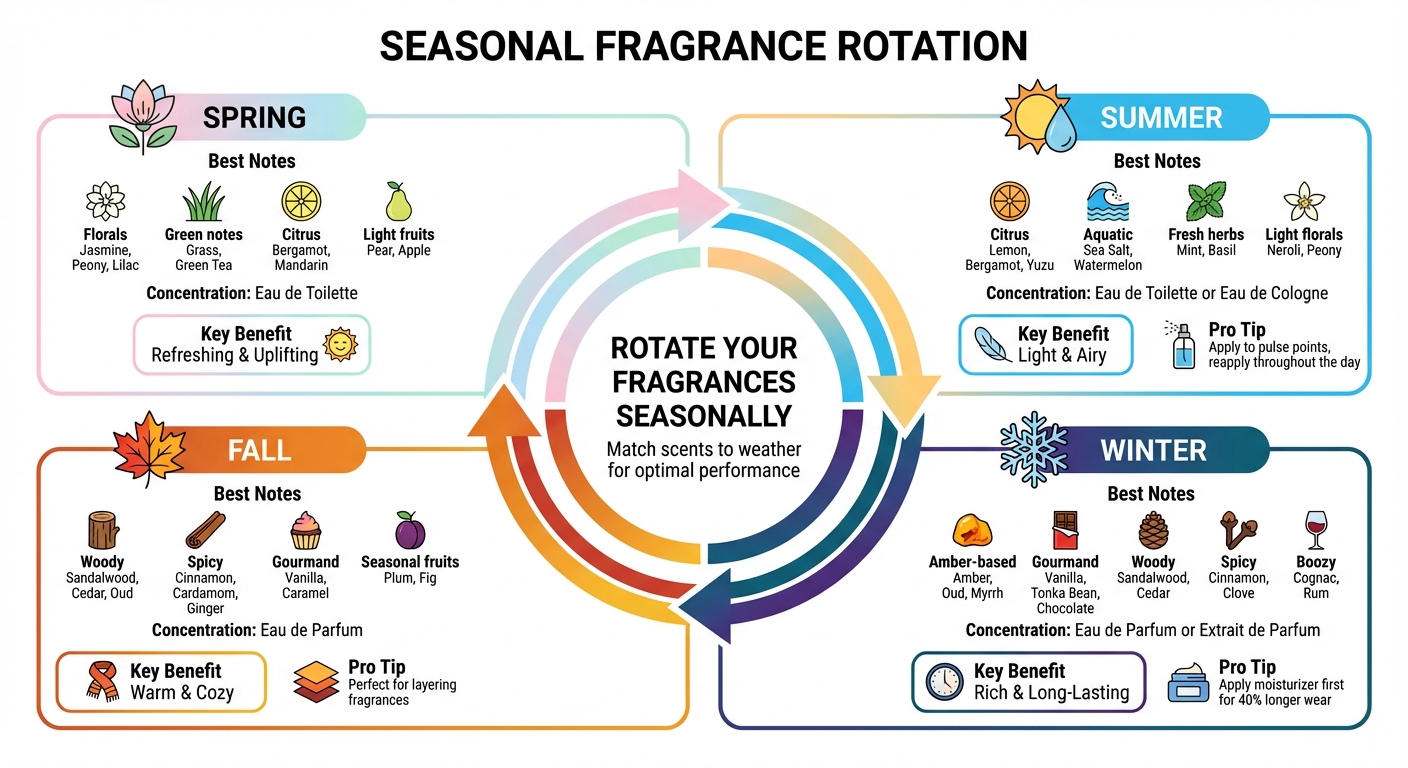
Εποχικός Οδηγός Αρωμάτων: Οι καλύτερες νότες αρωμάτων για Άνοιξη, Καλοκαίρι, Φθινόπωρο και Χειμώνα
How Climate Affects Perfume Performance
Ο καιρός παίζει καθοριστικό ρόλο στον τρόπο με τον οποίο συμπεριφέρονται τα αρώματα, επηρεάζοντας την εξάτμιση, τη διάχυση και τη διάρκειά τους. Παράγοντες όπως η θερμοκρασία, η υγρασία και η ροή του αέρα καθορίζουν πώς εξελίσσεται ένα άρωμα και πόσο παραμένει πάνω στην επιδερμίδα.
Τα αρωματικά έλαια βασίζονται στη θερμότητα για να απελευθερώσουν το άρωμά τους. Σε πιο ζεστές συνθήκες, εξατμίζονται γρηγορότερα, ενώ ο ψυχρότερος καιρός επιβραδύνει αυτή τη διαδικασία, επιτρέποντας στο άρωμα να παραμένει περισσότερο στο δέρμα. Η υγρασία επηρεάζει επίσης την απόδοση των αρωμάτων - ο υγρός αέρας βοηθά τις αρωματικές νότες να διαχέονται και να διαρκούν περισσότερο, ενώ ο ξηρός αέρας προκαλεί ταχύτερη εξάτμιση. Ο άνεμος και η κυκλοφορία του αέρα μπορούν να επιταχύνουν ακόμη περισσότερο τη διάλυση ενός αρώματος, ιδίως τις ημέρες με αεράκι.
Σημασία έχει και η συγκέντρωση του αρώματός σας. Οι πιο ελαφριές επιλογές, όπως το Eau de Toilette, είναι πιο κατάλληλες για ζεστό καιρό, ενώ το πλουσιότερο Eau de Parfum λειτουργεί εξαιρετικά σε ψυχρές, ξηρές συνθήκες. Η κατανόηση αυτών των δυναμικών σάς βοηθά να επιλέγετε το ιδανικό άρωμα για κάθε εποχή.
Θερμότητα και άρωμα
Σε ζεστό καιρό, τα αρώματα συμπεριφέρονται διαφορετικά. Οι υψηλές θερμοκρασίες επιταχύνουν την κίνηση των αρωματικών μορίων, οδηγώντας σε ταχύτερη εξάτμιση και πιο έντονη προβολή. Αυτό δημιουργεί αρχικά μια έντονη «άνθιση» του αρώματος, αλλά μειώνει τη συνολική διάρκειά του. Για παράδειγμα, οι εσπεριδοειδείς νότες - γνωστές για τον αναζωογονητικό τους χαρακτήρα - εξασθενούν σχεδόν αμέσως σε ακραία ζέστη. Όπως εξηγεί ο αρωματοποιός Francis Kurkdjian, "Οι εσπεριδοειδείς νότες χάνονται πολύ γρήγορα, αν και είναι οι πιο αναζωογονητικές". Μόρια όπως το λιμονένιο και το λιναλοόλη, κοινά σε αρώματα με βάση τα εσπεριδοειδή, είναι ιδιαίτερα πτητικά σε υψηλές θερμοκρασίες.
Η υγρασία προσθέτει ακόμη ένα επίπεδο πολυπλοκότητας. Ενώ βοηθά στη μεταφορά των αρωματικών μορίων, μπορεί να κάνει τις βαρύτερες νότες να μοιάζουν υπερβολικά έντονες ή «κολλώδεις». Γι’ αυτό οι πιο ελαφριές συγκεντρώσεις, όπως το Eau de Toilette, είναι ιδανικές για το καλοκαίρι - προσφέρουν ένα δροσερό άρωμα χωρίς να γίνονται υπερβολικές. Η εφαρμογή του αρώματος στα ρούχα αντί απευθείας στο δέρμα μπορεί επίσης να βοηθήσει στη διατήρηση της ακεραιότητάς του, ιδίως όταν υπάρχει εφίδρωση.
Κρύος καιρός και άρωμα
Καθώς η θερμοκρασία πέφτει, τα αρώματα προσαρμόζονται ξανά. Ο κρύος καιρός επιβραδύνει τον ρυθμό εξάτμισης, επιτρέποντας στις νότες κορυφής και καρδιάς να διαρκούν περισσότερο. Ωστόσο, αυτή η μειωμένη εξάτμιση σημαίνει επίσης ότι το άρωμα δεν προβάλλεται τόσο έντονα, δημιουργώντας μια πιο προσωπική, οικεία εμπειρία. Σύμφωνα με το The Perfume Society, "Ο ψυχρότερος καιρός επιβραδύνει τον ρυθμό εξάτμισης (έτσι οι νότες κορυφής και καρδιάς διαρκούν πολύ περισσότερο) και μπορεί να διαπιστώσετε ότι το άρωμά σας δεν προβάλλεται τόσο πολύ τον χειμώνα".
Τον χειμώνα, οι πιο πλούσιες συγκεντρώσεις όπως το Eau de Parfum ή το Extrait de Parfum είναι απαραίτητες. Παρέχουν την ένταση που χρειάζεται για να παραμένουν αισθητές στον κρύο, ξηρό αέρα. Η ενυδάτωση παίζει επίσης καθοριστικό ρόλο - ο ξηρός χειμωνιάτικος αέρας μπορεί να αποδυναμώσει τα αρωματικά έλαια πάνω στο δέρμα, αλλά η εφαρμογή μιας άοσμης ενυδατικής πριν από το άρωμά σας μπορεί να παρατείνει τη διάρκειά του. Για παράδειγμα, τα αρώματα με βάση τη βανίλια μπορούν να διαρκέσουν έως και 40% περισσότερο σε ενυδατωμένη επιδερμίδα σε σύγκριση με ξηρή επιδερμίδα. Οι βαρύτερες νότες βάσης όπως κεχριμπάρι, oud και ρητίνες είναι ιδιαίτερα αποτελεσματικές τον χειμώνα, καθώς το μοριακό τους βάρος τους επιτρέπει να αποδίδουν εξαιρετικά σε ψυχρότερες συνθήκες.
Αρώματα Άνοιξης: Φρέσκα, λουλουδάτα και πράσινα
Η άνοιξη φέρνει μια ευπρόσδεκτη ευκαιρία να αντικαταστήσετε τα βαθιά, ζεστά αρώματα του χειμώνα με πιο ανάλαφρα, αναζωογονητικά μείγματα. Καθώς ο κόσμος αρχίζει να ανθίζει και οι θερμοκρασίες ανεβαίνουν, το άρωμά σας μπορεί να αντικατοπτρίζει αυτή την αίσθηση ανανέωσης και ζωτικότητας. Το να ταιριάζετε το άρωμά σας με την εποχή όχι μόνο μοιάζει φυσικό, αλλά ενισχύει και τη σύνδεση ανάμεσα στο άρωμά σας και το περιβάλλον.
"Η άνοιξη είναι μια εποχή νέων ξεκινημάτων... επιλέξτε ένα άρωμα που να αντικατοπτρίζει αυτή τη νέα αφύπνιση και τα αισθήματα χαράς." — Perfume.com
Συνηθισμένες ανοιξιάτικες νότες
Τα ανοιξιάτικα αρώματα αντλούν συχνά έμπνευση από ανθισμένους κήπους και καταπράσινο τοπίο. Περιμένετε ντελικάτες λουλουδάτες νότες όπως κρίνο της κοιλάδας, παιώνια, πασχαλιά, άνθος κερασιάς και γιασεμί να κυριαρχούν, αιχμαλωτίζοντας τη γλυκιά ουσία της άνοιξης. Οι πράσινες νότες - όπως φρεσκοκομμένο γρασίδι, πράσινο τσάι και φύλλα βιολέτας - προσθέτουν μια δροσερή, φυσική διάσταση που θυμίζει την αναγέννηση της φύσης. Για να φωτιστεί η σύνθεση, οι εσπεριδοειδείς νότες όπως περγαμόντο, μανταρίνι, αιματόσαρκο πορτοκάλι και γκρέιπφρουτ χαρίζουν μια λαμπερή, ζωηρή πινελιά. Ελαφριές φρουτώδεις αποχρώσεις, όπως αχλάδι, μήλο και βερίκοκο, ολοκληρώνουν το άρωμα με ένα δροσερό τελείωμα. Αυτά τα στοιχεία συνεργάζονται για να δημιουργήσουν αρώματα αέρινα και ανα uplifting, ιδανικά για την εποχή.
Επιλέγοντας ανοιξιάτικα αρώματα
Όταν επιλέγετε ένα ανοιξιάτικο άρωμα, αναζητήστε συνθέσεις που δίνουν έμφαση σε ελαφριές, φρέσκες νότες κορυφής και καρδιάς. Για παράδειγμα, το Gucci Flora Gorgeous Jasmine EDP - που κυκλοφόρησε το 2022 - διαθέτει ένα ζωηρό μείγμα από ιταλικό μανταρίνι και περγαμόντο, συμπληρωμένο από μια λουλουδάτη καρδιά γιασεμιού και μανόλιας. Προσφέρει μέτρια προβολή και εντυπωσιακή διάρκεια. Μια ακόμη ξεχωριστή επιλογή είναι το Ralph Lauren Polo Blue Parfum (2022), που δημιουργήθηκε από τους Carlos Benaim και Pascal Gaurin. Αυτό το άρωμα συνδυάζει μανταρίνι, κάρδαμο και βετιβέρ, προσφέροντας ένα ισορροπημένο πράσινο άρωμα με αξιοσημείωτη διάρκεια δώδεκα ωρών.
Καθώς η άνοιξη δίνει σταδιακά τη θέση της στο καλοκαίρι, μπορείτε να πειραματιστείτε με layering αυτών των λουλουδάτων αρωμάτων με εσπεριδοειδείς πινελιές, δημιουργώντας μια αρμονική μετάβαση στους θερμότερους μήνες.
Καλοκαιρινά Αρώματα: Ανάλαφρα, εσπεριδοειδή και αέρινα
Όταν η ζέστη ανεβαίνει και η υγρασία κυριαρχεί, είναι η στιγμή να επανεξετάσετε τις αρωματικές σας επιλογές. Ο ζεστός καιρός επιταχύνει την εξάτμιση των μορίων του αρώματος, κάνοντας τα βαριά αρώματα να μοιάζουν υπερβολικά. Το μυστικό; Επιλέξτε πιο ελαφριές, αέρινες συνθέσεις που σας χαρίζουν μια αίσθηση φρεσκάδας.
"Ο ζεστός καιρός εντείνει τις νότες του αρώματος και τις κάνει να ‘ανθίζουν’ πιο γρήγορα πάνω στην επιδερμίδα – όταν τα μόρια θερμαίνονται, εξατμίζονται πιο γρήγορα." — The Perfume Society
Οι καλύτερες νότες για το καλοκαίρι
Ορισμένες αρωματικές νότες λάμπουν το καλοκαίρι, προσφέροντας μια δροσερή, αναζωογονητική αίσθηση. Οι εσπεριδοειδείς νότες όπως λεμόνι, περγαμόντο, yuzu και γκρέιπφρουτ προσφέρουν φωτεινή, ζωηρή ενέργεια που ταιριάζει ιδανικά με τις ηλιόλουστες ημέρες. Οι υδάτινες και θαλασσινές συμφωνίες - όπως θαλασσινό αλάτι, νούφαρο και καρπούζι - αποτυπώνουν την ουσία της θαλάσσιας αύρας. Για μια τραγανή πράσινη πινελιά, σκεφτείτε βασιλικό, μέντα, ευκάλυπτο ή φρεσκοκομμένο γρασίδι. Αν προτιμάτε μια ιδέα γλυκύτητας, οι ελαφριές φρουτώδεις νότες όπως καρύδα, αχλάδι και ροδάκινο προσθέτουν μια παιχνιδιάρικη διάσταση. Οι διάφανες λουλουδάτες νότες όπως neroli, παιώνια και μη ινδολικό γιασεμί προσφέρουν μια εκλεπτυσμένη, αέρινη πινελιά χωρίς να κατακλύζουν τις αισθήσεις.
Αυτές οι νότες όχι μόνο ταιριάζουν στην εποχή, αλλά ενισχύουν και τον τρόπο με τον οποίο αποδίδει το άρωμά σας στη ζέστη.
Πώς να φοράτε άρωμα το καλοκαίρι
Η επιλογή της σωστής συγκέντρωσης αρώματος είναι καθοριστική για τον ζεστό καιρό. Προτιμήστε πιο ελαφριές συνθέσεις όπως Eau de Toilette (EDT) ή Eau de Cologne αντί για βαρύτερο Eau de Parfum (EDP), ώστε το άρωμά σας να παραμένει διακριτικό και δροσερό.
"Οι ελαφρύτερες συγκεντρώσεις (EDT) και οι νότες κορυφής προτιμώνται ώστε να αποφεύγεται ένα υπερβολικό σillage." — Sylvaine Delacourte
Για να διαρκεί περισσότερο το άρωμά σας, ξεκινήστε απλώνοντας μια άοσμη ενυδατική κρέμα για να ενυδατώσετε την επιδερμίδα σας. Αυτό το απλό βήμα μπορεί να αυξήσει τη διάρκεια έως και 40%. Εστιάστε στα σημεία σφυγμού, όπως ο λαιμός και πίσω από τα αυτιά, καθώς και σε πιο δροσερές περιοχές, όπως το πίσω μέρος των γονάτων. Ψεκάστε από απόσταση 6–8 ιντσών για ομοιόμορφη εφαρμογή και αντισταθείτε στον πειρασμό να τρίψετε τους καρπούς σας μεταξύ τους, καθώς αυτό μπορεί να αλλοιώσει το άρωμα.
Καθώς τα αρώματα εξατμίζονται γρηγορότερα στη ζέστη, η επαναφορά είναι απαραίτητη. Ένα πρακτικό decant ταξιδιού, όπως τα φιαλίδια 2 ml, 5 ml και 8 ml, καθώς και το μπουκάλι decant 30 ml για τα περισσότερα αρώματα, της Scento, διευκολύνει την ανανέωση του αρώματός σας καθ’ όλη τη διάρκεια της ημέρας. Επιπλέον, τα μικρότερα μεγέθη σάς επιτρέπουν να πειραματίζεστε με διαφορετικά καλοκαιρινά αρώματα χωρίς να επενδύετε σε ολόκληρα μπουκάλια που ίσως χρησιμοποιήσετε μόνο για μία σεζόν.
Ο προσωπικός σας ειδικός αρωμάτων σας περιμένει
Κάντε το σύντομο κουίζ αρώματος και ανακαλύψτε αυθεντικά αρώματα designer και niche, επιλεγμένα στα μέτρα σας – εξερευνήστε τα σε decant και δείγματα των 2, 5, 8 και 30 ml, ώστε να δοκιμάσετε το καθένα πριν επιλέξετε ολόκληρο μπουκάλι.
Βρείτε το άρωμά σαςΦθινοπωρινά Αρώματα: Ζεστά, πικάντικα και ξυλώδη
Καθώς τα φύλλα αποκτούν χρυσαφένιες αποχρώσεις και ο αέρας γίνεται πιο δροσερός, είναι η ιδανική στιγμή να επανεξετάσετε τις αρωματικές σας επιλογές. Το φθινόπωρο ζητά πιο βαθιά, πιο πλούσια αρώματα που ταιριάζουν με τη ζεστή, πολυεπίπεδη αίσθηση της εποχής.
"Καθώς ο καιρός δροσίζει, τα φθινοπωρινά αρώματα συχνά ενσωματώνουν ζεστά και πικάντικα στοιχεία που ξυπνούν την αίσθηση του να κουλουριάζεσαι δίπλα στη φωτιά." — Eden Perfumes
Αυτή η εποχή του χρόνου είναι ιδανική για να εξερευνήσετε αρώματα που ίσως φαίνονταν υπερβολικά βαριά μέσα στη ζέστη του καλοκαιριού. Ας δούμε τις νότες που κάνουν τα φθινοπωρινά αρώματα τόσο γοητευτικά.
Συνηθισμένες φθινοπωρινές νότες
Τα φθινοπωρινά αρώματα περιστρέφονται γύρω από τη ζεστασιά, το βάθος και μια διακριτική αίσθηση απόλαυσης. Ξυλώδεις νότες όπως σανδαλόξυλο, κέδρος και oud προσφέρουν μια σταθερή, γήινη βάση που συνδυάζεται υπέροχα με τη δροσιά του φθινοπωρινού αέρα. Μπαχαρικά όπως κανέλα, κάρδαμο, τζίντζερ και γαρύφαλλο φέρνουν μια αίσθηση ζεστής θαλπωρής, θυμίζοντας ζεστά ροφήματα ή βραδιές δίπλα στο τζάκι. Για μια νότα γλυκύτητας, gourmand νότες όπως βανίλια, καραμέλα, σοκολάτα και καβουρδισμένοι ξηροί καρποί προσθέτουν μια απολαυστικά πολυτελή διάσταση. Τέλος, εποχικά φρούτα όπως δαμάσκηνο, σύκο και ρόδι υμνούν την αφθονία του φθινοπώρου.
| Κατηγορία νότας | Συνήθη παραδείγματα | Αποτέλεσμα |
|---|---|---|
| Ξυλώδεις | Σανδαλόξυλο, Κέδρος, Oud | Γειωμένη κομψότητα και βάθος |
| Πικάντικες | Κανέλα, Κάρδαμο, Τζίντζερ, Γαρύφαλλο | Φιλόξενη ζεστασιά και απολαυστική θαλπωρή |
| Gourmand | Βανίλια, Καραμέλα, Σοκολάτα, Καβουρδισμένοι Ξηροί Καρποί | Γλυκύτητα με μια πινελιά απόλαυσης |
| Εποχικές/Φρουτώδεις | Δαμάσκηνο, Σύκο, Ρόδι | Πλούτος που θυμίζει τη φθινοπωρινή συγκομιδή |
Layering αρωμάτων το φθινόπωρο
Το layering αρωμάτων είναι ένας δημιουργικός τρόπος να προσθέσετε βάθος και να προσαρμόσετε το άρωμά σας στη διάθεσή σας ή στην περίσταση.
"Το layering αρωμάτων μοιάζει πολύ με τη δημιουργία της τέλειας εμφάνισης - πρόκειται για τον συνδυασμό διαφορετικών στοιχείων ώστε να δημιουργήσετε κάτι μοναδικά δικό σας." — Joanna Colomas, Writer and Fragrance Specialist
Ξεκινήστε με μια ισχυρή βάση: βαρύτερες νότες βάσης όπως κεχριμπάρι ή σανδαλόξυλο εξασφαλίζουν διάρκεια. Προσθέστε ζεστασιά με μεσαίες νότες όπως κανέλα ή μοσχοκάρυδο και ολοκληρώστε με μια ελαφριά νότα κορυφής όπως εσπεριδοειδή για να διατηρήσετε την ισορροπία. Για παράδειγμα, η Joanna Colomas πρότεινε τον συνδυασμό του Tom Ford’s Tobacco Vanille με το Heretic Parfum’s Dirty Vanilla Roll-On Oil ώστε να δημιουργηθεί ένα ζεστό, φθινοπωρινό μείγμα.
Σε πιο δροσερό καιρό, προτιμήστε υψηλότερες συγκεντρώσεις όπως Eau de Parfum (EDP) αντί για Eau de Toilette (EDT). Το κρύο επιβραδύνει τη διάχυση του αρώματος, επομένως μια πιο συμπυκνωμένη φόρμουλα εξασφαλίζει ότι το άρωμά σας παραμένει αισθητό. Για να πειραματιστείτε με συνδυασμούς layering, δοκιμάστε μικρότερα decants όπως τα 2 ml, 5 ml και 8 ml φιαλίδια, καθώς και το μπουκάλι decant 30 ml για τα περισσότερα αρώματα, της Scento - είναι ιδανικά για αναμίξεις χωρίς να δεσμευτείτε σε ολόκληρα μπουκάλια. Στη συνέχεια, ανακαλύψτε πώς να οργανώσετε και να εναλλάσσετε τα εποχικά σας αρώματα για αβίαστη χρήση όλο τον χρόνο.
Χειμωνιάτικα Αρώματα: Πλούσια, κεχριμπαρένια και έντονα
Όταν καταφθάνει ο χειμώνας, ο ψυχρός αέρας μεταβάλλει τον τρόπο με τον οποίο συμπεριφέρονται τα αρώματα. Τα μόρια διαχέονται πιο αργά, μειώνοντας τις ντελικάτες νότες κορυφής και ενισχύοντας τον πλούτο των έντονων νοτών βάσης. Γι’ αυτό οι ψυχρότεροι μήνες απαιτούν αρώματα βαθιά, ζεστά και ικανά να σταθούν με αυτοπεποίθηση απέναντι στο κρύο.
"Η tonka είναι ένα ζεστό unisex άρωμα που θυμίζει κασμιρένιο πουλόβερ." – Kelsey Hodgson
Τα χειμωνιάτικα αρώματα πρέπει να μοιάζουν με ένα ζεστό στρώμα που σας τυλίγει με θαλπωρή και άνεση. Αυτά τα αρώματα είναι σχεδιασμένα να εξελίσσονται για ώρες, καθιστώντας τα ιδανικούς συντρόφους για μεγάλες, ψυχρές ημέρες.
Οι καλύτερες νότες για τον χειμώνα
Τα χειμωνιάτικα αρώματα βασίζονται συχνά σε gourmand νότες όπως βανίλια, tonka bean, καραμέλα και σοκολάτα για να δημιουργήσουν μια παρηγορητική αίσθηση, σαν να είστε «τυλιγμένοι σε μια κουβέρτα». Ρητινώδεις και κεχριμπαρένιες νότες - κεχριμπάρι, oud, benzoin και μύρο - προσθέτουν πολυτελές βάθος και υφή. Ξυλώδη στοιχεία όπως σανδαλόξυλο, κέδρος και guaiac wood χαρίζουν γειωμένη κομψότητα, ενώ πικάντικες συμφωνίες όπως κανέλα, κάρδαμο και γαρύφαλλο προσφέρουν μια άμεση έκρηξη ζεστασιάς. Για μια πινελιά απόλαυσης, boozy νότες όπως κονιάκ ή ρούμι μπορούν να θυμίσουν τη θαλπωρή μιας βραδιάς δίπλα στη φωτιά. Μαζί, αυτά τα στοιχεία δημιουργούν μια ολοκληρωμένη χειμωνιάτικη αρωματική γκαρνταρόμπα.
Για να διαρκεί περισσότερο το άρωμά σας τον χειμώνα, το κλειδί είναι η ενυδατωμένη επιδερμίδα. Τα αρώματα με βάση τη βανίλια, για παράδειγμα, μπορούν να διαρκέσουν έως και 40% περισσότερο σε ενυδατωμένο δέρμα σε σύγκριση με ξηρό δέρμα. Χρησιμοποιήστε μια άοσμη ενυδατική πριν εφαρμόσετε το άρωμά σας, εστιάζοντας στα σημεία παλμού όπως ο λαιμός, το στήθος και οι καρποί. Η θερμότητα του σώματος από αυτές τις περιοχές βοηθά το άρωμα να ακτινοβολεί όμορφα.
Επιλέγοντας χειμωνιάτικα αρώματα με μεγάλη διάρκεια
Τον χειμώνα, η συγκέντρωση γίνεται ιδιαίτερα σημαντική. Προτιμήστε Eau de Parfum (EDP) ή Extrait de Parfum, καθώς διαθέτουν υψηλότερες συγκεντρώσεις αρωματικών ελαίων που μπορούν να αντέξουν τον ξηρό αέρα και τα βαριά στρώματα ρούχων. Αναζητήστε αρώματα που φέρουν την ένδειξη Amber, Oriental ή Gourmand, καθώς είναι σχεδιασμένα να αποδίδουν εξαιρετικά σε ψυχρό καιρό.
Για επιπλέον διάρκεια, ψεκάστε το άρωμά σας σε μάλλινα κασκόλ, γιακάδες παλτών ή πουλόβερ. Αυτά τα υφάσματα βοηθούν το άρωμα να παραμένει και να προβάλλεται καλύτερα σε ψυχρές συνθήκες. Θέλετε να δείτε αν ένα άρωμα είναι κατάλληλο για τον χειμώνα; Δοκιμάστε το τεστ του ψυγείου: ψεκάστε ένα blotter και βάλτε το στο ψυγείο για 30 λεπτά. Αν το άρωμα ενταθεί ή διατηρήσει τον χαρακτήρα του, είναι εξαιρετική χειμωνιάτικη επιλογή· αν ξεθωριάσει, ίσως είναι υπερβολικά ελαφρύ για την εποχή.
Αν διστάζετε να επενδύσετε σε ολόκληρα μπουκάλια premium χειμωνιάτικων αρωμάτων όπως το Kilian Angels’ Share ή το Tom Ford Tobacco Vanille, μικρότερα decants όπως τα φιαλίδια 2 ml, 5 ml και 8 ml, καθώς και το μπουκάλι decant 30 ml για τα περισσότερα αρώματα, της Scento είναι ένας έξυπνος τρόπος να εξερευνήσετε αυτά τα πολυτελή αρώματα χωρίς να δεσμευτείτε σε μπουκάλια 250 €–300 €. Με προσεκτική οργάνωση και εναλλαγή, μπορείτε να απολαμβάνετε μια αρμονική αρωματική γκαρνταρόμπα όλο τον χρόνο.
Οργάνωση και εναλλαγή της συλλογής αρωμάτων σας
Η σωστή οργάνωση της συλλογής αρωμάτων σας κάνει τις εποχικές μεταβάσεις αβίαστες. Ταξινομώντας τα αρώματά σας ανά εποχή, μπορείτε εύκολα να επιλέγετε το ιδανικό άρωμα για κάθε ημέρα, ενώ παράλληλα διατηρείτε την ποιότητά τους με την πάροδο του χρόνου.
Επισήμανση και κατηγοριοποίηση ανά εποχή
Ξεκινήστε χωρίζοντας τη συλλογή σας σε τέσσερις εποχικές ομάδες: Άνοιξη, Καλοκαίρι, Φθινόπωρο και Χειμώνας. Χρησιμοποιήστε επισημασμένα κουτιά ή ράφια για να διατηρήσετε αυτές τις κατηγορίες ξεχωριστές και εύκολα προσβάσιμες. Η προσθήκη ετικετών μπορεί επίσης να σας βοηθήσει να παρακολουθείτε λεπτομέρειες αγοράς και να διασφαλίζετε ότι δεν θα ξεμείνετε ποτέ από τα αγαπημένα σας αρώματα.
Η σωστή αποθήκευση είναι καθοριστική για να διατηρούνται τα αρώματά σας σε άριστη κατάσταση. Να αποθηκεύετε πάντα τα μπουκάλια όρθια, σε δροσερό και σκοτεινό μέρος, ώστε να προστατεύονται από θερμότητα και υγρασία. Ενώ τα περισσότερα αρώματα διαρκούν 3 έως 5 χρόνια, η προσεκτική αποθήκευση μπορεί να παρατείνει σημαντικά τη διάρκειά τους. Καθώς αλλάζουν οι εποχές, εναλλάσσετε τη συλλογή σας - προβάλλετε μερικά από τα τρέχοντα αγαπημένα σας και φυλάξτε τα υπόλοιπα μέχρι να επιστρέψει η εποχή τους.
Χρήση decants για δοκιμή
Τα decants είναι ένας πρακτικός τρόπος να δοκιμάζετε πώς αποδίδει ένα άρωμα σε διαφορετικές εποχές. Τα φιαλίδια 2 ml, 5 ml και 8 ml, καθώς και το μπουκάλι decant 30 ml για τα περισσότερα αρώματα, της Scento είναι ιδανικά για να πειραματιστείτε με το πώς εξελίσσεται ένα άρωμα πάνω στην επιδερμίδα σας υπό διαφορετικές καιρικές συνθήκες. Δοκιμάστε ένα "Wrist Weather Test" εφαρμόζοντας ένα decant το δροσερό πρωί και ξανά στη ζέστη του απογεύματος. Αυτή η μέθοδος εξασφαλίζει ότι δεν θα βρεθείτε προ εκπλήξεως από ένα καλοκαιρινό άρωμα που γίνεται υπερβολικό στην υγρασία ή από ένα χειμωνιάτικο άρωμα που χάνεται πολύ γρήγορα στον ξηρό αέρα.
Παρακολούθηση χρήσης και προτιμήσεων
Ένα ημερολόγιο αρωμάτων μπορεί να σας βοηθήσει να παρακολουθείτε πώς αποδίδουν τα αρώματά σας καθ’ όλη τη διάρκεια του έτους. Καταγράψτε λεπτομέρειες όπως εποχικές εντυπώσεις, κομπλιμέντα και συνολική φορεσιμότητα. Με τον καιρό, θα παρατηρήσετε μοτίβα στις προτιμήσεις σας, γεγονός που θα σας διευκολύνει να βρείτε αντικαταστάσεις αν κάποιο αγαπημένο σας άρωμα σταματήσει να κυκλοφορεί. Η εναλλαγή της συλλογής σας όχι μόνο κρατά τα πράγματα φρέσκα, αλλά οξύνει και την αίσθηση της όσφρησής σας, εμβαθύνοντας την εκτίμησή σας για κάθε άρωμα. Ένα καλά οργανωμένο σύστημα εξασφαλίζει ότι η συλλογή σας παραμένει δυναμική και απόλυτα προσαρμοσμένη σε κάθε εποχή.
Εποχική εναλλαγή: μια στρατηγική αρώματος
Η εναλλαγή των αρωμάτων σας με τις εποχές δεν είναι απλώς πρακτική - μπορεί να κάνει μεγάλη διαφορά στον τρόπο που αποδίδουν τα αρώματά σας και στο πώς σας κάνουν να αισθάνεστε. Καθώς οι θερμοκρασίες αλλάζουν, τα αρώματα αλληλεπιδρούν διαφορετικά με την επιδερμίδα σας. Σκεφτείτε φωτεινά λουλούδια για την άνοιξη, ζωηρά εσπεριδοειδή για το καλοκαίρι, ζεστά μπαχαρικά για το φθινόπωρο και πλούσια, θερμά κεχριμπαρένια αρώματα για τον χειμώνα. Αυτή η προσέγγιση δημιουργεί μια αρωματική γκαρνταρόμπα που συμπληρώνει τόσο τον καιρό όσο και τη διάθεσή σας.
"Ακριβώς όπως δεν θα φορούσατε ένα βαρύ πουλόβερ το καλοκαίρι, το να φοράτε ένα άρωμα που σας θυμίζει κασμίρι ή βελούδο... σε μια αποπνικτική ημέρα μπορεί απλώς να μοιάζει λάθος." - The Perfume Society
Η εποχική εναλλαγή βοηθά επίσης τα αγαπημένα σας αρώματα να μη χάσουν τη γοητεία τους. Με την εναλλαγή, αποφεύγετε την οσφρητική κόπωση και διατηρείτε τα αρώματά σας νέα και συναρπαστικά.
Θέλετε να το δοκιμάσετε χωρίς να ξοδέψετε μια περιουσία; Ξεκινήστε με decants - αυτά τα πρακτικά δείγματα των 2 ml, 5 ml και 8 ml. Σας επιτρέπουν να εξερευνήσετε πώς αποδίδουν διαφορετικά αρώματα σε ποικίλες καιρικές συνθήκες πριν δεσμευτείτε σε ένα μπουκάλι κανονικού μεγέθους. Τα decants της Scento είναι ένας εξαιρετικός τρόπος να πειραματιστείτε τόσο με designer όσο και με niche επιλογές, προσφέροντάς σας την ελευθερία να ανακαλύπτετε χωρίς υπερβολικά έξοδα.
Έτσι, αποκτήστε μερικά decants, δοκιμάστε τα καθώς αλλάζουν οι εποχές και αφήστε την αρωματική γκαρνταρόμπα σας να εξελίσσεται μαζί με τον χρόνο. Είναι ένας απλός τρόπος να παραμένετε σε αρμονία με τις εποχές, ενώ ταυτόχρονα εκλεπτύνετε το προσωπικό σας στιλ.
Συχνές ερωτήσεις
Πώς μπορώ να καταλάβω αν ένα άρωμα είναι πολύ βαρύ για ζεστό καιρό;
Σε ζεστό καιρό, τα αρώματα με ζεστές, πικάντικες ή ξυλώδεις νότες μπορεί να φαίνονται υπερβολικά. Οι υψηλές θερμοκρασίες τείνουν να ενισχύουν αυτές τις βαρύτερες συνθέσεις, κάτι που μπορεί να οδηγήσει σε αισθητηριακή υπερφόρτωση ή ακόμη και σε οσφρητική κόπωση. Για να διατηρείτε μια ανάλαφρη και δροσερή αίσθηση, προτιμήστε αρώματα με καθαρές, αέρινες νότες που δεν θα σας βαραίνουν στη ζέστη.
Ποιος είναι ο καλύτερος τρόπος για να διαρκεί περισσότερο το άρωμα τον χειμώνα;
Για να βοηθήσετε το άρωμά σας να διαρκεί μέσα στις ψυχρές χειμωνιάτικες ημέρες, ξεκινήστε ενυδατώνοντας την επιδερμίδα σας με μια πλούσια λοσιόν ή ένα ελαφρύ έλαιο. Η ενυδατωμένη επιδερμίδα συγκρατεί καλύτερα το άρωμα. Επιλέξτε αρώματα με ζεστές, ανθεκτικές νότες όπως βανίλια ή ξυλώδεις αποχρώσεις - τείνουν να παραμένουν περισσότερο και να ταιριάζουν υπέροχα με τον ψυχρό καιρό.
Πόσα εποχικά αρώματα πρέπει να διατηρώ για να αποφεύγω τη σπατάλη;
Για να μειώσετε τη σπατάλη, εξετάστε το ενδεχόμενο να διατηρείτε μια συλλογή από 4–6 αρώματα που ταιριάζουν στη διάθεση και την ουσία κάθε εποχής. Αυτή η προσέγγιση διασφαλίζει ότι μπορείτε να απολαμβάνετε μια ποικιλία αρωμάτων καθ’ όλη τη διάρκεια του έτους, αποφεύγοντας παράλληλα τις υπερβολικές αγορές ή το να μένουν μπουκάλια αχρησιμοποίητα.

