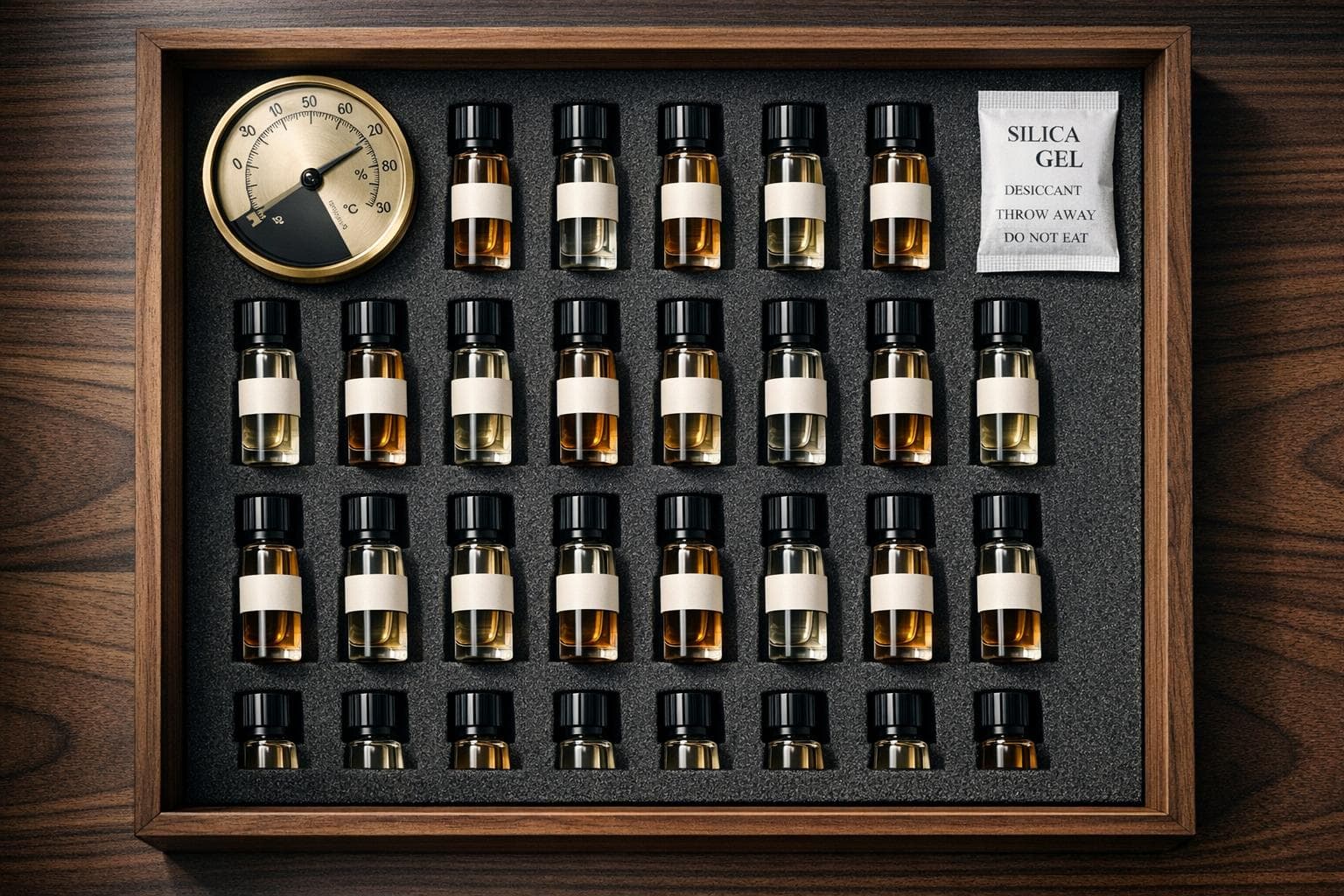
Θέλετε τα δείγματα αρώματός σας να διαρκούν περισσότερο; Η σωστή αποθήκευση μπορεί να παρατείνει τη διάρκειά τους έως και κατά δύο χρόνια. Οι περισσότεροι λάτρεις των αρωμάτων φθείρουν άθελά τους τα δείγματά τους λόγω κακής διαχείρισης, με το φως, τη θερμότητα και την υγρασία να αποτελούν τους βασικούς ενόχους. Δείτε τι πρέπει να γνωρίζετε:
- Διατηρήστε τα σε Δροσερό Περιβάλλον: Αποθηκεύστε τα μεταξύ 60–70°F για να αποτρέψετε την εξάτμιση και να εξασφαλίσετε σταθερή ποιότητα αρώματος.
- Αποφύγετε το Ηλιακό Φως: Το άμεσο φως διασπά γρήγορα τα μόρια του αρώματος. Επιλέξτε σκούρα ή αδιαφανή αποθήκευση.
- Ελέγξτε την Υγρασία: Τα υψηλά επίπεδα υγρασίας μπορούν να αραιώσουν τις νότες ή να προκαλέσουν μούχλα. Στοχεύστε σε υγρασία κάτω από 50%.
- Σφραγίστε Ερμητικά: Η έκθεση στον αέρα επιταχύνει την οξείδωση. Τυλίξτε τα καπάκια με ταινία ή μεταφέρετε το περιεχόμενο σε αεροστεγή φιαλίδια.
- Επιλέξτε Γυαλί: Τα γυάλινα φιαλίδια είναι πιο αξιόπιστα από τα πλαστικά για τη διατήρηση της ακεραιότητας του αρώματος.
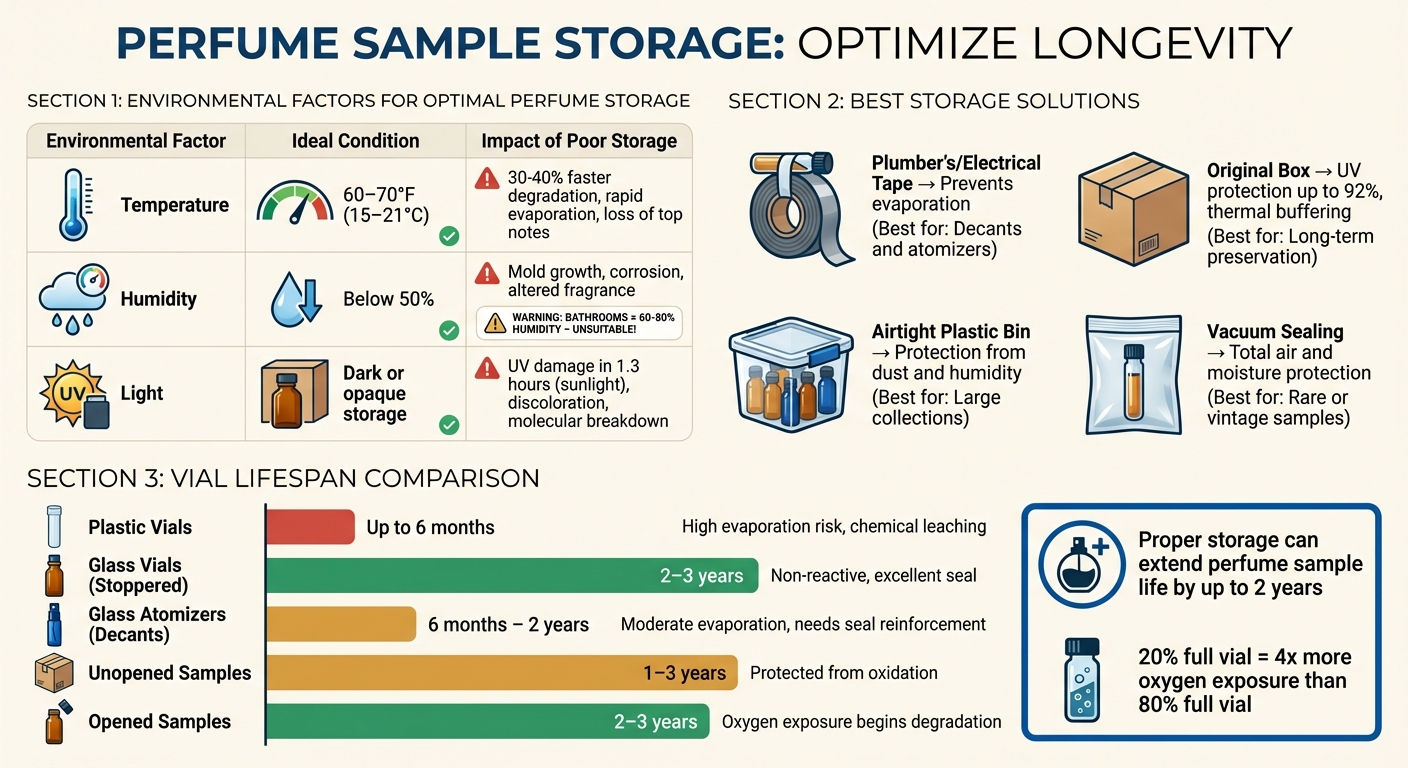
Οδηγός Αποθήκευσης Δειγμάτων Αρώματος: Ιδανικές Συνθήκες και Διάρκεια Ζωής ανά Τύπο Φιαλιδίου
Περιβαλλοντικοί Παράγοντες που Επηρεάζουν τα Δείγματα Αρώματος
Τα δείγματα αρώματος είναι ευαίσθητα και επηρεάζονται εύκολα από το περιβάλλον τους. Παράγοντες όπως η θερμότητα, το φως και η υγρασία μπορούν να δράσουν συνδυαστικά και να υποβαθμίσουν τα μόρια που δημιουργούν το μοναδικό οσφρητικό προφίλ ενός αρώματος.
Έλεγχος Θερμοκρασίας και Κλίματος
Η θερμότητα είναι ένας από τους μεγαλύτερους εχθρούς των δειγμάτων αρώματος. Όταν οι θερμοκρασίες υπερβαίνουν τους 70°F, το αλκοόλ και τα έλαια του αρώματος αρχίζουν να εξατμίζονται ταχύτερα και οι χημικές αντιδράσεις επιταχύνονται. Αυτό μπορεί να προκαλέσει υποβάθμιση των δειγμάτων σας κατά 30–40% ταχύτερα, οδηγώντας σε απώλεια έντασης και στην εξαφάνιση αυτών των λαμπερών νότες κορυφής.
Για άριστη διατήρηση, φυλάσσετε τα δείγματα σε θερμοκρασία μεταξύ 60–70°F (15–21°C). Οι υψηλότερες θερμοκρασίες τείνουν να επηρεάζουν πρώτα τις νότες κορυφής, αφήνοντας συχνά πίσω ένα άρωμα επίπεδο, μεταλλικό ή ξινό. Από την άλλη πλευρά, οι εξαιρετικά χαμηλές θερμοκρασίες μπορούν να επηρεάσουν τον τρόπο με τον οποίο αποδίδεται το άρωμα στο δέρμα σας. Αν και η ψύξη μπορεί να φαίνεται καλή ιδέα, τα τυπικά οικιακά ψυγεία είναι συνήθως υπερβολικά κρύα και υγρά. Αν πρέπει οπωσδήποτε να χρησιμοποιήσετε ψύξη, ένα ειδικό ψυγείο αρωμάτων είναι σαφώς καλύτερη επιλογή.
Έκθεση στο Φως και Προστασία
Το φως, και ιδιαίτερα η υπεριώδης ακτινοβολία, μπορεί να προκαλέσει σοβαρή βλάβη στα μόρια του αρώματος. Το άμεσο ηλιακό φως είναι ιδιαίτερα επιβλαβές για τις εσπεριδοειδείς και λουλουδένιες νότες, οι οποίες είναι εξαιρετικά πτητικές. Μάλιστα, ορισμένες αρωματικές ενώσεις μπορούν να αρχίσουν να διασπώνται σε μόλις 1,3 ώρες κάτω από έντονο ηλιακό φως.
Τα διαφανή γυάλινα φιαλίδια προσφέρουν ελάχιστη προστασία από τις υπεριώδεις ακτίνες. Ακόμη και ο τεχνητός φωτισμός, όπως οι λαμπτήρες φθορισμού, μπορεί σταδιακά να υποβαθμίσει ένα άρωμα, προκαλώντας ανεπιθύμητες νότες και αποχρωματισμό. Για να προστατεύσετε τα δείγματά σας, φυλάσσετέ τα σε σκοτεινά σημεία όπως συρτάρια, ντουλάπες ή τα αρχικά τους κουτιά. Η χάρτινη συσκευασία με ιδιότητες φιλτραρίσματος UV μπορεί να μπλοκάρει έως και το 92% του επιβλαβούς φωτός. Αν προβάλλετε τη συλλογή σας, σκεφτείτε να χρησιμοποιήσετε μεμβράνη παραθύρου με φίλτρο UV στο τζάμι της βιτρίνας για να αποκλείσετε σχεδόν όλες τις υπεριώδεις ακτίνες. Για ακόμη καλύτερη μακροχρόνια αποθήκευση, μεταφέρετε τα δείγματά σας σε κεχριμπαρένια ή βαθιά μπλε φιαλίδια, που προσφέρουν αποτελεσματικότερη προστασία από το φως σε σύγκριση με το διαφανές γυαλί.
Υγρασία και οι Επιπτώσεις της
Η υγρασία αποτελεί ακόμη μία σιωπηλή απειλή για την αποθήκευση αρωμάτων. Τα υψηλά επίπεδα υγρασίας μπορούν να αραιώσουν τα αρώματα με βάση το αλκοόλ και να προκαλέσουν χημικές μεταβολές στη σύνθεσή τους. Σε συνθήκες υγρασίας, μπορεί επίσης να εμφανιστεί μούχλα και οι ατμοποιητές να διαβρωθούν.
Τα μπάνια, με επίπεδα υγρασίας που συχνά κυμαίνονται μεταξύ 60–80%, είναι ιδιαίτερα ακατάλληλα για την αποθήκευση αρωμάτων. Τέτοιες συνθήκες μπορούν να αμβλύνουν τις εσπεριδοειδείς νότες και να κάνουν τις νότες βάσης να μυρίζουν ξινές ή πικρές. Αντίθετα, στοχεύστε σε ένα περιβάλλον αποθήκευσης όπου η υγρασία παραμένει κάτω από 50%. Οι ντουλάπες υπνοδωματίου ή τα συρτάρια συρταριέρας είναι ιδανικές επιλογές. Η προσθήκη ενός φακέλου silica gel στο κουτί αποθήκευσης μπορεί να βοηθήσει στην απορρόφηση της περίσσειας υγρασίας. Για σπάνια ή πολύτιμα δείγματα, το κλείσιμο σε σακούλες κενού αέρος προσφέρει ένα επιπλέον στρώμα προστασίας απέναντι στην υγρασία.
| Περιβαλλοντικός Παράγοντας | Ιδανική Συνθήκη | Επίδραση της Κακής Αποθήκευσης |
|---|---|---|
| Θερμοκρασία | 60–70°F (15–21°C) | Ταχεία εξάτμιση· απώλεια νοτών κορυφής και συνοχής |
| Υγρασία | Κάτω από 50% | Ανάπτυξη μούχλας· διάβρωση· αλλοίωση αρώματος |
| Φως | Σκοτεινή ή αδιαφανής αποθήκευση | Βλάβη από UV· αποχρωματισμός· μοριακή αποδόμηση |
Πώς να Αποθηκεύετε Σωστά τα Δείγματα Αρώματος
Για να διατηρήσετε τα δείγματα αρώματός σας στην καλύτερη δυνατή κατάσταση, εστιάστε σε τρεις βασικές αρχές: σφραγίστε τα καλά, αποθηκεύστε τα σωστά και χειριστείτε τα με προσοχή.
Σφράγιση και Πρόληψη της Έκθεσης στον Αέρα
Η έκθεση στον αέρα είναι ένας σημαντικός εχθρός των δειγμάτων αρώματός σας. Όταν το οξυγόνο αλληλεπιδρά με τις αρωματικές ενώσεις, προκαλεί οξείδωση, η οποία μπορεί να υποβαθμίσει το άρωμα. Για παράδειγμα, ένα φιαλίδιο που είναι γεμάτο μόνο κατά 20% έχει τέσσερις φορές περισσότερο χώρο πλούσιο σε οξυγόνο σε σύγκριση με ένα που είναι γεμάτο κατά 80%, πράγμα που σημαίνει ότι το τελευταίο μέρος του δείγματός σας θα αλλοιωθεί πιο γρήγορα.
Επειδή πολλά decants και δείγματα δεν διαθέτουν εργοστασιακή σφράγιση, θα χρειαστεί να τα ενισχύσετε. Τυλίξτε ταινία υδραυλικού ή ηλεκτρική ταινία γύρω από τη σύνδεση του ατμοποιητή ή του καπακιού για να δημιουργήσετε πιο στεγανή σφράγιση και να μειώσετε την εξάτμιση. Κατά τη σφράγιση, βιδώστε το καπάκι σταθερά μέχρι να αισθανθείτε αντίσταση ή να ακούσετε ένα κλικ.
Για φιαλίδια τύπου dabber, περιορίστε τον χρόνο που το καπάκι μένει ανοιχτό ώστε να διατηρηθούν καλύτερα οι πτητικές νότες κορυφής. Αν η αρχική συσκευασία παρουσιάζει διαρροές, μεταφέρετε το άρωμα σε ένα υψηλής ποιότητας, αεροστεγές γυάλινο μπουκαλάκι decant.
"Κάθε σωστή σφράγιση χαρίζει στο άρωμά σας έξι επιπλέον μήνες αυθεντικού χαρακτήρα." - Francis Kurkdjian, Αρωματοποιός
Δοχεία Αποθήκευσης και Οργάνωση
Μόλις τα φιαλίδιά σας σφραγιστούν, το επόμενο βήμα είναι να επιλέξετε τη σωστή λύση αποθήκευσης για ακόμη μεγαλύτερη προστασία. Τα αδιαφανή κουτιά είναι ιδανικά για να προστατεύουν τα φιαλίδια από τις επιβλαβείς ακτίνες UV, διατηρώντας παράλληλα τη συλλογή σας οργανωμένη. Για μεγαλύτερες συλλογές, μικροί πλαστικοί οργανωτές χειροτεχνίας με ξεχωριστές θήκες αποτελούν εξαιρετική επιλογή. Είναι αεροστεγείς και αποτρέπουν τα φιαλίδια από το να χτυπούν μεταξύ τους.
Αν προτιμάτε ακρυλικούς οργανωτές για καλύτερη ορατότητα, τοποθετήστε τους μέσα σε μια σκοτεινή ντουλάπα ή ένα συρτάρι αντί να τους αφήνετε σε ανοιχτά ράφια. Οι διαφανείς εκθέσεις μπορεί να δείχνουν κομψές, αλλά εκθέτουν τα δείγματά σας στο φως, επιταχύνοντας τη φωτοαποδόμηση.
Για να διατηρείτε τάξη, οργανώστε τα δείγματά σας ανά οσφρητική οικογένεια (όπως floral ή woody) ή ανάλογα με το πόσο συχνά τα χρησιμοποιείτε. Έτσι μειώνεται ο χρόνος αναζήτησης και χειρισμού των φιαλιδίων. Χρησιμοποιήστε καθαρές ετικέτες με το όνομα του αρώματος, τη μάρκα και την ημερομηνία απόκτησης ώστε να παρακολουθείτε την ηλικία κάθε δείγματος. Σε περιβάλλοντα με υγρασία, προσθέστε ένα φακελάκι silica gel στο κουτί αποθήκευσης για να απορροφά την υγρασία και να προστατεύει ετικέτες και σφραγίσεις.
| Μέθοδος Αποθήκευσης | Όφελος | Ιδανική Για |
|---|---|---|
| Ταινία Υδραυλικού/Ηλεκτρική Ταινία | Αποτρέπει την εξάτμιση στον λαιμό/τη σφράγιση | Decants και ατμοποιητές |
| Αρχικό Κουτί | Προστασία από UV και θερμική μόνωση | Μακροχρόνια διατήρηση |
| Αεροστεγές Πλαστικό Κουτί | Προστασία από σκόνη και υγρασία | Μεγάλες συλλογές δειγμάτων |
| Σφράγιση Κενού Αέρος | Απόλυτη προστασία από αέρα και υγρασία | Σπάνια ή vintage δείγματα |
Τοποθέτηση και Χειρισμός
Αποθηκεύετε πάντα τα φιαλίδια σε όρθια θέση ώστε να ελαχιστοποιείται η επιφάνεια του υγρού που εκτίθεται στον αέρα και να αποτρέπονται διαρροές από το καπάκι. Η οριζόντια τοποθέτηση μπορεί να αυξήσει την εξάτμιση και να αποδυναμώσει τις σφραγίσεις.
Αποφύγετε να ανακινείτε τα φιαλίδια, καθώς έτσι εισάγεται αέρας στο υγρό και επιταχύνεται η οξείδωση. Φυλάσσετε τα δείγματά σας σε σταθερό σημείο — μην τα πετάτε χαλαρά μέσα σε συρτάρια ή τσάντες. Για ταξίδια, χρησιμοποιήστε θήκες με επένδυση, δερμάτινες ταξιδιωτικές θήκες ή ατμοποιητές με περιτύλιγμα σιλικόνης για προστασία από κραδασμούς.
Η πτώση ενός φιαλιδίου μπορεί να προκαλέσει μικρορωγμές στο γυαλί ή ζημιά στο σπείρωμα των καπακιών και των ατμοποιητών, γι’ αυτό χειριστείτε τα με ιδιαίτερη φροντίδα. Για επιπλέον προστασία, επενδύστε τα δοχεία αποθήκευσης με βαμβάκι, χαρτί αφής ή bubble wrap ώστε να μην χτυπούν τα φιαλίδια μεταξύ τους. Επιπλέον, καθαρίζετε περιοδικά τα ακροφύσια για να αφαιρείτε υπολείμματα που θα μπορούσαν να φράξουν τον μηχανισμό ψεκασμού ή να αλλοιώσουν το άρωμα.
Ο προσωπικός σας ειδικός αρωμάτων σας περιμένει
Κάντε το σύντομο κουίζ αρώματος και ανακαλύψτε αυθεντικά αρώματα designer και niche, επιλεγμένα στα μέτρα σας – εξερευνήστε τα σε decant και δείγματα των 2, 5, 8 και 30 ml, ώστε να δοκιμάσετε το καθένα πριν επιλέξετε ολόκληρο μπουκάλι.
Βρείτε το άρωμά σαςΤύποι Φιαλιδίων και Πόσο Διαρκούν
Όταν πρόκειται για τη διατήρηση δειγμάτων αρώματος, ο τύπος του φιαλιδίου που χρησιμοποιείτε παίζει καθοριστικό ρόλο στη διατήρηση της ποιότητας του αρώματος. Το υλικό και η κατάσταση του φιαλιδίου σας επηρεάζουν άμεσα το πόσο καιρό το δείγμα σας παραμένει φρέσκο και πιστό στην αρχική του οσφρητική υπογραφή.
Πλαστικά έναντι Γυάλινων Φιαλιδίων
Τα γυάλινα φιαλίδια θεωρούνται ευρέως η καλύτερη επιλογή για την αποθήκευση δειγμάτων αρώματος. Είναι χημικά σταθερά, μη αντιδραστικά και προσφέρουν αεροστεγή σφράγιση, η οποία ελαχιστοποιεί την εξάτμιση. Αντίθετα, τα πλαστικά φιαλίδια είναι πιο επιρρεπή σε προβλήματα όπως η χημική έκπλυση, η οποία μπορεί να αλλοιώσει το άρωμα και να αποδυναμώσει το δοχείο με την πάροδο του χρόνου.
Η Victoria Frolova, αρωματοποιός και συγγραφέας του Bois de Jasmin, υπογραμμίζει τη σημασία αυτής της επιλογής:
"Αν τα φιαλίδια των δειγμάτων σας είναι από πλαστικό, μην τα αποθηκεύετε για περισσότερο από 6 μήνες. Τα συνηθισμένα γυάλινα φιαλίδια με πώμα μπορούν να φυλάσσονται σε σκοτεινό, δροσερό μέρος για 2–3 χρόνια προτού οι αλλαγές στο άρωμα γίνουν αισθητές".
Για επιπλέον προστασία, ιδίως από την υπεριώδη ακτινοβολία, προτιμήστε κεχριμπαρένια ή βαθιά μπλε γυάλινα φιαλίδια αντί για διαφανή. Αυτές οι μικρές επιλογές μπορούν να επηρεάσουν σημαντικά το πόσο καιρό τα δείγματά σας θα παραμένουν φρέσκα.
Ανοιγμένα έναντι Σφραγισμένων Δειγμάτων
Το αν ένα δείγμα είναι ανοιγμένο ή σφραγισμένο επηρεάζει σημαντικά τη διάρκεια ζωής του. Τα σφραγισμένα φιαλίδια μπορούν να παραμείνουν σταθερά για αρκετά χρόνια, όμως οι ειδικοί συνιστούν γενικά να χρησιμοποιούνται μέσα σε 1 έως 3 χρόνια ώστε να απολαμβάνετε το άρωμα στην καλύτερη εκδοχή του. Μόλις ανοίξει ένα φιαλίδιο, η έκθεση στο οξυγόνο πυροδοτεί την οξείδωση, η οποία αλλοιώνει σταδιακά το οσφρητικό προφίλ.
Συνήθως, τα ανοιγμένα δείγματα διαρκούν 2 έως 3 χρόνια, όπως υποδηλώνει και το σύμβολο Period After Opening (PAO), το οποίο συχνά αναφέρει 30 έως 36 μήνες. Ωστόσο, αυτό προϋποθέτει σωστές συνθήκες αποθήκευσης. Η κακή αποθήκευση — όπως η φύλαξη σε μπάνιο ή κάτω από άμεσο ηλιακό φως — μπορεί να μειώσει τη διάρκειά τους σε λιγότερο από έναν χρόνο.
Ο τύπος του αρώματος παίζει επίσης ρόλο στη μακροβιότητα. Τα πιο ανάλαφρα αρώματα, όπως οι εσπεριδοειδείς ή λουλουδένιες νότες, είναι πιο πτητικά και υποβαθμίζονται ταχύτερα, συχνά μέσα σε 1 έως 3 χρόνια. Αντίθετα, αρώματα με πιο σταθερά μόρια, όπως οι ξυλώδεις, πικάντικες ή ανατολίτικες νότες, μπορούν να διαρκέσουν πολύ περισσότερο — ορισμένες φορές πάνω από μία δεκαετία, εφόσον αποθηκευτούν σωστά.
| Τύπος Φιαλιδίου | Αναμενόμενη Διάρκεια Ζωής (Με Σωστή Αποθήκευση) | Βασικές Παράμετροι |
|---|---|---|
| Πλαστικά Φιαλίδια | Έως 6 μήνες | Υψηλός κίνδυνος εξάτμισης· χημική έκπλυση |
| Γυάλινα Φιαλίδια (με Πώμα) | 2–3 χρόνια | Μη αντιδραστικά· εξαιρετική σφράγιση |
| Γυάλινοι Ατμοποιητές (Decants) | 6 μήνες – 2 χρόνια | Μέτρια εξάτμιση· η ενίσχυση της σφράγισης μπορεί να βοηθήσει |
| Σφραγισμένα Δείγματα | 1–3 χρόνια | Προστατευμένα από την οξείδωση έως το άνοιγμα |
| Ανοιγμένα Δείγματα | 2–3 χρόνια | Η έκθεση στο οξυγόνο ξεκινά την αποδόμηση |
Συμπέρασμα
Η σωστή αποθήκευση των αρωμάτων σας μπορεί να κάνει τη διαφορά στη διατήρηση της ποιότητας και της διάρκειάς τους. Χωρίς την κατάλληλη φροντίδα, οι αρωματικές συνθέσεις μπορούν να αλλοιωθούν γρήγορα. Ωστόσο, με τις σωστές τεχνικές αποθήκευσης, μπορείτε να παρατείνετε τη διάρκεια ζωής ενός αρώματος έως και κατά δύο χρόνια.
Για να διατηρείτε τα δείγματά σας στην καλύτερη δυνατή κατάσταση, τοποθετήστε τα σε σκοτεινό, δροσερό χώρο, ιδανικά σε θερμοκρασία μεταξύ 60–70°F (15–21°C). Να τα αποθηκεύετε πάντα σε όρθια θέση με τα καπάκια τους καλά σφραγισμένα και να αποφεύγετε τα μπάνια, όπου η υγρασία και οι μεταβολές της θερμοκρασίας μπορούν να προκαλέσουν σοβαρή φθορά. Όπως επισημαίνει σοφά ο αρωματοποιός Francis Kurkdjian:
"Κάθε σωστή σφράγιση χαρίζει στο άρωμά σας έξι επιπλέον μήνες αυθεντικού χαρακτήρα".
Συχνές Ερωτήσεις
Πώς μπορώ να καταλάβω αν ένα δείγμα αρώματος έχει αλλοιωθεί;
Μπορείτε να αναγνωρίσετε ότι ένα δείγμα αρώματος έχει λήξει παρατηρώντας μερικές βασικές αλλαγές. Αν το άρωμα αναπτύξει ξινή, μεταλλική ή όξινη, σχεδόν ξιδάτη οσμή, αυτό είναι ένα ισχυρό σημάδι. Επιπλέον, προσέξτε τυχόν αισθητό σκουρόχρωμα ή αλλαγή στο χρώμα, ή αν το άρωμα μυρίζει δραστικά διαφορετικά από ό,τι αρχικά. Αυτές οι μεταβολές υποδηλώνουν ότι το άρωμα δεν βρίσκεται πλέον στην καλύτερη κατάστασή του.
Ποιος είναι ο καλύτερος τρόπος αποθήκευσης δειγμάτων αρώματος κατά τη διάρκεια ταξιδιού;
Όταν ταξιδεύετε με δείγματα αρώματος, βεβαιωθείτε ότι είναι καλά σφραγισμένα, διατηρούνται όρθια και προστατεύονται από θερμότητα, φως και υγρασία. Επιλέξτε στεγανά δοχεία όπως κεχριμπαρένιους γυάλινους ατμοποιητές ή rollerballs για να ελαχιστοποιήσετε τον κίνδυνο διαρροών. Φυλάξτε τα σε θήκη με επένδυση, καλά κλειστή, ή σε επενδεδυμένο πουγκί μέσα στη χειραποσκευή σας για επιπλέον προστασία. Αποφύγετε να τα τοποθετείτε σε μπάνια ή σε σημεία με συχνές μεταβολές θερμοκρασίας, καθώς αυτό μπορεί να επηρεάσει τη φρεσκάδα τους. Η χρήση θερμικής μόνωσης ή αδιαφανών δοχείων μπορεί επίσης να βοηθήσει στη διατήρηση της ποιότητάς τους καθ’ όλη τη διάρκεια του ταξιδιού σας.
Πρέπει να μεταφέρω μικροσκοπικά δείγματα σε μεγαλύτερα γυάλινα φιαλίδια για να διαρκέσουν περισσότερο;
Όταν πρόκειται για τη διατήρηση των δειγμάτων αρώματος φρέσκων και ανθεκτικών στον χρόνο, η καλύτερη επιλογή είναι να τα αφήνετε στα αρχικά, σφραγισμένα δοχεία τους. Η μεταφορά τους σε μεγαλύτερα φιαλίδια μπορεί να επιτρέψει την είσοδο αέρα, κάτι που ίσως οδηγήσει σε ταχύτερη αποδόμηση του αρώματος. Για άριστα αποτελέσματα, φυλάσσετε τα δείγματά σας στην αρχική τους συσκευασία, σε δροσερό και σκοτεινό σημείο, ιδανικά γύρω στους 60°F (15°C).

