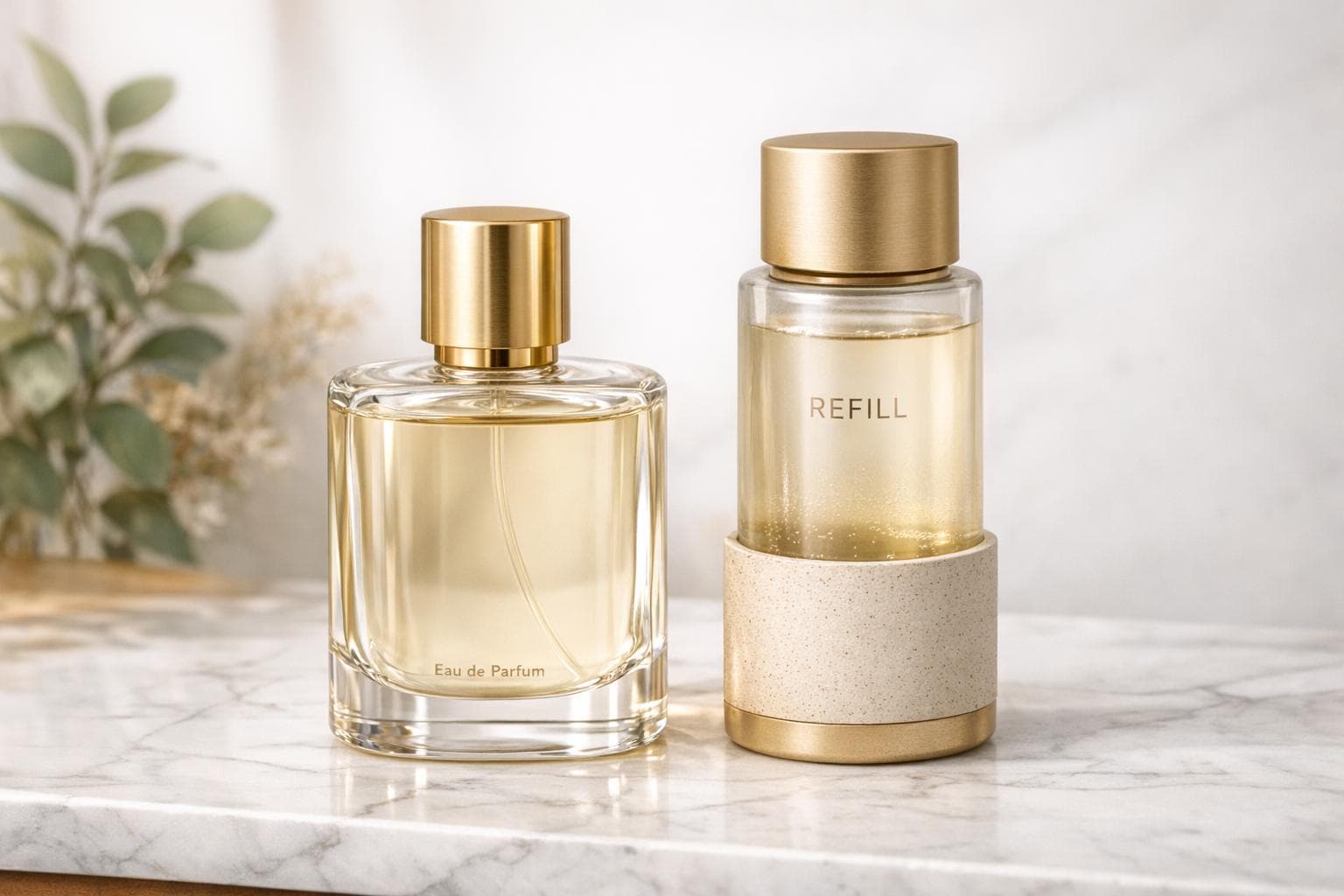
Οι μάρκες πολυτελείας επανεξετάζουν τη συσκευασία αρωμάτων για να αντιμετωπίσουν τη σπατάλη και να προσελκύσουν αγοραστές με οικολογική συνείδηση. Με 20 δισεκατομμύρια συσκευασίες αρωμάτων να απορρίπτονται κάθε χρόνο, τα επαναγεμιζόμενα συστήματα γίνονται μια πιο έξυπνη επιλογή τόσο για τον πλανήτη όσο και για το πορτοφόλι. Δείτε γιατί:
- Εξοικονόμηση κόστους: Τα ανταλλακτικά μειώνουν την τιμή ανά χιλιοστόλιτρο σε σύγκριση με την αγορά νέων φιαλών. Για παράδειγμα, ένα ανταλλακτικό 100ml YSL Libre μειώνει τα απορρίμματα συσκευασίας κατά περισσότερο από 50%.
- Μειωμένα απορρίμματα: Τα επαναγεμιζόμενα συστήματα περιορίζουν τη χρήση γυαλιού, πλαστικού και χαρτονιού. Οι επαναγεμιζόμενες επιλογές της Mugler εξοικονομούν έως και 70% των υλικών.
- Ανθεκτικός σχεδιασμός: Πολλές μάρκες δημιουργούν πλέον επαναγεμιζόμενες φιάλες ως ανθεκτικά, διακοσμητικά αντικείμενα.
- Ζήτηση από τους καταναλωτές: Το 78% των αγοραστών προτιμά βιώσιμα προϊόντα, με τις επαναγεμιζόμενες επιλογές να ευθυγραμμίζονται με τις αξίες τους.
Οι επαναγεμιζόμενες μορφές, οι υπηρεσίες αναπλήρωσης στο κατάστημα και τα refill pouches μεταμορφώνουν τα αρώματα πολυτελείας σε μια πιο υπεύθυνη και διαχρονική εμπειρία.
Προβλήματα με τις τυπικές φιάλες αρωμάτων πολυτελείας
Απορρίμματα από φιάλες μίας χρήσης
Η βιομηχανία ομορφιάς ευθύνεται για την παραγωγή του εντυπωσιακού αριθμού των 120 δισεκατομμυρίων μονάδων συσκευασίας παγκοσμίως κάθε χρόνο, και το μεγαλύτερο μέρος τους δεν φτάνει ποτέ καν στα προγράμματα ανακύκλωσης του δήμου. Τα αρώματα πολυτελείας διαδραματίζουν αξιοσημείωτο ρόλο σε αυτό το ζήτημα λόγω της "έντασης συσκευασίας" τους. Σκεφτείτε τις βαριές γυάλινες φιάλες, τις περίτεχνες μεταλλικές λεπτομέρειες, τις πλαστικές αντλίες και τα πολυστρωματικά χαρτονένια κουτιά που συχνά τα συνοδεύουν [5, 11]. Από όλα τα απορρίμματα συσκευασίας που παράγει ο τομέας της ομορφιάς, μόνο 14% φτάνει πράγματι σε εγκαταστάσεις ανακύκλωσης, και από αυτό, μόλις 9% ανακυκλώνεται επιτυχώς. Τα υπόλοιπα; Καταλήγουν σε χωματερές για δεκαετίες, επιβαρύνοντας ολοένα περισσότερο το περιβάλλον.
Υψηλό κόστος για αγοραστές και μάρκες
Η περίτεχνη συσκευασία των παραδοσιακών αρωμάτων πολυτελείας δεν βλάπτει μόνο το περιβάλλον - επιβαρύνει σημαντικά και το πορτοφόλι. Για τις μάρκες, η παραγωγή περίτεχνων γυάλινων φιαλών και διακοσμητικών μεταλλικών στοιχείων είναι μια διαδικασία απαιτητική σε πόρους, που συνεχίζει να γίνεται ακριβότερη. Αυτά τα κόστη αναπόφευκτα μετακυλίονται στους καταναλωτές, οι οποίοι τελικά πληρώνουν για τη συσκευασία κάθε φορά που αγοράζουν μια νέα φιάλη. Αντί να αγοράζουν μόνο το ίδιο το άρωμα, καλύπτουν επίσης το κόστος του βαριού γυαλιού, των πλαστικών και των μετάλλων που συνθέτουν τη συσκευασία. Αυτός ο κύκλος καθιστά τη συσκευασία σημαντικό παράγοντα αύξησης της συνολικής τιμής των αρωμάτων πολυτελείας.
Απόσταση από τους αγοραστές με οικολογική συνείδηση
Οι νεότεροι καταναλωτές σήμερα αντιμετωπίζουν ολοένα πιο κριτικά την παραδοσιακή συσκευασία πολυτελείας, θεωρώντας την σπάταλη και ασύμβατη με τις οικολογικές τους προτεραιότητες. Η απομάκρυνση από την υπερβολική χλιδή προς αυτό που ορισμένοι αποκαλούν "ήσυχη πολυτέλεια" αντανακλά μια ευρύτερη προτίμηση για προσεγμένο, λειτουργικό σχεδιασμό που δίνει προτεραιότητα στη μακροπρόθεσμη αξία έναντι της αναλώσιμης υπερβολής. Στην πραγματικότητα, 78% των καταναλωτών έχει δείξει ενδιαφέρον για την αγορά πιο βιώσιμων προϊόντων. Ωστόσο, πολλοί εξακολουθούν να αγνοούν το περιβαλλοντικό τίμημα που έχουν τα αγαπημένα τους αρώματα λόγω των συσκευασιών μίας χρήσης. Ιδίως για τους Millennials και τη Gen Z, η υπερβολική, μη λειτουργική συσκευασία αρχίζει να μοιάζει λιγότερο με ένδειξη κύρους και περισσότερο με σύμβολο σπατάλης.
Όπως το θέτει ο Arnaud Lancelot, Head of Reuse Projects στη We Don’t Need Roads:
"Οι στάσεις έχουν αρχίσει να αλλάζουν με τα πρόσφατα προβλήματα στην προμήθεια φιαλών και την έκρηξη στο κόστος τους".
Αυτές οι μεταβαλλόμενες αντιλήψεις αναδεικνύουν την αυξανόμενη ζήτηση για επαναγεμιζόμενες λύσεις που συνδυάζουν την πολυτέλεια με τη βιωσιμότητα, ευθυγραμμιζόμενες με τις αξίες των σημερινών καταναλωτών.
Πώς λειτουργούν τα επαναγεμιζόμενα συστήματα αρωμάτων
Οι μάρκες πολυτελείας επαναπροσδιορίζουν τον τρόπο με τον οποίο βιώνουμε το άρωμα, εισάγοντας επαναγεμιζόμενα συστήματα που συνδυάζουν τη βιωσιμότητα με την κομψότητα.
Επαναγεμιζόμενες φιάλες με αφαιρούμενα εξαρτήματα
Οι επαναγεμιζόμενες φιάλες έχουν εξελιχθεί σημαντικά, προσφέροντας έναν άψογο και οικολογικά συνειδητό τρόπο αναπλήρωσης των αγαπημένων σας αρωμάτων. Αυτά τα σχέδια συχνά διαθέτουν εξωτερική φιάλη κατασκευασμένη από βαρύ γυαλί και διακοσμημένη με μέταλλο, η οποία παραμένει μαζί σας επ’ αόριστον. Αντικαθίστανται μόνο τα εσωτερικά, επαναγεμιζόμενα εξαρτήματα. Προηγμένες τεχνολογίες, όπως το RT-Twist της Techniplast, αφαιρούν κάθε αβεβαιότητα από τη διαδικασία αναπλήρωσης. Το σύστημα αυτό χρησιμοποιεί καπάκι με αισθητήρα που σταματά αυτόματα τη ροή όταν η φιάλη γεμίσει, αποτρέποντας διαρροές και σπατάλη. Το μόνο που χρειάζεται είναι να βιδώσετε την ανταλλακτική κασέτα στη φιάλη σας και ο αισθητήρας αναλαμβάνει τα υπόλοιπα.
Άλλες μάρκες, όπως εκείνες που χρησιμοποιούν το σύστημα Replay της Silgan Dispensing, απλοποιούν ακόμη περισσότερο τη διαδικασία με έναν μηχανισμό πίεσης προς τα κάτω που απελευθερώνει το άρωμα με μία ομαλή κίνηση. Ορισμένα σχέδια ενσωματώνουν ακόμη και ελαφριές κασέτες αλουμινίου μέσα σε γυάλινη συσκευασία, δημιουργώντας μια κομψή μεταλλική όψη που αναβαθμίζει τη συνολική αισθητική. Η επιλογή ενός ανταλλακτικού μπορεί επίσης να μειώσει σημαντικά το περιβαλλοντικό σας αποτύπωμα. Για παράδειγμα, η αναπλήρωση μιας φιάλης 50ml Prada Paradoxe με ανταλλακτικό 100ml μειώνει το ανθρακικό σας αποτύπωμα κατά 74% σε σύγκριση με την αγορά δύο νέων φιαλών.
Υπηρεσίες αναπλήρωσης στο κατάστημα
Για όσους απολαμβάνουν μια πιο προσωπική πινελιά, οι υπηρεσίες αναπλήρωσης στο κατάστημα αναβαθμίζουν την εμπειρία του αρώματος σε κάτι ξεχωριστό. Αυτές οι υπηρεσίες ξεπερνούν την πρακτικότητα, δημιουργώντας ένα τελετουργικό που ενισχύει τη σύνδεση ανάμεσα στη μάρκα και τον πελάτη. Η Mugler ήταν από τις πρώτες που εισήγαγε αυτή την ιδέα με τα in-store fountains της - πολυτελείς σταθμούς διάθεσης εμπνευσμένους από τη μεγαλοπρέπεια των αρωματικών σιντριβανιών του 18ου αιώνα.
Η L’Oréal Luxe έχει υιοθετήσει αυτή την ιδέα, εγκαθιστώντας refill fountains σε επιλεγμένα καταστήματα Dillard’s στις Ηνωμένες Πολιτείες. Αυτοί οι σταθμοί επιτρέπουν στους πελάτες να αναπληρώνουν εμβληματικά αρώματα όπως το La Vie Est Belle της Lancôme, το Libre της YSL και το Acqua di Gio της Armani, όλα σε έναν σταθμό. Η Silvia Galfo, President της L’Oréal Luxe U.S., υπογραμμίζει την απήχηση αυτής της προσέγγισης:
"Περίπου το 25% ή 30% της δραστηριότητάς μας γίνεται με το refill. Η κίνηση του να έρχεσαι με τη φιάλη σου, να λαμβάνεις μια μικρή υπηρεσία - βλέπουμε επιτυχία σε αυτό".
Η Sephora έχει επίσης δοκιμάσει multi-brand refill fountains, καθιστώντας πιο εύκολο από ποτέ για τους πελάτες να αναπληρώνουν αρώματα από διαφορετικές σειρές σε μία βολική τοποθεσία.
Refill pouches και travel sprays
Για όσους προτιμούν την άνεση της αναπλήρωσης στο σπίτι, τα refill pouches και οι φιάλες μεγάλου μεγέθους αποτελούν εξαιρετική επιλογή. Αυτά τα pouches, κατασκευασμένα από εύκαμπτο πλαστικό ή "stretch glass", ζυγίζουν πολύ λιγότερο από την παραδοσιακή συσκευασία, ενώ εξακολουθούν να προστατεύουν το άρωμα. Ένα ανταλλακτικό 100ml του Mugler Angel EDP, με τιμή 164 €, χρησιμοποιεί 70% λιγότερο γυαλί, 60% λιγότερο πλαστικό, 100% λιγότερο μέταλλο και 76% λιγότερο χαρτόνι σε σύγκριση με την αγορά νέων φιαλών.
Τα travel sprays προσφέρουν μια ακόμη πρακτική λύση. Συμπαγή και ελαφριά, οι premium atomizers πωλούνται περίπου στα €9,75, διευκολύνοντας τη μεταφορά του signature scent σας χωρίς να χρειάζεται να έχετε μαζί μια φιάλη πλήρους μεγέθους. Είτε αναπληρώνετε στο σπίτι είτε ετοιμάζεστε για ταξίδι, αυτές οι επιλογές παρατείνουν τη ζωή του αρώματός σας και μειώνουν την ανάγκη για αναλώσιμες travel-sized φιάλες.
Γιατί οι μάρκες πολυτελείας επιλέγουν επαναγεμιζόμενες λύσεις
Επίτευξη περιβαλλοντικών στόχων
Οι μάρκες πολυτελείας υιοθετούν επαναγεμιζόμενα συστήματα ως έναν τρόπο ευθυγράμμισης με τους στόχους ESG (Environmental, Social, and Governance), διατηρώντας παράλληλα την premium απήχησή τους. Με την παγκόσμια βιομηχανία ομορφιάς να παράγει 120 δισεκατομμύρια μονάδες συσκευασίας ετησίως - οι περισσότερες από τις οποίες δεν ανακυκλώνονται μέσω των δημοτικών προγραμμάτων - η επαναγεμιζόμενη συσκευασία προσφέρει μια πρακτική εναλλακτική. Έως το 2024, η παγκόσμια αγορά επαναγεμιζόμενων προϊόντων προβλέπεται να ξεπεράσει τα 45 € δισεκατομμύρια.
Η L’Oréal βρίσκεται στην πρώτη γραμμή αυτής της μετάβασης, αναφέροντας εντυπωσιακή αύξηση 1.621% στα επαναχρησιμοποιούμενα προϊόντα μεταξύ 2019 και 2024. Τον Ιούνιο του 2025, η εταιρεία λάνσαρε το #JoinTheRefillMovement, μια καμπάνια με επικεφαλής την Chief Corporate Responsibility Officer Ezgi Barcenas και την Chief Corporate Affairs Officer Blanca Juti. Αυτή η πρωτοβουλία ανέδειξε τα περιβαλλοντικά οφέλη των refills, όπως το γεγονός ότι ένα ανταλλακτικό 100ml του La Vie Est Belle Elixir χρησιμοποιεί 73% λιγότερο γυαλί, 66% λιγότερο πλαστικό και 61% λιγότερο χαρτόνι σε σύγκριση με δύο φιάλες 50ml. Όπως δήλωσε η Ezgi Barcenas:
"Ως παγκόσμιος ηγέτης στην ομορφιά, έχουμε την ευκαιρία, αλλά και την ευθύνη, να δημιουργήσουμε πιο κυκλικές λύσεις και να θέσουμε ένα νέο πρότυπο για τον κλάδο".
Τα επαναγεμιζόμενα σχέδια επιτρέπουν στις μάρκες να μεταβούν από το παραδοσιακό μοντέλο "πάρε-φτιάξε-πέτα" σε ένα κυκλικό μοντέλο. Διατηρώντας την εξωτερική συσκευασία και αντικαθιστώντας μόνο τα εσωτερικά εξαρτήματα, οι μάρκες μειώνουν τα ενεργοβόρα υλικά όπως το γυαλί και το μέταλλο. Αυτή η προσέγγιση βοηθά στην επίτευξη στόχων βιωσιμότητας, διατηρώντας παράλληλα ανέπαφη την αίσθηση πολυτέλειας. Πέρα από τα περιβαλλοντικά οφέλη, αυτές οι πρακτικές ενισχύουν επίσης την εμπιστοσύνη και την αφοσίωση των καταναλωτών.
Ενίσχυση της αφοσίωσης των πελατών
Τα επαναγεμιζόμενα συστήματα δεν ωφελούν μόνο τον πλανήτη - δημιουργούν επίσης έναν κύκλο διατήρησης πελατών. Τα οικονομικά είναι απλά: τα refills κοστίζουν λιγότερο ανά χιλιοστόλιτρο από την αγορά νέων φιαλών, προσφέροντας καλύτερη αξία ενώ διατηρούν μια premium εμπειρία. Σύμφωνα με τη Laurence Pardieu-Duthil, Chief Sustainability Officer της L’Oréal για το Global Travel Retail, υπάρχει και ένα ακόμη απρόσμενο πλεονέκτημα:
"Έχουμε αποδείξει ότι τα refills προσελκύουν επίσης νέους καταναλωτές, οι οποίοι έλκονται από τη χαμηλότερη αρχική τιμή και όχι μόνο από τη βιωσιμότητα".
Δεν πρόκειται όμως μόνο για το κόστος. Όταν οι πελάτες αγοράζουν μια όμορφα σχεδιασμένη φιάλη που προορίζεται να διαρκέσει, δημιουργούν συναισθηματικό δεσμό με το προϊόν. Η αναπλήρωση ενισχύει αυτόν τον δεσμό, καλλιεργώντας μακροχρόνια αφοσίωση. Μελέτες δείχνουν ότι το 90% των ταξιδιωτών θεωρούν τις μάρκες πολυτελείας που προσφέρουν refills ως φροντιστικές και κοινωνικά υπεύθυνες.
Για να ενθαρρύνουν τις συνήθειες αναπλήρωσης, οι μάρκες χρησιμοποιούν έξυπνες στρατηγικές όπως το bundling. Για παράδειγμα, travel-retail sets που περιλαμβάνουν μια φιάλη πλήρους μεγέθους μαζί με ένα refill διευκολύνουν τους πελάτες να ξεκινήσουν μια ρουτίνα αναπλήρωσης. Ορισμένες μάρκες έχουν προσθέσει ακόμη και μοναδικά χαρακτηριστικά ασφαλείας, όπως εξατομικευμένα κλειδιά, ώστε να διασφαλίζουν ότι μόνο τα δικά τους refills ταιριάζουν στις πολυτελείς θήκες.
Επαναπροσδιορισμός της πολυτέλειας μέσω του σχεδιασμού
Η επαναγεμιζόμενη συσκευασία δεν είναι απλώς πρακτική - αποτελεί ευκαιρία για τις μάρκες πολυτελείας να καινοτομήσουν και να αναβαθμίσουν την εμπειρία του πελάτη. Αυτά τα σχέδια, που συχνά περιγράφονται ως "made to last", επικεντρώνονται στη δημιουργία θηκών ποιότητας κειμηλίου που μετατρέπουν την αναπλήρωση σε ένα εκλεπτυσμένο τελετουργικό. Στα τέλη του 2025, η Louis Vuitton λάνσαρε το "La Beauté Louis Vuitton", μια επαναγεμιζόμενη συλλογή μακιγιάζ σχεδιασμένη από την Dame Pat McGrath. Η σειρά περιλαμβάνει κραγιόν και σκιές ματιών σε εξαίσιες θήκες με bespoke σύστημα κλειδώματος με floral μοτίβο.
Η μηχανική παίζει επίσης καθοριστικό ρόλο στην αναβάθμιση της εμπειρίας πολυτέλειας. Για παράδειγμα, το σύστημα RT-Twist της Techniplast χρησιμοποιεί καπάκι με αισθητήρα που σταματά αυτόματα τη ροή όταν η φιάλη γεμίσει, εξαλείφοντας τις διαρροές. Η Chanel έχει ακολουθήσει διαφορετική κατεύθυνση, ενσωματώνοντας ελαφριές κασέτες αλουμινίου σε διαφανή γυάλινα σχέδια, όπου οι μεταλλικές αντανακλάσεις προσθέτουν στη οπτική γοητεία του προϊόντος. Όπως εξήγησε η Marissa Pagnani McGowan, Chief Sustainability Officer στη L’Oréal North America:
"Δεν πρόκειται απλώς για τη μείωση των απορριμμάτων - πρόκειται για τη δημιουργία ενός νέου τελετουργικού πολυτέλειας, όπου η βιωσιμότητα γίνεται μέρος της premium εμπειρίας".
Αυτή η εστίαση σε εκλεπτυσμένα, διαχρονικά σχέδια ευθυγραμμίζεται με την τάση της "ήσυχης πολυτέλειας", η οποία δίνει έμφαση στη διακριτική κομψότητα. Μεταξύ 2017 και 2023, οι επαναγεμιζόμενες προτάσεις σε βασικές αγορές όπως οι ΗΠΑ, το Ηνωμένο Βασίλειο και η Γαλλία αυξήθηκαν έως και 279%. Είναι σαφές ότι η καινοτομία στον επαναγεμιζόμενο σχεδιασμό δεν είναι μόνο περιβαλλοντικά υπεύθυνη - είναι και μια έξυπνη επιχειρηματική κίνηση.
sbb-itb-fb213bc
Δημιουργία συλλογής αρωμάτων με επαναγεμιζόμενες επιλογές
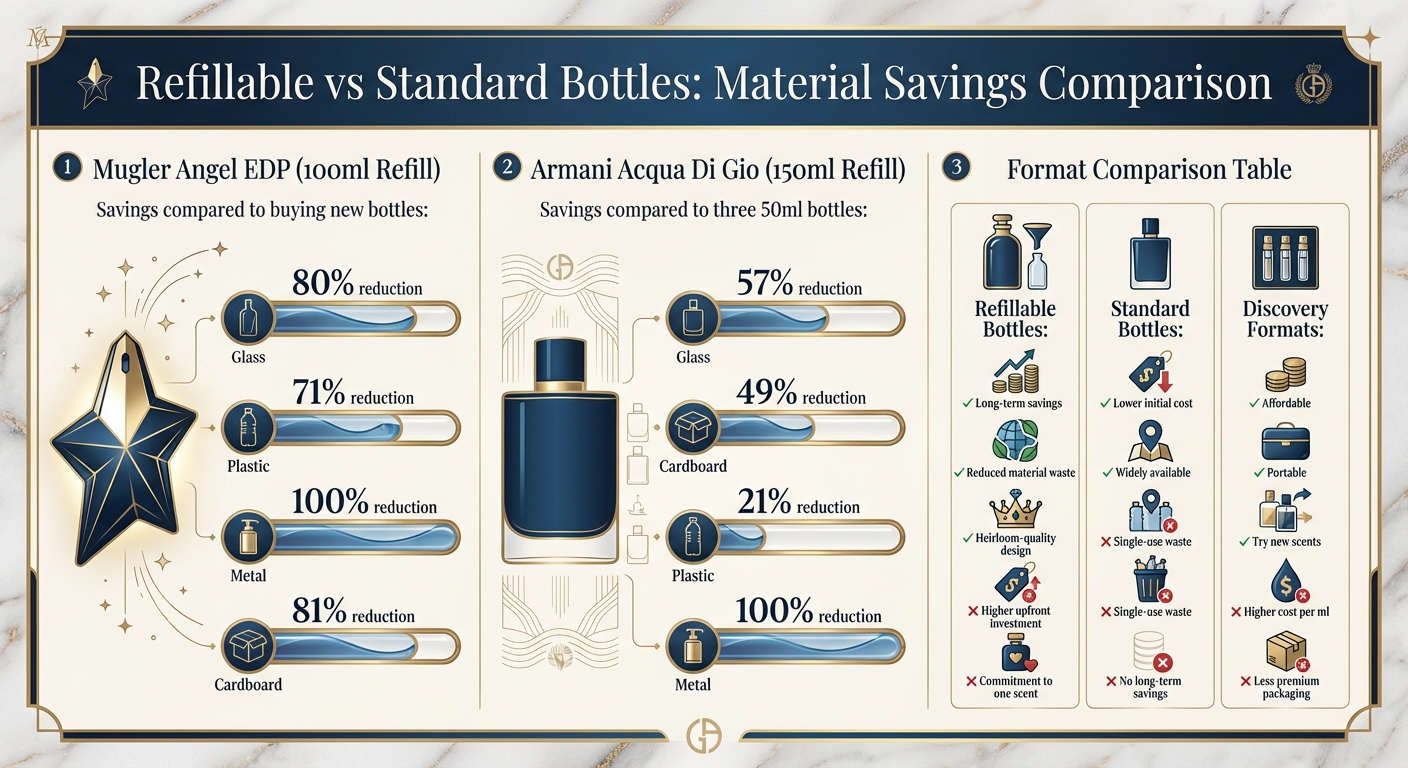
Σύγκριση περιβαλλοντικού αντίκτυπου: επαναγεμιζόμενες έναντι τυπικών φιαλών αρωμάτων
Από μεμονωμένες φιάλες σε ευέλικτες συλλογές
Ο τρόπος με τον οποίο οι άνθρωποι δημιουργούν τις συλλογές αρωμάτων τους εξελίσσεται, χάρη στην αυξανόμενη απήχηση των επαναγεμιζόμενων συστημάτων. Αντί να περιορίζονται στις παραδοσιακές φιάλες πλήρους μεγέθους, πολλοί στρέφονται σε πιο ευέλικτες επιλογές - συνδυάζοντας επαναγεμιζόμενα signature scents με μικρότερες μορφές όπως travel sprays και decants. Αυτή η αλλαγή ταιριάζει με τον γρήγορο, κινητικό τρόπο ζωής του σήμερα.
Τα επαναγεμιζόμενα συστήματα συχνά διαθέτουν εξωτερικά δοχεία από ανθεκτικά υλικά όπως βαρύ γυαλί ή μέταλλο, σχεδιασμένα να παραμένουν μόνιμο στοιχείο στο μπουντουάρ σας. Αντικαθίσταται μόνο το εσωτερικό refill, αντανακλώντας τη διακριτική κομψότητα της τάσης της "ήσυχης πολυτέλειας". Εδώ, η απλότητα και η φινέτσα υπερισχύουν της επιδεικτικής, υπερβολικής συσκευασίας.
Τα travel-retail sets έχουν επίσης αποκτήσει δυναμική ως σημείο εισόδου σε αυτή τη νέα προσέγγιση συλλογής. Αυτά τα sets συχνά συνδυάζουν μια φιάλη πλήρους μεγέθους με ένα refill, ενθαρρύνοντας βιώσιμες συνήθειες από την αρχή. Αυτή η αλλαγή στον τρόπο με τον οποίο οι άνθρωποι επιμελούνται τις συλλογές τους αναδεικνύει την αυξανόμενη σύνδεση ανάμεσα στην εξερεύνηση και τις αγορές πλήρους μεγέθους.
Σύγκριση επαναγεμιζόμενων και μη επαναγεμιζόμενων επιλογών
Κάθε μορφή αρώματος εξυπηρετεί έναν μοναδικό σκοπό στη δημιουργία μιας ολοκληρωμένης αρωματικής γκαρνταρόμπας. Ακολουθεί μια πιο προσεκτική ματιά στα πλεονεκτήματα και τα μειονεκτήματά τους:
| Μορφή | Οφέλη | Μειονεκτήματα |
|---|---|---|
| Επαναγεμιζόμενες φιάλες | Προσφέρουν μακροπρόθεσμη εξοικονόμηση, μειωμένη σπατάλη υλικών και σχεδιασμό ποιότητας κειμηλίου. | Απαιτούν υψηλότερη αρχική επένδυση και δέσμευση σε ένα άρωμα. |
| Τυπικές φιάλες | Πιο προσιτές αρχικά και ευρέως διαθέσιμες. | Παράγουν απορρίμματα μίας χρήσης και δεν προσφέρουν μακροπρόθεσμα οικονομικά οφέλη. |
| Μορφές ανακάλυψης | Προσιτές, φορητές και ιδανικές για δοκιμή νέων αρωμάτων. | Υψηλότερο κόστος ανά χιλιοστόλιτρο και λιγότερο premium συσκευασία. |
Για παράδειγμα, η αναπλήρωση μιας φιάλης 100 ml Mugler Angel Eau de Parfum μπορεί να εξοικονομήσει περίπου 80% του γυαλιού, 71% του πλαστικού, 100% του μετάλλου και 81% του χαρτονιού σε σύγκριση με την αγορά νέας φιάλης. Αντίστοιχα, ένα refill 150 ml του Armani Acqua Di Gio εξοικονομεί 57% του γυαλιού, 49% του χαρτονιού, 21% του πλαστικού και 100% του μετάλλου σε σύγκριση με την αγορά τριών φιαλών των 50 ml.
Σύνδεση της ανακάλυψης με τη δέσμευση σε πλήρες μέγεθος
Ένα από τα μεγαλύτερα εμπόδια στον κόσμο των αρωμάτων ήταν πάντα η γεφύρωση του χάσματος ανάμεσα στη δοκιμή και τη δέσμευση σε μια φιάλη πλήρους μεγέθους. Οι μορφές ανακάλυψης κάνουν αυτή τη διαδικασία ευκολότερη, δίνοντας στους καταναλωτές την ευκαιρία να δοκιμάσουν διεξοδικά ένα άρωμα πριν επενδύσουν σε ένα επαναγεμιζόμενο σύστημα. Αυτή η προσέγγιση ελαχιστοποιεί τον κίνδυνο να ξοδέψουν σε μια μεγάλη φιάλη που ίσως δεν ταιριάζει στις προτιμήσεις τους.
Πλατφόρμες όπως η Scento κάνουν αυτή τη μετάβαση απρόσκοπτη, προσφέροντας επιμελημένα decants σε μεγέθη όπως φιαλίδια 2 ml, 5 ml και 8 ml, καθώς και μπουκάλι decant 30 ml για τα περισσότερα αρώματα. Αυτές οι μικρότερες, travel-friendly επιλογές επιτρέπουν στους αγοραστές να δοκιμάσουν αυθεντικά designer αρώματα - ένα vial 8 ml, για παράδειγμα, παρέχει περίπου 120 ψεκασμούς - πριν αποφασίσουν για μια επαναγεμιζόμενη φιάλη.
Η Laurence Pardieu-Duthil, Chief Sustainability Officer for Global Travel Retail στη L’Oréal, υπογραμμίζει αυτή τη μετατόπιση:
"Έχουμε αποδείξει ότι τα refills προσελκύουν επίσης νέους καταναλωτές, οι οποίοι έλκονται από τη χαμηλότερη αρχική τιμή και όχι μόνο από τη βιωσιμότητα".
Για τους συχνούς χρήστες αρωμάτων, η εξοικονόμηση αυξάνεται γρήγορα. Επιλογές refill όπως το YSL Beauty Libre στα 152 € για 100 ml ή το Prada Paradoxe στα 154 € για 100 ml προσφέρουν σημαντικά πλεονεκτήματα κόστους ανά χιλιοστόλιτρο.
Συμπέρασμα
Τα επαναγεμιζόμενα συστήματα αναδιαμορφώνουν τη βιομηχανία αρωμάτων πολυτελείας, προσφέροντας έναν πιο έξυπνο και βιώσιμο δρόμο προς τα εμπρός. Για μάρκες όπως η Mugler, τα refills αντιπροσωπεύουν πλέον το 25% έως 30% της συνολικής τους δραστηριότητας, αποδεικνύοντας ότι η μείωση των απορριμμάτων και η αύξηση της κερδοφορίας μπορούν να συμβαδίζουν.
Τα περιβαλλοντικά πλεονεκτήματα είναι δύσκολο να αγνοηθούν. Μειώνοντας τη χρήση υλικών, τα επαναγεμιζόμενα συστήματα συμβάλλουν στον ευρύτερο στόχο μιας κυκλικής οικονομίας - όπου οι πόροι επαναχρησιμοποιούνται αντί να απορρίπτονται.
Δεν αφορά όμως μόνο το περιβάλλον· αυτά τα συστήματα αναβαθμίζουν και την εμπειρία του καταναλωτή. Η επένδυση εξαρχής σε μια όμορφα κατασκευασμένη φιάλη μοιάζει ανταποδοτική όταν τα refills γίνονται μια οικονομικά αποδοτική εναλλακτική. Επιπλέον, η κατοχή μιας υψηλής ποιότητας, επαναχρησιμοποιούμενης φιάλης προσθέτει αίσθηση διάρκειας και προσωπικής αξίας στη συλλογή αρωμάτων σας. Είναι ένας πιο προσεγμένος τρόπος να δημιουργήσετε μια αρωματική γκαρνταρόμπα, παραμένοντας πιστοί στις αξίες σας.
Οι αριθμοί αφηγούνται μια πειστική ιστορία. Οι επαναγεμιζόμενες προτάσεις έχουν εκτοξευθεί κατά 1.621% και η παγκόσμια αγορά έχει ξεπεράσει τα $45 δισεκατομμύρια. Επιπλέον, το 78% των καταναλωτών εκφράζει προτίμηση για βιώσιμα προϊόντα. Αυτή η αλλαγή αναδεικνύει πώς η πολυτέλεια και η βιωσιμότητα δεν βρίσκονται πλέον σε αντίθεση - δημιουργούν ένα νέο πρότυπο διαρκούς αξίας.
Για να γίνει η μετάβαση απρόσκοπτη, τα discovery decants από τη Scento προσφέρουν έναν εύκολο τρόπο εξερεύνησης αρωμάτων πριν τη δέσμευση σε πλήρη φιάλη. Μαζί, αυτές οι καινοτομίες εκσυγχρονίζουν το ταξίδι του αρώματος πολυτελείας - από τη δοκιμή έως την απόκτηση - μειώνοντας τα απορρίμματα σε κάθε στάδιο. Το αποτέλεσμα; Ένας πιο υπεύθυνος και πιο απολαυστικός τρόπος να απολαμβάνετε την τέχνη του αρώματος.
Συχνές ερωτήσεις
Πώς βοηθούν τα επαναγεμιζόμενα συστήματα αρωμάτων το περιβάλλον;
Τα επαναγεμιζόμενα συστήματα αρωμάτων προσφέρουν έναν πιο έξυπνο τρόπο μείωσης των απορριμμάτων, επαναχρησιμοποιώντας την αρχική φιάλη και αντικαθιστώντας μόνο την αρωματική κασέτα. Διατηρώντας ανθεκτικά γυάλινα ή μεταλλικά δοχεία σε χρήση, οι μάρκες μειώνουν σημαντικά την παραγωγή νέων υλικών συσκευασίας. Για παράδειγμα, η αναπλήρωση μιας φιάλης αρώματος πολυτελείας μπορεί να εξοικονομήσει έως και 44% του γυαλιού, 67% του πλαστικού και 61% του χαρτονιού σε σύγκριση με τη δημιουργία μιας ολοκαίνουργιας φιάλης.
Πολλές επαναγεμιζόμενες φιάλες σχεδιάζονται επίσης ώστε να είναι ελαφρύτερες, γεγονός που συμβάλλει στη μείωση των εκπομπών κατά τη μεταφορά και ελαχιστοποιεί τη χρήση υλικών. Αυτός ο προσεγμένος σχεδιασμός όχι μόνο περιορίζει τα απορρίμματα, αλλά μειώνει και το ανθρακικό αποτύπωμα που συνδέεται με την παραγωγή και την αποστολή. Καθώς περισσότεροι άνθρωποι επιλέγουν βιώσιμες λύσεις, τα επαναγεμιζόμενα συστήματα αναδεικνύονται σε σημαντική μετατόπιση προς μια πιο πράσινη προσέγγιση στην αγορά πολυτελείας.
Ποια είναι τα οικονομικά πλεονεκτήματα της επιλογής επαναγεμιζόμενων αρωμάτων πολυτελείας;
Τα επαναγεμιζόμενα αρώματα πολυτελείας προσφέρουν πιο προσιτό κόστος ανά χιλιοστόλιτρο σε σύγκριση με την αγορά φιαλών πλήρους μεγέθους. Παρότι το αρχικό κόστος μπορεί να φαίνεται υψηλότερο, η μακροπρόθεσμη εξοικονόμηση είναι σημαντική, καθιστώντας τα μια ελκυστική επιλογή για όσους αγαπούν τα αρώματα.
Πέρα από τα οικονομικά οφέλη, οι επαναγεμιζόμενες επιλογές υποστηρίζουν συνήθειες με περιβαλλοντική συνείδηση, μειώνοντας τα απορρίμματα συσκευασίας και προωθώντας την προσεγμένη κατανάλωση. Αυτός ο συνδυασμός πρακτικότητας και οικολογικής επίγνωσης καθιστά τα επαναγεμιζόμενα αρώματα μια προσεγμένη και συνετή επιλογή τόσο για το πορτοφόλι σας όσο και για τον πλανήτη.
Γιατί οι επαναγεμιζόμενες επιλογές γίνονται δημοφιλείς στις μάρκες πολυτελείας;
Οι επαναγεμιζόμενες επιλογές κάνουν αισθητή την παρουσία τους στον κόσμο της πολυτέλειας, συνδυάζοντας οικολογικά συνειδητές αξίες με μια αναβαθμισμένη εμπειρία πελάτη. Αυτές οι μορφές επιτρέπουν στους καταναλωτές να επαναχρησιμοποιούν όμορφα κατασκευασμένες φιάλες, αντικαθιστώντας μόνο το προϊόν στο εσωτερικό. Το αποτέλεσμα; Σημαντική μείωση των απορριμμάτων. Για παράδειγμα, οι μάρκες πολυτελείας μπορούν να περιορίσουν υλικά συσκευασίας όπως το γυαλί, το πλαστικό και το χαρτόνι έως και κατά 60%, προσφέροντας μια πιο αποδοτική ως προς τους πόρους προσέγγιση στην απόλαυση.
Οι αγοραστές με περιβαλλοντική ευαισθησία έλκονται ολοένα περισσότερο από τα μακροπρόθεσμα οφέλη των refillables. Πρόσφατες μελέτες αποκαλύπτουν αύξηση των επαναγεμιζόμενων επιλογών, που τροφοδοτείται από τις πρωτοβουλίες βιωσιμότητας των μαρκών και την αυξανόμενη επιθυμία των καταναλωτών για επιλογές με ουσιαστική αξία. Στις ΗΠΑ, σχεδόν οι μισοί καταναλωτές είναι διατεθειμένοι να ξοδέψουν περισσότερα για premium προϊόντα που δίνουν προτεραιότητα στη μείωση της περιβαλλοντικής επιβάρυνσης. Αυτή η μετατόπιση σηματοδοτεί μια νέα εποχή πολυτέλειας, όπου η απόλαυση και η περιβαλλοντική ευθύνη συνυπάρχουν.
Εισάγοντας επαναγεμιζόμενες λύσεις, οι μάρκες πολυτελείας δίνουν στους πελάτες τους τη δυνατότητα να λαμβάνουν προσεγμένες αποφάσεις με επίγνωση της σπατάλης - χωρίς να θυσιάζουν την κομψότητα και την αποκλειστικότητα που ορίζουν την κατηγορία. Είναι ένα ουσιαστικό βήμα προς τον συνδυασμό της βιωσιμότητας με τη φινέτσα.

