

Rare perfume materials are hard to scale, and synthetic biology is one way around that. I’d sum it up like this: scientists can put a plant’s scent-making steps into yeast or bacteria, feed them sugar, and make the same perfume molecule by fermentation.
For you, that means three things:
- More stable supply for materials tied to slow-growing crops or scarce raw sources
- Less pressure on land, water, trees, and animal sources
- More consistency from batch to batch
But there’s a catch. It is still expensive and hard to scale. Many lab results stay below 100 mg/L, while commercial output often needs to reach the g/L range. In one case, lavandulol and lavandulyl acetate only reached 24,9–42,4 mg/L. And building a fermentation plant for aroma chemicals can cost around €45–135 million.
Here’s the short version:
- Orris root can take about 5 years before use in perfumery
- Some terpene molecules can harm the microbes that make them
- Purification is a major cost problem
- EU rules add time, cost, and labelling pressure
- Fermentation-derived vanillin can still cost about 2x more per kg than the petrochemical synthetic route
My take: this is not about replacing perfumery. It is about giving perfumers another source for rare molecules when farming, forestry, or animal sourcing cannot meet demand.
A simple side-by-side view:
| Topic | Natural sourcing | Synthetic biology |
|---|---|---|
| Supply | Can be seasonal or tight | More steady once scaled |
| Time to produce | Can take years | Fermentation runs in tanks |
| Pressure on source material | High for scarce crops/species | Lower direct harvest pressure |
| Batch consistency | Can vary | Usually more even |
| Cost today | Often high, but known | Often still high at scale |
| Main limit | Scarcity | Yield, scale-up, purification, rules |
If I put it plainly: the science works, but the factory economics still decide what reaches a perfumer’s shelf.
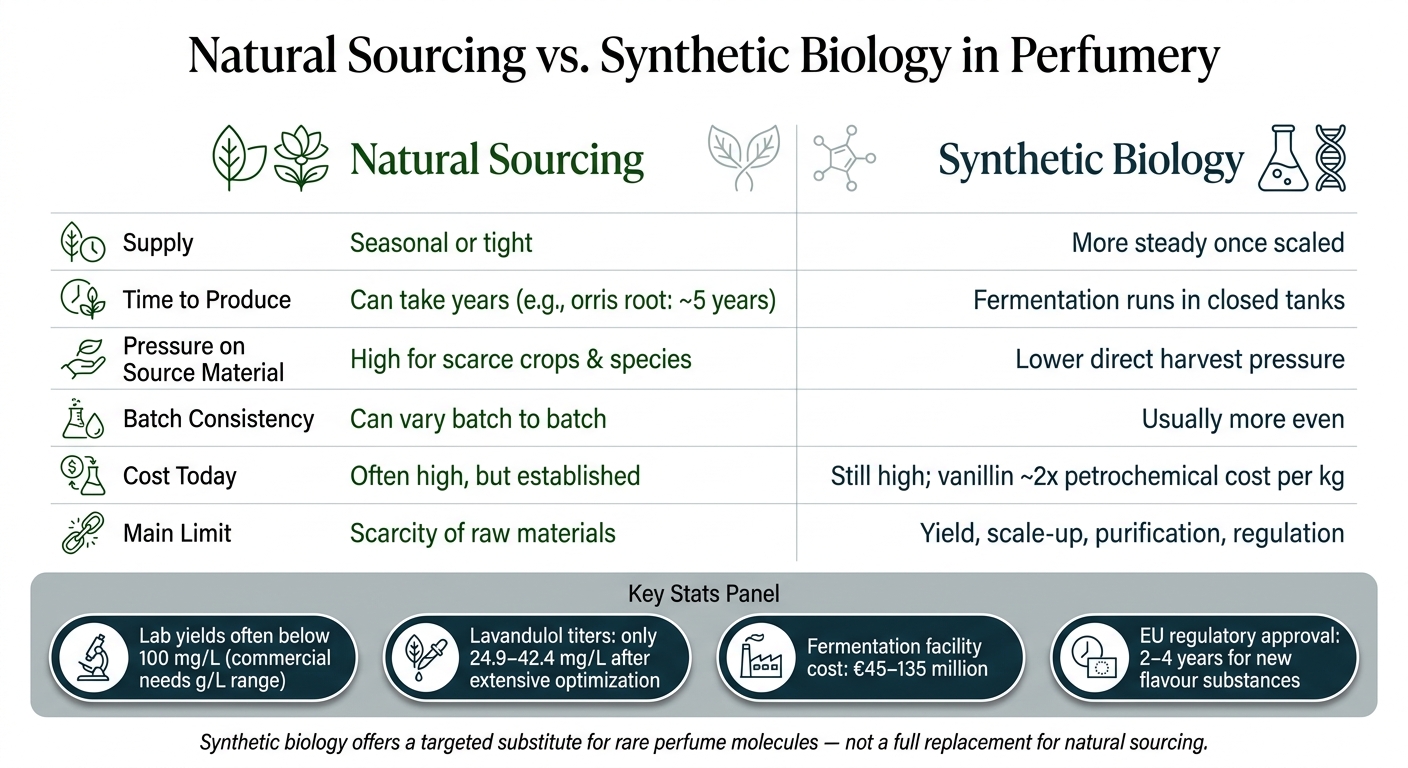
Natural Sourcing vs Synthetic Biology in Perfumery: Key Differences
Microbial Perfume : How Bacteria Can Actually Be Used To Create Designer Fragrances?
How synthetic biology recreates rare scent molecules
Scientists start by mapping the plant’s biosynthetic pathway for the target molecule, rather than relying on wild harvests. That pathway acts as the blueprint for microbial production.
From plant pathway to microbial host
Researchers transfer the pathway genes into a yeast or bacterial host. In plain terms, they teach the microbe to follow the same molecular steps the plant uses, so it can make the target aroma compound inside a controlled system.
How fermentation turns sugar into fragrance ingredients
The engineered microbe then ferments renewable sugars or biomass in closed tanks. As it processes that feedstock, it produces the fragrance ingredient, which is later extracted and purified. It’s a bit like giving the microbe a recipe and the right ingredients, then letting it do the work under steady conditions.
That controlled setup is what keeps output consistent from batch to batch. For perfumery, that matters a lot. A material has to smell the way it’s meant to smell every time.
Which molecules matter most in perfumery
The strongest candidates are rare molecules with an unstable natural supply. This gives perfumers steadier access to materials that might otherwise be too scarce to use at scale.
In practice, that’s what makes biosynthesis workable for modern fragrance supply: not hype, but dependable access to the scent molecules that matter most.
Why engineered biosynthesis is more eco-friendly than harvesting
The edge here is about the planet, not only supply chains.
Natural extraction vs engineered biosynthesis
Natural extraction puts pressure on land and water. Engineered biosynthesis makes the same molecules in bioreactors, with far less strain on ecosystems. Orris root is a good example. It needs years of growing and ageing before it can be processed - a long cycle that uses a lot of land, a lot of water, and steady harvesting from a crop that doesn’t give much, fast. Biosynthesis skips that whole bottleneck and produces the same molecular profile in a controlled bioreactor setting.
What this means for conservation and ingredient quality
Microbial production cuts direct pressure on species that don’t bounce back fast. Animal-derived musks and slow-growing trees like East Indian sandalwood don’t need to face the same harvesting pressure when a bioreactor can make the same aroma compound from renewable sugars. That’s the key point: biosynthesis is a targeted substitute, not a total swap. It steps in where scarcity is at its worst, while giving perfumers the same molecular profile batch after batch.
The hard part now is efficiency. These pathways still need to be tuned well enough to work at commercial scale.
Személyes illatszakértője már várja
Töltse ki rövid illatkvízünket, és fedezzen fel hiteles designer és niche parfümöket, amelyek az ízléséhez illenek – próbálja ki őket 2–8ml-es dekantokban és mintákban, hogy mindegyiket kipróbálhassa, mielőtt teljes flakon mellett dönt.
Találja meg illatátWhat still limits synthetic biology in perfumery
Rare fragrance molecules are still tough to produce at commercial scale. The biggest sticking points are pathway discovery, scale-up, and cost.
Finding pathways and improving yields
For many target molecules, the full plant pathway still isn’t fully mapped. That means rebuilding it in yeast or E. coli takes a lot of trial and error.
And even when researchers do know the pathway, the enzymes don’t always behave well outside the plant they came from. They can fold the wrong way, depend on cofactors the host cell can’t provide, or create unwanted side products that make purification harder. As a result, lab titers often remain below 100 mg/L, which makes production too expensive for many targets. To get into the g/L range needed for commercial manufacturing, teams usually have to reroute the host’s carbon flow, increase precursor supply, and shut down competing pathways. In practice, that often means several rounds of strain optimisation.
The work behind this can be slow and messy. A case study on lavandulol and lavandulyl acetate shows the point well: researchers screened dozens of candidate enzymes and built multi-plasmid expression systems, yet still reached titers of only 24,9–42,4 mg/L.
Scale-up, regulation, and cost
A strain that works nicely in a lab flask can still fall apart in an industrial bioreactor. Once production moves up in scale, oxygen supply, nutrient balance, and mixing all get harder to manage. On top of that, many terpene molecules are toxic to the same microbes meant to produce them. Monoterpenes such as α-pinene can inhibit E. coli growth before commercially useful titers are reached. Two-phase fermentation can reduce some of that stress, but it also adds more process complexity and more expense.
Purification is another problem people often underrate. Hydrophobic, volatile molecules are difficult to pull cleanly from broth. That step can account for a large share of total production cost, and tiny by-products that seem manageable in the lab can turn into a serious issue at ton scale. That affects batch consistency and regulatory compliance.
Commercial success also depends on rules, not just chemistry. In EU cosmetics, leave-on products must list fragrance allergens above 0,001 %. EU rules also leave the status of biotech-derived molecules as “natural” somewhat unclear. That matters because it can shape whether a biotech aroma ingredient reaches perfumers at all. Regulatory approval for new flavour substances in the EU can take 2–4 years, which slows innovation and pushes R&D costs much higher. For smaller brands, that kind of delay can stop a project cold.
Then there’s the most blunt limit of all: cost. Building a GMP-capable fermentation facility for aroma chemicals can demand capital investment of around €45–135 million, which sharply narrows the field of companies able to bring a new biotech molecule to market. Even fermentation-derived vanillin, one of the more established biotech fragrance ingredients, still costs about twice as much per kilogram as the guaiacol-derived synthetic version. And vanillin has had decades to improve. For rarer molecules, that price gap often decides whether they ever make it to market.
What synthetic biology means for the future of fragrance
Synthetic biology is shifting part of fragrance production away from fields and forests and into controlled fermentation tanks. In practice, that makes it less of a curiosity and more of a smart sourcing play for rare materials.
You can see that shift in the research itself. A lot of attention is going to terpenoids, a major group of fragrance compounds that includes many sandalwood and rose notes. Here, biosynthetic routes offer a clear edge over standard extraction. Biocatalysis is also moving forward, with engineered enzymes building complex molecules using less energy and producing less waste. On top of that, gene editing and AI are speeding up strain design and molecule screening.
The promise is obvious. Still, getting from a lab win to an ingredient a perfumer can buy at scale takes time. The main bottlenecks are not signs that the science has hit a wall. They sit in scale-up and commercial delivery.
As those bottlenecks get smaller, biotech ingredients are likely to move from niche status into the standard perfumer’s palette.
Synthetic biology won’t replace the craft of perfumery. It will broaden the range of ingredients perfumers can use with care and intention.
FAQs
How close is synthetic biology to commercial perfume scale?
Synthetic biology has moved well past the lab stage. In fragrance, it’s already being used at commercial scale.
Major fragrance houses now work with lab-grown, nature-identical molecules to make ingredients that are more consistent and easier to source.
This isn’t a niche corner of perfumery anymore. These biotech-derived materials allow year-round production at scale through microbial fermentation. That means less pressure on botanical harvesting and fewer supply swings tied to climate, crop yield, and sourcing limits.
Are biotech perfume molecules considered natural in the EU?
No. In the EU, biotech-derived fragrance ingredients are generally seen as nature-identical, not natural.
They’re produced in controlled bioreactors, where microorganisms recreate molecules that also exist in nature. So even if the final molecule matches the version found in a plant, it still isn’t classed as natural, because it wasn’t taken straight from a natural source.
Which rare fragrance materials are best suited to fermentation?
Fermentation works especially well for nature-identical fragrance molecules that are hard to source in large amounts or take a lot of effort to extract.
That includes materials linked to sandalwood, agarwood (oud), vanilla, and rose, along with compounds such as patchoulol, santalol, and valencene. It can also produce renewable options for animal-derived musk, plus nuanced scent profiles like orris root.