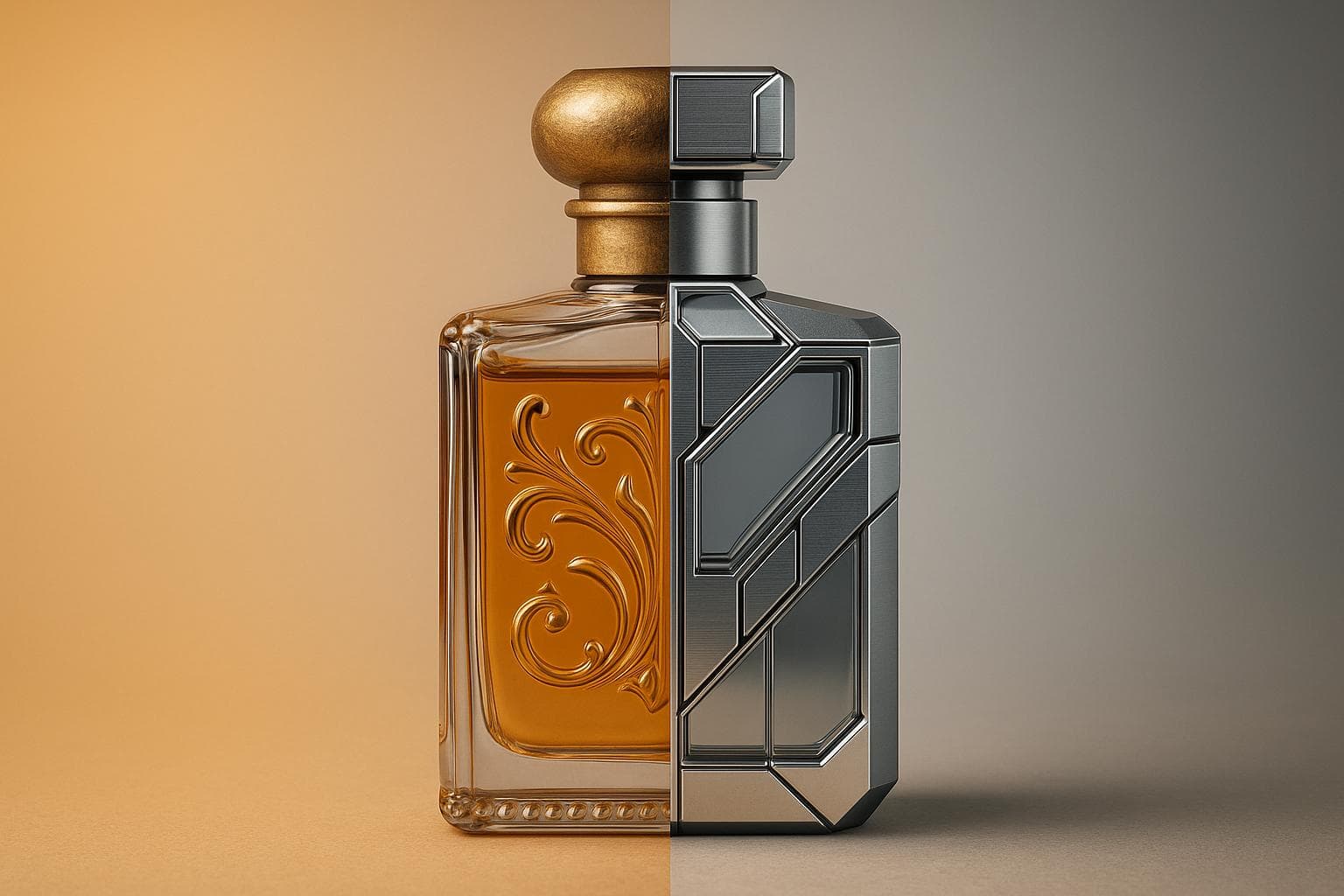
Artificial intelligence (AI) is changing the perfume world, speeding up processes that once took years. While "noses" (master perfumers) rely on years of training and memory to create fragrances, AI uses data and algorithms to suggest formulas in hours. Here’s a quick look at how these two methods compare:
- Traditional Perfumery: Relies on human skill, intuition, and storytelling. Fragrances are crafted over months or years, often requiring thousands of ingredient trials.
- AI-Driven Perfumery: Uses machine learning to analyze ingredient databases, consumer preferences, and safety data. It can generate formulas in days, reducing waste and development time.
Both approaches have strengths: human-led methods prioritize artistry and emotion, while AI brings speed, precision, and innovation. Increasingly, brands are blending the two for faster, more efficient, and still emotionally resonant creations.
Quick Comparison:
| Aspect | Traditional Perfumery | AI-Driven Perfumery |
|---|---|---|
| Process | Human-led, manual testing | Data-driven, automated suggestions |
| Timeline | 6 months to 4 years | Hours to weeks |
| Focus | Emotion, storytelling | Efficiency, pattern recognition |
| Testing | Manual, can involve animal testing | Digital toxicology, eco-friendly focus |
| Cost | High due to labor and materials | Lower due to reduced waste |
This evolution is shaping a hybrid model where AI handles technical tasks, and human perfumers refine the artistic elements. Whether you’re drawn to the craftsmanship of traditional methods or the efficiency of AI, the future of fragrance blends both worlds.
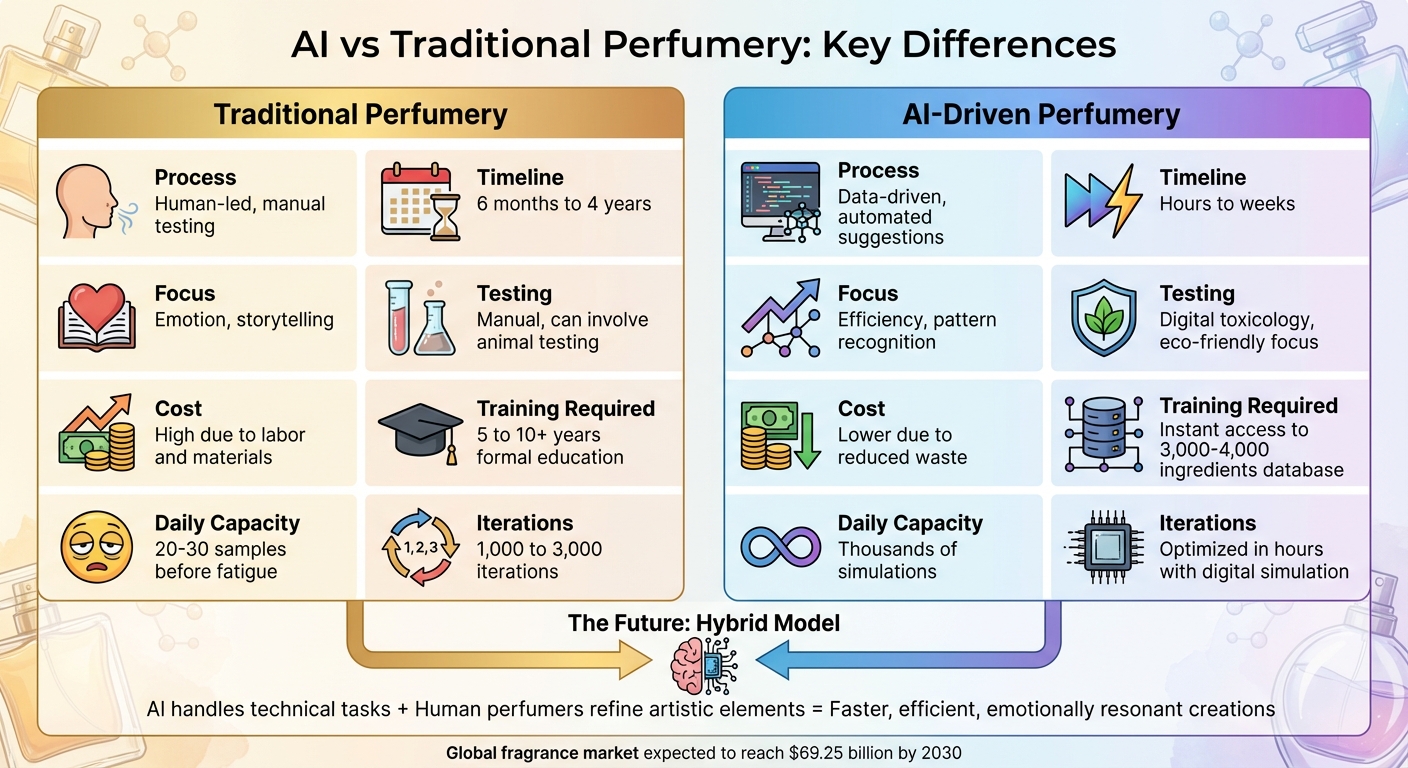
AI vs Traditional Perfumery: Side-by-Side Comparison
How Traditional Perfumery Works
The Perfumer’s Role
Traditional perfumers, often referred to as "noses", dedicate 5 to 10+ years to formal education and hands-on training before creating their own original fragrances. During this time, they sharpen their sense of smell and commit to memory the characteristics of over 1,000 ingredients from a working palette of 3,000 to 4,000 raw materials. This process is not unlike how chefs or sommeliers develop a deep understanding of flavors. Master perfumers learn to identify each ingredient at various dilutions and in countless combinations.
Their work is a blend of art and science. They take abstract concepts - like moods, places, or even emotions - and translate them into carefully crafted scents. For instance, a brief describing a "New York rooftop in summer" might inspire a citrus-aromatic composition, while a "seductive" feminine concept could lead to a floral-woody musk blend. Beyond creativity, perfumers must also navigate practical challenges, including regulatory requirements, budget constraints, and ingredient sourcing. They skillfully balance rare and expensive natural materials like rose or jasmine with reliable synthetics such as hedione or Iso E Super. This expertise is central to the iterative process of crafting a fragrance.
The Development Process
After interpreting a brief, the perfumer drafts one or more trial formulas, which lab technicians then prepare. The initial formula serves as a foundation for further refinement. Perfumers conduct evaluations - both on blotters and skin - to assess how the fragrance evolves through its top, heart, and base notes. They also check for compliance and stability. However, human noses have their limits; they can only evaluate 20 to 30 samples in a day before fatigue sets in.
Creating the perfect fragrance involves countless adjustments to achieve the right balance of brightness, sweetness, diffusion, and longevity, all while preserving the intended character. Consumer panels often play a role, providing feedback on attributes like appeal, quality, and purchase intent. This input can lead to significant changes. The entire process, from concept to completion, can take anywhere from 6 months to 4 years, with some fragrances requiring 1,000 to 3,000 iterations before they are finalized. This painstaking approach ensures depth and complexity but inherently limits how quickly new scents can be developed.
Strengths and Limitations
Traditional perfumery shines when intuition, experience, and storytelling are key. Human perfumers infuse their creations with personal memories, cultural influences, and narratives, turning a childhood garden or an imagined character into carefully chosen ingredients and accords. Their unique perspectives and artistic instincts can result in fragrances that feel deeply emotional or thought-provoking, often breaking trends to deliver something unexpected or daring.
However, this method is inherently time- and labor-intensive. It requires the collaboration of perfumers, lab technicians, evaluators, marketers, and regulatory teams over months or even years. Each round of revisions consumes valuable raw materials and lab resources, while consumer testing adds significant costs. These factors make traditional perfumery a costly endeavor and limit its ability to scale. Tight deadlines can compromise quality, and long development timelines increase risks - such as shifting trends or last-minute cancellations if testing results fall short. For U.S. consumers, these challenges contribute to the high price of premium fragrances, which often exceed $200 to $300 per bottle. Yet, many buyers never finish their full bottles, highlighting the inefficiency of the model.
This is where Scento‘s decants (2 ml, 5 ml and 8 ml vials, and a 30 ml bottle decant on most perfumes) come into play, offering a budget-friendly way to explore luxury fragrances without committing to a full bottle. These smaller sizes make it easier to discover and enjoy high-end scents while sidestepping the steep costs of traditional perfumery.
How AI-Driven Perfumery Works
AI Tools and Technologies
AI is transforming the way fragrances are created by leveraging machine learning and digital chemistry systems. These tools are trained on extensive datasets, including existing formulas, ingredient properties, toxicology data, and consumer insights. One such tool, Symrise Philyra, developed with IBM, analyzes thousands of fragrance formulas and raw materials to suggest new combinations. These proposals are optimized for creativity, target audiences, and cost efficiency.
Another standout tool is Givaudan Carto, which allows perfumers to interact with a touchscreen interface. Perfumers can select raw materials, and a robot produces instant samples using as little as 10 mL per cycle. The system also generates an "Odor Value Map", highlighting each ingredient’s impact. This ensures optimal olfactory performance while adhering to safety and regulatory guidelines. Meanwhile, ChemcoPilot takes things a step further by simulating how a fragrance performs on skin, predicting toxicology risks, and even calculating environmental factors like CO₂ emissions before any physical testing begins. Companies like Grupo Boticário and Natura &Co in Brazil rely on such platforms to create safer, more eco-conscious scents without resorting to animal testing. These advanced tools are central to the streamlined AI-powered workflow, which is explored further in the next section.
AI Workflow in Perfumery
The journey begins with a comprehensive brief and data input. Teams provide details about target consumers, market trends, desired scent profiles, regulatory requirements, budget constraints, and sustainability objectives. The AI system then analyzes the data, identifying patterns and connections between molecular structures, scent descriptors, and human responses. This helps pinpoint promising ingredient combinations.
From there, the AI generates candidate formulas, suggesting ingredient lists and dosages that align with the brief while meeting safety, cost, and regulatory standards. Digital modules evaluate these formulas for performance and safety, analyzing factors like volatility, longevity, skin compatibility, toxicity, and environmental impact - all before lab work begins. Perfumers or evaluators review the top candidates, and the results are used to refine the formulas in iterative cycles. This process dramatically reduces development timelines, which traditionally ranged from six months to several years, to just weeks or months.
Advantages and Limitations
AI-driven perfumery brings several benefits but also comes with certain challenges. By simulating outcomes and narrowing down options virtually, AI minimizes the need for physical batch testing. This reduces raw material usage, saves lab time, and lowers labor costs. Tools like digital chemistry platforms also help cut carbon footprints, reduce waste, and limit hazardous byproducts by selecting environmentally friendly molecules and optimizing synthesis methods. Predictive toxicology further streamlines the process by reducing the need for extensive physical safety tests and last-minute reformulations.
L’Oréal’s AI, for example, boasts a 95% accuracy rate in scent discovery for customers, illustrating the potential of these systems. Meanwhile, the global fragrance market is expected to reach $69.25 billion by 2030. AI also supports mass personalization by analyzing consumer data such as preferences, reviews, purchase histories, and demographic details. This allows brands to identify patterns - like preferences for fresh citrus scents versus sweet gourmand notes - and create formulas tailored to specific consumer clusters. Platforms like Scento use these insights to power personalized discovery engines.
However, the effectiveness of AI depends heavily on the quality of its training data. If datasets are biased or incomplete - such as an overemphasis on certain aroma chemistries or market segments - fragrance recommendations may become repetitive or miss critical safety concerns. Additionally, relying on historical successes can lead to conservative, trend-driven formulas that lack creativity and risk-taking. From an artistic standpoint, some perfumers argue that AI cannot replicate the intuitive leaps, emotional narratives, and rule-breaking that give perfumery its "soul". There’s also a risk of over-relying on AI’s "black box" decisions, where formulas are accepted without thorough human scrutiny of their safety, ethics, or creative alignment. These factors highlight the ongoing balance between technological efficiency and human artistry in modern perfumery.
Key Differences Between AI and Traditional Perfumery
Creative Process and Authorship
Traditional perfumery has always been rooted in human creativity and intuition. Master perfumers, often referred to as "noses", rely on years of experience and personal memory to craft fragrances that convey emotion and tell a story. Every scent carries a distinctive signature, shaped by the perfumer’s unique artistic vision.
When AI enters the picture, the approach shifts dramatically. Instead of relying solely on intuition, AI processes vast amounts of data, including molecular structures, ingredient properties, and historical formulas, to suggest combinations that might not naturally occur to a human creator. However, AI doesn’t replace creativity - it acts as a tool to enhance it. A prime example is IFF‘s Loc Dong, who used AI to amplify the dosage of styrallyl acetate and combine it with a lavender cream accord, resulting in a cutting-edge fragrance. This collaboration lightened the workload while maintaining the creative integrity of the process. AI’s ability to streamline ingredient selection and optimize formulas brings a new dimension to fragrance creation.
Speed and Efficiency
The traditional process of developing a fragrance is time-intensive, often taking anywhere from six months to four years. This lengthy timeline is due to the numerous iterations and refinements required to perfect a scent.
AI, on the other hand, drastically reduces these timelines. In some cases, what once took months can now be accomplished in a matter of hours or days. For example, Dutch startup EveryHuman uses AI-driven algorithms and questionnaires to generate unique scents in minutes. Similarly, in 2019, Symrise and IBM’s Philyra AI collaborated to create multiple perfume versions for O Boticário’s Valentine’s Day collection. Remarkably, blind tests even favored a fragrance entirely crafted by AI.
Environmental Impact and Safety
Traditional perfumery often involves extensive manual testing, which can generate significant waste and sometimes include animal testing to ensure safety. This approach, while effective, raises ethical and environmental concerns.
AI offers a more sustainable alternative. Tools like Chemcopilot can predict how a fragrance will perform on skin, assess its carbon footprint, and identify eco-friendly molecules - all before any lab work begins. Companies such as Grupo Boticário and Natura &Co are leveraging AI platforms to develop cruelty-free fragrances, reducing waste, minimizing carbon emissions, and addressing ethical considerations head-on.
Use of Data and Feedback
Feedback mechanisms also differ significantly between traditional and AI-driven perfumery. Traditional methods typically rely on small-scale qualitative feedback from expert panels and limited consumer testing.
In contrast, AI taps into vast datasets, including consumer reviews, purchase histories, molecular compositions, and sensory feedback. This allows for a deeper understanding of trends and preferences. For instance, L’Oréal’s AI technology boasts a 95% accuracy rate in matching customers with scents that suit their preferences. By combining data analysis with personalization, AI enables customization on a scale that traditional methods simply can’t match.
Comparison Table
The table below highlights the key distinctions between traditional and AI-driven approaches to perfumery:
| Aspect | Traditional Perfumery | AI-Driven Perfumery |
|---|---|---|
| Creative Process | Human-led artistry and storytelling | Data-driven suggestions and novel pairings |
| Speed | 6 months–4 years | Hours to days using simulations and robotics |
| Environmental/Safety | Manual testing, potential animal use, and waste | Digital toxicology predictions, lower CO₂ footprints, and greener molecules |
| Data/Feedback | Small-scale, qualitative human panels | Large datasets, real-time trend analysis, and optimization |
Where Human Expertise and Algorithms Meet
The Hybrid Model
In today’s fragrance industry, artificial intelligence (AI) and human creativity are working hand in hand. AI tools can scan massive ingredient libraries, draft initial formulas, and predict how these might perform. But it’s the human perfumers who bring the magic - testing these formulas on blotters and skin, tweaking ingredient balances, and weaving in emotional narratives like “sun-bleached linen” to give the scent a story and soul.
These AI systems, as previously discussed, are capable of analyzing thousands of ingredients, forecasting scent profiles, and simulating formula stability. However, human experts remain central to the process. They define the creative direction, assess how the fragrance evolves on skin, and ensure each blend feels original and aligned with the brand’s identity. They also craft the broader narrative - tying together the scent, its name, the bottle design, and the marketing campaign.
In 2019, IBM Research and Symrise’s AI system, Philyra, developed formulas for O Boticário’s Valentine’s Day launch. Interestingly, consumer testing showed a preference for the 100% AI-generated version. Similarly, at IFF, AI supported perfumer Loc Dong in creating a “futuristic aromatic” profile by pairing an unusually high dosage of styrallyl acetate with a unique lavender-cream accord.
Givaudan’s CARTO system is another example, using an Odors Value Map to optimize scents during the final refinement stages. These examples highlight how AI is expanding creative possibilities while leaving the ultimate artistic decisions in human hands. This collaboration is reshaping the role of modern perfumers, blending technology with artistry.
Changes to the Perfumer’s Role
Traditionally, perfumers spent weeks adjusting formulas, tweaking one or two ingredients at a time, and waiting for lab results before re-evaluating. AI has streamlined this process by simulating countless variations digitally, so only the most promising options move to the physical testing stage. This efficiency allows perfumers to focus more on the creative and emotional aspects of their work.
As a result, the role of a perfumer is evolving. They’re becoming more like creative directors - drafting detailed olfactory briefs, choosing from AI-suggested formulas, fine-tuning emotional nuances, and ensuring that speed doesn’t compromise quality or brand identity. Collaboration is growing across disciplines, with perfumers working alongside data scientists and sustainability teams. AI tools now flag compliance risks, estimate CO₂ footprints, and analyze market trends, helping teams make informed decisions.
New skills are also becoming essential. Perfumers need to be comfortable with data and AI tools, understanding how recommendation engines work, identifying biases, and preventing overly formulaic outcomes. They’re learning to interpret dashboards, adjust parameters, and evaluate predictive outputs like expected longevity or customer preferences. At the same time, soft skills - like articulating creative intent, curating AI-generated options, and defending artistic choices - are more important than ever. These shifts not only redefine the creative process but also pave the way for personalized scent innovations.
Future Directions
Looking ahead, AI is set to drive mass personalization and sustainable design in fragrance. Algorithms can analyze questionnaires, purchase histories, and lifestyle data to predict which notes an individual might prefer, then generate tailored formulas from modular components. Human perfumers ensure these modular accords blend seamlessly, maintaining brand identity and meeting safety standards.
AI is also advancing eco-conscious design. Machine-learning models trained on toxicology data and environmental metrics can flag risky ingredients, estimate CO₂ emissions, and suggest greener alternatives that still achieve the desired scent profile. While AI identifies potential substitutes, perfumers decide how much change the formula can handle without losing its artistic integrity.
In some cases, AI even designs entirely new aroma molecules. By analyzing extensive datasets of existing odorants, these systems can propose innovative molecules - like a woody-amber note with low allergenic risk - that are stable, manufacturable, and environmentally friendly. Chemists then synthesize the most promising candidates, and perfumers evaluate them, often discovering subtle nuances that elevate the fragrance. This feedback loop helps refine the AI’s predictive models further.
For consumers, this hybrid approach means more personalized options and an easier way to discover new favorites. Platforms offering curated decants or travel-size sprays can use AI to recommend scents based on individual preferences, while human experts continue to refine and narrate the collection. Services like Scento, which offers designer and niche fragrances in small decants (2 ml, 5 ml and 8 ml vials, and a 30 ml bottle decant on most perfumes), could combine AI-driven recommendations with expert storytelling. This is especially valuable in a market that has grown from around 300 annual fragrance launches in the 1990s to over 3,000 today.
sbb-itb-fb213bc
What This Means for Fragrance Buyers
Scent Exploration and Personalization
Imagine answering a few simple questions about your favorite fragrance notes, preferred brands, or the occasions you’re shopping for, and receiving a tailored shortlist from thousands of options. This is the power of data-driven fragrance matching. It’s especially helpful when venturing into unfamiliar scent categories - like transitioning from bright citrus to rich woody ambers. Algorithms analyze patterns to predict what might suit your preferences.
Traditional discovery, on the other hand, leans on emotional storytelling. A skilled sales associate or a brand’s evocative narrative might ask you about the memories or moods you want to evoke - perhaps a cozy New York winter evening or a breezy California road trip - and suggest scents that align with those feelings.
While AI focuses on your history to minimize costly mistakes, traditional methods tap into storytelling to inspire adventurous choices. Most U.S. buyers today combine both approaches: starting with AI-powered quizzes to narrow down options, then testing physical samples - like spray strips, decants, or mini vials - to see how a scent performs on their skin. This blend of precision and storytelling creates a more personalized and satisfying fragrance journey, leading buyers to platforms that expertly integrate data insights with human touch.
The Role of Discovery Platforms
The fragrance market has exploded - from around 300 launches per year in the 1990s to over 3,000 annually today. This sheer volume makes it impractical to rely solely on full-bottle purchases for exploration. Discovery platforms solve this problem by offering curated, small-format options that allow you to live with a scent before committing to a full-size bottle.
Take Scento, for example. Scento is a perfume decant and sample retailer, and every product is available for one-time purchase without any subscription. Scento+ is Scento’s optional membership: the monthly fee comes back in full as store credit to spend on any perfume, members get 10% off, a free sample with every order, a free perfume every six months and a birthday gift, and you can pause anytime; to cancel, contact our team. This setup shifts full-bottle purchases to a thoughtful, informed decision - saving you from spending €200–€300 on a bottle that might end up gathering dust.
As one satisfied customer, Elena R., put it: "I used to buy full bottles and regret them after a week. Now I get to date the perfume before I marry it."
Navigating a Growing Market
Discovery platforms don’t just simplify choice - they help you navigate an increasingly crowded market. With AI accelerating fragrance development and niche brands multiplying, the number of new releases can feel overwhelming. Curated sample sets, organized by themes like modern ambers, AI-created florals, or classic French chypres, let you compare a few related scents instead of endlessly scrolling through options.
Platforms like Scento, which offers over 1,000 luxury perfumes from top designer and niche houses, use AI to recommend personalized selections based on your past orders and ratings. Human curators then refine these suggestions, considering factors like seasonal relevance and storytelling.
This hybrid approach allows you to maintain a core collection of timeless staples while setting aside part of your budget for experimental or AI-driven creations. By tracking your usage with an app or spreadsheet, you can turn the overwhelming market into a learning experience. Over time, you’ll discover whether you prefer AI-optimized precision, the artistry of traditional methods, or a mix of both. And with Scento planning to introduce larger 30 ml+ bottles, you’ll soon have the option to upgrade your most-used decants into full bottles based on actual wear rather than impulse buys. This thoughtful blend of technology and tradition empowers you to explore, experiment, and refine your fragrance wardrobe with confidence.
Conclusion
AI and traditional perfumery are reshaping the way fragrances are created, blending the best of both worlds. While traditional methods infuse perfumes with human intuition, emotional resonance, and rich storytelling, AI brings unmatched speed, data precision, and insights into more sustainable practices. Together, they open doors to exploring molecular combinations in ways that were once unimaginable.
The future of perfumery seems to rest on hybrid workflows. AI takes on tasks like predicting toxicology, calculating carbon footprints, and suggesting eco-friendlier molecules. Meanwhile, human perfumers focus on refining the artistic and emotional aspects of a fragrance. Advanced tools now enable perfumers to select ingredients via touchscreen interfaces, with robotic systems crafting optimal formulations in mere hours. This collaboration allows for creative freedom while preserving the artisanal touch that gives a perfume its soul.
For fragrance enthusiasts, this partnership means a richer and more personalized experience. AI-powered tools can recommend scents with an impressive 95% accuracy, while curated sampling platforms let consumers explore both innovative creations and timeless classics before committing to a full bottle. On a broader scale, this approach reduces reliance on animal testing and helps brands foresee environmental impacts more effectively.
As the global fragrance market is expected to grow to $69.25 billion by 2030, brands that embrace AI as a collaborator rather than a replacement are likely to thrive. The role of the perfumer is evolving, merging technology, data, and creativity to craft scents that balance efficiency with emotion. Whether you’re drawn to AI-driven precision or the timeless artistry of traditional techniques, the ever-expanding world of fragrance offers something for everyone. This harmonious blend of innovation and tradition reflects the exciting evolution of modern perfumery explored in this article.
FAQs
How does AI make fragrance creation faster and more efficient?
AI brings a new level of speed and precision to fragrance creation by processing vast amounts of data on scent combinations, consumer preferences, and market trends. This technology enables the quick development of distinctive formulas while cutting down the time and expenses typically tied to traditional methods.
With AI, perfumers can explore an extensive range of scent variations much faster than manual experimentation. This approach not only saves time but also ensures that the final product balances creativity with meticulous accuracy.
How does AI in perfumery benefit the environment?
AI-powered perfumery is making strides in reducing waste and optimizing how resources are used. By enabling precise formulations, it minimizes the need for surplus raw materials and significantly cuts down on chemical waste. On top of that, AI streamlines production processes and supply chains, which helps lower energy use and shrink the industry’s carbon footprint.
With AI driving more efficient fragrance creation, the industry can curb overproduction and lessen the environmental toll often linked to traditional methods.
Can AI create fragrances with the same emotional impact as traditional perfumery?
AI-powered perfumery opens up new possibilities for crafting personalized scents, leveraging data to align with individual tastes in ways never seen before. It brings a fresh, tech-driven perspective to fragrance creation, offering unique opportunities for innovation.
That said, traditional perfumery is a world steeped in human artistry, rich storytelling, and heritage that resonates on a deeply emotional level. The craftsmanship and intuition honed over years of experience create fragrances that tell stories and evoke memories in ways that technology alone cannot achieve.
While AI can serve as a valuable tool to support and expand traditional techniques, it falls short of capturing the intricate emotional depth and creative nuances that only human hands and hearts can bring to the art of perfumery.

