When you wear your favorite perfume, have you ever thought about the hands behind its creation? Women around the world play a vital role in producing key fragrance ingredients like jasmine, shea butter, and argan oil. However, many of these women face low wages, limited opportunities, and harsh working conditions. Ethical sourcing is changing that.
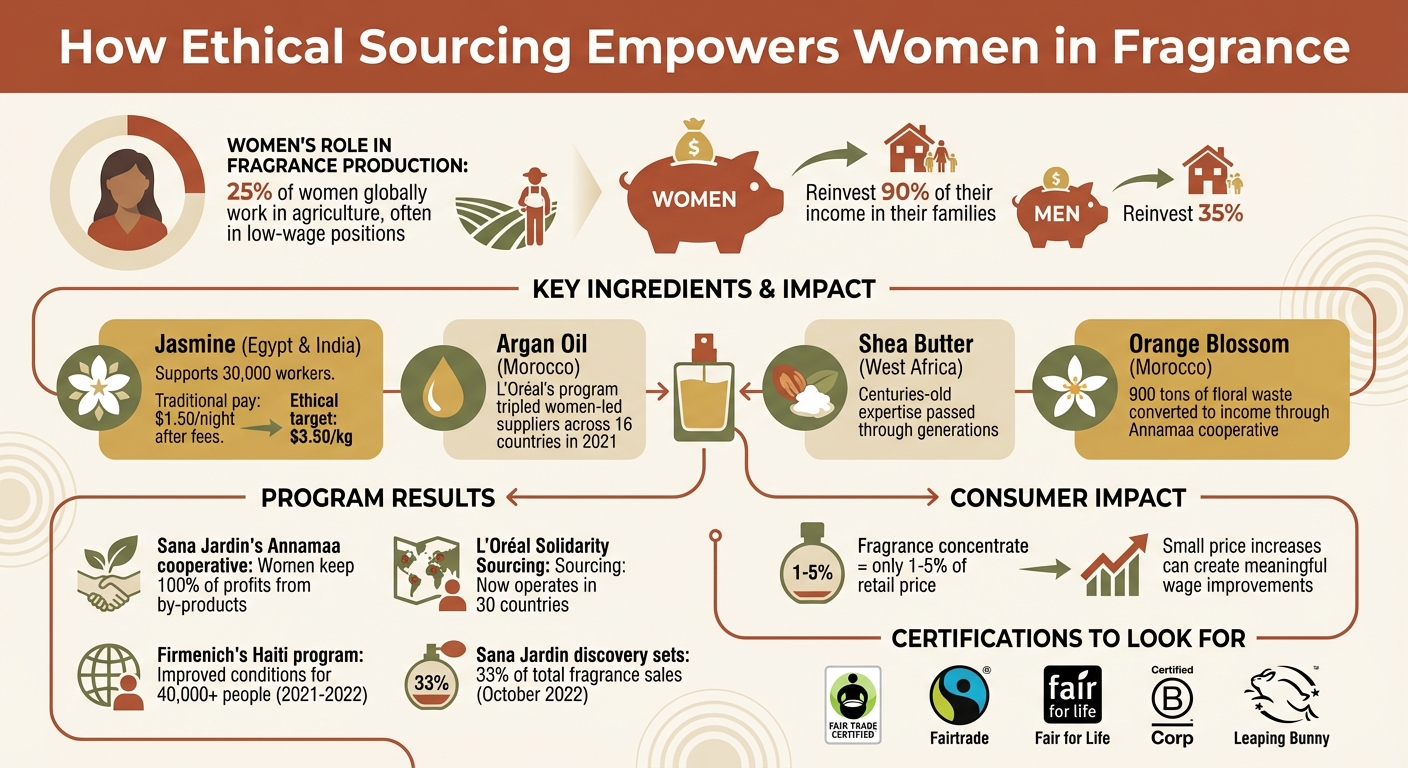
This approach ensures fair pay, safe workplaces, and opportunities for growth, transforming the lives of women in fragrance supply chains. Programs like L’Oréal’s Solidarity Sourcing and Sana Jardin’s Annamaa cooperative have helped thousands of women gain financial independence, leadership skills, and access to education. For example, Moroccan women in the Annamaa cooperative now keep 100% of profits from products made using floral by-products, turning waste into income.
Impact of Ethical Sourcing on Women in Fragrance Industry
What Is Ethical Sourcing in Fragrance?
Defining Ethical Sourcing
Ethical sourcing in fragrance ensures that every step of the supply chain respects human rights, safeguards the environment, and values diverse traditions and communities. At its heart are principles like transparency, fair wages, and safe working conditions, which aim to uplift marginalized groups.
Traditional sourcing practices often fail to provide fair wages or protect workers from exploitation. Ethical sourcing, on the other hand, aligns with fair trade principles, ensuring fair pay, safe workplaces, and even leadership opportunities for workers. When brands embrace ethical sourcing, they’re not just buying raw materials - they’re actively supporting the people behind those ingredients.
"My understanding of sustainability is that it leaves a net positive impact on the environment, and the business pays living wages, but I felt very strongly that we could do better than that." — Amy Christiansen, Founder and CEO, Sana Jardin
This approach highlights the importance of women’s contributions to the fragrance industry and their often-overlooked role in ingredient production.
Why Women Are Central to Fragrance Ingredient Production
Women are integral to the fragrance supply chain, especially in roles like harvesting, processing, and employing traditional artisanal techniques. Globally, nearly 25% of women work in agriculture, often in low-wage positions. Their efforts are the backbone of many fragrance ingredients.
Your Personal Fragrance Expert Awaits
Take our quick scent quiz to discover authentic designer and niche fragrances matched to your taste — explore them as 2ml, 5ml, 8ml & 30ml decants and samples, so you can try each one before committing to a full bottle.
Find Your ScentFragrance Ingredients That Rely on Women’s Labor
These ingredients highlight how fair sourcing practices can turn women’s labor into meaningful, long-term community benefits.
Argan Oil from Morocco
In Morocco, women manually extract argan oil by cracking nuts and grinding kernels - a labor-intensive process that makes this ingredient highly valued in both fragrances and cosmetics. In 2021, L’Oréal‘s Solidarity Sourcing program significantly expanded its support for women-led suppliers, tripling their numbers across 16 countries. This initiative has provided secure employment to vulnerable communities, converting what was once seasonal work into more stable and reliable livelihoods.
Shea Butter from West Africa
The production of shea butter in West Africa relies heavily on the expertise of women. From harvesting the nuts to the intricate extraction process, their centuries-old knowledge is indispensable. These traditional skills, passed down through generations, form the backbone of the shea butter supply chain. Ethical programs focused on fair pay and community benefits ensure that this work not only sustains families but also strengthens local communities.
Jasmine from Egypt and India
Egypt accounts for roughly half of the global jasmine supply, with women playing a key role in its harvest. The jasmine trade supports around 30,000 workers, yet traditional sourcing often pays as little as $1.50 for a night’s work after land fees, pushing entire families - children included - into the fields .
"I don’t mind people using perfume, but I want the people using this perfume to see in it the pain of children. And to speak up."
- Heba, Jasmine Picker
Ethical sourcing programs, like those run by Machalico, are stepping in to provide financing, healthcare, and education scholarships. These initiatives aim to break the cycle of poverty by advocating for fair pricing - pickers suggest $3.50 per kilogram as a sustainable rate. With such support, women can better care for their families and ensure their children have brighter futures .
How Ethical Sourcing Changes Women’s Lives
Ethical sourcing goes beyond just fair pay - it builds pathways for financial independence, leadership opportunities, and community transformation through better infrastructure and education.
Financial Independence Through Fair Wages
Fair wages provide women with the means to support their families and create lasting change. Research shows women reinvest about 90% of their income in their families, compared to 35% by men. This reinvestment improves access to essentials like better nutrition, education, and healthcare.
Frameworks such as Fair Trade guarantee living wages that cover basic family needs, including food, housing, and schooling. In Morocco, the luxury fragrance brand Sana Jardin took this approach a step further by launching the Annamaa cooperative in 2021 and 2022. Founder Amy Christiansen trained women harvesting orange blossoms to transform 900 tons of floral waste into products like candles and orange blossom water. The cooperative retains all profits from these products, giving women an extra income stream that isn’t tied to seasonal harvest cycles.
"My understanding of sustainability is that it leaves a net positive impact on the environment, and the business pays living wages, but I felt very strongly that we could do better than that." — Amy Christiansen, Founder and CEO, Sana Jardin
Leadership Training and Skill Development
Fair wages are just the starting point - true empowerment comes when women gain leadership and business skills to take control of their futures.
Ethical sourcing programs often include training in financial literacy, business management, and negotiation. Such skills are crucial for women in fragrance-producing communities, many of whom have never had access to resources that could help them grow their businesses or advocate for fair prices.
Sana Jardin, for example, trains members of the Annamaa cooperative in manufacturing, financial planning, and navigating markets. These women have learned to negotiate with both local and international buyers, enabling them to manage their operations independently.
"The brand not only trains the harvesters; it also seeks to address systemic barriers to success, including cultural bias, limited financial literacy, and broader misconceptions about gender roles in the region." — Amy Christiansen, Founder and CEO, Sana Jardin
By diversifying crops and cutting out exploitative middlemen, women gain more control over their income and reduce their reliance on a single harvest season. These efforts help shift the role of women in the fragrance industry from laborers to decision-makers.
Community Development and Education Access
When women are empowered, the benefits extend far beyond individuals - entire communities thrive.
Fair wages and leadership skills often lead to community-wide improvements, such as better schools, healthcare facilities, and water systems. Many ethical sourcing programs directly fund infrastructure projects, enhancing the quality of life for entire villages.
Firmenich’s "Naturals Together" program in Haiti is a prime example. Between 2021 and 2022, the initiative worked with local vetiver farmers, providing tools, training, and direct market access. It also supported community projects like schools and health centers, improving conditions for over 40,000 people.
The ripple effect is undeniable. Since women reinvest a large portion of their earnings into their families, ethical sourcing ensures children stay in school, families receive proper healthcare, and essential infrastructure continues to grow.
"Evidence is clear that when women are empowered, entire families and communities thrive." — Fair Trade USA
Similarly, L’Oréal’s Solidarity Sourcing program now operates in 30 countries, supporting women who produce ingredients like shea, argan, and galanga. These efforts highlight how ethical sourcing can transform not just individual lives, but the futures of entire communities.
How to Support Ethical Sourcing as a Consumer
When you choose brands that prioritize ethical sourcing, you’re doing more than just buying a product - you’re supporting fair wages, leadership opportunities, and community development for women in the fragrance supply chain.
Look for Certifications and Transparency
Certifications can help you identify brands that genuinely uphold ethical practices. Labels like Fair Trade Certified, Fairtrade, and Fair for Life ensure fair wages, safe working conditions, and community-focused programs, often with initiatives specifically aimed at empowering women. Similarly, a B Corp certification indicates a company’s commitment to social and environmental standards, while Leaping Bunny guarantees cruelty-free production.
Transparency is equally important. Some brands now include QR codes on their packaging, allowing you to trace ingredients back to their source. This level of detail shows exactly where and how materials were produced, reflecting a commitment to accountability.
"One of the most ethical things fragrance brands can do is to source raw materials that are produced with respect to nature and human beings." — Aurélien Guichard, Master Perfumer and Founder, Matière Première
By choosing brands that prioritize these values, you actively support efforts to create a fairer supply chain. This is a meaningful step when building a fragrance collection rooted in ethics.
Buy from Brands with Ethical Programs
Go a step further by supporting brands that invest in women-focused initiatives. For example, Sana Jardin collaborates with the non-profit Nest to source floral ingredients from Morocco. Through this partnership, female harvesters receive business mentorship and supplies. Their innovative "flower recycling" model even allows women to create and sell products from floral waste, enabling them to earn income year-round.
To learn more about a brand’s sourcing practices, check their sustainability page or reach out to their customer service team. Companies dedicated to ethical sourcing are typically transparent about their efforts and partnerships.
Choose Smaller Decants to Reduce Waste
Sampling fragrances through smaller decants is a great way to support ethically sourced products while minimizing waste. For instance, in October 2022, Sana Jardin revealed that its $39 discovery set, featuring 2ml samples of 10 fragrances, became a bestseller. This approach accounted for 33% of their overall fragrance sales, as customers preferred to "try before they invest" in a €124 50ml bottle.
Sizes ranging from 2 ml up to a 30 ml bottle decant let you test a fragrance over several days without committing to a full bottle. Platforms like Scento make it simple to explore and support ethically sourced fragrances in a responsible, sustainable way.
Conclusion
Ethical sourcing plays a key role in promoting economic growth and advancing gender equity within the fragrance industry. By ensuring fair wages, providing leadership opportunities, and maintaining safe working conditions, women involved in harvesting essential ingredients like jasmine, orange blossom, argan oil, and shea butter are empowered to reinvest in their communities, driving long-term progress.
Programs such as L’Oréal’s Solidarity Sourcing and Sana Jardin’s Beyond Sustainability model showcase the real-world impact of these efforts. For instance, Sana Jardin supported Moroccan women in establishing the Annamaa cooperative, where they retain 100% of the profits from products made using orange blossom by-products. As founder Amy Christiansen explains, "My core mission is to create social impact through business... The bigger the business becomes, the more impactful it is for the communities we work with".
These initiatives highlight the importance of choosing brands that prioritize ethical sourcing. Supporting companies with verified certifications, solidarity programs, or offering smaller decants can help foster financial independence and leadership for women in fragrance. Considering that fragrance concentrate accounts for just 1%–5% of a perfume’s retail price, even small increases in pay can make a meaningful difference in their lives.
When you wear a fragrance, let it tell a story - not just of scent, but of empowerment and the women whose work brings it to life.
FAQs
How can I tell if a fragrance is ethically sourced?
When choosing fragrances, keep an eye out for certifications and clear information about ingredients and supply chain practices. Brands that prioritize ethical sourcing often emphasize sustainable farming techniques, fair labor practices, and environmentally conscious methods. Many also share stories of their efforts to support local communities or protect biodiversity. Paying attention to these certifications and initiatives can guide you toward fragrances that are responsibly sourced.
Do ethical sourcing programs actually raise women’s incomes long-term?
Ethical sourcing programs have the potential to meaningfully improve women’s incomes while promoting gender equity. By prioritizing better labor rights and creating pathways for women to step into roles as microentrepreneurs, these initiatives can drive lasting change. Programs like Fairtrade certification, along with similar efforts centered on empowerment, have demonstrated clear, measurable benefits for women involved in supply chains.
Does buying smaller decants really reduce waste and help women?
Buying smaller decants is a smart way to explore various fragrances while minimizing waste. It allows you to enjoy a range of scents without the need to commit to full-size bottles that might go unused. This approach encourages mindful consumption and aligns with efforts to support ethical sourcing. Additionally, such practices can contribute to fair labor opportunities in the fragrance industry, creating more equitable conditions and empowering women within the field.

