Indigenous ingredients are reshaping luxury perfumery, blending ancestral knowledge with modern practices. From Australian sandalwood to Balsam Tolu, these materials carry centuries of tradition while addressing today’s need for ethical sourcing. Key highlights include:
- Australian Sandalwood: Used by the Martu people for mental clarity, now featured in high-end collections like Pura x Dutjahn. Harvesting aligns with Martu ecological practices to protect ecosystems.
- Balsam Tolu: Once a healing balm in South America, it now enhances oriental and amber fragrances. Sustainable methods ensure tree preservation for decades.
- African Aromatics: Resins like frankincense, central to rituals in regions like Ethiopia, are now reinterpreted in modern scents.
Challenges include balancing slow growth cycles (e.g., sandalwood takes 30 years to mature) with commercial demand, avoiding cultural tokenism, and ensuring fair profits for indigenous communities. Initiatives like the Pura x Dutjahn collaboration show how partnerships can preserve heritage while promoting responsible practices.
1. Balsam Tolu: From Ritual to Luxury Fragrance
Traditional Uses
For centuries, Tolu balsam has been a cornerstone of life for Pre-Columbian communities in northern South America, particularly in Colombia. Indigenous groups extracted the thick, amber-hued resin from Myroxylon balsamum trees, using it primarily as a "healing balm." It treated wounds, respiratory conditions like bronchitis and tuberculosis, and even rheumatism. The name itself, derived from the Greek word balsamon, underscores its medicinal significance.
But its purpose extended beyond healing. The resin was also central to ritual practices, often burned on coals during fumigation ceremonies to purify the air. Collectors employed traditional methods, making V-shaped cuts in the tree bark and gathering the resin in calabash gourds or clay pots - a process that remains unchanged for centuries. Today, this ancient tradition has transitioned into the world of luxury perfumery.
Modern Perfume Applications
The rich history and ritualistic roots of Balsam Tolu have seamlessly carried over into modern perfumery. Known for its ability to act as a fixative, it prolongs the life of delicate top notes and is a staple in creating base notes for oriental, amber, and floral fragrances. Typically used in concentrations of 1–6%, it enhances both the depth and longevity of a perfume’s composition.
A great example is the natural perfume house Ffern, which sources its Tolu balsam from families in Colombia’s Andes region. Using traditional methods, collectors make small incisions in Myroxylon toluiferum trees to gather the resin. Ffern incorporates this resin as a mid-note in their seasonal organic Eaux de Parfum. To make it suitable for alcohol-based perfumes, the raw material is often processed into resinoids and diluted to 50% in triethyl citrate for better solubility.
Sustainability Practices
Sustainability is a key focus in modern harvesting methods. Non-destructive techniques, such as V-shaped or vertical incisions (8–10 cm), ensure the trees are not harmed. These methods prevent girdling, allowing a single tree to produce resin for 30–40 years. Trees are only tapped once they reach 20–30 years of age and a trunk diameter of at least 12–15 cm. On average, a mature tree yields 1–3 kg of balsam annually.
To further protect the trees, tapping sites on the trunk are rotated, and rest periods are observed to aid recovery. By sourcing through small family networks in Colombia and Venezuela, rather than large-scale plantations, these methods help prevent overharvesting and promote long-term sustainability.
Sensory Profiles
Tolu balsam is prized for its warm and sweet balsamic character, enriched with hints of vanilla, cinnamon, amber, and delicate floral undertones. Its composition includes up to 80% resinous material, with approximately 15% comprised of free benzoic and cinnamic acids. This robust profile makes it an essential ingredient in oriental and amber accords, providing depth and lasting strength to modern fragrances.
2. Australian Native Botanicals in Perfume
Traditional Uses
Australian native botanicals bring a distinctive regional identity to modern perfumery, rooted in centuries of Indigenous tradition. The Martu people of Western Australia, for instance, have long used dutjahn (sandalwood) in rituals to promote mental clarity. This practice is deeply tied to their cultural responsibility to care for the land - an ethos that has preserved the resilient DNA of wild sandalwood through generations.
"Because of our Old People, we’ve used it for generations and it’s special to us. We want to share that story to the world." - Clinton Farmer, Martu leader and Chairman of KFDF
This rich heritage now finds a new voice in luxury perfumery, blending ancient traditions with modern creativity.
Modern Perfume Applications
In February 2025, Pura introduced the "Pura x Dutjahn" collection, a collaboration with the K Farmer Dutjahn Foundation. This collection includes four fragrances — Somewhere Land, Touch the Night Sky, So Many Colours, and Ochre Heart - all featuring ethically sourced Dutjahn Sandalwood Oil from Martu ancestral lands. By employing a "faceting" technique, perfumers pair Australian sandalwood with complementary notes like patchouli, vanilla, orris, and sea salt to evoke a deep connection to place.
Brands such as Goldfield & Banks have also embraced Australian botanicals, crafting collections that spotlight ingredients like Blue Cypress, Desert Rosewood, and Boronia (marketed as Southern Bloom). These creations, enhanced by artisanal blending, reflect a growing commitment to both storytelling and sustainability in perfumery.
Sustainability Practices
Sustainable harvesting is at the heart of using these native botanicals. Australian Sandalwood (Santalum spicatum) is wild-harvested from mature trees in arid regions, guided by Martu ecological knowledge. This approach protects fragile ecosystems while respecting the sacred nature of the land.
"There’s a sacredness to it that I honour. I’m not going to waste or compromise any of that. There’s a significance to this ingredient that goes beyond what you’re smelling." - Guy Vincent, CEO of Dutjahn Sandalwood Oils
This balance between tradition and innovation ensures the longevity of these precious resources.
Sensory Profiles
Australian sandalwood, denser than its Indian counterpart, requires a longer distillation process to maintain its quality. The result is an earthy aroma with hints of spice, leather, and smoke. Other native botanicals contribute equally unique characteristics: Blue Cypress adds woody, aromatic notes; Desert Rosewood offers rich, resinous tones; and Bohemian Lime delivers a bright, citrus-forward freshness. Together, these ingredients create olfactory experiences that are as diverse as the Australian landscape.
3. African Aromatics: Sacred Scents in Contemporary Perfumery
Traditional Uses
In many African cultures, scent has long served as a meaningful way to express identity, commemorate life transitions, and strengthen communal ties. For instance, in ancient Egypt, Kyphi - a fragrant blend of resins, honey, and wine - was central to temple rituals and even referred to as the "sweat of the gods". The Horn of Africa, including regions like Ethiopia and Somalia, has been a source of frankincense for thousands of years. Today, modern perfumers are reinterpreting these sacred aromas, blending respect for cultural traditions with sustainable practices.
Your Personal Fragrance Expert Awaits
Take our quick scent quiz to discover authentic designer and niche fragrances matched to your taste — explore them as 2ml, 5ml, 8ml & 30ml decants and samples, so you can try each one before committing to a full bottle.
Find Your ScentPros and Cons
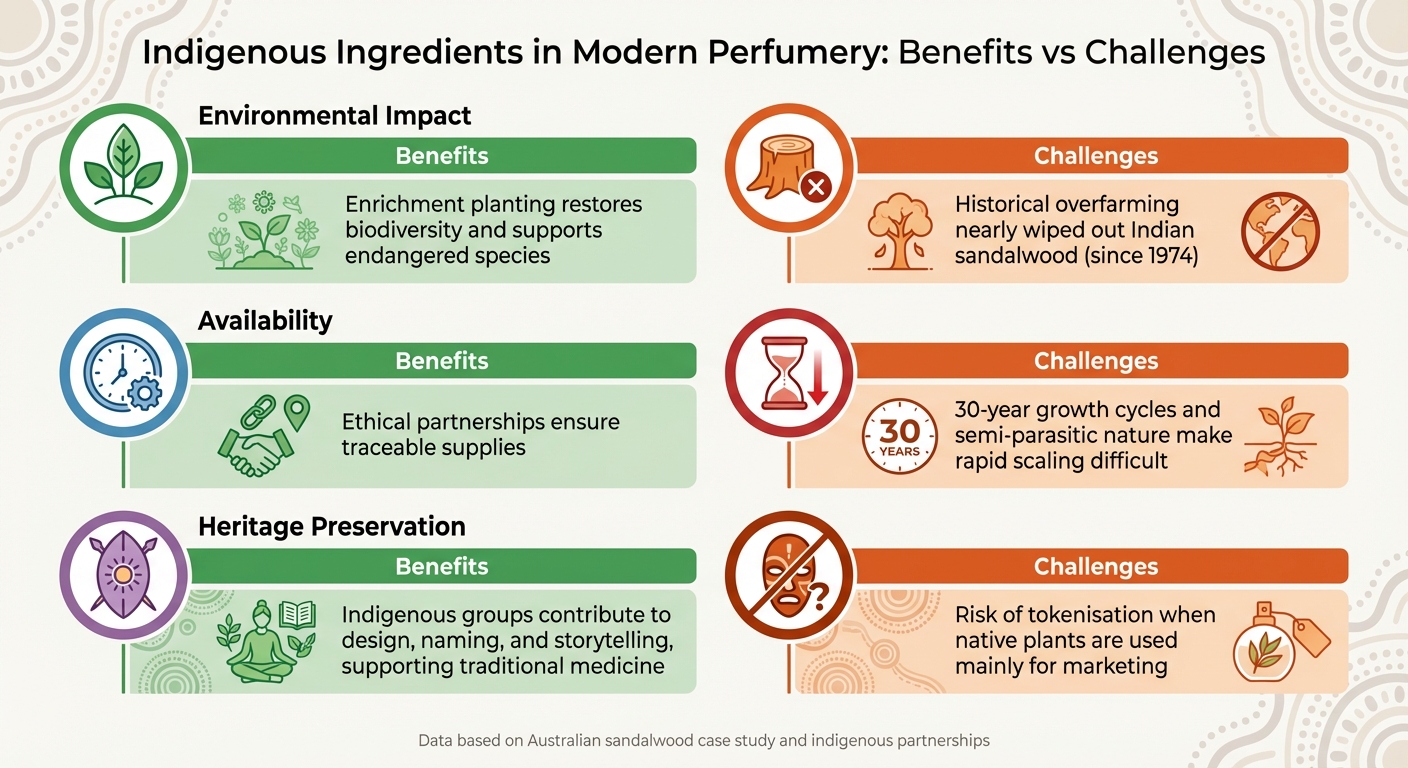
Indigenous Perfume Ingredients: Benefits vs Challenges Comparison
The use of indigenous ingredients in modern perfumery offers a fascinating mix of tradition and commercial challenges. One major factor is the environmental impact, which can vary widely. For instance, Australian sandalwood, harvested by the Martu tribe, supports biodiversity through enrichment planting. In contrast, unsustainable practices in India led to the near extinction of sandalwood starting in 1974.
Availability is another key hurdle. Sandalwood trees require up to 30 years to mature for oil extraction. Lindsey Kneuven, Head of Impact and Grants at Pura, highlights the importance of respecting indigenous timelines:
"We produce on Martu time. To impose standards and timelines on their practices is kind of tone-deaf".
The Martu tribe, with a population of about 1,000, partnered with Pura over 3.5 years to develop their sandalwood product.
| Factor | Benefits | Challenges |
|---|---|---|
| Environmental Impact | Enrichment planting restores biodiversity and supports endangered species | Historical overfarming nearly wiped out Indian sandalwood |
| Availability | Ethical partnerships ensure traceable supplies | 30-year growth cycles and the semi-parasitic nature of sandalwood make rapid scaling difficult |
| Heritage Preservation | Indigenous groups contribute to design, naming, and storytelling, supporting traditional medicine | Risk of tokenisation when native plants are used mainly for marketing |
This balance between environmental restoration and production limitations defines the modern use of indigenous ingredients. It’s a delicate dance between respecting nature, ensuring resource availability, and honoring cultural traditions.
Beyond the raw materials and long growth cycles, preserving cultural narratives is equally crucial. Authentic heritage preservation strengthens cultural storytelling. For example, the K Farmer Dutjahn Foundation collaborates with fragrance houses to include traditional ochre pigments in bottle designs, ensuring cultural stories are represented accurately rather than misappropriated. However, there is a fine line, as Tiffany Witehira, founder of Curionoir, warns:
"I refuse to tokenise my culture by just adding a Māori plant into something to make it ‘Māori’".
These challenges highlight the care needed to preserve both quality and cultural integrity. While economic opportunities for small communities are significant, they come with production hurdles. Wild-grown Australian sandalwood, for instance, is denser than plantation-grown varieties and requires longer distillation times. As Guy Vincent, CEO of Dutjahn Sandalwood Oils, explains:
"If processed too quickly, the quality is lost".
For perfume houses accustomed to fast, industrial processes, this slower, more labor-intensive approach offers exceptional quality but complicates scalability.
Conclusion
Modern perfumery blends traditional knowledge with ethical practices, particularly through the thoughtful use of indigenous ingredients. As Guy Vincent, CEO of Dutjahn Sandalwood Oils, highlights:
"There’s a significance to this ingredient that goes beyond what you’re smelling."
This perspective underlines the importance of respecting cultural heritage while embracing practices that align with environmental responsibility. Efforts like the Pura x Dutjahn collection showcase how genuine partnerships can honour cultural traditions while fostering responsible sourcing . Indigenous leaders consistently remind us that these practices are deeply rooted in cultural identity and significance.
However, there are hurdles to overcome. The 30-year growth cycle of sandalwood, the alignment with "Martu time" rather than conventional business timelines, and the risk of cultural tokenism all present unique challenges . Initiatives like the Pura x Dutjahn collaboration demonstrate how regenerative practices can not only preserve cultural values but also restore ecosystems .
Clinton Farmer, Martu leader and KFDF Chairman, encapsulates this sentiment:
"Because of our Old People, we’ve used it for generations and it’s special to us. We want to share that story to the world."
The future of indigenous ingredients in perfumery hinges on the industry’s ability to embrace this invitation with respect, equity, and patience. By doing so, the legacy of indigenous fragrance traditions can continue to thrive, guiding modern perfumery towards deeper respect and sustainability.
FAQs
How can I tell if an “indigenous” perfume ingredient is ethically sourced?
To determine if an indigenous perfume ingredient is sourced responsibly, look for clear signs of ethical practices. These include respecting local communities, ensuring fair wages, and safeguarding biodiversity. Brands that are transparent about their sourcing often provide certifications or collaborate with indigenous groups, which can serve as proof of their commitments. Taking the time to investigate a company’s stance on fair trade and environmental responsibility can help confirm the integrity of their ingredients.
Why does it take so long to scale ingredients like sandalwood in modern perfumery?
Sandalwood cultivation is a time-intensive process, as these trees need up to 30 years to reach maturity for oil extraction. Unfortunately, overharvesting has brought them dangerously close to extinction. This makes sustainable practices not just important, but necessary. Additionally, indigenous knowledge is vital in safeguarding these resources, ensuring they remain available for generations to come.
What’s the difference between cultural collaboration and cultural tokenism in fragrance?
Cultural collaboration in the fragrance world is about building respectful and meaningful partnerships with indigenous communities. This approach ensures their voices are heard, their contributions are acknowledged, and they are fairly compensated. It’s a way to celebrate and preserve cultural heritage while creating mutual value for everyone involved.
On the other hand, cultural tokenism takes a very different path. It involves the superficial use of cultural symbols or ingredients, often without involving or respecting the communities they originate from. This practice reduces rich traditions to mere marketing tools, stripping them of their depth and significance.
The heart of the matter lies in the intent. Collaboration is rooted in respect and genuine engagement, while tokenism prioritizes profit over culture, turning heritage into a commodity.

