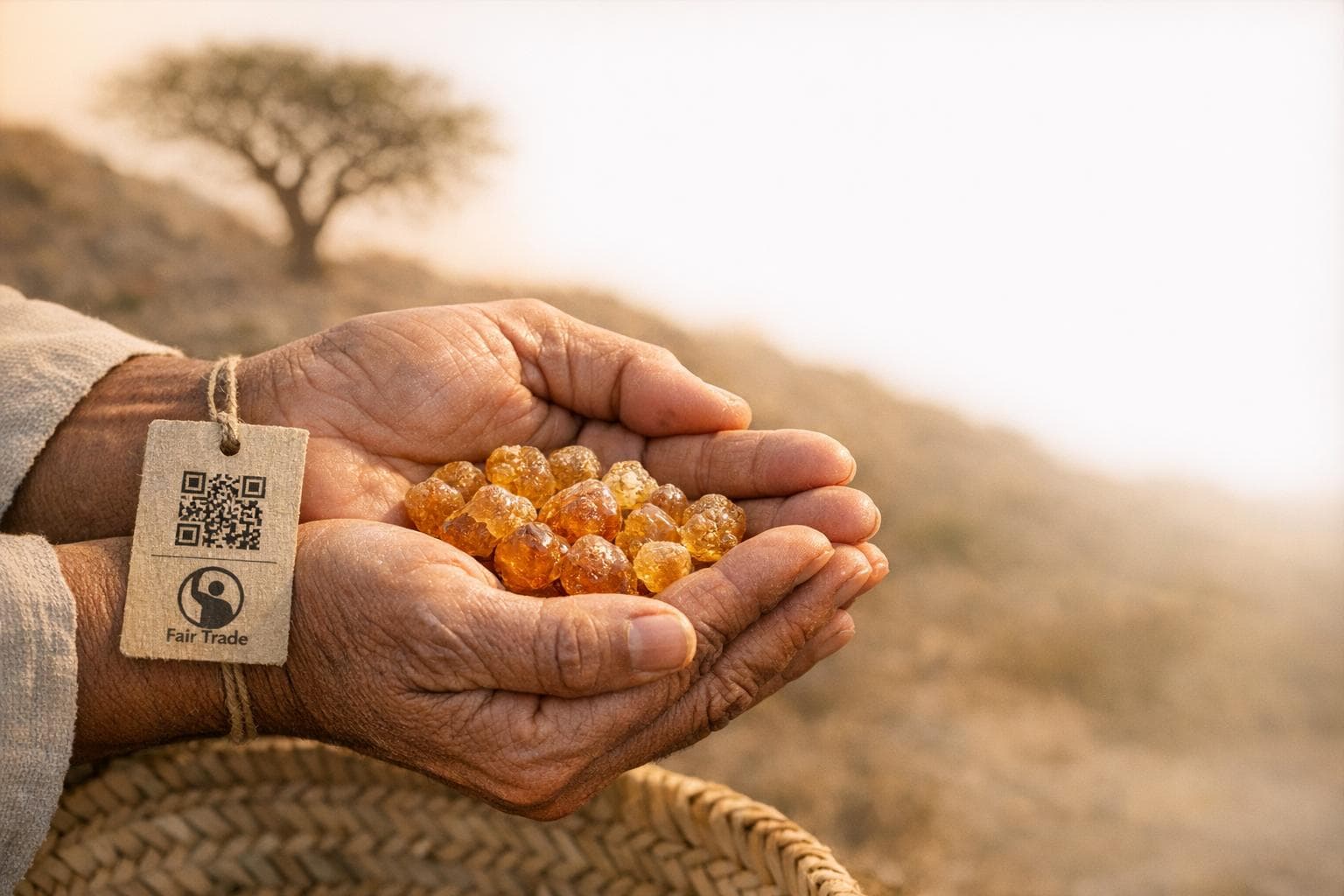
The fragrance industry thrives on rare, natural ingredients sourced from indigenous communities, but the imbalance in wealth, recognition, and sustainability raises ethical concerns. Workers harvesting key ingredients like jasmine, ylang-ylang, and vanilla often earn as little as €6 per day, while luxury brands profit significantly. Beyond low wages, these communities face challenges like cultural misappropriation, unsustainable harvesting, and limited control over their resources. Ethical sourcing practices - such as fair trade agreements, transparent supply chains, and benefit-sharing models - offer solutions that support workers, protect ecosystems, and preserve heritage.
Key takeaways:
- Workers earn a fraction of the billions generated by the fragrance industry.
- Overharvesting and synthetic alternatives threaten ecosystems and local economies.
- Ethical sourcing initiatives increase wages, empower communities, and ensure fair partnerships.
Challenges Facing Indigenous Communities
Exploitation and Economic Inequality
The financial disparity within the fragrance supply chain is stark, leaving indigenous workers with minimal benefits despite their critical role. In 2022, the global perfume market reached a staggering €50.85 billion, yet those harvesting the core ingredients see only a fraction of that wealth. For instance, in the Comoros, ylang-ylang pickers earn about €6.50 per day, while distillery workers make between €10.80 and €21.60 daily. Meanwhile, spice farmers in Zimbabwe face seasonal earnings of just €70 to €170 per month.
This economic gap stems from a power imbalance where middlemen buy raw materials from villagers at low prices, reaping the bulk of the profits before the products reach international markets. Dr. Anjanette DeCarlo, Chief Sustainability Scientist at the Aromatic Plant Research Center, calls this system "very neocolonial". Indigenous communities often lack the legal support or financial tools to negotiate fair terms with large fragrance and biotech corporations. Adding to these challenges, the rise of synthetic biology further threatens traditional livelihoods by replacing natural ingredients without offering alternative income streams. This economic exploitation often leads to cultural commodification, where indigenous heritage is used for profit without consent.
Cultural Appropriation and Loss of Heritage
Economic exploitation is closely tied to cultural misappropriation. Fragrance brands frequently utilize Traditional Ecological Knowledge (TEK) without proper credit, consent, or compensation - a practice often referred to as biopiracy. While around 40% of commercial drugs today are derived from plants and traditional medicine, the indigenous communities who preserve this knowledge rarely receive recognition or financial benefits. A striking example is the Mapuche Peoples of South America, who have extensive expertise with the Quillaja saponaria tree. This tree, vital to their medicinal practices, has been commercialized for vaccine production without fair benefit-sharing agreements. The result? Ecological harm and rising costs that disproportionately affect the Mapuche.
Indigenous control over genetic resources and Digital Sequence Information (DSI) is also slipping away, as biotech companies increasingly bypass their governance and consent. Beyond economic and genetic exploitation, fragrance brands often misuse indigenous narratives to market their products. These stories add a sense of luxury, even when the fragrance contains as little as 0.01% of the natural extract. Perfumer Christophe Laudamiel criticizes this practice:
"It’s as though you pretended that a piece of clothing made of 99% nylon was a high-quality wool cloth. Luxury houses wouldn’t accept that for their fashion ranges. Why would they accept it in their bottles?"
Environmental Degradation and Overharvesting
The economic and cultural pressures faced by indigenous communities often lead to unsustainable harvesting practices, further endangering their ecosystems. Overharvesting of rare ingredients not only depletes natural resources but also disrupts the cultural practices tied to them. For example, global demand for Quillaja saponaria extract has caused significant ecological damage in South America, creating shortages of this plant crucial to Mapuche medicine. Similarly, in New Zealand, the Ngāi Tahu iwi faced threats to Taramea (giant speargrass), a "taonga" or treasure plant traditionally used for perfume. Recognizing the environmental risks posed by large-scale extraction, the tribe turned down offers from perfume companies like Givaudan and instead established Taramea Fragrance Limited. This allowed them to manage harvesting in alignment with their tribal values, prioritizing environmental stewardship.
Overharvesting also creates a destructive feedback loop. Synthetic alternatives, which can cost up to a thousand times less than natural extracts like vanilla, drive down the prices of natural products. To compensate, indigenous farmers often increase harvesting efforts, further straining their ecosystems. This degradation weakens the environment’s ability to recover, leaving communities more vulnerable to climate change and reducing overall yields. For regions where a single crop, such as vanilla, accounts for up to 8% of national GDP and sustains over 150,000 families, the stakes couldn’t be higher.
How Ethical Sourcing Practices Address These Problems
Fair Trade and Benefit-Sharing Agreements
Ethical sourcing initiatives tackle the economic and societal imbalances by creating systems that ensure fair compensation and support for indigenous communities. Frameworks such as fair trade and Access and Benefit-Sharing (ABS) agreements, rooted in the Nagoya Protocol, provide both financial benefits - like royalties, milestone payments, and profit-sharing - and non-financial assistance, including training, infrastructure development, and technology transfer. Free, Prior, and Informed Consent (FPIC) further empowers indigenous groups by giving them control over projects impacting their lands and knowledge.
One example of this in action is the collaboration between German fragrance producer Symrise, Natura, and GIZ in the Brazilian Amazon from 2017 to 2021. This partnership trained indigenous communities in sustainable farming practices, equipped them with necessary tools, and helped 16 cooperatives achieve UEBT certification. The result? Over 1,200 families saw their income grow by more than 40%. Additionally, some biotech fragrance companies now allocate up to 4% of their revenue and equity to partner communities. A notable initiative, the Cali Fund - approved at COP16 - suggests companies using digital sequence information from nature contribute 1% of profits or 0.1% of revenue to support biodiversity and indigenous stewardship efforts.
Fair trade practices also ensure that workers earn living wages, enabling a decent quality of life. Elisa Aragon, CEO of Nelixia, highlights the importance of pricing in this context:
"If you want to talk about sustainability and ethics, price, which remains a taboo in the industry, is the core issue".
These efforts contribute to greater transparency and fairness throughout the supply chain.
Transparency and Traceability in the Supply Chain
Transparency addresses a major issue in the industry: brands promoting indigenous ingredients while using only minuscule amounts - often as little as 0.01% to 0.1% - of the actual natural extract in their products. Tools like third-party audits and traceability frameworks ensure that harvesters are fairly compensated and that companies obtain proper consent through FPIC before accessing indigenous resources or knowledge.
Organizations like the Union for Ethical Biotrade (UEBT) provide tools such as a responsible sourcing risk database, enabling companies to assess potential social and environmental risks tied to specific ingredients or regions before sourcing begins. Blockchain technology is also emerging as a powerful tool, offering a transparent and verifiable record of an ingredient’s journey from its indigenous source to the final product. Studies reveal that consumers are willing to pay up to 72% more for products verified as culturally authentic.
This level of transparency not only protects the contributions of indigenous communities but also builds trust with consumers seeking ethically sourced products.
Preserving Traditional Knowledge and Practices
Ethical sourcing goes beyond economics and transparency - it also plays a key role in preserving traditional knowledge and cultural heritage. Indigenous practices, such as the Māori concept of tikanga (the "right way"), ensure that harvesting respects both the environment’s mauri (life force) and the plant’s mana (prestige).
In New Zealand, Dr. John Reid and the Ngāi Tahu iwi revived the production of Taramea (giant speargrass) perfume in the late 2000s. By 2019, they launched the "Mea" brand to sell the oil directly, bypassing large corporations that previously offered only small commissions for raw materials. Surveys show that 74% of New York consumers value the cultural authenticity of such products, and 90% of Ngāi Tahu Māori believe that maintaining cultural attributes across the value chain preserves the status of a taonga (treasure).
Since indigenous territories house 80% of the planet’s intact biodiversity, valuing and preserving traditional skills not only safeguards heritage but also motivates younger generations to carry on these practices. As Nigerian designer and consultant Nkwo Onwuka explains:
"The local communities will see the value of their craft skills increase and will then attract the next generation to see those as a means of creating wealth and preserving the traditions and culture".
Case Studies of Successful Ethical Partnerships
Real-world examples highlight how ethical partnerships address social challenges in indigenous communities, particularly in fragrance ingredient sourcing.
Sandalwood Harvesting in Australia
Dutjahn Sandalwood Oils (DSO) represents a transformative step in indigenous involvement in the fragrance industry. Owned 50% by the Martu and Wongi Nations, DSO ensures that Traditional Custodians play a leading role in creating sustainable production systems. Sandalwood, or Dutjahn, holds deep cultural and spiritual importance for these communities.
The economic benefits are substantial. Western Australian sandalwood accounts for 40% of the global market, with a single liter of oil valued at several thousand euros. Through profit-sharing, royalties, and direct sales, the K Farmer Dutjahn Foundation (KFDF) funds community projects. KFDF has supported seven initiatives, benefiting 396 Martu people with programs like youth ranger training and cultural education. Clinton Farmer, KFDF’s Chairman, emphasizes the essence of this collaboration:
"When a brand sources an ingredient, they are connected to that plant, that land and its people. This is more than an economic relationship, this is a partnership where brands can empower communities to deliver lasting, positive change."
DSO’s partnerships with luxury brands like Estée Lauder, Givaudan, and Pura further amplify its impact. In February 2025, Pura launched a sandalwood-based fragrance collection, priced at €14.99 per scent, with a portion of sales going directly to KFDF. The packaging features artwork created by Martu community members during foundation-led workshops. Givaudan, a partner since 2017, has funded projects like the Western Desert Youth Ranger Program and introduced virtual reality tools for students at Wiluna Community School.
Sustainability is at the core of DSO’s practices. Harvesters plant multiple seeds for every tree removed, preserving the ecosystem and respecting ancient "Mother Trees" that are over 500 years old. During the COVID-19 pandemic, DSO collaborated with Givaudan and Aesop to distribute 250,000 protective sachets and 10,000 hand sanitizers to remote Indigenous communities, leveraging the healing properties of sandalwood oil.
Similar cooperative models in other regions are reshaping both community empowerment and product integrity.
Women-Led Shea Butter Cooperatives in Ghana
In Ghana, women-led shea butter cooperatives demonstrate how fair trade systems can uplift communities while supporting the fragrance industry. These cooperatives ensure fair wages, safe working environments, and opportunities for leadership and education. Beyond providing economic stability, they strengthen community ties and preserve traditional production methods.
While these cooperatives focus on economic empowerment, indigenous groups in North America are reclaiming their aromatic traditions with a renewed sense of purpose.
Reclaiming Native American Fragrance Traditions
Native American communities are regaining control over their aromatic heritage by moving away from exploitative commission-only systems to community-driven models. These frameworks allow them to retain control over the "mana" (prestige) and "mauri" (life force) of their natural resources, as the Māori would describe it.
This shift also incorporates "cultural credence attributes" - intangible values such as empowerment and authenticity - into product storytelling, enabling these fragrances to command higher market value. By overseeing the entire process, from harvesting to product creation, Native American perfumers preserve their traditions, ensure sustainable practices, and educate wider audiences about their unique aromatic heritage. These efforts protect cultural identity while promoting responsible resource management.
Your Personal Fragrance Expert Awaits
Take our quick scent quiz to discover authentic designer and niche fragrances matched to your taste — explore them as 2ml, 5ml, 8ml & 30ml decants and samples, so you can try each one before committing to a full bottle.
Find Your ScentBenefits of Ethical Sourcing for Communities and Brands
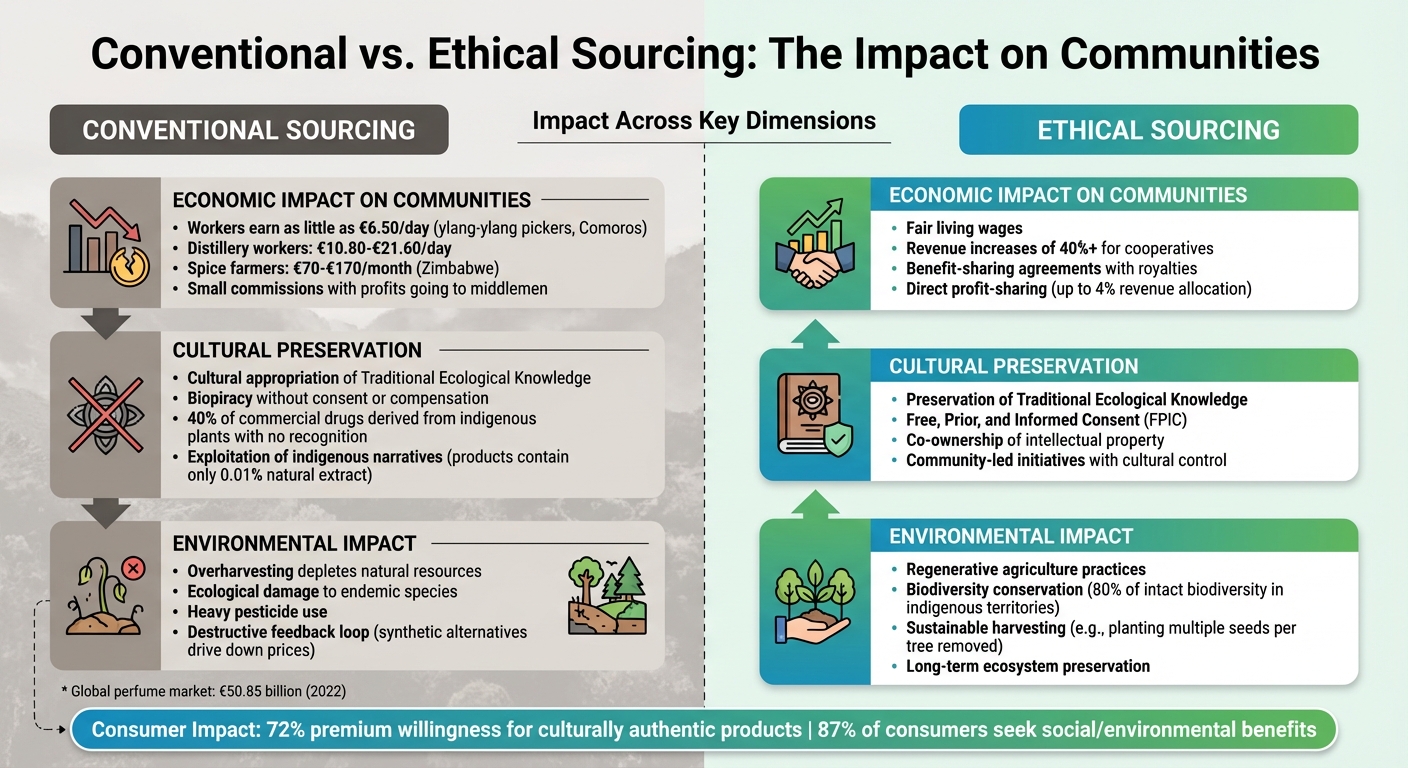
Conventional vs Ethical Sourcing in Fragrance Industry: Impact Comparison
Ethical sourcing creates meaningful advantages for both local communities and the brands involved. Between 2017 and 2021, the German fragrance producer Symrise collaborated with Brazilian company Natura and GIZ to introduce sustainable farming techniques to indigenous communities in the Amazon. This initiative supported 16 cooperatives, increased their revenue by over 40%, and positively impacted more than 1,200 families. For Symrise, the partnership ensured access to high-quality ingredients and opened doors to new research opportunities. These community-focused efforts directly translated into competitive benefits for the brand.
Consumer behavior strongly supports the case for ethical practices. A study in New York revealed that many consumers were willing to pay a 72% premium for fragrances that highlighted authentic cultural elements and empowered indigenous communities. This "green premium" helps brands stand out in a saturated market, particularly as 87% of consumers actively seek products with social or environmental benefits. Additionally, fairer wages for harvesters resonate on both ethical and business levels. Elisa Aragon, CEO of Nelixia, emphasized that "paying farmers better would change millions of lives, without having a really significant impact on the production cost of materials". Given that fragrance concentrate typically makes up just 1%–5% of a product’s retail price, brands can significantly improve community welfare with minimal effect on their profit margins.
Comparison of Conventional vs. Ethical Sourcing
| Approach | Economic Impact on Communities | Cultural Preservation | Environmental Impact |
|---|---|---|---|
| Conventional Sourcing | Low wages (as little as $15/month for some pickers); small commissions with profits concentrated in international firms | Risk of cultural appropriation; exploitation of traditional knowledge without compensation | Overharvesting; ecological damage to endemic species; heavy pesticide use |
| Ethical Sourcing | Fair wages that support decent living standards; benefit-sharing agreements; revenue increases of 40%+ for cooperatives | Preservation of Traditional Ecological Knowledge; co-ownership of intellectual property; community-led initiatives | Regenerative agriculture; biodiversity conservation; sustainable harvesting practices |
The contrast between these approaches highlights ethical sourcing as a smart business choice. Beyond financial benefits, it ensures supply chain stability and helps reduce risks. More than 140 companies have endorsed the IFRA-IOFI Sustainability Charter, a commitment to transparency and the avoidance of reputational damage caused by exploitation scandals. Sylvain Antoniotti, Laboratory Director at Université Côte d’Azur, underscores the importance of this approach:
"The SDGs are not just moral or theoretical constraints; they are strategic levers for optimized and sustainable business models driving long-term profit".
The Fragrance Industry’s Ethical Crossroads
The fragrance industry stands at a pivotal moment. For decades, the individuals who cultivate and harvest rare, natural ingredients have been largely overlooked in the supply chain. These workers, often the custodians of invaluable knowledge and tradition, receive minimal compensation, even as their contributions fuel a market worth billions. Ethical sourcing offers a way forward - one that uplifts lives without significantly increasing production costs. As Elisa Aragon, CEO of Nelixia, succinctly put it:
"Paying farmers better would change millions of lives, without having a really significant impact on the production cost of materials".
Real-world examples back this up. Between 2017 and 2021, Symrise collaborated with indigenous cooperatives in the Brazilian Amazon. This initiative led to a revenue boost of over 40% for participating families. By respecting Traditional Ecological Knowledge and implementing fair benefit-sharing agreements, brands not only secure sustainable access to premium ingredients but also help preserve cultural traditions. Such partnerships empower communities while strengthening the brand’s reputation and consumer loyalty.
Consumers play a critical role in driving this change. They can seek out certifications from groups like the Union for Ethical BioTrade or confirm that brands follow recognized benefit-sharing protocols. By demanding transparency about ingredient sourcing and fair compensation for harvesters, buyers encourage a more equitable industry. Supporting brands that commit to long-term partnerships with indigenous communities helps build a fairer and more sustainable market.
Ethical sourcing isn’t just the right thing to do - it’s also a smart business move. Studies reveal that many buyers are willing to pay up to 72% more for fragrances that genuinely support indigenous traditions. Professor Sylvain Antoniotti highlights this connection between ethics and profitability:
"The SDGs are not just moral or theoretical constraints; they are strategic levers for optimized and sustainable business models driving long-term profit".
Every purchase carries the potential to reshape the industry. By choosing brands that prioritize fairness, cultural respect, and environmental care, consumers honor indigenous heritage while helping to secure the future of both the planet and the luxury fragrances they cherish.
FAQs
How can I tell if a fragrance ingredient was ethically sourced from Indigenous communities?
When assessing ethical sourcing, it’s crucial to look for clear signs of respectful partnerships and fair benefit-sharing agreements. Adherence to international frameworks like the Nagoya Protocol is a strong indicator of responsible practices. Ethical sourcing often involves transparency, certifications, and active collaboration with Indigenous communities, ensuring their rights, traditions, and knowledge are honored.
Key markers to watch for include evidence of community participation in decision-making processes, documented agreements that outline mutual benefits, and strict compliance with laws safeguarding Indigenous rights and biodiversity. These steps help ensure that sourcing practices are both fair and sustainable.
What does Free, Prior, and Informed Consent (FPIC) mean in fragrance sourcing?
Free, Prior, and Informed Consent (FPIC) is a collective right that empowers indigenous communities to decide whether to approve or reject projects that could impact their land, resources, or cultural heritage. This process ensures that decisions are made voluntarily, without pressure, and are informed by accurate and comprehensive details.
Do synthetic alternatives help or hurt Indigenous growers and ecosystems?
Synthetic fragrances offer a way to lessen the demand for raw materials sourced from indigenous lands, which can help reduce strain on delicate ecosystems and protect endangered plant species. However, their use can also negatively impact communities by marginalizing traditional practices and sidelining generations of cultural knowledge tied to natural fragrance production. Ethical sourcing plays a crucial role here - it respects indigenous rights while supporting local development and safeguarding the environment. Striking a balance by thoughtfully incorporating synthetic alternatives can help protect ecosystems without undermining the livelihoods and heritage of indigenous communities.

