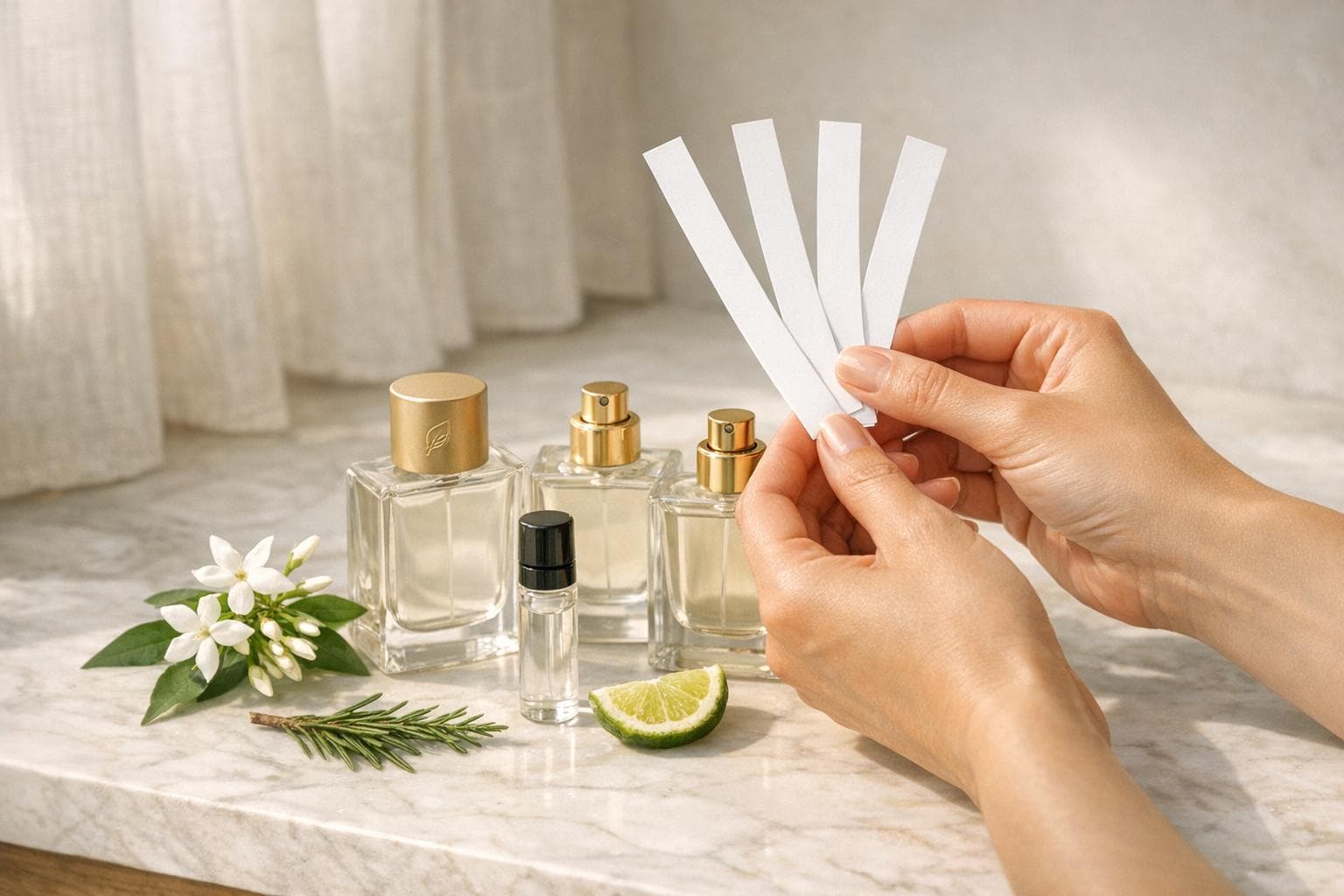
Vous recherchez des parfums véganes de luxe, mais vous ne savez pas par où commencer ? Voici un guide rapide pour vous guider dans votre choix.
- Comprendre les parfums véganes : Les parfums véganes ne contiennent aucun ingrédient d’origine animale et sont sans cruauté (cruelty-free). Cela exclut le miel, la cire d’abeille ou les muscs animaux. Recherchez des certifications telles que Leaping Bunny ou The Vegan Society pour confirmation.
- Connaître les ingrédients à éviter : La parfumerie traditionnelle fait souvent appel à des composants d’origine animale comme le musc (issu des glandes de chevrotain porte-musc), l’ambre gris (sécrétions de cachalot) ou la civette (sécrétions de civette). Les alternatives véganes privilégient les résines végétales, les extraits botaniques ou des molécules issues de la biotechnologie comme l’Ambroxan et le Cetalox.
-
Définir votre profil olfactif :
- Floral : Jasmin, rose ou lilas.
- Boisé : Santal, vétiver ou cèdre.
- Hespéridé : Citron, bergamote ou mandarine.
- Gourmand : Vanille, caramel ou poire.
- Parfums de peau : Des effluves subtils et intimistes sublimés par des muscs véganes.
-
Découvrir les maisons de référence : Parmi les marques véganes haut de gamme, on retrouve :
- Le Labo Santal 33 : Boisé, épicé, ressourçable.
- Chantecaille Frangipane : Floral aux nuances ambrées.
- Sana Jardin Tiger By Her Side : Un ambre épicé qui soutient les artisanes locales.
- Maison Louis Marie No.04 : Une signature centrée sur le santal, parfaite au quotidien.
- Aesop Hwyl : Des sillages fumés et ressourçants.
- Tester avant d’acheter : Utilisez des décants (échantillons de parfum) proposés par des plateformes comme Scento pour essayer les créations avant d’investir dans un flacon complet. Cela permet de vérifier la façon dont la fragrance évolue sur votre peau et s’intègre à votre quotidien.
- Vérifier la tenue et l’éthique : Les parfums véganes s’appuient souvent sur des fixateurs végétaux ou des molécules synthétiques de pointe pour garantir une excellente tenue. Vérifiez toujours les engagements éthiques grâce aux labels officiels.
Conseil d’initié : Les prix des parfums véganes haut de gamme varient généralement de 140 € à 300 € les 100 ml. Tester au préalable permet de faire un choix éclairé tout en évitant le gaspillage.
Plongez au cœur de la haute parfumerie végane pour dénicher la création en parfaite harmonie avec votre style et vos convictions.
Step 1: Learn About Vegan Ingredients in Luxury Perfumes
Maîtriser la composition de son parfum est essentiel pour faire des choix avisés. La parfumerie de luxe traditionnelle s’est longtemps appuyée sur des matières premières animales pour apporter profondeur et sillage. Aujourd’hui, les créations véganes emploient des alternatives végétales et issues de la chimie verte qui atteignent une complexité tout aussi remarquable. Cette évolution invite à apprécier la richesse unique des formulations d’origine végétale.
Comment repérer les ingrédients non véganes
Malgré des réglementations de plus en plus strictes, certains ingrédients d’origine animale subsistent en parfumerie. Le musc naturel provient des glandes du chevrotain porte-musc mâle, tandis que la civette est issue des sécrétions de l’animal du même nom. L’ambre gris, concrétion cireuse rejetée par le cachalot, est convoité depuis des siècles pour son pouvoir fixateur exceptionnel. Le castoréum, extrait des poches glandulaires du castor, apporte des accents cuirés ou fumés, et l’hyraceum, plus confidentiel, est obtenu à partir des déjections fossilisées du daman des rochers. De plus, la cire d’abeille, le miel, le lait et la lanoline (sécrétée par la laine de mouton) sont des sous-produits animaux incompatibles avec une démarche végane.
Pour déceler ces composants, vérifiez la présence des dénominations botaniques en latin sur les étiquettes, souvent gage d’une origine végétale. Si la liste mentionne simplement « fragrance » ou « parfum » sans précision, n’hésitez pas à solliciter la maison pour plus de transparence. Les labels Leaping Bunny, PETA ou The Vegan Society confirment également qu’un sillage est à la fois végane et non testé sur les animaux. Fort de ces repères, vous pourrez aisément écarter les ingrédients animaux et explorer la manière dont les notes végétales subliment les accords traditionnels.
Les atouts des matières premières végétales
Les compositions véganes tirent leur opulence d’absolues botaniques telles que le jasmin et la rose, conférant à la fragrance l’éclat autrefois recherché dans les notes animales. Les résines et baumes végétaux — comme le benjoin, le labdanum et le baume de Tolu — se substituent idéalement au castoréum pour structurer des facettes cuirées et profondes. Côté tenue, des fixateurs naturels tels que le rhizome d’iris, la vanille ou les gommes végétales remplacent l’ambre gris. Parallèlement, des molécules de synthèse comme l’Ambroxan et le Cetalox reproduisent les nuances chaudes, ambrées et sensuelles de l’ambre gris sans porter atteinte aux écosystèmes marins.
Ces alternatives égalent, et dépassent parfois, la régularité et la pureté des ingrédients d’origine animale. Comme le souligne le parfumeur naturel Kershen Teo de Prosody London :
« L’industrie du parfum a presque universellement délaissé les matières animales, non seulement en raison de leur coût, mais aussi parce qu’elle est désormais passée maître dans l’art de recréer tout ce qui fait la richesse du spectre olfactif. »
Étape 2 : Définir votre famille olfactive de prédilection
Une fois les ingrédients véganes bien appréhendés, il ne vous reste plus qu’à cibler l’univers olfactif qui incarne votre personnalité et sublimera votre quotidien.
La parfumerie végane haut de gamme explore un vaste horizon, des floraux aériens aux boisés envoûtants, prouvant qu’une démarche éthique n’enlève rien à l’élégance ni au relief d’un grand parfum. Toute la subtilité consiste à identifier la famille de senteurs qui fait écho à vos envies.
Les grandes familles olfactives véganes
Les créations véganes revisitent avec brio les grandes familles de la parfumerie grâce à des alternatives éthiques :
- Floraux : Du soliflore centré sur une rose bio ou un jasmin noble aux bouquets complexes mariant lilas et frangipane.
- Boisés : Des accords structurés autour du vétiver, du santal ou du cèdre. De nombreuses maisons d’exception emploient désormais des notes boisées bio-identiques afin de préserver les essences rares.
- Frais et hespéridés : Des compositions vibrantes mariant citron de Sicile, mandarine, bergamote et notes marines, parfaites pour un porté quotidien plein d’énergie.
- Gourmands : Une réinterprétation raffinée où la vanille de Madagascar s’allie au caramel épicé ou à la poire veloutée, pour une douceur chaleureuse sans lourdeur.
- Parfums de peau : Formulés à partir de muscs véganes et de molécules comme l’Ambroxan ou le Cetalox, ils révèlent un sillage intimiste qui sublime l’odeur naturelle de l’épiderme.
Chaque famille installe une atmosphère singulière, idéale pour ponctuer les différents instants de votre journée.
Accorder son sillage aux différentes occasions
Une garde-robe olfactive végane équilibrée s’adapte à chaque moment de vie. Pour le quotidien ou les contextes professionnels, privilégiez des sillages limpides et accueillants. Les hespéridés, les accords aquatiques ou les notes fruitées délicates (poire, pomme verte) s’avèrent parfaits pour les espaces partagés. Des floraux lumineux comme le néroli ou le jasmin accompagnent également les journées avec distinction.
Pour les soirées ou les grandes occasions, place aux architectures plus riches et magnétiques. Une vanille enveloppante, un ambre épicé, du patchouli ou de l’encens composent une aura sophistiquée, tandis qu’un parfum de peau aux muscs véganes offre une empreinte sensuelle qui s’épanouit jusqu’au bout de la nuit.
Pour les moments de bien-être et de sérénité, les bois profonds comme le Hinoki japonais, le cèdre ou le vétiver procurent un sentiment de paix intérieure. Cette tendance, souvent associée aux « bains de forêt » olfactifs, s’harmonise à merveille avec les instants de déconnexion. De nombreuses maisons de niche imaginent également des créations mixtes, bousculant les codes du genre avec des hespéridés floraux audacieux ou des ouds boisés opulents.
Étape 3 : Explorer les maisons véganes haut de gamme
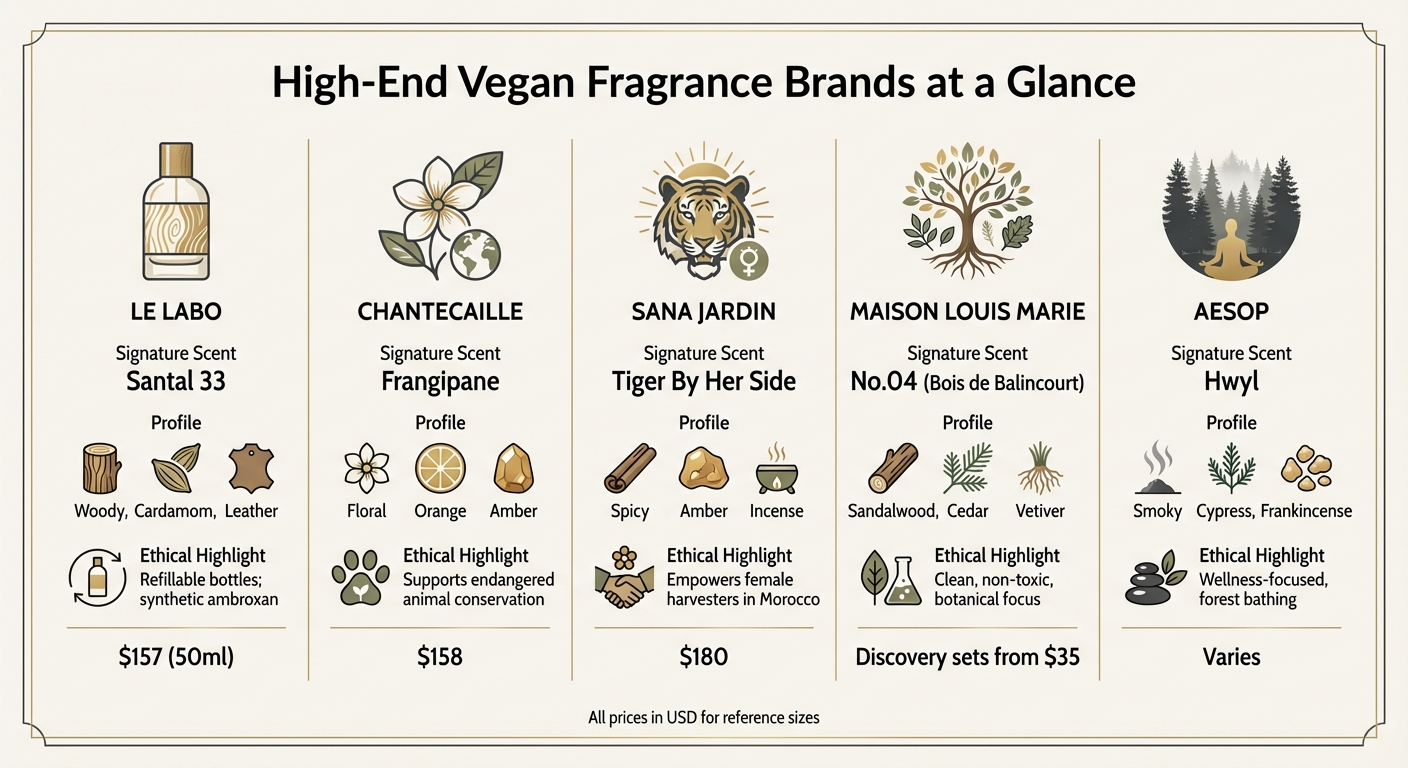
Guide comparatif des marques de parfums véganes haut de gamme
Votre univers de prédilection en tête, vous pouvez désormais vous intéresser aux plus belles maisons de parfums véganes. Ce segment s’est considérablement développé, dévoilant des sillages d’une sophistication comparable aux créations les plus prestigieuses. C’est le moment d’associer votre goût à vos exigences éthiques. Chaque marque se distingue par une identité forte et des œuvres signatures, vous guidant naturellement vers celle qui partage votre vision du luxe.
Le Labo Santal 33
Le Labo Santal 33 s’est imposé comme une véritable légende de la parfumerie contemporaine. Cette création mixte associe la rondeur boisée du santal à la fraîcheur épicée de la cardamome sur un fond cuiré affirmé, offrant un sillage saisissant qui sublime chaque grain de peau. En lieu et place du musc animal, la formule intègre de l’ambroxan de synthèse, garantissant un relief sans compromis moral.
Fidèle à sa démarche écoresponsable, Le Labo propose un service de recharge de ses flacons en boutique, limitant les emballages superflus. La marque affirme d’ailleurs avec un trait d’esprit bien connu :
« Nous pensons qu’il est plus humain de tester nos cosmétiques sur des New-Yorkais que sur des animaux. »
Accessible à partir de $157 le flacon de 1,7 oz (50ml), il s’agit d’une véritable pièce de haute parfumerie.
Chantecaille Frangipane
Chantecaille Frangipane déploie un floral d’une grande distinction, mariant la fleur de frangipanier à des éclats d’orange et à la chaleur de l’ambre. Engagée en faveur de la faune sauvage, la maison reverse une part de ses ventes à des programmes de protection des espèces menacées. Proposé aux alentours de $158, il allie noblesse du sillage, longévité remarquable et engagement pour le vivant.
Sana Jardin Tiger By Her Side
Sana Jardin Tiger By Her Side illustre la philosophie « Beyond Sustainability » de la maison, qui soutient l’émancipation des cueilleuses de fleurs au Maroc. Puisant son inspiration dans les rituels de l’Égypte antique, cet élixir associe un ambre ardent à des volutes d’encens pour forger une présence envoûtante, taillée pour les soirs d’exception. Proposé aux environs de $180, il comblera les amateurs de luxe porteur de sens.
Maison Louis Marie No.04
Maison Louis Marie No.04 (Bois de Balincourt) met à l’honneur le bois de santal au sein d’une atmosphère feutrée et tellurique. Soutenue par le bois de cèdre et le vétiver, cette composition est idéale au quotidien. La marque privilégie les formules épurées et propose des coffrets découvertes dès $35, permettant d’explorer l’ensemble de ses créations avant d’arrêter son choix. Souvent mis en regard de Santal 33, No.04 déploie un équilibre boisé comparable, rehaussé d’une touche de vétiver plus marquée.
Aesop Hwyl
Aesop Hwyl s’adresse aux amateurs de sillages méditatifs et boisés. Porté par un cyprès fumé et des touches d’oliban, il évoque la plénitude d’une marche sous la canopée, offrant une parenthèse aromatique apaisante. Une création idéale pour s’accorder un moment d’équilibre et de plénitude.
| Marque | Sillage emblématique | Profil olfactif | Engagement éthique | Prix indicatif |
|---|---|---|---|---|
| Le Labo | Santal 33 | Boisé, Cardamome, Cuir | Flacons ressourçables ; ambroxan synthétique | $157 (50ml) |
| Chantecaille | Frangipane | Floral, Orange, Ambre | Soutien aux programmes de préservation des espèces menacées | $158 |
| Sana Jardin | Tiger By Her Side | Épicé, Ambre, Encens | Émancipation économique des artisanes au Maroc | $180 |
| Maison Louis Marie | No.04 | Santal, Cèdre, Vétiver | Formules épurées, non toxiques, d’inspiration botanique | Coffrets découverte dès $35 |
| Aesop | Hwyl | Fumé, Cyprès, Oliban | Approche bien-être, inspiration sylvestre | Variable |
Votre expert parfum personnel vous attend
Faites notre quiz olfactif express pour découvrir des parfums de créateurs et de niche authentiques, choisis selon vos goûts – explorez-les en décants et échantillons de 2, 5, 8 et 30 ml, pour essayer chaque fragrance avant de vous engager sur un flacon entier.
Trouvez votre parfumÉtape 4 : Découvrir les créations grâce aux décants Scento

Les parfums de luxe véganes représentent un investissement certain, oscillant souvent entre 150 € et plus de 400 € le flacon. Dans cette optique, les décants constituent une solution privilégiée pour explorer ces jus sans risquer un achat précipité. Ils vous donnent l’opportunité de vivre pleinement avec une création avant de confirmer votre coup de cœur.
L’expérience des décants Scento
Scento propose des décants dans des formats adaptés à différentes durées d’essai : 2ml (environ 30 vaporisations) pour une semaine de découverte, et 8ml (près de 120 vaporisations), idéal pour apprivoiser une fragrance sur un mois complet.
Chaque décant est soigneusement reconditionné dans un flacon en verre scellé afin de préserver les matières précieuses de l’air, de la lumière et des variations de température. Forte d’un catalogue de plus de 90 maisons de créateurs et de niche, Scento rend l’univers de la parfumerie végane haut de gamme accessible en toute simplicité. Chaque décant est un achat à l’unité, pour essayer une nouvelle senteur quand vous le souhaitez.
Pourquoi tester avec un décant est indispensable
Un grand parfum révèle sa personnalité par vagues successives ; un simple essai sur touche en papier ne permet jamais de prévoir l’alchimie d’une note avec votre peau au fil des heures. Les décants vous permettent de juger la tenue et le sillage dans vos conditions de vie réelles — lors d’une journée de travail, d’un dîner ou au fil des saisons.
Cette approche évite les déceptions coûteuses d’un flacon délaissé au fond d’une étagère. C’est également une démarche plus vertueuse, qui réduit le gaspillage et limite les conditionnements superflus. Compacts, élégants et acceptés en bagage cabine selon la règle européenne des 100 ml pour les liquides, ces formats nomades se glissent aisément dans votre quotidien pour varier vos sillages au gré de vos envies.
Étape 5 : Évaluer la tenue et vérifier les certifications éthiques
Après avoir sélectionné les créations qui vous séduisent, deux critères essentiels méritent toute votre attention : la persistance du sillage sur la peau et la rigueur des certifications éthiques revendiquées.
Comment juger de la tenue d’un parfum
Pour mesurer précisément la persistance d’un parfum, vaporisez-le à la fois sur vos points de pulsation et sur une étoffe naturelle, dans différentes conditions. L’humidité ou la température ambiante modifient l’évaporation des notes de tête, de cœur et de fond : l’observer dans divers contextes permet d’apprécier son sillage réel.
Les concentrations en Eau de Parfum (EDP) offrent généralement une meilleure tenue grâce à leur part plus élevée de concentré odorant. Les parfumeurs véganes exploitent des molécules de pointe telles que l’Ambroxan, le Cetalox ou l’Iso E Super pour restituer la fixation autrefois confiée à l’ambre gris ou aux muscs naturels. Parallèlement, les résines végétales comme le benjoin et le labdanum agissent comme d’incomparables fixateurs naturels tout au long de la journée. Vos attentes quant à la tenue confirmées, il convient de valider la sincérité des engagements éthiques de la maison.
Comprendre la signification des labels éthiques
Il importe de distinguer un produit « végane » d’un produit « cruelty-free ». Un parfum végane est formulé sans aucune matière d’origine animale, tandis qu’un parfum cruelty-free garantit l’absence d’expérimentation animale. Une nuance demeure : une marque peut être exempte de tests sans pour autant être végane si sa formule renferme de la cire d’abeille ou du miel. De même, une griffe peut perdre son statut cruelty-free si sa maison-mère distribue ses gammes sur des marchés imposant les tests sur animaux par voie réglementaire.
| Label | Domaine d’application | Exigence fondamentale |
|---|---|---|
| Vegan Society Trademark | Végane | Absence totale de composants animaux, y compris miel, cire d’abeille ou lanoline |
Pour s’assurer du sérieux d’une démarche, fiez-vous aux organismes indépendants de référence. Leurs certifications attestent que les marques se conforment à des cahiers des charges rigoureux, dépassant les simples allégations commerciales pour offrir une traçabilité irréprochable.
Conclusion
Choisir un sillage d’exception respectueux du monde animal s’effectue en quelques étapes simples : de la maîtrise des accords à l’expérimentation grâce aux décants. Commencez par identifier les matières traditionnelles à écarter — musc, ambre gris ou civette — pour privilégier des alternatives modernes telles que l’Ambroxan. Définissez ensuite votre territoire olfactif, des vanilles néo-gourmandes addictives aux boisés contemplatifs, sans oublier les parfums de peau intimistes.
Lors de vos recherches, portez votre attention sur des maisons reconnues pour leur intégrité et leur transparence, à l’instar de Le Labo, Sana Jardin et Aesop. Avant d’investir dans un flacon de 100ml proposé entre 230 € et 300 €, prenez le temps d’évaluer la manière dont le parfum dialogue avec votre peau. Scento vous offre l’opportunité de savourer d’authentiques jus de niche et de créateurs en toute liberté.
Assurez-vous enfin que les créations sélectionnées portent les labels qui garantissent le respect de vos valeurs.
« Le consommateur contemporain, averti et connecté, recherche une beauté en accord avec ses idéaux. L’heure n’est plus aux compromis. » — FAB Team
Les plus beaux parfums véganes coûtant entre 140 € et 300 € les 100ml, essayer avant d’adopter demeure la méthode idéale pour allier plaisir, élégance et consommation raisonnée. Les décants Scento vous ouvrent ainsi les portes d’un luxe personnel, sur mesure et parfaitement aligné avec vos exigences.
Questions fréquentes
Un parfum « végane » est-il nécessairement « sans cruauté » (cruelty-free) ?
Bien que souvent associés, ces termes recouvrent deux réalités distinctes. Les parfums véganes sont élaborés sans aucune matière première d’origine animale, comme le musc animal ou la cire d’abeille. Les parfums sans cruauté (cruelty-free), quant à eux, n’ont fait l’objet d’aucun test sur les animaux. Une création peut ainsi être non testée sur les animaux tout en contenant des dérivés animaux non véganes. Pour cumuler ces deux vertus, une formule doit conjuguer l’absence totale d’ingrédients d’origine animale à l’interdiction formelle de tout test, à chaque stade de création.
Comment identifier les ingrédients animaux dissimulés sur les étiquettes ?
Pour repérer les composants d’origine animale, surveillez des dénominations comme la lanoline, le carmin, la kératine, la glycérine (qui peut être végétale ou animale), la civette, le castoréum, le miel, la cire d’abeille ou encore l’ambre gris. Les listes INCI n’étant pas toujours transparentes sur l’origine exacte de certains dérivés, privilégier des sillages porteurs de certifications véganes ou cruelty-free reconnues reste le moyen le plus sûr de s’assurer du respect de vos critères.
Quel format de décant Scento choisir pour débuter ?
Le format de 8ml est idéal pour commencer. Il offre la quantité parfaite de parfum pour découvrir, porter et analyser une création dans la durée avant d’opter pour un flacon grand format. C’est la contenance idéale pour faire évoluer votre collection à votre rythme et en toute confiance.

