La plupart des parfums modernes se construisent autant en laboratoire que dans les champs. D’après les recherches que j’ai consultées, les synthétiques représentent désormais 80–90 % des ingrédients de nombreux parfums commerciaux, et ils contribuent à porter la tenue sur peau à environ 6–10 heures.
Si je ramène cet article à ce qui vous importe le plus, l’essentiel est le suivant :
- Les molécules boisées-ambrées comme Iso E Super, Ambroxan et Cashmeran façonnent la projection, la texture et le fond.
- Les molécules plus lourdes et plus lipophiles durent généralement plus longtemps sur la peau, le coton et la laine, car elles s’évaporent plus lentement et adhèrent mieux.
- Les muscs et les fixateurs ne se contentent pas de « faire durer le parfum » ; ils ralentissent l’évaporation et modifient la manière dont la senteur se déploie.
- La microencapsulation et les profragrances permettent aux parfumeurs de contrôler la libération dans le temps, au lieu de s’appuyer uniquement sur des notes de fond denses.
- La production biotech transforme la manière dont certaines molécules aromatiques sont fabriquées, en particulier lorsque l’approvisionnement, l’échelle et les règles européennes comptent.
- En Allemagne et dans l’UE, REACH, ECHA et IFRA déterminent quelles matières peuvent encore être utilisées en parfumerie fine.
Voici la version courte : la parfumerie moderne est désormais une affaire de contrôle. Contrôle de la diffusion, de la longévité, de la texture et de l’accès au marché dans l’UE. C’est pourquoi un parfum peut sembler doux au départ, puis rester sur votre veste pendant des jours.
| Groupe de molécules | Son rôle principal | Ce qui compte le plus |
|---|---|---|
| Molécules boisées-ambrées | Apportent de l’élan, de la sécheresse et une structure de fond | Faible volatilité, longue tenue |
| Muscs | Apportent douceur, sillage et persistance | Forte adhérence sur la peau et les textiles |
| Fixateurs | Ralentissent l’évaporation | Transition plus fluide des notes de tête vers le fond |
| Systèmes à libération contrôlée | Retardent la libération de la senteur | Meilleur timing et meilleure rétention |
| Matières issues de la biotech | Modifient l’approvisionnement et la production | Approvisionnement, conformité UE, moindre utilisation des ressources |
Si je lisais cet article pour comprendre ce qui compte en matière de tenue, je me concentrerais sur un point simple : jugez un parfum à la manière dont il se comporte au fil des heures, et non seulement à sa liste de notes.
Woody-Amber Molecules: What Studies Say About Their Performance
Molécules modernes de parfumerie : longévité, volatilité et substantivité comparées
Iso E Super, Ambroxan, Cashmeran et matières apparentées
En prolongeant les molécules longue tenue évoquées plus haut, ces matières montrent comment la structure façonne la performance. Vous les trouverez dans de nombreuses fragrances fines modernes, mais seules, elles ne sentent généralement ni fort ni immédiatement évident. Elles agissent plutôt comme des matières structurelles. Elles ajoutent de la texture, de l’air et de la continuité, afin qu’un parfum paraisse lisse et cohérent, au lieu de passer brusquement d’une note à l’autre.
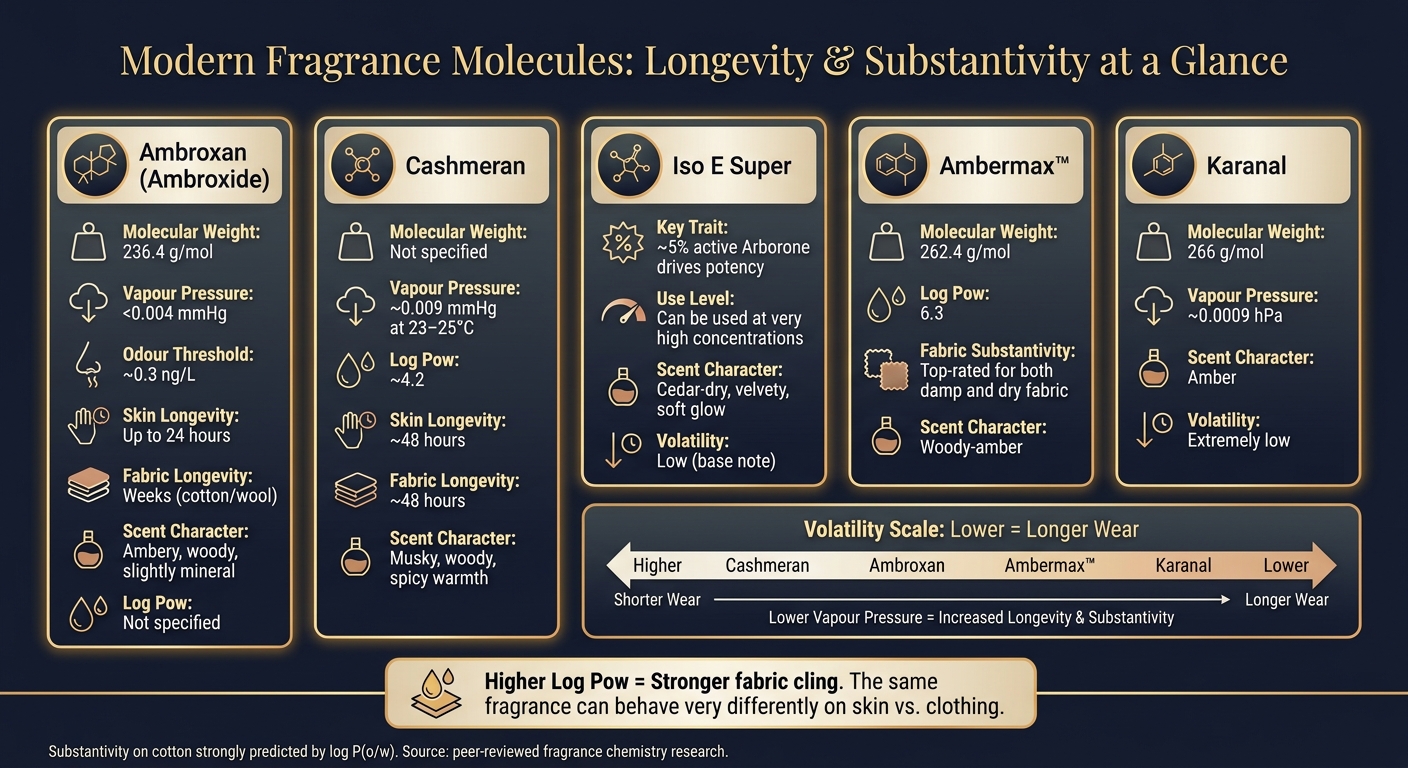
Iso E Super offre un effet boisé sec de cèdre, velouté, avec un éclat doux. Son profil olfactif provient de traces d’Arborone : environ 5 % du mélange, mais bien plus puissant que l’isomère principal B. Cela aide à comprendre pourquoi les fragrances à molécule unique peuvent utiliser Iso E Super à des niveaux très élevés.
Ambroxan — également appelé ambroxide — apporte une sécheresse ambrée, boisée, légèrement minérale, avec une forte diffusion. Son seuil olfactif se situe autour de 0,3 ng/L, de sorte que même d’infimes quantités peuvent modeler la projection d’un parfum. Cashmeran complète le trio avec une chaleur musquée-boisée-épicée, un log Pow d’environ 4,2 et une pression de vapeur proche de 9 mmHg à 23–25 °C. Ces chiffres indiquent une faible volatilité et une forte affinité pour les lipides cutanés et les fibres textiles.
Cette faible volatilité explique pourquoi ces matières s’installent dans le fond plutôt que de jaillir en tête. Utilisées ensemble, elles soutiennent les accords floraux, agrumes, aromatiques et musqués sans voler la vedette.
Pourquoi les molécules plus lourdes durent plus longtemps sur la peau et les textiles
Les molécules plus lourdes ont tendance à s’évaporer plus lentement, même si la forme, la polarité et la formule complète jouent toujours un rôle. Cette évaporation plus lente aide à expliquer pourquoi de nombreuses matières boisées-ambrées restent si bien en place dans le fond d’un parfum.
Ambroxan a une masse moléculaire d’environ 236,4 g/mol et une pression de vapeur inférieure à 4 mmHg, ce qui le place résolument dans le territoire des notes de fond. Les matières boisées-ambrées plus récentes vont encore plus loin. Ambermax™ atteint 262,4 g/mol avec un log Pow de 6,3 et est évalué au niveau le plus élevé pour la substantivité sur textile humide comme sec. Karanal, autre matière ambrée, présente une masse moléculaire de 266 g/mol et une pression de vapeur d’environ seulement 0,0009 hPa.
La substantivité — la durée pendant laquelle une matière reste sur la peau ou le tissu — dépend de bien plus que de la seule masse moléculaire. Les études sur le coton montrent qu’un log P(o/w) plus élevé prédit fortement un dépôt plus important. En termes simples, plus la molécule est lipophile, plus elle est susceptible de s’accrocher aux fibres.
Cette différence apparaît clairement dans la durée de tenue :
- Ambroxan peut s’estomper de la peau en moins de 24 heures, mais rester sur le coton ou la laine pendant des semaines.
- Cashmeran montre une substantivité d’environ 48 heures, aussi bien sur la peau que sur les textiles.
Le même parfum peut donc se comporter de deux manières très différentes selon l’endroit où vous le vaporisez : peau nue ou vêtement. Ce même schéma se retrouve avec les muscs et les fixateurs, où le contrôle de l’évaporation compte encore davantage.
Muscs, fixateurs et chimie de la longévité
Ce que font les muscs synthétiques dans une formule
Les matières boisées-ambrées construisent le fond. Les muscs et les fixateurs décident de la manière dont ce fond s’ouvre au fil du temps. Les muscs sont des matières de fond peu volatiles qui apportent douceur, corps et diffusion. Les principales familles sont les muscs nitrés, les muscs polycycliques et les muscs macrocycliques, chacune avec son propre profil de performance et de sécurité.
Les muscs polycycliques et macrocycliques peuvent rester stables pendant des années dans des flacons scellés lorsqu’ils sont conservés correctement. Cette persistance en fait des fixateurs utiles. Mais il existe un compromis. Leur résistance à la dégradation a suscité des préoccupations, surtout pour les muscs polycycliques, car ils se biodégradent mal et peuvent s’accumuler dans les milieux aquatiques. Les muscs macrocycliques sont aujourd’hui plus souvent privilégiés dans les formulations écoresponsables, car ils offrent une longue tenue et une belle diffusion avec un meilleur profil de biodégradabilité.
Les muscs font aussi plus que prolonger la tenue. Les muscs blancs — principalement polycycliques et certains macrocycliques — se lient fortement à la peau et aux textiles. Cela explique pourquoi une écharpe ou une veste peut encore porter la senteur longtemps après la fin de la journée.
Comment les fixateurs modifient l’évaporation dans le temps
Un fixateur ne se contente pas de se poser au-dessus de la formule et d’ajouter une odeur supplémentaire. Il modifie le rythme de l’évaporation, ralentissant l’effacement des notes de tête afin que le parfum évolue plus harmonieusement vers le cœur et le fond.
Ces matières diffèrent moins par leur famille olfactive que par la manière dont elles façonnent la libération, la douceur et la tenue :
| Type de matière | Volatilité | Persistance | Effet parfumé | Considérations réglementaires dans l’UE |
|---|---|---|---|---|
| Muscs synthétiques (polycycliques, macrocycliques) | Très faible | Longue tenue sur peau et tissu | Chaleur douce, propre et diffusive | Les muscs nitrés sont restreints ou non ajoutés dans certaines catégories de produits ; les muscs polycycliques sont surveillés pour leur persistance environnementale. |
| Fixateurs de type Ambrox (p. ex. Ambroxan) | Très faible | Longue tenue | Élan ambré, rayonnant, légèrement minéral | Examen standard de conformité parfum dans l’UE applicable |
La principale différence tient à la perception. Les muscs adoucissent la composition et laissent un sillage presque textile. Les molécules de type Ambrox injectent lumière et espace dans une senteur, lui donnant un rayonnement vers l’extérieur. Les parfumeurs utilisent les deux avec intention. Ils ne sont pas interchangeables.
Les technologies de libération contrôlée dans la recherche actuelle
La recherche actuelle se tourne de plus en plus vers les systèmes à libération contrôlée. L’idée est simple : gérer quand et comment les matières aromatiques s’évaporent, au lieu de simplement charger une formule en notes de fond denses.
La méthode la mieux étudiée est la microencapsulation. Ici, les molécules parfumées sont enveloppées dans une coque polymère ou de cyclodextrine qui s’ouvre sous l’effet de la chaleur, du frottement, de l’humidité ou d’un changement de pH. Dans une étude sur un polymère acrylate de polyuréthane (PUA), l’encapsulation a entraîné une réduction par 6,5 du taux d’évaporation de l’acétate de benzyle, une note de tête volatile. Environ 50 % en poids du parfum était encore présent après 60 jours.
Les tests textiles montrent la même logique à l’œuvre. Les systèmes de microcapsules à β-cyclodextrine ont conservé 50 % de rétention du parfum après 35 cycles de lavage. Une autre voie, les profragrances, va encore plus loin. Dans ce dispositif, des précurseurs odorants sont liés de manière covalente à une molécule porteuse. Le parfum n’est alors libéré que par hydrolyse, action enzymatique ou changement de pH pendant l’utilisation. Ainsi, la senteur reste inactive jusqu’au moment où elle est nécessaire, puis produit un effet marqué à l’application.
Pour la haute parfumerie, cela ouvre la voie à un contrôle plus précis du tempo olfactif, sans alourdir le fond. Cela marque aussi un passage de la simple recherche d’une tenue plus longue vers une production plus propre, ce qui mène à la biotech et à la durabilité.
Votre expert parfum personnel vous attend
Faites notre quiz olfactif express pour découvrir des parfums de créateurs et de niche authentiques, choisis selon vos goûts – explorez-les en décants et échantillons de 2, 5, 8 et 30 ml, pour essayer chaque fragrance avant de vous engager sur un flacon entier.
Trouvez votre parfumBiotech, durabilité et réglementation européenne
Comment la fermentation et la biocatalyse produisent des molécules parfumées
Si les muscs et les fixateurs façonnent la durée d’une senteur sur la peau, la biotech façonne désormais l’origine de certaines de ces molécules. En pratique, la biotechnologie est utilisée pour fournir des matières parfumées rares, de qualité irrégulière ou difficiles à obtenir à grande échelle. Des microbes ingénierés peuvent transformer des sucres renouvelables en composés aromatiques à base de terpènes, et ce même dispositif microbien peut être orienté vers des résultats boisés, hespéridés, herbacés ou résineux en modifiant les modules de voie métabolique impliqués.
Les matières de type Ambrox illustrent bien ce changement. Les voies biotech et semi-synthétiques ont conduit à des options à plus faible empreinte carbone et moins gourmandes en terres que les anciennes méthodes de production, et des produits comme Ambrofix™ de Givaudan sont positionnés ainsi. La vanilline produite par biotechnologie suit une idée similaire : des microbes ou des enzymes convertissent l’acide férulique en vanilline de haute pureté à partir de flux secondaires agricoles. Selon le règlement européen sur les arômes (CE) n° 1334/2008, la vanilline produite par biotransformation de précurseurs naturels peut être qualifiée de "naturelle", et des études rapportent des efficacités métaboliques maximales d’environ 25,7 % dans des conditions optimisées.
Constats environnementaux et règles européennes
Les muscs synthétiques restent sous étroite surveillance en raison de leur persistance dans l’eau et les boues. Le HHCB et l’AHTN sont encore largement détectés dans les eaux usées, les boues et les eaux environnementales à travers l’Europe. Dans les boues d’épuration, les concentrations rapportées vont de 250 à 26.500 µg/kg de matière sèche pour le HHCB et de 70 à 3.600 µg/kg de matière sèche pour l’AHTN.
Les stations d’épuration déplacent souvent ces composés vers les boues au lieu de les dégrader complètement. Une fois ces boues appliquées aux sols agricoles, la dispersion peut se poursuivre. Les facteurs de bioconcentration rapportés se situent autour de 600 pour l’AHTN et de 624 à 1.584 pour le HHCB, ce qui reste suffisamment élevé pour maintenir l’attention des régulateurs. Certains muscs suscitent une préoccupation encore plus stricte. Pour le traseolide, une PNEC aquatique a été calculée à seulement 6,9 × 10⁻⁴ µg/L.
Dans le cadre de REACH, les substances qui répondent aux critères PBT ou vPvB peuvent être restreintes ou soumises à autorisation. Les muscs nitrés tels que le musc xylène et le musc cétone ont déjà été interdits dans l’UE pour ces raisons. L’IFRA interdit également explicitement les matières parfumées identifiées comme PBT ou vPvB selon les définitions du règlement REACH de l’UE.
Pour les parfumeurs en Allemagne, cela signifie que le choix des ingrédients doit remplir deux fonctions à la fois : délivrer le profil olfactif recherché et rester conforme aux règles de l’UE. Cette tension influence désormais les molécules qui entrent dans les formules de parfumerie fine, non seulement pour la tenue et l’impact, mais aussi pour l’accès au marché.
Ce que la recherche signifie pour la découverte parfumée aujourd’hui
Pourquoi les parfums guidés par les molécules peuvent paraître puissants ou minimalistes
Les molécules aromatiques modernes peuvent donner à un parfum une impression aérienne, diffusive ou presque invisible dès la première vaporisation, tout en restant sur la peau toute la journée. Ce style transparent n’arrive pas par hasard. Il est le résultat d’une ingénierie moléculaire.
Des molécules comme Iso E Super et Hedione n’ajoutent pas une densité lourde de la manière habituelle. Elles élèvent plutôt la formule et l’aident à se diffuser dans l’air. Cela tient en grande partie à la volatilité et à la substantivité — les deux caractéristiques qui façonnent la manière dont une senteur passe de l’ouverture au fond.
Ces molécules se lient aussi bien et s’évaporent lentement. C’est pourquoi une seule application peut persister pendant des heures. C’est aussi pourquoi une fragrance musquée ou boisée-ambrée peut sembler épurée au départ, puis réapparaître plus tard dans la journée. Vous pensez qu’elle a disparu, et puis la voilà de nouveau. Une fois ce type de performance intégré à une formule, la réglementation devient aussi importante que la composition.
Dans l’ensemble de l’UE, la réglementation a modifié les matières que les parfumeurs peuvent encore utiliser. Cette pression a restreint l’accès aux ingrédients et poussé de nombreuses formules vers des profils plus légers et plus diffusifs, construits avec des substituts synthétiques plus propres. En pratique, elle a également orienté de nombreuses reformulations dans la même direction.
Comment Scento s’inscrit dans la découverte
Pour la découverte, c’est précisément pourquoi l’échantillonnage compte. Scento propose des parfums de créateurs en fioles de 2 ml, 5 ml et 8 ml, ainsi qu’en décant en flacon de 30 ml sur la plupart des parfums, afin de tester plus facilement les senteurs guidées par les molécules avant d’investir dans un flacon entier.
Cela compte plus qu’auparavant. Certains parfums ne révèlent pas leur propos dans les cinq premières minutes. Ils s’ouvrent avec douceur, restent près de la peau, puis s’étirent dans le temps. Un petit décant vous laisse l’espace de les porter correctement et de voir comment ils se comportent sur votre peau.
Conclusion : principales conclusions de la recherche actuelle
Pris ensemble, ces résultats changent la manière dont se fait la découverte parfumée. Les molécules synthétiques et issues de la biotech façonnent désormais la longévité, la diffusion et l’amplitude créative, et leur comportement sur la peau peut être mesuré et conçu avec précision. La réglementation européenne et la pression liée à la durabilité continuent également de déterminer quelles matières restent disponibles, accélérant le mouvement vers des alternatives issues de la fermentation. La conclusion pratique est simple : jugez la manière dont un parfum se comporte sur la peau au fil du temps, et non seulement ce que dit son étiquette d’ingrédients.
FAQ
Pourquoi certains parfums sentent-ils faiblement au départ, mais durent toute la journée ?
Vous êtes peut-être face à une adaptation olfactive, souvent appelée cécité olfactive. En termes simples, vos récepteurs olfactifs s’habituent à une senteur. Au bout d’un moment, votre cerveau commence à la filtrer, même si le parfum est encore sur votre peau.
Certaines molécules odorantes, comme Iso E Super, sont connues pour cela. C’est pourquoi un parfum peut sembler disparaître, puis réapparaître soudainement plus tard. Lorsque vos récepteurs se réinitialisent, ou lorsque la senteur se réchauffe avec la chaleur corporelle et le mouvement, vous pouvez la remarquer à nouveau.
Pourquoi le parfum dure-t-il plus longtemps sur les vêtements que sur la peau ?
Le parfum dure généralement plus longtemps sur les vêtements parce que la peau est chaude et chimiquement active, ce qui le fait s’évaporer plus vite. La chaleur corporelle, les huiles naturelles et le pH interagissent également avec les molécules parfumées. Cela aide une senteur à se projeter et à évoluer dans le temps, mais peut aussi la faire s’estomper plus tôt.
Le tissu est moins réactif, si bien que certaines molécules synthétiques, comme Iso E Super, ont tendance à tenir plus longtemps. Sur des vêtements non lavés, elles peuvent rester jusqu’à 7 jours.
Les molécules synthétiques de parfum sont-elles sûres et autorisées dans l’UE ?
Oui. Les molécules synthétiques de parfum sont autorisées dans l’UE, à condition que le parfum fini respecte les règles européennes en matière de sécurité, d’étiquetage et de conformité produit.
En Allemagne, cela signifie que le parfum doit faire l’objet d’une évaluation de sécurité avant son lancement. Cela signifie aussi que certains allergènes parfumants doivent être déclarés lorsqu’ils sont présents au-dessus du seuil de 1%. En outre, les mises à jour européennes récentes ont ajouté davantage d’allergènes parfumants et fixé des délais de conformité pour les produits nouveaux comme existants.
Quant à Iso E Super, il est décrit comme non toxique et non mutagène. Il n’est également pas répertorié comme allergène parfumant dans l’annexe européenne pertinente.

