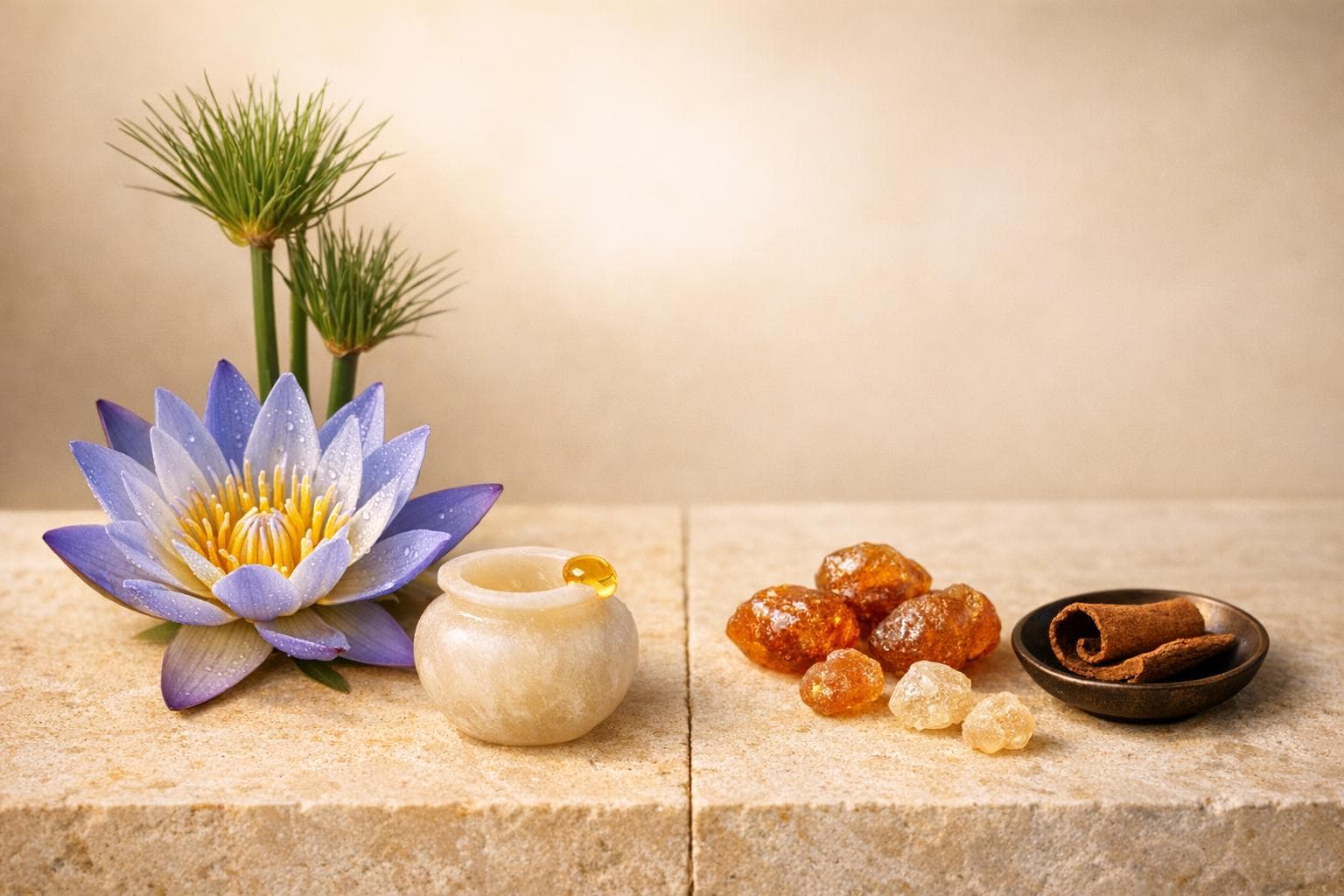
Les anciens Égyptiens maîtrisaient l’art de la parfumerie en mariant des ingrédients locaux et importés. Les matières issues du terroir, telles que les fleurs de lotus, l’huile de moringa et les herbes, offraient des senteurs légères et éphémères, largement utilisées au quotidien. Les résines et épices importées, comme la myrrhe, l’encens, la cannelle et la cardamome, apportaient des arômes intenses et durables, réservés aux rituels et à l’élite. Cet équilibre entre éléments accessibles et matières rares ne définissait pas seulement leur savoir-faire, il reflétait aussi les dynamiques sociales et économiques de l’époque.
À retenir :
- Ingrédients locaux : abordables, abondants et idéaux pour un usage quotidien (par ex. lotus, huile de moringa).
- Ingrédients importés : rares, coûteux et destinés aux usages religieux et à l’élite (par ex. myrrhe, encens, cannelle).
- Différence de tenue : les senteurs locales étaient fugaces, tandis que les matières importées offraient des fragrances persistantes.
Cet équilibre des ressources continue d’influencer la parfumerie moderne, où les ingrédients rares demeurent le symbole du luxe et de l’exclusivité.
Local Ingredients: Materials from the Nile Valley
La parfumerie égyptienne prospérait grâce aux terres fertiles de la vallée du Nil, qui fournissaient un approvisionnement constant en ingrédients naturels de grande qualité, essentiels à cet art raffiné.
Lotus bleu et lotus blanc
Le lotus bleu et le lotus blanc, souvent désignés comme des nénuphars, occupaient une place centrale dans l’élaboration des fragrances égyptiennes. Ces fleurs apportaient aux parfums une note fraîche et aquatique tout en revêtant une profonde signification spirituelle. Les archives anciennes décrivent le lotus comme symbolisant "la sueur des dieux" et incarnant la renaissance ainsi que le renouveau. Son importance apparaît clairement dans l’art des temples et des tombes, où des fleurs de lotus sont fréquemment représentées au sommet de vases à huile, soulignant leur rôle dans les rituels. L’extraction de leur essence relevait d’un procédé minutieux : certaines recettes détaillaient la macération de 1 000 fleurs de lotus dans une huile de balanites épicée pendant 24 heures, le processus étant répété afin d’obtenir un arôme plus puissant.
Huiles de moringa et de balanites
Deux huiles d’origine locale servaient de base aux parfums égyptiens. L’huile de moringa, également connue sous le nom d’huile de ben, était très prisée pour son parfum doux et neutre ainsi que pour sa résistance au rancissement, ce qui la rendait particulièrement adaptée à la chaleur intense de l’Égypte. L’huile de balanites, tirée de l’arbre Balanos aegyptiaca, possédait elle aussi des propriétés singulières. L’érudit antique Théophraste la célébrait comme l’huile la moins visqueuse disponible, la décrivant comme "de loin la plus appropriée" pour absorber et préserver les fragrances florales les plus délicates. Ces huiles neutres offraient un écrin parfait aux senteurs vibrantes des fleurs et des herbes.
Herbes et plantes
Les parfumeurs égyptiens incorporaient également une variété d’herbes locales, qui enrichissaient leurs compositions tout en apportant des vertus rafraîchissantes et médicinales. Le henné, par exemple, était apprécié non seulement pour son parfum affirmé, mais aussi pour son double usage en tant que teinture pour les mains et les pieds. Parmi les autres ajouts prisés figuraient le thym, la coriandre, la menthe et le genévrier, qui donnaient naissance à des infusions revigorantes parfaitement adaptées au climat chaud de l’Égypte. Au-delà de leurs qualités aromatiques, ces herbes possédaient des propriétés antiseptiques et curatives, faisant des huiles parfumées un élément essentiel de l’hygiène quotidienne à une époque antérieure au savon moderne. Ensemble, ces ingrédients locaux formaient l’épine dorsale de la parfumerie égyptienne, préparant le terrain à l’intégration ultérieure de matières importées.
Ingrédients importés : matières issues des routes commerciales
La parfumerie égyptienne était profondément enracinée dans les plantes locales, mais ce sont les ingrédients importés qui lui conféraient un surcroît de sophistication et de tenue. Ces matières exotiques, acheminées par de longues routes commerciales maritimes et terrestres, étaient recherchées pour leur rareté et leurs qualités transformatrices. Dès 2000 avant notre ère, le commerce de ces aromates était devenu un moteur économique majeur, l’Égypte servant à la fois de centre d’importation de matières premières et d’exportation de fragrances de luxe raffinées.
La mer Rouge reliait l’Égypte au pays de Pount, source essentielle de résines, tandis que des caravanes venues d’Inde et d’Asie du Sud-Est apportaient des épices. Un exemple remarquable de l’engagement de l’Égypte à s’assurer ces trésors est l’expédition de la reine Hatchepsout vers Pount, aux environs de 1470 avant notre ère. Représentée dans les reliefs de Deir el-Bahari, sa mission comprenait même le transport d’arbres à myrrhe vivants dans leurs mottes de racines — un exploit extraordinaire pour l’époque. Par ailleurs, la résine de pistachier parvenait de Syrie-Palestine via les réseaux commerciaux du Levant septentrional.
"Les ingrédients étrangers de nature durable étaient appréciés pour leur rareté, et les préparations à base d’ingrédients plus communs et plus éphémères (par ex. le lotus) ne semblent pas avoir été consignées avec la même fréquence." – Lise Manniche, égyptologue
Ces matières importées revêtaient une signification spirituelle profonde. Les Égyptiens croyaient que les plantes et arbres odorants pouvaient les relier au divin, créant sur terre des espaces sacrés. L’encens de temple kyphi, exemple célèbre, comprenait généralement environ 16 ingrédients — associant résines, herbes et épices importées à des raisins secs comme base. La valeur de ces ingrédients est soulignée par la découverte d’environ 350 litres d’huiles parfumées dans la tombe de Toutankhamon, un trésor si séduisant qu’il attira même les pilleurs de tombes.
Les résines importées telles que l’encens et la myrrhe offraient non seulement la rareté, mais aussi la longévité. À la différence de la beauté fugace des fleurs de lotus, ces résines étaient durables, ce qui les rendait idéales pour le stockage et le commerce. Leur combinaison unique de rareté, de portée religieuse et d’utilité pratique leur conférait un prestige auquel les ingrédients locaux, aussi charmants fussent-ils, ne pouvaient rivaliser.
Cette alliance d’importations précieuses et de plantes indigènes a posé les fondations de traditions qui continuent de façonner la parfumerie contemporaine.
Myrrhe et encens
Les résines importées de myrrhe et d’encens jouaient un rôle crucial dans la parfumerie de l’Égypte antique, se mêlant harmonieusement aux matières locales tout en apportant une profondeur sensorielle et cérémonielle singulière. Leur rareté et leur association aux rituels spirituels les élevaient à un rang de prestige inégalé.
Ces résines provenaient de contrées lointaines comme le pays de Pount (l’actuelle Somalie et l’Érythrée) et l’Arabie méridionale. Comme aucune des deux ne poussait sous le climat égyptien, elles étaient considérées comme des importations de luxe, symboles à la fois de richesse et de dévotion. Leur rareté, alliée à leurs propriétés particulières, les rendait indispensables dans les contextes religieux comme pratiques.
L’encens, avec son arôme boisé et terreux rehaussé de nuances douces et citronnées, occupait une place centrale dans les rituels de purification au lever du soleil. Les Égyptiens croyaient que sa fumée blanche portait les prières directement aux dieux, créant un lien sacré. L’effet apaisant de l’acétate d’incensole, un composé présent dans l’encens, renforçait encore l’atmosphère méditative des cérémonies dans les temples. Aujourd’hui encore, l’encens conserve une valeur élevée, témoignage de son héritage intemporel.
La myrrhe, quant à elle, offrait un parfum chaud, épicé et légèrement amer. Sa résine brun rougeâtre était essentielle aux offrandes de la mi-journée dédiées à Rê, le dieu du soleil. Au-delà de ses qualités aromatiques, la myrrhe avait des usages pratiques grâce à ses propriétés antibactériennes. L’analyse de récipients provenant d’un atelier de la 26e dynastie a révélé que 60 % contenaient des sous-produits de genévrier ou de cyprès, tandis que 54 % renfermaient de l’huile ou du goudron de cèdre. Ces découvertes soulignent l’importance de la myrrhe dans la momification et la préservation, dont les effets dépassaient ceux des huiles disponibles localement, comme l’huile de ricin ou de lin. Ce double rôle, rituel et pratique, illustre la manière dont les matériaux importés complétaient les ressources locales de l’Égypte.
Un exemple marquant de l’intégration de la myrrhe dans la parfumerie égyptienne est le parfum mendésien, souvent désigné comme "le parfum égyptien" du monde antique. Ce mélange somptueux associait la myrrhe à de la résine et à de l’huile de balanites, illustrant la capacité de l’Égypte à transformer des importations brutes en créations raffinées et très recherchées. De telles innovations ont consolidé la réputation de l’Égypte dans l’art de produire des fragrances d’exception. Comme le remarquait fort justement Théophraste, "Un parfum durable est ce qu’exigent les femmes".
L’importance spirituelle de ces résines allait plus loin encore. Le mot égyptien pour encens, sntr, se traduit par "rendre divin", reflet du rôle sacré de ces matières. Lors de la Belle Fête de la Vallée, les prêtres versaient une huile parfumée à la myrrhe sur les offrandes brûlées, libérant une fumée dense et suave destinée à atteindre les dieux. Ce geste symbolisait le lien divin que la myrrhe et l’encens apportaient aussi bien aux rituels religieux qu’à la vie quotidienne.
Cannelle, casse et cardamome
La cannelle, la casse et la cardamome, provenant d’Inde et d’Asie, parcouraient d’immenses routes caravanières s’étendant sur 1 491 miles. Comme l’a souligné la professeure Lise Manniche de l’Université de Copenhague, ces trajets allaient "encore plus loin [que Pount]" afin d’acheminer ces précieuses épices vers l’Égypte. Le voyage pouvait durer jusqu’à trois ans, les frais de transport atteignant 688 deniers par chameau avant même que les marchandises n’atteignent la Méditerranée. Un processus aussi long et onéreux mettait en évidence l’immense valeur de ces épices, préparant le terrain de leur importance économique et symbolique.
La rareté et le coût de la cannelle, de la casse et de la cardamome les plaçaient bien au-delà des produits du quotidien. Contrairement aux fleurs de lotus éphémères ou aux herbes communes de la vallée du Nil, ces épices étaient appréciées pour leur durabilité et leur prestige. Leur valeur dépassait souvent celle de l’argent ou de l’or, en faisant des symboles de richesse et de faveur divine. Ces ingrédients exotiques révolutionnèrent également la parfumerie égyptienne, apportant profondeur et complexité à des fragrances jusque-là dominées par de simples notes florales. Réservés à la royauté et aux rituels sacrés, ces sillages devinrent des marqueurs de sophistication.
"En Égypte, le parfum était à base de graisse, et les ingrédients le plus souvent mentionnés dans les textes sont l’encens, la myrrhe, la cannelle, la casse et la cardamome." – Lise Manniche, professeure à l’Université de Copenhague
Ces épices n’étaient pas seulement luxueuses — elles étaient essentielles à l’art de la parfumerie. Elles renforçaient les huiles de base, assurant une meilleure tenue des senteurs. Elles tenaient aussi un rôle majeur dans le kyphi, la célèbre fragrance égyptienne aux usages multiples : encens de temple, onguent médicinal et même boisson. Le mélange sur mesure de la reine Cléopâtre comportait de la cannelle associée à du miel, de l’iris, de la jacinthe et des fleurs d’oranger. Au-delà de la parfumerie, la cannelle était utilisée dans les rituels d’embaumement, car on lui attribuait le pouvoir de favoriser une renaissance propice. Ces usages soulignaient le rôle transformateur des épices dans l’élévation de l’art olfactif égyptien.
L’influence économique et politique de ces aromates était considérable. Vers 1500 avant J.-C., l’expédition de la reine Hatchepsout au pays de Pount recherchait spécifiquement la cannelle et la casse, les inscriptions du temple proclamant : "Jamais pareille chose ne fut apportée pour aucun roi depuis le commencement". Le commerce de ces biens de luxe alimentait l’économie égyptienne dès 2000 avant J.-C. Des siècles plus tard encore, les registres douaniers romains faisaient état de taxes élevées sur la cannelle et la casse importées. Ces épices, par leurs origines exotiques et leur attrait durable, contrastaient nettement avec les plantes plus accessibles de la vallée du Nil, consacrant leur statut de trésors du monde antique.
Votre expert parfum personnel vous attend
Faites notre quiz olfactif express pour découvrir des parfums de créateurs et de niche authentiques, choisis selon vos goûts – explorez-les en décants et échantillons de 2, 5, 8 et 30 ml, pour essayer chaque fragrance avant de vous engager sur un flacon entier.
Trouvez votre parfumAutres résines : galbanum et ladanum
Lorsqu’on compare ingrédients locaux et importés, le galbanum et le ladanum se distinguent par la manière dont ils ont transformé le paysage de la parfumerie égyptienne. Alors que des épices comme la cannelle et la casse apportaient chaleur et complexité, ces résines introduisaient des facettes vives, médicinales et balsamiques qui ajoutaient une tout autre profondeur. Importé de Perse et d’Arabie, le galbanum, avec sa tonalité verte et amère, devint essentiel dans des mélanges comme le Metopion, une préparation médicinale utilisée par les prêtres et les guérisseurs. Le ladanum, quant à lui, apportait une base sombre et résineuse, au parfum chaud et persistant, qui sublimait les fragrances portées par l’élite.
Ces résines étaient également des composants majeurs du Kyphi, un encens intimement lié aux rituels des temples. Ce mélange élaboré, composé de plus d’une douzaine d’ingrédients tels que le ladanum, la myrrhe, l’encens, le mastic et la résine de pin, exigeait 12 jours de préparation méticuleuse. Brûlé chaque nuit dans les temples, le Kyphi était censé favoriser le voyage sûr du dieu soleil Râ à travers le monde souterrain.
"Le Kyphi apaise l’anxiété, induit le sommeil et aligne l’âme avec le divin." – Plutarque, historien
Au-delà de leur usage cérémoniel, ces résines jouaient un rôle essentiel dans les pratiques de momification. Les propriétés de scellement du ladanum le rendaient idéal pour préserver la peau momifiée et stabiliser le corps durant l’embaumement. Fait remarquable, l’analyse chimique d’onguents retrouvés dans des jarres de la tombe du roi Toutankhamon — âgées de plus de 3 000 ans — a confirmé que le ladanum conservait encore son parfum après des millénaires.
La valeur économique du galbanum et du ladanum était immense, souvent assimilée à celle des métaux précieux. Mesurées en deben, une ancienne unité de poids, ces résines étaient fréquemment échangées comme présents diplomatiques entre les cours d’Égypte, du Hatti et de Babylone. Des temples tels qu’Edfou et Dendérah abritaient même des salles spéciales, connues sous le nom de per-wedja, où les prêtres préparaient les résines importées par broyage, filtrage et fermentation, tout en récitant des chants sacrés. Ces résines n’ont pas seulement façonné les rituels antiques ; elles continuent aussi d’inspirer les interprétations modernes des fragrances égyptiennes.
Local vs importé : comparaison directe
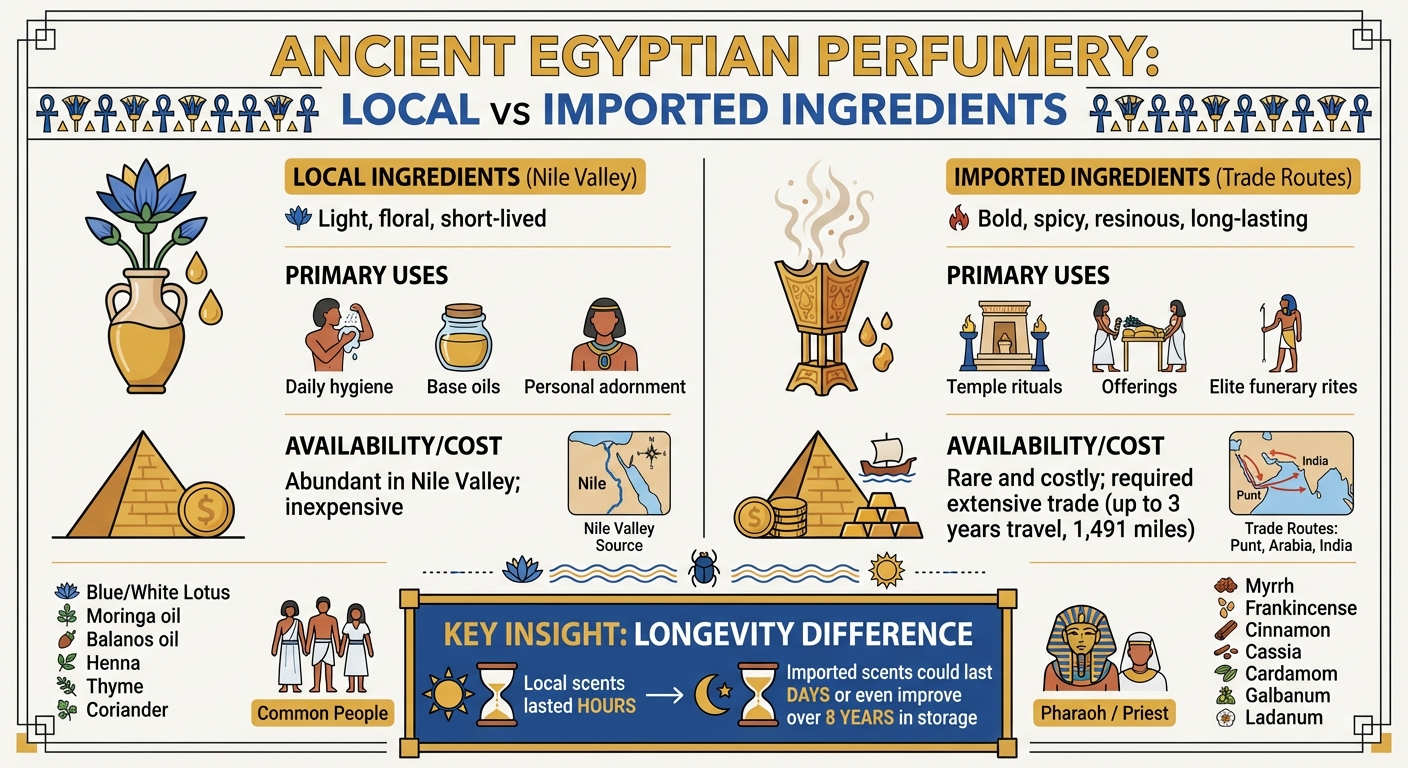
Ingrédients des parfums de l’Égypte antique : comparaison entre produits locaux et importés
Dans le prolongement de la réflexion précédente sur les ingrédients locaux et importés, cette section met en lumière leurs caractéristiques et usages contrastés. Dans la parfumerie de l’Égypte antique, la distinction entre ces deux catégories d’ingrédients influençait aussi bien la vie quotidienne que les pratiques cérémonielles. Les matières locales comme le lotus et l’huile de moringa étaient connues pour leurs senteurs légères et fugitives, tandis que les résines et épices importées offraient des fragrances intenses et durables, capables de persister durant des heures, voire des jours.
Cette différence de tenue était cruciale. Comme le notait le philosophe grec Théophraste, "Un parfum durable est ce qu’exigent les femmes". Pour accroître la persistance des parfums, des éléments importés tels que la cannelle et la casse étaient souvent incorporés dans les dernières étapes de production, surpassant les notes florales plus évanescentes. Le savoir-faire des parfumeurs de l’Égypte antique était si avancé que certaines créations pouvaient conserver — voire améliorer — leur senteur jusqu’à huit ans en réserve.
Le fossé économique entre ingrédients locaux et importés était tout aussi saisissant. Les matières d’origine locale étaient abondantes et abordables, tandis que les résines et épices importées s’accompagnaient d’un prix élevé, rivalisant souvent avec la valeur des métaux précieux. Cette disparité façonnait leurs usages : les ingrédients locaux étaient des piliers de la vie quotidienne, alors que les importations étaient réservées aux rituels sacrés et à l’élite.
Les matières locales remplissaient des fonctions pratiques : l’huile de ricin alimentait les lampes, le lotus ornait les personnes, et l’huile de moringa servait de base neutre au mélange des fragrances. À l’inverse, les ingrédients importés occupaient une place centrale dans les cérémonies des temples, les offrandes divines et les rites funéraires de l’élite.
Tableau comparatif
Le tableau ci-dessous présente les principales différences entre ingrédients locaux et importés.
| Attribut | Ingrédients locaux | Ingrédients importés |
|---|---|---|
| Profil olfactif | Léger, floral et de courte durée | Intense, épicé, résineux et longue tenue |
| Usages principaux | Hygiène quotidienne, huiles de base, parure personnelle | Rituels de temple, offrandes et rites funéraires de l’élite |
| Disponibilité/Coût | Abondants dans la vallée du Nil ; peu coûteux | Rares et onéreux, nécessitant un commerce étendu |
| Exemples historiques | Lotus bleu/blanc, huile de moringa, huile de balanites | Myrrhe, encens, cannelle, casse, cardamome |
Influence sur la parfumerie moderne
La méthode égyptienne antique de création des parfums — alliant des bases locales accessibles à des éléments rares importés — a jeté les bases de la structure des fragrances modernes. Aujourd’hui encore, les parfumeurs suivent un principe comparable, utilisant des supports neutres associés à des essences recherchées afin de composer des créations équilibrées. Ce concept influence non seulement la manière dont les senteurs sont conçues, mais s’étend également à leurs fonctions en matière de bien-être et d’usage pratique.
L’accent mis par les Égyptiens sur les matières exotiques plutôt que sur les plantes indigènes a laissé une empreinte durable, façonnant les perceptions modernes du luxe et de l’exclusivité en parfumerie. Cette préférence pour les ingrédients rares continue d’influencer la manière dont les parfums sont commercialisés, la rareté de leurs composants étant souvent mise en avant pour séduire les consommateurs.
Les formulations complexes de l’Égypte antique ont également préparé le terrain aux mélanges sophistiqués d’aujourd’hui. Prenons l’exemple du kyphi sacré — une composition de 16 ingrédients nécessitant des mois de préparation. Sa complexité en strates évoque la structure "pyramidale" que l’on retrouve dans de nombreuses fragrances de niche contemporaines. Dans un fascinant exercice de reconstitution historique, les archéologues Robert Littman et Jay Silverstein de l’Université d’Hawaï à Mānoa ont recréé l’ancien parfum "mendésien". En s’appuyant sur des textes grecs, ils ont associé la myrrhe, la cardamome, la cannelle et l’huile d’olive verte pour faire renaître ce sillage légendaire, présenté lors de l’exposition "Queens of Egypt" au National Geographic Museum. Littman le décrivait ainsi :
"C’était le Chanel N°5 de l’Égypte antique. C’était le parfum le plus prisé du monde antique."
L’usage thérapeutique des senteurs, enraciné dans des formules égyptiennes anciennes comme le Megalion pour apaiser l’anxiété, connaît aujourd’hui un renouveau. L’aromathérapie et les fragrances fonctionnelles sont désormais en plein essor dans l’univers du bien-être, soutenues par des recherches sur les bienfaits des composés naturels. Par exemple, il a été démontré que l’acétate d’incensole présent dans l’encens possède des propriétés anti-inflammatoires et anxiolytiques. L’intérêt croissant pour les huiles essentielles souligne cette résurgence, le marché mondial devant progresser de plus de 9 % par an jusqu’au milieu des années 2020.
Les parfumeurs contemporains puisent également dans l’héritage olfactif de l’Égypte à travers l’archéologie expérimentale. En 2005, la parfumeuse naturelle Mandy Aftel a recréé la fragrance funéraire de Sherit, une jeune Égyptienne momifiée âgée de 2 000 ans. En analysant des résidus d’encens et de myrrhe, Aftel a redonné vie à cette senteur ancienne dans son musée du parfum à Berkeley, en Californie. Ces efforts visant à ressusciter des techniques et des fragrances perdues montrent à quel point le savoir-faire de l’Égypte antique continue d’inspirer et d’influencer la parfumerie contemporaine. Du choix des ingrédients aux formulations complexes, l’héritage de l’art olfactif sophistiqué de l’Égypte perdure dans les innovations modernes.
Conclusion
Les parfumeurs de l’Égypte antique atteignirent dans leurs créations une harmonie qui continue de façonner l’art du parfum moderne. En associant des bases d’origine locale à des accents exotiques, ils composaient des senteurs en strates destinées aux rituels, au luxe et au bien-être. Des ingrédients comme l’huile de moringa, la balanite et le lotus fournissaient des fondations neutres et stables, permettant aux résines et épices importées — telles que l’encens, la myrrhe et la cannelle — de rayonner. Cet équilibre définissait non seulement leurs parfums, mais reflétait également les hiérarchies sociales et économiques de l’époque.
La distinction entre ingrédients locaux et importés soulignait les divisions de la société. Les Égyptiens ordinaires s’appuyaient sur la flore locale pour leur hygiène, tandis que les importations rares et onéreuses étaient réservées aux rituels du temple et à l’élite. L’égyptologue Lise Manniche a mis en lumière cette dynamique :
"Le parfum était un produit de luxe. Des ingrédients coûteux étaient importés, préparés et exportés... Ce commerce représentait une force majeure dans l’économie égyptienne".
La parfumerie moderne suit encore ce principe. Des bases neutres et accessibles, associées à des essences rares et précieuses, demeurent au cœur de cet art. La demande croissante en huiles essentielles, appelée à progresser de plus de 9 % par an jusqu’au milieu des années 2020, démontre combien ces pratiques anciennes continuent de résonner dans les tendances contemporaines du bien-être et du parfum. Les méthodes de l’Égypte antique offrent une source d’inspiration intemporelle aux artisans d’aujourd’hui.
La grande leçon léguée par les Égyptiens est limpide : le luxe ne réside pas seulement dans la rareté des matières, mais dans l’équilibre subtil entre des bases fiables et des accents distinctifs. Qu’il s’agisse de la composition raffinée du Kyphi ou de la simplicité du Susinum à base de lys, leurs parfums illustrent comment l’interaction entre éléments locaux et importés crée des fragrances capables de traverser le temps.
FAQ
Pourquoi les ingrédients importés rendaient-ils les parfums égyptiens plus durables ?
Les parfums de l’Égypte antique incorporaient souvent des ingrédients importés tels que les résines et les baumes, prisés non seulement pour leurs qualités aromatiques, mais aussi pour leurs avantages pratiques. Ces substances possédaient naturellement des propriétés antifongiques et antibactériennes, qui agissaient comme des conservateurs. Cela aidait à prévenir l’altération et prolongeait la durée de vie des parfums, permettant à leurs senteurs de perdurer au fil du temps.
Comment les Égyptiens extrayaient-ils le parfum du lotus sans distillation moderne ?
Les anciens Égyptiens avaient une méthode fascinante pour extraire le parfum des fleurs de lotus. Ils pressaient les fleurs afin d’en libérer les sucs naturels. Sur certains reliefs artistiques, on voit des femmes tordre des sacs remplis de fleurs de lotus, en faisant s’écouler le liquide dans un récipient placé en dessous. Cette technique leur permettait de capturer l’essence de la fleur sans recourir aux procédés modernes de distillation.
Quel rôle les routes commerciales jouaient-elles dans le fait de pouvoir porter certains parfums ?
Les routes commerciales jouaient un rôle crucial dans l’Égypte antique, en fournissant des ingrédients rares et très recherchés comme l’encens et la myrrhe depuis des régions telles que l’Arabie du Sud et le Levant. Ces importations avaient un coût élevé, faisant des parfums somptueux un privilège réservé aux prêtres, à la royauté et aux plus fortunés. Cette exclusivité d’accès aux matières importées mettait non seulement en lumière les hiérarchies sociales, mais soulignait aussi le lien profond entre les fragrances luxueuses et les pratiques rituelles, consolidant davantage leur association avec l’élite.

