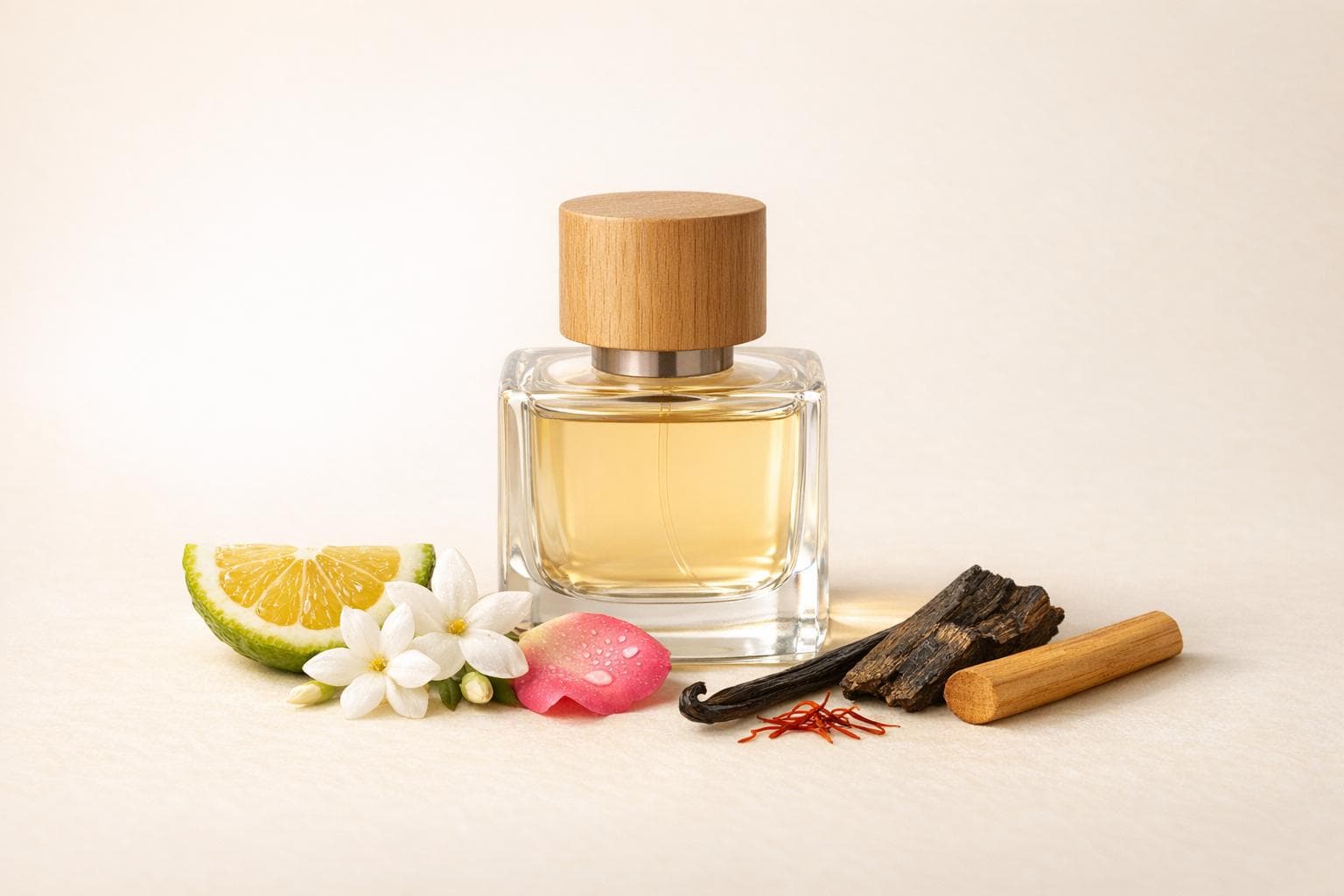
Les maisons de couture réinventent l’industrie du parfum en conjuguant héritage et influences internationales. Des marques emblématiques telles que Chanel, Dior, Guerlain, Bottega Veneta et Balmain s’appuient sur l’art de la narration, le sourcing d’ingrédients et le design pour imaginer des sillages qui résonnent à travers le monde entier. En voici un aperçu :
- Chanel : Célèbre pour ses créations intemporelles comme N°5, Chanel associe ses racines françaises à des ingrédients du bout du monde, tels que le vétiver d’Haïti et le bois de santal de Nouvelle-Calédonie.
- Dior : Profondément ancrée dans ses origines parisiennes, Dior met en lumière des récits personnels et des symboles forts, à l’instar du muguet dans ses sillages.
- Guerlain : Forte de plus de 1 100 créations, Guerlain puise son inspiration dans les traditions mondiales, comme l’Inde moghole pour Shalimar, tout en plaçant la durabilité au cœur de sa démarche.
- Bottega Veneta : Inspirées par l’artisanat vénitien, ses fragrances unisexes marient des ingrédients d’une grande diversité en célébrant le savoir-faire d’exception.
- Balmain : Balmain mise sur des créations audacieuses et non genrées, associant des influences du monde entier au luxe contemporain.
Ces maisons conjuguent avec brio leur héritage et les valeurs d’aujourd’hui, telles que l’approvisionnement éthique et l’inclusivité, faisant du parfum bien plus qu’une simple fragrance : une véritable expression d’identité et d’artisanat d’art.
1. Chanel
Influences culturelles
L’histoire olfactive de Chanel prend sa source dans l’effervescence avant-gardiste du Paris des années 1920. Gabrielle Chanel, pionnière de l’élégance moderne, voyait dans le parfum bien plus qu’une simple senteur : une forme d’art capable de redéfinir le monde de l’après-guerre. Depuis son adresse emblématique du 31, rue Cambon, côtoyant les plus grands artistes de son époque, elle imagine le parfum comme un véritable manifeste culturel. Cette vision donnera naissance à Chanel N°5, fruit d’une collaboration novatrice entre Gabrielle Chanel et Ernest Beaux, parfumeur français né en Russie. Ensemble, ils brisent les codes du XIXe siècle, délaissant les soliflores traditionnels au profit d’une création sans précédent.
« Je voulais faire un parfum artificiel, car pour elle, l’idée d’une senteur naturelle évoquant directement les fleurs relevait du XIXe siècle. C’était le passé. » — Julie Deydier, Responsable du Patrimoine chez CHANEL
Chanel N°5 introduit l’abstraction dans la parfumerie grâce à l’utilisation d’aldéhydes, imaginant une fragrance qui symbolise la complexité de la femme moderne plutôt que de reproduire une fleur unique. Cette philosophie se perpétue aujourd’hui sous la direction d’Olivier Polge, parfumeur créateur de la maison Chanel, qui aborde la composition olfactive à la manière d’une partition musicale. Cette quête d’innovation s’illustre également dans l’exigence absolue portée à la sélection des plus belles matières premières.
Ingrédients emblématiques
La sélection des matières premières chez Chanel témoigne d’une quête constante d’excellence et d’innovation. Au cœur de cette démarche s’inscrit son ancrage historique à Grasse, en France, où 30 hectares de champs de jasmin donnent naissance à une variété aux accents plus doux et plus verts. À titre d’exemple, il faut 1 000 fleurs pour produire à peine une once de parfum, et près de 700 000 corolles pour obtenir un seul kilogramme d’essence concrète.
Mais Chanel ne limite pas son sourcing au terroir local. La maison intègre des matières premières venues des quatre coins du globe, équilibrant ses racines françaises avec une vision internationale. Le vétiver est cueilli en Haïti dans le cadre de filières équitables, tandis que le santal (Santalum austrocaledonicum) provient de Nouvelle-Calédonie. Cette approche de terroir garantit que chaque ingrédient insuffle au parfum un caractère unique, intimement lié à son origine.
« Comme en cuisine, il faut parfois une note dissonante. Une pointe de poivre, qui ne se consomme pas seule mais en accord, apporte la vie. » — Olivier Polge, Parfumeur Maison, Chanel
Rayonnement commercial
L’engagement de Chanel pour la qualité et la créativité assoit sa place prépondérante sur le marché de la parfumerie. Chanel N°5 s’écoule à lui seul au chiffre impressionnant de 10 millions de flacons par an à travers le monde. La maison sait également accompagner l’évolution des sensibilités avec des créations contemporaines comme Bleu de Chanel, qui illustrent un détachement progressif des codes de genre traditionnels. Parallèlement, son accent mis sur les filières éthiques et l’agriculture régénératrice séduit les consommateurs d’aujourd’hui, en quête de transparence et de responsabilité dans l’univers du luxe.
2. Dior
Influences culturelles
L’univers olfactif de Dior est profondément lié à ses racines parisiennes et à la mémoire intime de Christian Dior. La maison signe ses débuts dans le monde du parfum avec Miss Dior en 1947. S’inspirant des traditions françaises et de la grande superstition de son fondateur, la griffe a façonné une identité olfactive qui rend hommage à des figures emblématiques telles que Catherine Dior ou Lucie Daouphars, dite « Lucky ». L’un des symboles les plus chers à l’héritage Dior reste le muguet, fleur fétiche que Christian Dior considérait comme son porte-bonheur. Ce motif traverse les collections de la maison, fidèle à sa maxime : « Lucky, c’est la mode incarnée ». Ces résonances culturelles et personnelles constituent le cœur même des signatures olfactives de Dior.
Ingrédients emblématiques
Le muguet demeure la pierre angulaire de l’identité parfumée de Dior, sans cesse réinterprété pour conserver une modernité éclatante. Ainsi, en 2021, Lucky s’est réinventé sous la direction de Francis Kurkdjian avec l’ajout de notes boisées et cuirées, offrant une nuance inédite à ce grand classique floral. Une autre œuvre emblématique, Dioressence, doit son existence à un heureux hasard vécu par le parfumeur Guy Robert : après avoir manipulé de l’ambre gris chez un fournisseur londonien, il s’était lavé les mains avec un savon évoquant la senteur de Miss Dior. L’harmonie inattendue de ces effluves contrastés fit naître en lui l’étincelle de cette composition magistrale.
« Je voulais revenir à la note de muguet pour la rendre plus incisive. Pour moi, Lucky devait être tout entier dédié au muguet. C’est une fleur qui s’épanouit à l’ombre, dans un sous-bois moussu — un univers humide et sombre qui exigeait une véritable force de caractère. » – Francis Kurkdjian
L’art de la narration
Chez Dior, l’art du récit célèbre autant les personnalités qui façonnent la maison que les compositions elles-mêmes. L’histoire de Lucky en offre une parfaite illustration, rendant hommage à Lucie Daouphars, surnommée affectueusement « Lucky ». Sa présence magnétique auprès de Christian Dior lui valut ce surnom, car elle possédait le don presque magique de transformer chaque robe qu’elle portait en défilé en un succès commercial incontestable.
« Monsieur Dior avait trois mannequins de prédilection... Mais Lucie était exceptionnelle. Elle avait été rebaptisée “Lucky” parce que la quasi-totalité des robes qu’elle présentait devenait la pièce maîtresse des ventes de la collection. » – Francis Kurkdjian
Rayonnement commercial
Dior conjugue avec virtuosité son illustre patrimoine et une sensibilité contemporaine pour séduire un public d’une rare diversité. La marque positionne ses parfums comme une véritable porte d’entrée vers le luxe, trouvant le juste équilibre entre exclusivité et accessibilité. Tout en préservant son aura haute couture, Dior s’adresse à une large audience grâce à des distributeurs de premier plan comme Sephora. Au sein de La Collection Privée, cette alliance de tradition et de modernité se reflète dans un positionnement haut de gamme : Lucky Eau de Parfum est proposé à 330 €, tandis que Lucky Esprit de Parfum atteint 470 €. Grâce à des matières d’exception, des récits captivants et des créations constamment renouvelées, Dior préserve l’élégance française tout en affirmant sa pertinence absolue aujourd’hui.
3. Guerlain
Influences culturelles
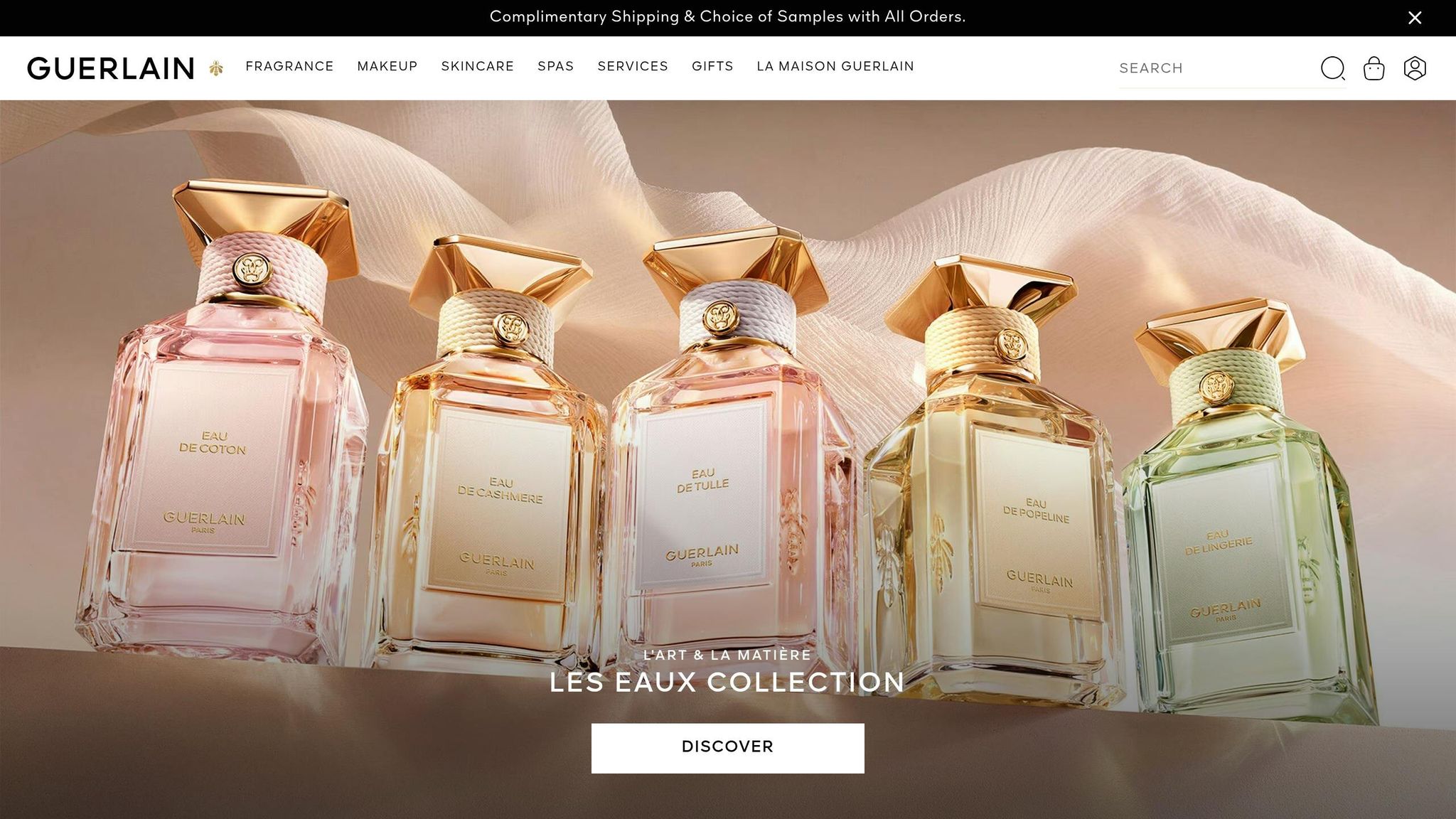
Depuis près de deux siècles, Guerlain conjugue avec maestria l’art de la haute parfumerie française et des influences venues d’horizons lointains. Depuis sa création en 1828, la maison a donné le jour à plus de 1 100 sillages, dont un grand nombre s’inspire de légendes et de traditions du monde entier. L’un de ses plus illustres chefs-d’œuvre, Shalimar (1925), est célébré comme le tout premier parfum ambré de l’histoire. Cette composition puise sa source dans l’histoire d’amour du XVIIe siècle unissant l’empereur Shah Jahan à Mumtaz Mahal, souverains à l’origine du Taj Mahal, scellant l’attachement de Guerlain au raffinement moghol. D’autres créations, à l’image de Mitsouko, vibrant hommage à la culture japonaise, ou de Mahora/Mayotte, inspiré par l’océan Indien, confirment cette aisance à intégrer des récits universels au cœur de ses élixirs. Ce dialogue des cultures est indissociable de la philosophie Guerlain, qui unit le savoir-faire européen aux plus beaux récits du monde.
Ingrédients emblématiques
L’identité olfactive de Guerlain repose sur sa célèbre « Guerlinade », accord emblématique réunissant bergamote, rose, jasmin, iris, vanille et fève tonka — autant d’ingrédients récoltés aux quatre coins du globe. Cette formule intemporelle a été revisitée pour le centenaire de Shalimar en 2025, mettant à l’honneur une vanille biologique de Madagascar préparée selon un savoir-faire d’une infinie précision. Guerlain s’est également illustrée en intégrant très tôt des molécules de synthèse dans ses formules. Ainsi, Shalimar a employé l’éthylvanilline pour sublimer la vanille d’une intensité que les extraits naturels ne pouvaient atteindre seuls. Devant cette audace créative, Ernest Beaux, le parfumeur de Chanel N°5, s’est exclamé avec admiration :
« Quand je mets de la vanille, je fais une crème anglaise ; quand Guerlain en met, il crée Shalimar ».
Delphine Jelk, directrice de la création des parfums Guerlain, détaille sa démarche pour moderniser Shalimar :
« Je voulais que le nouveau Shalimar conserve toute son émotion, aller au plus près de son cœur, de son essence... pour lui insuffler une sensualité en parfaite résonance avec l’esprit du temps ».
L’art de la narration
Les parfums Guerlain sont indissociables d’une écriture poétique, tissant des liens profonds entre les senteurs et des récits culturels ou sentimentaux saisissants. Jacques Guerlain affirmait :
« Un bon parfum est celui dont l’odeur correspond à un rêve initial ».
Cette vision transcende la composition olfactive pour embrasser l’univers artistique qui l’entoure. De récentes collaborations, notamment avec la créatrice de bijoux turque Begüm Khan, ont paré les flacons de bouchons précieux conçus comme de véritables joyaux de collection. Le centenaire de Shalimar en 2025 célèbre non seulement un patrimoine inestimable, mais propose également des relectures contemporaines, conjuguant tradition et regard neuf. Ces strates narratives permettent à Guerlain d’enchanter continuellement les connaisseurs comme les nouvelles générations.
Rayonnement commercial
Le rayonnement international de Guerlain repose sur sa capacité à honorer ses racines tout en embrassant les enjeux contemporains. La clientèle actuelle est particulièrement sensible à son engagement pour la durabilité et l’éthique. La maison compte 3 700 collaborateurs dans le monde à travers ses divisions parfum, soin, maquillage et spas. En phase avec les priorités actuelles, Guerlain a conçu des innovations écoresponsables, telles que des bougies et diffuseurs pour voiture rechargeables, ainsi que des packagings écoconçus. À ce sujet, Delphine Jelk souligne :
« En proposant ces solutions rechargeables, nous réduisons l’empreinte écologique tout en invitant nos clients à s’engager dans une vision plus responsable et durable du luxe ».
La maison veille également à la traçabilité éthique de ses matières premières, avec pour ambition d’auditer 70 de ses filières selon les normes de l’UEBT ou de Fair for Life d’ici 2026. Ses partenariats avec des exploitations biologiques, dont le Domaine Le Mas des Sources à Grasse qui s’étend sur environ 4 hectares, assurent des critères d’excellence et de responsabilité exigeants. Illustrant ce positionnement prestigieux, Shalimar L’Essence Eau De Parfum Intense est proposée aux alentours de $96.
4. Bottega Veneta
Influences culturelles
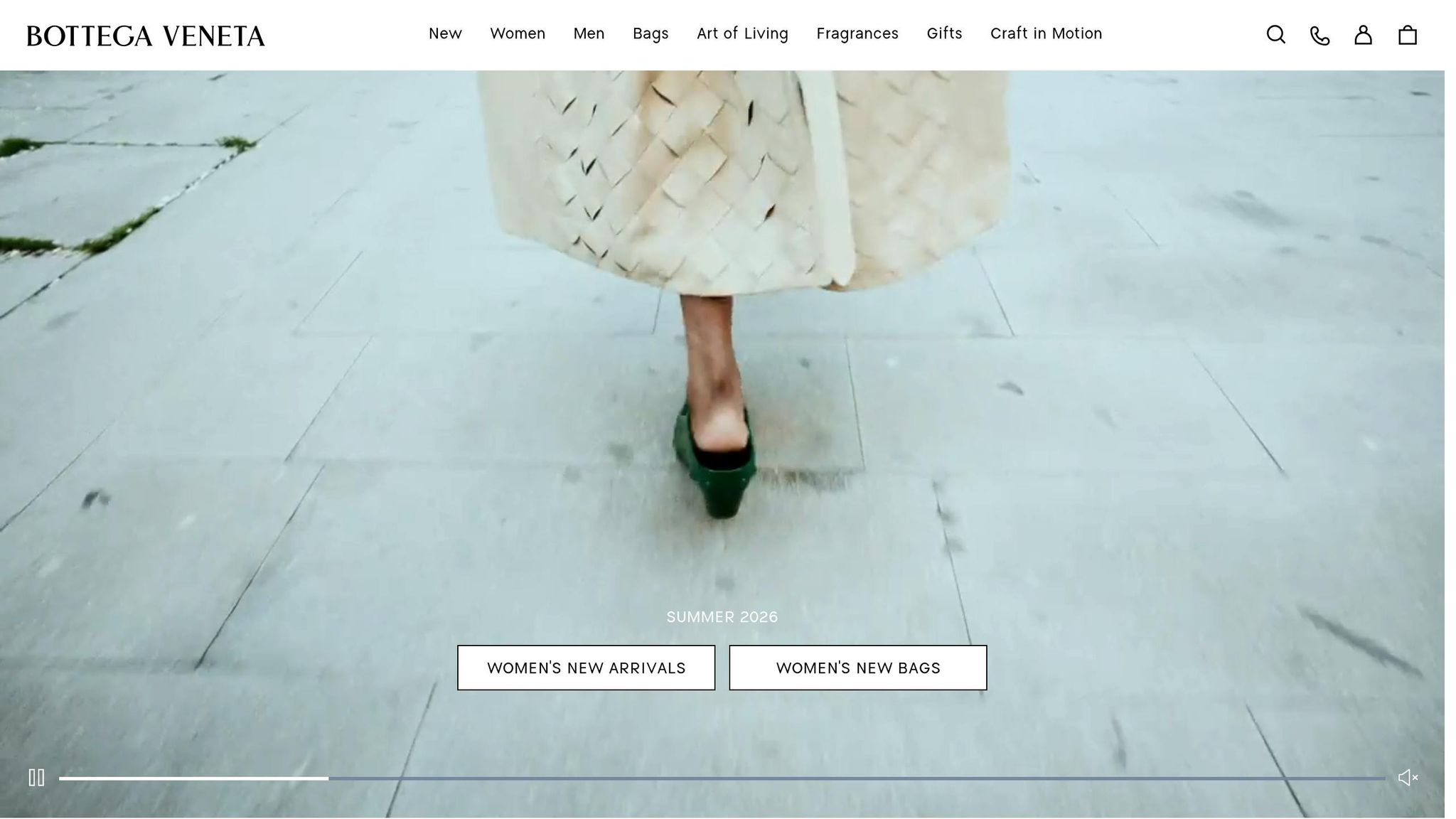
Bottega Veneta insuffle son héritage vénitien et les traditions d’artisanat d’art de la Vénétie au cœur de chacune de ses créations olfactives. S’inspirant du rôle historique de Venise comme carrefour des civilisations, la griffe développe ce qu’elle nomme un « intrecciato olfactif » : une philosophie parfumée qui fait écho à son célèbre tressage de cuir, mariant des éléments du monde entier en de magnifiques accords harmonieux. Le design du flacon rend lui aussi hommage aux maîtres verriers locaux, arborant un verre translucide inspiré de la lagune et un socle en marbre vert verde alpi, rappelant les chefs-d’œuvre soufflés de Murano. Cet ancrage dans la tradition et la haute facture façonne tant le choix des matières que les récits de cette collection.
Ingrédients emblématiques
La collection de fragrances compose une fresque d’ingrédients cosmopolites, affirmant la dimension multiculturelle chère à Bottega Veneta. Par exemple, Colpo di Sole associe l’angélique française à la fleur d’oranger du Maroc, tandis qu’Alchemie fait dialoguer les baies roses du Brésil et la myrrhe de Somalie. La bergamote d’Italie, le géranium de Madagascar et la cardamome du Guatemala viennent enrichir cette palette raffinée. Bartolomeo Rongone, directeur général de la maison, résume cette vision :
« Les fragrances sont la parfaite expression de la marque, qui est par essence synonyme de rencontres et d’influences culturelles ».
L’art de la narration
Dévoilée le 2 octobre 2024, la ligne se compose de cinq créations mixtes. Le directeur artistique Matthieu Blazy y exprime une vision résolument moderne et inclusive :
« Dès notre premier échange, j’ai tenu à adopter une approche sans distinction de genre ».
Ces élixirs sont pensés pour évoluer sur la peau au fil des heures, dévoilant leurs nuances d’inspiration culturelle afin d’offrir un sillage intime à chaque personnalité. L’écrin prolonge cette poésie : les capots en bois évoquent les pilotis soutenant les palais vénitiens, tandis que les flacons rechargeables sont exempts de plastique, un hommage délibéré au savoir-faire artisanal de Venise.
Rayonnement commercial
Positionnés sur le segment ultra-prestige, les parfums Bottega Veneta sont proposés au prix de $425 le flacon ($305 pour la recharge). Distribuée en exclusivité dans une centaine de boutiques seulement — soit environ un tiers du réseau de vente de la maison —, la collection met l’accent sur la rareté et l’exclusivité. Ce positionnement séduit une clientèle exigeante ainsi qu’une jeune génération en quête d’un luxe artisanal et non genré. Les résultats commerciaux confirment cette dynamique, avec des ventes annoncées à $911 millions au premier semestre 2024, en hausse de 3 % sur un an. En accord avec les aspirations actuelles tout en affirmant sa singularité, Bottega Veneta consolide ainsi son empreinte sur le marché de la haute parfumerie.
Votre expert parfum personnel vous attend
Faites notre quiz olfactif express pour découvrir des parfums de créateurs et de niche authentiques, choisis selon vos goûts – explorez-les en décants et échantillons de 2, 5, 8 et 30 ml, pour essayer chaque fragrance avant de vous engager sur un flacon entier.
Trouvez votre parfum5. Balmain
Influences culturelles
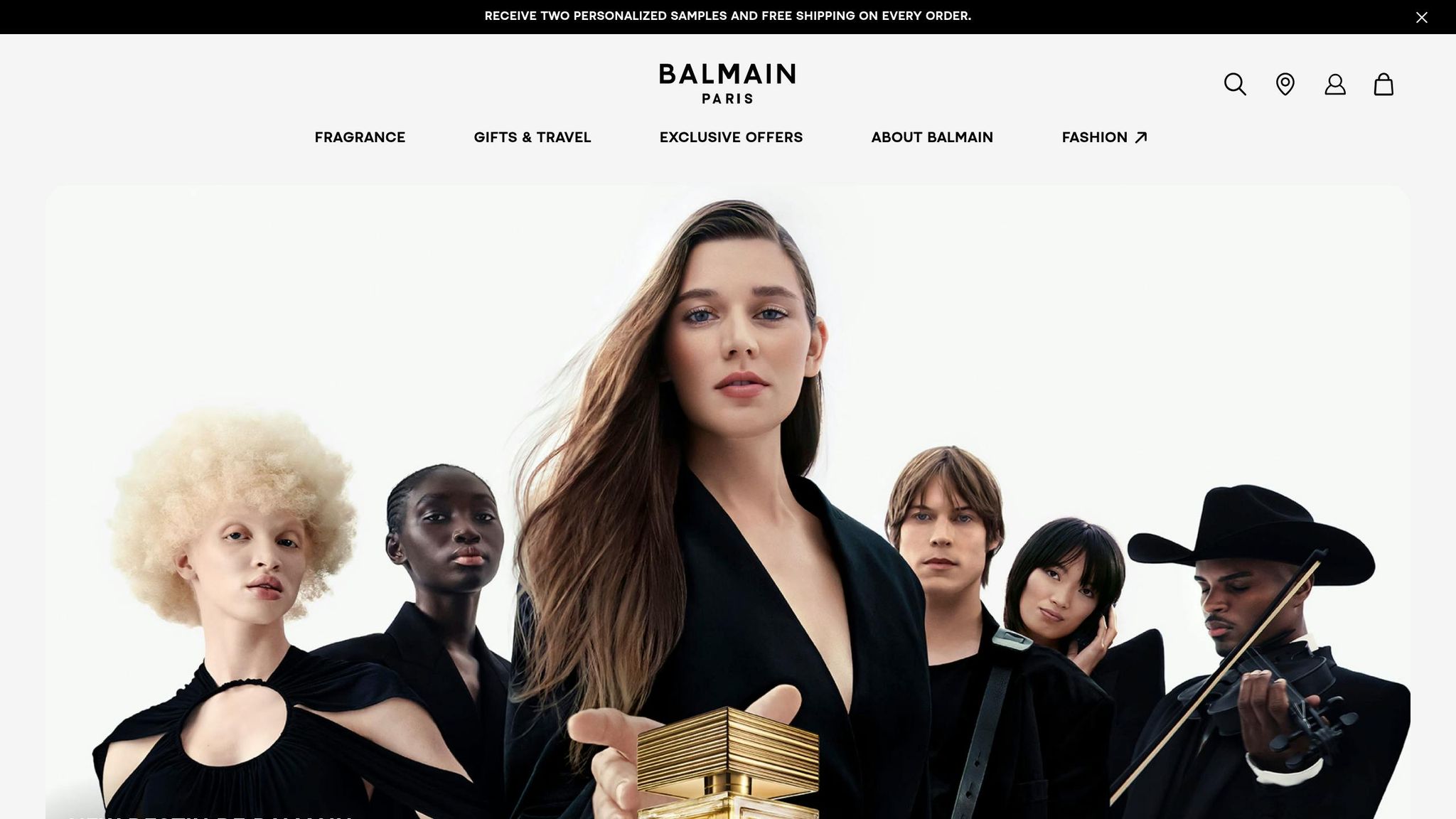
Balmain conjugue avec brio son héritage parisien né en 1945 avec une esthétique audacieuse et contemporaine, donnant naissance à des créations parfumées célébrant l’expression de soi et le mystère. Sous l’impulsion de son directeur artistique Olivier Rousteing, qui a lui-même suivi une formation en parfumerie pour en maîtriser les secrets, chaque sillage matérialise l’évolution créative de la maison. Le parfum est envisagé comme la véritable « ponctuation » du vestiaire Balmain, prolongeant la force et l’élégance théâtrale de sa haute couture. Ce lien s’exprime aussi à travers des éléments de design emblématiques, comme le motif du labyrinthe ou le monogramme « PB », gravés sur des flacons de verre épurés et rechargeables. Le choix méticuleux des ingrédients apporte une dimension supplémentaire à cet imaginaire.
Ingrédients emblématiques
Première création d’exception de cette nouvelle ère, Destin de Balmain met en valeur des matières premières de premier choix récoltées à travers le monde. Sa partition s’articule autour d’une fraise mûre, de baies roses, de pivoine et de lys, rehaussée de nuances lumineuses de litchi. Le maître parfumeur Quentin Bisch décrit ainsi la structure du parfum :
« un santal crémeux vient ancrer le parfum dans la puissance et la lumière... Il dégage une énergie irrésistible, presque électrique ».
Les notes de fond, dominées par le patchouli et le musc, incarnent le goût personnel d’Olivier Rousteing pour les sillages enveloppants, boisés et sensuels.
L’art de la narration
Pour la maison Balmain, les créations olfactives dépassent la simple senteur : ce sont des récits intimes, façonnés par la mémoire et la résilience. En août 2024, la maison a dévoilé Les Éternels de Balmain, une collection non genrée conçue pour une nouvelle génération d’amateurs de parfum, tout particulièrement sur les marchés asiatiques où le secteur devrait atteindre 12,23 milliards de dollars d’ici 2026. Cette démarche illustre une tendance forte unissant tradition et pluralité d’influences, embrassant une parfumerie mixte qui s’accorde avec les modes de vie actuels et la quête d’authenticité.
Rayonnement commercial
Balmain poursuit cette alliance d’élégance et d’engagement avec Destin de Balmain, proposé au tarif de $130 et certifié par le label Butterfly Mark récompensant l’excellence durable. Son flacon cubique rechargeable en verre reflète une conception durable et des pratiques éthiques, répondant ainsi aux exigences des amateurs de luxe éco-responsable.
Tableau comparatif : Forces et faiblesses
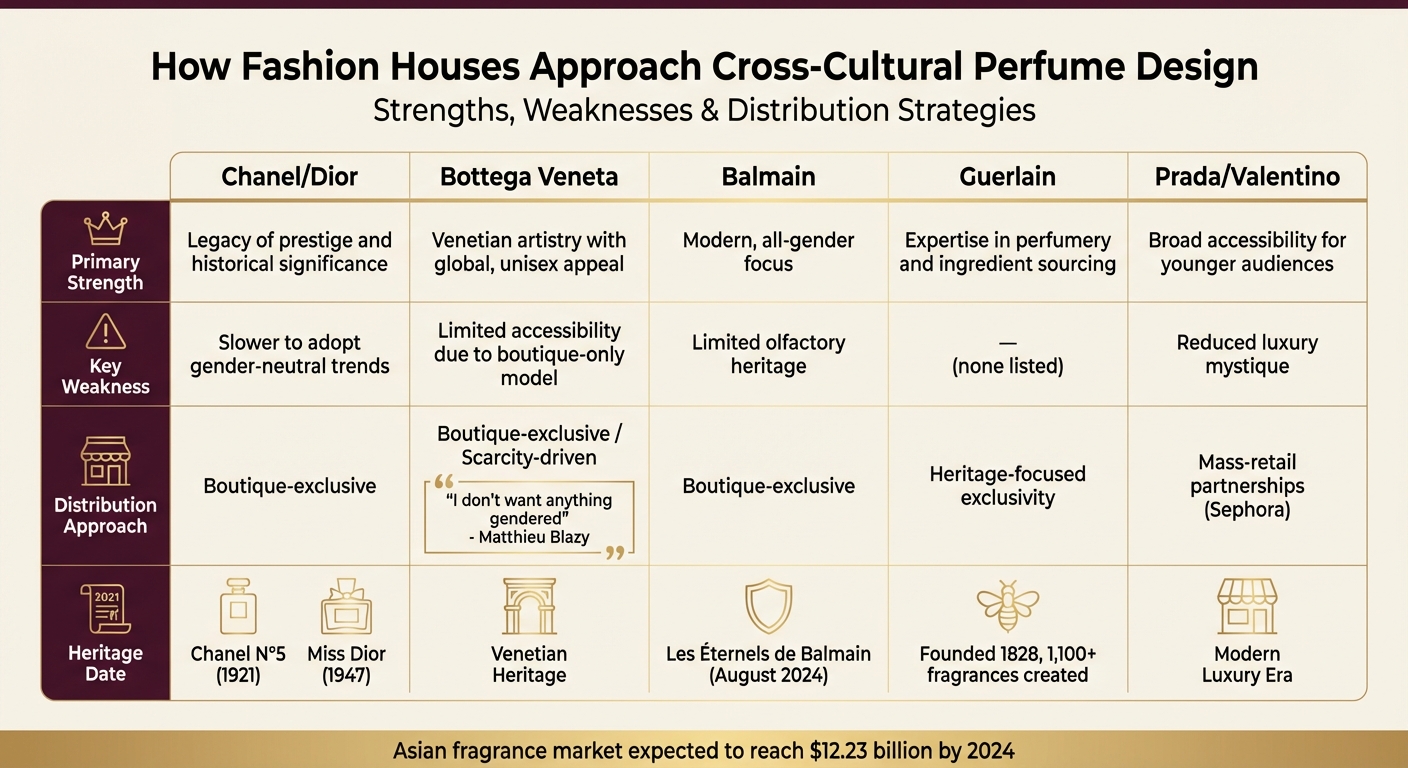
Comparaison des stratégies parfum des maisons de luxe : tradition contre approche moderne
Chaque maison de haute couture apporte sa propre vision à l’art du métissage culturel en parfumerie, cherchant l’équilibre entre tradition et avant-garde. Chanel et Dior capitalisent sur leur prestigieuse histoire — Chanel N°5 ayant vu le jour en 1921 et Miss Dior en 1947 — pour maintenir leur aura d’icônes intemporelles. Toutefois, un héritage aussi monumental peut parfois ralentir leur capacité à adopter pleinement les sillages mixtes et les codes contemporains de la non-genralité.
À l’inverse, Bottega Veneta adopte une posture différente en misant sur des sillages unisexes qui marient le grand artisanat vénitien à des ingrédients rares du monde entier. Comme l’a souligné son directeur artistique Matthieu Blazy : « Je ne voulais aucune étiquette de genre ». Cette approche trouve un écho remarquable sur des marchés dynamiques comme l’Asie, où l’industrie de la parfumerie devrait atteindre 12,23 milliards de dollars d’ici 2024, portée par un taux de croissance annuel de 2,78 % jusqu’en 2029. Cela étant, la distribution de Bottega Veneta, cantonnée à son réseau de boutiques en propre, peut limiter son accès auprès des clientèles aspirationnelles.
En août 2024, Balmain a inauguré « Les Éternels de Balmain », une ligne imaginée pour un public jeune et affranchi des normes de genre. Si cette approche répond parfaitement aux valeurs de notre temps, l’arrivée relativement récente de Balmain dans la haute parfumerie ne lui confère pas encore la légitimité historique de maisons séculaires comme Guerlain. De leur côté, Prada et Valentino privilégient une diffusion plus large en s’associant à Sephora, rendant leurs fragrances accessibles à un jeune public qui n’a pas encore accès à leurs pièces couture. Si cette stratégie élargit considérablement leur audience, elle peut en contrepartie atténuer ce sentiment de rareté qui caractérise le luxe ultime.
Ces différents choix mettent en lumière la manière dont les maisons s’adaptent aux nouvelles attentes du marché du parfum d’exception. Le tableau ci-dessous résume leurs forces, leurs points d’amélioration et leurs modèles de distribution :
| Maison de couture | Atout principal | Point faible majeur | Modèle de distribution |
|---|---|---|---|
| Chanel/Dior | Prestige patrimonial et portée historique majeure | Évolution plus mesurée vers les créations non genrées | Exclusivité boutiques et réseau sélectif |
| Bottega Veneta | Artisanat d’art vénitien et sillage universel non genré | Accessibilité restreinte par une présence uniquement en boutique | Boutiques en propre / Stratégie de rareté |
| Balmain | Vision contemporaine résolument inclusive et mixte | Patrimoine olfactif encore récent | Exclusivité en boutique |
| Guerlain | Excellence parfumeur séculaire et maîtrise du sourcing | - | Distribution sélective centrée sur l’héritage |
| Prada/Valentino | Large accessibilité pour les jeunes générations | Mystère et exclusivité du luxe atténués | Partenariats de grande distribution sélective (Sephora) |
Conclusion
Les maisons européennes historiques comme Chanel et Dior continuent de faire rayonner leur tradition d’artisanat et la subtilité de leurs accords classiques, tandis que Balmain ose une approche résolument contemporaine et affranchie du genre. À mesure que la haute parfumerie évolue, elle s’éloigne des frontières régionales rigides pour embrasser un langage olfactif universel, nourri d’une multiplicité d’influences et d’inspirations du monde entier.
Ce dialogue des cultures redéfinit l’expérience du parfum d’exception. En janvier 2026, Prada a par exemple présenté « Infusion de Santal Chai », une fragrance mixte inspirée du thé chai traditionnel indien, aux notes chaleureuses de cardamome, de gingembre et de santal. Ce lancement s’inscrit dans le sillage des échanges suscités en 2025 par la sandale « Kolhapuri » de la maison. En concertation, Prada s’est rapprochée des organismes LIDCOM dans le Maharashtra et LIDKAR dans le Karnataka à travers un protocole d’accord officiel, s’engageant à valoriser et rétribuer équitablement les artisans locaux dans le cadre du projet « Prada Made in India ». Avec « Infusion de Santal Chai », la griffe a illustré la façon dont une démarche éthique peut dépasser la simple inspiration esthétique pour bâtir un véritable échange culturel, jetant un pont vertueux entre le respect des traditions et l’ouverture internationale.
L’industrie se tourne ainsi vers un équilibre subtil entre inspiration artistique et collaborations équitables. Nombre de parfumeurs réinterprètent désormais des trésors ancestraux — des attars de rose du Moyen-Orient aux bois de santal d’Asie — pour concevoir des accords d’une modernité éclatante. Comme le rappelle avec justesse Aromacountry :
« Le parfum transcende les frontières, reliant l’histoire, les croyances et la mémoire par la grâce d’un art invisible ».
Alors que le marché de la parfumerie de luxe devrait atteindre 41,8 milliards de dollars d’ici 2033, la clé du succès réside désormais dans la célébration du patrimoine alliée à un sourcing éthique et un artisanat collaboratif et respectueux.
Pour les amateurs de belles fragrances, la découverte de ces horizons lointains passe plus que jamais par l’échantillonnage. Privilégier des décants de 2 ml permet d’apprécier chaque nuance sur sa peau sans engagement immédiat. Saisir la sensibilité et la démarche de chaque maison vous guidera ainsi vers le sillage en parfaite harmonie avec votre histoire personnelle.
Questions fréquentes
Comment les marques évitent-elles l’appropriation culturelle en parfumerie ?
Les maisons mettent en place des démarches rigoureuses pour s’assurer de célébrer les différentes cultures avec le plus profond respect et éviter toute appropriation culturelle. Cela implique des recherches historiques approfondies, des partenariats étroits avec des spécialistes ou des artisans locaux, et un engagement sincère à respecter les traditions liées à chaque ingrédient ou inspiration. En inscrivant leur narration dans des contextes authentiques et en valorisant les savoir-faire d’origine, les créateurs célèbrent la richesse du monde sans tomber dans le stéréotype ou la caricature, tissant ainsi de véritables liens de respect mutuel à travers leurs parfums.
Pourquoi un même ingrédient sent-il différemment selon son origine géographique ?
Le profil olfactif d’une même plante peut varier considérablement en fonction de son terroir d’origine. Le climat, la nature du sol ainsi que les techniques agricoles locales influencent directement sa composition biochimique. Ces éléments créent des facettes olfactives uniques et reconnaissables, alors même qu’il s’agit d’une espèce botanique identique.
Comment essayer des parfums de luxe sans acheter un flacon entier ?
Pour découvrir des créations prestigieuses sans acquérir immédiatement un grand format, il est idéal de se tourner vers des formats d’essai tels que des fioles de 2 ml, 5 ml et 8 ml, ainsi qu’un décant en flacon de 30 ml sur la plupart des parfums. Ces options très accessibles permettent de porter et d’évaluer la tenue d’une fragrance sur sa peau avant de faire son choix définitif. L’échantillonnage est la méthode privilégiée pour trouver les sillages qui épousent véritablement vos goûts. De nombreuses marques proposent également des coffrets découverte, parfaits pour explorer tout un univers de créations et leurs inspirations avant de succomber à un flacon grand format.

