Trouver votre parfum signature n’a pas à être compliqué. Votre fragrance reflète votre personnalité et votre style, laissant une impression durable avant même que vous ne preniez la parole. Voici un guide rapide pour vous aider à découvrir l’accord parfait :
- Comprendre les familles olfactives : Les fragrances sont regroupées en catégories comme les florales, boisées, hespéridées et gourmandes. Chaque famille s’accorde à des humeurs, des saisons et des modes de vie différents.
- Identifier vos préférences : Pensez aux senteurs liées à des souvenirs heureux ou à celles qui correspondent à votre routine quotidienne et à l’impression que vous souhaitez laisser.
- Tester sur la peau : Les fragrances évoluent avec le temps ; testez-les toujours sur votre peau afin d’observer leur interaction avec votre chimie corporelle.
- Essayer avant d’acheter : Optez pour de plus petits décants afin de découvrir comment une fragrance se comporte dans différents contextes avant de vous engager sur un flacon entier.
- Affiner votre choix : Choisissez une senteur qui résonne avec vous et s’accorde à votre environnement, puis constituez une petite collection pour différentes occasions.
Comment trouver votre parfum signature (4 étapes simples)
Étape 1 : Apprendre les principales familles olfactives
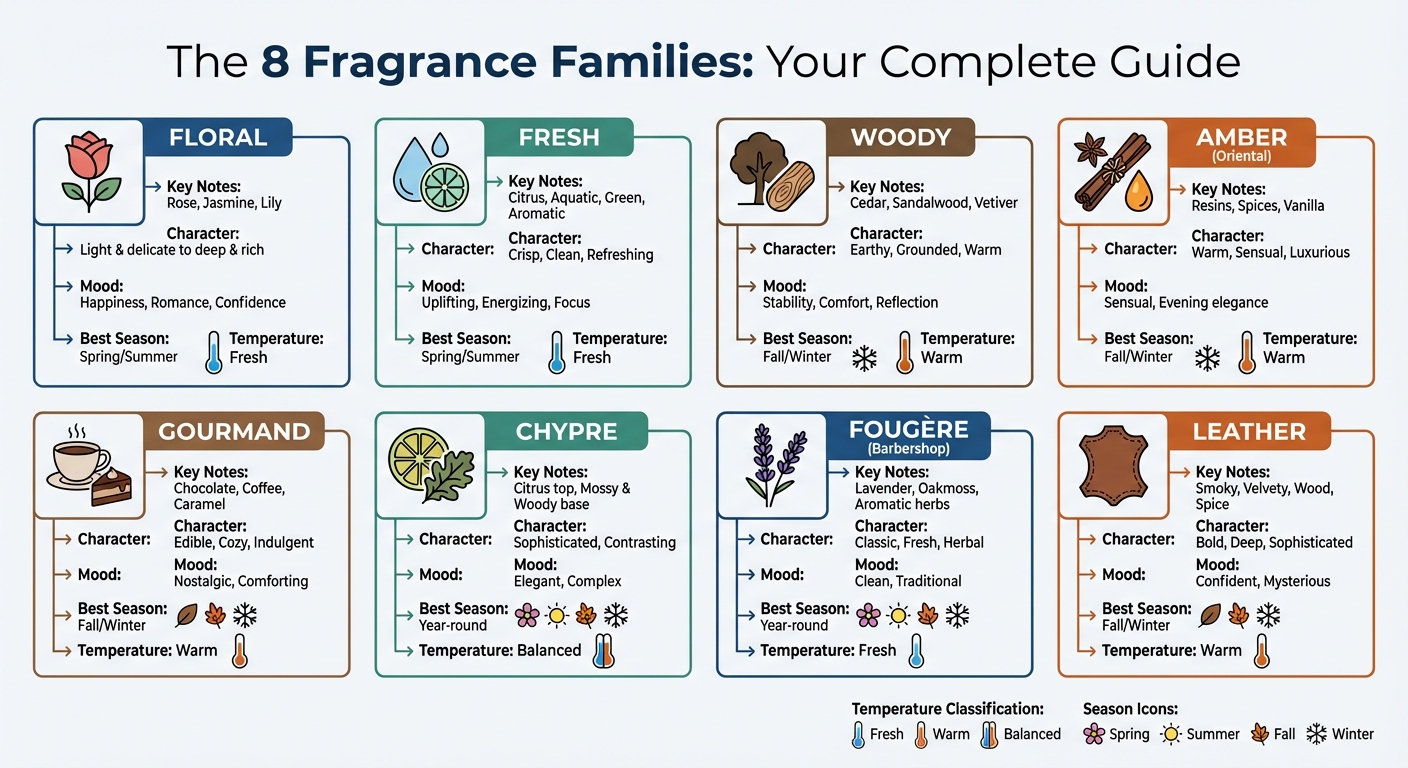
Guide des familles olfactives : caractéristiques, humeurs et meilleures saisons
Qu’est-ce qu’une famille olfactive ?
Les familles olfactives sont comme les "genres" de l’univers du parfum : elles regroupent les senteurs selon leurs caractéristiques dominantes. Elles facilitent l’exploration et la compréhension de ce qui correspond à vos goûts.
Les parfums sont généralement répartis en quatre à huit grandes familles, souvent classées comme "Chaudes" ou "Fraîches". Voici un aperçu des principales familles :
- Florale : C’est la famille la plus populaire, avec des notes comme la rose, le jasmin et le lys. Ces senteurs peuvent aller de légères et délicates à profondes et opulentes.
- Fraîche : Elle comprend les styles hespéridés, aquatiques, verts et aromatiques. Ce sont des senteurs nettes et lumineuses qui évoquent une sensation de fraîcheur.
- Boisée : Construite autour de notes terreuses comme le cèdre, le santal et le vétiver, elle offre une qualité chaleureuse et ancrée.
- Ambrée : Autrefois appelée Orientale, cette famille associe résines, épices et vanille pour un profil chaud et sensuel.
Les familles olfactives modernes se sont élargies pour inclure :
- Gourmande : Avec des notes "comestibles" comme le chocolat, le café et le caramel, ces senteurs sont enveloppantes et délicieusement indulgentes.
- Chyprée : Réputée pour son contraste sophistiqué entre des notes de tête hespéridées lumineuses et des fonds mousseux et boisés.
- Fougère : Souvent appelée la famille "barbershop", elle mêle lavande, mousse de chêne et herbes aromatiques.
- Cuir : Elle offre des notes fumées et veloutées, souvent associées au bois ou aux épices pour davantage de profondeur.
"Dans l’univers du parfum, les familles olfactives sont une manière de décomposer et de classer l’odeur d’un parfum plutôt que ce qu’il contient." – Joan Tanis, Directrice nationale de la formation, Maison Francis Kurkdjian
Comprendre ces familles vous aide à accorder vos choix de fragrance à votre style personnel et à vos préférences.
Associer les familles olfactives à vos préférences
Chaque famille olfactive s’accorde naturellement à des humeurs, des saisons et des modes de vie spécifiques. Par exemple, les senteurs Hespéridées sont vivifiantes et énergisantes, connues pour stimuler les niveaux de sérotonine et combattre la fatigue. Elles sont idéales pour les matins d’été ou les moments où vous avez besoin de concentration. Les fragrances Florales, souvent associées au bonheur et au romantisme, peuvent même renforcer la confiance en soi — en particulier le jasmin.
Pour l’ancrage et le réconfort, les senteurs Boisées apportent de la stabilité, ce qui les rend parfaites pour les moments calmes et introspectifs. Les fragrances Ambrées, avec leur chaleur luxueuse, créent une présence sensuelle, idéale pour les événements en soirée. Quant aux notes Gourmandes comme la vanille, elles évoquent une atmosphère cosy et nostalgique, particulièrement séduisante par temps froid.
Les saisons jouent également un rôle majeur dans le choix de la fragrance idéale. Les senteurs Fraîches et Hespéridées rayonnent au printemps et en été, tandis que les styles Ambrés, Boisés et Gourmands conviennent mieux aux températures plus fraîches ou aux espaces intérieurs. La chaleur intensifie la projection du parfum et accélère son évaporation ; les senteurs plus légères sont donc moins envahissantes durant les mois chauds.
Vos préférences personnelles tendent souvent vers une ou deux familles. Observez les parfums que vous possédez déjà : les motifs qui se dessinent dans votre collection peuvent révéler vos inclinations naturelles. Par exemple, si vous aimez l’odeur de l’herbe fraîchement coupée, vous pourriez apprécier les familles vertes ou aromatiques. Si vous êtes attiré par l’arôme des épices de pâtisserie ou du café, les senteurs Gourmandes pourraient être votre accord parfait.
Gardez à l’esprit que les fragrances interagissent de manière unique avec votre chimie corporelle. Un parfum qui sent le bois sur papier peut devenir sucré sur votre peau. C’est pourquoi tester une fragrance sur votre peau constitue une étape essentielle.
Étape 2 : Identifier vos préférences personnelles
Réfléchir aux senteurs qui éveillent des souvenirs
L’odorat a une manière unique de se relier à nos souvenirs. Une simple effluve familière peut instantanément vous transporter vers un moment, une personne ou un lieu précis de votre passé. Ce lien émotionnel fait de vos souvenirs personnels un excellent point de départ pour choisir un parfum signature.
Pensez aux arômes associés à vos instants les plus heureux. Était-ce les épices chaudes qui s’échappaient de la cuisine d’un parent, les floraisons délicates de roses ou de jasmin, ou la brise salée et hespéridée d’une escapade au bord de la mer ? Les odeurs du quotidien comme l’herbe fraîchement coupée, la pluie, le café qui infuse ou vos épices favorites peuvent également révéler vos affinités naturelles avec des familles olfactives telles que Fraîche, Boisée, Ambrée ou Florale.
Gardez à l’esprit que les fragrances réagissent différemment sur chaque personne en raison de la chimie propre à la peau. De plus, vos préférences peuvent évoluer avec le temps : ce que vous aimiez à vingt ans peut se transformer au fil des années, passant peut-être de fleurs légères à des notes plus riches et plus boisées.
Une fois que vous avez identifié les senteurs qui vous procurent de la joie, réfléchissez à la façon dont votre environnement quotidien et votre mode de vie peuvent influencer vos choix de fragrance.
Accorder votre parfum à votre mode de vie et à l’impression souhaitée
Votre routine quotidienne joue un rôle important dans le choix de la fragrance qui vous convient. Par exemple, si vous travaillez dans un environnement professionnel ou de bureau, les senteurs plus légères et plus fraîches sont un choix sûr : elles sont assez subtiles pour ne pas dominer vos collègues dans les espaces rapprochés. À l’inverse, si vous passez beaucoup de temps à l’extérieur ou êtes constamment en mouvement, des fragrances plus puissantes et affirmées fonctionnent mieux, car l’air libre évite qu’elles ne deviennent trop présentes.
Pensez également à l’impression que vous souhaitez laisser. Vous voulez projeter audace et assurance ? Recherchez des notes comme le cuir, l’oud ou le tabac. Pour une allure nette et raffinée, le musc, le thé ou les notes aquatiques sont d’excellentes options. Les personnalités rêveuses et romantiques s’accordent souvent aux fleurs douces et aux senteurs poudrées, tandis que les amoureux du grand air préféreront peut-être les fragrances vertes, herbacées ou boisées.
"Je porte des parfums pour me mettre dans différents états d’esprit ou changer de persona. Si vous voulez vous sentir d’une certaine manière, vous pouvez l’appliquer comme un déclencheur." – Jo Fairley, cofondatrice de The Perfume Society
Pour tirer le meilleur parti de votre collection de fragrances, visez une petite "boîte à outils" de trois à cinq senteurs. Incluez un parfum polyvalent du quotidien pour le travail, un choix remarquable pour les événements en soirée et une fragrance inattendue pour accompagner votre humeur ou expérimenter votre persona. Ainsi, votre parfum devient bien plus qu’une simple senteur : c’est un moyen d’exprimer qui vous êtes, où que vous soyez.
Étape 3 : Tester les fragrances sur votre peau
Pourquoi le test sur peau est essentiel
Les bandelettes de papier et les bouchons de flacon ne vous donnent qu’un aperçu des notes de tête d’une fragrance. Mais voici l’essentiel : votre peau est unique. Sa chimie — influencée par des facteurs comme le pH, les huiles naturelles, la température corporelle et même votre alimentation — interagit avec les molécules parfumées d’une manière entièrement personnelle. Une senteur vive et hespéridée sur touche peut se transformer en quelque chose de plus chaud et musqué au contact de votre peau, ou inversement.
Lorsque vous vaporisez un parfum pour la première fois, vous êtes accueilli par les notes de tête : ces éléments vibrants et captivants conçus pour créer une impression immédiate. Mais ces notes de tête sont fugaces, s’estompant généralement en moins de 30 minutes. Si vous choisissez une fragrance uniquement sur cette première envolée, vous passez à côté des notes de cœur et de fond, qui constituent la véritable essence de la senteur.
La véritable personnalité d’une fragrance se révèle lors du sillage final — l’étape qui apparaît plusieurs heures après l’application. C’est à ce moment que les notes plus profondes et persistantes, comme le musc et l’ambre, se mêlent à l’odeur naturelle de votre corps pour créer un accord harmonieux. Pour comprendre pleinement le caractère d’une fragrance, vous devez la tester sur votre peau.
Observer l’évolution des fragrances au fil du temps
Les fragrances sont conçues en couches, souvent décrites comme une pyramide. Les notes de tête — agrumes, gingembre ou autres éléments lumineux similaires — s’estompent en 15 à 30 minutes, laissant place aux notes de cœur, qui persistent jusqu’à quatre heures. Enfin, les notes de fond, comme la vanille ou le musc, émergent et peuvent durer beaucoup plus longtemps.
"Les notes de cœur et de fond sont en réalité les plus importantes, car elles sont la véritable signature de la senteur." – Kilian Hennessy, parfumeur
Pour tester efficacement les fragrances, appliquez chaque senteur sur une zone précise de votre peau — comme votre poignet gauche, votre poignet droit ou le pli du coude. Évitez de frotter la fragrance, car cela peut perturber son développement naturel. Laissez passer au moins trois heures avant de prendre une décision, afin de découvrir toute l’évolution de la senteur.
Gardez à l’esprit que votre odorat peut se fatiguer après avoir testé 5 à 7 fragrances. Pour éviter la fatigue olfactive, limitez chaque session à trois senteurs. Entre les tests, réinitialisez votre nez en respirant votre propre peau propre, par exemple l’intérieur de votre coude, plutôt que d’utiliser des éléments très odorants comme les grains de café. Évitez également de porter des lotions ou déodorants parfumés les jours de test, afin que votre peau offre une toile neutre à la fragrance.
Votre expert parfum personnel vous attend
Faites notre quiz olfactif express pour découvrir des parfums de créateurs et de niche authentiques, choisis selon vos goûts – explorez-les en décants et échantillons de 2–8ml, pour essayer chaque fragrance avant de vous engager sur un flacon entier.
Trouvez votre parfumÉtape 4 : Essayer des échantillons avant d’acheter des flacons entiers
Pourquoi l’échantillonnage en vaut la peine
Acheter un flacon grand format sur la base d’une rapide impression olfactive peut mener au regret. De nombreuses maisons conçoivent leurs notes d’ouverture pour capter instantanément l’attention, mais les fragrances sont comme des histoires : elles se déploient avec le temps. Ce qui commence comme une senteur lumineuse et séduisante peut se poser en quelque chose de totalement différent après quelques heures sur votre peau. Cette transformation peut parfois vous laisser avec un flacon coûteux qui ne correspond pas à vos goûts. Alors que les fragrances de luxe deviennent plus onéreuses et que 88 % des personnes portent du parfum quotidiennement, un mauvais choix peut peser à la fois sur votre budget et sur votre routine. L’échantillonnage vous donne la possibilité de découvrir chaque facette d’une fragrance — de son ouverture étincelante à son cœur riche et son fond durable — sans engagement important.
"Ne vous précipitez pas, car vous finissez par faire des erreurs coûteuses." – Jo Fairley, cofondatrice de The Perfume Society
Chez Scento, vous pouvez explorer des parfums de créateurs grâce à des décants disponibles en formats 0,75 ml, 2 ml ou 8 ml. Pour celles et ceux qui aiment tester en profondeur, l’option d’abonnement 8 ml offre suffisamment de produit pour évaluer la tenue d’une fragrance et sa capacité d’adaptation aux différents moments de votre vie. Ainsi, vous pouvez décider en toute confiance si un flacon entier est le bon choix.
Tester les échantillons en conditions réelles
Une fois que vous avez testé une fragrance sur votre peau, il est temps de voir comment elle se comporte dans le monde réel. Les environnements de boutique ne racontent qu’une partie de l’histoire : des facteurs comme la température, l’humidité et le niveau d’activité peuvent modifier considérablement le port d’une senteur. Par exemple, une fragrance qui paraît légère et aérienne dans un espace climatisé peut devenir envahissante sous la chaleur estivale, tandis qu’un parfum hivernal enveloppant peut sembler trop lourd pour une journée décontractée au bureau.
Pour comprendre véritablement la polyvalence d’un parfum, essayez de le porter dans différents contextes : pendant vos heures de travail, lors d’une séance de sport ou lors d’une sortie nocturne. Observez également sa performance selon les conditions météorologiques. Testez chaque échantillon au moins trois fois afin de déterminer s’il correspond à votre style personnel et s’intègre harmonieusement à votre quotidien. Cette approche réfléchie vous assure de trouver une senteur non seulement agréable, mais parfaitement faite pour vous.
Étape 5 : Choisir et affiner votre parfum signature
Faire votre choix final
Après avoir testé vos échantillons, réduisez vos options en appliquant le facteur S.P.A. : Senteur (résonne-t-elle véritablement avec vous ?), Performance (tient-elle toute la journée avec le niveau de projection adéquat ?) et Accessibilité (pouvez-vous la remplacer confortablement lorsqu’elle se termine ?). Observez la manière dont la fragrance se maintient aux marques de 3, 6 et 9 heures, et si elle convient à votre environnement quotidien. Par exemple, les senteurs plus légères et fraîches sont idéales au bureau, tandis que les fragrances plus riches et audacieuses conviennent aux modes de vie actifs ou en extérieur. Si une senteur disparaît à la mi-journée, elle pourrait ne pas réussir le test d’un port toute la journée.
Demandez-vous : Que dit cette fragrance de moi ? Votre parfum signature doit sembler être une extension naturelle de votre personnalité, et non quelque chose de déplacé ou de déguisé.
"Un parfum signature est un message personnel adressé au monde. Il communique qui vous êtes sans mots."
- Roja Dove, auteur de The Essence of Perfume
Tenez également compte de la concentration de la fragrance. L’Eau de Toilette offre une tenue modérée, l’Eau de Parfum procure une expérience plus durable, et le Parfum pur offre la tenue la plus prolongée. Une fois votre signature choisie, elle devient la pierre angulaire de votre voyage olfactif — mais ce n’est que le commencement.
Constituer une petite collection de fragrances
Après avoir choisi votre parfum signature, envisagez de créer une petite collection de fragrances adaptées à différentes humeurs et occasions. De nombreux experts recommandent de composer une "garde-robe olfactive" de 3 à 5 options. Voyez-la comme votre boîte à outils parfumée : tout comme vous ne porteriez pas la même tenue pour un barbecue décontracté et un gala en tenue de soirée, vos fragrances doivent correspondre au moment.
"Avoir une garde-robe de parfums, c’est comme avoir sa garde-robe habituelle : êtes-vous d’humeur costume-cravate aujourd’hui ? Alors vaporisons X. Est-ce une journée veste en cuir, bottes et jean ? Laissez-moi porter Y."
- Rodrigo Flores — Roux, parfumeur senior, Givaudan
Commencez modestement en expérimentant avec des décants plutôt qu’en vous engageant sur des flacons entiers. Chez Scento, les décants de 8 ml offrent environ 120 vaporisations, vous donnant de nombreuses occasions de tester une fragrance dans différents contextes avant de décider si elle mérite une place permanente dans votre collection.
Une garde-robe équilibrée pourrait inclure un Indispensable quotidien (une senteur polyvalente pour tous les jours), un Spécial soirée (quelque chose d’audacieux et d’envoûtant pour les sorties), une Étincelle saisonnière (pensez aux agrumes pour l’été ou à la vanille chaleureuse pour l’hiver) et un Imprévu (une option unique ou de niche qui surprend et enchante). Cette approche permet à vos préférences olfactives d’évoluer avec vos expériences de vie, vous offrant la liberté d’exprimer différentes facettes de votre personnalité.
Conclusion
Trouver votre parfum signature n’a pas à être un voyage intimidant. En comprenant les principales familles olfactives, en alignant vos choix avec votre mode de vie, en testant les fragrances sur votre peau, en les essayant avant de vous engager et en composant une petite collection, vous disposez d’un plan clair pour découvrir des senteurs qui résonnent véritablement avec vous. Ces étapes rendent la sélection d’un parfum à la fois agréable et intentionnelle.
"Un parfum est quelque chose d’invisible et pourtant d’inoubliable. Il se ressent avant de se voir, se retient avant de s’expliquer."
- Jean‑Claude Ellena, ancien parfumeur, Hermès
Fiez-vous à votre instinct et à votre expérience personnelle plutôt qu’aux tendances éphémères. Votre chimie de peau et vos préférences sont uniques, et elles évoluent avec le temps. Ce qui semble être l’accord parfait à 25 ans peut ne plus exercer le même attrait à 35 ans — et cela fait partie de la beauté du voyage.
Prenez votre temps. Les fragrances ont souvent besoin de 2 à 3 mois pour révéler pleinement leur caractère. Commencez avec de plus petits décants afin d’explorer de manière avisée avant d’investir dans des flacons grand format. Chez Scento, nos décants de 8 ml offrent environ 120 vaporisations, vous donnant de nombreuses occasions de découvrir une fragrance à travers différents moments et différentes humeurs.
Avant tout, savourez le processus. La bonne senteur — ou les bonnes senteurs — doit révéler votre confiance et refléter votre moi authentique. Lorsque vous trouverez l’accord parfait, vous le sentirez. Continuez à affiner votre collection au fil du temps et laissez votre voyage olfactif être aussi dynamique et personnel que vous l’êtes.
FAQ
Comment les familles olfactives vous aident-elles à choisir votre parfum signature ?
Les familles olfactives offrent une manière pratique de trouver des fragrances adaptées à votre personnalité et à votre vie quotidienne. Elles regroupent les parfums selon leurs traits dominants. Par exemple, les senteurs fraîches — pensez aux agrumes ou aux floraux aériens — sont vives et exaltantes, idéales pour la journée ou les moments actifs. À l’inverse, les senteurs chaudes, comme les notes épicées, boisées ou cuirées, dégagent de la profondeur et conviennent souvent mieux aux soirées ou aux saisons plus fraîches.
Choisir une famille olfactive qui correspond à votre humeur ou à l’occasion peut simplifier le processus de sélection. Un parfum floral, par exemple, peut apporter une touche de romantisme, tandis qu’une fragrance boisée évoque confiance et stabilité. Une fois que vous avez identifié une famille qui résonne avec vous, essayez quelques fragrances sur votre peau. Cela vous permet d’observer leur évolution au fil du temps, de vous assurer qu’elles s’harmonisent avec votre chimie naturelle et de trouver une senteur que vous aimerez porter chaque jour.
Pourquoi faut-il tester une fragrance sur votre peau avant de l’acheter ?
Tester une fragrance directement sur votre peau est essentiel, car les parfums réagissent différemment avec la chimie corporelle de chaque personne. Des éléments comme vos huiles naturelles, le pH de votre peau et même votre alimentation peuvent influencer la manière dont une senteur se déploie, la rendant souvent très différente de son odeur en flacon ou sur une bandelette. Ce qui peut sentir merveilleusement bon sur quelqu’un d’autre pourrait paraître trop affirmé, trop discret ou tout simplement pas tout à fait juste pour vous.
Le test sur peau vous aide également à repérer d’éventuelles sensibilités. Certains parfums peuvent irriter la peau, surtout si la vôtre a tendance à être sèche ou réactive. Appliquer une petite quantité sur un point de pulsation — comme le poignet ou le pli du coude — puis attendre quelques heures vous permet d’observer l’évolution de la senteur dans le temps tout en vous assurant qu’elle reste douce pour votre peau.
Scento simplifie ce processus grâce à ses décants à usage individuel (disponibles en formats 0,75 ml, 2 ml et 8 ml). Ces décants vous permettent de tester les fragrances directement sur votre peau sans vous engager sur un flacon entier. C’est une façon simple de découvrir votre senteur idéale tout en réduisant le gaspillage.
Que dois-je prendre en compte lorsque je commence une collection de fragrances ?
Construire une collection de fragrances revient à composer une garde-robe, mais pour votre sens de l’odorat. Commencez par explorer les familles olfactives — florale, fraîche, boisée, orientale ou fruitée — et observez comment les notes de tête, de cœur et de fond se déploient sur votre peau tout au long de la journée. Un mélange équilibré de classiques de créateurs et de fragrances de niche distinctives peut vous offrir des options pour chaque humeur et chaque occasion.
Tenez compte des saisons et de votre mode de vie lorsque vous choisissez vos senteurs. Les fragrances légères, hespéridées ou aquatiques sont parfaites pour la chaleur de l’été, tandis que les senteurs chaudes, épicées ou ambrées apportent une sensation enveloppante en hiver. En semaine, les fragrances subtiles et professionnelles fonctionnent bien, tandis que les senteurs audacieuses et riches brillent en soirée ou lors d’événements spéciaux. Laissez votre personnalité et vos habitudes quotidiennes guider votre sélection.
Pour éviter les achats superflus, commencez avec des décants (disponibles en formats 0,75 ml, 2 ml ou 8 ml) ou un abonnement de 8 ml afin de tester les fragrances avant d’investir dans des flacons entiers. Conservez votre collection dans un endroit frais et sombre afin de préserver leur qualité au fil du temps. Pour une touche personnelle, expérimentez la superposition de senteurs complémentaires afin de créer vos propres accords signature. Avec des choix réfléchis, votre collection de fragrances peut devenir une extension de votre style et sublimer chaque moment de votre journée.