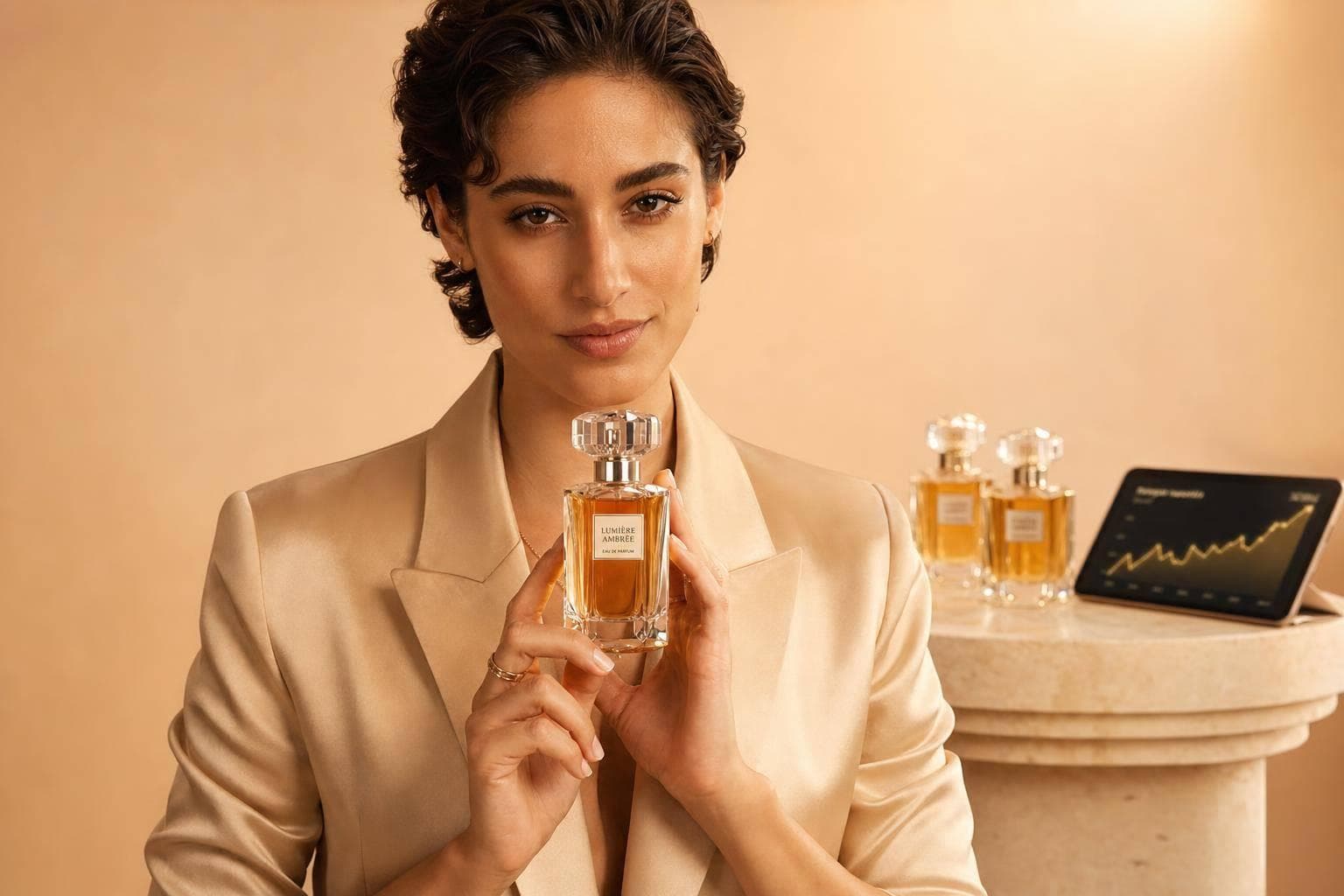
Les campagnes de parfums portées par des célébrités sont les plus performantes lorsque la personnalité, la fragrance et le récit de marque s’harmonisent parfaitement. À la lecture de cette analyse, quatre critères essentiels se démarquent : l’adéquation, l’implication personnelle, la cohérence visuelle et la maîtrise commerciale.
Quelques chiffres permettent de situer les enjeux en un coup d’œil :
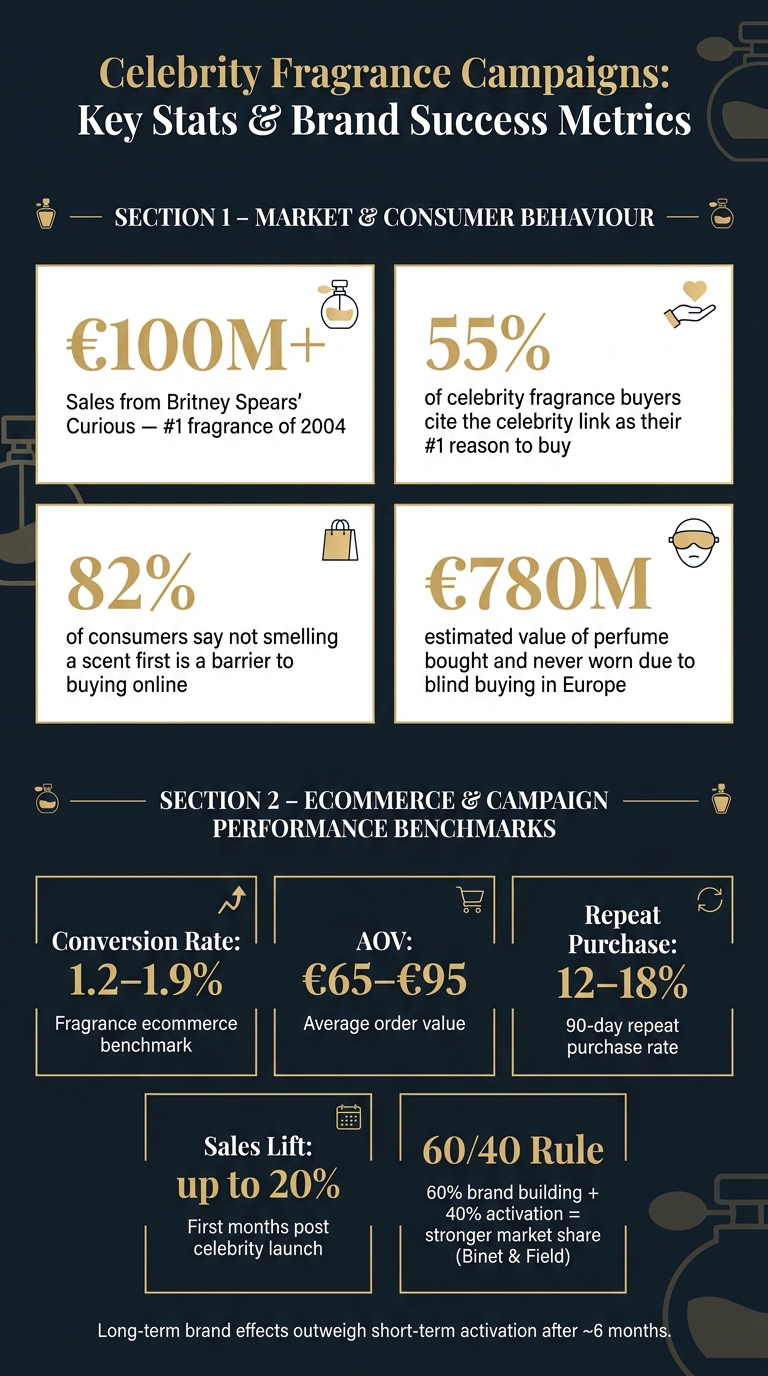
- Plus de 100 millions d’euros de ventes ont hissé Curious de Britney Spears au rang de parfum le plus vendu en 2004
- 55 % des acheteurs de parfums de célébrités affirment que le lien avec la personnalité est leur principale motivation d’achat
- 82 % des personnes interrogées déclarent que l’impossibilité de sentir un parfum au préalable constitue un frein en ligne
- Les critères de référence du commerce en ligne de parfums se situent autour de 1,2–1,9 % pour le taux de conversion et de 65–95 € pour le panier moyen (AOV)
Pour ne retenir que l’essentiel de cet article, la leçon est limpide :
- Choisir le visage idéal pour incarner le récit olfactif
- Créer une campagne sincère, et non artificielle
- Décliner les mêmes codes visuels sur chaque point de contact
- Mesurer l’impact sur les ventes, le réachat et l’exploitation des droits
- Encourager la découverte grâce à des échantillons sans risque avant l’achat d’un flacon grand format
Ces principes sont d’autant plus déterminants pour un détaillant de parfums de luxe en Europe. Lorsque le prix d’un flacon peut dépasser 300 €, les acheteurs recherchent un univers narratif clair ainsi qu’un moyen accessible de vérifier si la promesse s’accorde à leur peau. C’est précisément là qu’interviennent les formats découvertes : ils transforment l’intérêt pour la marque en essai concret.
Pour résumer en une phrase : la célébrité attire les regards, mais seule une rigueur de marque irréprochable transforme l’attention en ventes et en fidélité.
Campagnes de parfums de célébrités : chiffres clés et indicateurs de réussite de marque
Leçon 1 : Accorder le visage de la campagne à l’histoire de la fragrance
La première règle du branding pour un parfum incarné par une célébrité est élémentaire : chaque signal doit exprimer le même univers olfactif. L’image publique de la personnalité, le nom du parfum, le design du flacon, la palette de couleurs et le discours de campagne doivent tous converger vers une seule et même émotion. Dès lors, le public comprend instantanément l’esprit de la création.
Bâtir une identité limpide pour le parfum
Un parfum exige une personnalité affirmée — sensuelle, pure, rebelle, élégante ou espiègle — et ce caractère doit se retrouver partout. Le brief olfactif, le nom, la silhouette du flacon, les visuels de campagne et le descriptif produit doivent tous servir la même vision.
Les études portant sur l’achat de parfum en ligne révèlent que les consommateurs associent naturellement la personnalité et le mode de vie d’une célébrité aux facettes olfactives qu’ils imaginent. En d’autres termes, ils s’appuient sur cette égérie comme sur un repère intuitif pour en déduire les senteurs et l’ambiance. Une figure publique élégante et raffinée évoque d’emblée la sophistication et les tenues de soirée. Une personnalité audacieuse et disruptive annonce l’intensité ou la sensualité. Les clients s’en remettent à ces indices pour déterminer si une création s’accorde avec leur style de vie, souvent bien avant d’avoir lu la moindre note du descriptif.
Les données du marché confirment cette réalité sous un autre angle : dès lors que les parfums de célébrités sont devenus surexposés et génériques, leurs parts de marché ont chuté de manière vertigineuse.
Éviter que la notoriété n’éclipse le produit
La renommée suscite l’intérêt. Elle ne suffit pas, à elle seule, à construire une marque.
Les recherches sur le partenariat de célébrités démontrent que le concept sous-jacent à la campagne et l’adéquation entre la personnalité et le produit comptent bien plus que la simple présence d’une star. Une association mal pensée, ou une égérie qui monopolise l’ensemble du discours, peut brouiller, voire altérer l’identité du produit. On le constate couramment : la portée est remarquable, mais la conversion reste timide. Le public retient le visage, pas le parfum.
La parade est simple. Chaque support de campagne — visuel publicitaire, page de destination ou fiche produit — doit associer l’image de la célébrité à un discours précis axé sur le produit. Cela comprend la famille olfactive, les notes clés énoncées clairement, les occasions idéales pour le porter et le sillage émotionnel qu’il diffuse. La célébrité doit ouvrir la porte de l’univers de la fragrance, et non faire écran. Les travaux académiques sur l’incarnation des parfums de luxe aboutissent au même constat : une mauvaise affinité peut déprécier l’image de marque, tandis qu’un choix judicieux renforce la perception de luxe et la légitimité globale.
Appliquer cette approche à un e-commerce fondé sur la découverte
Sur les fiches produits, structurez l’offre autour de l’identité olfactive et de l’instant de vie, sans vous limiter au seul nom de la célébrité. Des classifications telles que fragrances fraîches du quotidien, parfums du soir sensuels ou signatures olfactives élégantes offrent aux clients une clé de lecture intuitive. Cela transforme la navigation en une découverte guidée plutôt qu’en une simple sélection de noms célèbres.
Les formats de 2 ml, 5 ml et 8 ml de Scento, ainsi qu’un décant en flacon de 30 ml sur la plupart des parfums, concrétisent parfaitement cette démarche de découverte. Les clients peuvent explorer un sillage de manière réfléchie, sans devoir acquérir d’emblée un flacon grand format.
L’adéquation capte l’attention ; l’implication personnelle forge la crédibilité.
Leçon 2 : Donner à la campagne une dimension personnelle et authentique
L’implication personnelle métamorphose la cohérence perçue en véritable confiance. Une campagne peut être irréprochable sur le plan visuel tout en restant dénuée d’âme. Dans ces moments-là, le public ne s’y trompe pas. Et dans l’univers de la parfumerie, cette perte de confiance ne pardonne pas.
Témoigner d’une implication réelle dans l’histoire du produit
Le gage le plus évident d’un engagement sincère réside dans la précision des détails. Lorsqu’une personnalité est capable de raconter le souvenir exact, l’émotion particulière ou le tournant de vie qui a inspiré la fragrance, le récit gagne immédiatement en authenticité. Ce niveau de détail distingue une démarche personnelle d’une simple opération d’endossement générique.
Des entretiens de fond, des séquences des coulisses de la création olfactive et des notes de composition explicitant le choix des ingrédients traduisent tous une contribution véritable. La clé d’or est élémentaire : démontrer l’implication par des actes et du contenu tangible, et non par de vagues slogans. Les consommateurs rejettent les initiatives perçues comme purement mercantiles. Dès que cette frontière est franchie, l’égérie comme la marque finissent par perdre toute substance.
Ces marques d’engagement offrent également aux acheteurs un vocabulaire auquel ils peuvent se fier. Loin des formules abstraites, ils saisissent avec clarté pourquoi la fragrance existe et ce qu’elle cherche à exprimer.
Une implication authentique confère de la profondeur à la personnalité. Un atout d’autant plus précieux si cette personnalité aide aussi les clients à décrypter le parfum.
Transformer la personnalité en repères concrets pour les acheteurs
L’aura d’une célébrité aide l’acheteur à se faire une idée immédiate du tempérament d’une fragrance. Qu’elle évoque le raffinement, l’audace, la discrétion, le romantisme ou l’esprit avant-gardiste, le client esquisse déjà le portrait du parfum avant même de l’avoir respiré. Les études sur l’authenticité des marques indiquent également que lorsque l’image d’une personnalité s’aligne avec l’idéal du moi du consommateur, la recommandation gagne en efficacité.
Cet aspect est encore plus déterminant pour la vente en ligne. Une étude sur le marché européen de la parfumerie estime que 780 millions d’euros de parfums sont achetés puis jamais portés, victimes des achats à l’aveugle. De plus, 82 % des consommateurs interrogés soulignent que l’impossibilité de sentir un parfum avant l’achat demeure le premier frein sur Internet.
Les indices incarnés par l’égérie permettent d’atténuer cette appréhension. L’esthétique, le ton et les évocations de style de vie offrent aux acheteurs des points d’ancrage concrets. C’est comparable à l’art d’appréhender l’atmosphère d’une pièce avant d’y entrer : sans en connaître chaque détail, vous en ressentez déjà l’ambiance. Le but est d’établir une résonance instantanée entre la personnalité et le client.
Dès lors que la personnalité est affirmée, l’univers visuel doit rendre cette histoire immédiatement reconnaissable.
Votre expert parfum personnel vous attend
Faites notre quiz olfactif express pour découvrir des parfums de créateurs et de niche authentiques, choisis selon vos goûts – explorez-les en décants et échantillons de 2, 5, 8 et 30 ml, pour essayer chaque fragrance avant de vous engager sur un flacon entier.
Trouvez votre parfumLeçon 3 : Bâtir un univers visuel immédiatement reconnaissable
Une fois l’harmonie et la personnalité établies, le volet visuel prend le relais : il rend la création identifiable d’un seul regard. Les campagnes les plus remarquables ne reposent pas sur une seule belle photographie. Elles déploient la couleur, le décor, le stylisme et la lumière comme une partition parfaitement concertée. C’est ainsi qu’une identité abstraite se métamorphose en une signature visuelle mémorable.
Maintenir une cohérence graphique sur chaque point de contact
Le parfum Light Blue de Dolce & Gabbana en est une brillante illustration. Depuis plus de deux décennies, la campagne s’ancre fidèlement dans les mêmes codes : les maillots de bain blancs, l’embarcation immaculée, la mer azur et les falaises de Capri. Le flacon prolonge cet univers avec son verre dépoli semblable à du verre poli par les flots et son capot de porcelaine inspiré des céramiques capriotes.
La ligne de parfums d’Ariana Grande s’appuie sur ce même principe, dans un registre esthétique tout à fait différent. Des tons pastel oniriques, des motifs de nuages, des éclairages doux et des flacons sculpturaux s’expriment sur les visuels, les réseaux sociaux et les packagings, composant une atmosphère unique qui fait écho à l’univers de ses projets musicaux. Les univers visuels diffèrent, mais l’exigence reste identique : chaque détail résonne avec la même identité.
La méthode la plus efficace consiste à définir un nombre restreint de codes visuels pérennes et à les employer avec constance :
- la palette
- le décor
- la lumière
- le symbole
Les photographies des flacons, les visuels de campagne, les maquettes d’e-mails, les publications sociales et les pages de destination doivent sembler issus d’une seule et même source d’inspiration.
Une fois ces repères instaurés, la marque peut faire évoluer ses mises en scène sans jamais égarer son public.
Privilégier la reconnaissance sur le long terme plutôt que l’engouement d’une semaine
Conservez immuables les codes fondamentaux et ne faites varier que les nuances saisonnières. Pour les célébrations d’hiver, la même palette peut s’enrichir de textures plus profondes. En été, des arrière-plans plus lumineux et des décors naturels extérieurs peuvent s’inviter, tout en préservant intacte la structure visuelle originelle.
L’opération estivale menée aux États-Unis pour Light Blue illustre la portée d’un tel concept : un bus aux couleurs de la marque transposait les finitions raffinées, les jeux de lumière tamisée et les agencements sur mesure de la campagne sous la forme d’une expérience physique et itinérante. L’univers visuel s’échappait des écrans pour s’ancrer dans le quotidien, demeurant immédiatement reconnaissable.
Cette rigueur doit irriguer chaque étape du parcours d’exploration, et pas seulement la campagne principale. Reprenez les mêmes codes sur l’étiquette de l’échantillon, la fiche produit et l’e-mail de confirmation, afin que l’harmonie de la maison s’affirme bien avant la réception du flacon complet.
Leçon 4 : Mesurer la performance et préserver le capital de marque
La constance visuelle n’a de valeur que si elle favorise l’adhésion commerciale et s’exécute sans risque juridique. Lorsque la direction esthétique est établie, l’étape suivante s’impose : analyser son pouvoir de conversion tout en veillant à une stricte conformité réglementaire.
Suivre les indicateurs révélateurs de l’impact de marque
La visibilité et les impressions traduisent l’ampleur de la diffusion d’une campagne. Elles ne confirment en rien si l’expérience a suscité un achat.
Ce qui prévaut, c’est l’ensemble des métriques qui accompagnent l’amateur de parfum depuis son premier regard jusqu’à sa deuxième ou troisième commande. Pour une maison de parfum, ces indicateurs englobent généralement le taux de clics (CTR) entre les visuels de campagne et les pages de présentation des fragrances par canal, le taux d’ajout au panier sur les sessions issues de ces campagnes, le taux de conversion par famille olfactive, le taux de réachat et de souscription à un abonnement sur un horizon de 3 à 6 mois, ainsi que la valeur moyenne des commandes (AOV) en euros.
Les indicateurs de référence de la parfumerie en ligne en Europe évaluent le taux de conversion sur site entre 1,2 et 1,9 %, le panier moyen entre 65 et 95 €, le taux de réachat à 90 jours entre 12 et 18 %, et le taux d’adhésion à un abonnement à moins de 5 %. Pour une boutique articulée autour des formats découvertes, la conversion de l’échantillon vers l’abonnement est l’un des signaux les plus révélateurs. Il atteste de la capacité d’un premier intérêt à se muer en un rituel pérenne de découverte.
Un tunnel d’acquisition clair s’avère ici précieux. Utilisez des balises UTM et analysez les cohortes à 7, 30 et 90 jours pour isoler les revenus marginaux générés.
Ces mesures ne trouvent toutefois leur utilité que si les créations associées restent dûment autorisées à l’usage.
Établir des règles rigoureuses pour l’utilisation de l’image, les licences et les contenus
Les campagnes orchestrées avec des célébrités comportent un risque juridique inconnu des initiatives purement centrées sur le produit. La raison est limpide : la création est indissociable d’une personne physique, et le droit à l’image est régi par une durée d’exploitation, un territoire géographique défini et une liste restreinte de canaux autorisés.
Les erreurs les plus fréquentes sont prévisibles, mais leurs conséquences financières sont lourdes :
- l’exploitation de contenus en dehors des territoires sous licence
- l’utilisation de visuels au-delà des dates contractuelles d’échéance
- la diffusion sur des plateformes n’ayant jamais reçu d’approbation formelle
La solution concrète réside dans un registre centralisé des droits. Un document unique doit recenser, pour chaque élément créatif, le titulaire des droits, la nature de la licence, les pays couverts (tels que DE, AT, CH ou l’ensemble de l’Union européenne), les canaux validés, les dates de début et de fin de validité, ainsi que les restrictions éventuelles de retouche. Mettez en place des alertes d’expiration automatisées pour retirer les visuels des régies publicitaires, du CMS et des gabarits d’e-mails avant l’échéance des droits.
La jurisprudence de l’Union européenne rappelle fermement ces enjeux. Dans les affaires Parfums Christian Dior c. Evora et L’Oréal c. Bellure, les cours ont confirmé que les titulaires de marques de parfums de prestige peuvent restreindre une communication publicitaire portant atteinte à leur image de marque, même dans le cadre d’une revente légitime des créations.
Dès lors qu’une personne est identifiable au sein d’un visuel, un consentement documenté s’impose. Si cette autorisation prend fin, l’ensemble des contenus doit être retiré sans exception. Un système structuré de Digital Asset Management (DAM), affichant les métadonnées juridiques au niveau de chaque ressource, offre la garantie la plus sereine pour piloter une campagne européenne en toute conformité.
Effet d’annonce éphémère ou capital de marque pérenne
Le parfum Someday de Justin Bieber a généré 3 millions de dollars américains au cours de ses trois premières semaines, s’imposant comme le parfum le plus vendu de toute l’histoire de Macy’s. C’est le modèle parfait d’un engouement instantané.
Toutefois, ces pics d’intérêt ne s’auto-entretiennent pas. L’association avec une personnalité stimule souvent les ventes de parfums jusqu’à 20 % lors des premiers mois qui suivent le lancement, avant que la courbe ne s’aplanisse si la maison n’a pas érigé des fondations narratives plus profondes.
Les études de Binet & Field mettent en lumière que les marques allouant environ 60 % de leur budget à la construction de la marque sur le long terme et 40 % à l’activation à court terme développent une part de marché plus robuste et un pouvoir de fixation des prix bien supérieur avec le temps. Leurs travaux indiquent également qu’une vision publicitaire axée sur la durée dégage environ le double de bénéfices par rapport à une démarche exclusivement opportuniste. Ces bénéfices de marque requièrent toutefois de la patience : ils ne surpassent l’activation immédiate qu’au bout d’environ six mois.
Cette répartition budgétaire est donc essentielle. L’énergie d’un lancement accélère les premières ventes ; la consolidation de la marque préserve le positionnement tarifaire, la fidélité de réachat et la réutilisation sereine des contenus futurs.
L’objectif consiste à concevoir des créations de lancement mesurables, pérennes et parfaitement sécurisées sur le plan juridique dès le premier jour.
Conclusion : La rigueur de marque, secret de la réussite des campagnes de célébrités
En définitive, l’enseignement est d’une remarquable évidence : les campagnes portées par des célébrités triomphent lorsque l’égérie, le sillage et les codes esthétiques chantent à l’unisson. Si la personnalité incarnée et la création olfactive divergent, le public le ressent immédiatement. Dès lors, le message s’estompe.
Ce qui résiste au temps, c’est la constance. L’univers narratif, l’identité visuelle et le flacon doivent conserver leur intégrité d’un lancement à l’autre. À trop multiplier les visages ou les changements de style, les maisons finissent par effacer leur empreinte dans la mémoire des passionnés.
L’édification d’une marque sur la durée l’emporte toujours sur le coup d’éclat passager. Une association avec une personnalité apporte sans nul doute une belle lumière lors d’un lancement ; elle déploie cependant toute sa puissance lorsqu’elle s’intègre dans le grand livre de la maison, et non comme un événement isolé.
Cette même exigence doit guider l’étape de découverte. Pour Scento, cela consiste à apporter une rigueur similaire à ses sélections de décants : des histoires olfactives transparentes, une esthétique raffinée et une initiation tout en sérénité.
La règle d’or se résume ainsi : justesse de l’association, sincérité, cohérence et vision à long terme transforment de simples campagnes de célébrités en véritables fleurons patrimoniaux.
FAQ
Comment choisir la célébrité idéale pour un parfum ?
Choisissez une personnalité dont la sensibilité publique correspond à l’émotion de la fragrance et aux instants auxquels elle se destine. Les parfums de stars rencontrent leur plus beau succès lorsqu’ils procurent au porteur une impression de proximité avec l’artiste. Cela s’accompagne en général d’un profil olfactif harmonieux et accessible, que l’on s’approprie avec naturel au quotidien.
Pour toucher un public large et plus jeune, privilégiez des noms emblématiques et des accords universellement appréciés. Les compositions florales délicates, les muscs soyeux, les inflexions fruitées ou les boisés nets, associés à un positionnement tarifaire situé entre 30 et 100 €, composent une proposition séduisante et évidente.
Si la création revendique un raffinement plus exclusif, la seule mention d’une célébrité ne saurait suffire. Il conviendra alors d’imaginer une collaboration reposant sur une véritable démarche créative et une communion esthétique intime avec la maison. La création y puisera un supplément d’âme, confortant son rang au sein de la haute parfumerie.
Pourquoi les échantillons de parfum sont-ils si essentiels en ligne ?
Les échantillons sont primordiaux sur Internet car ils permettent de combler la « barrière olfactive » : un sillage ne pouvant se transmettre par un écran, alors même qu’un flacon complet peut coûter plus de 300 €.
Ils accordent aux passionnés le temps nécessaire pour observer l’évolution d’un accord au contact unique de leur peau, bien au-delà de la première impression des notes de tête. Cette étape rassure, prévient les déceptions d’un achat imprudent et invite à trouver sa signature olfactive sans s’engager à l’aveugle dans une dépense inconsidérée.
Quels sont les meilleurs indicateurs pour mesurer l’efficacité d’une campagne ?
Les signaux de lancement les plus déterminants demeurent le volume de ventes et la notoriété de marque, complétés par le taux de conversion et le taux d’engagement.
Dans l’univers de la parfumerie, la confiance et l’expérience sensorielle priment. C’est pourquoi il s’avère tout aussi capital de suivre le coût par acquisition (CPA), le taux de conversion du test à l’achat, ainsi que le passage de l’échantillon au flacon grand format ou le taux de réachat. Ces données révèlent si l’attrait initial se transforme en une fidélité affirmée.
Deux repères clés se démarquent tout particulièrement : la conversion issue de l’échantillonnage et le retour sur investissement (ROI) des formats d’essai.

