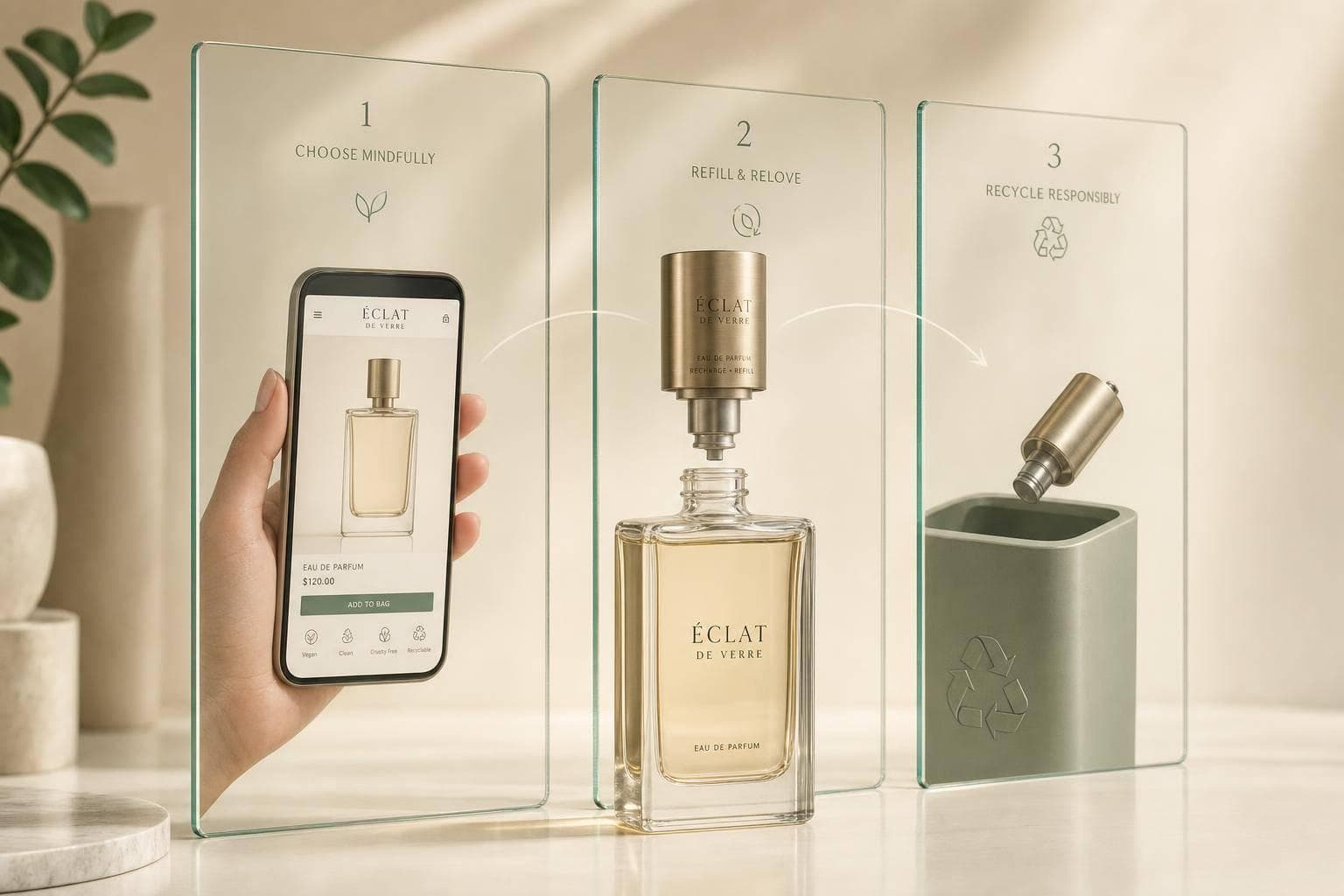
Un emballage écologique n’est efficace que si l’on sait quoi en faire. Dans l’univers de la parfumerie, cela signifie que les marques doivent aller au-delà du flacon rechargeable ou du verre allégé. Elles doivent guider les acheteurs : comment recharger, trier, rapporter ou conserver chaque élément du coffret.
Voici l’essentiel de la démarche :
- Partir des usages et des comportements, non du seul design
- Concevoir des systèmes de recharge et de retour d’une parfaite simplicité
- Remplacer le vocabulaire écologique vague par des allégations précises
- Détailler les étapes de tri sur le packaging et en ligne
- Suivre des indicateurs concrets : taux de recharge, scans de codes QR et retours
Quelques chiffres illustrent cet enjeu :
- En Allemagne, environ 69–71% des déchets d’emballage sont recyclés
- La moyenne de l’UE se situe autour de 55%
- Dior a indiqué qu’un flacon associé à une recharge de 300 ml permettait de réduire de 60% la consommation d’énergie, de 62% les déchets et de 53% l’utilisation d’eau par rapport à l’achat de quatre flacons de 100 ml
- 53% des allégations environnementales dans l’UE ont été jugées vagues, trompeuses ou non fondées
- 44% des consommateurs affirment ne pas faire confiance aux informations environnementales figurant sur les produits
La règle d’or est élémentaire : si une maison de parfum souhaite réduire l’empreinte de ses emballages, elle se doit d’accompagner le client à chaque étape - de la page produit à l’unboxing, en passant par la recharge et le tri final. En Allemagne, cela implique des consignes de tri explicites pour le Altglas, le Altpapier et le Gelber Sack/Gelbe Tonne, ainsi que des instructions de recharge parfaitement lisibles et accessibles.
Étape 1 : Cartographier le parcours client autour des points de contact de l’emballage
Les maisons de parfum prennent de bien meilleures décisions lorsque le packaging s’intègre à un endroit où il influence directement les comportements. Pour le visualiser clairement, il convient de cartographier l’ensemble du parcours : de la recherche initiale et la découverte du produit jusqu’au déballage, à l’usage quotidien, à la recharge et à la fin de vie. C’est la raison pour laquelle le parcours client constitue le véritable point de départ.
Identifier les moments où l’emballage guide les choix
Cette cartographie comprend généralement les points de contact suivants :
- la recherche avant achat
- la page produit ou le rayon en boutique
- le panier et la livraison
- le déballage et la première vaporisation
- l’usage quotidien et la conservation
- la recharge
- la fin de vie du flacon
Un audit rapide permet de déceler les étapes où l’emballage écologique exige encore un effort excessif de la part du client.
Pour les consommateurs en Allemagne, les consignes d’élimination sont primordiales. Le verre, le carton et les éléments en plastique relèvent souvent de filières de tri distinctes : Glascontainer, Papier et Gelber Sack/Gelbe Tonne.
| Étape du parcours | Décision clé du consommateur | Manque fréquent en Allemagne |
|---|---|---|
| Page produit / point de vente | Ce flacon est-il rechargeable ? Le prix est-il justifié ? Les engagements écologiques sont-ils crédibles ? | Absence de détail des matériaux, formulation écologique imprécise |
| Paiement / expédition | L’emballage d’envoi limite-t-il les déchets ? | Aucune option d’emballage ni consigne claire |
| Déballage | L’allègement du packaging est-il intentionnel ? Où jeter chaque élément ? | Absence d’icônes de tri ou de consignes en langue allemande |
| Usage quotidien | Dois-je conserver ce flacon pour le recharger ? | Aucune mention relative à la recharge sur le flacon |
| Moment de la recharge | Où recharger ? Le prix au ml est-il plus avantageux ? | Aucun localisateur de points de recharge en boutique ou en ligne |
| Fin de vie | Quel bac utiliser pour le verre, la pompe, le capot et l’étui ? | Absence d’instructions de tri détaillées par composant |
Intégrer des instructions précises aux moments clés
Une fois les zones d’ombre identifiées, la solution s’avère souvent limpide. Un texte court et percutant est bien plus efficace qu’un long plaidoyer sur le développement durable. Une inscription sous le flacon telle que Flakon nachfüllbar – bitte behalten Sie die Flasche, doublée de son équivalent en anglais, lève immédiatement toute hésitation au moment de l’utilisation.
Les codes QR permettent également d’apposer les consignes de réemploi et de tri directement sur le pack. Conformément au règlement sur les emballages et les déchets d’emballages (PPWR) de l’UE, ces informations doivent être claires, visibles et inaltérables. Un code QR placé sous le flacon ou à l’intérieur du coffret peut renvoyer vers une page où l’acheteur saisit son code postal (PLZ) pour découvrir les règles de tri propres à sa commune.
Une fois ces points de friction résolus, les marques peuvent concevoir des programmes de recharge et de retour véritablement adoptés par leurs clients.
Étape 2 : Développer des systèmes de recharge, de consigne et de réemploi faciles à adopter
Une fois les réticences levées, l’objectif suivant est simple : choisir un modèle d’économie circulaire que l’on n’abandonne pas après la première tentative.
Choisir le bon format : recharge, consigne ou formats découverte
Il n’existe pas de solution universelle pour les collections de haute parfumerie. Le modèle idéal dépend de deux critères : l’effort que votre client est prêt à consentir, et la complexité opérationnelle que votre marque peut absorber en coulisses.
| Modèle d’engagement | Effort du consommateur | Adéquation avec le luxe | Bénéfice écologique | Effort de la marque |
|---|---|---|---|---|
| Flacons rechargeables (à domicile) | Modéré | Élevé | Élevé | Modéré |
| Fontaines de parfum en boutique | Élevé | Très élevé | Élevé | Très élevé |
| Programmes de retour / consigne | Modéré | Modéré | Élevé | Élevé |
| Décants découverte (2 ml–8 ml) | Très faible | Modéré | Élevé | Modéré |
En Allemagne, les éco-recharges sont déjà bien plus familières que les produits intégralement rechargeables, ce qui facilite grandement l’adoption de formats peu contraignants. C’est un facteur déterminant : dès lors qu’une démarche paraît fastidieuse, les initiatives les plus vertueuses s’essoufflent.
Pour résumer l’approche :
- La recharge s’adresse aux passionnés qui connaissent et aiment déjà la fragrance.
- Le programme de retour séduit les acheteurs prêts à rapporter leur flacon vide, à condition que le processus soit parfaitement fluide.
- Les formats découverte préviennent le gaspillage dès l’origine en permettant d’essayer la création avant de s’engager sur un grand flacon.
Proposer des récompenses simples pour valoriser le choix écologique
L’alternative durable doit être l’option de la simplicité. Et, en toute franchise, le client doit y trouver son compte.
Un avoir en euros pour chaque retour de flacon fonctionne remarquablement bien, notamment lorsqu’il s’appuie sur le principe éprouvé du Pfand. En Allemagne, la culture de la consigne est ancrée dans le quotidien : ce réflexe mental permet d’en faire immédiatement percevoir la valeur.
Les programmes de fidélité peuvent également s’avérer efficaces, pourvu que les points accumulés se traduisent rapidement par un privilège concret. Si le client doit accumuler des points indéfiniment pour un avantage dérisoire, l’intérêt s’évapore.
Auprès d’une clientèle amatrice de luxe, la meilleure stratégie consiste souvent à valoriser l’engagement sans pour autant assimiler le geste à une tâche domestique. Offrez par exemple un accès exclusif et anticipé aux lancements de recharges, ou des tarifs privilégiés réservés aux membres. Cela préserve toute la noblesse de l’expérience tout en encourageant de nouvelles habitudes vertueuses.
Comment Scento s’inscrit dans la démarche de réemploi et de réduction des déchets
Scento est un détaillant de décants et d’échantillons de parfum, et chaque produit peut être acheté à l’unité, sans aucun abonnement. Scento+ est l’adhésion optionnelle de Scento : la cotisation mensuelle vous revient intégralement sous forme de crédit en magasin, à dépenser sur n’importe quel parfum ; les membres bénéficient de 10 % de réduction, d’un échantillon offert avec chaque commande, d’un parfum offert tous les six mois et d’un cadeau d’anniversaire, et vous pouvez mettre en pause ou résilier à tout moment. Cette flexibilité permet ainsi aux amateurs de parfum de tester un sillage sur leur peau avant de s’offrir le grand flacon.
Ce changement d’habitude, discret en apparence, est fondamental : explorer un format modeste au départ évite le gaspillage bien plus important d’un achat à l’aveugle d’un flacon qui restera finalement oublié sur une coiffeuse.
Une fois le modèle défini, il ne reste plus qu’à en expliquer les modalités avec une parfaite lisibilité, sur l’étui comme en ligne.
Votre expert parfum personnel vous attend
Faites notre quiz olfactif express pour découvrir des parfums de créateurs et de niche authentiques, choisis selon vos goûts – explorez-les en décants et échantillons de 2, 5, 8 et 30 ml, pour essayer chaque fragrance avant de vous engager sur un flacon entier.
Trouvez votre parfumÉtape 3 : Communiquer les choix d’emballage en toute clarté, sur l’étui et sur le web
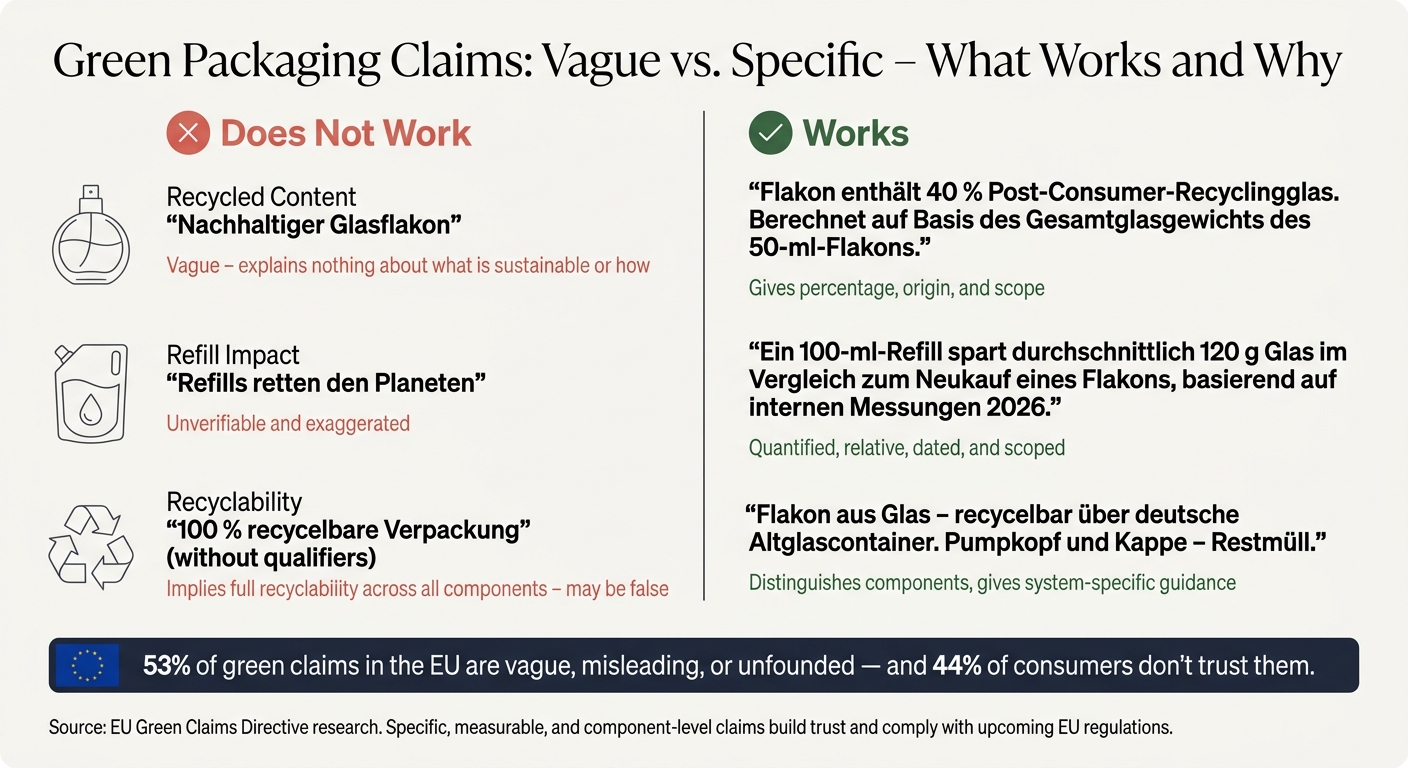
Allégations d’emballages écologiques : vagues contre spécifiques – ce qui fonctionne et pourquoi
Dès lors que le système de réemploi est établi, l’étape suivante s’impose d’elle-même : expliquer son fonctionnement avec précision et preuves à l’appui.
L’enjeu est bien plus crucial qu’on ne l’imagine généralement. Une étude européenne a révélé que 53 % des allégations vertes sont floues, trompeuses ou dénuées de fondement, tandis que 44 % des consommateurs déclarent douter de la sincérité des informations écologiques affichées sur les produits et les campagnes. Si le discours manque de netteté, le public ne saura que faire de l’emballage. Pire encore, il doutera de la véracité de votre engagement.
Bannir les formules écologiques floues au profit d’allégations précises et vérifiables
Le consommateur a besoin de repères limpides. Il doit savoir exactement :
- ce qui se recharge
- ce qui se recycle
- dans quel bac déposer chaque élément
Les mentions environnementales imprécises n’apportent aucune réponse. Conformément à la future réglementation européenne sur les allégations écologiques (Green Claims Directive), toute formulation générique doit désormais s’appuyer sur des preuves tangibles et, le cas échéant, sur des certifications reconnues.
Oubliez donc les formules abstraites : détaillez le matériau, le composant et la proportion. Par exemple :
Flacon composé de 30 % de verre recyclé post-consommation (PCR).
Étui fabriqué à partir de carton 100 % certifié FSC, issu de forêts gérées durablement.
Ce flacon de 50 ml peut être rechargé en boutique grâce à notre fontaine dédiée.
Ce degré d’exactitude permet au client de saisir immédiatement la portée de l’engagement. Il évite aussi un écueil très fréquent : la confusion entre taux de matière recyclée et recyclabilité. Il s’agit de deux notions bien distinctes, et le périmètre doit être explicite pour que l’acheteur sache précisément quel composant est concerné.
Tout aussi important : signalez clairement ce que l’emballage ne permet pas. Les centres de tri traditionnels allemands ne traitent pas la pompe ni le capot : il faut le mentionner en toutes lettres : Pumpkopf und Kappe in den Restmüll. Omettre ce détail peut être considéré en soi comme trompeur.
Placer les conseils de tri et de recharge là où le regard se pose naturellement
Un message bien formulé ne fait que la moitié du chemin. Son emplacement est tout aussi stratégique. Si l’instruction est reléguée en minuscules caractères dans un recoin discret, elle perd toute sa valeur.
Le fond du flacon est idéal pour de petits symboles explicites. Une icône de verre à côté de la mention Altglas et un symbole de plastique à côté de Restmüll orientent le geste en un coup d’œil. Le volet latéral de l’étui offre davantage de surface : c’est l’endroit parfait pour détailler le tri avec les volumes métriques, par exemple : Entsorgung: Flakon (50 ml) im Altglascontainer, Karton im Altpapier, Pumpe in den Restmüll. Le rabat intérieur du coffret accueille à merveille les conseils de recharge, comme : Unser 50-ml — Flakon ist nachfüllbar. Bitte bringen Sie den leeren Flakon in unseren Store oder nutzen das Online — Refill — System.
Sur les plateformes numériques, la logique reste identique. La page produit doit reprendre ces indications en y ajoutant quelques précisions utiles. Un encadré Verpackung & Entsorgung détaillant chaque composant sous forme de liste à puces est particulièrement recommandé. Une page dédiée Emballages & Recharges peut regrouper l’origine des matériaux, les guides de tri et la liste des boutiques, le tout accessible directement via un code QR imprimé sur le pack. Les autorités européennes de protection des consommateurs sont catégoriques : les informations correctives et les instructions doivent être parfaitement visibles au moment de l’achat, et non dissimulées dans les petits caractères d’un document annexe.
Privilégier l’impact chiffré aux déclarations spectaculaires
C’est souvent ici que les discours perdent leur crédibilité. Les proclamations grandiloquentes du style « Nos recharges sauvent la planète » ou « Emballage 100 % recyclable » sans la moindre nuance ni justification font précisément l’objet d’une surveillance accrue de la part des régulateurs.
Une démarche vertueuse consiste à présenter une allégation précise, comparative et quantifiable.
Pour un format rechargeable, la formulation idéale sera par exemple :
Ein 50-ml — Refill spart durchschnittlich 70 g Glas im Vergleich zum Neukauf eines Flakons - basierend auf internen Messungen, Stand: 2026.
Ou, pour un usage régulier sur l’année :
Sie reduzieren Ihren Glasverbrauch um rund 140 g pro Jahr im Vergleich zum Kauf von zwei neuen Flakons.
Ces déclarations font la différence car elles s’appuient sur des données tangibles. Le format est vérifiable, la différence de poids est mesurée, et la source de l’évaluation est clairement communiquée.
| Type d’allégation | Exemple de formulation | Pourquoi cela fonctionne / ne fonctionne pas |
|---|---|---|
| Contenu recyclé | Flakon enthält 40 % Post — Consumer — Recyclingglas. Berechnet auf Basis des Gesamtglasgewichts des 50-ml — Flakons. | Efficace : Précise le pourcentage, l’origine de la matière et le périmètre concerné. |
| Contenu recyclé | Nachhaltiger Glasflakon | Inefficace : Vague - n’explique aucunement ce qui est durable ni par quel procédé. |
| Impact de la recharge | Ein 100-ml — Refill spart durchschnittlich 120 g Glas im Vergleich zum Neukauf eines Flakons, basierend auf internen Messungen 2026. | Efficace : Chiffré, comparatif, daté et circonscrit à un format défini. |
| Impact de la recharge | Refills retten den Planeten | Inefficace : Invérifiable et disproportionné - contraire aux exigences européennes sur les allégations excessives. |
| Recyclabilité | Flakon aus Glas – recycelbar über deutsche Altglascontainer. Pumpkopf und Kappe – Restmüll. | Efficace : Distingue les différents éléments et propose des consignes pratiques adaptées aux filières réelles. |
| Recyclabilité | 100 % recycelbare Verpackung (sans nuances) | Inefficace : Sous-entend que tous les composants sont entièrement recyclables dans les faits, ce qui est souvent faux. |
Dès lors que l’allégation est sobre, visible et adossée à une donnée chiffrée, il devient bien plus aisé d’évaluer si les clients s’approprient ces recommandations au quotidien.
Étape 4 : Mesurer l’engagement et faire évoluer le dispositif
Une fois les informations déployées sur vos étuis et vos plateformes numériques, l’ultime mission consiste à vérifier si le public s’en empare véritablement.
Suivre les indicateurs qui attestent d’un engagement réel
Privilégiez les actes concrets aux simples études de notoriété. À travers l’emballage, les boutiques et vos canaux en ligne, les indicateurs majeurs à observer sont l’adoption des recharges, leur fréquence d’achat, le délai avant la première recharge, le taux de retour de flacons, la répartition des canaux de vente et les réassorts. Il est tout aussi instructif de mesurer les réachats de recharges et la transformation d’un format d’essai vers le grand flacon.
Sur le plan digital, surveillez les scans de codes QR apposés sur les étuis ainsi que les clics vers vos pages de tri ou de durabilité depuis les courriels de confirmation de commande. Ne vous arrêtez pas au simple scan : observez le comportement ultérieur. Les clients visionnent-ils le tutoriel de recharge ? Programment-ils un retour ou activent-ils un avantage fidélité ? En 2025, l’utilisation des codes QR sur les packagings a progressé de 44 % en glissement annuel, et 60 % des acheteurs les ont scannés en quête de renseignements avant l’achat.
Si vous proposez des décants de 2 ml, 5 ml ou 8 ml, analysez méticuleusement le taux de conversion vers le flacon complet.
S’appuyer sur les retours pour supprimer les points de friction
Prenez d’abord appui sur les données comportementales. Puis, prêtez une oreille attentive aux retours d’expérience pour comprendre les éventuels blocages.
Les questionnaires courts se révèlent précieux à cet égard. Adressez une enquête de 3 à 5 questions dans un délai de 2 à 7 jours après la livraison pour déceler rapidement les zones de doute. Demandez si les instructions de tri étaient explicites, et ce qui a pu compliquer la compréhension des consignes ou le retour du flacon.
Les demandes adressées au service client sont tout aussi instructives. Si les questions reviennent sans cesse sur la recyclabilité de la pompe, l’adresse de dépôt des flacons vides ou le maniement de la recharge, il ne s’agit pas d’anecdotes isolées. Cela dénote généralement une lacune sur votre étui ou votre boutique en ligne. Classez ces demandes par typologies, par exemple :
- doutes sur le tri sélectif
- ergonomie et prise en main de la recharge
- logistique et modalités de retour
Analysez ces thématiques chaque mois pour transformer ces interrogations en chantiers d’optimisation concrets. Dès qu’une modification est apportée, datez-la précisément, par exemple au 12.08.2026, afin que toute votre équipe mesure la portée des ajustements.
Conclusion : Les clés d’un engagement réussi autour du packaging écologique
Identifiez chaque moment où l’emballage façonne la décision. Développez des programmes de recharge et de retour qui s’utilisent sans la moindre hésitation. Privilégiez des engagements rigoureux et simples à vérifier. Enfin, analysez l’efficacité réelle du parcours à l’usage.
Mesurer, écouter, perfectionner, documenter : c’est ce qui sépare une promesse d’une véritable démarche durable. L’emballage vertueux ne trouve son sens que si l’acheteur le comprend, l’adopte au quotidien et en fait un réflexe pérenne.
Questions fréquentes
Comment les maisons de parfum peuvent-elles rendre la recharge totalement intuitive ?
Les marques y parviennent avec brio en se concentrant sur deux exigences absolues : la simplicité et un remplissage d’une propreté irréprochable.
Les mécanismes à valve directe permettent d’emboîter la recharge sur le flacon avec une grande fluidité. L’expérience devient instantanée, sereine et élégante. Des capteurs intégrés peuvent également interrompre le débit automatiquement, prévenant ainsi tout risque de goutte ou de débordement.
Les capsules amovibles (drop-in) subliment elles aussi ce rituel précieux : aucun risque d’éclaboussure, aucune approximation, et pas la moindre goutte de parfum égarée. Les puces NFC peuvent enrichir ce moment d’exception en renvoyant vers des tutoriels immersifs sur smartphone ou des rappels de réassort, rendant l’ensemble du processus plus naturel et agréable.
Quelles allégations d’emballage sont véritablement dignes de confiance ?
Les allégations ont d’autant plus de valeur lorsqu’elles reposent sur des informations transparentes ou des labels délivrés par des organismes tiers réputés comme COSMOS, Ecocert ou Fair for Life. Ces garanties sont infiniment plus concluantes que des mentions abstraites comme écologique ou naturel, qui séduisent sans apporter de preuves tangibles.
Une promesse gagne en crédibilité dès lors qu’elle met en avant un fait facilement contrôlable, tel que :
- une filière de recyclage accessible
- une empreinte carbone réduite grâce à des solutions rechargeables
- l’intégration de matières recyclées post-consommation
Les engagements les plus fiables sont toujours accompagnés de données chiffrées et de critères auditables. Si une maison avance des promesses spectaculaires sans fournir d’éléments concrets, la prudence reste de mise.
Comment trier un emballage de parfum en Allemagne ?
En Allemagne, un flacon de parfum doit impérativement être démonté avant d’être jeté. De nombreux flacons mêlent verre, métal et plastique : il n’est donc pas question de déposer l’objet d’un seul bloc dans le bac de tri.
Retirez la frette métallique ainsi que la pompe en plastique. Videz intégralement le flacon, rincez-le à l’eau très chaude, laissez-le tremper dans du vinaigre blanc tiède pendant une heure, puis nettoyez-le au savon à vaisselle avant de le laisser sécher à l’air libre pendant 24 heures.
Une fois le flacon parfaitement propre, déposez le verre dans le conteneur adéquat. Les pompes et diffuseurs en plastique n’étant généralement pas pris en charge par les filières de recyclage traditionnelles, ils doivent être jetés séparément avec les ordures ménagères résiduelles.

