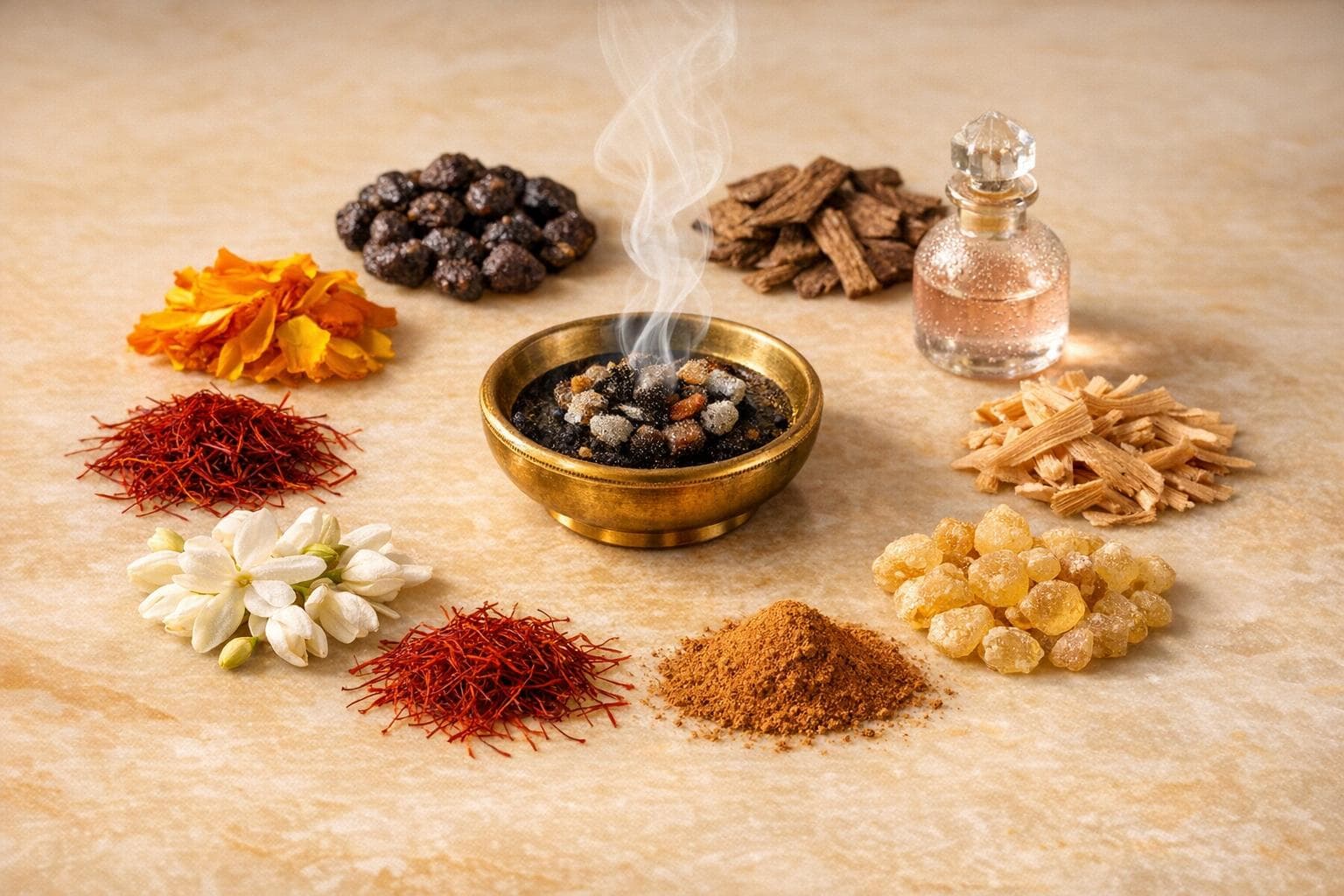
Fragrance has been a part of human rituals and celebrations for centuries, connecting people to their beliefs, memories, and communities. From ancient incense blends to modern-day traditions, scents play a key role in festivals worldwide. Here’s a quick look at ten practices that showcase the deep bond between fragrance and celebrations:
- Kyphi in Ancient Egypt: A sacred incense used in temple rituals, crafted with 16 ingredients over six months.
- Moroccan Rose Festivals: Celebrating the harvest of Rosa Damascena, with 60,000 roses needed for just 1 ounce of oil.
- Indian Sandalwood and Jasmine: Essential in weddings and Diwali, symbolizing spirituality and love.
- Oud and Frankincense in Eid: Burned in mabkhara for purification and hospitality, with oud oil priced at €364 per teaspoon.
- Myrrh in African Festivals: Used to connect with ancestors and for medicinal purposes.
- Orange Blossom in Italy: Distilled for hydrosol, symbolizing blessings during Festa Patronale.
- Incense in Japanese Obon: Agarwood and sandalwood incense honor ancestors in this spiritual tradition.
- Frangipani in Songkran: Garlands and fragrant water mark renewal and respect in the Buddhist New Year.
- Cedarwood in Native American Powwows: Smudging rituals for cleansing and grounding.
- Floral Scents in South Asian Holi: Natural fragrances from roses, jasmine, and marigold enhance the festival of colors.
These practices highlight how scents transcend time and geography, enriching festivals with meaning and connection.
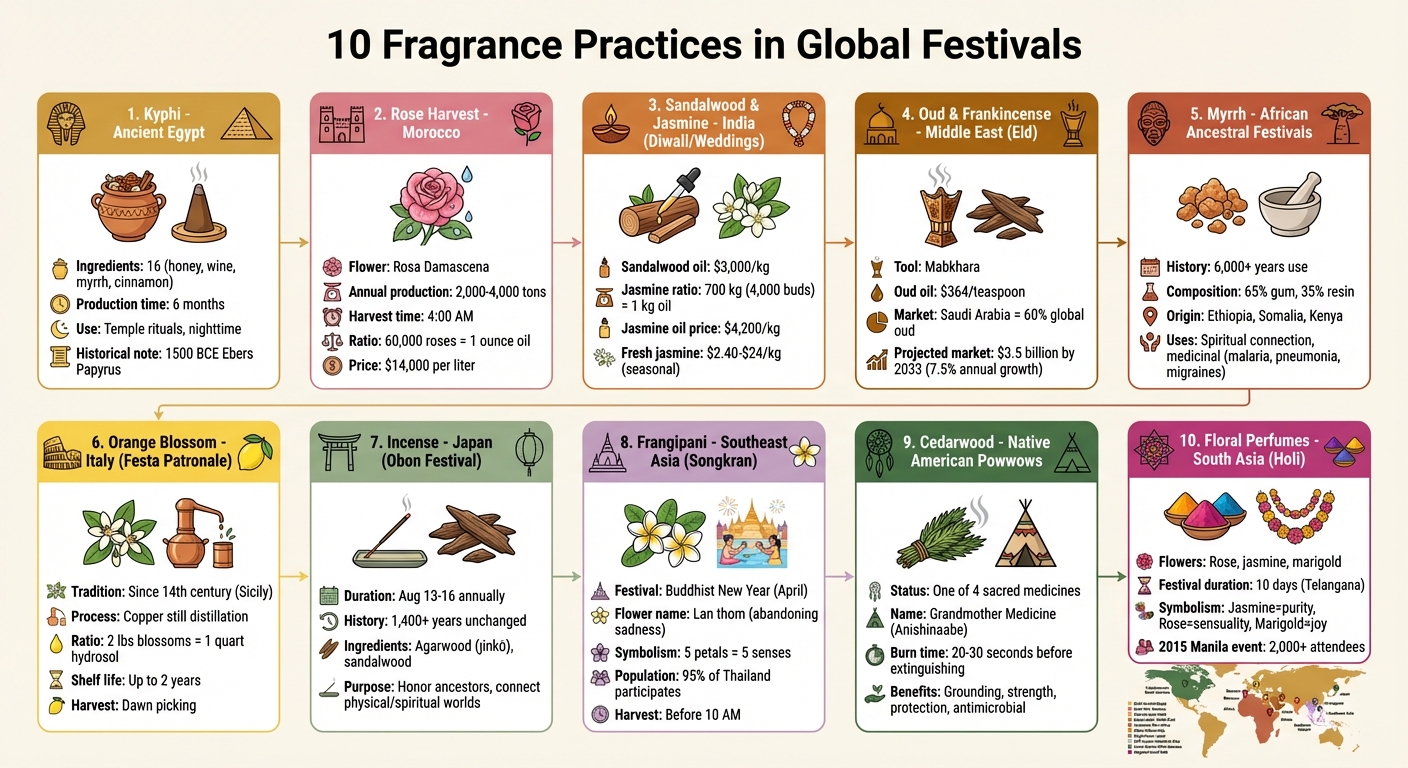
10 Global Festival Fragrance Practices: Key Ingredients, Costs, and Cultural Significance
1. Kyphi Incense in Ancient Egyptian Festivals
In ancient Egypt, fragrance wasn’t just a luxury - it was a sacred element of their spiritual practices, with Kyphi (Kapet) incense at the heart of many rituals. This intricate blend of 16 ingredients, including honey, wine, raisins, myrrh, juniper berries, and cinnamon, was believed to embody the "body of the gods" when burned.
Temple ceremonies operated on an "olfactory clock", with specific scents marking different times of the day. At sunrise, frankincense was burned; midday called for myrrh, and Kyphi was reserved for nighttime rituals to ensure Ra’s safe journey back through the underworld. Creating Kyphi was no simple task - it involved a six-month process of grinding ingredients with precision, accompanied by the chanting of sacred incantations.
"Kyphi is a mixture composed of sixteen ingredients... it causes a beneficent exhalation, by which the air is changed, and the body, being moved gently and softly by the current acquires a temperament conducive to sleep." — Plutarch, Greek Historian
The oldest recorded recipe for Kyphi is found in the Ebers Papyrus, a medical text dating back to around 1500 BCE. While its primary role was spiritual, Kyphi also had practical uses. It was used medicinally to treat conditions like asthma, anxiety, and liver ailments and was even mixed with honey to create pellets that acted as breath fresheners.
Kyphi’s significance in rituals highlights how fragrance in ancient Egypt went far beyond everyday use - it served as a profound connection between the human and the divine.
2. Rose Harvest at Moroccan Rose Festivals
Every May, the Kelaat M’Gouna region in Morocco’s Atlas Mountains comes alive with the Moussem des Roses (Festival of Roses), a vibrant celebration of the annual rose harvest. This area is renowned for producing between 2,000 and 4,000 tons of roses each year, making it a key global supplier of rose oil and rosewater.
The harvest, steeped in centuries-old tradition, begins at the crack of dawn - 4:00 AM to be exact. Workers meticulously pick the delicate Rosa Damascena petals during these early hours to preserve their rich concentration of oil. As rose-picker Ait Khouya Aicha explains:
"The fragrance is best early in the morning, but we must work quickly. The sun will burn the petals, and then the perfume will be ruined".
Once harvested, the petals are immediately processed using traditional copper stills, also known as alembics. Heated mountain water generates steam, which separates the essence into rose oil and rosewater. Each batch takes between 4 to 6 hours to complete.
It’s an incredibly labor-intensive process - about 60,000 roses are needed to produce a mere 1 ounce of rose oil. A single liter of this precious oil can fetch around $14,000 on the market.
During the three-day festival, the streets are adorned with rose petals, creating a stunning and fragrant spectacle. In May 2017, 23-year-old Fatima E Zahra El Amiri, hailing from the village of Bjaho, was crowned Rose Queen. She led the Grand Parade through the town, showered with petals as part of her ceremonial role. The festival also doubles as a key marketplace, where local cooperatives showcase and sell their distilled rosewater and oils to international buyers, including prominent perfume houses.
Beyond the festivities, rosewater holds a special place in Moroccan hospitality. Hosts often sprinkle Ma’ Ward (rosewater) on guests’ hands as a warm and aromatic gesture of welcome. It’s also a cherished ingredient in traditional recipes, such as the crescent-shaped pastry Kaab el Ghzal (gazelle horns) and the nation’s iconic mint tea. These culinary uses highlight how fragrance isn’t just smelled - it’s tasted, making it an integral part of Moroccan culture and tradition. The enduring role of rosewater underscores its significance as both a sensory delight and a cultural treasure.
3. Sandalwood and Jasmine in Indian Diwali and Weddings
In Indian celebrations like Diwali and weddings, the fragrances of sandalwood and jasmine play a profound role, adding depth and meaning to rituals. These scents are more than just pleasant aromas - they are steeped in tradition and spirituality, turning each event into a sensory and symbolic experience.
Sandalwood holds a revered place in Indian culture. It’s often ground into a paste and used in rituals for its calming and sacred properties. This precious material is also a cornerstone of traditional attars, with sandalwood oil sometimes fetching prices as high as $3,000 per kilogram.
Jasmine, particularly the Madurai malligai variety (Jasminum sambac), is another essential element of Indian festivities. In South Indian weddings, jasmine garlands and decorations are everywhere, symbolizing prosperity and good luck [25, 26]. The flowers are carefully harvested before sunrise to preserve their rich fragrance, making them perfect for religious offerings and ceremonial garlands [25, 26].
The process of producing jasmine oil showcases its rarity and value. Approximately 700 kilograms of fresh jasmine - around 4,000 buds - are needed to extract just one kilogram of oil, which is sold for about $4,200.
Thierry Wasser, the Perfumer and "Nose" at Guerlain, beautifully encapsulates jasmine’s significance:
"When you understand that the purpose of this flower is the celebration of love and brotherhood and family and friendship; when you smell it, it takes another dimension. And to me this flower is the expression of love. Period."
Jasmine also plays a key role during Diwali and other Hindu festivals. Devotees often adorn deities with jasmine garlands, a practice that highlights the flower’s spiritual importance. At the historic Meenakshi Temple in Madurai, jasmine takes center stage during the nightly ceremony, where the shrine of the goddess Meenakshi is surrounded by the flower’s intoxicating fragrance as she is symbolically put to rest. The price of fresh jasmine can vary widely, from 200 to 2,000 rupees (around $2.40 to $24) per kilogram, depending on the season and the specific festival.
4. Oud and Frankincense in Middle Eastern Eid Celebrations
During Eid celebrations in the Middle East, the distinct aromas of oud and frankincense fill the air, creating an atmosphere steeped in warmth and reverence. Much like offering coffee and dates to guests, this tradition is a cornerstone of hospitality, symbolizing a sacred connection and respect for visitors.
Central to this ritual is the mabkhara, a traditional incense burner that allows the fragrant smoke to envelop guests, enhancing the communal experience. This practice is deeply rooted in prophetic tradition, reflecting the guidance to cleanse oneself and wear one’s finest fragrance before attending congregational prayers. Saudi influencer Mohammed Abu Hajar captures the essence of this custom:
"In Islam, for Friday prayer, you need to bathe, you put on your best fragrance and when people are gathered there is an amazing aroma."
This blending of spiritual expression and cultural ritual mirrors age-old practices found in many parts of the world, where scent plays a dual role in personal and communal identity.
The economic impact of oud and frankincense is equally profound. Saudi Arabia alone accounts for approximately 60% of the global oud consumption. A single teaspoon of aged oud oil can sell for around $364, underscoring its value. By 2033, the Saudi perfume market is expected to surpass $3.5 billion, with an annual growth rate of 7.5%.
Beyond its economic and cultural significance, burning oud and frankincense is believed to purify homes, ward off negativity, and elevate spiritual focus. As Murtadha Al Lawati eloquently describes:
"To smell good in the mosque is a sign of respect for your religion and fellow man. It prepares your little soul to meet the big soul."
The choice of resin often reflects social standing, with families reserving their finest bakhoor blends for garments worn in public during Eid. This tradition of showcasing prized scents during celebrations parallels similar customs in festivals worldwide, emphasizing the universal language of fragrance and its ability to connect people across cultures.
5. Myrrh Resins in African Ancestral Festivals
Across Africa, the tradition of burning myrrh resin on charcoal serves as a powerful ritual that connects the living with their ancestors. The Northwest School of Aromatic Medicine captures this profound connection:
"Myrrh is believed to bridge the gap between ‘Heaven’ and ‘Earth,’ linking the spiritual and physical worlds. This connection is thought to not only enhance one’s own spiritual awareness but also facilitate communication with loved ones who have passed on to other realms."
But myrrh’s significance goes beyond its spiritual role. Among the Fulani people of Mali, for instance, the fragrant fumes of myrrh - known locally as barkanté - are believed to protect against "the witchery of an owl", a term they use for illnesses like pneumonia or malaria that affect both children and adults. Traditional healers employ myrrh fumes in treatments for migraines and fevers, often asking patients to inhale the smoke under a blanket to harness its healing properties.
The value of myrrh is deeply rooted in history. For over 6,000 years, the finest myrrh - sourced from Ethiopia, Somalia, and Kenya - was as precious as gold. This high-quality resin, composed of approximately 65% gum and 35% resin, was a prized export, underscoring its importance in trade and culture.
During seasonal festivals, communities burn myrrh alongside animal sacrifices as part of rituals to ensure agricultural success and collective well-being. This practice not only purifies spaces and dispels negativity but also strengthens ancestral bonds. These rituals, such as those observed in Zanzibar’s transition ceremonies, remain a cornerstone of cultural identity and heritage.
6. Orange Blossom Sprays in Italian Festa Patronale
In the heart of Italian Festa Patronale celebrations - festivals dedicated to patron saints - orange blossom water carries deep symbolic meaning. This ritual, an enduring Sicilian tradition since the 14th century, embodies both hospitality and blessing. It mirrors other global customs where specific scents play a pivotal role in cultural ceremonies.
The process of creating orange blossom water is as much an art as it is a tradition. At the break of dawn, bitter orange blossoms are carefully hand-picked to capture their most vibrant aroma. These blossoms are then distilled in a copper still with water, following a precise 1.33:1 weight ratio. From two pounds of blossoms, one quart of hydrosol is produced - a fragrant essence that can last up to two years.
During the festival, hosts greet guests with a gentle spray of orange blossom water, offering it as a gesture of welcome and blessing. This simple yet profound act transforms the occasion into a spiritual celebration, blending the region’s agricultural roots with Catholic tradition. It also marks the seasonal shift from winter to spring. As nyc.ph eloquently notes:
"The appearance of orange blossoms serving as an important temporal marker... signaling the progression of the season".
Orange blossoms, long associated with purity and renewal, trace their symbolic roots back to the Renaissance, where they represented elegance and nobility. Today, their timeless fragrance continues to unite communities, celebrating both spiritual connection and shared heritage across generations.
Votre expert parfum personnel vous attend
Faites notre quiz olfactif express pour découvrir des parfums de créateurs et de niche authentiques, choisis selon vos goûts – explorez-les en décants et échantillons de 2–8ml, pour essayer chaque fragrance avant de vous engager sur un flacon entier.
Trouvez votre parfum7. Incense Offerings in Japanese Obon Festival
In Japan, the Obon Festival, held annually from August 13 to 16, is a deeply spiritual tradition where families use incense to honor and welcome the spirits of their ancestors. This centuries-old practice, unchanged for over 1,400 years, serves as a bridge between the physical world and the spiritual realm, blending reverence with ritual.
The ritual begins with meticulous preparation. Families clean gravestones and the household Buddhist altars, known as butsudan, before lighting senkō incense. These incense sticks, often crafted from agarwood (jinkō) or sandalwood, are chosen for their rich, evocative aromas, which play a central role in the ceremony.
Koju, a traditional incense maker, describes the significance of this practice:
"The smoke from incense connects us with Buddha and sends our prayers as we speak with Buddha in our hearts."
Each day of Obon carries its own unique customs. On mukae-bon (August 13), families light welcoming fires and burn incense to invite the spirits. On August 14 and 15, they visit graves, adorning them with flowers and incense offerings. Finally, on okuri-bon (August 16), sending fires and lanterns are lit to guide the spirits back to their world.
The rising smoke of incense holds profound symbolism, representing the fleeting nature of life. As it ascends and fades, it serves as a reminder of impermanence and the far-reaching effects of virtuous actions. For those participating, lighting an incense stick becomes a moment of introspection, symbolizing the burning away of negativity to uncover a purer self. This ancient ritual transforms scent into a timeless connection between the living and the divine, preserving a bond that transcends generations.
8. Frangipani Garlands in Southeast Asian Songkran
In Thailand, Laos, and neighboring regions, the Songkran festival celebrates the Buddhist New Year every April with rituals steeped in fragrance and meaning. Central to these celebrations are frangipani garlands, locally called Phuang Malai. These garlands play a key role in ceremonies where families honor their elders, seek blessings, and symbolically cleanse away the misfortunes of the past year. The timing is perfect, as frangipani trees bloom in abundance during this season, filling the air with their delicate scent.
The frangipani flower holds deep symbolism, representing renewal and immortality. Known in Thai as lan thom, which translates to "abandoning sadness", the flower is admired for its ability to produce new blooms even after being uprooted. In Buddhist tradition, its five petals are believed to signify the five senses, adding another layer of spiritual significance to its ceremonial role.
Crafting these garlands begins in the early hours of the morning. Artisans carefully string together white and golden-yellow frangipani flowers alongside jasmine and roses using fine cotton thread. During Songkran, families exchange these garlands, draping them around each other’s necks as a gesture of apology and blessing. Travel writer Matt Munro captured this tradition vividly in Lonely Planet:
"families congregate in matching Hawaiian shirts and drape floral garlands around each other’s necks."
The garlands are not just for personal exchange - they also adorn Buddha statues in Thailand’s thousands of temples, a practice embraced by nearly 95% of the population. This ritual use of fragrance extends beyond decoration, weaving into the spiritual fabric of the festival.
Frangipani’s scent also plays a role in another cherished tradition: the preparation of Nam Ob Thai, a fragrant water used during Songkran. Thai traditional fragrance expert Thiwaporn Sektrakul explains:
"We bless people by pouring fragrant water mixed with pure water over them. The water is refreshing as well as fragrant."
This alcohol-free perfume is crafted by blending frangipani flowers - picked before 10 AM to capture their peak aroma - with jasmine, white clay, and borneo camphor for a cooling effect. Families use this aromatic water to gently pour over elders’ hands and Buddha statues, symbolizing respect and spiritual cleansing. This practice beautifully illustrates how scent serves as a bridge between the physical and the spiritual realms during Songkran, connecting people and traditions in a deeply meaningful way.
9. Cedarwood Smudging in Native American Powwows
In Native American Powwows, cedarwood smudging is a ritual used to cleanse both the participants and the ceremonial space. Cedar is one of the four sacred medicines - alongside tobacco, sage, and sweetgrass - integral to spiritual practices among Indigenous nations. In Anishinaabe tradition, cedar is affectionately known as "The Grandmother Medicine", a name rooted in a story about a grandmother whose nurturing spirit gave rise to the cedar. This practice reflects a global tradition of using sacred scents to purify and prepare spaces for ritual.
The smudging process involves burning dried cedar leaves or wood in a fireproof vessel, such as an abalone shell or clay bowl. Participants use an eagle feather to guide the aromatic smoke over their bodies, starting from the head and moving downward, before extending the cleansing to the ceremonial surroundings. The smoke serves as a spiritual conduit, carrying prayers to the Creator and ancestors. Cassandra Okimosh, an Indigenous culture educator, explains:
"Cedar is associated with strength and protection. It is believed to offer grounding energy and to connect individuals with the earth".
The ritual is carried out with great care and respect. Cedar is lit with a wooden match and allowed to burn for 20 to 30 seconds before being extinguished - not by blowing, which is considered improper. Instead, participants wave a hand over the flame to smother it. Once the ceremony ends, the ashes are returned to the earth, symbolizing the return of energy to the soil.
A Mayo Clinic study conducted between 2021 and 2023 with nine Native American participants highlighted the profound impact of cedar smudging. The ritual made participants feel stronger, more valued, and hopeful. Valerie Guimaraes, a member of the Ho — Chunk nation who led the initiative, shared:
"It’s a form of prayer to the creator, and it’s about restoring balance and harmony".
Cedar’s role extends beyond the spiritual, as it also possesses antimicrobial properties that physically cleanse spaces. This dual purpose reinforces its importance in ceremonies and its enduring connection to ancestral traditions.
10. Floral Mehndi Perfumes in South Asian Holi
In South Asia, Holi is much more than a festival of colors - it’s a celebration that intertwines scent, tradition, and the arrival of spring, symbolizing the "blossoming of love". At the heart of this celebration are floral fragrances, which connect participants to the season’s renewal and nature’s vibrancy.
A beautiful example of this is the tradition of Phoolon ki Holi in Vrindavan, Uttar Pradesh. At the Banke Bihari Temple, devotees replace synthetic powders with showers of rose and marigold petals. This transforms the celebration into a "fragrant reel of devotion", accompanied by traditional hymns, honoring the playful acts of Lord Krishna and Radha. The air becomes alive with the natural aroma of flowers, adding a deeper sensory layer to the festivities.
The creation of floral perfumes for Holi has its roots in traditional methods. Petals from flowers like rose, jasmine, and marigold are sun-dried, ground into fine powders, and blended with aromatic agents such as sandalwood or rose water. Each flower carries its own symbolic meaning - jasmine represents purity, roses evoke sensuality, and marigolds signify joy. In Telangana, the vibrant colors of Holi are derived from Moduga (Palash) flowers, which also contribute their organic fragrance to the 10-day celebration.
Another fragrant element of Holi is the application of mehndi. Derived from the Lawsonia inermis plant, henna brings its own earthy aroma to the festivities. Neha Cadabam, a Senior Psychologist at Cadabams Hospitals, highlights the uplifting power of these colors and scents, noting that they "energize participants and create a festive atmosphere".
Even beyond South Asia, the fragrant traditions of Holi have made their way to global celebrations. At the March 2015 Holi Festival in Manila, organized by the Asia Society Philippines and the Embassy of India, over 2,000 attendees enjoyed henna tattoo booths, embracing these aromatic practices. The use of natural floral scents not only offers an eco-friendly alternative to synthetic dyes but also provides a spiritual link to ancestral traditions, enriching the celebration for all.
Conclusion
Fragrance has always been a bridge between cultures, weaving connections through shared sensory experiences. From the sacred frankincense rituals of Ancient Egypt to the vibrant floral celebrations of Holi in South Asia, scent has transcended time and geography. As Scento aptly puts it, "Fragrance knows no borders. It’s been a centerpiece of human culture for centuries".
These ancient traditions remain alive today, shaping how we experience and appreciate scent. Festivals play a pivotal role in preserving these rituals, passing them down to younger generations and reinforcing a sense of identity and connection. These practices not only honor cultural heritage but also continue to inspire modern fragrance trends.
In today’s world, exploring these historic scents has become more accessible than ever. Curated decants and subscription services offer a way to experience luxurious fragrances - featuring classic ingredients like oud, sandalwood, and jasmine - without committing to the expense of full-sized bottles. This approach solves a common dilemma: avoiding the investment in a costly fragrance that might remain unused.
Scento bridges the gap between ancient traditions and modern convenience by offering decants in 0.75ml, 2ml, and 8ml sizes. Whether you’re captivated by the spiritual essence of sandalwood or the rich depth of oud, Scento makes it possible to explore these cherished ingredients without the steep price tag of €300+ for a full bottle. With every spray, Scento transforms these storied scents into a modern-day tribute to centuries of cultural heritage.
FAQs
How are fragrances used to enhance spirituality in festivals around the world?
Fragrances hold a special place in festivals around the world, often acting as a link between the tangible and the spiritual. Many traditions incorporate aromatic elements like incense, oils, and perfumes into rituals to invite divine energy, cleanse spaces, or encourage moments of spiritual introspection. For instance, ancient Egyptians relied on myrrh and lotus oil in temple ceremonies, while Middle Eastern customs use oud and bakhoor to set a sacred tone during religious gatherings.
Scents also have a unique ability to stir deep memories and reinforce cultural bonds, tying individuals to cherished moments and collective traditions. The act of burning incense or applying fragrant oils during celebrations is often seen as a way to purify surroundings, repel negativity, and foster a sense of unity and transcendence. Around the world, fragrance continues to serve as a vital element in spiritual practices and the preservation of cultural heritage.
Why are oud and frankincense important in Middle Eastern Eid traditions?
Oud and frankincense hold a cherished place in Middle Eastern Eid traditions, deeply woven into the cultural and spiritual fabric of the region. Oud, often called "liquid gold", is celebrated for its rich, woody aroma. It’s more than just a fragrance - it’s a part of purification rituals and a symbol of luxury and warm hospitality. Frankincense, known for its warm and resinous scent, has been treasured for millennia, serving as both a perfume and a sacred element in religious ceremonies.
These scents do more than just fill the air during Eid celebrations; they embody the region’s heritage. Fragrance carries a profound significance, honoring traditions while fostering a deep sense of connection and reverence throughout the festivities.
Why are floral fragrances significant during Holi celebrations in South Asia?
Floral fragrances hold a special place in the South Asian festival of Holi, representing the arrival of spring and the renewal of life. They also evoke the deeper symbolism of the festival - the victory of good over evil. Scents like jasmine, rose, and sandalwood are commonly used during Holi, adding an aromatic layer to the celebrations and fostering a sensory link to tradition and spirituality.
These natural fragrances are thought to carry qualities of purity and positive energy, while also inviting divine blessings. Their presence enhances the communal spirit of Holi, turning the festivities into a celebration of joy, unity, and a profound connection to cultural roots.