
L’approvisionnement éthique dans l’industrie du parfum garantit que des ingrédients naturels tels que l’huile de rose et le bois de santal sont obtenus selon des méthodes qui protègent l’environnement, respectent les droits des travailleurs et préservent les traditions locales. Cette approche répond à des enjeux tels que la surexploitation, l’exploitation des travailleurs et la perte de biodiversité, tout en favorisant des salaires équitables, des conditions sûres et une agriculture durable.
À retenir :
- Protection de l’environnement : Les entreprises évitent de nuire aux écosystèmes sensibles et encouragent l’agriculture régénératrice afin de restaurer les sols et la biodiversité.
- Travail équitable : Les travailleurs reçoivent une rémunération juste, une formation adéquate à la sécurité et des horaires de travail humains. Le travail des enfants et toute forme d’exploitation sont interdits.
- Transparence : Les chaînes d’approvisionnement sont auditées, et des outils tels que la blockchain ou les codes QR permettent de vérifier l’origine des ingrédients et les pratiques éthiques.
- Soutien direct aux communautés : Les marques s’associent à des agriculteurs locaux en finançant des écoles, des soins de santé et des projets d’accès à l’eau potable afin d’améliorer les conditions de vie.
Défis & solutions :
- Bergamote (Italie) : Trouver l’équilibre entre la protection de la biodiversité et les besoins agricoles grâce à une collaboration locale.
- Patchouli (Indonésie) : Prévenir la déforestation et garantir des salaires équitables grâce à l’agroforesterie et à des politiques strictes en matière de travail.
- Ylang-ylang (Madagascar) : Former les agriculteurs, améliorer les pratiques de récolte et soutenir l’éducation ainsi que les soins de santé.
Des certifications telles que UEBT et des outils comme EcoVadis garantissent que les fournisseurs respectent des normes éthiques, tandis que des systèmes de traçabilité permettent aux consommateurs de vérifier les allégations. En choisissant des parfums issus d’un approvisionnement éthique, vous soutenez des pratiques justes, protégez les écosystèmes et contribuez au bien-être des communautés.
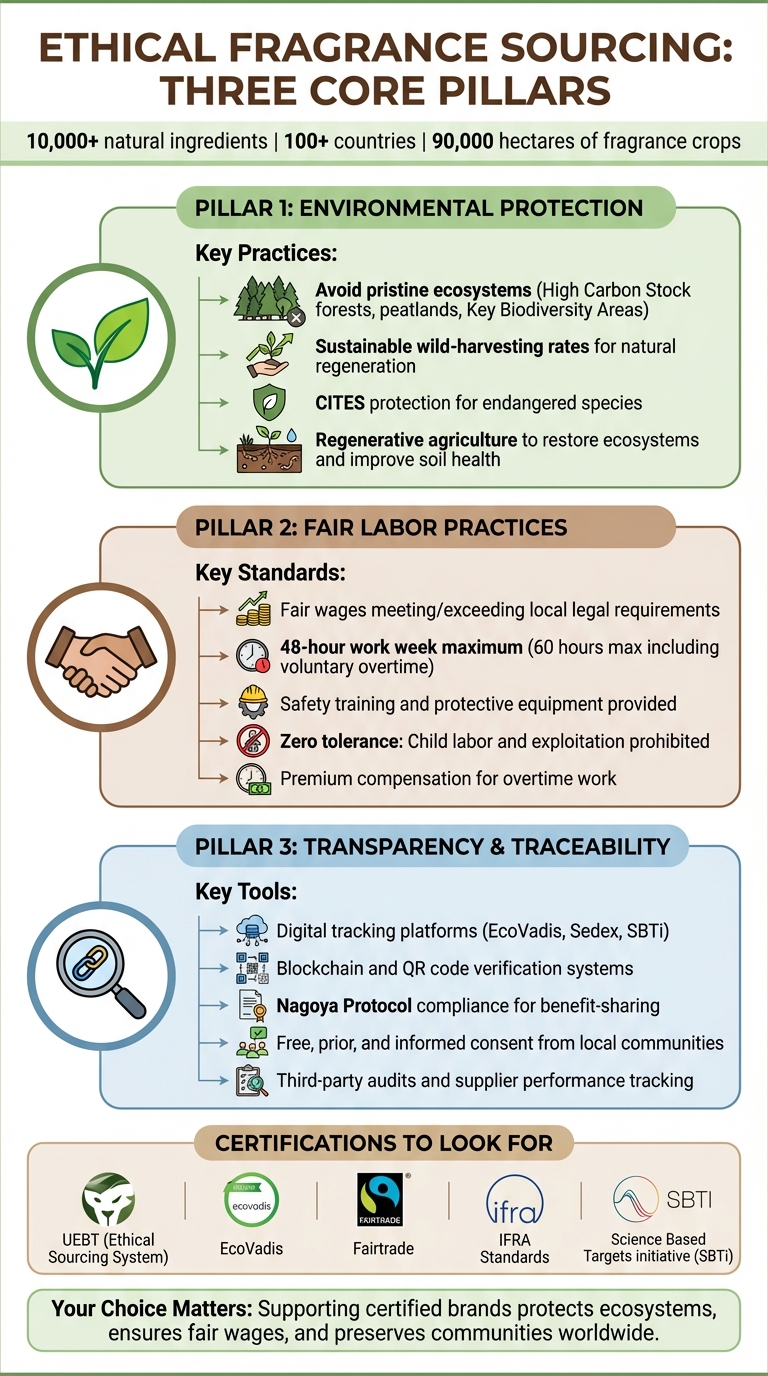
Trois piliers de l’approvisionnement éthique en ingrédients de parfumerie
Votre expert parfum personnel vous attend
Faites notre quiz olfactif express pour découvrir des parfums de créateurs et de niche authentiques, choisis selon vos goûts – explorez-les en décants et échantillons de 2, 5, 8 et 30 ml, pour essayer chaque fragrance avant de vous engager sur un flacon entier.
Trouvez votre parfumPrincipes fondamentaux de l’approvisionnement éthique en ingrédients
L’approvisionnement éthique dans l’industrie du parfum repose sur trois piliers essentiels : la protection de l’environnement, la garantie de pratiques de travail équitables et le maintien d’une transparence totale tout au long de la chaîne d’approvisionnement. Avec plus de 10 000 ingrédients naturels provenant de plus de 100 pays, ces principes guident la gestion responsable d’environ 90 000 hectares de cultures destinées à la parfumerie.
Protection de l’environnement et pratiques responsables
La préservation de la biodiversité et des écosystèmes est au cœur de l’approvisionnement éthique. Les entreprises s’efforcent de prévenir tout dommage environnemental, de minimiser les impacts inévitables et de compenser lorsque cela s’avère nécessaire. Elles s’engagent à éviter les écosystèmes vierges tels que les forêts à haut stock de carbone, les tourbières et les zones clés pour la biodiversité.
Pour les ingrédients récoltés à l’état sauvage, des taux de collecte durables sont essentiels afin de permettre la régénération naturelle, tandis que les espèces menacées sont protégées par la réglementation CITES. Au-delà de la préservation, l’approvisionnement éthique met désormais l’accent sur l’agriculture régénératrice, une pratique conçue pour restaurer les écosystèmes, améliorer la santé des sols et renforcer la résilience climatique.
"Nous reconnaissons que nous avons l’importante responsabilité de contribuer à la préservation de l’environnement et de la biodiversité de la planète pour les générations futures." — Gilles Andrier, Directeur Général, Givaudan
Ces engagements environnementaux sont intimement liés aux droits et au bien-être des travailleurs.
Salaires équitables et sécurité des travailleurs
L’approvisionnement éthique garantit aux travailleurs des salaires justes, conformes ou supérieurs aux exigences légales locales, et suffisants pour couvrir les dépenses essentielles de la vie quotidienne. La durée du travail est limitée à 48 heures par semaine, avec un maximum de 60 heures en incluant les heures supplémentaires volontaires, rémunérées à des taux majorés.
Les employeurs sont responsables de fournir à leurs travailleurs une formation à la sécurité, les équipements de protection nécessaires ainsi que les installations essentielles. Le travail des enfants et les pratiques d’exploitation sont strictement interdits. Ces normes protègent les moyens de subsistance des nombreuses familles impliquées dans la récolte de matières naturelles telles que les résines, les épices et les gommes à travers le monde.
"Pour nous, la durabilité est indissociablement liée au succès économique, à l’acceptation sociale et à l’intégrité écologique. Nous attendons de nos fournisseurs qu’ils établissent le même lien." — Dr Heinz-Jürgen Bertram, Directeur Général, Symrise
La protection du travail est encore renforcée par l’exigence de chaînes d’approvisionnement transparentes.
Transparence et traçabilité dans la chaîne d’approvisionnement
La transparence garantit que les entreprises comme les consommateurs peuvent retracer l’origine des ingrédients et vérifier leurs méthodes de production. Chaque acteur de la chaîne de valeur doit fournir des données précises sur l’approvisionnement et la transformation des matières premières. Des plateformes numériques comme EcoVadis, Sedex et l’initiative Science Based Targets sont de plus en plus utilisées pour suivre la performance des fournisseurs et assurer leur responsabilité.
Le Protocole de Nagoya joue un rôle essentiel pour garantir que les bénéfices issus des ressources génétiques et des savoirs traditionnels soient partagés équitablement avec les communautés autochtones et locales. En outre, les entreprises doivent obtenir le consentement libre, préalable et éclairé des populations locales avant d’utiliser leurs terres ou leurs ressources en eau. Cette approche protège les droits des petits exploitants agricoles tout en sécurisant l’approvisionnement en ressources naturelles délicates provenant de régions comme Madagascar et l’Andalousie.
"La durabilité commence par la collaboration. Un impact réel naît de l’action collective, c’est pourquoi nous travaillons en étroite coopération avec les fournisseurs, les clients et les leaders du secteur pour bâtir des chaînes d’approvisionnement éthiques, transparentes et durables." - dsm-firmenich
Comment fonctionne l’approvisionnement éthique en ingrédients
L’approvisionnement éthique n’est pas seulement un concept : c’est un processus concret, ancré dans des pratiques de terrain et un véritable savoir-faire opérationnel.
Identifier des sources d’ingrédients responsables
Les marques de parfum commencent souvent par mettre en place un Code de conduite des fournisseurs ou une Politique d’approvisionnement responsable. Ces lignes directrices garantissent que les fournisseurs de premier rang respectent des principes tels que les droits humains, la protection de l’environnement et les pratiques commerciales éthiques. Pour étayer cette démarche, des équipes de terrain se rendent dans les régions de production afin d’évaluer sur place les méthodes de culture et de distillation.
Prenons l’exemple de Symrise : l’entreprise s’approvisionne en environ 10 000 matières premières provenant de plus de 100 pays, ce qui rend ces évaluations de terrain cruciales. De même, le programme Sourcing4Good de Givaudan classe les fournisseurs selon leurs efforts en matière de transparence, de gestion des risques et de traçabilité. Par ailleurs, les marques exigent que les fournisseurs respectent des accords internationaux comme le Protocole de Nagoya et la CITES. Ces mesures contribuent à instaurer la confiance et à bâtir des partenariats directs et fiables avec les producteurs.
Établir des partenariats directs avec les communautés locales
L’approvisionnement éthique va bien au-delà des contrats : il s’agit de cultiver des relations directes avec les agriculteurs et les coopératives. Les marques garantissent des salaires équitables et contribuent au développement local en finançant des écoles, des infrastructures de santé et des projets d’eau potable. Le programme Naturals Together de Firmenich, par exemple, collabore avec des agriculteurs haïtiens pour l’approvisionnement en vétiver. En fournissant formation, outils et accès au marché, le programme a eu un impact positif sur plus de 40 000 personnes tout en sécurisant un approvisionnement de haute qualité et parfaitement traçable.
"L’avenir à long terme des ressources naturelles ne peut être assuré qu’en construisant des relations solides avec les producteurs locaux à travers le monde." – Givaudan
Un autre exemple est The 7 Virtues, une entreprise sociale qui s’approvisionne en huiles essentielles comme la rose et la fleur d’oranger dans des zones de conflit telles que l’Afghanistan et le Rwanda. Cette initiative aide les agriculteurs à remplacer des cultures illégales par des ingrédients de parfumerie légaux, favorisant à la fois la stabilité économique et la paix.
Préserver la qualité et l’authenticité
Des relations solides avec les producteurs permettent également des contrôles de qualité en temps réel, garantissant transparence et authenticité. Des ingrédients tels que les fleurs et les bois sont souvent distillés ou extraits immédiatement après la récolte afin de capturer l’expression la plus pure de leur parfum. Des techniques avancées, comme l’analyse par chromatographie en phase gazeuse dans des laboratoires modernes, confirment les profils chimiques de ces matières et garantissent leur conformité à des standards de qualité rigoureux.
En 2023, Diptyque a indiqué que l’ensemble de ses matières premières naturelles faisait l’objet d’un approvisionnement transparent, garantissant l’origine des ingrédients utilisés en quantités supérieures à 100 parties par million. Des audits réguliers menés par des tiers garantissent en outre le respect des normes sociales, de sécurité et environnementales. Par exemple, Lush s’approvisionne en huile de santal auprès d’une coopérative appartenant à la communauté en Australie-Occidentale. Ce partenariat soutient une gestion durable des terres, une tarification équitable et la préservation culturelle. Ces efforts continus ne se contentent pas de préserver la qualité : ils renforcent également les liens éthiques avec les communautés locales.
Défis d’approvisionnement pour les ingrédients de parfumerie courants
L’approvisionnement en ingrédients naturels destinés à la parfumerie s’accompagne de questions éthiques et environnementales complexes. Explorons les défis liés à certaines matières prisées et la manière dont l’industrie s’efforce d’y répondre.
La bergamote d’Italie
Les producteurs italiens de bergamote doivent relever le défi délicat de concilier protection de l’environnement et impératifs économiques. Pour les accompagner, les maisons de parfum collaborent avec les communautés locales afin de mettre en œuvre des techniques agricoles qui préservent la biodiversité tout en assurant la disponibilité de cet ingrédient sur le long terme. Par exemple, Givaudan s’est engagée à s’approvisionner de manière responsable pour tous ses matériaux d’ici 2030, près de 80 % de ses ingrédients naturels provenant déjà directement de producteurs locaux à travers le monde.
"Notre stratégie ‘Naturals at Origin’ génère des bénéfices à de nombreux niveaux. Elle nous permet de soutenir les communautés locales et de préserver l’avenir de notre industrie, tout en offrant à nos clients une palette inégalée et toujours plus riche de matières naturelles responsables." – Valerie, Directrice du développement commercial Naturals, Givaudan
D’autres ingrédients naturels présentent leurs propres défis d’approvisionnement.
Le patchouli d’Indonésie
En Indonésie, la culture du patchouli fait face à deux défis majeurs : garantir des salaires équitables et protéger les forêts. La juste rémunération des travailleurs est une priorité, et des règles strictes sont en place pour empêcher la destruction des forêts à haut stock de carbone et des tourbières, écosystèmes essentiels dans les zones d’approvisionnement. Des entreprises comme Symrise appliquent des politiques interdisant le travail des enfants (âge minimum de 15 ans) et le travail forcé dans leurs chaînes d’approvisionnement. En complément, des méthodes agroforestières sont utilisées pour réduire la pression sur les sols et les écosystèmes, favorisant ainsi des pratiques agricoles plus durables.
À Madagascar, l’ylang-ylang exige quant à lui une approche différente pour surmonter ses propres défis.
L’ylang-ylang de Madagascar
Les forêts brumeuses de Madagascar, où prospère l’ylang-ylang, requièrent une gestion attentive afin de préserver leur biodiversité unique. Pour y répondre, les entreprises de parfumerie s’associent directement aux récoltants et distillateurs locaux, en leur fournissant formation, équipements et soutien financier afin d’améliorer les pratiques de récolte. La Fondation Givaudan intervient également pour faire face aux enjeux sociaux et économiques de ces régions en soutenant des initiatives d’éducation et de santé. En encourageant la diversification des cultures, les familles malgaches sont incitées à développer des sources de revenus complémentaires, réduisant ainsi leur dépendance à une seule culture. La distillation sur place permet de préserver la qualité olfactive tout en maintenant une plus grande part de la valeur économique au sein de la communauté locale.
Certifications et outils de vérification
Les certifications et les outils numériques jouent un rôle essentiel pour garantir l’engagement de l’industrie du parfum en faveur d’un approvisionnement éthique. Ils apportent la transparence et la responsabilité nécessaires pour instaurer la confiance tout au long de la chaîne d’approvisionnement. Face à la multitude d’allégations liées à l’approvisionnement éthique, ces systèmes fournissent des preuves tangibles que les ingrédients sont obtenus de manière responsable.
Certifications reconnues en matière d’approvisionnement éthique
Certaines certifications sont spécifiquement conçues pour confirmer que les fournisseurs de parfumerie respectent les normes de l’approvisionnement éthique. Des plateformes telles que EcoVadis et Sedex sont largement utilisées par les grandes entreprises du parfum pour évaluer la performance des fournisseurs selon des critères éthiques, sociaux et environnementaux. Ces évaluations portent sur des domaines clés comme les pratiques de travail, l’impact environnemental et la conduite générale des affaires.
La certification UEBT Ethical Sourcing System (ESS) garantit que les entreprises accordent la priorité à la protection de la biodiversité et aux droits humains tout au long de leurs chaînes d’approvisionnement. Les évaluations de terrain de l’UEBT ont identifié la rémunération équitable — souvent liée à la notion de salaire vital — comme l’un des trois principaux défis des chaînes d’approvisionnement de la parfumerie.
"Nous nous engageons à nous approvisionner en tous matériaux et services de manière à protéger les personnes et l’environnement d’ici 2030." – Gilles Andrier, Directeur Général, Givaudan
Par ailleurs, IFRA établit des normes de sécurité volontaires pour l’industrie du parfum, notamment sur l’utilisation sûre des ingrédients. Représentant environ 80 % de la production mondiale de parfums en volume, l’IFRA délivre des certificats de conformité attestant que certaines compositions parfumées respectent les normes de sécurité. Toutefois, ces certificats ne traitent pas directement de l’approvisionnement éthique. En outre, l’initiative Science Based Targets (SBTi) vérifie que les fournisseurs progressent vers des objectifs de réduction des émissions et des gaz à effet de serre conformes à la science climatique.
Ces certifications constituent la base de systèmes de traçabilité avancés, essentiels pour favoriser la transparence dans toute la chaîne d’approvisionnement.
Technologie de traçabilité et vérification par le consommateur
Les outils numériques permettent désormais de suivre les ingrédients avec une grande précision. La liste de transparence de l’IFRA fait office de "palette du parfumeur" de l’industrie, en proposant un inventaire détaillé des ingrédients utilisés dans les formulations parfumées à travers le monde. L’édition 2025 comprend 3 691 ingrédients, répartis en 3 312 composants parfumants et 379 ingrédients fonctionnels. Pour les ingrédients naturels, l’IFRA utilise un système de dénomination spécialisé fondé sur la norme ISO 9235. Ce système attribue des lettres et des chiffres pour indiquer la partie de la plante utilisée ainsi que la méthode de transformation. Par exemple, "G2.5" désigne une huile d’écorce d’orange exprimée à froid, où "G" signifie "fruit" et "2,5" précise le procédé d’expression à froid. Parmi les ingrédients répertoriés, 1 021 sont classés comme substances naturelles complexes (NCS) avec ces identifiants détaillés.
Des initiatives de transparence comme Sourcing4Good de Givaudan visent à renforcer la visibilité de la chaîne d’approvisionnement et à améliorer la traçabilité des ingrédients naturels. Les consommateurs peuvent vérifier les allégations éthiques en recherchant le label UEBT sur l’emballage des produits ou en consultant en ligne la bibliothèque des normes IFRA afin de vérifier les concentrations acceptables des ingrédients.
Conclusion
L’approvisionnement éthique joue un rôle crucial dans la protection de notre planète, l’élévation des communautés locales et la préservation des ingrédients naturels les plus précieux — comme la bergamote italienne et l’ylang-ylang malgache — qui confèrent aux parfums d’exception leur caractère extraordinaire. À l’échelle mondiale, il souligne combien les choix individuels des consommateurs peuvent nourrir un progrès éthique véritablement significatif.
Vos décisions d’achat ont du poids. Soutenir des marques dotées de politiques d’approvisionnement transparentes, de certifications délivrées par des tiers telles que l’UEBT ou Fairtrade, ainsi que de partenariats directs avec des producteurs locaux, contribue activement à des systèmes qui privilégient des salaires équitables, des conditions de travail sûres et la préservation de la biodiversité. Par exemple, le programme de vétiver de Firmenich en Haïti a eu un impact positif sur plus de 40 000 vies, prouvant que la demande des consommateurs pour des pratiques éthiques peut engendrer des bénéfices concrets et mesurables pour les communautés.
Privilégiez les marques qui offrent une véritable traçabilité — qu’elle passe par des codes QR, des rapports de transparence ou des récits détaillés sur l’origine des ingrédients. Des entreprises comme Givaudan accomplissent des avancées remarquables, en s’engageant à s’approvisionner de manière responsable pour l’ensemble de leurs matériaux d’ici 2030, établissant ainsi une référence pour le reste de l’industrie. En choisissant ces maisons, vous soutenez non seulement les artisans qui cultivent ces trésors botaniques rares, mais vous contribuez également à protéger les écosystèmes qui les font vivre.
Chaque parfum issu d’un approvisionnement éthique porte en lui un récit plus profond de respect, de collaboration et de durabilité. Ces efforts, enracinés dans des partenariats directs avec les communautés locales, illustrent l’harmonie entre savoir-faire traditionnel et responsabilité contemporaine. En faisant des choix éclairés, vous contribuez à faire prospérer durablement ces traditions artisanales, tout en préservant les trésors naturels de notre planète pour les générations futures.
FAQ
Comment puis-je vérifier qu’un parfum est issu d’un approvisionnement éthique ?
Pour vous assurer qu’un parfum est issu d’un approvisionnement éthique, commencez par examiner le degré de transparence de l’entreprise concernant sa chaîne d’approvisionnement. Vérifiez si elle partage ouvertement des informations sur l’origine de ses ingrédients et les conditions dans lesquelles ils sont obtenus. Des certifications telles que Fair Trade ou des preuves d’audits menés par des tiers peuvent être de solides indicateurs de pratiques responsables. Recherchez également des engagements publics démontrant sa volonté d’agir avec responsabilité.
Portez attention aux programmes visant à améliorer la traçabilité et à soutenir les communautés locales impliquées dans la production. Ces initiatives reflètent souvent un engagement sincère en faveur de pratiques éthiques. Enfin, consulter les politiques d’approvisionnement responsable de l’entreprise ou ses rapports publiés peut vous apporter un éclairage supplémentaire sur l’origine de ses ingrédients.
Les certifications éthiques incluent-elles des normes sociales et environnementales ?
Les certifications éthiques englobent généralement des lignes directrices relatives à la fois aux pratiques de travail et aux normes environnementales. Elles visent à promouvoir un traitement équitable des travailleurs, à garantir des environnements de travail sûrs et à encourager des pratiques qui protègent les ressources naturelles. Ainsi, elles contribuent à garantir que les processus d’approvisionnement sont menés de manière responsable et durable.
Pourquoi certains ingrédients sont-ils plus difficiles à sourcer de manière éthique que d’autres ?
Certains ingrédients présentent des défis particuliers en matière d’approvisionnement éthique en raison de leur origine géographique, de la fragilité des écosystèmes dont ils proviennent et de la complexité de leurs chaînes d’approvisionnement. De nombreuses matières naturelles se trouvent dans des régions reculées ou sensibles, ce qui rend indispensable une collaboration étroite avec les communautés locales afin de promouvoir des pratiques de récolte responsables. Les plantes rares et les environnements fragiles sont menacés par la surexploitation, ce qui accentue encore la pression sur ces ressources. À cela s’ajoute la fragmentation des chaînes d’approvisionnement, qui complique la traçabilité, le respect de normes de travail équitables et la réduction de l’impact environnemental.

