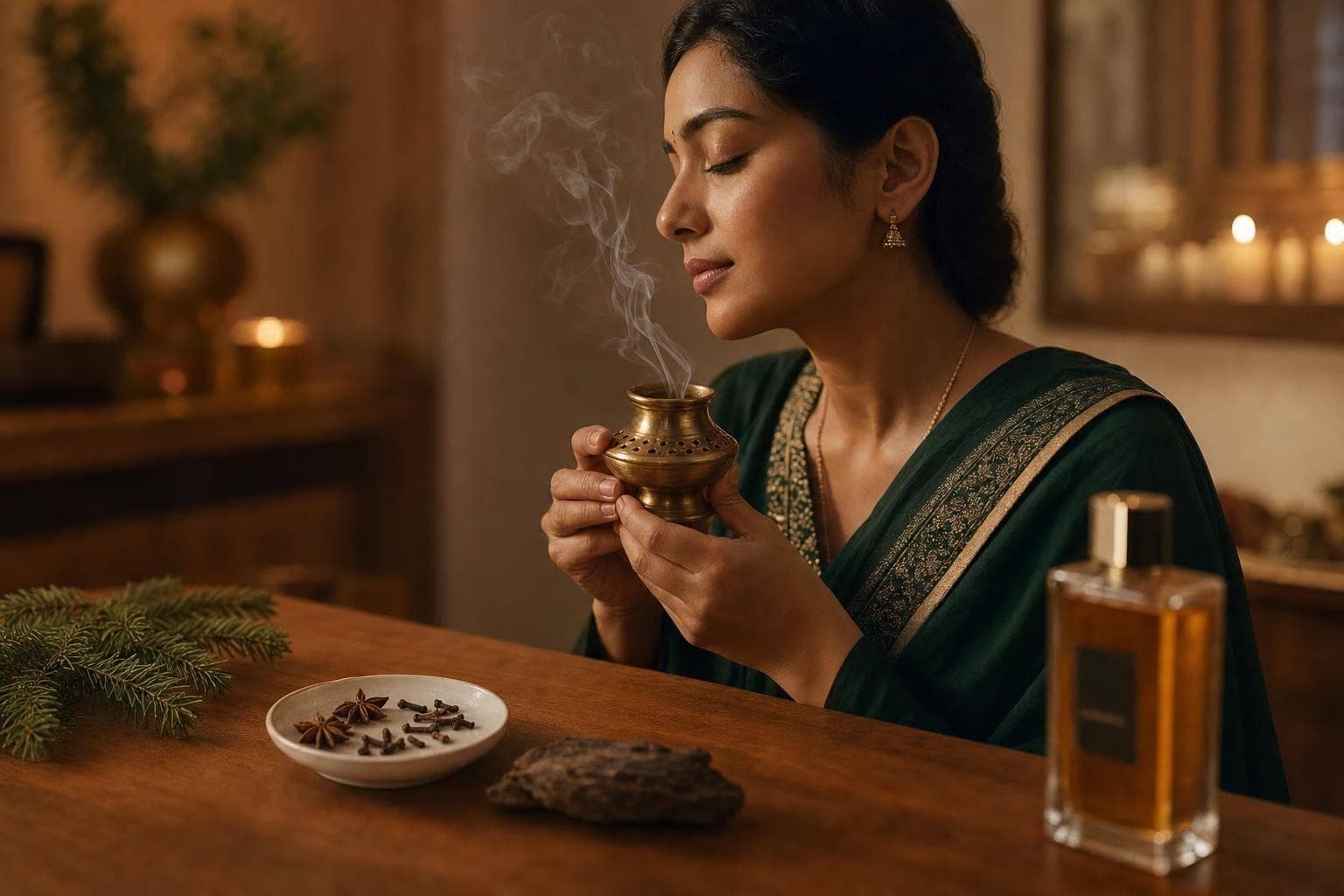
Une effluve de fête peut me faire voyager dans le temps en une fraction de seconde. Il ne s’agit pas seulement de nostalgie. L’odorat est intimement lié à la mémoire et aux émotions, raison pour laquelle l’encens, le sapin, la cannelle, l’oud ou le vin chaud confèrent à un rituel un caractère partagé, personnel et inoubliable.
Pour résumer l’essentiel, l’idée est simple : le parfum contribue à définir qui nous sommes, à quoi nous appartenons, et le moment où un instant s’extrait du quotidien. Il opère cette magie au sein des foyers, des lieux de culte et des rassemblements publics. En Allemagne, cela évoque le Glühwein, le Lebkuchen, les branches de sapin et les Räucherkerzen. Dans les foyers musulmans, ce sont l’oud, le bakhoor et les attars. Dans le cadre liturgique, ce sont l’oliban et la fumée des résines.
L’essentiel à retenir :
- L’odorat accède instantanément à la mémoire, ce qui explique pourquoi les senteurs festives nous accompagnent durant des années.
- Les fragrances partagées forgent l’identité collective, que ce soit au sein d’une famille, d’une communauté religieuse ou d’une coutume locale.
- Les senteurs saisonnières se démarquent car elles n’apparaissent qu’à des moments précis, et non au quotidien.
- Les parfums rituels influencent souvent nos goûts futurs, des accords dominés par l’encens jusqu’à l’ambre, les épices, les bois et l’oud.
- Les petits décants, tels que les formats 2 ml, 5 ml ou 8 ml, constituent une excellente manière d’explorer ces sillages avant de s’engager pleinement.
Quelques exemples illustrent parfaitement cela :
- En Allemagne, la fin novembre et le mois de décembre embaument souvent la cire d’abeille, les conifères, les amandes grillées et les épices chaudes.
- Lors de l’Eid ou des rassemblements du vendredi, nombreux sont ceux qui emploient l’oud ou le bakhoor pour parfumer les pièces, les vêtements et les espaces d’accueil.
- Dans la liturgie catholique, la fumée d’encens accompagne la prière et sanctifie les jours de fête.
Cet article se conçoit avant tout comme un guide autour d’une idée maîtresse : le parfum ne se contente pas d’accompagner le rituel, il contribue à le définir. Dès lors que ce lien s’impose à l’esprit, le choix de nos propres fragrances prend tout son sens.
Comment le parfum forge l’identité au cœur de la vie rituelle
Senteurs partagées, identité de groupe et mémoire collective
L’odeur agit souvent comme un code partagé. Elle permet de signifier l’appartenance, de perpétuer les traditions et de se reconnaître à travers l’habitude et le souvenir. Les effluves communes d’encens, de vin chaud ou de mets dorés concourent à façonner un espace rituel partagé.
Ce phénomène s’observe dans l’intimité du foyer. Une famille qui brûle le même mélange d’encens à chaque Avent ou confectionne les mêmes biscuits épicés chaque mois de décembre commence à tisser sa propre empreinte olfactive. Le sillage s’inscrit dans l’histoire familiale. Des matières patrimoniales telles que les résines, les herbes aromatiques, les eaux florales et les épices se trouvent au cœur de cette alchimie. Dans certaines régions rurales du sud de l’Allemagne, les traditions des Rauhnächte invitent encore à purifier les maisons et les étables par la fumée de résine de sapin ou de pin, de cannelle, de clous de girofle, de cardamome et d’écorces d’agrumes séchées. Transmis des grands-parents aux plus jeunes, ces mélanges portent en eux des vertus protectrices et une symbolique saisonnière.
Cet héritage olfactif explique également pourquoi les parfums de fête se distinguent si nettement des senteurs du quotidien.
Comment le parfum distingue le quotidien du temps festif
Les senteurs de fête possèdent une telle importance précisément parce qu’elles demeurent absentes du quotidien la majeure partie de l’année. La résine de conifère, les épices pour vin chaud et les cônes d’encens n’imprègnent pas les semaines ordinaires ; leur réapparition signale instantanément un passage. Le message est clair : le temps de la fête s’ouvre. C’est là toute la puissance de la mémoire rituelle. Les odeurs indiquent le moment de se réunir, de célébrer ou de marquer une transition.
En Allemagne, l’alliance fin novembre des branches de conifères, de la fumée des Räuchermännchen, du Lebkuchen et du Glühwein annonce l’entrée dans la période festive. D’autres traditions suivent la même rythmique, bien que les matières premières diffèrent. Les eaux florales et les arômes des mets d’apparat resurgissent durant le Ramadan ou l’Eid, extrayant ces périodes de la routine quotidienne. Avec le temps, la moindre effluve de ces senteurs suffit à indiquer l’avènement d’un instant solennel.
Les traditions olfactives festives à travers les cultures
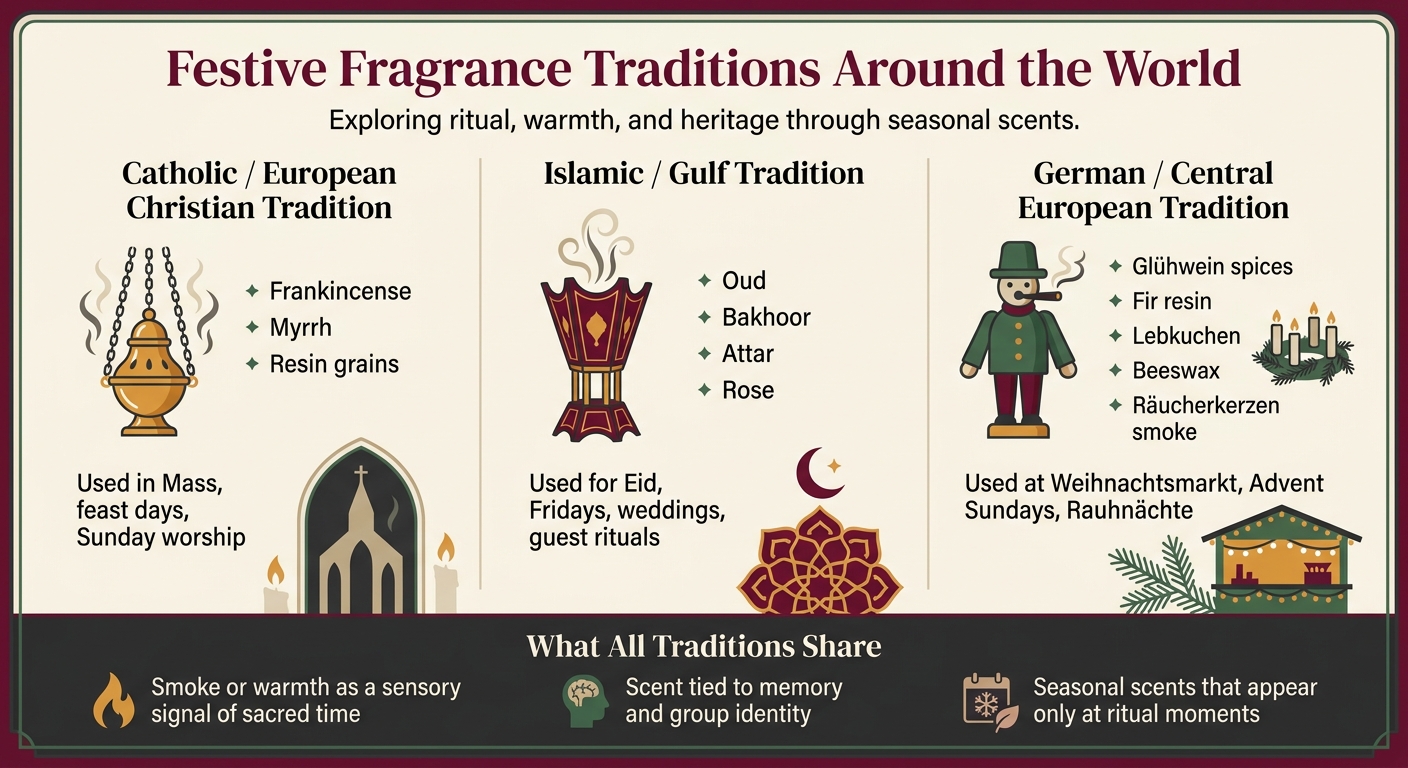
Traditions olfactives festives à travers le monde
La fumée sacrée : l’encens dans les espaces religieux et cérémoniels
Dans de multiples traditions, la fumée symbolise l’élévation au-delà du temps profane vers la prière, l’hospitalité ou le recueillement silencieux. Le rôle de la fragrance demeure immuable ; seule varie la signification spirituelle qui lui est conférée.
Durant la messe catholique, le prêtre fait consumer des grains de résine d’oliban sur des charbons ardents dans un encensoir. La fumée montante figure la prière et sanctifie l’instant, démarquant les solennités et le culte dominical de la vie séculière.
L’encens d’église, le bakhoor du Golfe et le Kōdō japonais emploient chacun le parfum pour signifier le respect, l’accueil ou la quiétude. Dans l’art du Kōdō, la fragrance est vécue comme une attention disciplinée et méditative plutôt que comme un simple artifice décoratif.
Dans d’autres contextes, cette même expression s’étend du culte vers la bénédiction et les rituels d’hospitalité.
Oud, attars et hospitalité festive dans les cultures islamiques
Dans nombre de cultures islamiques, le parfum possède une dimension à la fois sociale et spirituelle. Les recueils de Hadiths rapportent que le Prophète Mahomet ne refusait jamais le parfum, et certaines traditions recommandent aux hommes de se parfumer tout particulièrement pour le vendredi et pour l’Eid. L’oud, le bakhoor et l’attar sont intimement liés aux célébrations de l’Eid, aux prières du vendredi, aux noces et aux rituels d’accueil.
L’oud, par sa rareté et sa profondeur, accompagne les grandes réceptions, où le porter ou le faire brûler exprime la joie et le respect. Le bakhoor — de précieux copeaux de bois imprégnés de parfum, consumés sur le charbon d’un mabkhara — embaume les demeures et les vêtements avant l’arrivée des convives. S’envelopper de ses volutes est un geste d’accueil raffiné. Privilégier un attar plutôt qu’une fragrance alcoolisée témoigne d’un attachement à la piété et d’une continuité avec les traditions ancestrales.
Lorsque les mêmes accords d’oud et recettes de bakhoor se perpétuent de génération en génération, le parfum fait bien plus qu’embaumer une pièce. Il relie les matins d’Eid contemporains à ceux des aïeux.
En Allemagne, cette grammaire rituelle adopte les tonalités de l’hiver : conifères, épices, volutes de bois et vin chaud.
Le paysage olfactif des fêtes en Allemagne : sapin, épices et classiques du Weihnachtsmarkt
Sur presque chaque Weihnachtsmarkt — de Lübeck à Munich —, les mêmes effluves reviennent : Glühwein, sapin, Lebkuchen et Räucherkerzen. Ensemble, ils incarnent la saison. Ils révèlent une identité saisonnière partagée, bien au-delà de la simple date de Noël sur un calendrier.
Au cœur du foyer, l’Adventskranz met à l’honneur les bougies de cire d’abeille et les branches de sapin frais. Allumé lors de chacun des quatre dimanches de l’Avent, il insuffle un rythme olfactif hebdomadaire qui guide vers Noël. Les traditionnels cônes d’encens de l’Erzgebirge, consumés à l’intérieur des figurines en bois Räuchermännchen, enveloppent l’espace d’une douce tiédeur fumée. Cette fragrance, presque exclusivement associée aux célébrations hivernales, tire précisément de cette rareté temporelle son incomparable pouvoir d’évocation.
Ces notes cérémonielles influencent également nos choix contemporains de haute parfumerie, tout particulièrement pour ceux qui recherchent l’émotion d’un souvenir festif sans s’orienter immédiatement vers un flacon complet.
Votre expert parfum personnel vous attend
Faites notre quiz olfactif express pour découvrir des parfums de créateurs et de niche authentiques, choisis selon vos goûts – explorez-les en décants et échantillons de 2, 5, 8 et 30 ml, pour essayer chaque fragrance avant de vous engager sur un flacon entier.
Trouvez votre parfumComment intégrer les senteurs festives à une garde-robe olfactive moderne
De la mémoire rituelle au choix d’une fragrance personnelle
Ces résonances rituelles ne s’éteignent pas une fois la célébration achevée. Elles guident bien souvent les préférences olfactives tout au long d’une vie.
Une personne ayant grandi au contact de l’encens d’église se sentira tout naturellement attirée par des compositions articulées autour de l’oliban, de la myrrhe, du labdanum ou du benjoin. Les souvenirs de l’Eid baignés de bakhoor et d’attars de rose orienteront vers de somptueux accords ambrés et boisés d’oud. Cette affinité n’a rien du hasard. La mémoire des rituels éclaire bien souvent les choix de parfums à venir.
Dès lors que ce lien est mis en lumière, l’exploration olfactive devient limpide. Plutôt que de choisir au hasard, vous pouvez vous orienter vers des notes évocatrices comme l’encens, l’oud, le sapin, la cannelle ou les amandes grillées. La démarche gagne ainsi en intention et en profondeur. C’est également pourquoi la découverte par échantillons s’avère bien plus avisée que l’achat d’un grand flacon à l’aveugle.
Découvrir les fragrances inspirées des rituels sans acquérir un flacon entier
Les parfums d’inspiration rituelle révèlent toute leur splendeur dans des atmosphères singulières. Puisqu’ils se prêtent davantage aux instants d’exception qu’à une utilisation quotidienne, les décants constituent une alternative particulièrement judicieuse.
C’est tout le raffinement des formats d’essai. Scento propose des fioles de 2 ml, 5 ml et 8 ml, ainsi qu’un décant en flacon de 30 ml sur la plupart des parfums, offrant aux passionnés une manière idéale d’apprivoiser ces sillages sacrés avant de faire le choix d’un flacon complet.
Conclusion : Pourquoi le parfum demeure au cœur de l’identité festive
À travers l’ensemble de ces cultures, une certitude subsiste : le parfum capture l’âme d’un rituel avec une intensité qu’aucune photographie ni aucun récit ne sauraient égaler. L’effluve d’encens dans une nef, la chaleur épicée du Glühwein sur un Weihnachtsmarkt, ou le sillage précieux de l’oud et des attars au sein de l’hospitalité islamique ne font pas qu’accompagner la cérémonie. Ils sculptent la façon dont nous nous en souvenons. Les senteurs de fête ne se contentent pas d’escorter ces moments : elles les gravent dans notre mémoire.
L’odorat communique directement avec les centres du souvenir et de l’émotion ; un soupçon de cannelle ou une touche de sapin peuvent faire renaître un mois de décembre précis bien plus vite qu’une image. C’est cette force singulière qui confère au parfum festif son rôle intemporel de marqueur d’identité et d’appartenance.
Si les matières premières diffèrent selon les traditions, leur vocation demeure identique : le sillage murmure que cet instant est à part, qu’il est chargé de sens. C’est également la raison pour laquelle ces empreintes olfactives continuent d’inspirer notre quête de fragrances aujourd’hui.
L’essentiel pour nos lecteurs en Allemagne et en Europe
Une garde-robe de parfums d’exception peut sublimer la saison, la mémoire, les origines et le sacré. Les décants au format voyage, tels que les fioles de 2 ml, 5 ml et 8 ml, ainsi qu’un décant en flacon de 30 ml sur la plupart des parfums, proposés par Scento, permettent d’explorer ces créations d’inspiration rituelle en toute liberté avant de s’engager pour un grand flacon.
Les rituels de fête vivent autant à travers leur signature olfactive qu’à travers les tenues, les mets partagés ou les paroles échangées. Le parfum ne se contente pas de jalonner les saisons : il en préserve l’âme, transmettant l’identité d’une génération à l’autre.
Questions fréquentes
Pourquoi les parfums ravivent-ils si intensément les souvenirs de fête ?
Les fragrances réveillent les souvenirs festifs avec une intensité incomparable en raison du cheminement singulier de l’odorat dans notre cerveau. À la différence des autres sens, il communique de manière quasi directe avec les structures cérébrales maîtresses de l’émotion et de la mémoire.
Cette voie privilégiée permet à un sillage de ressusciter un instant précis instantanément, avant même que l’esprit n’ait pu identifier la senteur. C’est la raison pour laquelle ces réminiscences se révèlent souvent plus vives, plus profondes et remarquablement pérennes.
En quoi les parfums rituels façonnent-ils l’identité culturelle ?
Les fragrances rituelles contribuent à forger l’identité culturelle car elles lient les coutumes partagées à l’intimité du souvenir et au sentiment sacré. Les encens, les huiles précieuses et les parfums font bien plus qu’enchanter les sens. Ils sacralisent les moments, approfondissent le recueillement et font naître le sentiment précieux d’appartenir à une lignée.
Cela se manifeste avec éclat lors des réjouissances festives. Durant l’Eid, des notes nobles comme l’oud et le bakhoor imprègnent les intérieurs et les salons, instaurant une atmosphère chaleureuse et une continuité temporelle. Au cœur des cérémonies indiennes, le jasmin est indissociable de la fête, de la ferveur spirituelle et de la tradition familiale. Ces effluves perpétuent l’histoire vivante et transmettent les valeurs de génération en génération.
Quelles notes de parfumerie incarnent le mieux les traditions festives ?
Les notes les plus remarquables s’harmonisent généralement avec la saison et l’esprit de la célébration. Les réjouissances hivernales s’accordent magnifiquement avec l’ambre, la vanille, l’oud et les épices chaudes. Les moments empreints de délicatesse et de romantisme s’épanouissent quant à eux autour de la rose, des fleurs blanches et des muscs soyeux.
Certaines essences portent également en elles une profonde charge cérémonielle. Le jasmin revêt une dimension sacrée en Inde. L’osmanthus est profondément célébré en Chine. Enfin, la myrrhe, l’oliban et l’encens demeurent intimement attachés aux sanctuaires et aux rituels du monde entier.

