Perfume trust breaks down when buyers cannot check what is in the bottle, where key materials came from, or whether the product is genuine. In a category where one bottle can cost €300,00+, that gap matters.
I’d sum it up like this: traceability gives you proof, not just promises. It helps you check origin, batch details, sourcing records, and product checks before you spend money. That matters even more when many shoppers care about a product’s impact, but far fewer trust brand claims.
Here’s the article in plain terms:
- The problem: perfume supply chains are often hidden, long, and hard to verify.
- The risk: buyers worry about safety, labour practices, and fake bottles.
- The fix: tools like batch codes, supplier records, QR scans, serial numbers, and blockchain logs make claims easier to check.
- What builds trust: visible proof on the product page and on the bottle itself.
- Why it matters for decants: when you buy 2 ml, 5 ml, or 8 ml instead of a full bottle at €200,00+, you still need to know the juice came from the right source.
One stat stands out: about 83 % of EU shoppers say a product’s impact matters, but only 49 % trust brand claims about it. That gap is where traceability matters most.
If I’m buying fragrance online, I don’t want polished wording. I want a simple way to check the facts.
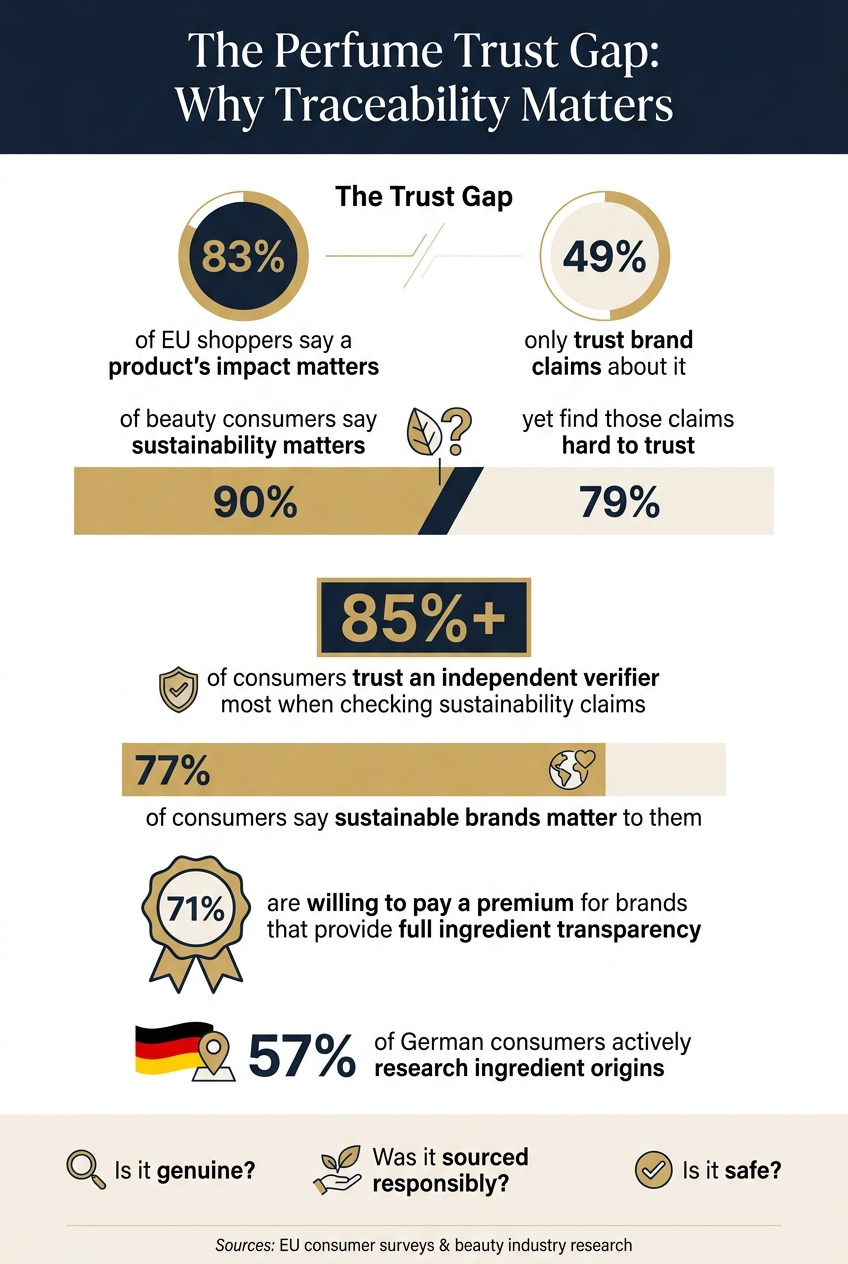
Consumer Trust Gap in Perfume: Key Traceability Stats
Revolutionizing Fragrance Supply Chains: Bastille Parfums & Avery Dennison
The Problem: Opaque Sourcing Weakens Consumer Confidence
When you pick up a bottle of perfume, most of the sourcing story is still hidden. Brands usually share only broad labels like Parfum, not the actual materials inside or where they came from. And the longer the supply chain gets, the harder it is to check what is genuine, safe, and responsibly sourced.
Where the perfume supply chain loses visibility
The lack of visibility starts early. One fragrance can include dozens of ingredients from several countries, moving through multiple middlemen before it reaches a perfume house. Natural materials like rose, sandalwood, or patchouli may come from different regions. Synthetic aromachemicals often come from chemical suppliers that share very little. With each handoff, the trail gets murkier.
It gets worse further down the chain. Brands almost never reveal the country of origin, harvest year, extraction method, or upstream supplier for each material. By the time the finished bottle lands with a retailer, most of that story is gone. And when that story disappears, so do warning signs around materials like vanilla, sandalwood, frankincense, and florals.
How missing information leads to safety, ethics, and counterfeit concerns
Opaque sourcing creates three main concerns: safety, ethics, and authenticity.
Safety: EU cosmetics rules restrict some substances and require allergen disclosure above set thresholds. But ingredient lists are still technical and hard for most people to read. If a shopper wants to avoid parabens, synthetic musks, or suspected endocrine disruptors, there’s no simple way to tell whether a fragrance fits those standards.
Ethics: Investigations by media and human-rights organisations have found that child labour is structurally embedded in parts of the jasmine supply chain, directly linking luxury perfumes to exploitative practices. If brands don’t share audited sourcing data, shoppers can’t tell the difference between products with proper standards behind them and products that just borrow phrases like natural or responsibly sourced for marketing.
Authenticity: Fake bottles wreck trust, even when the packaging looks convincing. Counterfeit perfumes are not a small issue in Europe. German customs authorities regularly seize fake personal-care goods - including perfumes - worth hundreds of millions of euros, and many counterfeits copy genuine packaging while containing unregulated or hazardous ingredients. Without serialised batch codes or tools people can actually check, anyone buying online or through less familiar channels has little practical way to confirm what they’re getting.
Why this matters under EU and German expectations
In Europe, this lack of visibility turns into both a compliance issue and a trust issue. EU rules set a safety baseline, but they don’t give shoppers direct proof of sourcing. EU Regulation (EC) No 1223/2009 lays out the basic safety and information rules for cosmetics sold in Europe, including perfumes. Product information files can be checked by authorities, not by shoppers. And batch numbers on packaging usually can’t be matched to a public database to confirm authenticity or production date.
For German consumers, that gap between compliance and transparency is especially frustrating. Surveys show that many people want shopping to be easy. They expect brands to provide clear, trustworthy information so they don’t have to investigate products on their own. When that information is missing, buyers hold back - above all on fragrances priced over €100 - and stay with brands they already know.
The Solution: Traceability Systems That Make Perfume More Verifiable
Traceability swaps vague claims for records people can check.
From batch numbers to supplier records
In the EU, perfumes carry a batch code that links each bottle to a production run and recall trail. Brands also keep a Product Information File for each fragrance. Put together, those records connect the bottle in your hand to the paperwork behind it. So a shopper can do more than read a label. They can check whether a product is genuine and whether it sits inside a clear recall path.
Distributor records push that trail further. Alongside regulatory files, brands can collect supplier documents such as certificates of analysis, origin statements, sustainability certifications, and audit reports tied to specific raw material lots. When those documents connect to batch records, a brand can trace a bottle back to source and forward through retail.
Digital tools that strengthen visibility and authenticity
Digital tools bring that traceability into view for shoppers.
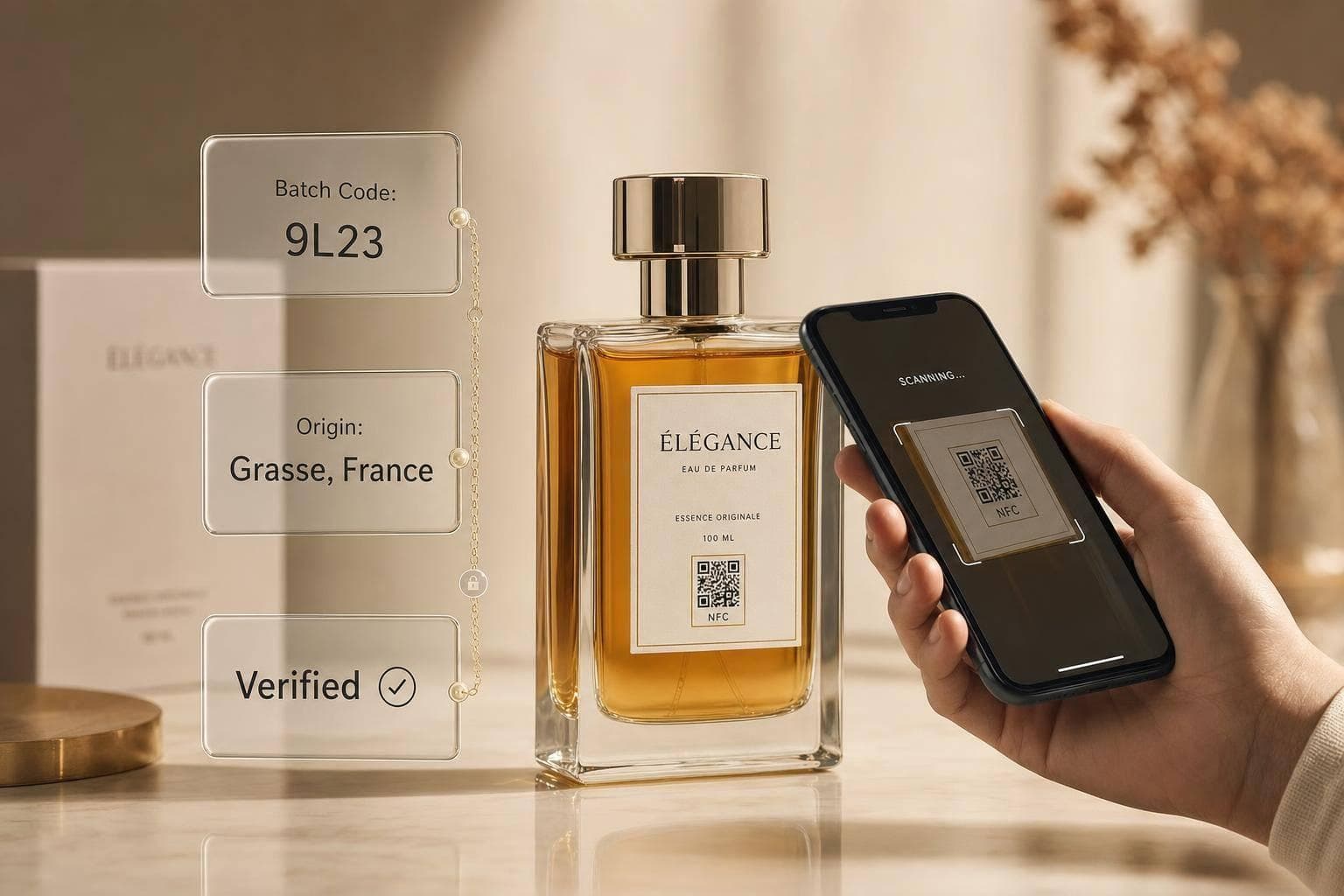
QR codes are the easiest place to start. A code on the bottle can open a transparency page with ingredient provenance, batch details, and compliance summaries, all on a smartphone. Pilot projects in fragrance have already used QR-based systems to log each step of an ingredient’s journey, from smallholder farmers to processing sites and then final manufacturing.
Serial numbers go one step further. Instead of marking only a batch, they give each unit its own identifier. That makes duplicated or invalid codes easier to spot, which helps fight fake bottles.
Blockchain-based systems record supply-chain events in a shared ledger that is hard to alter. In plain terms, no single party can quietly rewrite the record later.
Luxury groups already use blockchain and shared supplier mapping to show product history and raw-material origins.
The point is simple: proof no longer stays buried in internal files. It travels with the product.
Main traceability methods used in perfume: a comparison
Not every traceability tool does the same job. Some support compliance in the background. Others put proof right in front of the buyer.
| Traceability Method | Operational Focus | What shoppers can see | Ease of Verification | Value for buyers |
|---|---|---|---|---|
| Batch Numbers | Production run & recall | Moderate (printed on bottle) | Moderate (requires brand contact) | Baseline authenticity |
| PIF Documentation | Regulatory compliance | Low (internal/legal use) | Hard (not publicly accessible) | High for regulators |
| GS1 Barcodes | Logistics & inventory | Low | Easy (scanner) | Operational efficiency |
| QR / NFC Labels | Consumer transparency | High (instant smartphone scan) | Easy (digital link) | High - direct sourcing proof |
| Blockchain | Supply chain integrity | High (if public-facing) | Moderate (requires app or interface) | Maximum - tamper-resistant records |
Batch numbers and PIFs cover compliance. QR/NFC and blockchain make that proof visible to shoppers.
One survey found that 77 % of consumers say sustainable or environmentally responsible brands matter to them, and 71 % are willing to pay a premium for brands that provide full transparency on ingredient source and impact.
For shoppers in Germany, that mix of solid documentation and simple access can turn compliance into confidence. The product page, the code on the box, and the bottle itself all become part of the same trust chain.
Votre expert parfum personnel vous attend
Faites notre quiz olfactif express pour découvrir des parfums de créateurs et de niche authentiques, choisis selon vos goûts – explorez-les en décants et échantillons de 2–8ml, pour essayer chaque fragrance avant de vous engager sur un flacon entier.
Trouvez votre parfumHow Traceability Turns Transparency Into Consumer Trust
Transparency on its own doesn’t do much. Shoppers need a way to check what a brand says. In perfume, that proof is what turns ethical sourcing from a nice-sounding claim into something people can believe. So the key issue isn’t whether brands should be open. It’s what kind of proof shoppers can verify for themselves.
What shoppers trust more when proof is visible
About 90 % of beauty consumers say sustainability matters, yet 79 % find those claims hard to trust. That gap says a lot. People aren’t asking for more brand messaging. They want proof from a source outside the brand itself.
And the numbers back that up. More than 85 % of consumers say an independent verifier is the source they trust most when checking a brand’s sustainability statements. On cosmetics, trusted seals and labels help shoppers judge a product quickly. In Germany, 57 % of consumers look into where ingredients come from, while many see corporate sustainability programmes as greenwashing.
The proof that carries weight is plain and checkable:
- origin details for key materials
- certification badges with a clear explanation
- batch numbers linked to records shoppers can verify
- authenticity checks people can run on their own
These signals help answer the three things shoppers care about most: is it genuine, is it safe, and was it sourced responsibly? When those answers are easy to find, the sense of risk drops. Buying feels simpler.
Low — Traceability vs High — Traceability Perfume
The contrast becomes obvious when you place low- and high-traceability perfume next to each other.
| Dimension | Low — Traceability Perfume | High — Traceability Perfume |
|---|---|---|
| Ingredient visibility | Vague or incomplete origin information | Clear sourcing details for key materials, including country or region |
| Authenticity verification | Difficult to confirm if the product is genuine | Batch numbers, digital checks, or retailer-level verification available |
| Sustainability proof | Broad claims with no supporting evidence, no independent verification | Certifications, supplier records, or chain-of-custody data backed by third-party audits or recognised eco-labels |
| Buyer confidence | Lower confidence, higher perceived risk | Higher confidence, lower perceived risk |
Research shows that traceability is a strong predictor of consumer trust when it is backed by independent verification. Brands that share sourcing details, audit data, and traceability records tend to build longer-term loyalty. By contrast, impact claims without proof are doing more damage to credibility, especially in premium categories. Visible proof cuts doubt and removes friction from the buying decision.
In modern retail, that means traceability has to appear where discovery happens, not sit buried in internal records.
What This Looks Like in Practice for Scento and Modern Perfume Retail
Making traceability easy to understand online
In perfume retail, traceability only helps when people can see it right where they decide to buy. On a product page, that means placing sourcing and compliance details near the fragrance description and price, not hiding them in the footer.
A simple label such as "Origin & Quality" does the job well. Under that section, the page can show the origin of key ingredients, like jasmine oil from India, along with the filling location. Small icons for origin, authenticity, and compliance make the details easy to scan in a few seconds. Dates should use the German format, such as 09.09.2026, so production or quality-check timestamps feel familiar at once. Safety markers can sit beside this information in plain language, without forcing shoppers to decode technical terms.
A QR code on the decant label carries that proof from the screen to the bottle. Once scanned, it can open a deeper traceability trail with ingredient-level sourcing, supply-chain timestamps, authenticity checks, and compliance documents in collapsible sections. That way, the main page stays clean, while anyone who wants the full paper trail can dig in.
Why traceable decants support smarter, lower-waste discovery
This matters even more with decants, because buyers cannot inspect a full bottle before paying. When a full bottle costs €200,00+, buying blind is a serious risk. A 2 ml, 5 ml, or 8 ml decant gives people room to test a scent in daily life, not just on a paper strip or in a rush at a counter.
Still, that only works if shoppers trust what is inside.
At Scento, each decant comes from a verified original bottle sourced through authorised EU channels. Showing the batch number, decanting date, and source on the product page makes it clear that the smaller format contains the same genuine fragrance as the full bottle. That lowers purchase risk and makes side-by-side testing more practical before someone commits to a larger bottle. In plain terms, discovery feels safer, and waste stays lower.
Conclusion: Trust grows when perfume journeys are visible
Opaque sourcing creates a very specific kind of doubt. It lingers because there is nothing concrete to check. Traceability clears that doubt by replacing broad claims with facts shoppers can review for themselves: where key ingredients come from, how the fragrance moved into the decant, which standards it meets, and how each part can be verified.
When traceability is presented clearly, in plain language and familiar formats, compliance stops feeling like legal fine print. It starts to work as a visible sign of quality. And when the path of a fragrance can be followed from ingredient origin to authenticated bottle to traceable decant, trust is no longer just a promise. It is something people can prove.
FAQs
How can I verify a perfume batch code myself?
Find the batch code on the bottle or box. It connects your item to a specific production run and date, but it’s best used with other checks rather than on its own.
You can also check for QR codes or NFC chips linked to the brand’s official distribution records. If the origin still doesn’t feel right, contact the brand directly and ask them to match the batch details with their production logs.
Does traceability prove a perfume is ethically sourced?
Not by itself. Traceability doesn’t automatically prove a perfume is ethically sourced, but it does give you the paper trail needed to check those claims.
It connects an ingredient to its source, processing site, and final product through records like batch numbers, audit trails, and third-party certifications. With that level of detail, shoppers in Germany can look past vague marketing language and see whether a purchase lines up with their ethical values.
Why is traceability especially important for decants?
Traceability matters for decants because it helps prove provenance, quality, and authenticity.
A decant is a smaller volume taken from a larger bottle. So the key issue is simple: can you trace that liquid back to the original factory-sealed bottle? A clear chain of custody helps do exactly that. It shows the fragrance is genuine, matches the source bottle, and keeps the correct batch codes tied to it.
Without that traceable link, the risk of counterfeits goes up. And when people in Germany are paying premium fragrance prices, they should be able to check ethical and environmental claims before they spend that kind of money.