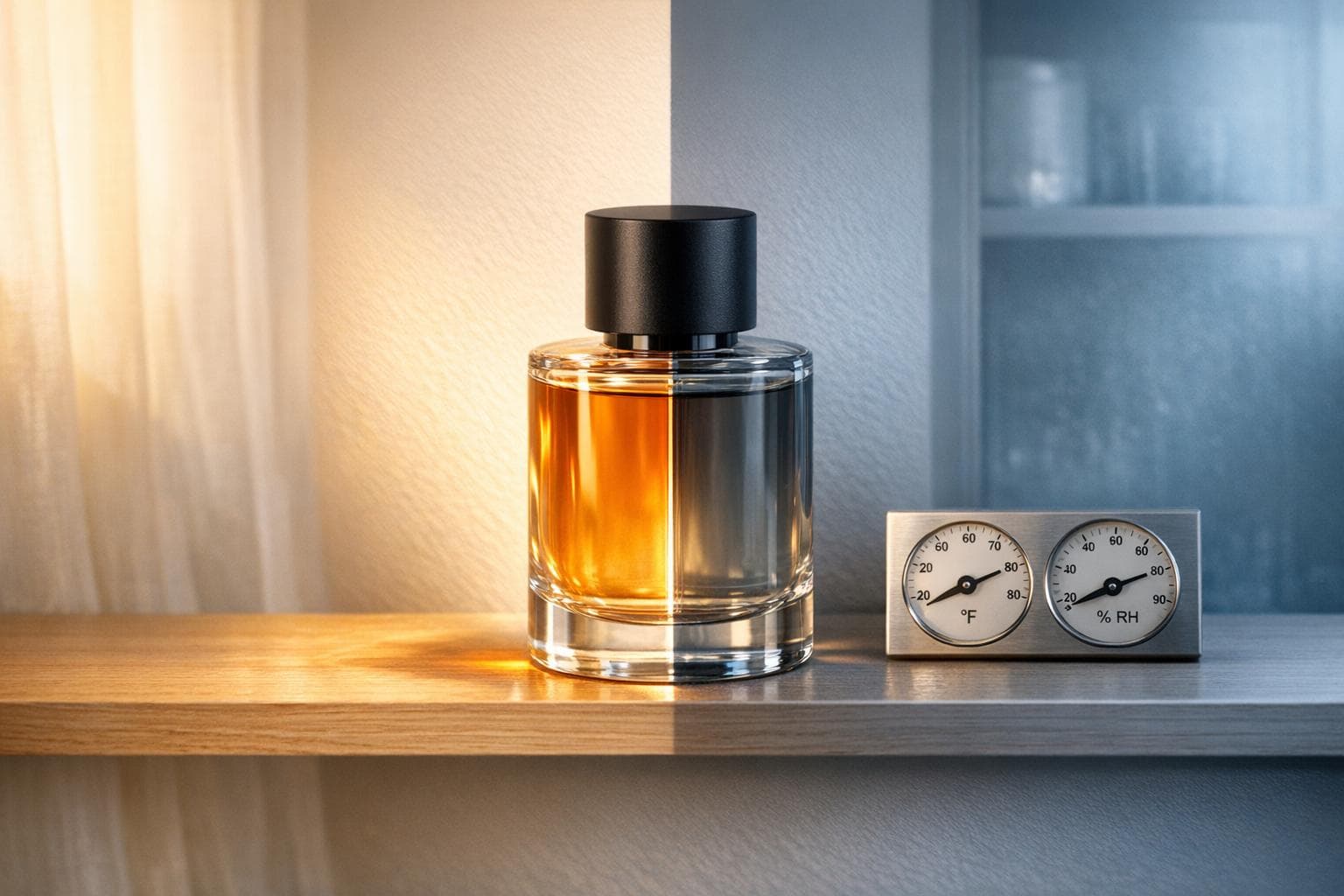
Conserver un parfum n’est pas aussi simple qu’il n’y paraît. Des facteurs comme la température, la lumière et l’humidité peuvent avoir un impact considérable sur vos fragrances, les faisant se détériorer plus vite ou leur faisant perdre leur profil olfactif d’origine. Si l’été apporte des défis tels que la chaleur, les rayons UV et l’humidité, l’hiver introduit des risques comme les variations de température et l’air sec.
Voici ce que vous devez savoir :
- Risques en été : La chaleur accélère la dégradation chimique, les rayons UV altèrent les molécules odorantes, et l’humidité peut diluer les parfums mal scellés.
- Risques en hiver : Les écarts de température entre le froid extérieur et la chaleur intérieure mettent les composés parfumés à rude épreuve, tandis que l’air sec accélère l’oxydation et l’évaporation.
- Conditions de conservation idéales : Gardez les parfums entre 55 et 70°F (12 à 21°C), avec une humidité de 40 à 60 %. Conservez-les dans un endroit frais et sombre, à l’abri du soleil, des sources de chaleur et de l’humidité.
Pour protéger votre collection toute l’année :
- Rangez les flacons à la verticale dans leur emballage d’origine ou dans des espaces fermés comme des placards.
- Évitez les salles de bains et les rebords de fenêtre.
- Utilisez des sachets de gel de silice en été et assurez-vous que les bouchons sont bien fermés en hiver.
Pour encore plus de praticité, de petits décants comme les flacons de 8 ml de Scento aident à limiter l’exposition aux agressions environnementales, tout en gardant vos grands flacons en sécurité à la maison.
Summer Storage Challenges
Les conditions estivales peuvent faire des ravages même sur les fragrances les plus précieuses. Le mélange de chaleur, de rayons UV et d’humidité accélère le vieillissement, réduisant la durée de vie habituelle des parfums, généralement comprise entre 2 et 5 ans. Voyons en détail comment ces facteurs affectent vos fragrances pendant les mois les plus chauds.
Les dommages causés par la chaleur aux fragrances
Les températures élevées sont un ennemi majeur du parfum. La chaleur accélère les réactions chimiques au sein de la fragrance, dégradant les molécules les plus délicates — en particulier les notes de tête comme les agrumes — et augmentant l’évaporation. Cela peut provoquer une explosion olfactive puissante mais éphémère, souvent suivie d’une note de fond désagréable, métallique ou vinaigrée. Avec le temps, le liquide peut foncer, se dilater et perdre tout son équilibre.
Pour éviter cela, ne laissez jamais un parfum dans une voiture ou sur un rebord de fenêtre ensoleillé pendant l’été. Des variations extrêmes de température peuvent ruiner une fragrance en seulement quelques heures.
Dommages causés par la lumière du soleil et les UV
Si la chaleur est nocive, les rayons UV le sont tout autant. Ces rayons dégradent les molécules odorantes, ternissent les notes les plus vibrantes et modifient durablement le parfum. Comme l’explique ForScent :
La lumière directe, en particulier la lumière du soleil, contient des rayons ultraviolets (UV). Ces rayons sont comme de petits assassins implacables qui attaquent les molécules du parfum
. L’exposition aux UV peut également faire foncer le liquide ou le rendre trouble, diminuant davantage sa qualité.
Même les flacons en verre foncé, qui offrent une certaine protection contre les UV, ne sont pas totalement à l’abri d’une exposition prolongée au soleil. Pour préserver votre parfum, conservez les flacons dans leur boîte d’origine ou dans un endroit sombre et frais, comme un placard.
Les effets de l’humidité sur les flacons
L’humidité estivale n’affecte pas seulement la fragrance elle-même — elle peut aussi compromettre le flacon. Un excès d’humidité peut s’infiltrer dans les flacons mal fermés, diluer la formule et perturber son équilibre délicat.
Les salles de bains sont particulièrement risquées pendant les mois humides. La combinaison de l’humidité saisonnière et de la vapeur de douche crée un « effet sauna », accélérant l’oxydation et réduisant drastiquement la durée de vie d’un parfum — de plusieurs années à moins d’une seule. Pour protéger vos fragrances, rangez-les à la verticale dans un placard sec avec des sachets de gel de silice pour absorber l’humidité. Veillez toujours à bien refermer les bouchons après chaque utilisation afin de limiter l’exposition à l’humidité.
Les défis de conservation en hiver
L’hiver pose des défis spécifiques pour la conservation des parfums, les changements extrêmes de température et la faible humidité affectant l’intégrité des fragrances de différentes manières.
Les risques liés aux basses températures
Les passages fréquents entre le froid glacial de l’extérieur et les espaces intérieurs chauffés peuvent être éprouvants pour les parfums. Comme l’explique Perfame :
Déplacer un parfum entre des espaces froids et chauds fait se dilater et se contracter le liquide. Ces variations mettent les composés parfumés sous tension et peuvent altérer l’homogénéité du mélange olfactif.
Cette tension peut entraîner une séparation des ingrédients, donnant au liquide un aspect trouble ou sirupeux. Le froid extrême rend également le verre plus fragile, augmentant le risque de fissures. Si les températures plus basses ralentissent l’activité moléculaire et stabilisent le parfum, elles réduisent aussi l’évaporation et la diffusion, ce qui peut atténuer les notes les plus légères comme les agrumes et les fleurs. À cela s’ajoute l’air sec de l’hiver, qui complique encore davantage la conservation.
Les problèmes liés à une faible humidité
L’air sec accentue les risques en accélérant l’oxydation, ce qui peut ternir la fragrance et introduire des notes acides ou métalliques. Perfame souligne un autre problème causé par une faible humidité :
De minuscules gouttelettes de parfum peuvent sécher plus rapidement autour de la buse lorsque l’humidité est faible. Essuyez le vaporisateur tous les quelques usages avec un chiffon doux pour éviter les dépôts et conserver une brume fine et uniforme.
Sans nettoyage régulier, l’obstruction de la buse peut entraîner une pulvérisation inégale ou grossière au lieu d’un voile délicat. De plus, une faible humidité peut perturber le rapport délicat entre alcool et fragrance à cause de l’évaporation. Wani Perfumes explique :
Une humidité très faible peut affecter le ratio alcool/fragrance par évaporation. Les parfums sont des solutions soigneusement équilibrées — un excès d’humidité ou une évaporation perturbe cet équilibre, affectant à la fois la diffusion et la tenue.
Pour préserver la qualité du parfum, visez une humidité relative de 40 à 60 %. Pour les flacons vintage avec bouchon en verre, l’air sec peut dessécher les joints, compromettant leur étanchéité et exposant la fragrance à l’oxydation.
Été vs hiver : comparaison des conditions de conservation
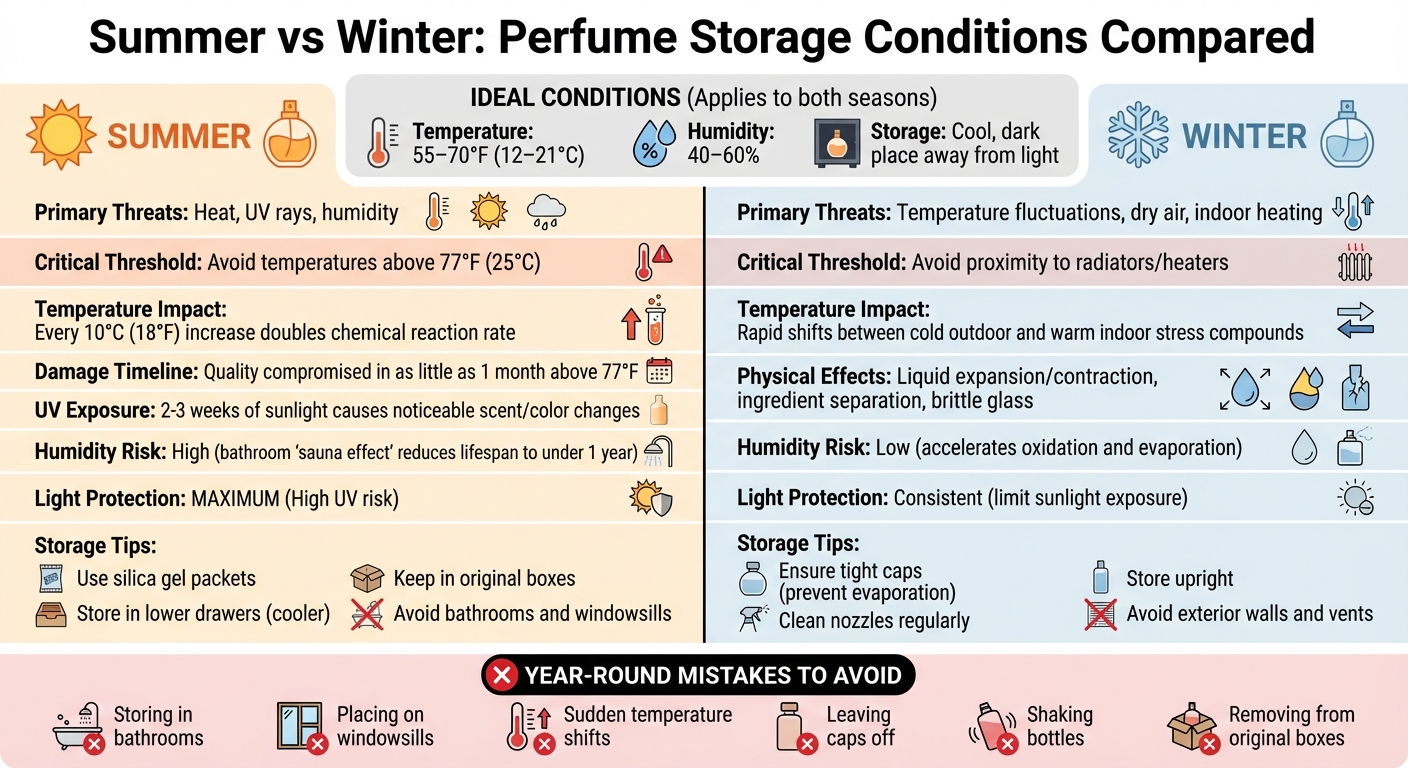
Tableau comparatif des conditions de conservation des parfums en été et en hiver
Si chaque saison apporte ses propres défis à la conservation des parfums, maintenir de bonnes conditions reste essentiel tout au long de l’année. En été, les principales menaces sont la chaleur et l’exposition aux UV, tandis qu’en hiver, les risques viennent des variations de température et de la sécheresse de l’air.
Plages de température et d’humidité
L’environnement idéal pour conserver les parfums se situe entre 55 et 70°F (12 à 21°C) avec une humidité de 40 à 60 %. Toutefois, chaque saison présente ses propres difficultés. En été, les températures élevées peuvent fortement affecter la qualité d’une fragrance. Comme le souligne Wani Perfumes :
Chaque augmentation de 10°C (18°F) de la température double approximativement la vitesse des réactions chimiques
.
Une exposition prolongée à des températures supérieures à 77°F (25°C) peut compromettre la qualité d’un parfum en à peine un mois. Pour y remédier, stockez les flacons dans la zone la plus fraîche et la plus stable en température de votre maison.
L’hiver, en revanche, présente des risques liés au chauffage artificiel, qui peut provoquer des variations rapides de température. Ces fluctuations mettent les composés parfumés sous tension et accélèrent l’oxydation. De plus, placer les flacons trop près de sources de chaleur peut endommager les notes de tête les plus délicates en quelques jours seulement. Pour protéger votre collection, évitez de ranger les flacons près des radiateurs ou des bouches d’aération, et assurez-vous qu’ils soient bien fermés afin de prévenir l’évaporation et de préserver l’équilibre des ingrédients.
| Facteur | Recommandation en été | Recommandation en hiver |
|---|---|---|
| Température idéale | 55–70°F (12–21°C) | 55–70°F (12–21°C) |
| Seuil critique | Éviter les températures supérieures à 77°F (25°C) | Éviter la proximité des radiateurs/chauffages |
| Plage d’humidité | 40–60 % (Éviter les zones très humides comme les salles de bains) | 40–60 % (Éviter l’air sec près des bouches d’aération) |
| Protection contre la lumière | Maximale (Risque élevé d’UV) | Constante (Limiter l’exposition au soleil) |
| Risque principal | Dégradation chimique induite par la chaleur | Choc thermique causé par le chauffage intérieur |
Quelle que soit la saison, contrôler l’exposition à la lumière est tout aussi important que gérer la température et l’humidité.
Protection contre la lumière toute l’année
Protéger les parfums des UV est une priorité constante, quelle que soit la saison. Le soleil intense de l’été comme la lumière froide des fenêtres en hiver peuvent entraîner des variations rapides de température, endommageant les composés parfumés. Wani Perfumes explique :
Les rayons UV dégradent la structure moléculaire des composés parfumés, altérant leur senteur et provoquant ce que les parfumeurs appellent la “photo-oxydation”.
Même 2 à 3 semaines d’exposition régulière au soleil peuvent entraîner des changements perceptibles dans le parfum et la couleur d’une fragrance. Pour éviter cela, conservez les flacons dans leur boîte d’origine, qui bloque non seulement les UV mais aide aussi à isoler des variations de température. Que ce soit au cœur de l’été ou en plein hiver, ranger vos fragrances loin des fenêtres et dans leur emballage reste essentiel pour préserver leur qualité.
Votre expert parfum personnel vous attend
Faites notre quiz olfactif express pour découvrir des parfums de créateurs et de niche authentiques, choisis selon vos goûts – explorez-les en décants et échantillons de 2, 5, 8 et 30 ml, pour essayer chaque fragrance avant de vous engager sur un flacon entier.
Trouvez votre parfumSolutions de conservation selon la saison
Gérer efficacement les défis saisonniers peut aider à prolonger la vie de vos parfums. Voici comment adapter vos méthodes de stockage en été comme en hiver afin de limiter les dommages causés par les écarts de température et l’exposition à la lumière.
Comment conserver les parfums en été
En été, il est essentiel de protéger vos fragrances de la chaleur et du soleil. Gardez-les dans des espaces sombres et fermés, comme des placards ou des tiroirs de commode, idéalement dans les tiroirs du bas où les températures sont plus fraîches. En cas de chaleur extrême, vous pouvez envisager de stocker les parfums dans un mini-réfrigérateur ou un réfrigérateur classique. Assurez-vous que les flacons soient bien fermés pour éviter qu’ils n’absorbent les odeurs.
Pour les déplacements, enveloppez les flacons dans une serviette pour les isoler et placez-les dans l’habitacle plutôt que dans le coffre afin d’éviter une chaleur excessive. Pour gérer l’humidité — surtout sous les climats tropicaux — placez des sachets de gel de silice dans votre espace de stockage. Conserver les parfums dans leur emballage d’origine apporte également une couche de protection supplémentaire contre la chaleur et la lumière.
Si l’été exige des stratégies pour lutter contre la chaleur, le stockage hivernal se concentre sur la protection contre le froid et la sécheresse.
Comment conserver les parfums en hiver
En hiver, évitez de ranger les parfums près des radiateurs, des bouches d’aération ou des murs extérieurs, car ces zones sont sujettes aux variations de température. Privilégiez plutôt des placards intérieurs ou des tiroirs de coiffeuse fermés.
L’air sec intérieur peut accélérer l’oxydation ; veillez donc toujours à bien refermer les bouchons après chaque utilisation. Rangez les flacons à la verticale pour réduire l’exposition à l’air, et nettoyez régulièrement l’embout du vaporisateur pour éviter l’accumulation de résidus susceptibles d’altérer le parfum.
Erreurs de conservation à éviter
Quelle que soit la saison, certaines erreurs peuvent endommager vos parfums et compromettre leur qualité. Évitez de stocker les fragrances dans les salles de bains, où l’humidité et les variations de température peuvent accélérer leur détérioration, ou sur les rebords de fenêtre, où la lumière directe peut modifier à la fois le parfum et la couleur.
N’exposez jamais les parfums à des changements brusques de température, car cela peut mettre les ingrédients sous tension. Replacez toujours les bouchons immédiatement après usage pour éviter l’oxydation et l’évaporation. Évitez de secouer les flacons, car cela peut créer des bulles d’air qui perturbent l’intégrité du parfum. Enfin, gardez les parfums dans leurs boîtes d’origine — elles sont conçues pour les protéger contre la lumière, les variations de température et les dommages physiques.
Scento : gérer ses parfums au fil des saisons
Faire face aux défis de conservation selon les saisons devient bien plus simple lorsque vous utilisez de petits décants. Ces formats compacts aident à limiter les effets des variations de température et d’humidité, tout en réduisant le gaspillage et les contraintes de stockage. Vos grands flacons peuvent rester soigneusement rangés dans un endroit frais et sombre à la maison, tandis que de plus petits décants vous permettent de faire tourner vos fragrances sans exposer de grandes quantités de parfum aux agressions environnementales.
Voyons comment les décants de 8 ml et les étuis atomiseurs de Scento facilitent la gestion saisonnière des fragrances.
Décants de 8 ml pour un usage saisonnier
Les décants de 8 ml de Scento contiennent environ 120 pulvérisations, ce qui est parfait pour environ 30 jours d’utilisation quotidienne. Ce format garantit que vous utiliserez le parfum avant que les variations de l’environnement n’en affectent la qualité.
Par exemple, pendant les fortes chaleurs estivales, vous n’aurez à gérer qu’un petit flacon au lieu de vous soucier de la protection de plusieurs grands flacons.
Pour compléter ces décants, Scento propose également des atomiseurs protecteurs qui préservent vos fragrances des agressions extérieures.
Designs protecteurs des atomiseurs
Les étuis atomiseurs de Scento, disponibles dans des styles comme Limone di Capri, Rosso Fiore, Le Moooo et Toile de Jouy, offrent une protection supplémentaire aux flacons en cristal de 8 ml. Leurs designs opaques et hermétiques protègent contre les rayons UV et l’oxygène, deux facteurs majeurs de dégradation des fragrances. Scento est un détaillant de décants et d’échantillons de parfum, et chaque produit peut être acheté à l’unité, sans aucun abonnement. Scento+ est l’adhésion optionnelle de Scento : la cotisation mensuelle vous revient intégralement sous forme de crédit en magasin, à dépenser sur n’importe quel parfum ; les membres bénéficient de 10 % de réduction, d’un échantillon offert avec chaque commande, d’un parfum offert tous les six mois et d’un cadeau d’anniversaire, et vous pouvez mettre en pause à tout moment ; pour résilier, contactez notre équipe.
Conclusion
Préserver votre collection de fragrances suppose de comprendre comment les différentes saisons affectent vos parfums. En été, la chaleur et l’exposition aux UV peuvent accélérer la dégradation chimique, tandis qu’en hiver, les flacons sont régulièrement exposés à l’air froid extérieur puis au chauffage intérieur. Ce changement de température peut mettre les composés parfumés sous tension et potentiellement altérer le sillage avec le temps.
Beaucoup de personnes rangent sans le savoir leurs parfums dans des endroits vulnérables à l’humidité et aux variations de température, ce qui peut nuire à la fragrance. Pour conserver votre collection dans les meilleures conditions, stockez les flacons dans un endroit frais et sombre (entre 59 et 72°F), à la verticale et idéalement dans leurs boîtes d’origine. Cela réduit l’exposition à la lumière, à la chaleur et à l’oxygène, qui sont les principaux responsables de la dégradation des parfums.
Les décants de 8 ml de Scento offrent une solution pratique à ces défis. Ces petits flacons vous permettent d’utiliser uniquement ce dont vous avez besoin tout en gardant vos grands formats à l’abri des extrêmes saisonniers. Leur design opaque et hermétique protège le parfum des rayons UV et de l’oxygène, contribuant à préserver sa qualité. De plus, l’étui atomiseur portable permet d’emporter facilement votre senteur favorite sans exposer le grand flacon à des conditions défavorables.
Comme le conseille l’expert en parfumerie Jonny Webber de PerfumeDirect.com :
Investissez dans un flacon de parfum de voyage portable. Ainsi, vous pourrez profiter de votre senteur préférée en déplacement sans soumettre le flacon grand format à des conditions potentiellement défavorables
. Avec environ 120 pulvérisations par flacon, les décants de Scento sont généralement utilisés avant que les changements saisonniers n’en affectent la qualité, garantissant ainsi que votre collection principale reste en sécurité à la maison.
FAQ
Comment savoir si mon parfum s’est détérioré ?
Si votre parfum sent étrange, a changé de couleur ou ne tient plus aussi longtemps qu’avant, il s’est probablement détérioré. Ces changements surviennent généralement lorsque la fragrance est exposée à la chaleur, à la lumière ou à l’air, ce qui peut dégrader ses ingrédients.
Peut-on conserver un parfum au réfrigérateur sans risque ?
Conserver votre parfum au réfrigérateur peut sembler être une idée astucieuse, mais ce n’est généralement pas une bonne pratique. Le froid extrême, combiné aux éventuelles variations de température, peut dégrader les huiles essentielles et modifier la senteur au fil du temps. Mieux vaut choisir un endroit frais, sombre et stable — à l’abri de la lumière directe et de la chaleur — pour préserver votre fragrance dans les meilleures conditions.
Quel est le meilleur endroit pour conserver un parfum dans un appartement ?
L’endroit idéal pour conserver votre parfum dans un appartement est un espace frais, sombre et stable. Un tiroir ou un placard convient parfaitement, car il protège la fragrance de la lumière directe du soleil, de la chaleur et de l’humidité — des facteurs qui peuvent altérer sa qualité au fil du temps. Évitez absolument les endroits comme les salles de bains, où la température et le taux d’humidité ont tendance à fluctuer et peuvent nuire à la tenue du parfum.

