Les parfums contrefaits sont partout, surtout en ligne. Savoir repérer un faux emballage peut vous éviter de gaspiller votre argent et de mettre votre santé en danger. Voici sept signes clés à surveiller :
- Cellophane lâche ou mal scellé : Le cellophane authentique est tendu, transparent et thermoscellé avec précision. Les faux utilisent souvent un film fin et relâché, avec des coutures désordonnées.
- Impression floue ou texte mal orthographié : Un emballage authentique présente un texte net, en haute résolution, sans aucune faute. Les contrefaçons peuvent afficher des logos flous, un texte mal centré ou des erreurs.
- Codes de lot manquants ou incohérents : Le code de lot sur la boîte doit correspondre à celui du flacon. Les faux omettent souvent ce détail ou utilisent des codes incohérents.
- Matériaux de boîte bon marché : Les vraies boîtes sont solides et bien conçues, tandis que les fausses utilisent un carton fragile qui se plie facilement.
- Logos déformés : Les logos sur un emballage authentique sont nets et parfaitement alignés. Les faux peuvent présenter des logos flous ou mal imprimés.
- Verre de mauvaise qualité et bouchons mal ajustés : Les flacons authentiques utilisent un verre épais et limpide, avec des bouchons parfaitement ajustés. Les contrefaçons présentent souvent un verre léger et des bouchons instables.
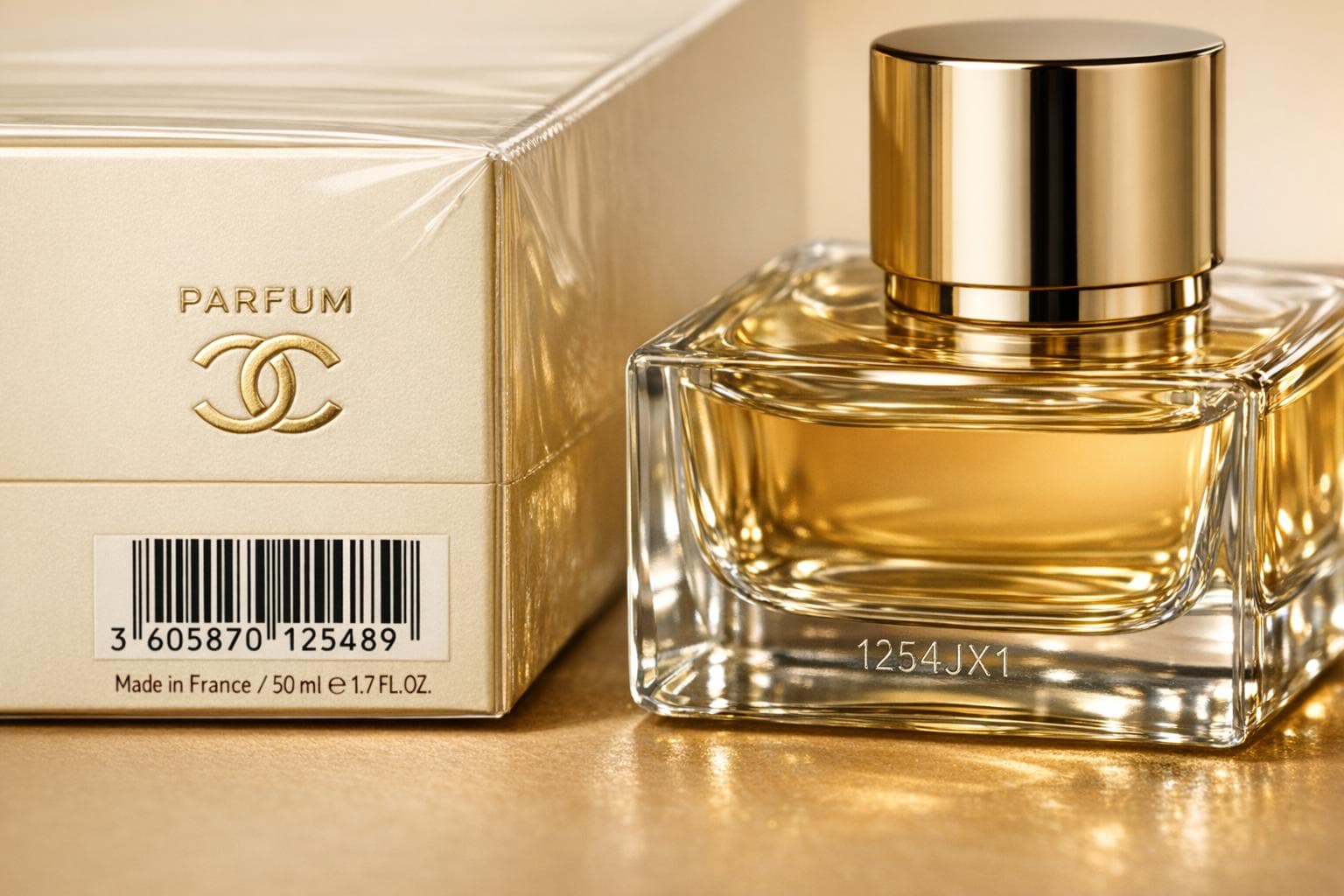
- Placement incorrect du code-barres : Les codes-barres doivent être imprimés nettement et placés au bas ou à l’arrière de la boîte. Des codes-barres mal placés ou bavés sont des signaux d’alerte.
Les parfums contrefaits n’ont pas seulement une apparence bon marché, ils peuvent aussi contenir des substances chimiques nocives. Inspectez toujours l’emballage avec attention et achetez auprès de revendeurs de confiance pour éviter les contrefaçons.
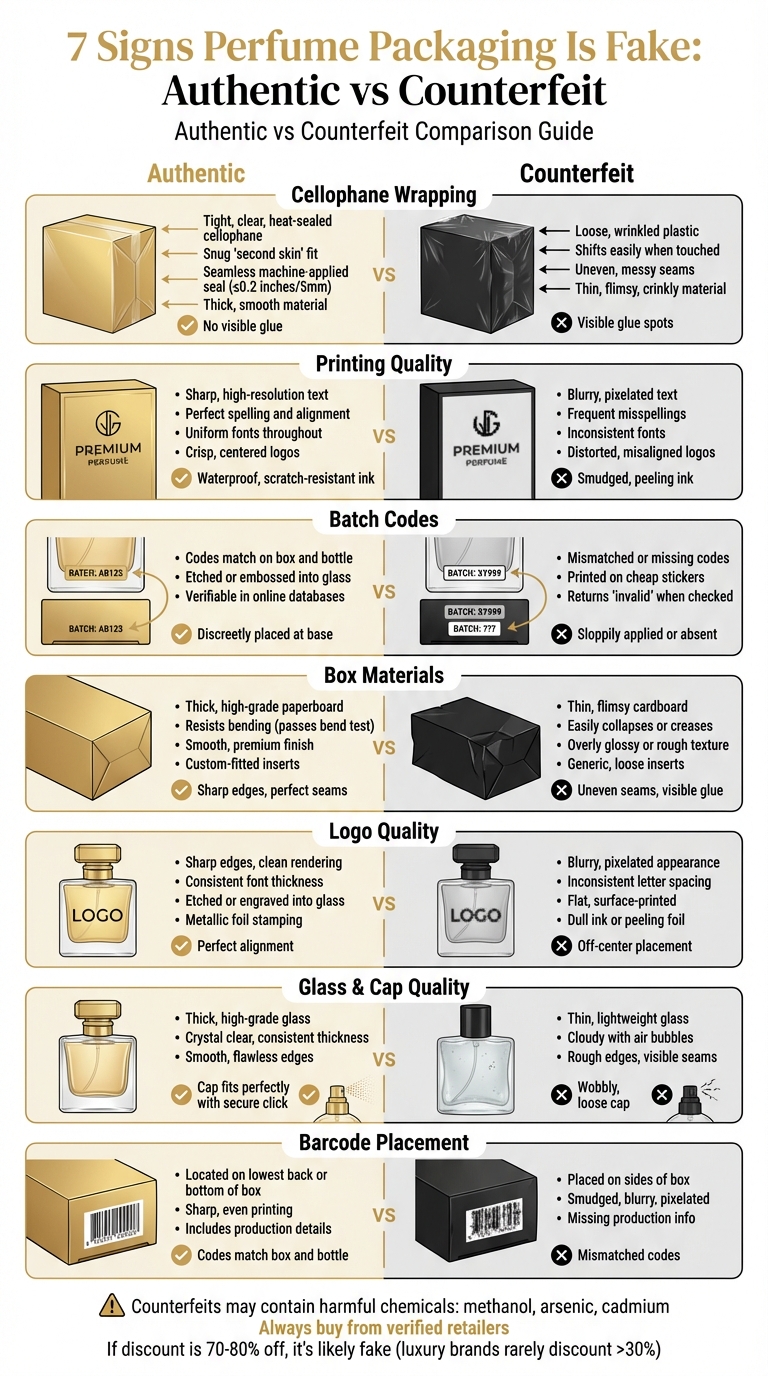
7 signes d’un faux emballage de parfum : comparaison entre authentique et contrefaçon
1. Cellophane lâche ou mal scellé
Qualité du matériau
Les parfums de créateur authentiques sont enveloppés dans un cellophane haut de gamme, transparent, résistant et difficile à déchirer. Lorsque vous manipulez une boîte authentique, le film paraît lisse et robuste — jamais fragile ni froissé. Il est conçu pour transmettre une impression de qualité et de soin.
À l’inverse, les parfums contrefaits rognent souvent sur les coûts en utilisant un plastique fin et bon marché. Ce matériau a tendance à sembler léger et peut paraître trouble, rayé ou irrégulier, au lieu de la finition cristalline attendue d’un produit premium.
Normes de fabrication de l’emballage
La manière dont le cellophane est appliqué constitue un autre indice révélateur d’authenticité.
"Les marques de luxe utilisent un cellophane de haute qualité qui épouse parfaitement la boîte, presque comme une seconde peau. Si vous voyez un emballage lâche, des traces de colle désordonnées ou des coutures irrégulières, c’est immédiatement un signal d’alerte." — Databazaar.com
L’emballage d’un parfum authentique repose sur la précision. Le cellophane est tendu, ajusté à la boîte comme un gant, et reste fermement en place lorsque vous le manipulez. Si le film glisse ou bouge sous votre pouce, c’est un fort indicateur que le produit pourrait être faux.
Le thermoscellage est un autre signe distinctif d’authenticité. Les produits authentiques utilisent des machines pour créer des coutures parfaitement droites, généralement d’une largeur ne dépassant pas 0,2 pouce (5 mm). En revanche, les emballages contrefaits présentent souvent des coutures irrégulières, des traces de colle visibles ou un excès d’adhésif. Un test rapide ? Tenez la boîte inclinée sous la lumière : des bulles d’air emprisonnées ou d’autres défauts sont le signe de normes de fabrication médiocres.
| Caractéristique | Cellophane authentique | Cellophane contrefait |
|---|---|---|
| Ajustement | Ajusté, effet "seconde peau" ; immobile | Lâche, froissé ou se déplace facilement |
| Scellage | Thermoscellage net, appliqué à la machine | Coutures irrégulières et désordonnées ; emballé manuellement |
| Adhésif | Finition propre ; aucune colle visible | Traces de colle ou excès d’adhésif visibles |
| Matériau | Épais, lisse et de haute qualité | Plastique fin, fragile ou froissable |
2. Impression floue ou texte mal orthographié
Précision de l’impression et des étiquettes
Les marques de parfums de luxe veillent à ce que chaque détail de leur emballage soit réalisé avec un soin minutieux. Une impression haute résolution est utilisée pour tous les textes, logos et éléments graphiques, offrant des contours nets, propres et un alignement irréprochable. Sur une boîte authentique, le nom de la marque, le nom du parfum et la liste des ingrédients sont toujours orthographiés correctement — il n’y a aucune place pour les fautes ou les erreurs dans ces produits d’exception. Cette précision est une signature d’authenticité et distingue clairement ces créations des versions contrefaites.
À l’inverse, un emballage contrefait révèle souvent ses défauts à l’examen attentif. Le texte peut sembler flou, pixellisé ou mal aligné, car les contrefacteurs s’appuient généralement sur des designs scannés puis réimprimés. Les logos peuvent paraître brouillés, certaines lettres peuvent être bavées, et la qualité générale de l’impression semble inférieure. Les fautes d’orthographe constituent un autre indice révélateur : vous pourriez trouver des erreurs dans le nom de la marque, du parfum ou dans la liste des ingrédients — des fautes qu’un fabricant authentique n’autoriserait jamais.
"Les marques de luxe appliquent un contrôle qualité extrêmement strict. Une faute de frappe est un signal d’alerte majeur." — Databazaar
Un autre signe d’alerte réside dans l’utilisation de polices "presque identiques" par les contrefacteurs. Ces caractères peuvent différer légèrement en graisse, espacement ou alignement, créant un rendu incohérent. Un emballage authentique, en revanche, présente un texte parfaitement centré, des polices uniformes et une saturation des couleurs constante. En outre, les étiquettes authentiques sont imprimées avec une encre imperméable et résistante aux rayures, garantissant leur durabilité. Si vous remarquez une impression irrégulière, qui s’écaille ou bave, il s’agit probablement d’un faux.
| Caractéristique | Impression de parfum authentique | Impression de parfum contrefait |
|---|---|---|
| Clarté du texte | Nette, précise et haute résolution | Contours flous, brouillés ou pixellisés |
| Orthographe | Correcte et irréprochable | Fautes fréquentes |
| Cohérence de la police | Type et taille de police uniformes | Polices incohérentes ou non assorties |
| Qualité du logo | Parfaitement reproduit et centré | Logos déformés ou mal alignés |
| Qualité de l’encre | Imperméable et résistante aux rayures | Encre bavée, ternie ou qui s’écaille |
3. Codes de lot manquants ou incohérents
Cohérence des codes et des logos
Chaque parfum authentique est doté d’un code de lot — un identifiant alphanumérique unique qui révèle sa date de production et son origine. Ce code est imprimé à la fois sur l’emballage extérieur et sur le flacon, et ils doivent correspondre parfaitement.
Les contrefacteurs rognent souvent sur les coûts en associant des flacons et des boîtes provenant de sources différentes, ce qui entraîne des codes incohérents. Cette anomalie compte parmi les signes les plus évidents d’un produit contrefait. Elle est aussi importante que les autres défauts d’emballage et souligne l’importance de normes de fabrication strictes. Pour confirmer la validité d’un code de lot, vous pouvez utiliser des outils en ligne fiables comme CheckFresh. Si le code apparaît comme "invalid" ou "not found", il s’agit d’un avertissement clair.
"Si le code sur la boîte et le code sur le flacon ne correspondent pas, vous êtes face à une contrefaçon. Aucune exception. C’est l’un des signaux d’alerte les plus clairs que vous puissiez trouver." – Databazaar
La façon dont un code de lot est appliqué en dit également long sur l’authenticité. Les flacons authentiques présentent des codes gravés ou embossés dans le verre, créant un relief perceptible au toucher. À l’inverse, les versions contrefaites ont souvent recours à des méthodes de qualité inférieure, comme des codes imprimés sur des autocollants amovibles ou avec une encre qui bave facilement.
| Caractéristique | Code de lot d’un parfum authentique | Code de lot d’un parfum contrefait |
|---|---|---|
| Cohérence | Correspond exactement sur la boîte et le flacon | Souvent incohérent ou absent |
| Application | Gravé, embossé ou imprimé avec précision | Imprimé sur des autocollants bon marché ou avec une encre qui bave |
| Vérifiabilité | Peut être contrôlé dans les bases de données du fabricant ou via des outils en ligne | Renvoie souvent "invalid" ou "not found" |
| Emplacement | Discrètement situé à la base ou près du bas | Peut être absent ou appliqué grossièrement |
Tout comme le cellophane et les détails d’impression évoqués plus haut, la concordance des codes de lot est un indicateur essentiel d’authenticité. Vérifiez toujours que les codes sur la boîte et le flacon correspondent ; toute incohérence indique directement une contrefaçon.
4. Matériaux de boîte bon marché et mauvaise fabrication
Qualité du matériau
La qualité de la boîte elle-même est un indicateur clé d’authenticité. Une boîte de parfum authentique se distingue par son poids et sa résistance. Les maisons de luxe privilégient un carton épais et haut de gamme, au toucher solide et soigné. À l’inverse, les boîtes contrefaites utilisent souvent un carton fin et fragile qui se plie au moindre effort.
Un simple "test de pliage" peut être révélateur : appuyez doucement sur le côté de la boîte. Les boîtes authentiques résistent à la déformation et conservent leur forme sous la pression. Si la boîte s’écrase ou se froisse facilement, il s’agit probablement d’un faux. De plus, les boîtes authentiques présentent une finition lisse et raffinée, tandis que les versions contrefaites peuvent sembler excessivement brillantes, rugueuses ou recouvertes d’une couche plastique bon marché.
"Les boîtes authentiques utilisent un papier robuste et haut de gamme, à la texture lisse. L’impression est nette et uniforme, avec des couleurs éclatantes et des contours précis et définis." – Echo Shao, fondatrice de LansBox
Ces différences de qualité de matériau ne sont pas seulement esthétiques — elles révèlent le niveau général de savoir-faire de l’emballage.
Normes de fabrication de l’emballage
La construction interne de la boîte constitue un autre indice de son authenticité. Ouvrez la boîte et examinez l’intérieur. Les boîtes authentiques comportent des inserts sur mesure conçus pour maintenir solidement le flacon de parfum en place. Si le flacon bouge ou si l’insert paraît fragile ou générique, vous pourriez être face à une contrefaçon. Les emballages de luxe privilégient la protection durant le transport et assurent un ajustement parfait.
Examinez attentivement les coins et les rabats de la boîte. Un emballage authentique est fabriqué avec un soin méticuleux, avec des arêtes nettes et des coutures parfaitement alignées. Il ne doit y avoir ni colle visible ni bords rugueux. Les boîtes contrefaites, en revanche, présentent souvent une fabrication négligée — coutures irrégulières, bords mal découpés ou résidus de colle sont des signes fréquents d’un faux.
5. Logos incorrects ou déformés
Précision de l’impression et des étiquettes
La qualité d’un logo en dit long sur l’authenticité d’un produit. Les logos authentiques sont nets, avec des contours propres et un rendu irréprochable. À l’inverse, les emballages contrefaits présentent souvent des logos qui semblent flous, pixellisés ou mal imprimés. Observés de près, les logos authentiques conservent toute leur netteté, tandis que les contrefaçons révèlent des textures granuleuses et une encre qui paraît baver.
"Le logo de la marque doit être parfait. Si les contours paraissent flous ou que l’image est déformée, vous êtes probablement face à une contrefaçon." – Databazaar
La typographie est un autre indice révélateur. Les marques de luxe sont extrêmement rigoureuses dans le choix de leurs polices, en garantissant une épaisseur, une hauteur et un espacement des lettres constants sur tout l’emballage. Les contrefacteurs utilisent souvent des caractères similaires, mais légèrement différents, ce qui entraîne des variations visibles. Même de légères incohérences dans l’alignement ou l’espacement entre les lettres peuvent signaler un faux. Cette exigence dans la conception du logo reflète la précision générale des emballages authentiques. Tout comme le cellophane et l’impression d’origine sont irréprochables, un logo parfaitement exécuté est non négociable pour un produit authentique.
Cohérence des codes et des logos
L’authenticité ne dépend pas seulement de l’apparence d’un logo — elle tient aussi à son toucher et à son emplacement. Les logos des parfums authentiques sont positionnés, dimensionnés et alignés de manière constante sur l’ensemble de l’emballage du produit. Par exemple, le logo sur le flacon doit correspondre parfaitement à celui de la boîte en termes de police, de taille et de couleur. Tout mauvais alignement, inclinaison ou positionnement décentré constitue un signe d’alerte évident.
La méthode d’application compte aussi. Sur les flacons authentiques, les logos sont souvent gravés ou incrustés dans le verre, leur conférant un relief raffiné. Passez vos doigts sur le logo — vous devriez sentir un embossage ou une gravure de haute qualité. Les logos contrefaits, en revanche, sont généralement plats et imprimés en surface, sans aucun détail tactile. De nombreuses marques de luxe utilisent également des techniques avancées comme le marquage à chaud métallisé, qui offre aux logos une finition élégante et sophistiquée. À l’inverse, les faux produits peuvent recourir à une encre terne et plate ou à une dorure mal appliquée qui se décolle sur les bords.
"Les flacons de parfum authentiques présentent une gravure ou une impression laser précise et nette, d’aspect homogène et professionnel." – Alexandria UK
Votre expert parfum personnel vous attend
Faites notre quiz olfactif express pour découvrir des parfums de créateurs et de niche authentiques, choisis selon vos goûts – explorez-les en décants et échantillons de 2–8ml, pour essayer chaque fragrance avant de vous engager sur un flacon entier.
Trouvez votre parfum6. Verre de mauvaise qualité et bouchons mal ajustés
Qualité du matériau
Les flacons authentiques sont fabriqués dans un verre épais et haut de gamme, solide et soigneusement travaillé, tandis que les versions contrefaites paraissent souvent plus légères en raison de matériaux plus fins et moins coûteux.
Pour faire la différence, tenez le flacon face à une lumière vive. Le verre authentique apparaîtra cristallin, avec une épaisseur uniforme sur toute sa surface. À l’inverse, les faux peuvent présenter des signes tels qu’un aspect trouble, des bulles d’air ou des surfaces irrégulières. Passez vos doigts le long des bords du flacon — les flacons authentiques offrent une finition lisse et impeccable, alors que les contrefaçons présentent souvent des arêtes rugueuses ou des lignes de joint visibles dues à des moules de mauvaise qualité. Une fois le verre inspecté, portez votre attention sur le bouchon.
Normes de fabrication de l’emballage
Le bouchon est souvent un indice très révélateur d’authenticité. Les marques de luxe conçoivent leurs bouchons avec précision, afin qu’ils s’ajustent parfaitement et se ferment avec un clic satisfaisant. Ces bouchons sont fabriqués à partir de matériaux durables et de haute qualité, et procurent une sensation de solidité en main. Lors du test, le bouchon doit glisser sans effort et se verrouiller fermement sans aucun jeu.
"Un bouchon mal ajusté est un énorme signal d’alerte. Les marques de luxe investissent des fortunes pour créer une expérience utilisateur irréprochable, et un bouchon branlant, au toucher bon marché, détruit complètement cette illusion." – Databazaar
Les bouchons contrefaits, en revanche, sont généralement fabriqués en plastique léger et creux. Ils sont souvent de travers ou se détachent trop facilement. De plus, prêtez attention au vaporisateur. Les vaporisateurs authentiques diffusent une brume fine et uniforme et possèdent un tube discrètement coupé, tandis que les versions contrefaites peuvent crachoter, fuir ou présenter un tube grossier et surdimensionné.
7. Placement incorrect du code-barres ou du numéro de série
Emplacement du code-barres et qualité d’impression
L’emplacement d’un code-barres peut être un signe révélateur de l’authenticité d’un parfum. Les parfums authentiques placent généralement leur code-barres sur la partie arrière inférieure ou le fond de la boîte. Si vous trouvez le code-barres sur les côtés de la boîte, c’est un fort indice que le produit pourrait être contrefait.
"Pour vérifier si le code-barres de votre parfum est authentique, vous devez vous assurer qu’il se trouve sur la partie arrière inférieure de la boîte. S’il est placé ailleurs, par exemple sur les côtés de la boîte, il pourrait s’agir d’un parfum contrefait." – Leanna Serras, rédactrice spécialisée en parfums, FragranceX
La qualité de l’impression est tout aussi importante que l’emplacement. Les codes-barres authentiques sont imprimés avec netteté et régularité, souvent accompagnés de détails de production, tandis que les codes-barres contrefaits peuvent sembler bavés, flous ou pixellisés. Ces défauts résultent souvent de l’utilisation d’équipements d’impression de faible qualité.
Correspondance des codes et détails gravés
L’authenticité va au-delà du simple code-barres — les numéros de série et les codes de lot jouent eux aussi un rôle crucial. Sur les produits authentiques, les codes figurant sur la boîte et le flacon doivent correspondre parfaitement. Les produits contrefaits échouent souvent à ce test, car leurs boîtes et leurs flacons proviennent de fournisseurs différents, ce qui entraîne des codes incohérents.
De plus, les flacons authentiques présentent des codes de lot gravés au laser ou gravés dans le verre, et non simplement imprimés en surface. Pour vérifier ces codes, vous pouvez utiliser des outils en ligne comme CheckFresh ou CheckCosmetic, qui permettent de confirmer la date de fabrication et l’authenticité de la marque.
Tout comme le positionnement précis des logos et le cellophane parfaitement ajusté, l’emplacement correct et la qualité des codes-barres et des numéros de série sont essentiels pour confirmer l’authenticité d’un parfum.
Arnaques aux faux parfums DÉVOILÉES 🚨 | Comment repérer de fausses fragrances (Creed, MFK, Parfums de Marly) | MaxAroma
Conclusion
Repérer un faux emballage de parfum ne consiste pas seulement à éviter une déception — c’est aussi une question de protection de votre santé et de votre budget. Les parfums contrefaits, souvent produits dans des installations non réglementées, peuvent contenir des substances nocives comme le méthanol, des solvants industriels, l’arsenic, le béryllium et le cadmium. Ces ingrédients toxiques peuvent entraîner des problèmes graves, notamment une dermatite de contact, des brûlures chimiques, de sévères éruptions cutanées et même des troubles respiratoires.
Au-delà de la sécurité, les fausses fragrances sont également inférieures en qualité et en performance. Alors que les parfums authentiques peuvent tenir 8 à 12 heures, les contrefaçons s’estompent souvent en seulement 1 à 4 heures. Elles n’offrent pas non plus la complexité des fragrances authentiques, faisant l’impasse sur l’équilibre délicat entre notes de tête, de cœur et de fond. Elles ont plutôt tendance à sentir de manière excessivement synthétique, plate, ou simplement l’alcool pur. Ces différences soulignent l’importance de choisir des produits authentiques.
La meilleure façon de vous assurer que vous achetez de véritables parfums de créateur est de passer par des revendeurs vérifiés disposant de chaînes d’approvisionnement directes. Des vendeurs de confiance comme Scento s’approvisionnent directement auprès des fabricants, garantissant l’authenticité. Ils proposent également des politiques de retour transparentes et des pratiques de stockage appropriées afin d’assurer la qualité de chaque flacon. Ce lien direct avec la source constitue votre meilleure défense contre les contrefaçons.
Si vous tombez sur une offre affichant 70 à 80 % de réduction, elle est presque certainement trop belle pour être vraie. Les marques de luxe accordent rarement plus de 30 % de remise sur leurs produits, même pendant les soldes. En restant vigilant sur l’emballage et en vous en tenant à des vendeurs réputés, vous pouvez éviter les risques et profiter de la véritable essence de vos fragrances préférées.
FAQ
Comment savoir si un parfum est authentique lors d’un achat en ligne ?
Lorsque vous achetez un parfum en ligne, il est essentiel de vous assurer de son authenticité. Commencez par examiner attentivement l’emballage. Les produits authentiques présentent une impression nette et précise, une orthographe correcte et un cellophane parfaitement tendu. Soyez attentif à des détails tels que la cohérence des logos et l’utilisation de matériaux de haute qualité.
Ensuite, vérifiez la présence d’un code de lot ou d’un numéro de série sur le flacon ou la boîte. Vous pouvez vérifier ce code sur le site officiel de la marque afin de confirmer l’origine du produit. Un autre signal d’alerte concerne le prix : s’il est inhabituellement bas par rapport au prix de vente habituel, il pourrait s’agir d’une contrefaçon. Enfin, prenez le temps de vous renseigner sur le vendeur. Lisez les avis et assurez-vous qu’il bénéficie d’une solide réputation comme source fiable de parfums authentiques.
Quels sont les risques pour la santé liés à l’utilisation de faux parfums ?
Utiliser des parfums contrefaits n’est pas seulement un pari sur la qualité — cela peut présenter de sérieux risques pour la santé. Ces produits sont souvent fabriqués avec des ingrédients de qualité inférieure et non réglementés, susceptibles de provoquer une irritation cutanée comme des éruptions, des démangeaisons, voire des brûlures. C’est particulièrement préoccupant pour les personnes à la peau sensible. Au-delà des problèmes de peau, les faux parfums peuvent également laisser des taches sur les vêtements en raison de substances chimiques nocives ou déclencher des réactions allergiques, ce qui en fait un choix risqué.
Inhaler les vapeurs de fragrances contrefaites peut également être nocif. Chez les personnes souffrant d’asthme ou d’autres sensibilités, ces composés volatils peuvent entraîner des problèmes respiratoires. Plus inquiétant encore, certains faux parfums contiennent des contaminants dangereux, tels que des solvants non déclarés ou des résidus biologiques, ce qui augmente le risque d’effets indésirables. Pour préserver votre bien-être, privilégiez des fragrances authentiques, testées pour leur sécurité.
Pourquoi un faux parfum perd-il son odeur si rapidement ?
Les faux parfums ont tendance à perdre rapidement leur odeur parce qu’ils sont fabriqués avec des ingrédients bon marché et de qualité inférieure, qui n’ont ni la bonne concentration ni la stabilité nécessaire. Les matières synthétiques utilisées dans ces imitations sont mal équilibrées, ce qui fait disparaître la fragrance bien plus vite que dans un parfum authentique.
À l’inverse, les parfums authentiques sont élaborés avec un soin méticuleux, à partir d’huiles essentielles premium et de formulations savamment équilibrées. Cette attention au détail garantit un sillage constant et longue tenue que les produits contrefaits ne peuvent tout simplement pas égaler.