Alterner vos fragrances selon la saison permet à votre sillage de s’harmoniser avec le climat tout en révélant le meilleur de sa performance. Les parfums réagissent différemment à la température et à l’humidité : les notes plus légères et fraîches conviennent aux mois chauds, tandis que les accords riches et affirmés s’épanouissent dans le froid. Voici comment composer une garde-robe olfactive saisonnière :
- Associez les notes aux saisons : privilégiez les floraux et les agrumes au printemps, les senteurs aquatiques rafraîchissantes en été, les tonalités épicées et boisées à l’automne, et les notes audacieuses et chaleureuses comme l’ambre et l’oud en hiver.
- Conservez-les correctement : gardez vos fragrances hors saison dans des endroits frais, sombres et secs afin de préserver leur qualité.
- Adoptez des parfums de transition : accompagnez les changements de saison avec des fragrances qui équilibrent notes fraîches et notes chaleureuses.
- Superposez les produits : associez laits et huiles assortis pour intensifier la tenue et le sillage.
- Commencez par des décants : essayez de plus petits formats pour tester les parfums saisonniers avant d’investir dans un flacon entier.
Ces gestes vous permettent de savourer vos fragrances toute l’année, tout en préservant leur qualité et leur impact.
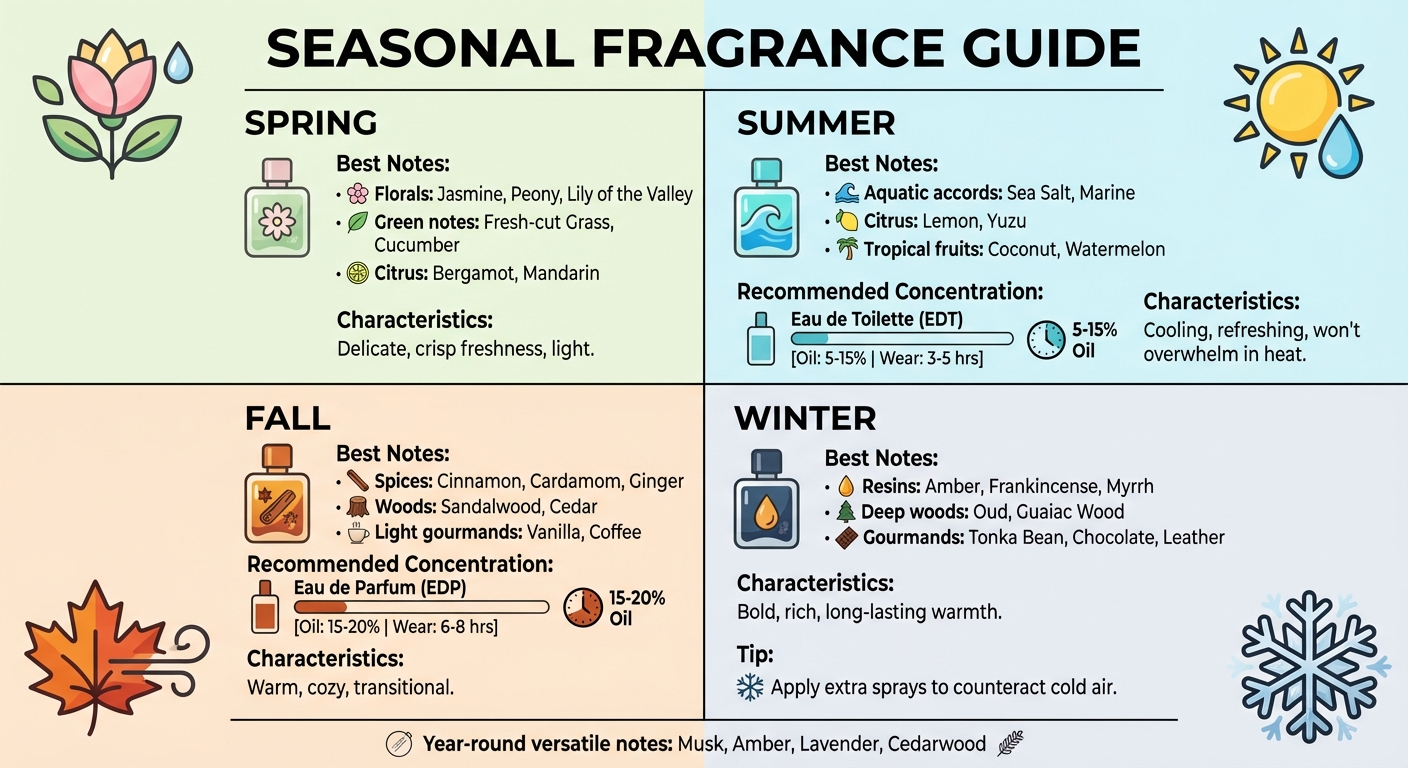
Guide des fragrances saisonnières : meilleures notes et concentrations selon la saison
1. Match Fragrance Notes to Each Season
La rotation saisonnière des fragrances commence par l’accord entre les notes parfumées et la météo propre à chaque saison. Le printemps évoque le renouveau, ce qui en fait le moment idéal pour les floraux délicats comme le jasmin, la pivoine ou le muguet. Les notes vertes telles que l’herbe fraîchement coupée ou le concombre, ainsi que les agrumes pétillants comme la bergamote et la mandarine, apportent une fraîcheur éclatante. Ces senteurs plus légères accompagnent la douceur printanière sans jamais paraître envahissantes.
L’été appelle des notes fraîches et rafraîchissantes qui ne deviennent pas écrasantes sous la chaleur. Les accords aquatiques aux nuances de sel marin ou de tonalités marines, les agrumes zestés comme le citron ou le yuzu, et les fruits tropicaux tels que la noix de coco et la pastèque sont idéaux. L’Eau de Toilette (EDT), avec sa concentration en huiles de 5 % à 15 % et sa tenue de 3 à 5 heures, constitue un excellent choix pour ces mois plus chauds.
L’automne marque une transition vers des senteurs plus chaudes et enveloppantes. Les épices comme la cannelle, la cardamome et le gingembre se marient magnifiquement avec des bases boisées telles que le santal ou le cèdre. Une touche de notes gourmandes légères comme la vanille ou le café ajoute de la profondeur. Les tendances 2025 mettent en avant des Eaux de Parfum (EDP) épicées à base ambrée, affichant une concentration en huiles de 15 % à 20 % et une tenue de 6 à 8 heures.
L’hiver exige des fragrances audacieuses et opulentes, capables de s’imposer face au froid. Les résines comme l’ambre, l’encens et la myrrhe, les bois profonds comme l’oud et le bois de gaïac, ainsi que les gourmands décadents tels que la fève tonka, le chocolat ou le cuir offrent à la fois chaleur et longévité. Quelques vaporisations supplémentaires peuvent aider à contrer l’effet atténuant de l’air froid.
Pour celles et ceux qui préfèrent conserver une signature olfactive constante toute l’année, des notes polyvalentes comme le musc, l’ambre, la lavande et le bois de cèdre s’adaptent avec élégance à toutes les saisons.
2. Conservez correctement vos fragrances hors saison
Bien conserver vos fragrances est tout aussi important que de choisir le parfum idéal pour la saison. Pour garder vos fragrances hors saison fraîches et fidèles à leur caractère d’origine, il convient de les protéger de leurs principaux ennemis : la chaleur, la lumière et l’humidité. Ces facteurs peuvent dégrader la fragrance, l’affadir, en modifier la couleur ou altérer son arôme au fil du temps.
L’emplacement de conservation idéal ? Un endroit sombre, sec et à température stable : pensez aux placards de chambre, tiroirs de commode ou armoires. Visez une température comprise entre 50°F et 71°F. Évitez les zones soumises aux variations de température, comme les rebords de fenêtre, les comptoirs de salle de bain ou les endroits proches des radiateurs et des bouches d’aération. Ces conditions peuvent provoquer la dilatation et la contraction du liquide dans le flacon, compromettant ainsi la fragrance. Les salles de bain, en particulier, sont à proscrire en raison de l’exposition constante à la vapeur et à l’humidité, qui peut accélérer la décomposition des composants du parfum.
"L’emballage d’origine qui accompagne votre parfum n’est pas seulement esthétique : il remplit aussi une fonction pratique ! Les flacons sont souvent conçus pour protéger la fragrance de l’exposition à la lumière et à l’air." — MOODEAUX
Comme le souligne MOODEAUX, l’emballage d’origine est bien plus qu’une jolie boîte : c’est un véritable bouclier fonctionnel contre la lumière et l’air. Pour protéger davantage vos fragrances, rangez toujours les flacons à la verticale et assurez-vous que les bouchons sont bien fermés. Cela prévient l’oxydation, l’évaporation et d’autres formes d’altération. Lorsqu’ils sont conservés correctement, les flacons ouverts peuvent durer de 3 à 5 ans, tandis que les flacons non ouverts peuvent se conserver de 5 à 10 ans, voire davantage.
Enfin, ne gardez pas trop longtemps les flacons presque vides. L’excès d’oxygène dans un flacon majoritairement vide accélère l’oxydation et ternit la fragrance restante. S’il ne vous reste que quelques vaporisations, mieux vaut les terminer ou vous en séparer plutôt que de laisser le parfum perdre son charme.
3. Utilisez des parfums de transition entre les saisons
Lorsque vous composez votre garde-robe olfactive pour les changements de saison, les parfums de transition sont votre arme secrète. Ces fragrances vous aident à traverser les variations météorologiques imprévisibles du printemps et de l’automne. Imaginez : les matinées vous accueillent avec une fraîcheur vive, tandis que les après-midis se réchauffent nettement. Dans ces moments-là, une fragrance hivernale opulente peut sembler trop intense, tandis qu’un parfum estival léger peut manquer de tenue. Les parfums de transition viennent combler cet écart, en offrant un assemblage harmonieux d’éléments saisonniers.
Recherchez des fragrances à double personnalité : des ouvertures fraîches, hespéridées ou vertes, qui évoluent vers des bases chaudes, boisées ou épicées. Un excellent exemple est 1725 Casanova de Histoires de Parfums. Il s’ouvre sur une bergamote et un pamplemousse lumineux, associés à la lavande et à la badiane, avant de se poser sur des notes réconfortantes de vanille, d’amande et de santal. Autre choix adapté à la transition de l’hiver au printemps : 1826, également signé Histoires de Parfums. Cette fragrance débute sur la mandarine et la bergamote, évolue vers les fleurs blanches et le gingembre, puis s’achève sur l’ambre, le patchouli et la vanille.
Certaines notes jouent le rôle d’ancrages fiables durant ces passages. Pensez au musc blanc, à la rose, à la pivoine, à la lavande et aux ambres modérés. Par ailleurs, la superposition peut tout changer. Par exemple, appliquer un lait corporel légèrement vanillé sous votre fragrance estivale aux agrumes à l’approche de l’automne peut introduire une chaleur subtile sans alourdir l’ensemble.
| Période de transition | Éléments frais | Éléments chaleureux | Combinaisons recommandées |
|---|---|---|---|
| De l’hiver au printemps | Bergamote, mandarine, thé vert | Ambre doux, gingembre, musc blanc | Notes de tête hespéridées avec bases ambrées ou vanillées |
| De l’été à l’automne | Pamplemousse, lavande, réglisse | Santal, cardamome, patchouli | Herbes aromatiques associées à des bases boisées ou épicées |
Le test est essentiel. Essayez de porter la fragrance choisie à la fois lors de matinées fraîches et d’après-midis chauds. Si les notes chaudes dominent ou si les éléments frais s’estompent trop rapidement, ce n’est peut-être pas le bon choix. Associées à une conservation et une sélection réfléchies, les fragrances de transition assurent une allure olfactive impeccable, quelle que soit la saison.
Votre expert parfum personnel vous attend
Faites notre quiz olfactif express pour découvrir des parfums de créateurs et de niche authentiques, choisis selon vos goûts – explorez-les en décants et échantillons de 2, 5, 8 et 30 ml, pour essayer chaque fragrance avant de vous engager sur un flacon entier.
Trouvez votre parfum4. Superposez vos fragrances avec des produits assortis
Utiliser des produits pour le corps assortis est une manière élégante et judicieuse de prolonger la tenue de votre fragrance et d’en améliorer la diffusion. Une peau hydratée retient mieux les molécules parfumées, tandis qu’une peau sèche a tendance à absorber les huiles de parfum trop rapidement, ce qui fait s’estomper la senteur prématurément. En appliquant d’abord un lait ou une huile, vous créez une barrière qui ralentit l’évaporation, permettant à la fragrance de se révéler plus progressivement.
Une méthode efficace consiste à créer un "sandwich olfactif". Commencez par un lait parfumé, appliquez ensuite votre parfum sur les points de pulsation, puis terminez avec une huile corporelle complémentaire. Cette technique est particulièrement utile lors des transitions saisonnières, lorsque votre fragrance doit s’adapter à une météo changeante. Par exemple, lors du passage de l’été à l’automne, essayez de superposer un lait léger aux agrumes avec votre parfum, puis d’ajouter une huile corporelle boisée pour apporter de la chaleur sans dominer l’ensemble du sillage.
"Pour faire durer votre fragrance plus longtemps, essayez d’appliquer d’abord une crème corporelle parfumée, puis de superposer le parfum de votre choix. L’impact est toujours longue durée." — Jo Malone CBE, fondatrice, Jo Loves
Pour de meilleurs résultats, appliquez votre lait ou votre huile juste après la douche, lorsque votre peau est encore humide. Cela scelle l’hydratation et renforce la tenue de la fragrance. Concentrez-vous sur les points de pulsation comme les poignets, le cou et l’arrière des oreilles : des zones où la chaleur naturelle active le parfum. Évitez de frotter vos poignets l’un contre l’autre après avoir appliqué votre parfum, car la friction peut briser les délicates notes de tête.
Si vous préférez que votre fragrance demeure intacte, les hydratants non parfumés fonctionnent tout aussi bien. Ils agissent comme une base neutre, augmentant à la fois la projection et la longévité de votre parfum sans interférer avec son profil olfactif. Cela se révèle particulièrement utile en hiver, lorsque l’air sec peut accélérer l’évaporation des fragrances. Pour une option accessible, des produits comme les laits corporels eos (€10.99) sont fiables, tandis que des choix milieu de gamme comme les huiles corporelles Lake & Skye (€48) offrent une texture plus luxueuse.
Cette simple technique de superposition améliore non seulement la performance de votre fragrance, mais s’accorde aussi parfaitement à vos préférences olfactives saisonnières.
5. Essayez d’abord de petits formats décantés
Explorer les fragrances saisonnières peut être à la fois exaltant et délicat, surtout lorsque vous n’êtes pas prêt à vous engager dans un flacon entier. Les petits décants offrent une façon intelligente et économique d’expérimenter sans grever votre budget.
Un flacon de 50 ml d’une fragrance haut de gamme coûte souvent entre $250 et $300, ce qui en fait un pari coûteux si la senteur ne vous convient pas. Les décants, eux, vous permettent de tester des fragrances à une fraction du prix.
"Nous recommandons de commencer par des échantillons avant de s’engager dans des flacons entiers... c’est la façon la plus intelligente de trouver vos accords saisonniers." — Pierre Caunac, Histoires De Parfums
Utiliser des décants est également une manière pratique de construire une garde-robe olfactive saisonnière équilibrée. Les recherches suggèrent que 5 à 8 senteurs soigneusement choisies suffisent à couvrir les quatre saisons : généralement 1 à 2 fragrances par saison, plus une option polyvalente à porter toute l’année. Un décant de 8 ml offre environ 120 vaporisations, vous laissant amplement le temps de tester la manière dont une fragrance s’intègre dans votre rotation saisonnière. Cette méthode vous aide à identifier vos favoris avant un investissement plus conséquent.
Des plateformes comme Scento facilitent l’expérimentation avec des décants, du 2 ml, 5 ml et 8 ml jusqu’au décant en flacon de 30 ml sur la plupart des parfums. Le format 8 ml est particulièrement utile pour les transitions saisonnières. Par exemple, vous pouvez superposer un décant d’agrumes frais d’été avec une huile chaude à la vanille à l’approche de l’automne. Cela vous permet d’explorer la manière dont les fragrances dialoguent entre elles avant d’opter pour un flacon grand format.
Autre avantage ? Les décants sont incroyablement nomades. Contrairement aux flacons pleine taille, ces petits vaporisateurs se glissent facilement dans un sac ou un bagage cabine, ce qui les rend parfaits pour les voyages ou un usage quotidien. Et si l’un d’eux est perdu ou abîmé, l’impact financier reste minime comparé à la perte d’un flacon entier.
Conclusion
Faire évoluer votre garde-robe olfactive ne se résume pas à varier les plaisirs : il s’agit de créer une connexion fluide entre votre sillage et le monde qui vous entoure. Porter des fragrances lourdes et épicées sous la chaleur estivale peut sembler étouffant, tandis que les agrumes légers peinent souvent à rayonner dans le froid hivernal. En choisissant des fragrances qui complètent la saison, vous permettez à chaque parfum de s’exprimer pleinement, en s’adaptant naturellement aux variations de température et d’humidité.
Cette pratique protège également votre collection de fragrances. Une conservation saisonnière appropriée aide à préserver l’intégrité de vos parfums, en les protégeant de l’oxydation et de la dégradation. Grâce à ces gestes, vous pouvez préserver vos senteurs favorites pendant des années, afin qu’elles restent aussi vibrantes que le jour où vous les avez achetées.
La rotation saisonnière ajoute une dimension de plaisir à votre collection. Imaginez la fraîcheur exaltante des floraux au printemps ou la chaleur enveloppante de la vanille et de l’oud en hiver : ces choix réfléchis créent ce que certains appellent une "harmonie olfactive".
"La rotation saisonnière des parfums transforme la fragrance d’un choix unique et figé en une relation dynamique et évolutive avec le sillage." - Le Parfumier
FAQ
Comment choisir une signature olfactive à porter toute l’année ?
Lorsque vous choisissez une signature olfactive, tenez compte de son profil parfumé et de la manière dont il s’accorde à votre style personnel et à votre chimie de peau. Optez pour quelque chose d’équilibré : ni trop intense pour l’été, ni trop discret pour l’hiver. Des notes comme les agrumes frais, les floraux doux ou les bois légers sont d’excellentes options qui fonctionnent en toute saison. Recherchez une fragrance qui semble être une extension de vous-même, magnifiant votre présence tout en s’intégrant naturellement à diverses occasions tout au long de l’année.
Comment savoir si mon parfum a tourné ?
Vous pouvez reconnaître un parfum périmé en observant quelques changements perceptibles. Si l’odeur diffère de celle que vous aviez lors de l’achat, si le liquide a changé de couleur ou si la texture semble plus épaisse, ce sont de solides indicateurs que le parfum n’est plus adapté à l’usage.
Par quelle taille de décant devrais-je commencer ?
Un décant de 8 ml est la façon idéale d’explorer une fragrance avant d’investir dans un flacon pleine taille. C’est aussi un choix judicieux pour alterner les parfums au fil des saisons, avec juste assez de produit pour en profiter sans créer de gaspillage inutile.

