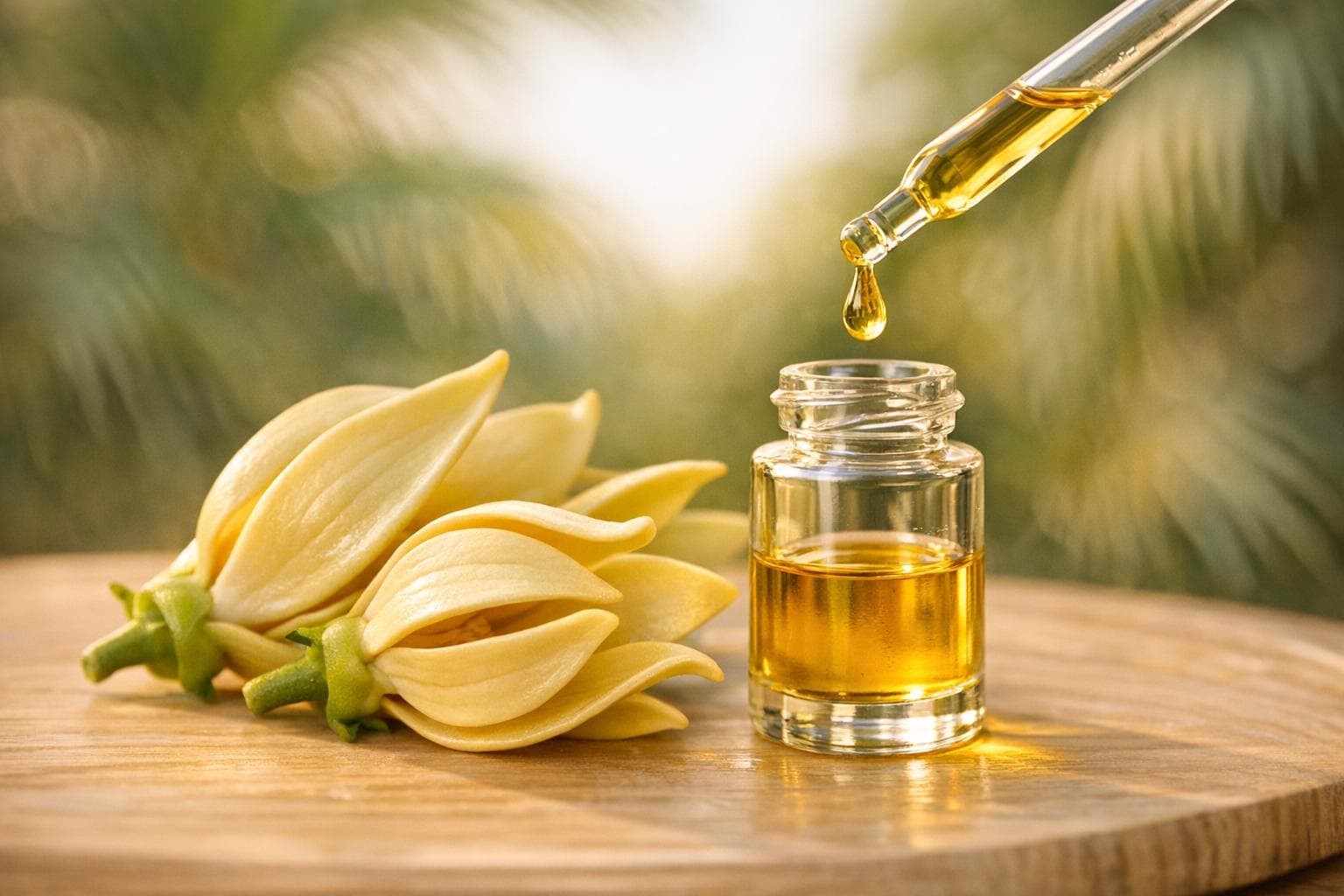
L’ylang-ylang (Cananga odorata) est un arbre tropical originaire d’Asie du Sud — Est, qui s’épanouit tout particulièrement aux Philippines, en Indonésie et en Malaisie. Réputé pour ses fleurs parfumées en forme d’étoile, il est profondément ancré dans les coutumes et cérémonies locales depuis des siècles. Aujourd’hui, il joue un rôle majeur dans l’industrie mondiale de la fragrance, grâce notamment à sa présence dans des parfums iconiques comme Chanel N° 5.
Points clés :
- Origines : Originaire d’Asie du Sud — Est, l’arbre peut atteindre 98 pieds de hauteur et produit des fleurs utilisées lors des mariages, des offrandes religieuses et dans les remèdes traditionnels.
- Rayonnement mondial : Introduite en parfumerie en 1860, l’huile d’ylang-ylang est aujourd’hui une pierre angulaire des fragrances de luxe.
- Production : L’huile est distillée à partir de fleurs cueillies à la main, nécessitant 110 livres de fleurs pour obtenir 2,2 livres d’huile. Les Comores et Madagascar dominent la production mondiale.
- Qualités d’huile : Distillée par étapes, l’huile de qualité la plus élevée est utilisée dans la parfumerie fine, tandis que les qualités inférieures conviennent aux savons et aux cosmétiques.
- Durabilité : Les méthodes modernes, comme la distillation à l’énergie solaire, réduisent la pression environnementale.
Le parcours de l’ylang-ylang, des traditions d’Asie du Sud — Est à la parfumerie de luxe, témoigne de son attrait durable et de sa remarquable polyvalence.
Contexte culturel et historique de l’ylang-ylang
Usages dans les cérémonies et la vie quotidienne en Asie du Sud — Est
Avant que l’ylang-ylang n’acquière une reconnaissance internationale, il était profondément enraciné dans les traditions d’Asie du Sud — Est. En Indonésie et aux Philippines, la fleur jouait un rôle essentiel dans les rituels de mariage. Les lits des jeunes mariés étaient parsemés de pétales d’ylang-ylang, un geste censé inspirer l’amour et la passion. Les mariées malaisiennes adoptaient les significations symboliques de la fleur — paix, beauté et amour — en l’intégrant à leur coiffure, à leurs bouquets et même au décor de leurs pavillons de mariage.
L’importance de la fleur dépassait le cadre nuptial. Aux Philippines, l’ylang-ylang était utilisé dans des offrandes destinées à honorer des figures religieuses et des images sacrées. Les habitants l’entrelacaient en colliers ou le tressaient dans leurs cheveux, croyant que ses fleurs parfumées apportaient équilibre et harmonie. Au-delà de son importance cérémonielle, l’ylang-ylang s’invitait aussi dans la vie quotidienne. À Mayotte, par exemple, il était associé à l’huile de coco pour créer la crème "boori-boori", un remède traditionnel contre la fièvre et une protection naturelle contre les rayons UV.
Ces pratiques culturelles révélaient non seulement la polyvalence de la fleur, mais ouvraient aussi la voie à son entrée sur les marchés mondiaux.
Développement de la distillation et de l’exportation de l’ylang-ylang
La place de l’ylang-ylang dans les traditions locales a préparé son évolution vers un produit mondial recherché, portée par les progrès des techniques de distillation. Albertus Schwenger, alors actif à Manille, joua un rôle déterminant dans le perfectionnement de ces méthodes, transformant l’ylang-ylang d’un trésor régional en un luxe exportable. À la fin du XIXe siècle, des missionnaires et colons français introduisirent l’arbre dans les îles de l’océan Indien, comme La Réunion, les Comores et Madagascar. Ces régions devinrent rapidement des acteurs clés de la chaîne d’approvisionnement mondiale, dépassant la production d’Asie du Sud — Est.
Au départ, les Philippines dominaient la production d’ylang-ylang, conservant un monopole jusqu’à ce que la Première Guerre mondiale perturbe les chaînes d’approvisionnement. La concurrence croissante déplaça le centre de gravité de l’industrie vers les îles de l’océan Indien. En 1998, l’huile d’ylang-ylang représentait 29 % des exportations annuelles des Comores. Aujourd’hui, les Comores produisent environ 70 tonnes sur les 100 tonnes annuelles mondiales, tandis que Mayotte dépend de l’ylang-ylang pour 84 % de ses recettes d’exportation.
L’attrait de l’ylang-ylang s’est encore amplifié avec des produits comme l’"huile de Macassar", une lotion capillaire de l’époque victorienne, et son inclusion dans Chanel N° 5, lancé en 1921. Ces jalons ont consacré le statut de la fleur comme pilier de la parfumerie de luxe à travers le monde.
Culture et transformation de l’ylang-ylang
Processus de production et qualités de l’huile d’ylang-ylang
Principales zones de production en Asie du Sud — Est
En Asie du Sud — Est, la culture et la transformation de l’ylang-ylang reflètent une alliance entre pratiques traditionnelles et avancées modernes. Des pays comme les Philippines, l’Indonésie, la Malaisie et le Cambodge comptent parmi les principaux producteurs, cultivant des arbres Cananga odorata dans des forêts tropicales humides où la fleur possède de profondes racines historiques. Ces arbres prospèrent dans des climats humides, avec des pluies abondantes et un ensoleillement régulier, fleurissant tout au long de l’année, avec une production maximale généralement après la saison des pluies.
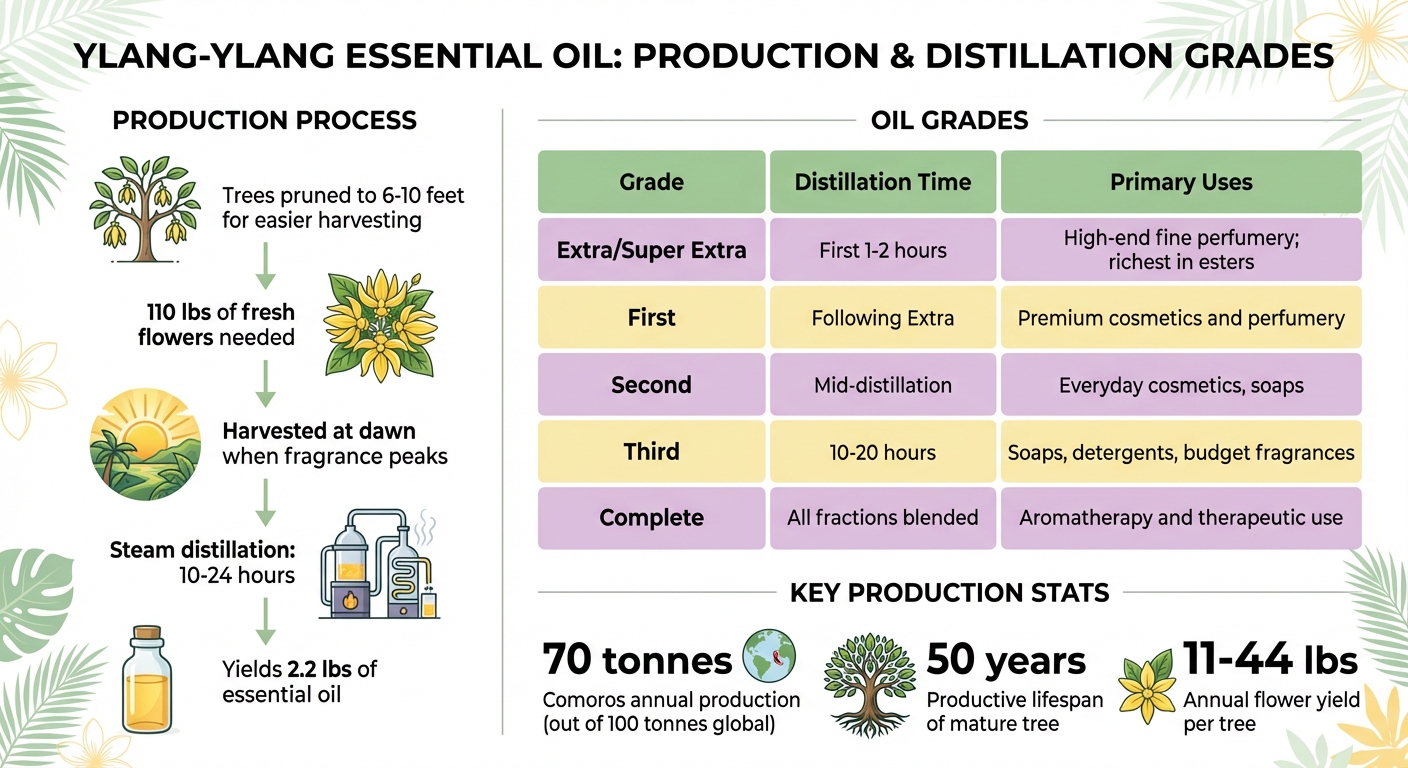
Les arbres d’ylang-ylang s’épanouissent dans des sols acides, que l’on trouve couramment sur les pentes volcaniques ou dans les plaines alluviales riches en nutriments. Si les arbres sauvages peuvent atteindre jusqu’à 100 pieds de hauteur, les cultivateurs de plantations les taillent à une hauteur plus maîtrisable de 6 à 10 pieds. Cette pratique facilite non seulement la cueillette à la main, mais stimule également la production florale. Un arbre adulte peut produire entre 11 et 44 livres de fleurs par an et rester productif près de 50 ans, à partir de sa cinquième année.
La récolte est un processus délicat. Les fleurs sont cueillies à l’aube, lorsque leur parfum est à son apogée, les cueilleurs sélectionnant les fleurs passées du vert à un jaune chartreuse éclatant avec un centre cramoisi. En raison de leur fragilité, les fleurs doivent être soumises à une distillation à la vapeur immédiatement après la cueillette afin de préserver leurs composés aromatiques. En moyenne, 110 livres de fleurs fraîches sont nécessaires pour produire seulement 2,2 livres d’huile essentielle.
L’association de conditions de culture idéales et de techniques de transformation précises garantit la production d’une huile essentielle d’ylang-ylang de haute qualité.
Distillation à la vapeur et qualités d’huile
L’huile essentielle d’ylang-ylang est extraite par distillation fractionnée à la vapeur, un procédé qui sépare les fractions d’huile selon leur densité et leur volatilité. Cette méthode nécessite 10 à 24 heures pour être menée à bien, capturant différentes qualités d’huile à des intervalles précis. Par exemple, le Groupe Biolandes, en novembre 2023, gère 270 hectares de plantations d’ylang-ylang à Madagascar et aux Comores. Ses opérations mobilisent 200 cueilleurs quotidiens, qui récoltent plus de 440 000 livres de fleurs par an, produisant des huiles certifiées biologiques et issues du commerce équitable.
Le processus de distillation produit plusieurs qualités d’huile, chacune adaptée à des usages particuliers :
| Qualité | Moment de distillation | Usages principaux |
|---|---|---|
| Extra / Super Extra | Premières 1 à 2 heures | Parfumerie fine haut de gamme ; la plus riche en esters et en densité |
| Première | Après l’Extra | Cosmétiques premium et parfumerie |
| Deuxième | Milieu de distillation | Cosmétiques du quotidien, savons et parfumerie fonctionnelle |
| Troisième | Fin de distillation (10 à 20 heures) | savons, détergents et fragrances accessibles |
| Complète | Mélange de toutes les fractions | Aromathérapie et usage thérapeutique |
La qualité Extra, distillée durant les premières 1 à 2 heures, est prisée pour ses notes de tête sucrées, crémeuses et fruitées, ce qui en fait une favorite de la parfumerie de luxe.
Les innovations récentes ont également affiné les méthodes traditionnelles. Par exemple, Givaudan a lancé un programme d’approvisionnement spécialisé sur l’île de Mohéli, aux Comores, en janvier 2025. Ce programme forme les travailleurs à ne récolter que les fleurs mûres et intègre un processus de distillation modifié qui abaisse les températures de 140 °F à 86 °F, garantissant le début de la distillation dans les deux heures suivant la récolte. Les méthodes traditionnelles de distillation restent toutefois gourmandes en ressources, nécessitant près d’une tonne de bois de chauffe pour produire seulement 0,8 gallon d’huile.
Votre expert parfum personnel vous attend
Faites notre quiz olfactif express pour découvrir des parfums de créateurs et de niche authentiques, choisis selon vos goûts – explorez-les en décants et échantillons de 2, 5, 8 et 30 ml, pour essayer chaque fragrance avant de vous engager sur un flacon entier.
Trouvez votre parfumProfil olfactif et utilisation en parfumerie
Qualités aromatiques de l’ylang-ylang
L’ylang-ylang est reconnu pour son parfum floral doux et crémeux, riche de nuances complexes. Son arôme révèle des notes épicées évoquant l’œillet et le clou de girofle, ainsi qu’une subtile nuance de banane, due à l’acétate de benzyle naturellement présent. L’expert en parfumerie Steffen Arctander l’a un jour décrit avec vivacité :
"L’huile d’ylang-ylang a été appelée le “jasmin du pauvre”, un surnom que l’auteur rejette vivement… Elle est si singulière en elle-même, si simple et pourtant si complexe dans son odeur… qu’elle trouve aisément sa propre place en parfumerie."
Le profil olfactif de l’huile peut varier selon sa qualité. La qualité Extra, issue de la première partie de la distillation, offre une note florale vive et éclatante. À l’inverse, les qualités inférieures apportent des nuances plus profondes et plus opulentes, aux accents balsamiques, boisés et cuirés.
Souvent comparé au jasmin, au narcisse et à la tubéreuse, l’ylang-ylang est considéré comme une fleur "solaire", exhalant un caractère chaud et tropical. Sa polyvalence et sa capacité à ancrer les compositions en font un pilier de la parfumerie classique comme contemporaine. Ces qualités inspirent son usage fréquent dans les fragrances signatures, où il relie l’élégance intemporelle à une séduction résolument actuelle.
L’ylang-ylang dans les fragrances de créateurs
L’ylang-ylang tient un rôle de premier plan dans certains des parfums les plus iconiques jamais créés. Chanel N° 5, lancé en 1921, intègre l’ylang-ylang dans ses notes de tête, apportant de la profondeur à sa composition florale aldéhydée révolutionnaire. Samsara de Guerlain, introduit en 1989, utilise la fleur pour composer un cœur hypnotique et sensuel, qui s’accorde avec fluidité au santal crémeux et à la vanille. Quant à Soleil Blanc de Tom Ford, il capture la chaleur tropicale et l’aura ensoleillée de l’huile de monoï, l’ylang-ylang évoquant l’essence même d’une peau caressée par le soleil.
Pour celles et ceux qui hésitent à investir dans des flacons grand format de ces fragrances luxueuses, les décants offrent une alternative idéale. Les décants de 8 ml de Scento permettent aux amateurs de parfum d’explorer les multiples facettes de l’ylang-ylang dans ces compositions célébrées, sans s’engager dans un achat plus conséquent.
L’influence de l’ylang-ylang sur la parfumerie internationale
Voyage de l’Asie du Sud — Est aux maisons de parfum européennes
L’industrie mondiale du parfum remarqua pour la première fois l’ylang-ylang en 1860, grâce au marin allemand Albertus Schwenger, qui lança la distillation commerciale à Manille. Des missionnaires et colons français jouèrent ensuite un rôle décisif dans l’introduction de la plante sur des îles comme La Réunion, les Comores, Madagascar et Mayotte. Ces régions devinrent rapidement des fournisseurs essentiels pour les parfumeurs européens. Aujourd’hui, les Comores se distinguent en produisant 70 des 100 tonnes mondiales d’ylang-ylang par an, ce qui en fait un contributeur majeur à l’économie d’exportation du pays.
L’ylang-ylang a scellé sa place dans l’histoire de la parfumerie en 1921 avec son inclusion dans le légendaire Chanel N° 5. Sa polyvalence doit beaucoup à la distillation fractionnée, un processus qui sépare l’huile en qualités distinctes — Extra, I, II et III — chacune adaptée à des usages différents, des fragrances de luxe aux savons du quotidien. Le processus de production est également très efficace, puisqu’il ne faut que 50 kilogrammes de fleurs pour obtenir 1 kilogramme d’huile, ce qui en fait un ingrédient très apprécié des parfumeurs.
Cette riche histoire a non seulement façonné l’héritage de l’ylang-ylang, mais a aussi inspiré des approches modernes destinées à assurer sa durabilité future.
Culture responsable et tendances actuelles
À mesure que l’industrie évolue, la culture de l’ylang-ylang se transforme elle aussi, avec une attention croissante portée aux pratiques éthiques et durables. Les méthodes traditionnelles, bien qu’efficaces, ont posé des défis environnementaux. Ainsi, la distillation de seulement trois litres d’huile d’ylang-ylang peut consommer près d’une tonne de bois de chauffe, contribuant à la déforestation aux Comores. Pour y remédier, les producteurs modernes adoptent des solutions innovantes.
En 2026, Le Sourceur s’est associé à AGK pour introduire un alambic solaire aux Comores, révolutionnant le procédé. Leur approche, qui produit un "Ylang Extra Supérieur", distille l’huile en une seule heure au lieu des 20 heures traditionnelles, réduisant l’impact environnemental d’un facteur impressionnant de 20. De même, le projet de Givaudan à Mohéli a encore affiné le processus, abaissant les températures de distillation de 140 °F à 86 °F et traitant les fleurs dans les deux heures afin de capturer une essence supérieure.
Biolandes, autre chef de file des pratiques durables, exploite depuis 1997 une plantation biologique de 270 hectares à Ambanja, Madagascar. Son système du champ au flacon est certifié commerce équitable, garantissant une production éthique tout en répondant à la demande croissante d’huile d’ylang-ylang biologique de haute qualité. Cette évolution vers davantage de transparence et de durabilité séduit particulièrement les parfumeurs de niche, qui recherchent les fractions premium "Extra Supérieur" pour leur pureté et leur excellence.
Conclusion
L’ylang-ylang occupe une place privilégiée dans l’univers de la parfumerie, illustrant la contribution précieuse de l’Asie du Sud — Est au paysage mondial de la fragrance. Originaire des luxuriantes forêts tropicales des Philippines, d’Indonésie et de Malaisie, cette "fleur des fleurs" possède une histoire profondément enracinée dans la tradition. Son entrée dans la parfumerie moderne commence avec la première distillation commerciale d’Albertus Schwenger à Manille en 1860, avant de gagner sa place comme ingrédient luxueux dans des créations iconiques telles que Chanel N° 5.
Les parfumeurs apprécient l’ylang-ylang pour son profil distinctif — une harmonie de notes douces, crémeuses et épicées. Avec des variations selon sa qualité de distillation, il sublime avec naturel un vaste éventail de compositions parfumées. Des bouquets floraux lumineux aux accords riches et exotiques, l’adaptabilité de l’ylang-ylang en fait un composant essentiel de nombreuses familles olfactives.
Les efforts en faveur de pratiques durables, comme la distillation solaire aux Comores et les procédés avancés développés par Givaudan à Mohéli, assurent l’avenir de l’ylang-ylang tout en soutenant des écosystèmes fragiles. Ces initiatives protègent non seulement une ressource naturelle précieuse, mais ouvrent aussi de nouvelles perspectives dans l’art de la parfumerie.
Découvrez l’attrait de l’ylang-ylang avec les décants soigneusement sélectionnés par Scento, disponibles en fioles de 2 ml, 5 ml et 8 ml, ainsi qu’en décant en flacon de 30 ml sur la plupart des parfums. Ils offrent une façon idéale d’explorer des fragrances de créateurs sans s’engager dans l’achat d’un flacon entier.
FAQ
Pourquoi l’ylang-ylang sent-il différemment selon les parfums ?
Le profil olfactif de l’ylang-ylang peut varier considérablement dans les parfums, selon le type d’extrait utilisé — comme les différentes qualités d’huile essentielle, le concrète ou l’absolue — et le procédé de distillation appliqué. La région de culture, comme les Philippines ou Madagascar, ainsi que les conditions de croissance spécifiques, jouent également un rôle majeur dans la formation de son arôme. En outre, la durée et la température de distillation contribuent à son sillage final, faisant de lui un ingrédient hautement modulable dans l’univers de la parfumerie.
Que signifient les huiles d’ylang-ylang “Extra”, “Première” et “Complète” ?
En parfumerie, l’huile d’ylang-ylang “Extra” est considérée comme la qualité la plus élevée, prisée pour sa pureté exceptionnelle. Le terme “Première” désigne une qualité premium ou initiale, tandis que “Complète” fait référence à une version entièrement raffinée. Ces appellations permettent de distinguer les différents niveaux de transformation et de pureté essentiels à la création de fragrances.
Comment choisir des fragrances à l’ylang-ylang plus durables ?
Lorsque vous choisissez des fragrances à l’ylang-ylang dans une optique de durabilité, privilégiez les marques qui mettent en avant des principes écologiques et issus du commerce équitable. Recherchez des produits dotés de certifications comme biologique ou commerce équitable, car elles soutiennent souvent la biodiversité et bénéficient aux communautés locales. L’ylang-ylang provenant de régions telles que Madagascar et les Comores — où les initiatives de culture durable sont de plus en plus répandues — garantit des pratiques de production plus responsables. Porter attention à ces éléments favorise une consommation éthique et contribue à protéger l’environnement.

