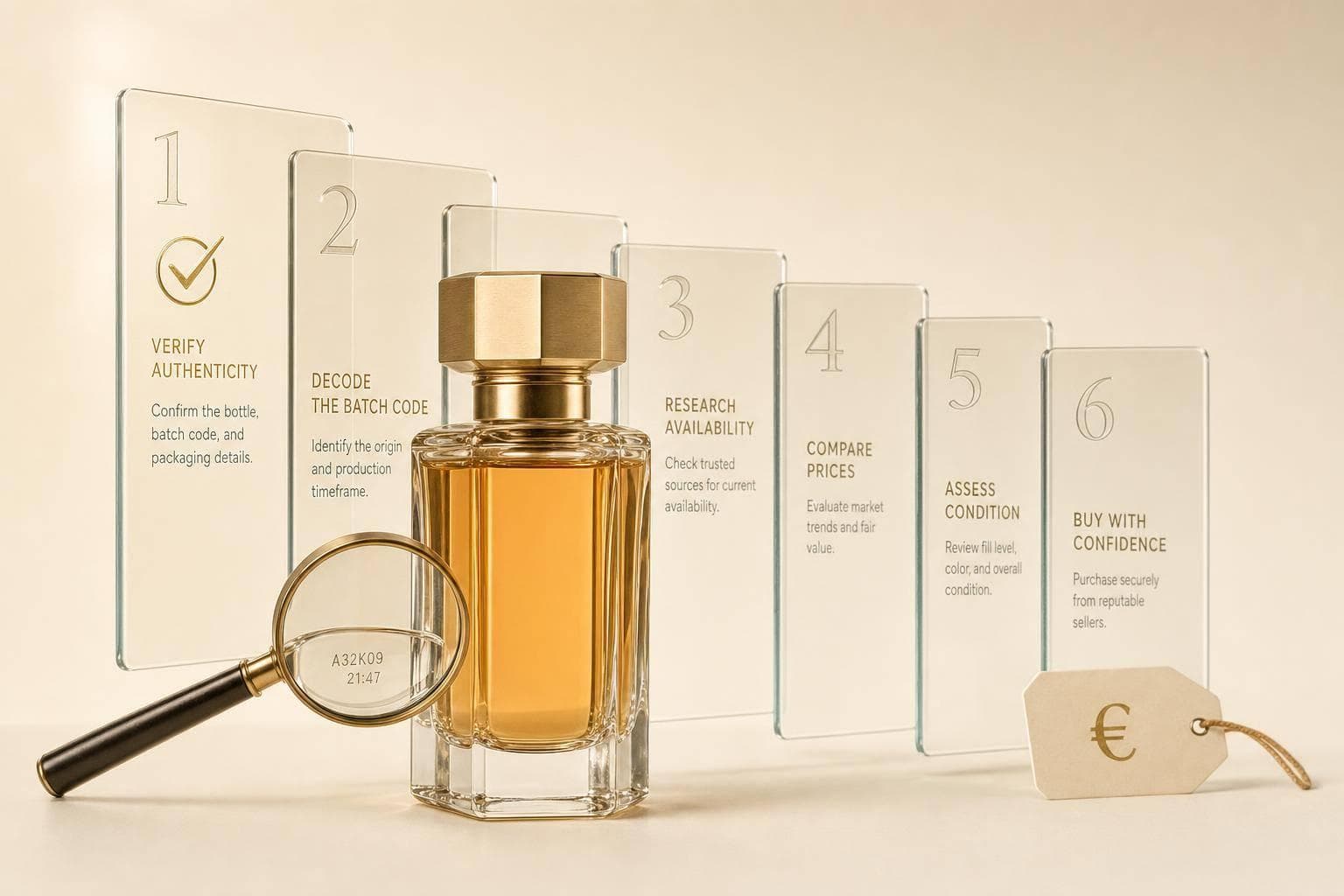
Η αγορά ενός καταργημένου αρώματος δεν είναι θέμα τύχης. Έχει να κάνει με τον έλεγχο έξι σημείων πριν πληρώσετε: κατάσταση κυκλοφορίας, έκδοση, batch code, κατάσταση φιάλης, ιστορικό πωλητή και συνολικό κόστος σε €.
Αν θέλω να αποφύγω μια αλλοιωμένη φιάλη ή ένα υπερτιμημένο άρωμα, διατηρώ τη διαδικασία απλή:
- Επιβεβαιώνω ότι έχει καταργηθεί και δεν είναι απλώς εκτός αποθέματος
- Ελέγχω αν η σύνθεση άλλαξε πριν αποσυρθεί
- Αντιστοιχίζω το batch code και τη συσκευασία στη σωστή περίοδο παραγωγής
- Εξετάζω την κατάσταση της φιάλης για διαρροές, σκούρο χρώμα, θολότητα ή χαμηλή στάθμη
- Συγκρίνω τιμές ολοκληρωμένων πωλήσεων, όχι μόνο τις τιμές που ζητούνται
- Δοκιμάζω πρώτα με ένα decant εάν η φιάλη κοστίζει ακριβά
Ορισμένα δεδομένα καθορίζουν ολόκληρη την αναζήτηση. Οι αλλαγές στους κανονισμούς της IFRA οδήγησαν ορισμένους οίκους να αλλάξουν φόρμουλες ή να αποσύρουν αρώματα, με την 51st IFRA Amendment να ορίζει προθεσμία συμμόρφωσης έως τις 30.10.2025. Ορισμένες παλιές φιάλες πωλούνται πλέον σε εξαιρετικά υψηλές τιμές, με παραδείγματα όπως το Guerlain Djedi να έχουν καταγραφεί πάνω από τα €3.000. Αυτό σημαίνει ότι το ρίσκο αυξάνεται μαζί με την τιμή.
Ο κανόνας μου λοιπόν είναι απλός: αν κάποιο στοιχείο δεν είναι σαφές, περιμένω. Προτιμώ να χάσω μια φιάλη παρά να πληρώσω υπερβολικά για τη λάθος επιλογή.
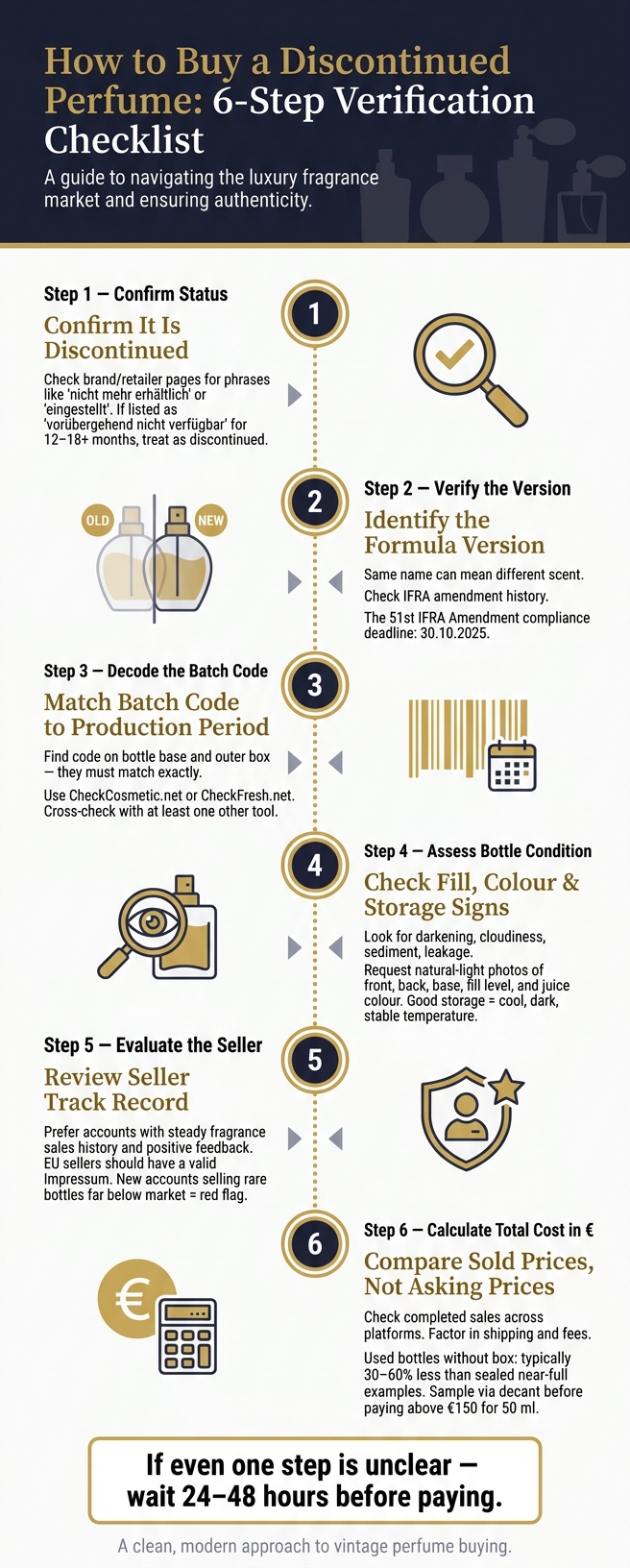
How to Buy a Discontinued Perfume: 6 — Step Verification Checklist
Γρήγορη σύγκριση
| Τι ελέγχω | Τι θέλω να γνωρίζω | Γιατί έχει σημασία |
|---|---|---|
| Κατάσταση κυκλοφορίας | Παράγεται ακόμα, έχει αναδιαμορφωθεί ή έχει καταργηθεί | Με εμποδίζει να μπερδέψω το χαμηλό απόθεμα με μια καταργημένη σειρά |
| Έκδοση | Αρχική, μεταγενέστερη φόρμουλα ή παλαιότερη φιάλη | Το ίδιο όνομα μπορεί να κρύβει διαφορετικό άρωμα |
| Batch code | Ημερομηνία παραγωγής στη φιάλη και στο κουτί | Βοηθά στον χρονικό εντοπισμό της φιάλης |
| Κατάσταση | Στάθμη, χρώμα, διαρροές, σημάδια κακής αποθήκευσης | Ένα παλιό άρωμα μπορεί να μυρίζει άσχημα ακόμα κι αν η φιάλη είναι αυθεντική |
| Πωλητής | Ιστορικό, φωτογραφίες, όροι επιστροφής | Μειώνει την πιθανότητα μιας κακής συναλλαγής |
| Τιμή | Πρόσφατες τιμές πώλησης συν επιπλέον έξοδα | Κρατά τον προϋπολογισμό μου προσγειωμένο |
Αυτός ο οδηγός συμπυκνώνει τη διαδικασία σε μια σαφή ρουτίνα αγοράς, ώστε να αναζητώ με λιγότερες υποθέσεις και περισσότερο έλεγχο.
Πώς να επιβεβαιώσετε ότι ένα άρωμα έχει όντως καταργηθεί
Η ένδειξη εξάντλησης αποθέματος και η κατάργηση μπορεί με την πρώτη ματιά να φαίνονται ίδιες. Ωστόσο, σημαίνουν πολύ διαφορετικά πράγματα ως προς την τιμή, τον συγχρονισμό και το πόσο γρήγορα πρέπει να δράσετε. Πριν υποθέσετε ότι ένα άρωμα έχει χαθεί οριστικά, ελέγξτε πρώτα τις ενδείξεις του οίκου και των καταστημάτων λιανικής.
Ξεκινήστε με τις επίσημες ενδείξεις του οίκου και των λιανοπωλητών
Ξεκινήστε από τον γερμανικό ή ευρωπαϊκό ιστότοπο του οίκου. Αναζητήστε το άρωμα με το ακριβές του όνομα και δείτε αν η σελίδα του προϊόντος υπάρχει ακόμα. Εάν η σελίδα έχει εξαφανιστεί ενώ η υπόλοιπη σειρά παραμένει ενεργή, αυτό αποτελεί μια πρώτη προειδοποιητική ένδειξη.
Εάν η καταχώριση εξακολουθεί να υπάρχει, προσέξτε προσεκτικά τη διατύπωση. Οι γερμανικοί και ευρωπαϊκοί ιστότοποι χρησιμοποιούν συχνά μηνύματα διαθεσιμότητας που σας ενημερώνουν εάν το άρωμα έχει καταργηθεί οριστικά ή απλώς αναμένεται νέα παραλαβή:
| Φράση | Τι σημαίνει συνήθως |
|---|---|
| „nicht mehr erhältlich" / „eingestellt" | Μόνιμη αφαίρεση από τον κατάλογο |
| „aus dem Sortiment genommen" | Απόσυρση από τη σειρά προϊόντων |
| „vorübergehend nicht verfügbar" | Προσωρινό πρόβλημα αποθέματος, πιθανότατα θα επιστρέψει |
| „aktuell ausverkauft" / „bald wieder verfügbar" | Βραχυπρόθεσμη έλλειψη, όχι κατάργηση |
Εάν ένα προϊόν εμφανίζει την ένδειξη „vorübergehend nicht verfügbar" για περισσότερους από 12–18 μήνες χωρίς καμία αλλαγή, είναι λογικό να το θεωρήσετε ουσιαστικά καταργημένο, ακόμη και αν ο οίκος δεν το δηλώνει ρητά. Ελέγξτε επίσης τους μεγάλους ευρωπαίους λιανοπωλητές. Δείτε αν χρησιμοποιούν την ίδια διατύπωση και αν το προϊόν εξακολουθεί να εμφανίζεται στα αποτελέσματα αναζήτησης αλλά όχι πλέον στην κανονική πλοήγηση του ιστότοπου.
Αν η εικόνα παραμένει ασαφής, επικοινωνήστε με την εξυπηρέτηση πελατών του οίκου και κάντε μια ξεκάθαρη ερώτηση: το άρωμα εξακολουθεί να παράγεται ή έχει καταργηθεί; Αποθηκεύστε την απάντηση και σημειώστε την ημερομηνία σε μορφή ΗΗ.ΜΜ.ΕΕΕΕ, όπως 07.08.2026.
Πολλές καταργήσεις γίνονται αθόρυβα. Το άρωμα δεν εξαφανίζεται από τη μια μέρα στην άλλη. Αποσύρεται σταδιακά από τους καταλόγους μέσα σε λίγους μήνες. Ενδείξεις εκκαθάρισης όπως Abverkauf ή Last Chance, ειδικά με εκπτώσεις από −30 % έως −50 %, εμφανίζονται συχνά λίγο πριν από την πλήρη απόσυρση.
Χρησιμοποιήστε τις βάσεις δεδομένων αρωμάτων και τα αρχεία της κοινότητας με προσοχή
Οι πηγές της κοινότητας μπορούν να βοηθήσουν, αλλά δεν θα πρέπει να είναι ο πρώτος σας σταθμός. Χρησιμοποιήστε τες για να επιβεβαιώσετε όσα ήδη υποδεικνύουν οι επίσημες πηγές.
Το Basenotes και το Fragrantica είναι ιδιαίτερα χρήσιμα εδώ. Το Basenotes σας επιτρέπει να φιλτράρετε τον κατάλογό του βάσει της κατάστασης Discontinued, γεγονός που το καθιστά ένα εύχρηστο σημείο εκκίνησης. Οι ενότητες σχολίων του Fragrantica περιλαμβάνουν συχνά σημειώσεις σχετικά με ημερομηνίες κατάργησης ή έτη αναδιαμόρφωσης. Ωστόσο, η ημερομηνία του σχολίου έχει σημασία. Το ίδιο και η επανάληψη. Εάν πολλοί ανεξάρτητοι χρήστες συγκλίνουν στο ίδιο έτος, αυτό έχει μεγαλύτερη βαρύτητα από μια παλιά ανάρτηση χωρίς συνέχεια.
Ένας καλός κανόνας: θεωρήστε έναν ισχυρισμό περί κατάργησης αξιόπιστο μόνο όταν τουλάχιστον δύο ξεχωριστές πηγές συμφωνούν. Για παράδειγμα:
- μια διαγραμμένη σελίδα του οίκου μαζί με μια καταχώριση λιανοπωλητή με την ένδειξη „nicht mehr erhältlich"
- ένα επίσημο email του οίκου μαζί με αρκετά χρονολογημένα σχόλια σε βάσεις δεδομένων που αναφέρονται στο ίδιο έτος
Εάν οι πηγές διαφωνούν, εμπιστευτείτε τις επίσημες ενδείξεις του οίκου και των λιανοπωλητών έναντι των συζητήσεων της κοινότητας.
Ελέγξτε τα batch codes και τις γενιές συσκευασίας
Αφού ελέγξετε την κατάσταση κυκλοφορίας, εξετάστε την ίδια τη φιάλη. Εδώ τα πράγματα γίνονται πιο συγκεκριμένα.
Τα batch codes μπορούν να σας αποκαλύψουν πότε παρήχθη μια συγκεκριμένη φιάλη. Συνήθως θα βρείτε τον κωδικό χαραγμένο ή τυπωμένο στη βάση της φιάλης και στο εξωτερικό κουτί. Δωρεάν εργαλεία όπως το CheckCosmetic.net και το CheckFresh.net υποστηρίζουν δεκάδες κορυφαίους οίκους αρωμάτων και μπορούν να μετατρέψουν αυτόν τον κωδικό σε μήνα και έτος παραγωγής. Μην βασίζεστε σε έναν μόνο αποκωδικοποιητή. Διασταυρώστε το αποτέλεσμα με τουλάχιστον ένα ακόμη εργαλείο και, στη συνέχεια, βεβαιωθείτε ότι η ημερομηνία ταιριάζει με το γνωστό χρονικό πλαίσιο κυκλοφορίας του αρώματος.
Οι γενιές συσκευασίας προσφέρουν ένα επιπλέον επίπεδο τεκμηρίωσης. Οι κοινότητες των λατρών του αρώματος συχνά χαρτογραφούν τις διαφορετικές εκδόσεις ενός αρώματος συγκρίνοντας λεπτομέρειες όπως το σχήμα της φιάλης, το σχέδιο του καπακιού, την τοποθέτηση του λογοτύπου, τις γραμματοσειρές της ετικέτας και τα υλικά του κουτιού σε διαφορετικά έτη. Συνδυάζοντας την ημερομηνία του batch με τη γενιά της συσκευασίας, μπορείτε συχνά να περιορίσετε τη φιάλη σε μια συγκεκριμένη παρτίδα παραγωγής.
Πού να ψάξετε online και offline χωρίς να βιαστείτε να αγοράσετε
Δεν ενέχουν όλες οι πηγές το ίδιο επίπεδο κινδύνου. Γι’ αυτό βοηθά να αξιολογήσετε την πηγή πριν αρχίσετε να κυνηγάτε τη χαμηλότερη τιμή. Μόλις μάθετε αν ένα άρωμα είναι διαθέσιμο, καταργημένο ή βρίσκεται σε αυτή τη γκρίζα ζώνη ενδιάμεσα, ξεκινήστε με την επιλογή χαμηλότερου ρίσκου και συνεχίστε προς τα έξω.
| Τύπος πηγής | Πλεονεκτήματα | Μειονεκτήματα | Επίπεδο τιμής | Κίνδυνος αγοραστή |
|---|---|---|---|---|
| Αξιόπιστοι εξειδικευμένοι λιανοπωλητές | Καλύτερη επιμέλεια, λεπτομερείς φωτογραφίες και batch codes | Περιορισμένο απόθεμα πραγματικά καταργημένων ειδών | Μεσαίο–Υψηλό | Χαμηλός |
| Εξειδικευμένα καταστήματα decant | Χαμηλό αρχικό κόστος, δυνατότητα δοκιμής πρώτα | Υψηλότερο κόστος ανά ml | Μεσαίο | Χαμηλός |
| Marketplaces & αγγελίες | Η ευρύτερη επιλογή, πιθανότητα εύρεσης σπάνιων κομματιών | Υψηλότερος κίνδυνος απομίμησης, συχνά χωρίς επιστροφές | Μεταβλητό | Υψηλός |
| Τοπικό στοκ και outlets | Δυνατότητα εύρεσης στην αρχική τιμή | Απαιτεί μετακινήσεις, το ιστορικό αποθήκευσης μπορεί να είναι ασαφές | Χαμηλό–Μεσαίο | Μεσαίος |
Online καταχωρίσεις, εξειδικευμένοι πωλητές και πωλήσεις συλλεκτών
Ζητήστε καθαρές φωτογραφίες από την πρόσοψη, την πίσω πλευρά, τη βάση, το κουτί, τη σφράγιση, το batch code, τον πίνακα συστατικών, το barcode, τη στάθμη και το χρώμα του υγρού. Η καταχώριση θα πρέπει επίσης να διευκρινίζει το μέγεθος της φιάλης σε ml, εάν είναι σφραγισμένη, ανοιγμένη, tester ή decant, καθώς και ποια έκδοση σύνθεσης είναι. Στα καταργημένα αρώματα, αυτές οι λεπτομέρειες επηρεάζουν τόσο την αυθεντικότητα όσο και την τιμή.
Ο πωλητής έχει εξίσου μεγάλη σημασία με τη φιάλη. Δείξτε μεγαλύτερη εμπιστοσύνη σε λογαριασμούς με σταθερό ιστορικό στις πωλήσεις αρωμάτων και θετικές κριτικές σε πολλές συναλλαγές. Ένας ολοκαίνουργιος λογαριασμός που πουλάει πολλά σπάνια αρώματα πολύ κάτω από την τιμή της αγοράς θα πρέπει να σας προβληματίσει. Εάν ο πωλητής βρίσκεται στη Γερμανία ή σε άλλη χώρα της ΕΕ, αναζητήστε ένα σωστό Impressum με διεύθυνση εταιρείας και στοιχεία ΑΦΜ/VAT. Εάν αυτό λείπει, θεωρήστε το προειδοποιητικό σημάδι.
Πριν αγοράσετε, συγκρίνετε τη ζητούμενη τιμή με πρόσφατες ολοκληρωμένες πωλήσεις σε διάφορες πλατφόρμες. Μια τιμή που φαίνεται υπερβολικά χαμηλή δεν αποτελεί αυτόματα ευκαιρία. Τις περισσότερες φορές, είναι μια ένδειξη να επιβραδύνετε και να ελέγξετε πιο σχολαστικά.
Τοπικά καταστήματα, αδιάθετο στοκ και τακτικές αναζήτησης στη γερμανική γλώσσα
Εάν οι διαδικτυακές αναζητήσεις δεν αποδίδουν καρπούς, στραφείτε σε τοπικό αδιάθετο στοκ, παλαιότερο απόθεμα και εκκαθαρίσεις καταστημάτων. Στη Γερμανία, αυτό το κομμάτι συχνά εξαρτάται από την υπομονή και τη σωστή ορολογία. Χρήσιμοι όροι αναζήτησης περιλαμβάνουν: Restposten Parfum, Lagerverkauf, Geschäftsschließung, NOS Parfum, Vintage Parfum και Sammlerflakon.
Μικρότερα αρωματοπωλεία, περιφερειακά φαρμακεία/καταστήματα καλλυντικών, εκπτωτικά κέντρα και τοπικές αγγελίες αξίζουν συχνά μια ματιά. Βοηθά επίσης να ρωτήσετε απευθείας το προσωπικό εάν διαθέτουν παλαιότερες συσκευασίες im Lager ή in anderen Filialen. Μερικές φορές η φιάλη που αναζητάτε δεν φτάνει ποτέ στο ράφι. Μπορεί να βρίσκεται ακόμα σε μια αποθήκη, σε ένα περιφερειακό υποκατάστημα, σε μια γωνιά εκπτώσεων ή σε ένα Räumungsverkauf.
Χρησιμοποιήστε decants για δοκιμή πριν αγοράσετε μια πλήρη φιάλη
Πριν επενδύσετε σε μια ολόκληρη φιάλη, δοκιμάστε το άρωμα σε μικρότερο μέγεθος. Εάν η τιμή φαίνεται υψηλή ή το ιστορικό της παρτίδας είναι ασαφές, ένα decant είναι η πιο ασφαλής πρώτη κίνηση. Ένα decant των 2 ml, 5 ml ή 8 ml σας δίνει αρκετό χρόνο εφαρμογής για να επιβεβαιώσετε το οσφρητικό προφίλ και να εντοπίσετε τυχόν αλλοιωμένες νότες που μπορεί να υποδηλώνουν οξείδωση ή φθορά από θερμότητα.
Το Scento (scento.com) προσφέρει αυθεντικά designer και niche αρώματα σε decants των 2 ml, 5 ml και 8 ml για καταναλωτές στην ΕΕ.
Αυτό είναι επίσης εξαιρετικά χρήσιμο σε αναδιαμορφωμένα αρώματα. Ένα σύγχρονο decant σας δίνει ένα σημείο αναφοράς πριν αρχίσετε να το συγκρίνετε με μια παλαιότερη φιάλη.
Ο προσωπικός σας ειδικός αρωμάτων σας περιμένει
Κάντε το σύντομο κουίζ αρώματος και ανακαλύψτε αυθεντικά αρώματα designer και niche, επιλεγμένα στα μέτρα σας – εξερευνήστε τα σε decant και δείγματα των 2–8ml, ώστε να δοκιμάσετε το καθένα πριν επιλέξετε ολόκληρο μπουκάλι.
Βρείτε το άρωμά σαςΠώς να ελέγξετε την αυθεντικότητα, την κατάσταση και τη δίκαιη τιμολόγηση
Μόλις καταλήξετε σε μια καταχώριση, ελέγξτε τη φιάλη πριν ξεκινήσετε τη διαπραγμάτευση.
Ελέγξτε τη συσκευασία, τις λεπτομέρειες της φιάλης και τη συνέπεια του batch code
Ξεκινήστε με το batch code. Πρέπει να εμφανίζεται τόσο στο κουτί όσο και στη φιάλη, και οι δύο κωδικοί πρέπει να ταιριάζουν απόλυτα. Εάν ένας από τους δύο λείπει, είναι μουτζουρωμένος ή εμφανώς διαφορετικός, θεωρήστε το σοβαρό καμπανάκι κινδύνου.
Στη συνέχεια, εξετάστε τη συνολική κατασκευή. Μια αυθεντική φιάλη αποπνέει συνήθως συνέπεια από πάνω μέχρι κάτω: καπάκι, γυαλί, εκτύπωση και ψεκαστήρας πρέπει να ευθυγραμμίζονται ως προς την ποιότητα. Οι ετικέτες πρέπει να είναι τοποθετημένες ίσια. Οι γραμματοσειρές πρέπει να φαίνονται καθαρές και ευκρινείς. Τα ορθογραφικά λάθη είναι κακό σημάδι. Στις παλαιότερες φιάλες, το σελοφάν μπορεί να δείχνει την ηλικία του, αλλά θα πρέπει να μοιάζει εργοστασιακό, όχι χαλαρό ή κολλημένο στο χέρι.
| Έλεγχος | Τι να προσέξετε | Γιατί έχει σημασία |
|---|---|---|
| Batch code | Ίδιος κωδικός στο κουτί και στη φιάλη | Οι αταίριαστοι ή απόντες κωδικοί αποτελούν σημαντική ένδειξη απομίμησης |
| Ποιότητα ετικέτας και εκτύπωσης | Καθαρό κείμενο, χωρίς μουτζούρες, χωρίς ορθογραφικά λάθη | Η κακή ποιότητα εκτύπωσης αποκαλύπτει συχνά ψεύτικες φιάλες |
| Καπάκι και ψεκαστήρας | Σταθερή εφαρμογή, αρμονικές αναλογίες, λεπτός ομοιόμορφος ψεκασμός | Τα φθηνά καπάκια και ο ανομοιόμορφος ψεκασμός υποδηλώνουν πρόχειρη κατασκευή |
| Φινίρισμα γυαλιού | Ομοιόμορφο, καθαρό, χωρίς φυσαλίδες ή κυματιστές παραμορφώσεις | Το ανομοιόμορφο γυαλί μπορεί να υποδεικνύει μη αυθεντικές ή επαναγεμισμένες φιάλες |
| Σελοφάν | Εργοστασιακή εμφάνιση, σφιχτή σφράγιση, χωρίς ίχνη κόλλας | Το χαλαρό ή χειροποίητα τοποθετημένο περιτύλιγμα είναι συνηθισμένη τακτική σε απομιμήσεις |
Εάν δύο ή περισσότερες λεπτομέρειες φαίνονται ύποπτες, μην τις αγνοήσετε. Οι παραχαράκτες μπορούν να αντιγράψουν μερικά πράγματα καλά, αλλά συχνά αποτυγχάνουν όταν εξετάζετε τη συνολική παρουσίαση.
Αξιολογήστε το ιστορικό αποθήκευσης και τα σημάδια αλλοίωσης του αρώματος
Μια αυθεντική φιάλη σε κακή κατάσταση παραμένει μια κακή αγορά. Ρωτήστε πώς αποθηκεύτηκε και αν εκτέθηκε σε θερμότητα, φως ή έντονες μετακινήσεις. Οι αξιόπιστοι πωλητές μπορούν συνήθως να σας πουν αν το άρωμα φυλασσόταν σε ντουλάπα, συρτάρι ή σε δωμάτιο με σταθερή θερμοκρασία.
Τα αρώματα που αποθηκεύονται σωστά σε δροσερές, σκοτεινές συνθήκες διατηρούνται συχνά σε άριστη κατάσταση για 3 έως 5 χρόνια, και σε πολλές περιπτώσεις για πολύ περισσότερο. Η κακή αποθήκευση μπορεί να μειώσει δραστικά αυτό το διάστημα.
Προσέξτε για σκούρο χρώμα, θολότητα, ίζημα, διαχωρισμό των συστατικών ή διαρροές. Μια ελαφριά χρωματική αλλαγή από απαλό χρυσό σε κεχριμπαρένιο μπορεί να είναι φυσιολογική με την πάροδο του χρόνου. Ωστόσο, ο έντονος διαχωρισμός, τα αιωρούμενα σωματίδια ή μια ξινή και αλλοιωμένη μυρωδιά υποδηλώνουν συνήθως αποσύνθεση. Ζητήστε φωτογραφίες σε φυσικό φως που να δείχνουν:
- την πρόσοψη, την πίσω πλευρά και τη βάση
- το εσωτερικό του κουτιού, τις σημάνσεις των κωδικών, τη στάθμη και το χρώμα του υγρού
Αυτές οι φωτογραφίες αποκαλύπτουν πολύ περισσότερα από ό,τι μια επεξεργασμένη εικόνα του πωλητή.
Ερευνήστε την αξία της αγοράς και θέστε ένα ανώτατο όριο προϋπολογισμού σε ευρώ
Αφού βεβαιωθείτε για την κατάσταση και την αυθεντικότητα, συγκρίνετε τη φιάλη με πρόσφατες τιμές ολοκληρωμένων πωλήσεων. Ορίστε το ανώτατο όριό σας πριν αρχίσετε να περιηγείστε σε περισσότερες καταχωρίσεις, όχι μετά. Τα σπάνια αρώματα μπορούν να επηρεάσουν γρήγορα την κρίση σας. Εκείνη τη στιγμή, σχεδόν οποιαδήποτε τιμή μπορεί να αρχίσει να μοιάζει δικαιολογημένη.
Κοιτάξτε τις ολοκληρωμένες πωλήσεις, όχι μόνο τις ενεργές τιμές ζήτησης. Εστιάστε στις λεπτομέρειες που επηρεάζουν περισσότερο την αξία:
- μέγεθος φιάλης σε ml
- στάθμη πλήρωσης
- ύπαρξη αρχικού κουτιού
- σπανιότητα
- κατάσταση
- συλλεκτική ζήτηση
Μια σφραγισμένη, με το κουτί της, σχεδόν γεμάτη φιάλη συνήθως θα πουληθεί ακριβότερα. Οι χρησιμοποιημένες φιάλες χωρίς συσκευασία συχνά πωλούνται με έκπτωση 30–60 % σε σύγκριση με σχεδόν γεμάτα δείγματα, ανάλογα με τη στάθμη και την κατάσταση.
Καθορίστε το ανώτατο όριό σας από τις ολοκληρωμένες πωλήσεις και, στη συνέχεια, προσθέστε τα έξοδα αποστολής και τυχόν προμήθειες. Βάσει του Widerrufsrecht, οι εμπορικοί πωλητές συνήθως προσφέρουν νόμιμο δικαίωμα υπαναχώρησης, ενώ οι ιδιωτικές πωλήσεις συνήθως όχι. Καταγράψτε το τελικό συνολικό σας ποσό σε € πριν συγκρίνετε τις επιλογές σας.
Δημιουργήστε μια μακροπρόθεσμη διαδικασία έρευνας και αποφύγετε τα δαπανηρά λάθη
Αφού ελέγξετε την κατάσταση κυκλοφορίας, την αυθεντικότητα και την τιμή, το επόμενο βήμα είναι απλό: φτιάξτε ένα σύστημα και μείνετε πιστοί σε αυτό. Οι άνθρωποι που κάνουν επιτυχημένες αγορές σε βάθος χρόνου κάνουν συνήθως ένα πράγμα που οι άλλοι παραλείπουν. Καταγράφουν κάθε αγορά.
Διατηρήστε ένα προσωπικό ημερολόγιο αρωμάτων και αρχείο φωτογραφιών
Δεν χρειάζεστε περίπλοκο λογισμικό. Ένα υπολογιστικό φύλλο είναι αρκετό.
Καταγράψτε την ημερομηνία αγοράς (07.08.2026), τον πωλητή, την τελική τιμή σε €, το μέγεθος της φιάλης σε ml, το batch code, τη στάθμη, την κατάσταση και σημειώσεις εφαρμογής, όπως το άνοιγμα, το dry-down και τη διάρκεια. Αποθηκεύστε επίσης καθαρές φωτογραφίες της φιάλης, του κουτιού, του batch code και της στάθμης. Ένα όνομα αρχείου όπως Dior_Fahrenheit_EDT_100ml_1N02_2026-08-07 διευκολύνει πολύ την αναζήτηση αργότερα. Κρατήστε τις αποδείξεις και τις φωτογραφίες μαζί με το υπόλοιπο αρχείο σας.
Πολλοί έμπειροι συλλέκτες προσθέτουν δύο επιπλέον στήλες που βοηθούν σημαντικά:
- μέγιστη τιμή που θα πλήρωνα ξανά
- στοχευμένες εναλλακτικές αντικατάστασης
Αυτά τα δύο πεδία βάζουν φρένο στις παρορμητικές αγορές και σας βοηθούν να παραμείνετε εντός του καθορισμένου προϋπολογισμού.
Μόλις αυτό το αρχείο αρχίσει να μεγαλώνει, γίνεται πολύ πιο εύκολο να συγκρίνετε τα καταργημένα αρώματα με νεότερες επιλογές πριν δεσμευτείτε σε μια αγορά.
Ισορροπήστε το κυνήγι καταργημένων αρωμάτων με τις σύγχρονες ανακαλύψεις
Η προσπάθεια να κυνηγήσετε κάθε καταργημένη φιάλη μπορεί να εξαντλήσει τόσο την ενέργεια όσο και το πορτοφόλι σας. Ένας καλύτερος τρόπος είναι να ορίσετε οσφρητικούς ρόλους, όπως καθημερινή χρήση, χειμερινή θαλπωρή ή επίσημες περιστάσεις. Στη συνέχεια, κρίνετε τόσο τα παλαιότερα όσο και τα σύγχρονα αρώματα με βάση τον ρόλο που πρέπει να καλύψουν, και όχι βάσει του ενθουσιασμού που τα περιβάλλει.
Αυτή η αλλαγή οπτικής έχει σημασία. Εάν ένα σύγχρονο άρωμα εξυπηρετεί τον ίδιο σκοπό με πολύ λιγότερα χρήματα και λιγότερο ρίσκο, το να πληρώσετε υπεραξία για μια παλαιότερη φιάλη αρχίζει να φαίνεται πολύ λιγότερο λογικό.
Δοκιμάστε με δείγμα οποιοδήποτε άρωμα ξεπερνά τα €150,00 για 50 ml πριν το αγοράσετε. Τα decants είναι ο ευκολότερος τρόπος για να ελέγξετε αν ένα καταργημένο άρωμα εξακολουθεί να δικαιολογεί την υψηλότερη τιμή του. Το Scento προσφέρει αυθεντικά designer και niche αρώματα σε decants των 2 ml, 5 ml και 8 ml για τους ευρωπαίους αγοραστές, δίνοντάς σας τον χρόνο να φορέσετε μια σύγχρονη εναλλακτική σε διαφορετικές εποχές και περιστάσεις πριν αποφασίσετε αν ο καταργημένος στόχος αξίζει πράγματι το επιπλέον κόστος.
Συμπέρασμα: Η ασφαλέστερη διαδικασία αγοράς
Μετατρέψτε όλα τα παραπάνω σε μια τελική ρουτίνα πριν από την αγορά:
- Επιβεβαίωση κατάστασης - Η κατάργηση έχει επαληθευτεί μέσω σημάτων του οίκου και βάσεων δεδομένων.
- Έλεγχος αυθεντικότητας - Τα batch codes, η συσκευασία και οι φωτογραφίες του πωλητή δεν παρουσιάζουν ασυνέπειες.
- Αξιολόγηση κατάστασης - Η στάθμη πλήρωσης, η κατάσταση της φιάλης και ο κίνδυνος αλλοίωσης έχουν ληφθεί υπόψη.
- Έλεγχος αξίας αγοράς - Έχουν εξεταστεί οι πρόσφατες τιμές ολοκληρωμένων πωλήσεων σε €, υπολογίζοντας το τελικό συνολικό κόστος.
- Δοκιμή εναλλακτικών - Έχουν δοκιμαστεί στο δέρμα και καταγραφεί decants αντίστοιχων σύγχρονων αρωμάτων.
- Προετοιμασία τεκμηρίωσης - Η καταχώριση στο αρχείο είναι έτοιμη για την ημερομηνία αγοράς, τον πωλητή, την τιμή, το batch code και τις φωτογραφίες παραλαβής.
Εάν λείπει έστω και ένα βήμα, σταματήστε. Συγκεντρώστε πρώτα τα στοιχεία που λείπουν. Στη συνέχεια, περιμένετε 24–48 ώρες πριν προχωρήσετε στην πληρωμή.
Συχνές Ερωτήσεις
Πώς μπορώ να καταλάβω αν ένα άρωμα έχει πραγματικά καταργηθεί;
Ξεκινήστε από τον επίσημο ιστότοπο του κατασκευαστή. Εάν το άρωμα δεν εμφανίζεται πλέον στην τρέχουσα συλλογή, ενδέχεται να έχει καταργηθεί. Μπορείτε επίσης να επικοινωνήσετε απευθείας με τον οίκο για επιβεβαίωση.
Τα καταργημένα αρώματα συχνά αντιγράφονται, επομένως αξίζει να ελέγξετε το batch code της φιάλης με εργαλεία όπως το CheckFresh ή το CheckCosmetic. Εάν ο κωδικός λείπει ή η ημερομηνία παραγωγής δεν είναι λογική, αντιμετωπίστε το ως προειδοποιητικό σημάδι και αγοράστε μόνο από αξιόπιστες πηγές.
Πώς μπορώ να χρονολογήσω σωστά μια φιάλη;
Εντοπίστε το batch code. Πρόκειται για έναν σύντομο αλφαριθμητικό κωδικό, συνήθως τυπωμένο στο κάτω μέρος ή χαμηλά στην πίσω πλευρά της φιάλης, καθώς και στο κάτω ή πίσω μέρος του κουτιού. Στα αυθεντικά προϊόντα, είναι συχνά χαραγμένος ή εκτυπωμένος με λέιζερ και όχι κολλημένος ως μια φθηνή ετικέτα.
Στη συνέχεια, εισαγάγετε τον κωδικό σε ένα εργαλείο επαλήθευσης όπως το CheckFresh ή το CheckCosmetic και επιλέξτε τη σωστή μάρκα. Εάν ο κωδικός είναι έγκυρος, το εργαλείο θα εμφανίσει μια εκτιμώμενη ημερομηνία παραγωγής. Αυτό σας δίνει έναν απλό τρόπο να εκτιμήσετε την ηλικία του αρώματος.
Πότε είναι το decant η ασφαλέστερη επιλογή;
Ένα decant είναι συχνά ο ασφαλέστερος και πιο οικονομικός τρόπος για να δοκιμάσετε αρώματα υψηλής ποιότητας, ειδικά σπάνια ή καταργημένα, χωρίς να ρισκάρετε σε μια τυφλή αγορά (blind buy) που μπορεί να ξεπεράσει τα €300.
Με ένα decant των 2 ml, 5 ml ή 8 ml, μπορείτε να ζήσετε με ένα άρωμα για ένα διάστημα και να δείτε πώς εξελίσσεται στο δέρμα σας για αρκετές ημέρες ή ακόμα και εβδομάδες πριν δεσμευτείτε για μια πλήρη φιάλη.

