
Η συσκευασία των αρωμάτων έχει εισέλθει σε μια νέα εποχή, συνδυάζοντας εργαλεία αιχμής όπως τσιπ NFC, κωδικούς QR, AR και τρισδιάστατη εκτύπωση (3D printing) για τη δημιουργία πιο έξυπνων και αποδοτικών σχεδίων. Αυτές οι εξελίξεις ανταποκρίνονται σε δύο βασικές προκλήσεις: τη μείωση των 12 δισεκατομμυρίων τόνων πλαστικών αποβλήτων της βιομηχανίας ομορφιάς και την ικανοποίηση των απαιτήσεων των καταναλωτών για διαφάνεια των προϊόντων. Ακολουθεί μια συνοπτική εικόνα των όσων συμβαίνουν:
- Τσιπ NFC: Επιτρέπουν έξυπνες επαναπληρώσεις, παρακολουθούν τη χρήση και συνδέονται με προγράμματα επιβράβευσης.
- Κωδικοί QR: Προσφέρουν λεπτομερείς πληροφορίες για τα συστατικά, οδηγούς χρήσης και διαδραστικές λειτουργίες.
- Εργαλεία AR: Βοηθούν τους χρήστες να εξερευνήσουν οπτικά τις αρωματικές νότες, ιδανικά για διαδικτυακές αγορές.
- Τρισδιάστατη εκτύπωση (3D printing): Μειώνει τα απόβλητα παραγωγής έως και 90% και υποστηρίζει επαναγεμιζόμενα, αρθρωτά σχέδια.
Επωνυμίες όπως οι Paco Rabanne, Bastille Parfums και Byredo αξιοποιούν ήδη αυτές τις τεχνολογίες για να προσφέρουν διαδραστικές, οικολογικά ευαισθητοποιημένες εμπειρίες. Για παράδειγμα, τα επαναγεμιζόμενα συστήματα μπορούν να μειώσουν το αποτύπωμα άνθρακα έως και 50% μετά από δέκα χρήσεις. Καθώς αυτές οι καινοτομίες εδραιώνονται, αναδιαμορφώνουν τον τρόπο με τον οποίο ανακαλύπτουμε και απολαμβάνουμε τα αρώματα, απαντώντας ταυτόχρονα στις ανησυχίες για τη βιωσιμότητα.
How Technology Changes Perfume Packaging
Η βιομηχανία αρωμάτων αγκαλιάζει καινοτομίες όπως τα τσιπ NFC, τους κωδικούς QR και την επαυξημένη πραγματικότητα (AR) για να μεταμορφώσει τον τρόπο με τον οποίο οι καταναλωτές αλληλεπιδρούν με τη συσκευασία. Αυτές οι πρωτοπορίες ξεπερνούν την αισθητική, αντιμετωπίζοντας την παραχάραξη, τη βιωσιμότητα και την ευκολία του χρήστη. Ας δούμε αναλυτικά πώς κάθε τεχνολογία αναδιαμορφώνει την αρωματική εμπειρία.
Τσιπ NFC για Έξυπνες Επαναπληρώσεις
Τα τσιπ NFC (Near Field Communication) γεφυρώνουν το χάσμα μεταξύ των φυσικών προϊόντων και των ψηφιακών εργαλείων. Ακουμπώντας απλώς το smartphone σας στο μπουκάλι, μπορείτε να ξεκλειδώσετε λειτουργίες όπως πιστοποίηση γνησιότητας προϊόντος, παρακολούθηση χρήσης και οδηγούς επαναπλήρωσης που διασφαλίζουν μια διαδικασία χωρίς διαρροές και ταλαιπωρία.
Ένα εξαιρετικό παράδειγμα είναι το «Phantom» του Paco Rabanne, το οποίο κυκλοφόρησε τον Σεπτέμβριο του 2021. Αυτό το άρωμα ενσωματώνει μια ετικέτα NFC ST25TV02K διακριτικά τοποθετημένη στο καπάκι ψεκασμού. Για την επαναγεμιζόμενη έκδοση των 150 ml, το άγγιγμα της ετικέτας κατευθύνει τους χρήστες σε έναν οδηγό βίντεο που εξηγεί τη διαδικασία επαναπλήρωσης βήμα προς βήμα. Σχεδιασμένο με βασικούς τεχνολογικούς συνεργάτες, η συμπαγής εσωτερική χωρητικότητα συντονισμού 99 pF του τσιπ διασφαλίζει απρόσκοπτη ενσωμάτωση.
Σύμφωνα με την STMicroelectronics, «το Phantom αποδεικνύει την αναγκαιότητα της τεχνολογίας όταν επιδιώκεται η προσφορά μιας καλύτερης εμπειρίας για τους χρήστες και τον υπόλοιπο κόσμο».
Αυτά τα τσιπ περιλαμβάνουν επίσης αισθητήρες για την παρακολούθηση της ποσότητας του προϊόντος που απομένει, στέλνοντας ειδοποιήσεις στο smartphone σας όταν έρθει η ώρα για επαναπλήρωση ή εκ νέου παραγγελία. Ορισμένοι οίκοι συνδέουν μάλιστα τα τσιπ NFC με προγράμματα επιβράβευσης, ανταμείβοντας τους πελάτες για την υπεύθυνη επαναπλήρωση ή ανακύκλωση των φιαλών τους. Έως το 2025, αυτή η «έξυπνη» λειτουργικότητα αναμένεται να αποτελέσει βασικό χαρακτηριστικό στις σειρές αρωμάτων, βοηθώντας τα brands να διαχειρίζονται τους κύκλους ζωής των προϊόντων ενισχύοντας ταυτόχρονα την αφήγηση της ιστορίας τους.
Κωδικοί QR για Διαφάνεια και Αλληλεπίδραση
Οι κωδικοί QR μετατρέπουν τη συσκευασία σε πύλη λεπτομερών πληροφοριών και διαδραστικών εμπειριών. Παρέχουν λίστες συστατικών, προειδοποιήσεις αλλεργιογόνων και δεδομένα προέλευσης, ανταποκρινόμενοι στους κανονισμούς διαφάνειας της ΕΕ. Για τους καταναλωτές που εστιάζουν στην καθαρή ομορφιά (clean beauty), αυτοί οι κωδικοί τους επιτρέπουν να επαληθεύουν τους ισχυρισμούς πριν δεσμευτούν σε μια αγορά.
Ωστόσο, οι κωδικοί QR δεν αφορούν μόνο τη διαφάνεια – προσφέρουν επίσης συναρπαστικές δυνατότητες, όπως εικονικές δοκιμές, οδηγούς βίντεο και συμβουλές ειδικών σχετικά με τεχνικές εφαρμογής. Ορισμένοι συνδέονται ακόμη και με εργαλεία τεχνητής νοημοσύνης, όπως προτάσεις αρωμάτων ή ερωτηματολόγια ανάλυσης δέρματος. Με το 70% των καταναλωτών να αναζητούν εξατομικευμένες εμπειρίες ομορφιάς αλλά μόνο το 30% των εμπορικών σημάτων να τις παρέχουν, αυτή η τεχνολογία γεφυρώνει ένα κρίσιμο κενό.
Κοιτάζοντας μπροστά, οι κωδικοί QR πρόκειται να διαδραματίσουν μεγαλύτερο ρόλο παγκοσμίως. Έως το 2027, οι δισδιάστατοι γραμμωτοί κώδικες (2D barcodes), όπως οι κωδικοί QR, θα γίνονται δεκτοί στα ταμεία παγκοσμίως στο πλαίσιο της πρωτοβουλίας GS1 Sunrise, η οποία δοκιμάζεται ήδη σε 48 χώρες που καλύπτουν το 88% του παγκόσμιου ΑΕΠ. Επιπλέον, οι κανονισμοί της ΕΕ απαιτούν οι ψηφιακές ετικέτες για τα καλλυντικά να παραμένουν προσβάσιμες για τουλάχιστον 10 χρόνια μετά την κυκλοφορία ενός προϊόντος. Ένα σημαντικό πλεονέκτημα των δυναμικών κωδικών QR είναι η ευελιξία τους – οι οίκοι μπορούν να ενημερώνουν το συνδεδεμένο περιεχόμενο, όπως εποχιακές προωθήσεις ή εκπαιδευτικά προγράμματα, χωρίς να επανεκτυπώνουν τη συσκευασία.
Λειτουργίες AR για την Εξερεύνηση του Αρώματος
Η επαυξημένη πραγματικότητα βοηθά να γίνει ο αόρατος κόσμος των αρωμάτων πιο απτός. Σκανάροντας ένα μπουκάλι αρώματος με το τηλέφωνό σας, τα ψηφιακά επίπεδα του AR μπορούν να ζωντανέψουν τα αρωματικά στοιχεία – φανταστείτε κινούμενες εκρήξεις εσπεριδοειδών ή ντελικάτα πέταλα λουλουδιών. Αυτά τα διαδραστικά σημεία σάς επιτρέπουν να εξερευνήσετε λεπτομερώς τις αρωματικές νότες, καθιστώντας το AR ιδιαίτερα πολύτιμο για όσους αγοράζουν διαδικτυακά και δεν μπορούν να δοκιμάσουν τα αρώματα από κοντά.
Οι οίκοι χρησιμοποιούν επίσης το AR για να δείξουν πώς μπορούν να συνδυαστούν διαφορετικά αρώματα σε στρώσεις (layering). Οι οπτικές επιδείξεις καθοδηγούν τους χρήστες στον συνδυασμό αρωμάτων για τη δημιουργία μιας εξατομικευμένης σύνθεσης, ενθαρρύνοντάς τους να πειραματιστούν και να αποκτήσουν εμπιστοσύνη στις αρωματικές τους επιλογές. Αυτό όχι μόνο αναβαθμίζει την εμπειρία αγορών, αλλά προωθεί και την παράλληλη χρήση πολλαπλών προϊόντων.
Η ενσωμάτωση αυτών των τεχνολογιών όχι μόνο βελτιώνει την εμπειρία του χρήστη, αλλά υποστηρίζει και οικολογικά συνειδητές πρακτικές. Μειώνοντας τα απόβλητα και απλοποιώντας τις αλληλεπιδράσεις, η βιομηχανία αρωμάτων ευθυγραμμίζεται με τις προσδοκίες των σύγχρονων καταναλωτών για βιωσιμότητα και ιχνηλασιμότητα.
3D εκτύπωση για συσκευασίες με λιγότερα απόβλητα
Η τρισδιάστατη εκτύπωση (3D printing) κερδίζει έδαφος στη βιώσιμη συσκευασία αρωμάτων, στεκόμενη επάξια δίπλα σε τεχνολογίες όπως τα NFC, QR και AR. Αυτό που την κάνει να ξεχωρίζει είναι η ικανότητά της να χρησιμοποιεί ελάχιστες πρώτες ύλες. Σε αντίθεση με την παραδοσιακή κατασκευή, η οποία συχνά περιλαμβάνει την αφαίρεση της περίσσειας υλικού, η 3D εκτύπωση δημιουργεί αντικείμενα στρώση προς στρώση. Αυτή η μέθοδος μειώνει τα απόβλητα παραγωγής κατά ένα εντυπωσιακό 70% έως 90% σε σύγκριση με τις συμβατικές τεχνικές. Είναι ιδιαίτερα κατάλληλη για τη δημιουργία περίτεχνων πωμάτων, διακοσμητικών λεπτομερειών ή επαναγεμιζόμενων μηχανισμών χωρίς περιττά απόβλητα, ευθυγραμμιζόμενη απόλυτα με τη στροφή της αρωματοποιίας προς τη βιωσιμότητα.
Ένα από τα σημαντικότερα πλεονεκτήματα του 3D printing είναι η ικανότητά του να δημιουργεί αρθρωτά και επαναγεμιζόμενα εξαρτήματα. Αυτά σχεδιάζονται για μακροχρόνια χρήση, μετατρέποντας αυτό που κάποτε ήταν συσκευασία μιας χρήσης σε κάτι ανθεκτικό και επαναχρησιμοποιήσιμο. Η παραγωγή κατόπιν ζήτησης προσθέτει ένα ακόμη επίπεδο αποδοτικότητας, μειώνοντας τα αποθέματα που καταλήγουν σε απόβλητα. Για παράδειγμα, αντί να βασίζονται σε ένθετα αφρού ή πλαστικού μίας χρήσης, οι εταιρείες μπορούν να εκτυπώνουν προσαρμοσμένα στηρίγματα για εύθραυστα γυάλινα ανταλλακτικά μόνο όταν χρειάζεται.
Τα υλικά που χρησιμοποιούνται στο 3D printing ενισχύουν περαιτέρω τον φιλικό προς το περιβάλλον χαρακτήρα του. Ανακυκλωμένα και βιολογικής βάσης νήματα, όπως το rPLA που παράγεται από βιομηχανικά απόβλητα, χρησιμοποιούνται ευρέως. Αυτά τα υλικά μπορούν να διαμορφωθούν σε εκπληκτικά σχέδια – όπως φακοειδή μοτίβα ή floral υφές – που μετατρέπουν τα μπουκάλια σε αντικείμενα συλλογής και όχι σε είδη μίας χρήσης. Καθώς το 62% των σύγχρονων καταναλωτών προτιμά βιώσιμες μάρκες, ο συνδυασμός του πολυτελούς σχεδιασμού με περιβαλλοντικά υπεύθυνες πρακτικές ανταποκρίνεται άμεσα σε αυτή τη ζήτηση.
Ένα άλλο πλεονέκτημα του 3D printing είναι ο ρόλος του στην ταχεία δημιουργία πρωτοτύπων. Οι οίκοι μπορούν να δοκιμάσουν ελαφριά σχέδια χαμηλών αποβλήτων πριν δεσμευτούν σε παραγωγή πλήρους κλίμακας. Αυτή η ευελιξία είναι ιδιαίτερα πολύτιμη σε αγορές όπως η Γερμανία, όπου οι πωλήσεις αρωμάτων εκτοξεύτηκαν από 1,3 δισεκατομμύρια ευρώ το 2021 σε σχεδόν 2 δισεκατομμύρια ευρώ το 2023. Υιοθετώντας το 3D printing, οι επωνυμίες μπορούν να προσαρμόζονται γρήγορα στις μεταβαλλόμενες προτιμήσεις των καταναλωτών παραμένοντας παράλληλα πιστές στις αρχές της κυκλικής οικονομίας.
Ο προσωπικός σας ειδικός αρωμάτων σας περιμένει
Κάντε το σύντομο κουίζ αρώματος και ανακαλύψτε αυθεντικά αρώματα designer και niche, επιλεγμένα στα μέτρα σας – εξερευνήστε τα σε decant και δείγματα των 2, 5, 8 και 30 ml, ώστε να δοκιμάσετε το καθένα πριν επιλέξετε ολόκληρο μπουκάλι.
Βρείτε το άρωμά σαςΣύγκριση Τεχνολογιών Έξυπνης Συσκευασίας
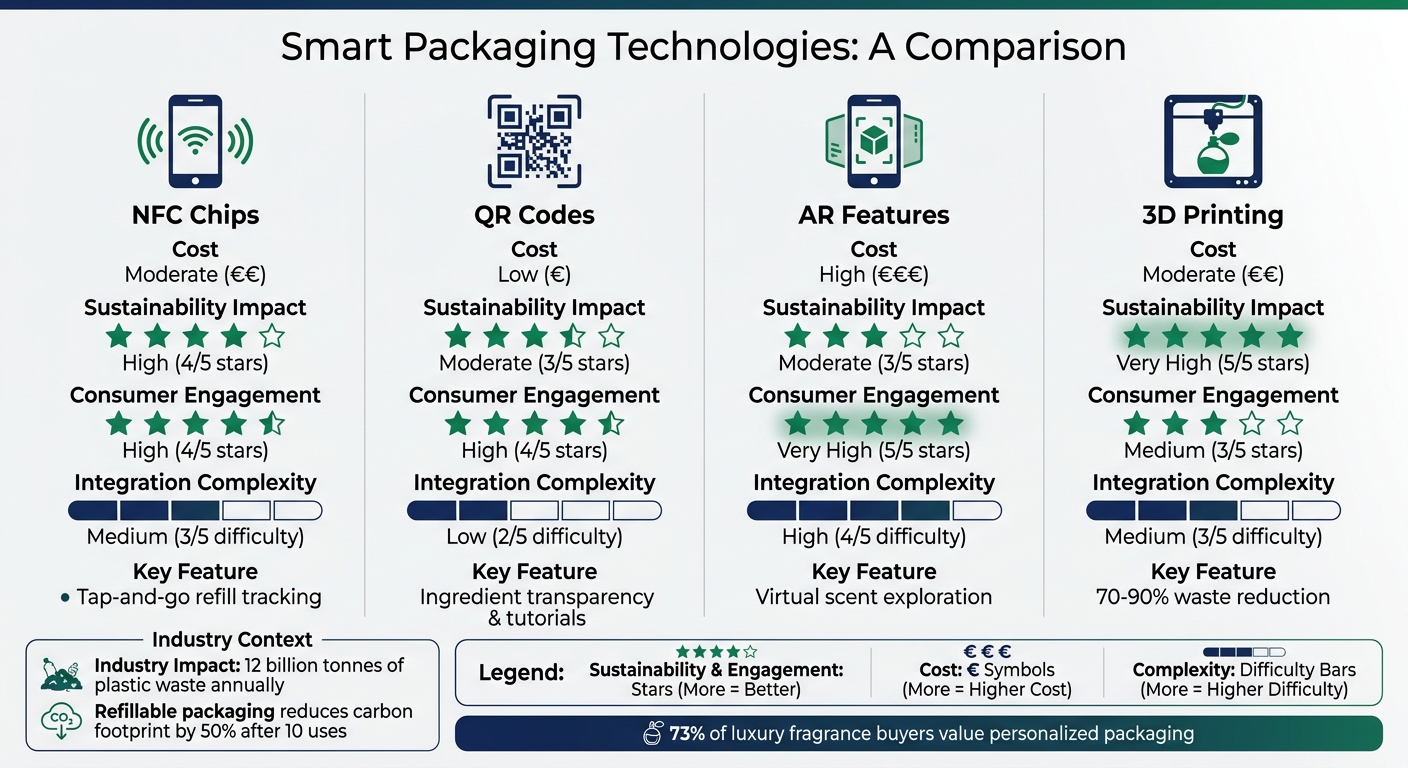
Smart Perfume Packaging Technologies Comparison: Cost, Sustainability & Engagement
Οι σύγχρονες καινοτομίες όπως τα NFC, οι κωδικοί QR, το AR και το 3D printing προσφέρουν έναν συνδυασμό πλεονεκτημάτων και προκλήσεων όσον αφορά τη δημιουργία βιώσιμων συσκευασιών αρωμάτων. Ας αναλύσουμε πώς ξεχωρίζει κάθε τεχνολογία.
Τα τσιπ NFC παρέχουν μια απρόσκοπτη εμπειρία με τη λειτουργία tap-and-go, διευκολύνοντας τις επαναπληρώσεις παρακολουθώντας τη χρήση και αυτοματοποιώντας τις νέες παραγγελίες. Αυτή η τεχνολογία επιτυγχάνει μια ισορροπία μεταξύ μέτριου κόστους και υψηλής αλληλεπίδρασης με τον καταναλωτή, προσφέροντας έναν βολικό τρόπο προσέλκυσης των χρηστών.
Οι κωδικοί QR, από την άλλη πλευρά, είναι μια λύση χαμηλού κόστους που μπορεί να εκτυπωθεί απευθείας πάνω στη συσκευασία. Συνδέουν τους πελάτες με αναλυτικές πληροφορίες, όπως η διαφάνεια των συστατικών, η ιστορία του brand ή τα προγράμματα επιβράβευσης. Παρόλο που προσφέρουν ισχυρή αλληλεπίδραση, απαιτούν από τους χρήστες να σαρώσουν τον κωδικό, κάτι που είναι ελαφρώς λιγότερο άμεσο σε σύγκριση με την απλότητα του NFC. Από την άποψη της βιωσιμότητας, οι κωδικοί QR ενισχύουν κυρίως την ψηφιακή διάδραση, αλλά δεν αντιμετωπίζουν άμεσα τα υλικά απόβλητα.
Οι δυνατότητες AR απογειώνουν την αλληλεπίδραση προσφέροντας καθηλωτικές εμπειρίες. Σκεφτείτε την εικονική εξερεύνηση αρωμάτων ή τη διαδραστική αφήγηση ιστοριών που συνδέεται με τη φυσική συσκευασία. Με το 73% των αγοραστών πολυτελών αρωμάτων να εκτιμούν τις προσωπικές πινελιές στη συσκευασία, το AR προσθέτει έναν εντυπωσιακό παράγοντα που βρίσκει βαθιά απήχηση. Ωστόσο, το υψηλό κόστος ανάπτυξης και οι τεχνικές απαιτήσεις το καθιστούν λιγότερο προσιτό, ιδιαίτερα για μικρότερους οίκους.
Τέλος, η τρισδιάστατη εκτύπωση (3D printing) αναδεικνύεται ως πρωταγωνιστής της βιωσιμότητας. Επιτρέποντας την παραγωγή επαναγεμιζόμενων εξαρτημάτων κατόπιν ζήτησης, μειώνει σημαντικά τα απόβλητα παραγωγής. Αυτό είναι ένα κρίσιμο βήμα προς τα εμπρός για την αντιμετώπιση των συγκλονιστικών 12 δισεκατομμυρίων τόνων πλαστικών αποβλήτων της βιομηχανίας ομορφιάς. Το μέτριο κόστος και η μέτρια πολυπλοκότητα ενσωμάτωσης την καθιστούν μια συναρπαστική επιλογή για μάρκες που στοχεύουν να δώσουν προτεραιότητα σε φιλικές προς το περιβάλλον πρακτικές.
Ακολουθεί μια γρήγορη σύγκριση αυτών των τεχνολογιών:
| Τεχνολογία | Κόστος | Επίδραση στη Βιωσιμότητα | Αλληλεπίδραση Καταναλωτή | Πολυπλοκότητα Ενσωμάτωσης |
|---|---|---|---|---|
| Τσιπ NFC | Μέτριο | Υψηλή | Υψηλή | Μέτρια |
| Κωδικοί QR | Χαμηλό | Μέτρια | Υψηλή | Χαμηλή |
| Λειτουργίες AR | Υψηλό | Μέτρια | Πολύ Υψηλή | Υψηλή |
| 3D Printing | Μέτριο | Πολύ Υψηλή | Μέτρια | Μέτρια |
Ανάμεσα σε αυτές, το 3D printing ξεχωρίζει για την ικανότητά του να μειώνει άμεσα τα απόβλητα, υποστηρίζοντας παράλληλα την επαναγεμιζόμενη συσκευασία. Κάθε τεχνολογία, ωστόσο, διαδραματίζει μοναδικό ρόλο στον συνδυασμό της βιωσιμότητας με τη συμμετοχή των καταναλωτών, ανοίγοντας τον δρόμο για πιο καινοτόμες και οικολογικές λύσεις συσκευασίας αρωμάτων.
Τι Σημαίνει Αυτό για το Scento
Η προσέγγιση του Scento – προσφέροντας φιαλίδια 2 ml, 5 ml και 8 ml, καθώς και μπουκάλι decant 30 ml για τα περισσότερα αρώματα – χρησιμοποιεί έξυπνη συσκευασία για να απογειώσει την εμπειρία του πελάτη. Με την προσθήκη κωδικών QR στις ετικέτες των decants, οι πελάτες μπορούν να κατευθύνονται σε εξατομικευμένες σελίδες προορισμού που προτείνουν το επόμενο άρωμά τους με βάση τις προτιμήσεις τους. Αυτό μετατρέπει κάθε decant σε ένα σκαλοπάτι, καθοδηγώντας τους χρήστες στο αρωματικό τους ταξίδι πριν αποφασίσουν να επενδύσουν σε ένα πλήρες μπουκάλι.
Πηγαίνοντας ένα βήμα παραπέρα, το Scento ενσωματώνει τσιπ NFC για να εμβαθύνει την αλληλεπίδραση με τους πελάτες, ειδικά καθώς το brand επεκτείνεται προσφέροντας πλήρη μπουκάλια 30ml+. Αυτά τα τσιπ μπορούν να παρακολουθούν τη χρήση επαναπλήρωσης, επιβραβεύοντας τους πελάτες μόλις φτάσουν τις δέκα επαναπληρώσεις – ένα ορόσημο όπου το περιβαλλοντικό αποτύπωμα μειώνεται σημαντικά. Ως μέρος ενός προγράμματος επιβράβευσης, οι πελάτες που φτάνουν αυτό το όριο θα μπορούσαν να απολαμβάνουν προνόμια όπως εκπτώσεις ή πρόσβαση σε αποκλειστικά αρώματα περιορισμένης έκδοσης.
«Γενικά, όταν ένα προϊόν χρησιμοποιείται για περισσότερες από δέκα επαναπληρώσεις, το αποτύπωμα άνθρακα μειώνεται κατά μέσο όρο κατά 50%». — Alessandro Prestini, CEO, Berlin Packaging | Premi Industries
Για μελλοντικές προσφορές πλήρων φιαλών, το 3D printing προσφέρει συναρπαστικές δυνατότητες. Ειδικά προσαρμοσμένα ένθετα κατασκευασμένα από βιοδιασπώμενα υλικά θα μπορούσαν να αντικαταστήσουν τις παραδοσιακές συσκευασίες αφρού, διατηρώντας την premium εμπειρία unboxing που αναμένουν οι Ευρωπαίοι καταναλωτές, αντιμετωπίζοντας παράλληλα τα 12 δισεκατομμύρια τόνους πλαστικών αποβλήτων ετησίως της βιομηχανίας ομορφιάς. Επιπλέον, τα σχέδια φιαλών περιορισμένης έκδοσης με 3D εκτύπωση θα μπορούσαν να προσφέρουν μια ουσιαστική ανταμοιβή για τους πελάτες που μεταβαίνουν από τα decants στα πλήρη μπουκάλια, συνδυάζοντας τη βιωσιμότητα με την αίσθηση της αποκλειστικότητας.
Οι λειτουργίες AR μπορεί να ακούγονται εξαιρετικά προηγμένες, αλλά αντιμετωπίζουν μια βασική πρόκληση: την αδυναμία να μυρίσει κανείς αρώματα στο διαδίκτυο. Τα διαδραστικά εργαλεία AR θα μπορούσαν να αναπαραστήσουν οπτικά τις αρωματικές οικογένειες – όπως λουλουδάτες, ξυλώδεις ή δροσερές – και να επιδείξουν πώς λειτουργούν τα επαναγεμιζόμενα φιαλίδια. Με τις προτάσεις αρωμάτων βάσει τεχνητής νοημοσύνης να ενισχύουν την αλληλεπίδραση κατά περίπου 30%, το AR θα μπορούσε επίσης να κάνει τα κουίζ ανακάλυψης του Scento πιο διαδραστικά, αποκαλύπτοντας εικονικές νότες αρωμάτων καθώς οι χρήστες δοκιμάζουν περισσότερα decants. Αυτό θα συνέβαλε στη μείωση της αβεβαιότητας των αγορών στα τυφλά («blind buys») στην αγορά αρωμάτων των 52 δισεκατομμυρίων ευρώ.
Μαζί, αυτές οι καινοτόμες λύσεις συσκευασίας και τεχνολογίας υποστηρίζουν την αποστολή του Scento να καθοδηγήσει τους πελάτες από την ανακάλυψη στην απόκτηση ενός πλήρους μπουκαλιού, παραμένοντας προσηλωμένο στη βιωσιμότητα και αναβαθμίζοντας την εμπειρία των καταναλωτών.
Συμπέρασμα
Η συσκευασία των αρωμάτων εξελίσσεται σε ένα εργαλείο που συνδέει τους οίκους και τους καταναλωτές με συναρπαστικούς τρόπους. Με την ενσωμάτωση τσιπ NFC, κωδικών QR, δυνατοτήτων AR και τρισδιάστατης εκτύπωσης (3D printing), οι μάρκες αναδιαμορφώνουν τον τρόπο με τον οποίο βιώνουμε τα αρώματα. Τα τσιπ NFC διευκολύνουν την παρακολούθηση των επαναπληρώσεων και την εκ νέου παραγγελία, οι κωδικοί QR προσφέρουν πληροφορίες για τα συστατικά και εκπαιδευτικούς οδηγούς, οι λειτουργίες AR βοηθούν τους χρήστες να εξερευνήσουν τα οσφρητικά προφίλ πριν αποφασίσουν την αγορά τους και η 3D εκτύπωση υποστηρίζει εξατομικευμένες συσκευασίες χαμηλών αποβλήτων. Αυτές οι καινοτομίες όχι μόνο αντιμετωπίζουν τα πλαστικά απόβλητα, αλλά καθιστούν επίσης τη διαδικασία ανακάλυψης αρωμάτων πιο διαδραστική και φιλική προς το περιβάλλον.
Η επαναγεμιζόμενη συσκευασία αποτελεί βασικό παράγοντα για τη μείωση των περιβαλλοντικών επιπτώσεων, μειώνοντας τις εκπομπές άνθρακα κατά περισσότερο από 50% μετά από δέκα επαναπληρώσεις. Κορυφαίοι οίκοι όπως οι Lancôme και Armani αποδεικνύουν ήδη ότι η πολυτέλεια και η βιωσιμότητα μπορούν να συμπορευθούν υιοθετώντας αυτό το μοντέλο.
Το Scento οδηγεί την ανακάλυψη αρωμάτων σε ένα νέο επίπεδο στον κλάδο των 52 δισεκατομμυρίων ευρώ. Προσφέροντας decants σε φιαλίδια 2 ml, 5 ml και 8 ml, καθώς και μπουκάλι decant 30 ml για τα περισσότερα αρώματα, το Scento σας επιτρέπει να εξερευνήσετε επώνυμα αρώματα χωρίς να δεσμευτείτε σε ένα πλήρες μπουκάλι των 300+ ευρώ που μπορεί να μείνει αχρησιμοποίητο. Τα έξυπνα χαρακτηριστικά συσκευασίας, όπως οι κωδικοί QR, αναβαθμίζουν την εμπειρία καθοδηγώντας σας προς αρώματα που ταιριάζουν στις προτιμήσεις σας.
Το μέλλον της συσκευασίας αρωμάτων επικεντρώνεται στη δημιουργία σχεδίων που προορίζονται να διατηρηθούν και να αγαπηθούν, αντί να απορριφθούν. Είτε δοκιμάζετε decants είτε κατευθύνεστε προς ένα μπουκάλι πλήρους μεγέθους, αυτές οι τεχνολογίες εξασφαλίζουν ένα εξατομικευμένο και οικολογικό ταξίδι. Η προσέγγιση του Scento όχι μόνο θέτει ένα νέο πρότυπο για τη βιωσιμότητα, αλλά αλλάζει και τον τρόπο με τον οποίο βιώνουμε και απολαμβάνουμε τα αρώματα.
Θέλετε να ανακαλύψετε το επόμενο signature άρωμά σας; Περιηγηθείτε στην επιλεγμένη συλλογή του Scento και δείτε πώς η έξυπνη συσκευασία φέρνει την επανάσταση στον κόσμο της αρωματοποιίας.
Συχνές Ερωτήσεις
Λειτουργούν τα τσιπ NFC ή οι κωδικοί QR χωρίς εφαρμογή;
Τα τσιπ NFC συχνά χρειάζονται μια ειδική εφαρμογή για να λειτουργήσουν, ενώ οι κωδικοί QR μπορούν να σαρωθούν άμεσα με οποιαδήποτε συσκευή διαθέτει κάμερα. Αυτή η ευκολία χρήσης καθιστά τους κωδικούς QR μια πιο πρακτική επιλογή για άμεση πρόσβαση, χωρίς να απαιτούνται επιπλέον λήψεις εφαρμογών.
Είναι τα επαναγεμιζόμενα συστήματα αρωμάτων πραγματικά πιο οικολογικά συνολικά;
Τα επαναγεμιζόμενα συστήματα αρωμάτων προσφέρουν μια πιο φιλική προς το περιβάλλον προσέγγιση, ιδιαίτερα όταν έχουν σχεδιαστεί προσεκτικά με γνώμονα τη βιωσιμότητα. Περιορίζοντας την ανάγκη για συνεχή παραγωγή και απόρριψη πλήρων φιαλών, συμβάλλουν στην ελαχιστοποίηση των αποβλήτων και υποστηρίζουν ένα μοντέλο κυκλικής οικονομίας. Η χρήση ανθεκτικών υλικών, όπως το ανακυκλωμένο γυαλί, μειώνει περαιτέρω το αποτύπωμα άνθρακα, ειδικά όταν τα μπουκάλια ξαναγεμίζονται πολλές φορές. Αυτή η στροφή προς την επαναγεμιζόμενη συσκευασία αντικατοπτρίζει την αυξανόμενη ζήτηση καταναλωτών και ρυθμιστικών αρχών για πιο πράσινες, πιο διαρκείς λύσεις στον τομέα των αρωμάτων.
Πώς συμβάλλει η 3D εκτύπωση στη μείωση των απορριμμάτων συσκευασίας;
Η τρισδιάστατη εκτύπωση (3D printing) συμβάλλει στη μείωση των απορριμμάτων συσκευασίας χρησιμοποιώντας μια προσθετική διαδικασία. Αυτή η τεχνική κατασκευάζει εξαρτήματα στρώση προς στρώση, πράγμα που σημαίνει ότι παράγει πολύ λιγότερο περιττό υλικό σε σύγκριση με τις παραδοσιακές μεθόδους παραγωγής. Επιπλέον, επιτρέπει την παραγωγή επαναχρησιμοποιήσιμων ή επαναγεμιζόμενων εξαρτημάτων, γεγονός που μπορεί να παρατείνει τη διάρκεια ζωής της συσκευασίας. Στον κόσμο των αρωμάτων, αυτή η μέθοδος ενισχύει τη βιωσιμότητα επιτρέποντας τη δημιουργία επαναγεμιζόμενων ανταλλακτικών από ανακυκλωμένα υλικά. Αυτό μειώνει την εξάρτηση από συσκευασίες μιας χρήσης και ενθαρρύνει μια πιο κυκλική οικονομία.

