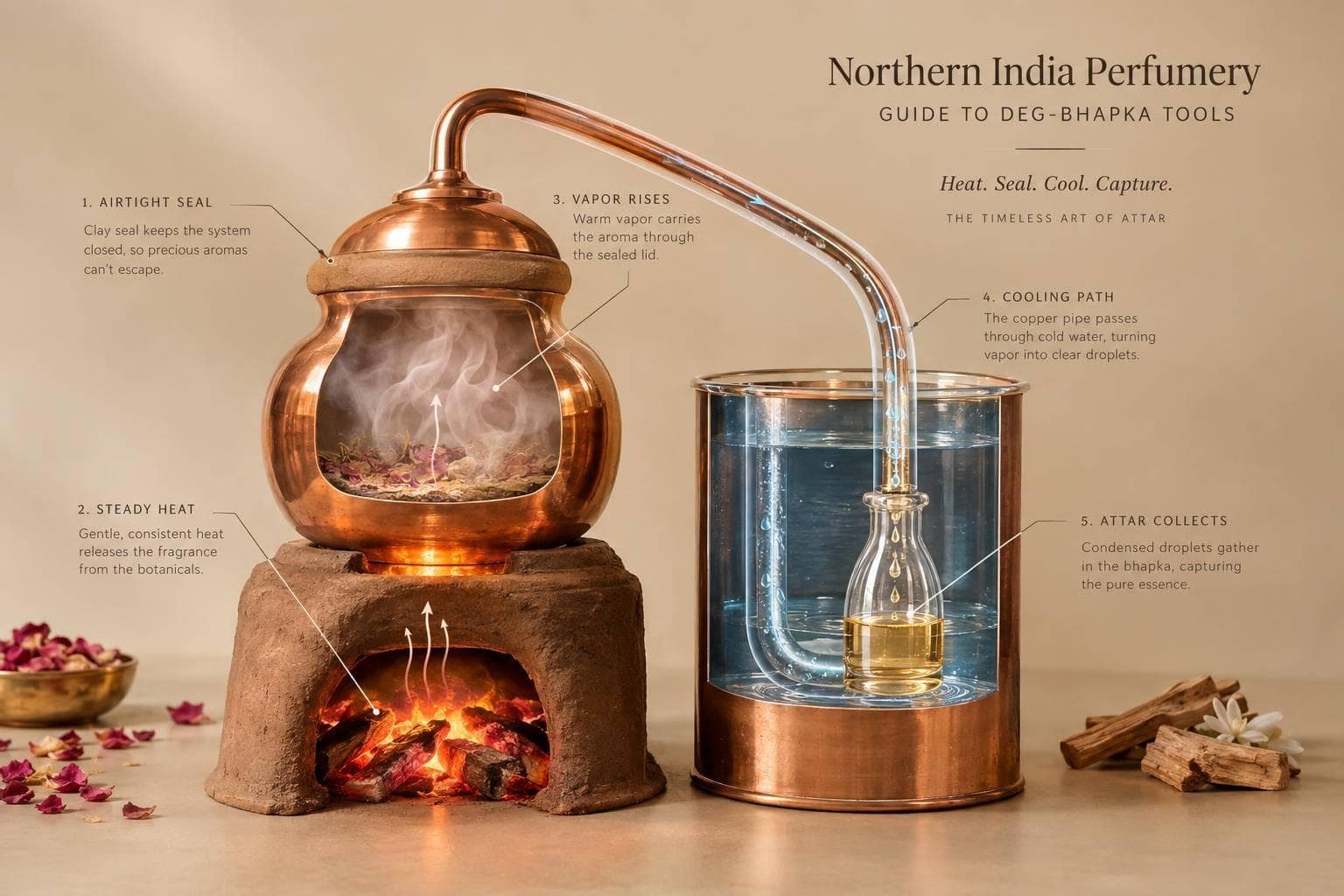
I’d start with 3 controls for making attar: steady heat, sealed joints and a cool receiver. Check the seals and cooling water before heating - each helps keep the aroma in the system.
Here’s how I group the tools:
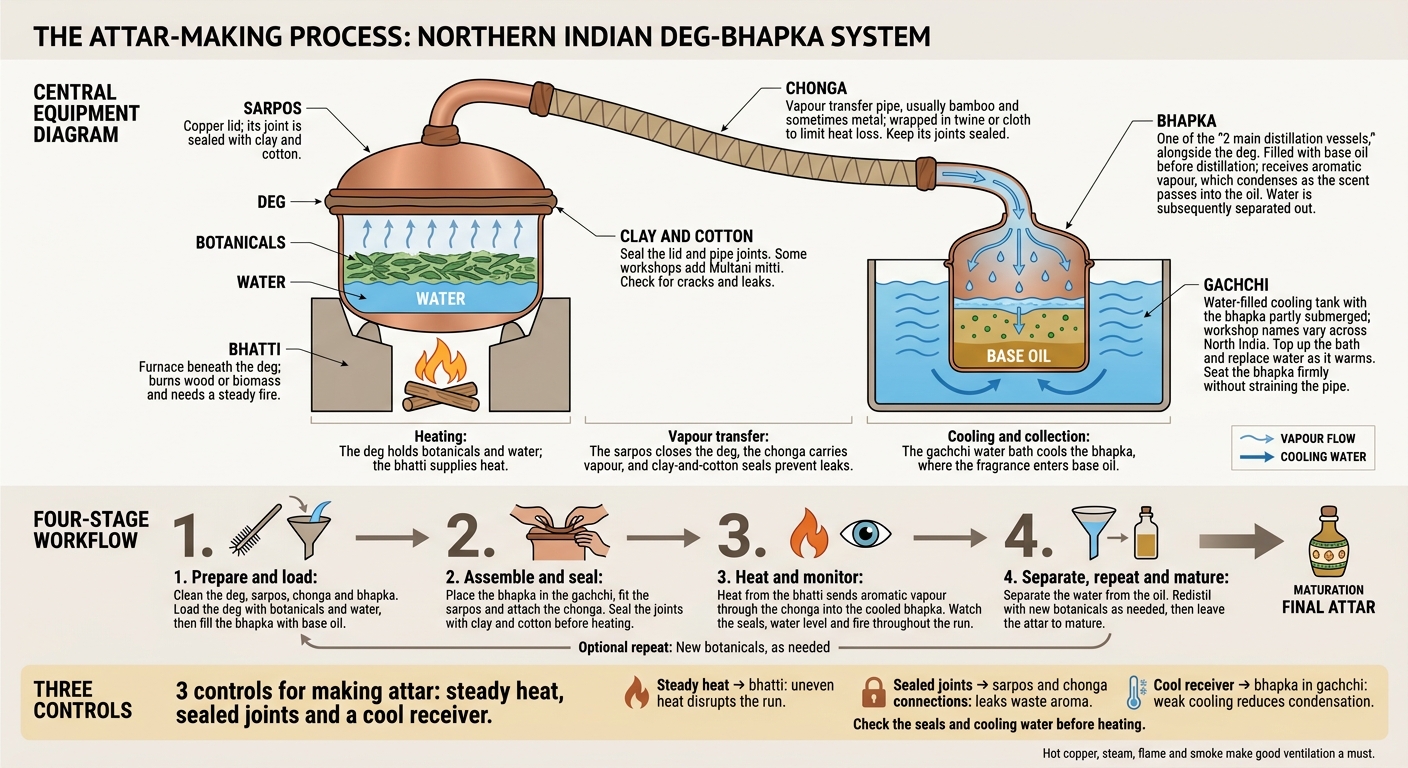
- Heating: The deg holds botanicals and water; the bhatti supplies heat.
- Vapour transfer: The sarpos closes the deg, the chonga carries vapour, and clay-and-cotton seals prevent leaks.
- Cooling and collection: The gachchi water bath cools the bhapka, where the fragrance enters base oil.
The process runs from loading and sealing to heating, separating water from oil, repeating as needed and maturing. My main takeaway? <u>The tools work as one system</u> - not as separate pieces.
Deg-Bhapka Tools: How Attar Is Made
Deg and Bhapka: The 2 Main Vessels
The deg and bhapka are the two main distillation vessels. The deg heats the botanicals and water, while the bhapka receives the aromatic vapour in base oil.
Deg and Sarpos: Loading the Still and Fitting the Lid
The copper deg is filled with botanicals and water, then covered with its copper lid, the sarpos. Clay and cotton seal the joint to keep vapour inside.
As the mixture heats, it releases aromatic vapour. This travels through the chonga and into the bhapka.
Bhapka: Collecting Fragrance in Base Oil
The bhapka is filled with base oil before distillation begins. Its body sits in cooling water, which draws away heat as aromatic vapour enters through the transfer pipe.
Inside the vessel, the vapour condenses and the scent passes into the oil. The water is then separated out. The next step relies on a vapour-tight path and secure seals.
Chonga and Seals: The Vapour Path
Once the bhapka is filled, the vapour path must remain tightly sealed from the deg to the receiver.
Chonga: The Vapour Transfer Pipe
The chonga carries vapour from the deg to the bhapka. Usually made from bamboo, though sometimes metal, it is wrapped in twine or cloth to limit heat loss. This helps the vapour reach the cooled receiver before it condenses. The pipe’s joints must stay sealed throughout.
Clay and Cotton: Sealing the Joints
Distillers use cotton and wet clay to seal the lid and pipe joints. Some workshops add Multani mitti for a tighter seal that resists heat. They check for cracks and leaks, as even small gaps let volatile aroma escape.
With the vapour path sealed, attention turns to balancing heat and cooling around the bhapka.
Személyes illatszakértője már várja
Töltse ki rövid illatkvízünket, és fedezzen fel hiteles designer és niche parfümöket, amelyek az ízléséhez illenek – próbálja ki őket 2, 5, 8 és 30 ml-es dekantokban és mintákban, hogy mindegyiket kipróbálhassa, mielőtt teljes flakon mellett dönt.
Találja meg illatátCooling Tank and Furnace: Balancing Heat
Once the vapour path is sealed, heat and cooling determine how much fragrance is retained. Steady heat in the deg and enough cooling at the bhapka prevent aromatic vapour from escaping before it condenses.
Gachchi: The Receiver’s Cooling Bath
Gachchi is the workshop term for the water-filled tank in which the bhapka is partly submerged. Names vary across North India. The bath cools the bhapka directly, without a separate condenser.
Keep the bath topped up and replace water as it warms. The bhapka’s position matters as much as the water level. Seat it firmly so the submerged surface stays in contact with the water and no strain is placed on the pipe.
Bhatti and Fuel: The Still’s Heat Source
The bhatti is the furnace beneath the deg. It burns wood or biomass and needs a steady fire. Uneven or excessive heat can affect distillation inside the deg.
Hot copper, steam, flame and smoke make good ventilation a must. During the move from loading botanicals to collecting attar, heat and cooling need to stay balanced.
The Attar-Making Process from Start to Finish
From Loading Botanicals to Maturing Attar
With the vessels, seals and cooling bath in place, the run follows a fixed sequence.
- Prepare and load: Clean the deg, sarpos, chonga and bhapka. Load the deg with botanicals and water, then fill the bhapka with base oil.
- Assemble and seal: Place the bhapka in the gachchi, fit the sarpos and attach the chonga. Seal the joints with clay and cotton before heating.
- Heat and monitor: Heat from the bhatti sends aromatic vapour through the chonga into the cooled bhapka. Watch the seals, water level and fire throughout the run.
- Separate, repeat and mature: Separate the water from the oil. Redistil with new botanicals as needed, then leave the attar to mature.
The balance of heat, sealing and cooling shapes the final attar.
Conclusion: How the Tools Work Together
Success depends less on any one tool than on how they work together. Attar relies on three controls: steady heat from the bhatti, a sealed vapour path and strong cooling in the gachchi. Each tool supports a link in that chain. Leaks waste aroma, weak cooling reduces condensation, and uneven heat disrupts the run.
FAQs
Which base oils work best for attar?
Sandalwood oil remains the long-established, preferred base for North Indian attars [2][3]. It works as both a carrier and fixative, holding volatile aromatic compounds during deg-bhapka distillation and helping the fragrance last 8–12 hours or longer on skin [2][3].
Because sandalwood is costly and scarce, some modern producers use liquid paraffin or DOP instead. These substitutes lack the depth and ageing potential of genuine sandalwood oil [4].
How can I check for vapour leaks safely?
Check that the raw clay creates an airtight seal at every connection between the deg, chonga and bhapka. Even tiny leaks can let fragrance escape, with the lightest, most delicate top notes lost first. A proper seal directs the fragrant steam through the chonga into the bhapka - the receiving vessel - instead of letting it escape.
How do I know when to replace the cooling water?
The provided sources give no exact indicator or schedule for replacing the cooling water. In deg-bhapka distillation, the bhapka sits submerged in a cooling tank called a gachchi. The water cools the fragrant steam, helping it condense into liquid.
Artisans monitor temperatures throughout the 8–10-hour process to keep the botanicals from burning and ensure the steam condenses properly.

