


Most perfumes are not “good” or “bad” because they are natural or synthetic. I’d judge them by land use, water use, energy demand, CO₂, waste, species pressure, and how much of the bottle you’ll actually finish.
In plain terms: some natural materials can be resource-heavy, while some lab-made materials can cut pressure on farms and wild species. At the same time, older synthetic musks can stay in water and sediment for a long time. That’s why I wouldn’t trust simple claims like natural = better.
A few numbers make the point fast:
- Fragrance ingredient production is linked to about 470.000 tonnes of CO₂
- It also uses about 81 million tonnes of water
- Jasmine absolute can need 600–1.000 kg of flowers for 1 kg of material
- Rose absolute can need 350–500 kg of petals for 1 kg
- A 100 ml bottle only makes sense if you wear it often
- Unused perfume in Europe is estimated at €780 million
If I want to buy with less waste, I’d keep it simple:
- check where ingredients come from
- look for plantation-grown rather than wild-harvested rare materials
- watch for organic or RSPO claims where they fit
- don’t assume natural is lower-impact
- don’t assume synthetic is worse
- buy 30 ml, 50 ml, or a decant first if I’m unsure
- pick refillable bottles when possible
| What to compare | Natural materials | Synthetic materials |
|---|---|---|
| Land and water | Often high | Often lower |
| Energy use | Can be high in farming and extraction | Depends on process and power source |
| Biodiversity pressure | Can be high for rare plants | Usually lower direct species pressure |
| Persistence in nature | Often lower, but not always | Varies a lot; some older musks last a long time |
| Best buying rule | Check source and yield | Check chemistry route and biodegradability |
So my short take is this: the lower-waste perfume choice is usually the one with clear sourcing, lower-pressure materials, smaller bottle sizes, and packaging you’ll refill or recycle.
Natural Perfume Ingredients: Sourcing, Extraction, and Limits
How Farming and Harvesting Shape the Environmental Cost
The footprint starts long before a bottle is filled. For natural perfume ingredients, the main drivers are land use, water use, oil yield, and labour practices. And when yields are low, the upstream cost can get very heavy, even for a tiny amount of finished material.
That’s why jasmine and rose are among the most resource-hungry naturals in perfumery. Jasmine absolute needs about 600–1.000 kg of hand-picked flowers for 1 kg of absolute, or roughly 8.000 blossoms per millilitre. Rose absolute also asks a lot from the field, with about 350–500 kg of petals needed per kilogram. Patchouli is a different story. Its oil yield is around 1,5–4 %, which works out to about 25–70 kg of plant material for 1 kg of oil.
Rose and jasmine are often grown in intensive monocultures. That can shrink local biodiversity and make pest pressure worse. In dry areas, these crops may also need heavy irrigation and regular fertilisation, which pushes up water and nutrient inputs per kilogram of oil.
How Extraction Methods Affect the Final Footprint
After harvest, processing has a big effect on the final footprint. Life-cycle comparisons show that steam distillation uses about 12,44 MJ of energy and creates 5,51 kg CO₂-eq per kilogram of essential oil. Supercritical CO₂ extraction comes in much lower, at about 1,4 MJ and 2,32 kg CO₂-eq.
| Extraction Method | Energy Demand | Key Environmental Concern |
|---|---|---|
| Steam distillation | High | High energy and water use |
| Supercritical CO₂ extraction | Low | Lower heat; CO₂ can be recaptured and reused |
| Solvent extraction | Low to moderate | Petrochemical solvent waste and residue risks |
| Cold pressing | Very low | Mechanical process only |
Each method comes with a trade-off. Solvent extraction still has a place for delicate florals like jasmine and rose, but it brings petrochemical solvents such as hexane into the process, along with the risk of residue. Supercritical CO₂ extraction runs at about 31 °C and can lower both energy demand and emissions compared with steam distillation. Cold pressing stays the simplest option here: a low-energy mechanical process.
For some naturals, though, footprint is only one part of the picture. Supply pressure and traceability can matter just as much.
Scarcity, Ethics, and Certification for High — Value Naturals
Some ingredients come with problems that start well beyond the farm. Sandalwood trees grow slowly and have a long history of being cut without enough replanting, which has led to population decline and illegal logging in some regions. Oud has its own pressure point. It forms when Aquilaria trees react to fungal infection, and wild trees with high-value resin have been exploited so heavily that several Aquilaria and Gyrinops species are now listed under CITES Appendix II. That means international trade needs proof that exports do not damage wild populations. Plantation-grown oud gives buyers a more traceable option.
Labour matters too. For hand-worked crops like jasmine and vanilla, the issue isn’t just yield. It’s also fair pay and working conditions for smallholder farmers who take on much of the economic risk.
EU organic certification can point to lower use of synthetic fertilisers and pesticides in ingredients such as rose, jasmine, and patchouli, but it does not cover every part of the footprint. For palm-derived materials used in fragrance bases and solvents, RSPO is the main standard to check.
When you’re sizing up a fragrance brand, a few details tell you a lot:
- origin country
- whether ingredients are wild-harvested or plantation-grown
- any organic or RSPO certification
If that origin data is missing, take it as a red flag.
The same life-cycle lens also needs to be used for synthetics, where lower land use can still come with energy use and pollution trade-offs.
Synthetic Perfume Ingredients: Efficiency, Risks, and Green Chemistry
How Synthetics Can Lower Land and Water Use
Synthetic ingredients give perfumers a way to build many scent effects without depending on crops or wild harvesting. Because they are made in controlled production settings from defined raw materials, they can often deliver higher yields per kilogram than agricultural sources.
That matters because the farm stage of natural ingredients can make up 30–100 % of total environmental burdens. This includes land use, irrigation, fertilisers, and fuel. Chemically identical lab-made molecules can also recreate scarce or slow-growing botanical notes without harvesting those materials at scale. And some bio-based synthetics use renewable feedstocks such as plant sugars, plant oils, or biomass instead of fossil carbon.
Still, the label synthetic doesn’t settle the issue on its own. The outcome depends on the feedstock, the manufacturing process, and how long the material stays in the environment.
Where Synthetics Raise Concerns for the Environment
Lower land use doesn’t mean zero impact. Many synthetic aroma chemicals are still made from fossil-based feedstocks, and extracting and refining those starting materials adds to climate change and ecotoxicity. Production can also use a lot of energy, so plants powered by fossil fuels may add more emissions.
Persistence is another issue. Older groups such as nitro musks and some polycyclic musks break down slowly in the environment. Galaxolide (HHCB) and tonalide (AHTN) are among the most widely detected synthetic musks in water, sediments, and aquatic organisms around the world. Galaxolide’s half-life in river water is estimated at around 100 days, and in river sediments at 150–200 days. Near some sewage treatment plant outlets, risk quotients above 1 point to higher environmental risk. Lab studies have linked environmental concentrations of these musks to oxidative stress, genotoxicity, and growth impairment in microalgae and bivalves.
Fragrance VOCs also deserve attention. Studies of fragranced consumer products found that every tested product emitted VOCs classified as toxic or hazardous. These emissions can add to smog formation and affect indoor air quality, especially in enclosed spaces. And this isn’t only a synthetic issue. Both natural and synthetic ingredients can add to VOC emissions.
So the production route matters just as much as the raw material itself.
How Green Chemistry Is Changing Fragrance Manufacturing
Green chemistry is helping make synthetic fragrance production cleaner. The IFRA Green Chemistry Compass scores feedstocks, solvents, catalysts, energy, and waste as "Most Preferred", "Needs Improvement", or "Least Preferred".
In practical terms, that can mean:
- shifting reaction conditions to lower temperatures, often 40–60 °C with enzymes or solid catalysts instead of above 100 °C in standard routes
- replacing petroleum-derived solvents such as toluene or hexane with safer options, or using solvent-free processes
- designing molecules with better biodegradability in mind
Life cycle assessment under ISO 14040/44 is then used to compare full ingredient pathways and identify lower-impact options.
The sector is also moving toward renewable and biomass-balanced feedstocks, certified under schemes such as REDcert — EU and ISCC. These gains make the most sense when they are measured across the full life cycle.
The next step is to compare those gains with natural ingredients through the same life-cycle lens.
Il tuo esperto di profumi personale ti aspetta
Fai il nostro veloce quiz olfattivo per scoprire autentici profumi di design e di nicchia scelti in base ai tuoi gusti: esplorali in decant e campioni da 2–8ml, così puoi provarne ognuno prima di scegliere il flacone intero.
Trova il tuo profumoNatural vs Synthetic: How to Compare Sustainability Properly
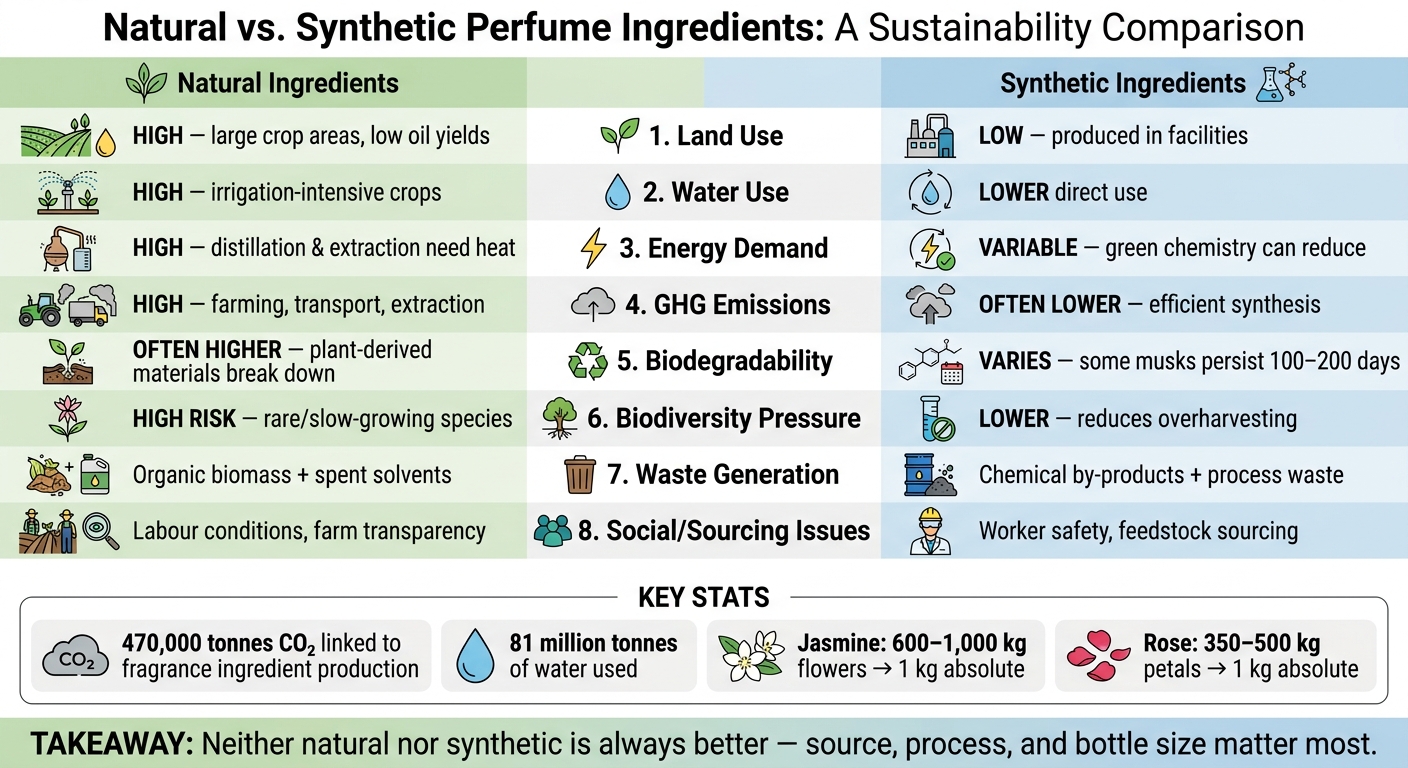
Natural vs Synthetic Perfume Ingredients: Sustainability Comparison
The Factors That Matter Most in a Real Comparison
The main question isn’t whether an ingredient is natural or synthetic. The better question is: which ingredient, source, and production method performs best when you look at the factors that count.
| Factor | Natural Ingredients | Synthetic Ingredients | What It Means for Sustainability |
|---|---|---|---|
| Land use | High - large crop areas for low oil yields | Low - produced in facilities with far less land per kg | Synthetics reduce pressure on agricultural land and ecosystems |
| Water use | High - irrigation-intensive crops carry hidden costs | Lower direct use, but upstream processing still consumes water | Water-stressed naturals can carry hidden environmental costs |
| Energy demand | High - distillation and solvent extraction need a lot of heat | Variable - green chemistry routes can cut this | Process design matters more than the label itself |
| GHG emissions | High when farming, transport, and extraction are added together | Often lower per kg under efficient synthesis and lower-carbon energy | Industry data suggest synthetics often have a lower carbon footprint |
| Biodegradability | Often higher - many plant-derived materials break down more easily | Varies a lot - some musks persist, others break down well | You have to assess this molecule by molecule |
| Waste generation | Organic biomass and spent solvents | Chemical by-products and process waste | Better synthesis and extraction can cut waste on both sides |
| Habitat and biodiversity | High risk for rare or slow-growing species | Lower direct pressure on wild species | Synthetics can reduce overharvesting pressure |
| Social and sourcing issues | Labour conditions and transparency in farming regions | Worker safety and feedstock sourcing | Certifications and supplier transparency matter for both |
Industry life-cycle data suggest that efficient synthetic routes often come with a lower footprint than naturals, but that only holds up when feedstocks and processing are handled well.
That’s why simple labels can send buyers in the wrong direction. Natural sounds clean. Synthetic can sound harsh. But the truth is less neat than that.
Common Myths That Confuse Fragrance Buying Decisions
A few stubborn ideas keep showing up in fragrance marketing and everyday shopping. And honestly, they make smart buying harder than it needs to be.
Myth: Natural always means eco-friendly.
Not necessarily. Some natural materials use a lot of land and water, and some are overharvested. If natural production scales without strict management, it can drain and damage ecosystems.
Myth: Synthetic always means harmful.
That’s too blunt. Many newer synthetics are made to have low persistence and better biodegradability, unlike older molecules that drew regulator attention.
Myth: If a fragrance smells like rose, it must contain rose.
It doesn’t. A rose accord can be built without farming roses at all.
Myth: Natural perfumes are safer for sensitive skin.
Also false. Natural doesn’t mean non-allergenic. What matters is concentration, the full formula, and your own skin response.
The same comparison points above can help when you read a fragrance label, weigh a sourcing claim, or scan an ingredient story. They’re also useful when choosing smaller bottles, decants, and brands that share clear sourcing details.
Practical Buying and Usage Choices for Lower — Waste Fragrance Habits
How Buying Smaller Volumes Can Cut Perfume Waste
Once you’ve looked at ingredients, the next big waste factor is bottle size. European consumers are sitting on an estimated €780 million in unused perfume. A lot of that comes from buying full-size bottles too soon, before a scent has had time to prove itself.
Here’s the simple maths. One spray gives roughly 0,1 ml, so five sprays a day works out to around 15 ml per month. Use a fragrance that often, and a 100 ml bottle will last just under seven months. But that kind of size only makes sense if it’s your daily signature. If you wear perfume now and then, 30 ml or 50 ml is usually the better fit.
That’s where smaller test sizes help. An 8 ml decant gives about 120 sprays. That’s enough time to wear a fragrance in warm weather, cooler days, and those odd skin-chemistry days when a scent behaves a bit differently. In other words, you get a proper trial instead of a first-impression gamble.
Scento offers 2 ml, 5 ml, and 8 ml decants, along with an 8 ml monthly subscription, which gives readers a way to test a scent before committing to a full bottle.
What to Check When Choosing Fragrances More Consciously
After volume, the next things to look at are packaging and sourcing. That’s where a lot of hidden waste shows up.
Ingredient transparency matters more than vague marketing. German shoppers already take sustainability into account when buying cosmetics and pay attention to the absence of harmful raw materials. So fragrance brands need to be specific. Do they use certified naturals? Synthetic stand-ins for threatened species? Green chemistry methods? Those details matter far more than a generic “clean” label.
The better buy isn’t always the one with the nicest story on the box. It’s the one that keeps waste lower across both use and packaging.
Packaging is the other plain, practical check. In Germany, simple glass bottles are easier to recycle than coated bottles or designs made from several materials. Refillable options go a step further. Refilling a 60 ml bottle of Alien Eau de Parfum saves 64 % of glass, 68 % of plastic, 100 % of metal, and 57 % of cardboard compared with buying a new bottle. Across Europe, refillable fragrances make up around 6 % of sales. That’s still a small share, but the direction is clear.
A quick €/ml check can also stop a bad buy. A 5 ml decant priced at €12,90 comes to about €2,58 per ml. That can be close to the per-ml price of many full bottles, but with much less risk. If the scent doesn’t suit you, you’re not left staring at 95 ml of regret on a shelf.
Conclusion: Better Information Leads to Lower — Waste Fragrance Choices
The simplest low-waste rule is still the best one: buy only what you’ll finish. Ingredient source, packaging, and bottle size matter more than the label on its own. The biggest cuts in waste usually come from buying less and buying smaller - test first, size down when it makes sense, and pick refillable or clearly sourced formats when you can.
FAQs
How can I tell if a perfume is truly sustainable?
Look past broad labels like natural, green, or clean. They sound nice, but they don’t tell you much on their own. What matters is proof you can check.
Focus on things like:
- Third-party certifications such as UEBT, Fair Trade, COSMOS, NATRUE, or Rainforest Alliance
- Ingredient-level traceability, especially for sandalwood, vanilla, and wild resins
- Transparent sourcing reports, audit summaries, full INCI lists, and LCA data
Production methods matter too. A balanced mix of natural, nature-identical, and biotech-made ingredients can help protect biodiversity and cut dependence on fossil-fuel-derived synthetics.
Are synthetic ingredients always lower-impact than natural ones?
No. Synthetic ingredients do not automatically have a lower impact than natural ones, and natural ingredients are not automatically the better choice either.
What matters is the full life cycle: energy use, waste, solvent handling, and sourcing. Some synthetic materials use fewer resources, which can make them a better option in some cases. But many are still made from non-renewable petroleum.
So the answer comes down to the specific molecule and the way it is produced. That’s where the real difference lies.
What bottle size should I buy to reduce waste?
To cut waste, test a scent in a smaller decant before you commit to a full bottle.
Scento offers curated decants in 0,75 ml, 2 ml, 5 ml, and 8 ml sizes. That gives you enough time to wear a fragrance for days or even weeks, see how it settles on your skin, and decide if it fits your taste and routine.
It’s a simple way to avoid half-used bottles sitting on a shelf - and to avoid spending € on something that looked good at first, but never became part of your wardrobe.