A perfume batch code checker is a free lookup tool: pick the brand, type the short code printed on the bottle and its box, and it returns the month and year the bottle was made. This guide compares eight of them. The free Scento Decoder reads 13 houses, 10 decoded from each brand’s own code format and 3 published as explicit estimates; CheckFresh and Batchcode.org cover long A–Z brand lists; Lot Date states the longest list, 3,573 brands. No checker can prove a perfume is genuine, because a real code can be copied onto a fake. To date your own bottle, type its code into our free batch code checker.
In short
- The batch code is a short run of letters and digits on the underside of the bottle and on the box flap or base. It is not the barcode.
- The barcode (EAN) identifies the product and is the same on every bottle of it; the batch code marks the production run, so it can be turned into a month and year.
- For a niche or luxury house such as Parfums de Marly, Louis Vuitton or Creed, start with the Scento Decoder; for a designer or cosmetics brand, try CheckFresh, CheckCosmetic or Batchcode.org.
- A code dates a bottle. It does not prove the bottle is genuine, because counterfeiters can copy real codes.
Have a code in front of you? Check a batch code with the Scento Decoder, free and in 10 languages.
Or go straight to a house page: Tom Ford, Jo Malone London, Yves Saint Laurent, Giorgio Armani, Dior, Creed, Chanel, Versace, Parfums de Marly, Louis Vuitton, Amouage, Maison Francis Kurkdjian and Xerjoff.
Every result is cross-referenced against Scento’s 12-point intake authentication, run on 50,000+ bottles received since 2021. Editorial transparency: Scento publishes this guide and operates the Scento Decoder; the other free tools compared below remain solid fallbacks if a bottle isn’t recognized.
Batch code checkers compared
We opened each of these tools on 3 November 2026, recorded what its own page says, and read every page again on 27 November 2026.
| Checker | Brands listed | What it returns | Languages | What it says about authenticity |
|---|---|---|---|---|
| Scento Decoder | 13 houses (10 decoded, 3 estimates) | Production month and year read from the brand’s own code format; a clearly marked estimate for 3 houses | 10 | Reads the date only; a code alone does not prove a bottle is genuine |
| CheckFresh1 | No count stated (A–Z list) | Production date, the product’s age and general shelf-life text | About 100 interface languages | No authenticity claim on the page |
| Batchcode.org2 | No count stated (A–Z list, 3CE to Zara) | Manufacture date and age; also explains period-after-opening symbols and shelf life | English, Spanish | No authenticity claim; “educational purposes only” |
| CheckCosmetic3 | No count stated (Acqua di Parma to Zirh) | Manufacture date and general shelf life | English | No authenticity claim; says results can occasionally be incorrect |
| CosmeticCalculator4 | “500+ Brands” in its header (the dropdown shows about 90) | Estimated manufacture date, expiry date and a Fresh / Expiring Soon / Expired status | English | No clear authenticity claim; dates are estimates “if supported” |
| batchcodechecker.org5 | “Over 1,000 brands supported” | Production date and shelf-life information, usually a manufacturing period | Simplified Chinese, Traditional Chinese, English, Vietnamese | Says it can “assist in authenticity verification”; “not found” does not necessarily mean fake; treat results “as a reference” |
| Lot Date6 | 3,573 supported brands | Production-date estimate plus expiry and freshness context; some brands give month and year only | 11 | “Batch-code decoding is a freshness signal, not proof of safety or authenticity” |
| batch-code.com7 | No count stated (searchable selector) | Manufacture date and freshness or expiry status | English | “A valid batch code alone cannot guarantee authenticity, as counterfeiters can replicate batch codes” |
How do you check a perfume batch code?
Five steps take a bottle from code to date.
- Find the code. It sits on the bottom of the bottle, on the box flap or base, and is sometimes embossed. It is usually a few letters and digits, not the long barcode.
- Check that the code on the bottle and the code on the box match.
- Pick the house in a checker (the Scento Decoder for the 13 houses it reads, CheckFresh or Lot Date for most other brands) and enter the code exactly as printed, without the barcode digits.
- Read the date and compare it with the perfume’s launch year. A date before the perfume existed is a warning sign.
- If a checker says “not found”, try another one or the house page below. A valid date still does not prove the bottle is genuine.
For more ways to spot a fake, see our guides on spotting fake perfumes using batch codes and the key differences between fake and real perfume.
Batch code formats by house
Ten of the 13 houses in the Scento Decoder are decoded from the brand’s own code format. Each house name below opens its page, with where to find the code and more worked examples. Several formats use a single year digit or letter, so the same code can fit more than one year; the decoder returns the most recent year that is not in the future, and the launch year of the perfume settles the rest.
| House | What the code looks like | How the date is read | Example |
|---|---|---|---|
| Tom Ford | 3 characters (newer bottles: 8), for example A94 | Plant, then month (1–9, then A, B, C for October to December), then the last digit of the year; the year digit repeats every ten years | A94 = September 2024 |
| Jo Malone London | 3 characters, for example C31 | Same plant, month and year-digit layout as Tom Ford; a year digit that fits two decades gives the more recent year | C31 = March 2021 |
| Yves Saint Laurent | 6–7 characters, for example 38X302S | Two-character plant code, year letter, month code (1–9, then O, N, D), then the lot; the year letters repeat every 22 years | 38X302S = March 2023 |
| Giorgio Armani | 6–7 characters, for example 38P102 | Same layout as Yves Saint Laurent: plant code, year letter, month code, lot | 38P102 = January 2017 |
| Dior | 4 characters, for example 1L01 | Year digit, month letter, two-character lot; the month letter comes from one of two alphabets that alternate by decade, so A–M letters fit either 1998–2007 or 2018–2027 | 1L01 = November 2021 |
| Creed | 5–10 characters, for example A4220M01 (often quoted as 20M01); since late 2022, F plus 6 digits | Two-digit year, then a month letter (A–M in even years, N–Z in odd years, skipping I and O), then the run; the F plus 6 digits code is a serial with no date in it | A4220M01 = December 2020 |
| Chanel | 4 digits, for example 8302 | The first two digits count months in a cycle that repeats every 8 years; the last two are a sub-lot. One code therefore fits two or three possible years | 8302 = December 2014 or December 2022 |
| Versace | 7 digits, or 1 digit, 3 digits and letters | Year and day of the year: 2-digit year plus 3-digit day, or the last digit of the year plus a 3-digit day then lot letters; the newest layout, seen since about 2024, has no agreed reading yet | 2308406 = 25 March 2023 |
| Parfums de Marly | 6 or 7 digits, sometimes a letter at the end | First digit is the last digit of the year, the next two are the production week, the rest is the lot; the brand does not publish this, so the decoder treats it as medium confidence | 949902 = week 49 of 2019, December 2019 |
| Louis Vuitton | 4 characters, laser-etched, for example 1H02 | Year digit, month letter (A = January to M = December, no I), two-character lot; the brand does not publish this, so the decoder treats it as medium confidence | 1H02 = August 2021 |
Three houses do not publish a code format that can be decoded. For these the Decoder shows a clearly marked estimate rather than a date.
- Amouage: several formats exist side by side, such as G22911, H21D5B and A33511F012, and Amouage has told customers the codes are for internal tracking only.
- Maison Francis Kurkdjian: usually five digits, sometimes with a letter, such as 21196 or S22070; no bottle with a known production date confirms the reading that third-party decoders use.
- Xerjoff: a 6-digit number or a 6-character mix of letters and digits, laser-etched on the base; the brand does not document it publicly.
How can you tell if a perfume is original?
A batch code alone does not prove a perfume is original, because it only reads a production date. To check a decant or full bottle, buy from a registered business with a published returns policy, check it is sold under its real name, and compare how the scent develops and lasts with a full bottle.
How to check that a decant or full bottle is genuine
Batch code tools read a production date; on their own they cannot tell you a bottle is genuine. To check that a decant or a full bottle is genuine, buy from a registered seller, make sure the perfume is sold under its real name, look up a full bottle’s batch code and compare how the scent develops and lasts. A genuine decant is the original perfume, poured from a sealed, original bottle into a smaller atomiser.
- The seller: buy from a registered business with a published returns policy.
- Anonymous sellers: be wary of anonymous marketplace sellers. If the liquid is not the original, nobody is accountable.
- The name: make sure the fragrance is sold under its real name, never as a “dupe”, “clone” or “inspired-by”.
- The batch code: own the full bottle or about to buy one? Look up its batch code with Scento’s free batch code checker. It reads the production date, but a code alone does not prove a bottle is genuine.
- The scent: compare how it develops and lasts with the full bottle or a shop tester. A genuine decant opens, develops and lasts exactly like the full bottle. A thin scent that fades within an hour or two is a warning sign.
Each Scento decant is hand-poured from an original full-size bottle, never a clone, dupe or inspired-by version.
What a batch code tells you, and what it cannot
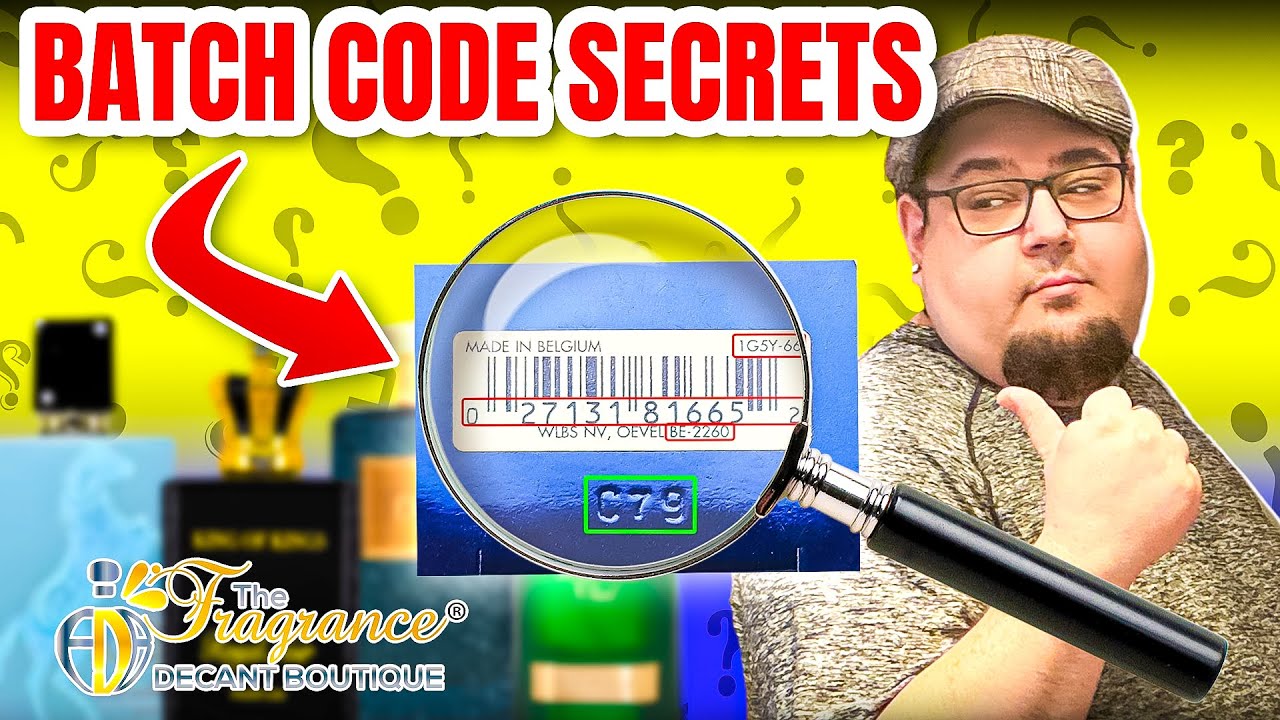
A batch code identifies one production run. Decoded, it tells you roughly when the bottle was made, which lets you test that date against the perfume’s launch year. It does not tell you whether the bottle is genuine, and it is not an expiry date: perfume has no fixed expiry, and the shelf-life figures some checkers print are general guides. The short video below shows what a batch code looks like on a real bottle.
Scento Decoder: what it checks and what it cannot
- What it checks: the production month and year for 13 houses, read from each brand’s own code format for 10 of them and given as a clearly marked estimate for Amouage, Maison Francis Kurkdjian and Xerjoff. Each house page shows where that house puts its code and worked examples.
- What it cannot do: prove that a bottle is genuine, or date a brand outside its 13 houses. It also cannot date a decant vial: manufacturer batch codes belong to the original full-size bottles and are not printed on decant vials, Scento’s own included, so a vial with no code is expected.
- Where: scento.com/perfume-batch-code, free, no sign-up, in 10 languages.
1. CheckFresh.com
CheckFresh is a free batch code checker with a long A–Z list of brands. Choose the brand, type the code and it returns the production date.1
Supported Brands
CheckFresh does not state how many brands it covers. Its page asks you to “Choose the brand of your cosmetic” from an A–Z list, so look for your house there before you type a code.
How It Works
After you pick the brand and enter the code, CheckFresh shows the production date read from the code and the product’s age, for example “8 months 2 days”. It also prints general shelf-life text: about five years for perfume and at least three years for skin care, with the note “The shelf life may vary depending on the manufacturer.” The page needs no fee or sign-up, offers about 100 interface languages and shows a live feed of recent checks.
Limits
CheckFresh makes no claim about whether a bottle is genuine, and the shelf-life lines are general figures rather than a date for your bottle. The site links to no app of its own; an iPhone app called Check Fresh is listed by a separate developer.
2. Batchcode.org
Batchcode.org calls itself a “100% Free Tool” and offers an A–Z dropdown of brands, from 3CE to Zara.2
Supported Brands
The page gives no brand count. It says “New brands added regularly.”, and you pick your house from the dropdown.
How It Works
Choose the brand and enter the code to see the manufacture date and the product’s age. The site also explains period-after-opening symbols and shelf life: about three years unopened, and five years or more for perfume. It is available in English and Spanish.
Limits
Batchcode.org carries a disclaimer that it is for “educational purposes only” and makes no claim about authenticity. It works on the web only, and the page shows an Amazon affiliate notice.
3. CheckCosmetic.com
CheckCosmetic now runs at checkcosmetic.net; the older article name was CheckCosmetic.com. It reads manufacture dates for beauty and perfume brands.3
Supported brands
The page says “Currently the following brands are supported:” and gives no count. The list runs from Acqua di Parma to Zirh.
Output Details
Enter the code to get the manufacture date plus general shelf life. The site is in English and has a mobile version at m.checkcosmetic.net.
Limits
CheckCosmetic warns that “occasionally calculation results can be incorrect”. It says its data comes partly from official sites and partly from “consultants and resellers”. It makes no claim about authenticity.
Other free checkers worth knowing
- CosmeticCalculator. What it checks: an estimated manufacture date, an expiry date and a Fresh, Expiring Soon or Expired status, with a manual mode and reminders. Its header says “500+ Brands”, though its dropdown lists about 90.4 What it cannot do: say whether a bottle is genuine; it describes its dates as estimates “if supported” and tells you to check the packaging.
- batchcodechecker.org. What it checks: the production date and shelf-life information, usually as a manufacturing period, for “Over 1,000 brands”, free and with no registration, in four languages.5 What it cannot do: settle authenticity: it says a “not found” result does not necessarily mean fake and that results should be treated “as a reference”.
- Lot Date. What it checks: a production-date estimate with freshness context for 3,573 listed brands, in 11 languages; some brands return month and year only. It has a free web checker and free Android and iPhone apps with in-app purchases.6 What it cannot do: read barcodes, shade numbers, SKUs or UPCs, and it says batch-code decoding is “a freshness signal, not proof of safety or authenticity”.
- batch-code.com. What it checks: a manufacture date and a freshness or expiry status, free and with no sign-up, through a searchable brand selector.7 What it cannot do: guarantee authenticity: it states that “counterfeiters can replicate batch codes”, and says an unrecognised code is a red flag.
Which checker to use for which bottle
- Niche house such as Parfums de Marly, Louis Vuitton or Creed: use the Scento Decoder, which reads each house’s own code format.
- Designer or cosmetics brand: try CheckFresh, CheckCosmetic or Batchcode.org and pick the brand from the list.
- Shelf-life question: Batchcode.org and CosmeticCalculator both explain shelf life, and our guide to whether perfume expires covers how long a fragrance lasts.
- Two tools disagree: go back to the format table above and use the perfume’s launch year to rule out dates that are too early.
- Not found anywhere: contact the house, quoting the code and the perfume name.
- Want to scan the bottle with your phone instead of typing a code? Our guide to perfume authenticity apps compares photo, QR and NFC scans.
The bottom line
A batch code dates a bottle. A good checker turns a few characters into a month and a year, and that is useful when you want to know how old a bottle is or whether the date fits the perfume’s launch.
It is one check among several, so combine it with the checks in the genuine-check section above: buy from a registered seller with a published returns policy, make sure the code on the bottle matches the one on the box, and see whether the scent develops and lasts like a tester. If you are buying second-hand, our guide to buying perfume on Vinted adds checks for marketplace listings, and the QR code steps cover another quick test.
A batch code tells you when a bottle was made, not whether it is past its best: our guide to whether perfume expires explains how long a fragrance keeps once opened and the signs that it has turned.
Buying a bottle as a gift? See our perfume gift sets. For Christmas, our perfume advent calendar for men puts a different perfume behind each door.
How we compared the checkers
Updated 27 November 2026. We first opened each third-party tool on 3 November 2026 and recorded its own wording: brand count, what it returns, languages and what it says about authenticity. On 27 November 2026 we loaded all seven pages again, plus Lot Date’s app store listings, and checked every table cell and card against them. Lot Date’s page names 11 languages and links Android and iPhone apps, so its row and card were corrected, and CheckFresh’s card now says which iPhone app is not its own; the other five read as before. Where a page gives no count, the table says so, and where a header and a brand dropdown disagree, both figures are given. The Scento Decoder’s coverage comes from its published methodology; Scento publishes this guide and operates the Decoder.
Sources
- CheckFresh, https://checkfresh.com, accessed and .
- Batchcode.org, https://batchcode.org, accessed and .
- CheckCosmetic, https://checkcosmetic.net/, accessed and .
- CosmeticCalculator, https://cosmeticcalculator.com, accessed and .
- batchcodechecker.org, https://batchcodechecker.org/, accessed and .
- Lot Date, https://lotdate.com/, accessed and .
- batch-code.com, https://www.batch-code.com/, accessed and .
Update — the Scento Decoder is now live
Editorial transparency: Scento publishes this guide and operates the Scento Decoder. The decoder gets a section here separate from the comparative review above. Here's what is different about it.
Brand coverage. The decoder also covers luxury-niche houses such as Maison Francis Kurkdjian, Parfums de Marly, Xerjoff, Amouage and Louis Vuitton, where the three tools above mark several brands as “not yet supported.”
Languages. 10 languages: English, German, French, Spanish, Italian, Romanian, Greek, Hungarian, Czech and Polish.
Data provenance. Every batch decoded by the Scento Decoder is cross-referenced against Scento's 12-point intake authentication program — over 50,000 bottles received and verified since 2021. The other tools rely on user submissions; ours has direct provenance from our own warehouse intake.
Mobile-first UX. Built as a server component with no signup, no ads, and no interstitial. Tap, paste, decode. Sub-second result on a 4G connection.
If the Scento Decoder doesn't recognize a particular bottle, the three tools above remain solid free fallbacks. For an exact date that no decoder can deliver, contact the brand's customer service directly — most luxury houses respond within 48 hours.
Per-brand verification pages cover the houses with the highest GSC volume: Tom Ford, Creed, Dior, Yves Saint Laurent, Maison Francis Kurkdjian, Parfums de Marly, Amouage, Xerjoff, and five others.
Svar på dina frågor
- Where do I find the batch code on a perfume?
- The batch code is often found in a few specific places: on the bottom of the bottle, on the packaging, or near the label - typically on the side or back of the product. Take a close look at these areas; the code dates the bottle but does not prove it is genuine.
- Why does my batch code show "not found" in a checker?
- If a batch code returns a "not found" result, it could be due to a few reasons: the brand may not be supported by the checker, the code might have been entered incorrectly, or the code itself could be damaged or illegible. Double-check the accuracy of the entered code and confirm whether the tool indexes the brand. For brands with no public decoding algorithm, the Scento Decoder at /perfume-batch-code returns an estimated date with that label visible.
- Can a batch code confirm my perfume is authentic?
- Not on its own. A batch code dates the bottle: a checker reads when it was made and, for some brands, its shelf life, but a real code can be copied onto a fake. Use it as one check among several: buy from a registered seller with a published returns policy, make sure the code on the bottle matches the one on the box, and compare how the scent develops and lasts with a tester or the full bottle.
- Is the Scento Decoder more accurate than CheckFresh?
- For designer brands like Tom Ford, Creed, Dior, and Yves Saint Laurent, both tools use the same publicly documented decoding algorithms and return identical results. For niche houses (Maison Francis Kurkdjian, Amouage, Parfums de Marly, Xerjoff, Louis Vuitton), the Scento Decoder draws on Scento's 12-point intake authentication database — over 50,000 bottles verified since 2021 — covering brands the older tools mark as 'not yet supported.' If neither tool decodes your bottle, contact the brand's customer service directly; most luxury houses respond within 48 hours. Try the Scento Decoder at /perfume-batch-code.
- How do I check that a decant is genuine?
- Buy from a registered business with a published returns policy, make sure the perfume is sold under its real name and never as a dupe, clone or inspired-by version, and check that it opens, develops and lasts like the full bottle. A genuine decant is the original perfume, poured from a sealed, original bottle into a smaller atomiser. If you own the full bottle, Scento's free batch code checker reads its production date, but a code alone does not prove a bottle is genuine.
- What is the difference between a batch code and a barcode?
The barcode (EAN) identifies the product and is the same on every bottle of it. The batch code marks one production run, so a checker can turn it into a month and year. Checkers such as Lot Date reject barcodes, so enter the short code from the base of the bottle or the box flap instead.
- Why do two checkers give different dates for the same code?
Many codes use a single year digit or letter, so one code can fit more than one year. Tools also differ in how far they trust a reading: some print an estimate, others a range. When two disagree, check the house format table above and use the perfume’s launch year to rule out any date before it existed.
- Should the batch code on the bottle match the box?
Yes, compare them. A matching bottle and box code is one sign that the pack belongs together, and a different code is a reason to look closer. Some houses print the box code a character or two differently, so check the house page. A match is still not proof that a bottle is genuine.
- Can a batch code tell me if my perfume has expired?
No. A batch code gives the production date only. Perfume has no fixed expiry date, and the shelf-life figures some checkers show are general guides that vary by maker. How long a bottle stays good depends on how it is stored; our guide on whether perfume expires explains the signs that a fragrance has turned.
- What is the best perfume batch code checker?
It depends on the house. For the 13 houses it reads, from Dior and Tom Ford to Creed, Parfums de Marly and Louis Vuitton, the free Scento Decoder reads each brand’s own format. For other designer and cosmetics brands, CheckFresh has a long A–Z list in about 100 languages, and Lot Date states the longest list, 3,573 brands. None of them proves a bottle is genuine.
- Is CheckFresh accurate?
CheckFresh is free and reads the production date from the code you enter, but it makes no claim about authenticity, and its shelf-life lines are general figures. Many codes carry a single year digit, so one code can fit two decades: compare the date with the perfume’s launch year, and if it still looks wrong, try a second checker.
- Which batch code checker covers the most brands?
Of the eight compared here, Lot Date states the largest list, 3,573 brands. batchcodechecker.org says “Over 1,000 brands”, CosmeticCalculator’s header says “500+ Brands”, and CheckFresh, Batchcode.org, CheckCosmetic and batch-code.com give no count. A long list is not the same as a correct reading for your house, so check the house format table above.
- Can I check a cologne batch code the same way?
Yes. Checkers ask for the house, not the concentration, so a cologne, an eau de toilette or an eau de parfum is looked up the same way: pick the house and enter the short code from the base of the bottle or the box flap. The date you get is that bottle’s production run.
- Can I check a perfume batch code online for free?
Yes. Every checker on this page lets you look up a code on its website without paying, and Lot Date’s app is free to download, with paid upgrades. What you get is a production date: none of them can tell you whether the liquid in the bottle is genuine.
- Why is there no batch code on my perfume decant?
Because the code belongs to the full-size bottle the decant was poured from. Manufacturer batch codes are not printed on decant vials, Scento’s included, so a checker has nothing to read on a vial. To judge a decant, use the checks in the genuine-check section above: the seller, the name and how the scent develops and lasts.
Citera den här sidan
Scento (2026). Batch Code Tools for Perfume Verification. Uppdaterad 27 november 2026. https://www.scento.com/se/blog/batch-code-tools-perfume-verification
Relaterade guider
- →How to Spot Fake Perfumes Using Batch Codes
- →How to Spot Fake Perfumes Using QR Codes
- →Batchkodskontroll för parfym: kontrollera om din parfym är äkta
- →Batchkodskontroll för Versace: är din parfym äkta?
- →Förfalskad mot äkta parfym: de viktigaste skillnaderna
- →De 7 tydligaste tecknen på falska parfymflaskor
- →Topp 5 appar för att kontrollera parfymers äkthet