Biotechnology is transforming how fragrances are made, replacing traditional plant extraction with lab-based processes like precision fermentation and plant cell technology. This shift offers multiple advantages:
- Eco-Friendly Production: Fragrance compounds like Ambrofix™ require significantly less land - up to 220x less - compared to farming methods.
- Year-Round Consistency: Unlike farming, biotech processes are unaffected by weather or seasons, ensuring stable and reliable outputs.
- Molecular Precision: Lab-created molecules are pure and allergen-free, providing safer and more predictable results.
- Wellness Benefits: Biotech enables the creation of "neuroscents" that target mood, stress, and focus by interacting with the brain’s limbic system.
- Biodiversity Protection: Rare or endangered plants no longer need to be harvested, preserving species like sandalwood and agarwood.
As demand for sustainable, wellness-driven fragrances grows, biotechnology is leading the way with efficient, ethical, and scientifically precise solutions.
How Biotechnology Creates Fragrance Ingredients
Biotechnology is reshaping the fragrance industry with two cutting-edge methods that offer a sustainable and consistent way to produce scent ingredients. These processes not only eliminate the uncertainties of traditional farming but also help preserve rare and endangered plant species. Let’s take a closer look at these innovative approaches and their impact on creating wellness-oriented fragrances.
Plant Cell Biotechnology
Instead of cultivating entire plants, plant cell biotechnology focuses on growing plant cells in controlled laboratory bioreactors. This technique is especially useful for producing rare and costly ingredients like orris butter, which traditionally requires years of aging. By isolating only the cells responsible for producing fragrance molecules, scientists can create these ingredients with minimal resource use.
This method also plays a crucial role in protecting biodiversity. Ingredients sourced from endangered plants - such as sandalwood, agarwood, and certain orchids - can now be synthesized without disrupting wild populations. As David Banks, Marketing Director at Bell Flavors & Fragrances, explains:
"I don’t have to cut down another tree - to me, that’s a win".
Additionally, this approach ensures safer formulations by producing purified fragrance molecules. By replicating natural extraction methods without relying on traditional agriculture, plant cell biotechnology offers a sustainable alternative.
Precision Fermentation
Precision fermentation takes a different route, employing microorganisms like yeast (Saccharomyces cerevisiae) and bacteria (Escherichia coli) as miniature factories for fragrance production. Scientists program these microbes using plant DNA, enabling them to convert sugars into complex scent molecules. Unlike chemical synthesis, which can result in mixtures with unwanted byproducts, fermentation delivers pure molecules with precise scent characteristics.
Several fragrance companies have already adopted this method to create innovative products. Firmenich, for instance, introduced Clearwood®, the first-ever biotech ingredient offering a sustainable patchouli profile. Givaudan has developed Ambrofix™ (woody/ambery notes) and Akigalawood® (spicy/woody) in its Switzerland pilot plant. In another example, Ginkgo Bioworks partnered with Robertet in 2015 to engineer yeast strains capable of producing peach, apricot, and coconut scents, marking a significant advancement in biotech fragrance production.
Unlike traditional farming, fermentation ensures consistent quality year-round. Sarah Reisinger, Senior Vice President for Research Operations at Firmenich, highlights the efficiency of biology in this process:
"Biology is amazing. For example, if you want a specific oxygenation, a P450 enzyme is incredibly efficient".
Together, these biotechnological methods are paving the way for a new generation of sustainable and wellness-focused fragrances, combining nature’s essence with scientific precision.
Benefits of Biotech Fragrances for Wellness and the Environment
Biotechnology offers breakthroughs that go far beyond the confines of a lab. By addressing environmental concerns and enhancing personal wellness, this approach is reshaping the fragrance industry. The transition from traditional methods to biotech processes marks a significant shift in how fragrances affect both the planet and individual well-being.
Environmental Benefits
Biotech fragrances make a strong case for environmental sustainability. For instance, producing just 1 kg of Ambrofix™, a woody-amber fragrance made through fermentation, requires 100 times less land compared to traditional methods. Similarly, BisaboLife™ uses 220 times less land than conventional harvesting techniques.
Unlike agriculture, which is vulnerable to weather, diseases, and seasonal changes, biotech production occurs in controlled bioreactors. These systems are immune to such disruptions, ensuring consistent and reliable outputs.
Biotechnology also helps protect endangered plant species. A good example is the Massoia tree, whose bark is traditionally stripped to extract lactones, leading to the tree’s death. With biotech, yeast can produce these creamy, fruity scent molecules without harming any plants. Agnes, Head of Ingredient Research at Givaudan, highlights their approach:
"At Givaudan, we take a collaborative approach to biotechnological innovation. Our scientists work closely with our perfumers to develop delightful fragrance ingredients that are good for the planet and inspiring on a creative level, too".
Additionally, biotech processes utilize renewable resources, such as sugarcane and upcycled waste like patchouli oil byproducts, transforming low-value materials into high-quality fragrance ingredients. This efficiency not only reduces waste but also results in allergen-free, consistent fragrance production.
Allergen-Free and Consistent Ingredients
Biotech methods go beyond environmental benefits by refining ingredient purity and ensuring reliability. Traditional essential oils often contain allergens like limonene, linalool, and eugenol. Biotech processes, however, produce purified molecules free from these common allergens, guaranteeing safer options for consumers.
On an industrial scale, biotech fermentation achieves remarkable efficiency. For example, yields of β-Farnesene can reach 130 g/L in 200-ton bioreactors. This batch-to-batch consistency is critical for fragrances designed to support emotional or therapeutic outcomes, ensuring each product delivers the same experience every time.
Mood-Enhancing and Functional Scents
This precision doesn’t just benefit safety and sustainability - it also opens doors for functional, mood-enhancing fragrances. By expanding the range of available ingredients, biotechnology enables the creation of "neuroscents" that interact with the brain’s limbic system to influence mood and memory.
Studies reveal that 78% of UK consumers believe fragrances can boost their mental well-being, while 24% actively seek aromatherapy-related wellness products. Biotech helps meet this demand by producing pure molecules that interact predictably with brain receptors. For example, linalool derived from lavender can ease anxiety without causing drowsiness, while limonene from citrus promotes mental alertness and increases confidence.
Kristal Goodman, Head of Product Innovation at THG LABS, captures this evolution:
"Biotechnology is revolutionizing the development of functional fragrance actives by expanding the perfumer’s palette beyond traditional ingredients like lavender and jasmine".
The demand for sustainable fragrances is on the rise, with the market expected to surpass $36 billion by 2029. Consumers are increasingly drawn to products that align with their wellness goals and environmental values. Biotech-derived ingredients, which can legally be labeled as "natural" in both the U.S. and Europe, meet these clean-label demands without the ecological toll of intensive farming. With its precision and sustainability, biotechnology is ushering in a new era of fragrances that support both personal wellness and environmental care.
Biotechnology vs. Traditional Extraction Methods
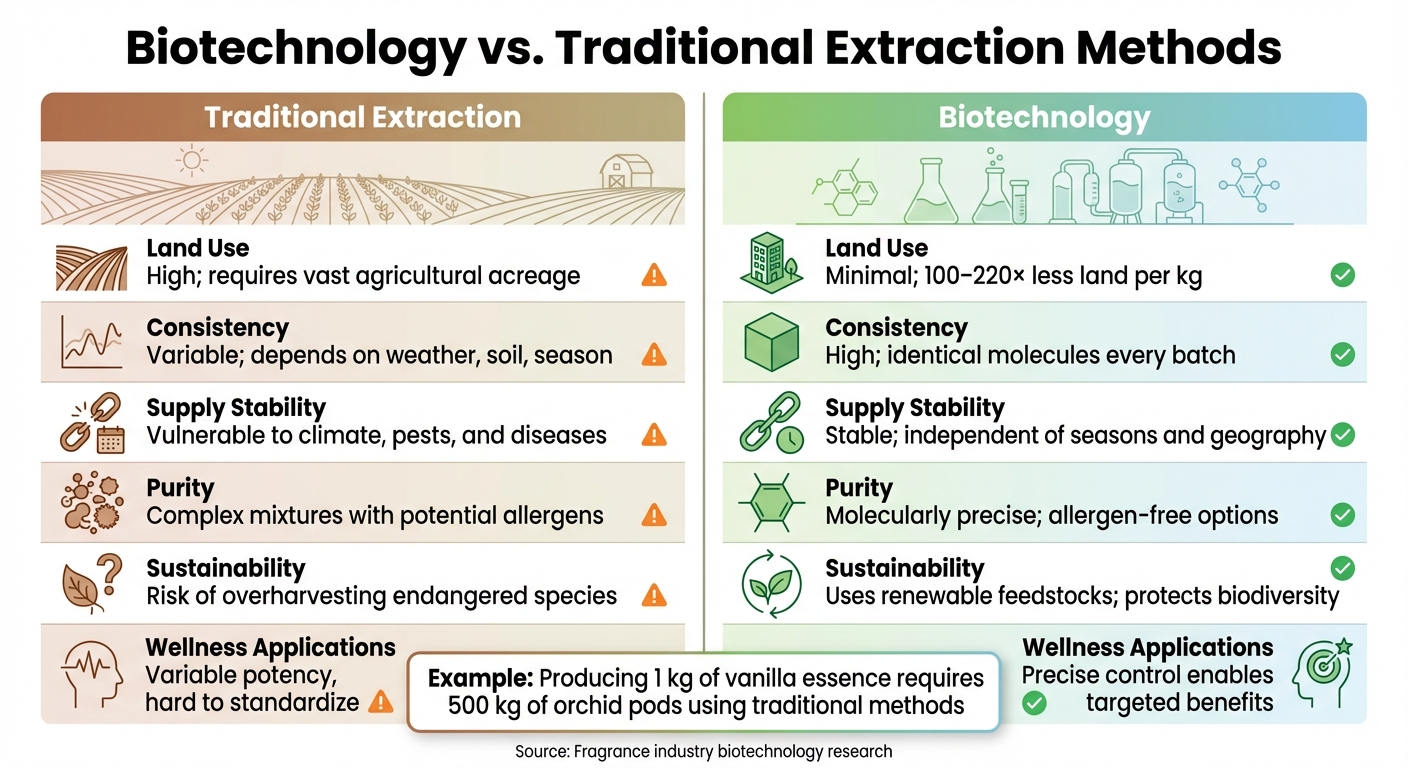
Biotechnology vs Traditional Extraction Methods in Fragrance Production
Traditional extraction methods rely on large-scale harvesting of plants to capture nature’s scents. For instance, producing just 1 kg of vanilla essence demands approximately 500 kg of orchid pods. This approach is not only resource-intensive but also highly susceptible to external factors like weather conditions, pests, and geopolitical issues. These vulnerabilities highlight the need for a more reliable and efficient alternative.
Biotechnology offers a modern solution by using controlled fermentation processes to create fragrance molecules. Instead of depending on seasonal harvests, biotech methods utilize fermentation tanks to produce consistent and pure results year-round. As David Banks aptly put it:
"I don’t have to cut down another tree - to me, that’s a win".
This transition from agricultural fields to laboratory fermenters ensures stable production, unaffected by environmental or geopolitical disruptions.
Biotechnology also excels in precision, particularly for wellness-focused fragrances. Traditional essential oils are complex blends of hundreds of molecules, some of which may include allergens. Biotech, on the other hand, isolates and produces specific molecules, eliminating unwanted compounds. Sarah Reisinger, Senior Vice President for Research Operations at Firmenich, emphasizes this advantage:
"Biology is amazing. For example, if you want a specific oxygenation, a P450 enzyme is incredibly efficient".
This level of molecular precision allows for the creation of fragrances with targeted wellness benefits, which are often challenging to achieve with natural extracts due to their variability.
Comparison Table: Biotechnology vs. Traditional Extraction
| Aspect | Traditional Extraction | Biotechnology |
|---|---|---|
| Land Use | High; requires vast agricultural acreage | Minimal; 100–220x less land per kg |
| Consistency | Variable; depends on weather, soil, season | High; identical molecules every batch |
| Supply Stability | Vulnerable to climate, pests, and diseases | Stable; independent of seasons and geography |
| Purity | Complex mixtures with potential allergens | Molecularly precise; allergen-free options |
| Sustainability | Risk of overharvesting endangered species | Uses renewable feedstocks; protects biodiversity |
| Wellness Applications | Variable potency, hard to standardize | Precise control enables targeted benefits |
sbb-itb-fb213bc
The Future of Wellness Fragrances Through Biotechnology
AI-Designed Neuroscents
Artificial intelligence is now at the forefront of biotech advancements, crafting neuroscents that do more than just smell good - they actively influence the brain to promote stress relief and mental clarity. By engineering molecules that interact with specific odor receptors, these fragrances are designed to deliver measurable wellness benefits. For instance, Givaudan has identified 20 odor receptors that natural scent molecules can activate, paving the way for tailored scent experiences. Similarly, fragrance innovators like SIX7 are teaming up with neuroscientists and sensory designers to create "codes" - compounds engineered to produce targeted emotional effects. Considering that about 75% of daily emotions are triggered by smell, this shift redefines fragrance as a functional tool for emotional well-being rather than just a cosmetic indulgence.
Reimagining Ingredients with Biotechnology
Biotechnology is also breathing new life into scents that were once thought to be lost forever. In 2025, Future Society (Arcaea) unveiled a collection of six fragrances, each crafted from the DNA of extinct flowers. Among these is "Solar Canopy", which revives the aroma of Hibiscadelphus wilderianus, a Hawaiian flower last documented in 1912. By combining genetic sequencing with fermentation, scientists extracted fragrance genes from preserved herbarium specimens and recreated the scent using engineered yeast. This process, dubbed "scent-surrection," is revolutionizing how rare and extinct aromas are brought back to life. Additionally, Firmenich’s Dreamwood™, introduced in 2020, offers a sustainable alternative to Mysore sandalwood, achieving the same luxurious scent profile without cutting down a single tree.
These innovations not only highlight sustainability but also set the stage for fragrances that target emotional wellness with scientific precision.
Functional Fragrances for Emotional Wellbeing
The wellness fragrance industry is evolving from offering pleasant scents to delivering targeted emotional benefits through advanced biotechnology. By isolating and synthesizing specific molecules, these fragrances provide consistent effects like stress relief, relaxation, and improved focus - something traditional essential oils, with their natural variability, often fail to achieve. Neuroscientist Karina Del Punta, Ph.D., emphasizes the emotional depth of these advancements:
"Reconstructed scents of extinct flowers are not just olfactory curiosities - they’re emotional bridges between what has been lost and what still might be saved".
Another groundbreaking area of research involves microbiome-interactive scents. These fragrances work in harmony with the skin’s natural bacteria to either neutralize unpleasant odors or generate pleasing aromas. Often referred to as "living deodorants", they represent a transformative approach to fragrance, enhancing well-being by working with your body’s biology from within. This next wave of innovation promises to redefine how we experience and benefit from scents in everyday life.
Conclusion
Biotechnology is reshaping how wellness fragrances are crafted, moving away from traditional farming practices toward precise lab-based fermentation. This shift tackles pressing issues like climate-induced supply chain disruptions and the over-harvesting of endangered plants such as sandalwood. At the same time, it offers consistent, allergen-free ingredients that align with modern consumer priorities for safety and environmental responsibility.
The environmental benefits are undeniable. Data shows this approach significantly reduces ecological strain, ensuring fragrance production can protect biodiversity while maintaining a stable, year-round supply.
What makes biotech-driven fragrances stand out is their molecular precision. Unlike natural plant extracts, which can vary based on season or geography, fermentation-derived molecules consistently deliver the same olfactive profiles. This reliability is especially important for fragrances designed to support stress relief or improve focus.
As these advantages continue to gain recognition, the future of wellness fragrances is becoming clear. The next chapter lies at the intersection of scientific innovation and environmental stewardship. With the sustainable fragrance market expected to surpass $36 billion by 2029, brands adopting biotechnology aren’t just meeting consumer expectations - they’re leading the way toward a more ethical and forward-thinking industry. From reviving extinct floral scents through DNA sequencing to creating neuroscents that interact directly with brain chemistry, biotechnology is proving that sustainability and sensory sophistication can go hand in hand.
FAQs
How does biotechnology contribute to sustainable fragrance creation?
Biotechnology is reshaping the way fragrances are produced by harnessing the power of engineered microorganisms like yeast and E. coli. These tiny organisms are programmed to transform renewable resources, such as simple sugars, into valuable scent molecules like sandalwood, citrus, or vanilla. This fermentation-based approach offers a more efficient and environmentally conscious alternative to traditional farming methods.
One of the standout benefits of this process is its ability to reduce the strain on natural resources. By eliminating the need for large-scale farming, it cuts down on land use, water consumption, pesticides, and carbon emissions. Moreover, fermentation provides consistent results year-round, unaffected by seasonal or climate variations, ensuring a reliable supply of high-quality ingredients.
This method is not only energy-efficient but also generates less waste and requires fewer solvents, making it a cleaner option overall. By producing natural and high-quality scents without exhausting botanical resources, biotechnology is paving the way for a more sustainable future in fragrance creation.
How do neuroscents enhance wellness fragrances?
Neuroscents are more than just pleasant aromas - they’re scientifically designed scent molecules that can influence your mood and emotions. By engaging directly with the brain’s limbic system through olfactory receptors, these fragrances can help create a sense of calm, boost energy levels, or enhance focus. Essentially, they turn a simple fragrance into a powerful tool for mental and emotional well-being.
What makes these scents particularly fascinating is how they’re developed. Using biotechnology, they are crafted with exceptional precision, ensuring purity while minimizing the strain on natural resources. This method not only supports more sustainable practices but also enables the creation of fragrances that target specific wellness goals, like easing stress, sharpening mental clarity, or encouraging relaxation. Neuroscents represent a seamless blend of science and sustainability, offering a new way to experience the benefits of fragrance.
How does biotechnology help protect endangered plants used in fragrances?
Biotechnology has opened the door to crafting fragrance ingredients in laboratories using microorganisms like yeast and bacteria. By engineering these microbes, scientists can produce scent compounds identical to those found in nature, removing the need to harvest endangered plants such as agarwood, rosewood, or rare varieties of roses.
This approach plays a crucial role in protecting delicate ecosystems while ensuring a steady, year-round supply of ingredients. It also minimizes the strain of traditional farming and harvesting on the environment, offering a greener way to create fragrances and preserving biodiversity for generations to come.

