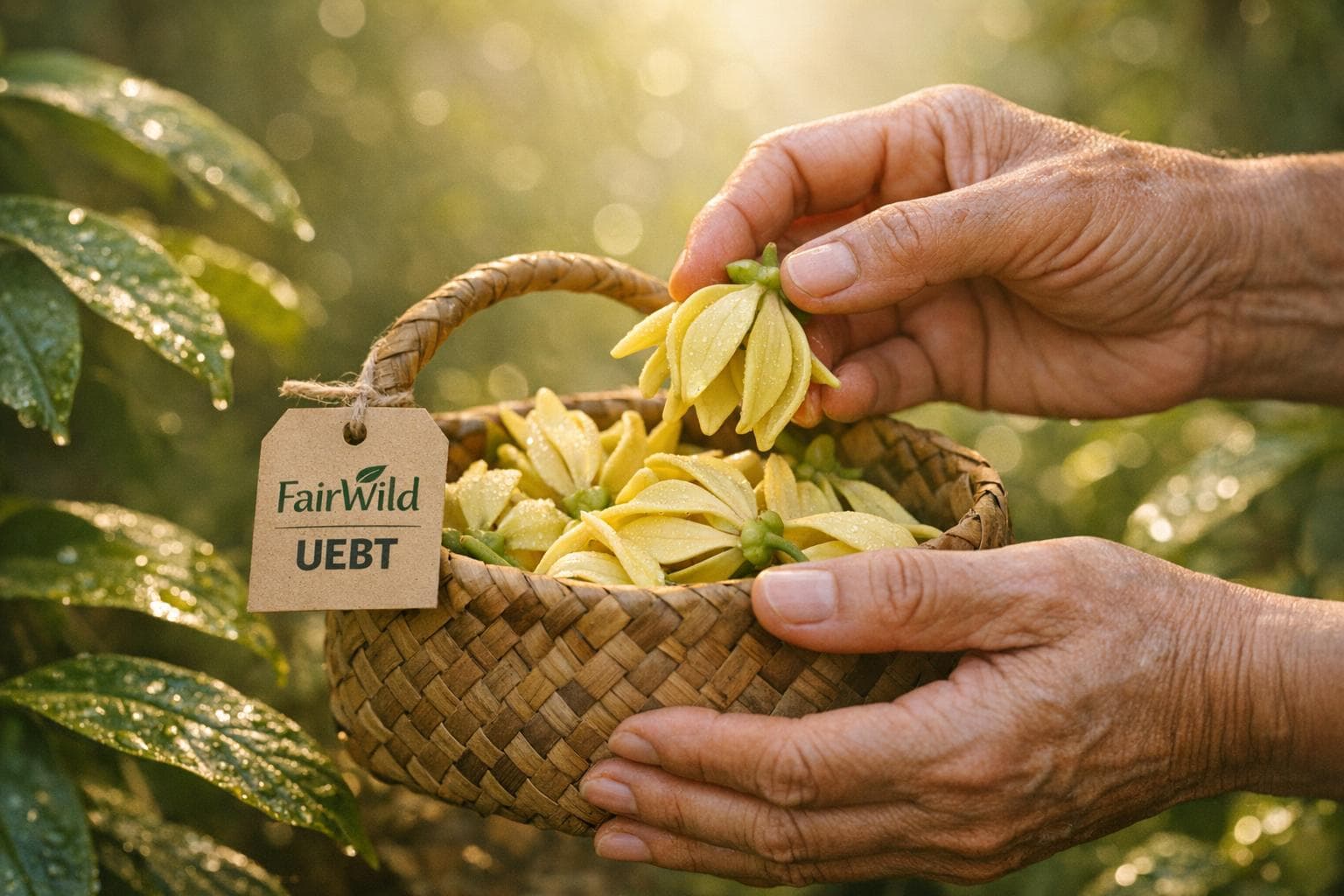
Ethical harvesting safeguards both ecosystems and the knowledge of indigenous communities involved in perfume-making. This approach ensures fair compensation, respects ancestral methods, and promotes sustainable resource use. Without these practices, overharvesting and economic exploitation threaten rare plants like frankincense and vanilla, alongside the traditions tied to them.
Key takeaways:
- Fair pay matters: Some workers earn as little as €6/day. Ethical models aim to improve wages and living conditions.
- Biodiversity at risk: Overharvesting disrupts ecosystems; frameworks like FairWild enforce sustainable methods.
- Knowledge preservation: Mentorship programs, like those in Oman, help pass down specialized harvesting techniques.
- Consumer choices count: Certifications like FairWild and UEBT guide buyers toward ethically sourced fragrances.
The fragrance industry must prioritize long-term solutions to protect resources and heritage while empowering communities.
Threats to Indigenous Perfume-Making Practices
Economic Impact and Wages in Indigenous Perfume Harvesting Communities
Indigenous perfume-making traditions, nurtured over centuries, are now at risk due to unsustainable practices and economic exploitation. These challenges not only threaten biodiversity but also jeopardize the cultural heritage tied to these crafts. Addressing these issues requires a closer look at the factors contributing to this decline.
Overharvesting and Environmental Strain
The overharvesting of key fragrance ingredients is disrupting ecosystems and threatening the sustainability of natural resources. In 2025, IFRA flagged four fragrance materials as being at risk of future trade restrictions under CITES, the treaty aimed at protecting endangered species. For instance, when plants like sandalwood are harvested faster than they can regenerate, it destabilizes local ecosystems and impacts the livelihoods of indigenous communities reliant on these resources. Economic pressures worsen the situation. After Madagascar liberalized vanilla prices in 2023, farmers were forced to sell their crops at extremely low prices to avoid financial losses, leading to unsustainable harvesting practices.
Adding to these pressures, synthetic alternatives - often far cheaper than natural extracts - dominate the market, confusing consumers and diminishing the value of traditional, natural crops. This economic imbalance not only harms the environment but also paves the way for exploitative labor practices, further eroding the cultural knowledge tied to indigenous perfume-making.
Economic Exploitation of Indigenous Communities
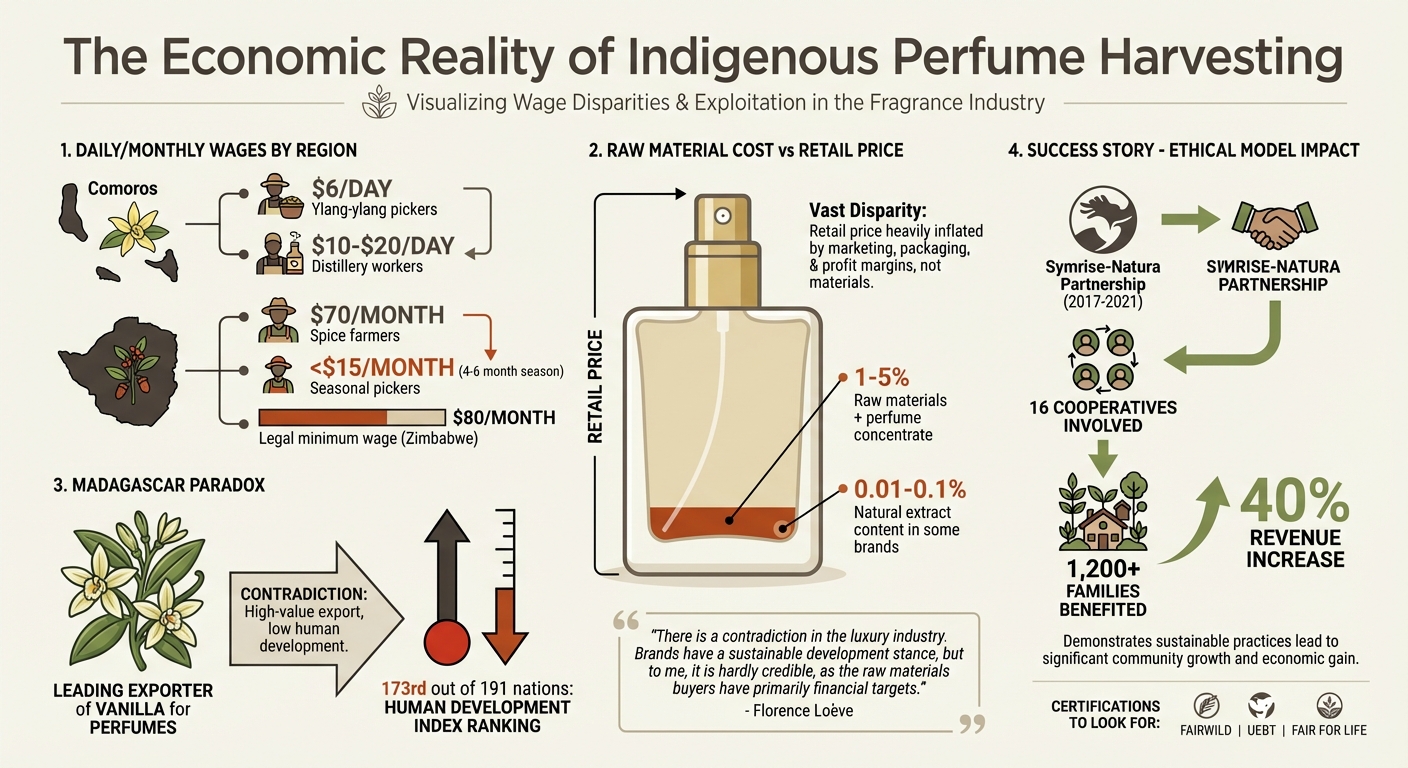
Indigenous harvesters often face harsh economic realities. In the Comoros, for example, ylang-ylang pickers earn as little as $6 per day, while distillery workers make between $10 and $20. In Zimbabwe, spice farmers typically earn just $70 per month, with seasonal pickers earning less than $15 per month during a four- to six-month harvest season. These wages fall far below basic living standards, forcing families to resort to child labor - an issue documented in Egyptian jasmine and Comorian ylang-ylang harvesting.
"There is a contradiction in the luxury industry. Brands have a sustainable development stance, but to me, it is hardly credible, as the raw materials buyers have primarily financial targets." — Florence Loève, Journalist
The economic structure of the perfume industry further highlights this exploitation. The raw materials and perfume concentrate often make up only 1% to 5% of a bottle’s retail price, with some brands including as little as 0.01% to 0.1% of a natural extract just to market its presence. Despite Madagascar’s role as a leading exporter of vanilla for perfumes, the country ranks 173rd out of 191 nations on the Human Development Index - a stark contrast to the high value of its exports.
"There is a dominator mindset that is very neocolonial... You could substitute the word ‘Frankincense’ with ‘chocolate,’ and the injustices would be the same." — Dr. Anjanette DeCarlo, Chief Sustainability Scientist at the Aromatic Plant Research Center
This economic exploitation not only deprives communities of fair compensation but also undermines their ability to preserve and pass on their traditional crafts.
Loss of Cultural Knowledge
As indigenous communities are relegated to low-paying supplier roles, their rich ancestral knowledge is at risk of disappearing. Industry models that prioritize speed and volume often favor younger, faster workers over elders who hold the most traditional methods. This dynamic erodes the transfer of knowledge that has been cultivated over generations.
"Too often, brown people are in the narrative only as farmers or suppliers, rarely in creative positions or as the main character." — Yosh Han, founder of Eau de Yosh
The use of generic, Eurocentric terms like "Oriental" further disconnects fragrances from their specific cultural origins, erasing the identities of the communities behind them. For example, Black consumers in the U.S. account for 22% of national spending on women’s fragrances, yet they are rarely represented in the creative or production aspects of the industry. Without economic stability or cultural acknowledgment, the knowledge and traditions tied to indigenous perfume-making are at risk of being lost forever.
To safeguard these traditions, it’s essential to prioritize ethical harvesting practices that ensure fair compensation and cultural recognition, preserving both biodiversity and the intangible heritage of indigenous communities.
Understanding Ethical Harvesting
Ethical harvesting transforms the supply chain into a force for ecosystem regeneration, replacing exploitative practices with methods that prioritize ecosystem health, economic equity, and respect for heritage. This approach ensures that ingredients are sourced in ways that protect biodiversity, support local communities, and honor traditional knowledge. It shifts the focus from short-term extraction to long-term preservation.
By addressing the challenges of overharvesting and community exploitation, ethical harvesting provides a framework that links environmental care with social responsibility. Instead of treating natural resources as commodities to be exploited for profit, this model emphasizes the importance of protecting both the plants and the people who rely on them for their livelihoods.
| Principle | Core Focus | Sustainability Impact |
|---|---|---|
| Biodiversity | Ecosystem harmony and plant health | Prevents overharvesting and protects wildlife |
| Social Ethics | Human rights and ancestral crafts | Strengthens communities and preserves traditions |
| Fair Trade | Traceability and fair contracts | Ensures equitable economic benefits |
| Benefit Sharing | Nagoya Protocol compliance | Respects Indigenous rights to genetic resources |
Sustainability and Biodiversity Protection
Ethical harvesting treats plants as part of a living ecosystem, not just as resources to be replenished. This involves careful management of water use, wildlife protection, and harvest schedules that allow for natural regeneration. For example, with frankincense trees, this means giving them a rest period of five to six years to maintain resin quality and ensure their long-term survival.
Omani initiatives, such as those achieving FairWild certification, demonstrate how this approach works in practice. These programs protect Boswellia sacra trees and train young harvesters under the guidance of experienced elders . By doing so, they avoid the ecological damage caused by overharvesting and ensure the sustainability of the supply chain.
"Wadi Dawkah is setting a powerful example of purpose-driven leadership within the Frankincense supply chain... The team’s dedication to implementing genuinely sustainable and ethical practices sets a high benchmark within the Frankincense sector." — Deborah Vorhies, CEO, FairWild
This focus on sustainability is further strengthened by fair trade practices, which build resilience within local communities.
Fair Trade and Community Partnerships
Fair trade practices ensure that communities benefit directly from their work through transparent contracts, fair wages, and certification under frameworks like the Nagoya Protocol. These measures help protect harvesters from market fluctuations and ensure consistent economic support.
Between 2017 and 2021, Symrise partnered with Natura and GIZ to train indigenous communities in the Brazilian Amazon on sustainable farming techniques. The initiative involved 16 cooperatives and led to a 40% increase in revenue for participants, directly improving the lives of over 1,200 families. Additionally, the communities earned certification from the Union for Ethical Biotrade (UEBT), which opened up better market opportunities.
The Nagoya Protocol on Access and Benefit Sharing (ABS) plays a key role in these partnerships. It ensures that any benefits derived from genetic resources or traditional knowledge are fairly shared with the communities that provide them. These legal frameworks promote trust and long-term collaboration, replacing exploitative practices with relationships built on mutual respect.
Respecting Ancestral Methods
Preserving traditional harvesting techniques is essential for maintaining ingredient quality and cultural heritage. Indigenous communities often use specialized tools and methods passed down through generations, such as the manghaf, a knife specifically designed for harvesting resin without harming the plant.
At Wadi Dawkah, Amouage’s FairWild-certified project ensures that younger Omanis learn these ancestral techniques under the guidance of three elders from Thumrait . This mentorship not only preserves technical skills but also keeps the cultural significance of these practices alive.
"The harvest must respect both tangible and intangible heritage, such as the ancestral craft of Frankincense harvesting. It also ensures that the work is carried out in accordance with international human rights standards." — FairWild Foundation
Traditional methods often include sustainability measures that industrial processes overlook. These time-tested practices ensure that harvesting supports both ecological balance and cultural continuity, making the ingredients more than just commodities - they become symbols of the ecosystems and traditions they come from.
These ethical approaches are essential for protecting indigenous perfume traditions, which will be explored further in the next section.
How Ethical Harvesting Protects Indigenous Perfume Traditions
Ethical harvesting practices go beyond sustainability by actively preserving the cultural heritage tied to traditional perfume-making. These approaches benefit ecosystems, empower local communities, and protect ancestral knowledge, ensuring that indigenous traditions in fragrance crafting endure for future generations. By fostering partnerships rather than exploitation, the global fragrance industry can support these time-honored methods.
Protecting Plant Species and Ecosystems
Ethical harvesting helps balance commercial needs with ecological health. For example, FairWild standards enforce rest periods for plants, allowing them to regenerate. In Oman, frankincense trees are left untouched during the Khareef monsoon season, with traditional harvesters extending the rest cycle to five or six years to ensure both higher-quality resin and the trees’ longevity.
Strict certification rules also prohibit harvesting plants listed under CITES (Convention on International Trade in Endangered Species), safeguarding species critical to indigenous traditions. Unlike large-scale industrial farming, which often relies on monocultures, indigenous methods typically favor polyculture on smaller plots, naturally supporting biodiversity.
In a groundbreaking move, Amouage became the first organization in the Arabian Peninsula to achieve FairWild Certification in August 2025. Their work at the Wadi Dawkah UNESCO World Heritage Site focuses on Boswellia sacra, ensuring traditional harvesting techniques are respected while maintaining ecological balance.
"Protecting biodiversity is essential for the future of both nature and fragrance." — Matthias Vey, Vice President, Scientific Affairs, IFRA
Economic Empowerment for Indigenous Communities
Fair wages and contracts transform subsistence labor into sustainable livelihoods. While some harvesters earn as little as $15 per month for several months of work, ethical frameworks aim to provide compensation that supports basic family needs.
In 2022, the Union for Ethical BioTrade (UEBT) highlighted a project in Zimbabwe led by Shamiso Mungwashu. This initiative worked with spice farmers to establish "ethical prices" that go beyond the legal minimum wage of $80 per month. By calculating a "living wage" that covers essentials like food, electricity, and education for a family of four, the project ensured fairer compensation.
"Paying 80 dollars is legal. But is it necessarily ethical?" — Shamiso Mungwashu, Specialist, Fairtrade Support Network Zimbabwe
Beyond wages, ethical sourcing supports local entrepreneurship. For instance, between 2014 and 2018, the Kāti Huirapa Rūnaka ki Puketeraki in New Zealand revived the ancient "taramea" (speargrass) perfume. After years of research and sustainable harvest trials, the rūnaka launched the "Mea" brand in 2018. Supported by the Ministry of Primary Industries’ Sustainable Farming Fund, this community-driven business model not only generates financial returns but also preserves traditional extraction methods.
Safeguarding Cultural Knowledge
The preservation of ancestral skills and techniques is a cornerstone of ethical harvesting. Standards like FairWild emphasize respect for traditional methods, such as the Omani "manghaf" knife technique, which allows resin to be harvested without harming the plant.
In August 2023, Amouage initiated a heritage preservation program at Wadi Dawkah. The project brought together three elders from Thumrait to teach younger Omanis traditional harvesting methods. Among the participants were descendants of harvesters who worked in the same groves in the 1960s. This mentorship ensures that these invaluable skills, once used to produce a commodity considered more precious than gold, are passed down to future generations.
"Each of us, whether the team working at Wadi Dawkah or the local community, feel enormous pride in gaining this international recognition. We hope that our contribution pays respectful homage to our forebears." — Ghanem Jaddad, Public Relations Officer, Wadi Dawkah
Your Personal Fragrance Expert Awaits
Take our quick scent quiz to discover authentic designer and niche fragrances matched to your taste — explore them as 2ml, 5ml, 8ml & 30ml decants and samples, so you can try each one before committing to a full bottle.
Find Your ScentCase Studies: Ethical Harvesting in Practice
Dutjahn Sandalwood in Australia
In 2017, Dutjahn Sandalwood Oils (DSO) partnered with Givaudan, a global leader in fragrance production, to create a unique model emphasizing Indigenous ownership while promoting ecological renewal and safeguarding cultural traditions. DSO is half-owned by the Dutjahn Custodians, representing the Martu and Wongi Nations. For these communities, the sandalwood tree (Dutjahn) holds profound spiritual significance, far beyond its economic value.
Through this partnership, royalties from oil sales are directed to the K Farmer Dutjahn Foundation (KFDF), an Indigenous-led nonprofit. KFDF has supported seven projects, benefiting 396 Martu people, including initiatives focused on traditional harvesting techniques. This model has received global recognition, earning the UN Equator Prize and two Australian Exporter Awards.
"Dutjahn (Australian sandalwood, Santalum Spicatum) is more than a sacred plant to the Martu and Wongi Nations, it is part of our soul and a key link to our spiritual identity."
- Darren Farmer, Chairman of Dutjahn Custodians
The harvesting process aligns with "Caring for Country" principles, ensuring sustainability by planting multiple seeds for every tree harvested. By combining wild-harvested wood from native title lands with plantation resources, this circular approach supports regeneration. Western Australian sandalwood now makes up about 40% of the global market, with a liter of oil commanding thousands of euros in the beauty industry.
This collaboration highlights how Indigenous ownership can seamlessly integrate environmental renewal with cultural preservation, a theme that resonates in other examples.
Givaudan‘s Community Partnerships

Givaudan’s efforts extend beyond its collaboration with Dutjahn Sandalwood. Through its "Sourcing4Good" program, the company has woven Indigenous-led supply chains into its global operations. The Givaudan Foundation plays a pivotal role by funding community organizations, ensuring that traditional custodians manage their lands rather than simply providing raw materials.
By 2025, the Givaudan Foundation had overseen 67 social and environmental projects across 27 countries, directly impacting over 90,200 community members. These initiatives include training Martu rangers to use modern technology for mapping and evaluating sandalwood resources, as well as supporting the "Voices of Wiluna" film project, which preserves oral histories and traditional knowledge.
"Sourcing an ingredient connects a brand directly to the plant, land, and community. This is more than an economic relationship, this is a partnership where brands can empower communities to deliver lasting, positive change."
- Clinton Farmer, Chair of K Farmer Dutjahn Foundation
Givaudan’s ethical sourcing model also extends to other regions, including patchouli in Indonesia, clove leaf oil in Madagascar, and citrus in Brazil. These efforts demonstrate how ethical practices in sourcing can scale globally while respecting and maintaining local traditions.
Indigenous Sourcing of African Botanicals
In Oman, a project at Wadi Dawkah achieved FairWild Certification for frankincense, blending ancestral harvesting methods with modern traceability systems. Overseen by Matthew Wright, Head of Wadi Dawkah, this initiative preserves the traditional craft of collecting Boswellia sacra while ensuring fair contracts for workers. The first harvest under this framework, conducted between September 2023 and March 2024, established optimal harvesting times and quality standards.
The project employs innovative traceability tools, such as QR codes that track individual trees and monitor their health. This ensures sustainable harvesting practices and shifts the focus from seasonal exploitation to year-round income for local communities.
"Wadi Dawkah is setting a powerful example of purpose-driven leadership within the Frankincense supply chain, a product imbued with mystery and magic since the dawn of time."
- Deborah Vorhies, CEO, FairWild
The Future of Ethical Practices in Fragrance
Preserving Heritage Through Traditional Practices
The fragrance industry is at a crossroads, where the survival of indigenous perfume-making traditions hinges on ethical harvesting practices. Programs that bridge generations - pairing community elders with younger members - are playing a crucial role in safeguarding these traditions. For example, at Wadi Dawkah, seasoned elders are actively teaching young Omanis the age-old art of frankincense tapping, ensuring that these ancestral techniques endure.
Brands like Amouage are stepping up by directly managing sourcing sites, a move that protects not only the land but also the cultural heritage tied to these resources. By preserving these traditions, the industry also ensures the availability of the natural biodiversity that inspires unique fragrance creations.
Supporting Sustainable Natural Perfumery
Protecting traditional methods doesn’t just honor heritage - it also fuels the development of sustainable, nature-driven perfumery. With the industry continuing to grow, sustainable ingredient sourcing has become a necessity rather than an option. Tools like CITES monitoring, certifications such as FairWild and UEBT, and frameworks like the Nagoya Protocol all work together to ensure that biodiversity is preserved while respecting the traditional knowledge of local communities .
Empowering Consumers to Make Ethical Choices
Ethical practices are gaining momentum as more informed consumers demand accountability from the fragrance industry. Heather D’Angelo, founder of the Coalition of Sustainable Perfumery, highlights the long-term impact of current decisions:
"The choices we make today as indie perfumers can have wide-scale impacts down the line".
Consumers are increasingly scrutinizing brands that feature natural extracts prominently in their marketing, even when these ingredients make up as little as 0.01% to 0.1% of the formula. Certifications like FairWild and UEBT are becoming essential tools for shoppers, helping them identify products that align with fair labor practices and biodiversity protection.
The economic impact of this shift is clear. For instance, the Symrise-Natura partnership in the Brazilian Amazon boosted revenue by over 40% for 16 cooperatives between 2017 and 2021. This success underscores how consumer awareness can drive tangible benefits for indigenous communities. As more people connect their purchasing decisions to cultural and environmental preservation, the demand for ethically sourced fragrances is poised to grow even further.
Conclusion
The fragrance industry is at a turning point where ethical harvesting practices play a crucial role in preserving indigenous perfume-making traditions. For instance, brands like Amouage have embraced FairWild certification at Wadi Dawkah, ensuring sustainable practices while safeguarding heritage. Similarly, collaborations such as the one between Symrise and Natura have increased cooperative revenue by over 40%, proving that ethical sourcing can uplift communities while driving business growth.
However, brands need to go beyond surface-level actions - like incorporating a mere 0.01% of a natural extract for marketing appeal - and focus on building genuine, transparent relationships with indigenous communities. This involves paying fair prices that exceed legal minimums, addressing essential needs like education and healthcare, and funding initiatives that pass ancestral knowledge from elders to younger generations.
As a consumer, your choices make a difference. Look for third-party certifications like FairWild, UEBT, or Fair For Life on fragrance labels. These certifications guarantee commitments to fair labor, biodiversity protection, and the preservation of traditional harvesting methods.
Take, for example, the 1,500-year-old Deg-Bhapka process in Kannauj, India - a living testament to cultural heritage. Similarly, the traditional techniques for tapping frankincense in Oman underscore the importance of economic sustainability in keeping these practices alive. By choosing fragrances sourced ethically, you’re not just purchasing a product - you’re supporting the craftspeople, ecosystems, and cultural wisdom that underpin authentic perfumery.
The future of fragrance doesn’t have to echo the exploitative practices of the past. By demanding transparency, supporting certified brands, and acknowledging that quality ingredients deserve fair compensation, we can help ensure that indigenous perfume-making traditions endure for generations to come.
FAQs
What does ‘ethical harvesting’ mean in perfumery?
In perfumery, ethical harvesting refers to sourcing natural ingredients in ways that are both sustainable and respectful of the environment and local communities. This approach avoids overharvesting, helps maintain biodiversity, and ensures that the people involved in the process are treated fairly. By offering proper compensation and following frameworks like the Nagoya Protocol, ethical harvesting not only protects ecosystems but also supports the traditions and livelihoods of indigenous communities. It plays a key role in preserving both the natural world and the time-honored practices of perfume-making.
How can I tell if a fragrance’s natural ingredients are truly ethical?
To determine if a fragrance’s natural ingredients are sourced responsibly, focus on brands that prioritize transparency in their practices. Look for certifications such as FairWild or CITES, which emphasize fair trade and resource conservation. Additionally, brands adhering to frameworks like the Nagoya Protocol often provide details about their supply chains. These companies typically support indigenous communities by ensuring fair benefit-sharing and promoting sustainable resource use.
Does buying ethically sourced perfume help Indigenous communities?
Ethically sourced perfumes do more than just smell good - they make a positive impact. When you choose these fragrances, you’re supporting Indigenous communities by promoting fair benefit-sharing, sustainable harvesting, and respect for their rights. Certifications such as FairWild and efforts by companies dedicated to ethical practices help ensure that traditional knowledge and resources are protected. At the same time, these initiatives provide economic opportunities, creating a meaningful connection between the perfume industry and the communities that contribute to its rich heritage.

