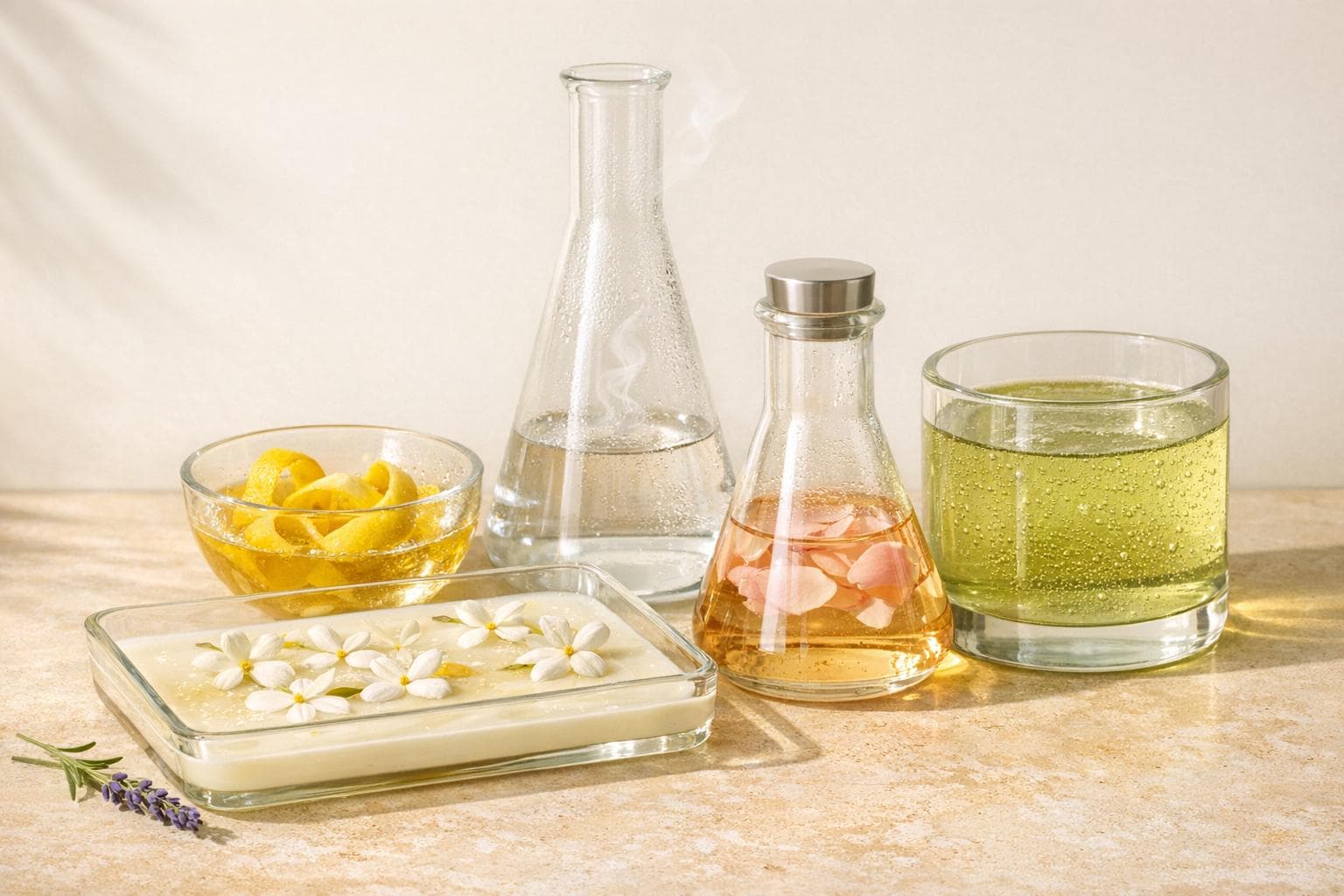
French perfumery relies on advanced methods to extract natural essences from botanicals, shaping the fragrances we love. From historical techniques like enfleurage to modern supercritical CO₂ extraction, each method offers unique advantages for preserving scent profiles. Here’s a quick overview:
- Enfleurage: Uses fat to absorb delicate floral aromas, ideal for fragile flowers like jasmine and tuberose.
- Expression: Mechanically extracts oils from citrus peels without heat, maintaining their vibrant aroma.
- Steam Distillation: Efficiently extracts oils using steam, best for robust materials like lavender and sandalwood.
- Solvent Extraction: Dissolves aromatic compounds with solvents, yielding deeper, richer scents like absolutes.
- Supercritical CO₂ Extraction: A modern, solvent-free method that preserves delicate molecules using low-temperature pressurization.
Each technique has specific strengths, suited to different raw materials and applications. Whether it’s the precision of CO₂ extraction or the artisanal charm of enfleurage, these methods define the artistry of French perfumery.
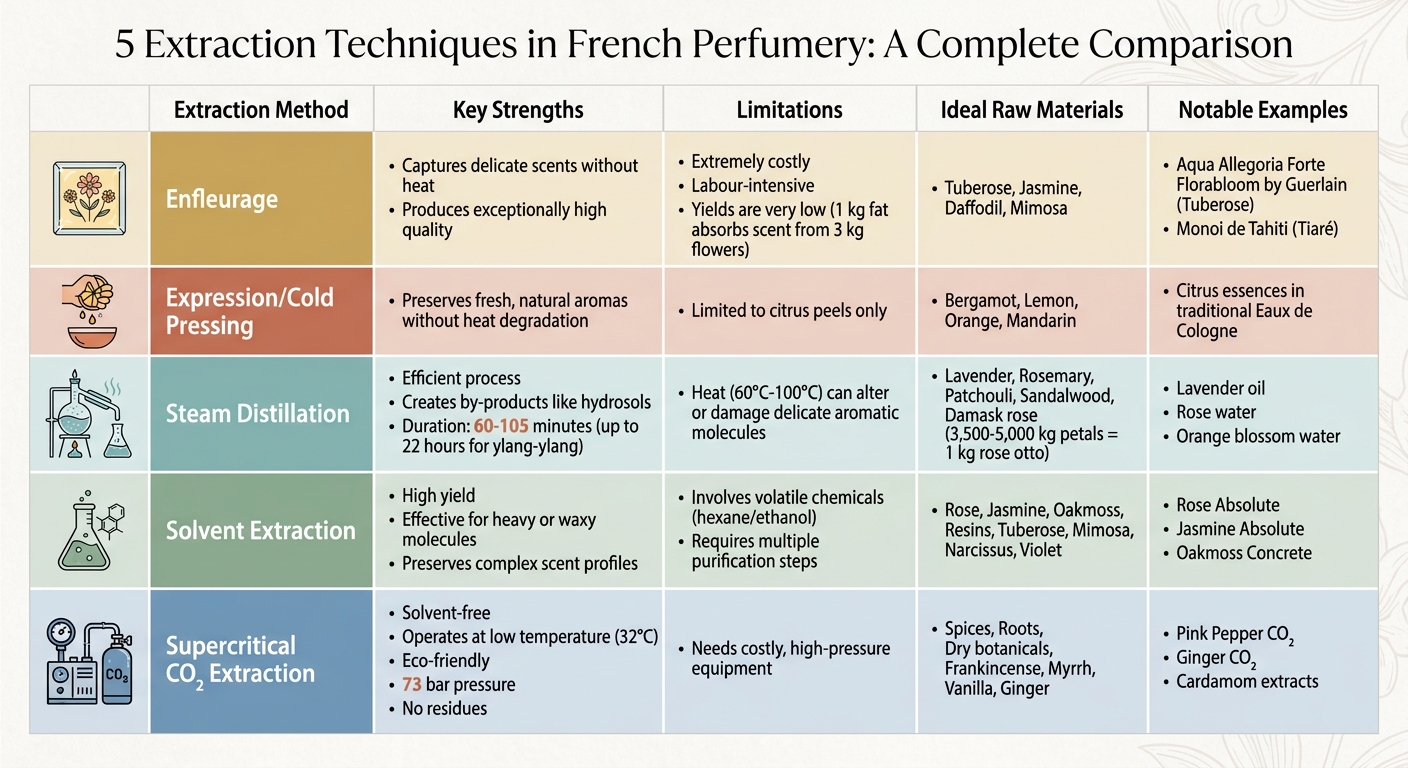
Comparison of 5 French Perfume Extraction Methods: Enfleurage, Expression, Steam Distillation, Solvent Extraction, and CO2
1. Enfleurage
Enfleurage is one of the oldest and most intricate methods of extracting fragrances in French perfumery. This traditional technique involves spreading a layer of odorless fat - historically a mix of 75% pork and 25% beef tallow, though now often replaced with plant-based alternatives like mango butter or coconut oil - across glass plates known as chassis. Fresh flowers are carefully placed on the fat, which gradually absorbs their aromatic oils.
There are two main approaches to enfleurage. In cold enfleurage, delicate flowers like jasmine and tuberose are used since they continue releasing their fragrance even after being picked. These flowers are replaced every 24 to 48 hours over a span of 30 to 60 days until the fat is fully infused. Hot enfleurage, or maceration, uses sturdier blooms such as rose and orange blossom. These flowers are mixed into fat heated to 40–60°C for several hours, with the process repeated over two to four weeks. The resulting fragrant fat, known as pomade, is then washed with alcohol to extract the aromatic compounds, producing a concentrated absolute.
Scent Fidelity
What sets enfleurage apart is its ability to capture the "post-harvest emanation" - the ongoing release of scent from a flower after it has been picked. This process creates a fragrance profile that is airy and true to the living flower, unlike solvent extraction, which can yield heavier scents. As Julien Marchetti from Premiere Peau puts it:
"The flower decides what to release, and when, and how much. The fat simply receives... Enfleurage listens".
While this method delivers exceptional scent accuracy, it is far from efficient.
Yield Efficiency
Enfleurage is a labor-intensive process. Each cycle requires 25–36 rounds of fresh flowers, with about 8,000 hand-picked jasmine blossoms needed to produce just one kilogram of extraction material. This meticulous process, which can take anywhere from four to ten weeks, is a major factor in its high cost .
Material Suitability
This method is particularly suited for extracting scents from fragile flowers that cannot withstand steam distillation, such as gardenia, lilac, lily of the valley, and violet. In July 2025, Whitney Swales, a perfumer at Wit & West Perfumes, crafted an iris enfleurage extrait for "The Violetear Eau de Parfum" using over 40 rounds of fresh iris flowers harvested from her garden across two seasons. She noted:
"Enfleurage allows me to create extractions from flowers that are not available commercially, such as iris or lilac".
Guerlain has also embraced this technique, recently using tuberose extracted via enfleurage in mango butter for their fragrance Aqua Allegoria Forte Florabloom, showcasing a contemporary take on this historic method. Its selective use also aligns with sustainable practices.
Environmental Impact
Enfleurage offers certain environmental benefits alongside its artisanal charm. Cold enfleurage, in particular, is a low-energy, manual process that avoids the high heat and heavy machinery typical of other extraction methods. While the traditional approach relied on animal fats, modern adaptations favor plant-based alternatives to meet sustainability and vegan standards. Ethyl alcohol is used to separate the aromatic compounds from the fat, and historically, the leftover fat was repurposed in soap making. This renewed interest in enfleurage, especially in Grasse, reflects a broader appreciation for craftsmanship and natural processes within the luxury fragrance market.
2. Expression
Expression, or cold pressing, is a simple mechanical method used specifically for extracting oils from citrus fruits. This process works by breaking the oil glands found in the peels of citrus fruits. Unlike distillation, it avoids exposing the material to heat, which helps maintain the fresh and vibrant aroma of the citrus.
Today, modern techniques involve a device called a pelatrice, which punctures the peel. The mixture of juice and oil is then separated using centrifugation . Historically, the sponge method was common in 19th-century Sicily before the introduction of centrifugation . This straightforward approach sets expression apart from the more intricate methods often used in French perfumery.
Scent Fidelity
Expression stands out for its ability to preserve the true-to-life scent of citrus. Since it avoids heat or chemical solvents, the process keeps the volatile top notes intact, which are essential to the characteristic freshness of citrus fragrances. As Bastille Parfums explains:
"The advantage of this method is that it does not involve heating the citrus fruit, which guarantees an ultra-realistic smell."
This results in an essence that perfectly captures the natural aroma of the fruit.
Material Suitability
This method is exclusively used for citrus peels, as their essential oils are stored in readily accessible glands within the outer layer of the fruit. The technique works particularly well for materials that are naturally rich in oil, making it a practical and efficient choice. The resulting product is referred to as an "essence", setting it apart from steam-distilled essential oils.
Environmental Impact
Expression offers a sustainable approach by avoiding the use of volatile organic solvents like hexane. Additionally, the process captures the fruit juice as a valuable byproduct, reducing waste. The absence of chemical residues and the low energy requirements make this method an environmentally friendly choice.
3. Steam Distillation
Steam distillation involves placing plant material on a perforated grid above boiling water, allowing only steam to interact with the material. This process typically lasts 60–105 minutes for most botanicals, but some exceptions, like ylang-ylang, require up to 22 hours and additional fractional distillation to produce distinct grades.
Scent Fidelity
The oils produced through steam distillation tend to be lighter and fresher compared to the richer absolutes obtained via solvent extraction. Fractional distillation can further refine the oil by removing unwanted components. However, the high temperatures involved (60°C to 100°C) can damage fragile fragrance compounds. For instance, flowers like jasmine, which are sensitive to heat, are better processed using solvent or CO₂ extraction methods.
Raphaël Dumont from Première Peau highlights this limitation:
"Steam distillation works brilliantly for hardy, resinous, or herbaceous materials. It falters with delicate flowers whose fragrance molecules are too fragile to survive the heat."
Material Suitability
This method is particularly effective for robust plant materials such as woods (e.g., sandalwood and cedar), barks, roots, seeds, and resins like frankincense and myrrh. It is also widely used for aromatic herbs like lavender, rosemary, peppermint, and eucalyptus. Some heat-tolerant flowers, like Damask rose (Rosa damascena) and orange blossoms (used for neroli), respond well to this process. However, the yields from these materials can be quite modest: for example, 3,500–5,000 kg of Damask rose petals are needed to produce just 1 kg of rose otto, while approximately 1,000 kg of bitter orange blossoms yield only 1 kg of neroli oil.
Environmental Impact
One of the key benefits of steam distillation is its use of only water and steam, eliminating the need for volatile organic solvents like hexane, which are used in solvent extraction. Additionally, the process generates hydrosol, a valuable byproduct. However, steam distillation requires significant amounts of water and energy, making it less efficient compared to supercritical CO₂ extraction, which operates at much lower temperatures (around 32°C).
Your Personal Fragrance Expert Awaits
Take our quick scent quiz to discover authentic designer and niche fragrances matched to your taste — explore them as 2ml, 5ml, 8ml & 30ml decants and samples, so you can try each one before committing to a full bottle.
Find Your Scent4. Solvent Extraction
Solvent extraction involves combining raw materials with volatile solvents such as hexane or ethanol to dissolve aromatic compounds, waxes, and pigments . Once mixed, the solution is filtered and concentrated, resulting in a "concrete" when fresh flowers are used or a "resinoid" when working with dried materials like resins or balsams. The concrete is then treated with alcohol to separate the aromatic oils from non-aromatic waxes, yielding the final product known as an "absolute" .
By the late 19th century, this method had become a cornerstone of industrial processes in Grasse, celebrated for its reliability and efficiency . It effectively addresses the limitations posed by heat-sensitive materials, which are often problematic in steam distillation.
Scent Fidelity
One of the major advantages of solvent extraction is its ability to preserve the intricate and delicate scent profiles of raw materials, as it avoids exposing them to heat. This ensures that complex aroma compounds remain intact . For instance, rose absolute produced through solvent extraction is known for its deeper, richer character, while rose essential oil obtained via distillation offers a lighter, more delicate scent. Similarly, ylang-ylang absolute has a creamier and more intense aroma compared to the fresher, lighter profile of its essential oil counterpart.
Material Suitability
This technique is particularly suited for processing "noble" flowers that are iconic in French perfumery, such as jasmine, tuberose, mimosa, narcissus, and violet. Whitney Swales, Perfumer and Co-Founder of Wit & West Perfumes, highlights the importance of this method:
"In the case of jasmine, jasmine’s volatile aromatic oils are composed of heat-sensitive chemical compounds that do not allow for extraction methods such as steam distillation to yield a usable product."
In addition to flowers, solvent extraction is also ideal for working with materials like oakmoss, iris (orris), vanilla, and resins such as benzoin and labdanum .
Environmental Impact
Beyond its technical advantages, solvent extraction also offers some environmental benefits. Vacuum processing and solvent reclamation help reduce waste. Additionally, by-products like floral waxes and "by-absolutes" are repurposed in products such as skincare items, solid fragrances, and candles. However, one concern with this method is the potential presence of solvent residues in the final absolute. This issue has been addressed by newer techniques like supercritical CO₂ extraction, which eliminate such risks .
5. Supercritical CO₂ Extraction
Supercritical CO₂ extraction offers a modern approach that protects the delicate nature of aroma compounds, unlike traditional methods. By pressurising carbon dioxide to 73 bar at a temperature of just 32°C, the CO₂ enters a supercritical state. In this state, it combines the density of a liquid with the diffusivity of a gas, enabling it to extract aromatic molecules without the need for high heat.
Scent Fidelity
The low-temperature process ensures that even the most fragile aroma compounds remain intact. As CO₂ naturally returns to its gaseous form when depressurised, it leaves behind no solvent residues. This results in a pure extract that more closely mirrors the original material. For example, CO₂-extracted vanilla often has a lighter, fresher scent that truly reflects the natural bean, while vanilla absolute tends to have a denser, more syrupy profile.
Material Suitability
This method is particularly effective for extracting essences from spices, roots, resins, and dry botanicals. Dark Tales, a botanical perfumery house, uses CO₂ extraction to preserve the true character of ingredients like frankincense, myrrh, vanilla, chamomile, sandalwood, rose, ginger, blackcurrant bud, peppermint, and patchouli. The technique is ideal for capturing delicate aroma molecules that might degrade under traditional methods.
Environmental Impact
CO₂ extraction also stands out for its eco-friendly credentials. Unlike solvent extraction, which uses chemicals like hexane or ethanol, this method avoids harmful residues altogether. Fulvio Ciccolo, author and researcher at Scentspiracy, highlights its benefits:
"Among the most advanced and sustainable methods, CO₂ extraction uses supercritical carbon dioxide".
Comparison Table
Below is a detailed comparison of various extraction methods, highlighting their strengths, limitations, ideal raw materials, and examples of their application. Each method presents distinct benefits and challenges, making them suited to different perfumery needs.
| Extraction Method | Strengths | Limitations | Ideal Raw Materials | Notable Examples |
|---|---|---|---|---|
| Enfleurage | Captures delicate scents without heat; produces exceptionally high quality | Extremely costly; labour-intensive; yields are very low | Tuberose, Jasmine, Daffodil, Mimosa | Aqua Allegoria Forte Florabloom by Guerlain (Tuberose); Monoi de Tahiti (Tiaré) |
| Expression | Preserves fresh, natural aromas without heat degradation | Limited to citrus peels | Bergamot, Lemon, Orange, Mandarin | Citrus essences found in traditional Eaux de Cologne |
| Steam Distillation | Efficient process; creates by-products like hydrosols | Heat can alter or damage delicate aromatic molecules | Lavender, Rosemary, Patchouli, Sandalwood | Lavender oil; Rose water; Orange blossom water |
| Solvent Extraction | High yield; effective for heavy or waxy molecules | Involves volatile chemicals; requires multiple purification steps | Rose, Jasmine, Oakmoss, Resins | Rose Absolute; Jasmine Absolute; Oakmoss Concrete |
| Supercritical CO₂ Extraction | Solvent-free; operates at low temperatures (32°C); eco-friendly | Needs costly, high-pressure equipment | Spices, Roots, Dry botanicals | Pink Pepper CO₂; Ginger CO₂; Cardamom extracts |
When comparing yields, traditional enfleurage stands out for its inefficiency - requiring 1 kg of fat to absorb the scent from 3 kg of flowers.
Interestingly, Guerlain has reimagined enfleurage by using mango butter as a vegetable-based alternative to fat for tuberose extraction, achieving a richer and creamier floral essence. Similarly, their innovative 22-hour steam distillation of ylang-ylang produces distinct olfactory grades, showcasing how modern techniques can refine traditional methods . These advancements underline the precision and artistry inherent in French perfumery.
The Five Extraction Techniques in French Perfumery
French perfumery owes much of its reputation to the mastery of diverse extraction methods. From the meticulous process of enfleurage to the advanced supercritical CO₂ extraction - operating at precise conditions of 32°C and 73 bar - each technique showcases a commitment to preserving the essence of raw materials and highlights the expertise that defines French fragrance craftsmanship.
What’s fascinating is how ancient methods like enfleurage, once considered nearly obsolete, are finding their way back into modern perfumery. For instance, Grasse has recently embraced this historic technique to create luxurious compositions. As Fulvio Ciccolo insightfully puts it:
"The history of fragrance extraction is a rich interplay of ancient craftsmanship and modern technology."
Today, this interplay isn’t just reserved for perfumers. Thanks to Scento’s curated decants, fragrance enthusiasts can now experience these techniques firsthand. You can compare the earthy depth of essential oils derived from steam distillation, the richness of absolutes from solvent extraction, and the crisp clarity of CO₂ extracts - all crafted from the same raw ingredient but offering distinctly different olfactory profiles.
Whether it’s the warm, grounding base notes preserved by enfleurage or the vibrant spice tones captured through CO₂ extraction, these methods transform raw botanicals into exquisite scents. By exploring these curated decants, you can deepen your understanding of the artistry behind fragrance creation - all while expanding your collection in an accessible and affordable way.
FAQs
How do I choose the right extraction method for a specific botanical?
Choosing the right extraction method hinges on the botanical’s characteristics and the desired scent profile. Cold expression works well for citrus peels such as bergamot, capturing their zesty freshness without heat. For fragile flowers like jasmine, enfleurage is a gentle technique that preserves their delicate aroma. When dealing with rare or sensitive materials, solvent-based methods like supercritical CO₂ extraction are ideal, as they maintain the integrity of aromatic compounds without exposing them to heat or pressure. Selecting the appropriate method ensures the botanical’s essence is captured at its best.
Why do the same ingredients smell different as an essential oil, absolute, or CO₂ extract?
The way a scent is extracted plays a major role in its character, as each method influences the chemical makeup of the aromatic compounds. Essential oils are produced through distillation or expression, which preserve the more volatile compounds, giving them a lighter and fresher fragrance. Absolutes, on the other hand, are created using solvent extraction. This method captures a broader spectrum of molecules, resulting in a deeper and more complex aroma. Finally, CO₂ extraction employs low temperatures to gently extract delicate compounds, creating a scent profile that closely mirrors the original material.
Which extraction methods are the most eco-friendly in French perfumery?
In French perfumery, two methods stand out for their low environmental impact: cold expression and enfleurage. These techniques rely on mechanical processes and avoid or minimise the use of solvents, making them kinder to the planet. They are particularly valued for their ability to gently capture natural aromas while keeping sustainability at the forefront.

