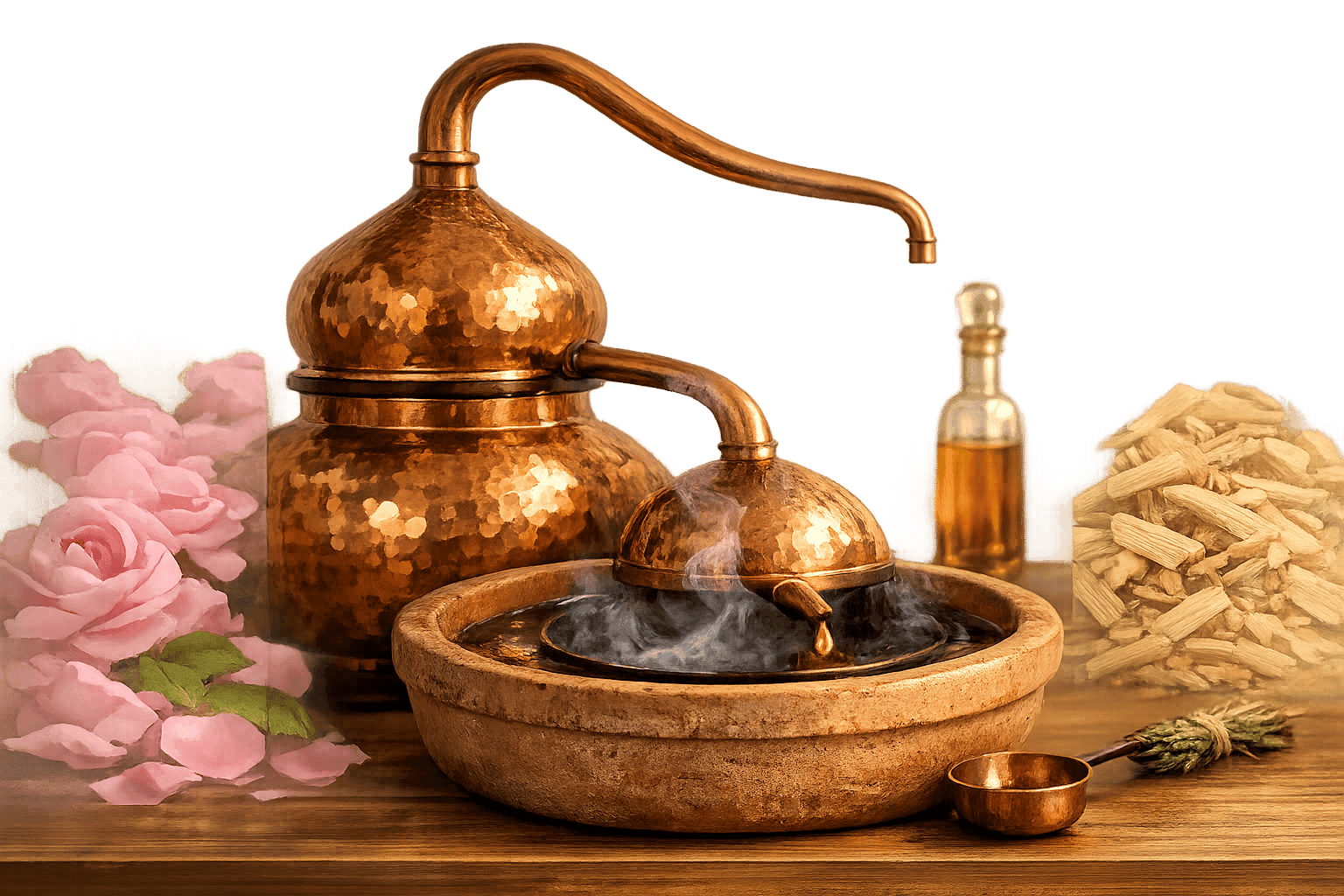
Attars are natural perfume oils with a history dating back over 5,000 years. Unlike modern perfumes, they are made without alcohol, using a slow hydro-distillation process to extract fragrances from flowers, woods, and spices, which are then infused into sandalwood oil. This method preserves the purity of the ingredients and creates long-lasting scents that evolve with body heat.
Key highlights:
- Ingredients: Rose, jasmine, sandalwood, oud, saffron, and more.
- Process: Copper stills (Deg and Bhapka system) are used for distillation.
- Craftsmanship: Passed down through generations, especially in places like Kannauj, India.
- Cultural Significance: Used in religious rituals, daily life, and as gifts in Middle Eastern and Islamic traditions.
- Challenges: Declining distilleries and high production costs (e.g., €5,100 per liter of jasmine attar).
This centuries-old craft reflects precision, patience, and respect for nature, offering a fragrance experience unmatched by synthetic alternatives.
Natural Ingredients in Attar Production
The raw materials used in attar crafting define their fragrance profile and lasting power. Artisans carefully choose botanicals based on their origin, as terroir greatly impacts their character. For example, a Taif rose has a distinct aroma compared to one grown in Kannauj. Each ingredient undergoes precise handling to preserve its unique essence, laying the groundwork for the specialized processes described below.
Flowers
Rosa Damascena (Damask rose) is a cornerstone of Middle Eastern attars. These roses are harvested at dawn, the time when their scent is most concentrated. To protect their delicate oils, the petals are quickly processed - stems and leaves are removed by hand, and the petals are gently washed to eliminate debris. The fresh flowers are immediately placed in copper stills to prevent any loss of aroma. These stills, capable of holding up to 99 lbs of petals, allow the flowers to move freely during distillation, ensuring optimal extraction.
Jasmine (Motia or Sambac), known for its rich and sweet scent, requires even more careful handling. Its essence is so valuable that a liter of hydro-distilled jasmine attar can cost around €5,100. Other floral ingredients like Kewra (screwpine), which adds fruity and honeyed notes, and Lotus, with its airy, aquatic aroma, are often included in spiritual blends for their unique characteristics.
Woods and Resins
Sandalwood oil serves as the backbone of many traditional attars. Its creamy, smoky scent acts as a natural fixative, helping lighter floral notes linger for 8–12 hours or more. To enhance its fragrance, artisans soak dried sandalwood chips in distilled water before slowly hydro-distilling them, which softens the wood fibers and releases more aromatic compounds.
Agarwood (oud) introduces a deep, balsamic complexity to attars, often adapting uniquely to the wearer’s skin. Resins like frankincense and myrrh are processed differently - they are heated in copper vessels until they produce "liquid tears." These are then scraped out and blended with sandalwood oil to create a rich base. Once extracted, these oils are aged in camel or calfskin leather flasks, allowing excess water to evaporate while intensifying the wood and resin aromas over time.
Herbs and Spices
Saffron is celebrated for its ability to create "suede chords", which lend a warm, powdery texture with subtle metallic and floral undertones. Spices like cloves and cardamom add layers of complexity, preventing the attar from feeling flat. These spices are usually pre-soaked before distillation to maximize their aromatic release. The extraction technique also plays a role in shaping their character - for instance, CO₂-extracted ginger has a fresh, green quality, while steam-distilled ginger delivers a classic spicy warmth. Beyond their fragrance, ingredients like saffron and camphor have been valued for their therapeutic benefits in both Ayurvedic and Middle Eastern practices.
Premium spiced attars, such as Oudh Qadeem al — Hindi featuring saffron, are highly sought after and can cost around €60 (approximately ₹4,752.38).
Distillation Tools and Equipment
The traditional Deg and Bhapka system, in use since around 1000 CE, stands as a testament to centuries of craftsmanship. This method relies on copper vessels, bamboo pipes, and clay seals, chosen not only for their practicality but for their role in preserving the essence of the craft. Unlike modern techniques that rely on precision machinery and chemical solvents, this system demands the artisan’s expertise and careful oversight to create high-quality attars.
The Deg and Bhapka System
At the heart of this process is the Deg, a large copper still where botanical materials are combined with water and heated over a brick-and-clay furnace called a Bhatti. Copper’s ability to distribute heat evenly helps protect the delicate floral oils during distillation. The Bhapka, another copper vessel, acts as the receiver. It is partially submerged in a cooling water tank known as a Gachchi. Traditionally, the Bhapka is filled with sandalwood oil, which serves as both a fixative and a carrier, absorbing the aromatic compounds as they condense.
A bamboo or metal pipe, called the Chonga, links the Deg to the Bhapka. As water in the Deg boils, steam carries the volatile aromatic compounds through the Chonga to the receiver, where the cooling water causes condensation into the base oil. This hydro-distillation process relies solely on water and heat, ensuring the botanical essence remains pure and free from chemical residues. The precise transfer of vapors during this stage is critical for capturing the desired aromatic profile.
Cooling Pipes and Clay Seals
The system’s efficiency hinges on consistent vapor flow and effective cooling. The Chonga, traditionally made of bamboo, plays a key role in this. Proper condensation depends on keeping the Gachchi’s water level high enough to cool the Bhapka throughout the distillation cycle.
Sealing the system with raw clay is equally essential. Artisans carefully apply clay to every joint connecting the Deg, Chonga, and Bhapka, creating an airtight setup that prevents the loss of precious aromas. Even minor leaks can result in significant aromatic losses, with the lightest and most fragrant top notes escaping first. The process also requires slow, steady heat to ensure the vapors travel at a controlled rate, protecting the delicate aromatic molecules from damage. These intricate techniques, honed over generations, reflect the enduring legacy of this traditional craft.
The Hydro — Distillation Method
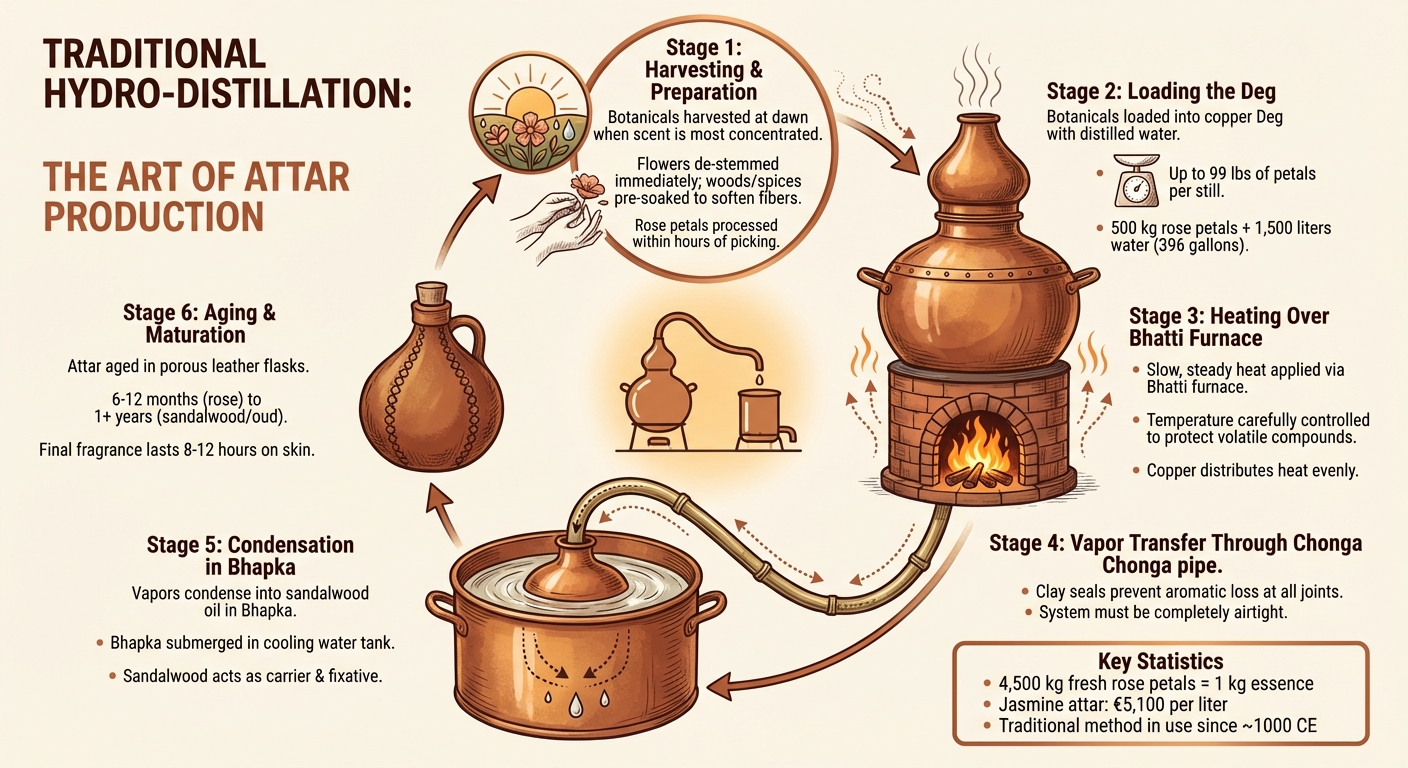
Traditional Attar Production Process: From Botanicals to Aged Fragrance
This method takes the traditional setup to the next level, transforming botanicals into their pure aromatic essence. Once the system is sealed, artisans begin the intricate hydro-distillation process. Precision is key - rushing any step risks ruining the delicate fragrance compounds.
Preparing the Botanicals
To protect the volatile oils, artisans harvest and process botanicals at dawn. Flowers are picked and de-stemmed immediately, often right near the fields.
For tougher materials like agarwood, sandalwood, or spices, pre-soaking is essential. This softens the fibers, making it easier for steam to penetrate during heating. After preparation, the botanicals are loaded into the Deg and covered with distilled water.
Heating and Collecting Vapors
The prepared botanicals are then gently heated to release their fragrance. The Deg is placed over a traditional Bhatti furnace, where artisans carefully control the heat. A slow, steady temperature ensures the volatile compounds aren’t damaged. Steam carries these compounds through the Chonga to the receiver.
The scale of rose distillation is staggering. For every 500 kg (about 1,102 lbs) of rose petals, approximately 1,500 liters (396 gallons) of water are used. To produce just 1 kg of essence, an astonishing 4,500 kg (nearly 9,920 lbs) of fresh petals are required. The slow movement of vapors through the sealed system helps preserve even the most delicate top notes.
Infusing into Sandalwood Oil
Using the traditional Deg and Bhapka system, the aromatic steam is condensed and infused into Mysore sandalwood oil, which is pre-filled in the Bhapka. This step is critical, as the sandalwood oil serves as both a carrier and a fixative.
"The Bhapka already contains sandalwood oil. As the fragrant condensate drips into the Bhapka, the sandalwood oil absorbs the aromatic compounds. This is a crucial step, as the sandalwood acts as a carrier and fixative for the scent." – Parfum.to
To enhance the concentration, artisans may repeat the process with fresh botanicals. Afterward, the attar is aged for months or even years, resulting in a scent that lasts 8–12 hours.
Your Personal Fragrance Expert Awaits
Take our quick scent quiz to discover authentic designer and niche fragrances matched to your taste — explore them as 2ml, 5ml, 8ml & 30ml decants and samples, so you can try each one before committing to a full bottle.
Find Your ScentAging and Maturation
After distillation, attar undergoes a crucial maturation phase to develop its full aromatic depth. Freshly distilled attars often have a sharp, green edge due to volatile top notes. Controlled aging allows oxidation to soften these harsh elements, bringing out the deeper, richer base notes. Depending on the ingredients, this process can take anywhere from several months to many years. Techniques like leather flask storage and careful environmental controls play a key role in this transformation.
Leather Flask Storage
In Kannauj, India, traditional attar-makers rely on porous leather flasks, called Kuppis, for the final stage of maturation. These flasks allow residual water to evaporate slowly, concentrating the fragrance while thickening the oil. For example, sandalwood and oud attars often mature for at least a year, with some evolving over decades. In contrast, rose attars typically stabilize within six to twelve months.
Storage Conditions
Proper storage is critical to preserving attar’s quality. Attars are kept in dark, cool, and dry environments, as exposure to sunlight can degrade the oils. Bottles are sealed with caps featuring silicone septums to avoid reactions with materials like plastic or aluminum. Perfumers often transfer the oils into smaller containers to reduce headspace, which helps minimize oxidation. Additionally, they refrain from using applicators directly on the skin to prevent contamination. As Scentient Nature notes, "The higher the quality of an oil, the better the aging (in general)".
History and Meaning in Middle Eastern Culture
Attars are more than just fragrances; they are deeply tied to the traditions and rituals of the Middle East. Their origins trace back to Mesopotamian civilizations, which were already extracting fragrant oils for religious ceremonies as early as 3000 BCE. These ancient practices have evolved but remain an essential part of both sacred and everyday life.
Religious Practices
In Islamic tradition, attars hold a special place. Applying perfume before daily prayers (salah) or visiting the mosque is considered a cherished Sunnah, following the example of the Prophet Muhammad ﷺ. The Prophet emphasized the importance of fragrance, saying, "The best of perfumes is musk", and encouraged believers to accept perfumes when offered.
One reason attars are favored in Islamic worship is their alcohol-free composition, making them ideal for religious use. Fragrance is also closely linked to tahara (cleanliness), a core aspect of faith.
"When entering a mosque you want to present yourself in the best manner, and that means dressing up and smelling good" – Haisam Mohammed, founder of Unifrom
Fragrance also plays a role in fostering mindfulness during zikr circles - gatherings for the remembrance of God. Scents like oud and frankincense are used to create a calming and reflective atmosphere. In many mosques, it’s common for worshippers to pass around a vial of attar, allowing everyone to apply it as a sign of unity. Additionally, the burning of bakhoor (scented wood chips) in a mabkhara (incense burner) purifies spaces, whether in mosques or homes, creating an environment of sanctity. Pilgrims returning from Mecca often bring back attars as sacred keepsakes, further emphasizing their spiritual significance.
Daily Life and Celebrations
Attars extend beyond religious rituals into daily grooming and social traditions. Applied to pulse points like the wrists, behind the ears, and at the base of the throat, attars release their fragrance gradually with body heat. In the Middle East, layering scents is a common practice - attars are applied directly to the skin, while clothing is perfumed with bakhoor smoke.
Offering attar to guests is a gesture of respect and hospitality in Arab culture.
"Families create signature attars for different occasions, like holidays, celebrations, or just to welcome guests. Each family has recipes of blends that they know work beautifully together" – Renaud Salmon, creative director at Amouage
Attars are also popular gifts during festivals and special events, symbolizing both affection and social standing.
A modern example of this tradition was seen in 2021 when Indian attar brand Boond Fragrances provided "Maati" attar - designed to replicate the scent of rain-soaked earth - as wedding favors for a prominent Bollywood wedding. This initiative, led by founders Krati and Varun Tandon, aimed to reintroduce traditional hydro-distilled attars to younger generations. Historically, cooling attars like vetiver were even used to scent bed linens and curtains during hot summer nights. As attars weave into both everyday routines and special occasions, their production remains a craft steeped in family tradition.
Artisanal Knowledge Transfer
The art of attar-making is a family legacy, with techniques and recipes passed down through generations in family-owned distilleries. These recipes are closely guarded secrets, shared only among family members to protect their heritage.
"The exact formula of each attar is kept secret and is passed on from generation to generation" – La Carrément Belle équipe
Mastering the craft relies on intuition developed through years of experience rather than written instructions. In Kannauj, a city known as the "perfume capital of India", traditional distilleries have been operating for over 400 years using copper deg (stills) and bhapka (receivers), tools that have remained largely unchanged. This meticulous process not only preserves the distinct aroma of each attar but also carries forward a legacy of craftsmanship.
However, the industry faces challenges. At its peak, 60% of Kannauj’s 1.7 million residents worked in the attar trade. Today, a new generation is striving to revitalize this heritage, highlighting the contributions of South Asian and Middle Eastern artisans.
The Timeless Craft of Middle Eastern Attars
Creating Middle Eastern attars is a process steeped in centuries of tradition, precision, and respect for nature. From the use of traditional copper deg vessels for hydro-distillation to the staggering 4,000 kilograms of roses required to produce just one kilogram of pure attar, every detail reflects an unwavering dedication to capturing the purest essence of nature. These fragrances are not designed to overwhelm; instead, they interact with body heat, revealing subtle, evolving layers that can linger for hours or even days.
"Attars move differently. Their scent trail doesn’t shout, it traces the air like the subtle smoke of incense. They’re not meant to announce their presence; they’re meant to be discovered." – Melissa Szaro, Northwest School of Aromatic Medicine
What sets attars apart is their depth and authenticity. Unlike alcohol-based perfumes that deliver an immediate burst of scent, attars unfold gradually, revealing layers and complexities that only deepen over time. Many attars are aged in leather flasks, where their character matures over months or even years. This is fragrance in its purest form - 100% natural, deeply personal, and rooted in rich traditions.
For those new to attars, start with a small dab on your pulse points and allow the scent to evolve naturally. Seek out labels that guarantee "100% natural" to ensure you’re experiencing a genuine attar rather than a synthetic replica. Whether you’re captivated by the honeyed warmth of rose, the grounding essence of vetiver, or the sacred depth of oud, attars offer a sensory experience that modern perfumes simply cannot replicate.
In a world dominated by mass-produced fragrances, attars stand as a reminder that true luxury lies in time-honored craftsmanship and patience. They invite us to rediscover the art of fragrance - an art that values quality, tradition, and the beauty of nature.
FAQs
How can I tell if an attar is truly 100% natural?
To ensure an attar is completely natural, check that it’s crafted from botanical ingredients using age-old techniques like steam or hydro-distillation. Genuine attars avoid synthetic additives and derive their fragrance from natural sources such as flowers, spices, herbs, or woods. Prioritize products with clear information about their sourcing and production processes to confirm their authenticity.
Why do attars smell different on different people?
Attars can smell distinct on different individuals due to how they interact with personal skin chemistry. Elements such as skin pH, natural oils, and body temperature play a role in shaping how the fragrance unfolds and changes throughout the day.
What’s the best way to store attar so it lasts longer?
To ensure your attar retains its fragrance and quality for as long as possible, keep it in a cool, dark place, away from direct sunlight or temperature fluctuations. Opt for airtight glass bottles, as they help protect the natural oils and maintain the scent’s integrity.

