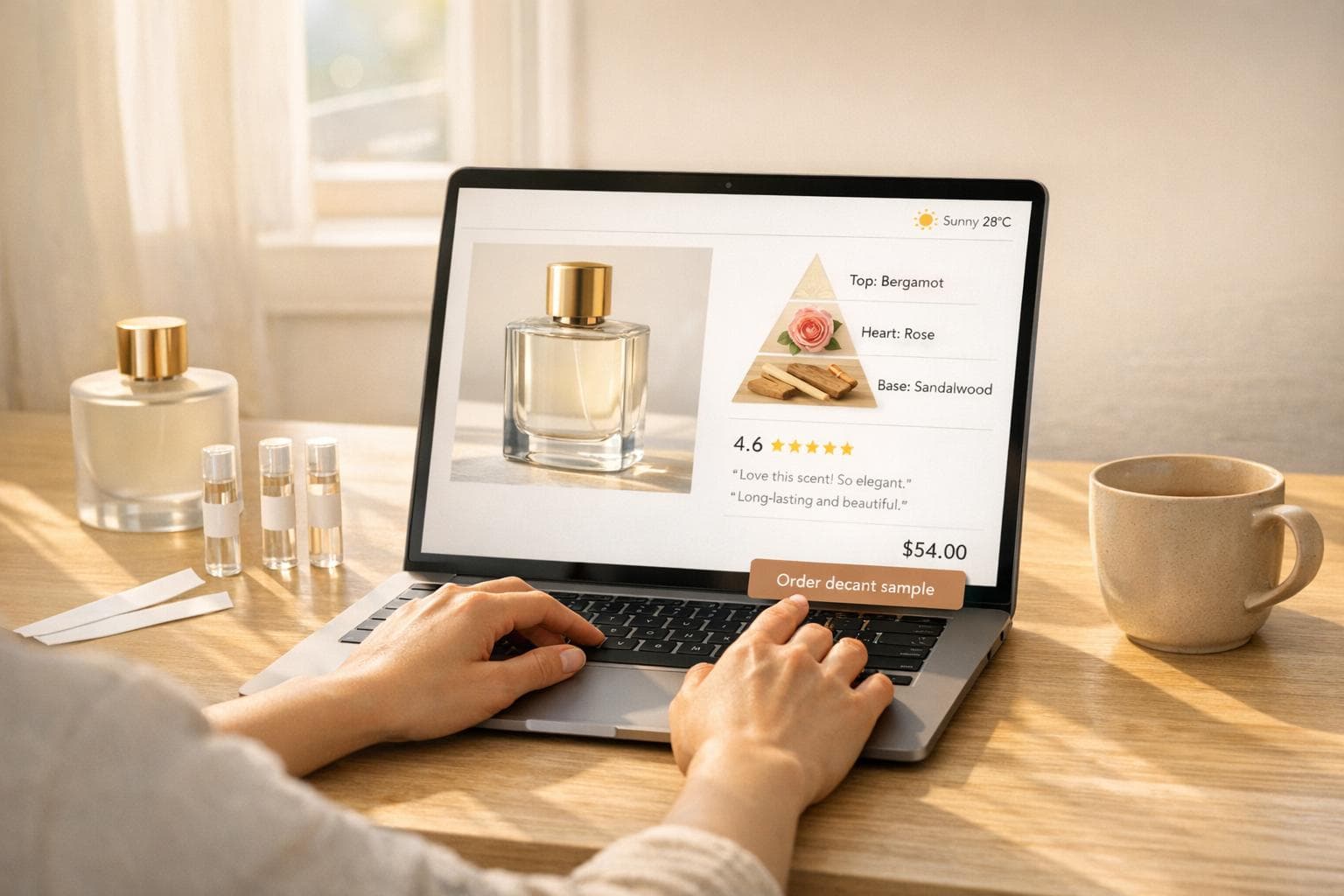
When buying fragrances online, you can’t rely on scent alone. Instead, shoppers focus on detailed descriptions, reviews, and smaller samples to avoid costly mistakes. Here’s what matters most:
- Scent Descriptions: 88% of buyers rely on note pyramids (top, heart, base) and scent families to imagine the fragrance.
- Price Sensitivity: 62% prioritize cost, while decants (2 ml–8 ml) help test perfumes before committing to full bottles.
- Trust in Retailers: Batch code transparency, return policies, and retailer credibility are non-negotiable.
- Climate & Demographics: Warm regions favour lighter scents, while colder climates suit richer notes. Gen Z prefers variety, often layering scents for unique combinations.
- Performance Metrics: Longevity, projection, and sillage matter. Reviews detailing wear time and intensity are better than vague praise.
- Social Media Influence: TikTok and Instagram drive discovery, but viral hype should be balanced with research.
To avoid blind-buy regrets, start with samples, test in real conditions, and only invest in full bottles once a fragrance proves its worth. Services like Scento offer decants, making it easier to build a personalized fragrance wardrobe.
Key Factors Behind Online Fragrance Choices
What Consumers Look for First
For 88% of fragrance shoppers, the scent itself is the top priority when making a purchase. Since smelling a fragrance online isn’t possible, consumers depend heavily on note descriptions, scent families, and evocative storytelling to imagine how a perfume might smell. Search phrases like "long-lasting amber" or "fresh citrus for summer" are often the starting point for many buyers.
Price comes in second, with 62% of shoppers identifying it as a major consideration. Interestingly, brand names carry less weight, influencing only 26% of buyers. Instead, the emotional connection a fragrance promises tends to drive decisions. Whether it’s the confidence evoked by woody notes or the calm offered by soft musks, people often choose scents that align with their personal feelings and desired identity, rather than sticking to a particular brand.
Another critical factor is trust. With counterfeit products circulating online, consumers are becoming more cautious. Features like batch code verification, transparent return policies, and signs of retailer credibility are essential for building trust before making a purchase. These priorities can also shift based on demographics and local climates, which we’ll explore next.
How Demographics and Climate Shape Preferences
Geography and climate play a key role in how fragrances perform and are perceived. For example, heat enhances scent diffusion, making lighter citruses and aquatic fragrances ideal for warm weather. Conversely, richer ambers and woody scents thrive in cooler temperatures, as the cold can mute the intensity of lighter fragrances. A scent that feels perfect during a crisp German winter might feel overpowering in humid conditions.
Generational preferences also influence buying habits. Gen Z, for instance, tends to shy away from sticking to a single "signature scent." Instead, they prefer curating a collection of fragrances suited to different moods, occasions, or seasons. The trend of scent layering - mixing multiple fragrances to create unique combinations - has also gained momentum, often fueled by social media influencers and celebrity collaborations. Women are slightly more inclined to experiment with new scents (23% compared to 18% of men), while men show a stronger tendency toward brand loyalty (32% versus 22%). Online platforms have adapted to these trends, offering personalized search filters to accommodate such diverse preferences.
While climate and personal preferences play a big role, price and perceived value remain key factors in how consumers make their final decisions.
Price and Value: Decants vs. Full Bottles
When it comes to fragrance, value isn’t just about the price per millilitre - it’s about cost-per-wear. A €300 bottle might seem like a worthy investment, but it loses its appeal if it sits unused on a shelf. In fact, 67% of European fragrance buyers own at least one bottle they’ve worn fewer than three times. On average, consumers lose around €340 on regretted purchases over a three-year period.
This is where smaller formats, like decants, have become increasingly popular. Decants, typically available in sizes like 2 ml, 5 ml, or 8 ml, allow buyers to test a fragrance’s performance throughout the day and in their specific climate before committing to a full bottle. As Avery Sinclair, Senior Fragrance Editor, explains:
"A scent must prove itself in wearability, longevity, and personal appeal."
Services like Scento cater to this need by offering authentic designer fragrances in 2 ml, 5 ml and 8 ml vials, and a 30 ml bottle decant on most perfumes. This approach lets shoppers explore fragrances without the financial risk of a blind buy. Scento is a perfume decant and sample retailer, and every product is available for one-time purchase without any subscription. Scento+ is Scento’s optional membership: the monthly fee comes back in full as store credit to spend on any perfume, members get 10% off, a free sample with every order, a free perfume every six months and a birthday gift, and you can pause or cancel anytime. This makes it easier than ever to find a fragrance that truly resonates.
How to Read Fragrance Information Online
Fragrance Notes and Scent Families Explained
Fragrances are like layered stories, with each note contributing to the overall experience. These layers - top, heart, and base notes - unfold over time. Top notes are the first impression, often light and fleeting, such as citrus, ginger, or fresh aromatics, typically lasting up to an hour. Heart notes, which define the scent’s personality, emerge between 1 and 4 hours after application. Finally, base notes, like woods, musks, resins, or vanilla, create the lasting foundation, lingering for 4 hours or more.
However, note lists only give part of the picture. As Lescento Fragrances aptly describes it:
"Note lists are a map, not the territory... You don’t experience each note separately; you experience the composition."
The real magic lies in accords - the harmonious blend of notes that create a unified scent. When reading descriptions, focus on sensory terms like "creamy", "dry", or "fizzy." These words often paint a clearer picture of the fragrance than a simple ingredient list.
Even bottle design can hint at the fragrance family. Dark or opaque bottles often suggest deeper, smoky, or woody scents, while clear bottles with sharp lines lean toward fresh or citrusy compositions. Pastel tones and softer shapes typically indicate floral or powdery fragrances.
To get a fuller picture, combine note descriptions with consumer reviews, as they often reveal how a fragrance performs in daily life.
How to Use Reviews and Social Media
Online reviews can be a goldmine of information, especially when they provide detailed insights into how a fragrance evolves over time. Look for specifics, such as how long it lasts on skin or fabric, and how its sillage - its aromatic trail - performs. For example, a review like "lasts 8 hours on skin, longer on fabric" tells you far more than vague comments like "amazing performance". Avery Sinclair, Senior Fragrance Editor, highlights the importance of such details:
"A review detailing ‘8 hours on skin, 12 on shirt, and moderate sillage for 90 minutes’ is far more credible than a blanket ‘insane performance.’"
Social media platforms like TikTok and Instagram Reels are great for discovering new fragrances, but approach them with caution. Viral terms like "beast mode" or "compliment magnet" often reflect hype rather than balanced opinions. Always cross-check these recommendations with thorough reviews, and look for consistent patterns - if multiple reviewers describe a scent as "soft and powdery", that’s a more reliable indicator than one overly enthusiastic post.
Also, consider the preferences of the reviewer. A fan of heavy oud-based fragrances might dismiss the appeal of a light aquatic scent. Knowing a reviewer’s general taste helps you weigh their opinions more effectively.
Reading Longevity, Sillage, and Concentration Claims
Understanding performance metrics like longevity, projection, and sillage can help you evaluate fragrances more effectively. Longevity refers to how long a scent lasts, projection describes how far it radiates from your skin, and sillage is the aromatic trail it leaves as you move.
Fragrance concentration labels - such as EDT (Eau de Toilette), EDP (Eau de Parfum), and Parfum - offer a general guide to intensity but don’t always guarantee performance. For instance, an EDT with persistent base notes might outlast an EDP in some cases. The table below provides a quick guide to concentrations:
| Concentration | Oil Percentage | What to Expect |
|---|---|---|
| Parfum | 15–30% | Long-lasting with a subtle sillage |
| Eau de Parfum (EDP) | 15–20% | Strong longevity, ideal for all-day wear |
| Eau de Toilette (EDT) | 5–15% | Lighter, better for casual or daytime use |
| Cologne | 2–4% | Refreshing but fades quickly |
It’s important to note that longevity claims often differ between skin and fabric. Citrus notes might vanish from your skin within an hour but linger on clothing much longer. Similarly, heavier scents like ambers can remain detectable on fabric for days. Always consider these differences when reading reviews.
Steps for Choosing Fragrances Online
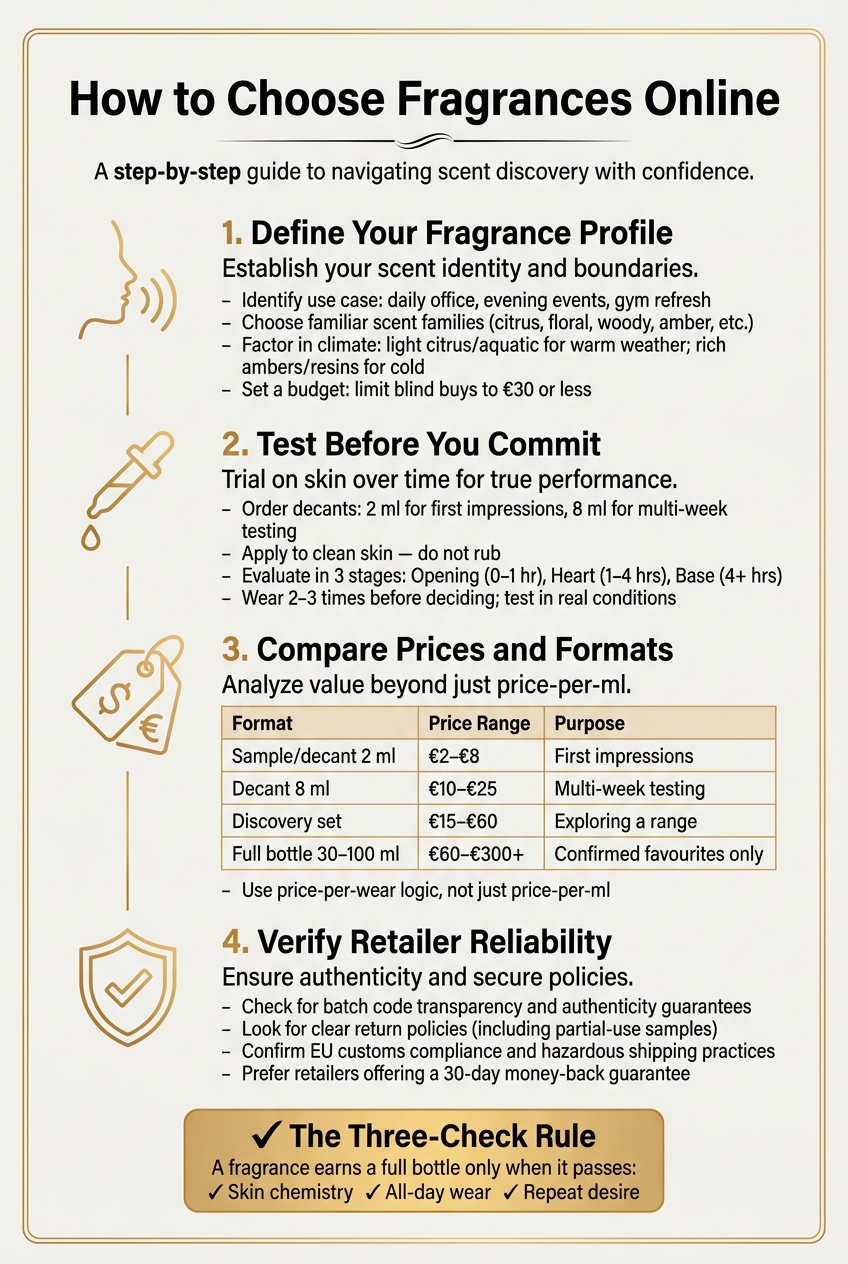
How to Choose Fragrances Online: A Step-by — Step Guide
Define Your Fragrance Profile
Start by identifying how and when you plan to use the fragrance: is it for daily office wear, evening events, or perhaps a quick refresh after the gym? Once you have a specific purpose in mind, think about the scent families you already enjoy. Sticking to familiar types can make choosing easier. Don’t forget to factor in the climate - lighter options like citrus or aquatic scents work well in warm weather, while richer notes like creamy ambers or resins shine in colder months. Finally, set a budget. For blind purchases, it’s wise to limit spending to €30 or less unless you’ve sampled the scent beforehand.
Once your profile and budget are clear, the next step is testing.
Test Before You Commit: Samples and Decants
The simplest way to avoid disappointment is to try the fragrance on your own skin before buying a full bottle. As Avery Sinclair, Senior Fragrance Editor, advises:
"A perfume that smells amazing on first spray is not automatically a bottle-worthy perfume. A bottle purchase should survive three checks: skin chemistry, all-day wear, and repeat desire."
Start with a clean, unscented application area, and avoid rubbing the fragrance into your skin, as this can alter its development. Evaluate it over time, focusing on three key stages: the opening (within the first hour), the heart (1–4 hours), and the base (after 4+ hours). Test it in the actual conditions you plan to wear it - whether that’s during a busy workday, a warm afternoon, or in an air-conditioned office. Ideally, wear it two or three times before making a decision.
Decants make testing more practical. A 2 ml decant is perfect for an initial impression, while an 8 ml size provides enough for several weeks of wear. At Scento, you can order decants in 2 ml, 5 ml and 8 ml vials, and a 30 ml bottle decant on most perfumes from a curated range of over 1,000 designer fragrances.
Once you’re confident in a fragrance’s performance, compare prices and formats to ensure you’re getting good value.
Comparing Prices and Formats
While price per millilitre is a common way to compare costs, price per wear often provides a better sense of value. For example, a fragrance that lasts eight hours and requires only two sprays could be a smarter investment than a cheaper option that fades quickly and needs frequent reapplication. The structure of the fragrance also plays a role - a resin-heavy EDT may outlast a lighter EDP in practice.
| Format | Typical Cost | Best For |
|---|---|---|
| Sample vial / decant (2 ml) | €2–€8 | First impressions, initial skin test |
| Decant (8 ml) | €10–€25 | Multi-week testing, travel |
| Discovery set | €15–€60 | Exploring a curated range |
| Full bottle (30–100 ml) | €60–€300+ | Confirmed favourites only |
As Avery Sinclair puts it:
"The cleanest decision rule is this: sample when uncertainty is meaningful, buy the bottle when the scent has already proven itself on your skin and in your life."
Once you’ve ensured the fragrance fits your needs and budget, it’s time to verify the reliability of the retailer.
How to Check If a Retailer Is Reliable
For EU shoppers, checking a retailer’s credibility is crucial before making a purchase. Look for clear batch code transparency and use available tools to confirm authenticity. Ensure the retailer offers explicit guarantees of authenticity, clear return policies (including for partially used samples), and proper shipping practices, as fragrances are classified as hazardous materials.
Additionally, verify that the retailer complies with EU customs and consumer protection regulations. A 30-day satisfaction guarantee, like the one offered by Scento, is a good sign that the retailer stands behind their products. This extra layer of security can make your online fragrance shopping experience smoother and more reliable.
Your Personal Fragrance Expert Awaits
Take our quick scent quiz to discover authentic designer and niche fragrances matched to your taste — explore them as 2ml, 5ml, 8ml & 30ml decants and samples, so you can try each one before committing to a full bottle.
Find Your ScentHow Digital Channels Shape Fragrance Discovery
Finding Fragrances Through Social Media
Social media has completely changed how people discover fragrances. Platforms like TikTok and Instagram have taken over as the go-to places for exploring new scents, replacing the traditional experience of testing perfumes with a sales associate and blotter strip. Now, consumers watch creators describe scents with imaginative phrases like "main character energy" or "compliment monster".
This shift is all about storytelling. Jack Li, Fragrance Category Lead at TikTok Shop, puts it simply:
"The creators who are successful in selling fragrances are great storytellers."
Brands have adapted to this trend. For example, Carolina Herrera created a TikTok series in 2025 and 2026 featuring its iconic stiletto-shaped "Good Girl" bottle touring New York City. This visually striking campaign built instant brand recognition without relying on traditional scent descriptions. Similarly, Interparfums boosted its marketing spend for Amazon and TikTok by 25% in 2026, while scaling back on conventional retail advertising.
Of course, viral trends come with their own challenges. In 2026, unanticipated social media hype caused Guess Bella Vita and DKNY Be Delicious to sell out multiple times, highlighting how unpredictable online demand can be. For shoppers, this means it’s smart to balance the buzz with independent reviews and reports on factors like longevity before making a quick purchase.
These digital platforms not only spark initial interest but also play a key role in guiding consumers through the research and trial phases. This online momentum has fundamentally changed what buyers look for in their fragrance collections.
Shifts in What Consumers Want
Consumer preferences are evolving in two major ways. First, the idea of having a single signature scent is fading. Instead, people are curating "fragrance wardrobes" - thoughtfully assembled collections of scents tailored to different moods, seasons, or occasions. To make this easier, shoppers are gravitating toward smaller formats, which allow them to experiment with a variety of fragrances without committing to the cost of full-size bottles.
Second, there’s been a noticeable shift toward comfort-focused scents. Warm, gourmand fragrances with notes like vanilla, toasted marshmallow, cocoa, and tonka have grown steadily more popular since the pandemic. These comforting profiles resonate with consumers who now prefer reassurance over bold, statement-making scents. This trend has sparked vibrant discussions across social media.
Both of these shifts highlight a common theme: smaller formats and lower-risk ways to discover fragrances are becoming the norm. At Scento, this digital-first philosophy is embraced by offering a curated selection of designer and niche fragrance decants, enabling shoppers to build a personalised fragrance wardrobe without a large upfront cost.
Building a Long — Term Approach to Fragrance
From Decants to a Full Fragrance Wardrobe
Creating a thoughtful fragrance collection is a gradual journey. Start small by using decants - those handy little samples - and test each scent in different settings over a few days. Only commit to a full bottle once you’re confident it meets your expectations. A helpful guideline is the Three — Check Rule, often referenced by fragrance editors: a fragrance deserves a full bottle only if it passes three key tests - works well with your skin chemistry, performs throughout the day, and remains desirable even after the initial excitement wears off.
Instead of searching for that elusive “one perfect scent,” think of fragrances as having specific roles in your wardrobe. You might need a dependable scent for the office, a cozy one for winter evenings, or something light and fresh for warm summer days. At Scento, decants in 2 ml, 5 ml and 8 ml vials, and a 30 ml bottle decant on most perfumes are designed for this kind of intentional exploration, making it easier to build a diverse fragrance wardrobe.
Common Mistakes and How to Avoid Them
One of the most expensive mistakes in fragrance shopping is the blind buy - purchasing a full bottle based solely on its listed notes, trendy reputation, or attractive packaging without actually testing it on your skin. A scent that doesn’t suit your personal chemistry or daily life can quickly become an expensive decoration. As Avery Sinclair wisely points out:
"A perfume that smells amazing on first spray is not automatically a bottle-worthy perfume."
Take your time to test fragrances, especially during different seasons. For instance, a rich amber that feels perfect in winter might be overwhelming in summer. Also, limit yourself to trying no more than three fragrances at a time. Overloading your nose can lead to fatigue, making it harder to fully appreciate each scent’s unique qualities. These careful steps are even more essential in areas where local fragrance options are limited.
Online Fragrance Shopping in Emerging Markets
In regions where access to niche or designer fragrance boutiques is scarce, online shopping becomes more than just a convenience - it’s often the only viable choice. Decants are particularly valuable here, allowing buyers to test high-end imports without immediately committing to the full cost of a bottle, which often includes hefty shipping fees and customs duties. Spending a small amount on decants is a smart way to avoid costly mismatches and unnecessary regrets.
This approach is especially practical for niche fragrances or highly concentrated formulas, where full bottles can easily range between €150 and €220. For shoppers managing tight budgets or living in areas with limited retail access, decants and curated discovery sets make it possible to explore global fragrance brands without breaking the bank. They offer a gateway to luxury that feels both accessible and thoughtful.
Conclusion: Making Better Fragrance Choices Online
Shopping for fragrances online can feel overwhelming, but having a clear approach makes it much easier. Start by identifying the scent families you enjoy and understanding how fragrances evolve - from the bright top notes to the deeper base notes. Look for retailers that provide detailed ingredient lists and guarantee authenticity. This knowledge helps connect your initial research to practical testing, paving the way for better decisions.
Think of your first purchase as an experiment rather than a long-term commitment. Opt for smaller formats, like 2 ml or 8 ml decants, to see how a fragrance works with your skin and lifestyle. As Arielle Fontaine, Senior Editor and Fragrance Strategist, explains:
"The best online perfume purchase starts with a sample and ends with repeat wear."
At Scento, you can explore this approach with decants starting at 2 ml. With a selection of over 1,000 designer fragrances and a 30-day satisfaction guarantee, you can experiment confidently before investing in a larger bottle. Soon, their 30 ml+ bottles will allow you to build a complete fragrance wardrobe.
FAQs
How can I predict how a perfume will smell from notes online?
Understanding fragrance notes - top, middle, and base - can give you a better idea of how a perfume will evolve on your skin. Top notes, like lemon, are the first to hit your senses but fade quickly. Middle notes, such as jasmine, form the heart of the fragrance and linger longer. Finally, base notes, like vanilla, provide lasting depth and richness.
To explore scents without committing to a full bottle, tools like fragrance finders or decant services - such as Scento’s curated sample sets - are incredibly helpful. They allow you to experience a variety of perfumes firsthand, taking out much of the guesswork. Remember, your personal skin chemistry and even the environment around you can affect how a fragrance smells on you.
How many wears should I test a decant before buying a full bottle?
Before purchasing a full bottle of fragrance, it’s wise to try a decant or sample several times. Usually, 2–3 wears are sufficient to assess how long it lasts, how it develops throughout the day, and how it reacts with your skin. This approach ensures the scent aligns with your tastes and fits seamlessly into your daily life before you commit to a bigger purchase.
What’s the best way to spot a trustworthy online fragrance retailer?
When searching for a reliable online fragrance retailer, start by reading customer reviews to get a sense of others’ experiences. Make sure the retailer provides clear information about product authenticity, as this is key to avoiding counterfeit items. Also, take the time to check their return and shipping policies - these should be transparent and customer-friendly.
Look for trust signals, such as authenticity certificates or a clear satisfaction guarantee, which can add an extra layer of confidence. Be wary of prices that seem unusually low; they can be a red flag for fake products. When reading reviews, keep an eye out for overly glowing or repetitive feedback, as this might indicate bias or even fake reviews.
By carefully assessing a retailer’s reputation and their commitment to authenticity, you can shop with confidence and enjoy a safe, satisfying fragrance-buying experience.

