
Perfume brands face a unique challenge when selling online: customers can’t smell the product. To overcome this, they rely on storytelling to evoke emotions, create sensory connections, and build trust. This approach has become essential, especially as online fragrance sales grew by 77% during the pandemic.
Key strategies include:
- Descriptive Product Pages: Combining imagery, emotional language, and user reviews to simulate the scent experience.
- Social Media Campaigns: Using platforms like TikTok and Instagram for influencer-led stories and short-form videos.
- Interactive Tools: Fragrance quizzes and augmented reality features to personalize the shopping journey.
- Email Storytelling: Sharing behind-the-scenes content and tailored recommendations to deepen engagement.
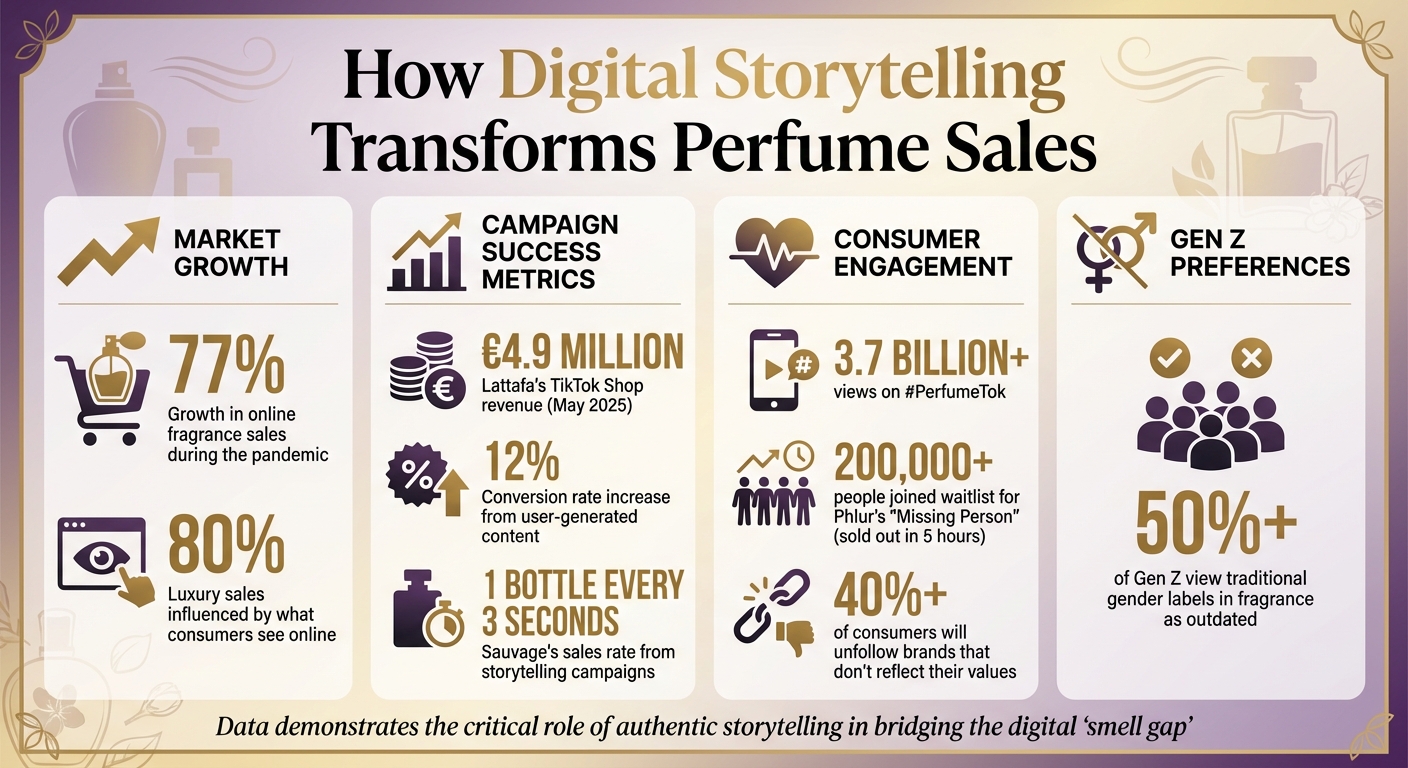
Key Statistics: Digital Storytelling Impact on Perfume Brand Success
Creating the Core Fragrance Story
Establishing Your Brand’s Story and Position
Your brand’s story is the foundation of every marketing effort. It’s what sets you apart and gives your audience a reason to connect with you. Start by identifying what makes your brand stand out - whether it’s rooted in heritage, a personal journey, or a distinct philosophy.
Take UAE-based fragrance house Lattafa, for example. In May 2025, the brand pulled in €4.9 million through TikTok Shop by presenting itself as a bridge between Arabian heritage and the modern, fast-paced Western digital world. Under the guidance of Head of Social Media Emaan Shoaib, Lattafa collaborated with influencers like Paulreactss and Danielrenemusic. The result? Two of their products landed in Amazon‘s Top 10 Bestsellers for Perfumes and Fragrances.
"Our success is largely attributed to our strong online community." – Emaan Shoaib, Head of Social Media and Digital Marketing, Lattafa
Modern consumers expect more than just a product - they want transparency. Ingredient sourcing, ethical practices, and alignment with personal values now play a huge role in purchasing decisions. In fact, over 40% of consumers will unfollow brands that don’t reflect their values. Your brand story should address these concerns, emphasizing not just what you sell but why you exist and what you stand for.
This shift in consumer mindset has also redefined fragrance positioning. It’s no longer just about "smelling good for others" but about "feeling good for yourself." Fragrances are now marketed around self-care, emotional wellbeing, and mood enhancement rather than attraction or approval. This aligns with a broader trend: over half of Gen Z consumers view traditional gender labels in fragrance as outdated.
Once your brand’s essence is clear, the next step is to create individual stories for each fragrance.
Writing Stories for Each Fragrance
Transform the technical aspects of a scent into emotional, sensory-driven narratives. Instead of listing notes, evoke imagery like "a sunlit beach where the salt air mingles with wild herbs". These descriptions bring fragrances to life in a way that resonates emotionally.
A great example is Phlur’s February 2022 launch of "Missing Person", guided by influencer Chriselle Lim. Instead of relying on celebrity endorsements, the brand leaned into Lim’s personal emotional experiences. The result? The fragrance sold out in just five hours, with over 200,000 people joining the waitlist, thanks to TikTok users sharing heartfelt reactions.
"If you can tap into someone’s emotions, we’ve found it’s more likely that a consumer will want to purchase." – Chriselle Lim, Creative Director and Owner, Phlur
Every fragrance story should answer a key question: why was this scent created? What need or emotion does it address? Use a narrative structure to guide the story. Start with the inspiration or setting (exposition), introduce a desire or challenge (conflict), and conclude with how the fragrance fulfills that need (climax). For instance, a fragrance aimed at relieving stress might begin with the chaos of daily life and end with notes that evoke calm and clarity.
Ground your stories in universal emotions or personal memories. Scents tied to childhood moments or significant life events feel more relatable. Avoid generic phrases and instead paint vivid, specific scenes that allow customers to imagine themselves wearing the fragrance.
These well-crafted narratives not only resonate emotionally but also support your business goals.
Aligning Stories with Business Objectives
The stories you create should align with your business goals, whether it’s building brand awareness, boosting sales, or educating customers. With 80% of luxury sales influenced by what consumers see online, visual storytelling is essential to bridge the "smell gap" in digital spaces.
Position discovery formats like perfume decants not as smaller, cheaper options but as key tools for building a versatile "scent wardrobe." This approach meets the demand for personalized, sustainable choices. Incorporate customer reviews and unboxing videos to add authenticity and social proof.
Since mobile is the primary platform for many consumers, ensure your video narratives are impactful even without sound.
Finally, define your brand’s purpose clearly. What specific problem does your brand solve? For discovery-focused models, this could mean reducing the waste of full-sized bottles that are never fully used. Every story should reinforce this central message of smart, personalized fragrance exploration. Up next, we’ll explore how to tailor these stories for different digital platforms.
Tailoring Stories for Different Digital Channels
Building Story-Focused Product Pages
A well-crafted product page weaves together evocative descriptions - think phrases like "morning dew on wild jasmine in a Mediterranean garden" - with practical details such as note breakdowns, ingredient origins, and customer reviews. This mix of storytelling and information helps create a sensory-rich experience for shoppers.
Take Yves Saint Laurent’s Black Opium fragrance page as an example. It incorporates a curated gallery of user-generated content under the hashtag #yslbeauty, featuring fan-created visuals directly on the page. This approach not only provides social proof but also bridges the "smell gap", showing potential buyers how others enjoy and style the fragrance.
Interactive elements can further enhance the shopping experience by translating scent into visuals. Atelier Cologne introduced augmented reality buttons on its product pages, allowing users to explore visualizations of raw ingredients and their origins. Bixente Barnetche, Customer Engagement and E-commerce Business Director at Atelier Cologne, explains:
"When you are not able to use one of your senses, you have to find another way [to engage with customers]. That’s why we wanted to do things like augmented reality and create meaningful content".
For discovery-focused products like sample sets or subscriptions, position them as tools for building a personalized "scent wardrobe." Include customer testimonials or unboxing videos to illustrate how real people incorporate these offerings into their routines.
Creating Stories for Social Media
Each social media platform plays a unique role in the customer journey. TikTok and Instagram Reels are ideal for creating awareness and sparking discovery with short-form video, while YouTube builds deeper trust with detailed reviews and behind-the-scenes content.
The numbers speak for themselves: #PerfumeTok has amassed over 3.7 billion views, making it a powerful discovery platform for younger audiences. Short-form videos thrive on algorithms that push content to non-followers, giving brands a chance to gain organic reach.
Snif tapped into this potential by partnering with TikTok influencer Amelia (Professor Perfume) to develop a custom scent for her wedding. Amelia shared not just the fragrance profile but also its personal meaning, leveraging her niche authority to boost both credibility and sales. This founder-led, emotionally driven strategy resonates strongly with Gen Z, who often prefer authenticity over traditional celebrity endorsements.
On Instagram, mood boards and "Get Ready With Me" videos can highlight how fragrances fit into daily self-care rituals. Meanwhile, YouTube offers a platform for creators to share detailed note breakdowns, reviews on longevity, and brand origin stories - helping justify premium price tags.
Beyond social feeds, direct channels like email can further personalize your storytelling.
Using Email and Interactive Tools for Storytelling
Email campaigns are an excellent way to nurture customer relationships through exclusive content and tailored discovery experiences. Share behind-the-scenes stories about perfumers, offer early access to limited editions, or provide curated scent recommendations based on user preferences.
Interactive tools like quizzes can make the process of finding a signature scent more engaging. For example, a "Perfume Finder" could ask aspirational questions like, "If you could escape anywhere, where would it be?" or use emotion wheels to guide users toward fragrances that align with their mood or memories. This emotional approach resonates with how people often associate scent with feelings or moments.
Social media also offers opportunities for direct engagement. Polls and "Ask Me Anything" sessions can serve as informal focus groups. Alex Suazo, VP Digital Marketing & Social at Finn Partners, emphasizes the value of these interactions:
"If you can get a pulse from your audience in the comments section, DMs or via AMA, that qualitative data can help inform creative and content strategies... It’s an awesome focus group at your disposal 24/7".
Use these insights to refine your storytelling, ensuring it reflects what your audience truly values. By tailoring your narrative across channels, you can create a cohesive brand experience that resonates deeply with your customers.
Inside Phlur: Chriselle Lim on Storytelling, Scent Craft, and Building a Fragrance Brand

sbb-itb-fb213bc
Advanced Campaign Formats for Digital Storytelling
Taking digital storytelling to the next level, advanced campaign formats provide fresh ways to captivate audiences and strengthen their connection to your brand.
Multi-Part Story Campaigns
Think of serialized content as a story that unfolds over time, keeping your audience hooked. The best campaigns follow a classic narrative arc: start by introducing your brand’s world (exposition), spotlight a challenge your audience relates to (conflict), guide them through the journey toward a solution (rising action), unveil your product or launch (climax), and show how it transforms their experience (resolution).
Adding a personal touch, such as founder-led storytelling, can elevate these campaigns. When founders share their personal fragrance journeys through Q&A sessions or behind-the-scenes glimpses, it creates a sense of authenticity that traditional ads often lack. As Karlee Bedford, Brand Director at Maple Leaf Sports & Entertainment, aptly puts it:
"Storytelling is an opportunity to emotionally connect with consumers. It offers the consumer more than just a product or service - it offers them an experience".
Interactive and Customer-Created Stories
Interactive formats shift your audience from passive viewers to active participants. Features like polls, quizzes, and user submissions invite customers to shape your brand’s story while offering valuable insights into their preferences. Questions like "What destination matches your scent personality?" or "Which era inspires your fragrance wardrobe?" can spark engagement that goes beyond technical details about fragrance notes.
User-generated content (UGC) is another powerful tool. Take Yves Saint Laurent’s approach in February 2016: they featured a curated UGC gallery on the Black Opium product page, showcasing real customers’ lifestyle photos under #yslbeauty. This strategy proved effective, boosting conversion rates by as much as 12%.
To encourage participation, use narrative-driven prompts like "Show us your signature scent moment" or "Tag us in your perfume layering guide." These hooks not only generate content but also weave personal stories into your brand’s larger narrative, creating a deeper connection between product experiences and brand identity.
Connecting Decants and Subscriptions to Story Arcs
Turn your product tiers into chapters of a customer’s fragrance journey. For example, assign samples to the discovery phase, 2 ml vials to deeper exploration, and 8 ml bottles to commitment. This transforms each size into a meaningful step in their experience.
Subscription services can amplify this storytelling by offering curated themes for each delivery. Instead of random monthly selections, align shipments with seasonal narratives like "Spring Florals", "Summer Escapes", or "Holiday Indulgence." This approach not only adds depth but also guides subscribers through a year-long sensory journey. As fragrance creator Funmi Monet explains:
"Fragrance is a hobby you can enjoy without having a specific skill. You don’t have to be a makeup artist... You don’t have to look a certain way".
Measuring and Improving Storytelling Performance
To understand how well your storytelling resonates, track engagement metrics like comments, shares, and mentions. These indicators can reveal your narrative’s impact on your audience. For example, perceived value shows whether your storytelling enhances your brand’s premium appeal (β = 0.63), while purchase intention highlights if the emotional connection you’ve built inspires action (β = 0.48).
Sentiment analysis is another critical tool, offering insights into the emotional tone of conversations about your brand. Pay attention to shifts from neutral to positive sentiment following a specific storytelling campaign. These metrics provide a foundation for fine-tuning your storytelling strategies in real time.
Metrics That Matter for Storytelling
Focus on the metrics that connect your storytelling to measurable business outcomes. Time on page and dwell time, for instance, indicate how deeply users engage with your content - if visitors spend 40% more time on story-driven pages, it’s a sign your approach is resonating. Keep an eye on untagged mentions to uncover genuine, organic discussions about your fragrances.
Other useful metrics include share of voice, which measures how well your stories stand out in a crowded market. Additionally, narrative transportation - the extent to which your story immerses consumers in your brand’s world - can signal strong conversion potential. Given that over 40% of consumers may unfollow brands with misaligned values, tracking sentiment becomes essential. These insights not only measure success but also guide you in refining your storytelling.
Testing Different Story Approaches
Experimentation is key to discovering what resonates most with your audience. Use A/B testing to evaluate different emotional tones, content lengths, and narrative angles. Social media polls, such as asking "Which fragrance journey speaks to you?", can offer quick, informal feedback without the need for extensive research. Digital platforms allow for real-time adjustments - if a particular story generates negative sentiment or low engagement, you can pivot immediately.
As Peter Levin, Creative Director at Finn Partners, explains:
"A brand’s story starts with its truth... consumers will seek out brands that feel authentic to both their values and what they want from a product or company".
Building a Reusable Storytelling System
To maintain a consistent and engaging narrative, document your brand’s core story in a centralized guide. This "North Star" guide should outline key elements like your brand’s main themes, emotional tone, and visual style, ensuring cohesiveness across all channels, whether it’s a product description, social media post, or email campaign.
Create templates for recurring formats, such as product launches, seasonal campaigns, or customer spotlights, to streamline your team’s workflow. Additionally, centralize feedback by using a smart inbox to capture mentions, direct messages, and comments. This makes it easier to spot trends and refine your storytelling approach as needed.
Conclusion
Selling fragrances online hinges on the power of storytelling to bridge the sensory gap. By weaving together visuals, narratives, and emotional triggers, brands help customers imagine the scent experience before making a purchase.
Leading fragrance brands excel at creating immersive narratives across multiple channels. From TikTok and Instagram Reels that spark interest to YouTube reviews and story-rich product pages that drive conversions, storytelling is at the heart of their strategy. When these narratives align with customer values, they foster emotional connections, encourage loyalty, and boost sales.
The numbers back it up: shoppable user-generated content (UGC) increases conversion rates by 12%, and campaigns like Sauvage’s - built on compelling stories - achieve staggering results, with a bottle sold every three seconds. Success lies in having a structured system to document the brand’s core message, tailor it for different platforms, and refine it through audience feedback.
The influence of storytelling in digital fragrance marketing is undeniable. As Peter Levin, Creative Director at Finn Partners, puts it:
"Telling a brand’s story begins with finding its truth... consumers will seek out brands that feel authentic to both their values and what they want from a product or company".
Whether you’re introducing a new fragrance or enhancing your online presence, the brands that stand out are those that craft stories customers want to join - turning a €160 purchase into a sensory experience that lingers long after the sale. This experience is further enhanced when you build a year-round perfume wardrobe that adapts to every season.
FAQs
How do perfume brands use storytelling to create emotional connections?
Perfume brands craft compelling stories to turn their scents into emotional journeys. Since our sense of smell is closely linked to memory and emotion, these narratives - whether about rare ingredients, seasonal inspirations, or far-off origins - give each fragrance a distinct personality that connects with consumers on a deeper level. Tales of master perfumers, time-honored techniques, or vintage influences add layers of richness and a sense of history, making the experience feel more personal and meaningful.
Digital platforms take these stories even further, using tools like virtual scent explorations, engaging short videos, and social media campaigns to reach wider audiences. By weaving in themes of nostalgia, adventure, or intimacy, brands create emotional ties that linger. A single fragrance transforms from a passing scent into a cherished memory.
How do social media platforms help fragrance brands tell their stories online?
Social media has become a powerful tool for fragrance brands, turning scents into vivid, emotional stories that resonate with audiences. Platforms like TikTok, Instagram Reels, and X are perfect for sharing short-form videos that bring perfumes to life. These videos can reveal the inspiration behind a fragrance, offer a glimpse into behind-the-scenes moments, or present mood-driven visuals that encapsulate the essence of a scent in just a few seconds.
Beyond brand-created content, these platforms thrive on user-generated posts and influencer collaborations. Micro-influencers and everyday fans often share personal moments - like unboxing a new perfume or offering first impressions - which adds an authentic layer to the brand’s narrative. Hashtags such as #PerfumeTok are driving enormous engagement, helping new launches gain viral momentum and sparking curiosity among U.S. audiences.
By blending visually compelling storytelling with genuine peer recommendations, social media allows brands to create emotional connections with consumers. This strategy not only builds excitement but also drives online sales, removing the traditional reliance on in-store sampling.
How do interactive tools improve the online perfume shopping experience?
Interactive tools are revolutionizing the way we shop for perfumes online, turning what could be a distant experience into something engaging and highly personalized. Take scent quizzes, for example - they ask about your favorite notes, moods, or even lifestyle choices to recommend fragrances that truly match your preferences. Then there’s augmented reality (AR), which adds a visual layer to the experience. With AR, you can explore a perfume’s ingredients or admire the design of its bottle in real time, making the process feel more immersive and exciting.
Live chat or video consultations with fragrance experts take this personalization a step further. These one-on-one interactions allow customers to get tailored advice, boosting their confidence in choosing the right scent. Together, these tools not only make shopping more enjoyable but also help build a stronger connection between shoppers and the brand, ultimately encouraging purchases. For Scento, incorporating features like a scent-profile quiz, AR ingredient previews, and live chat could guide customers in selecting the perfect size - 2 ml, 5 ml or 8 ml vials, or a 30 ml bottle decant on most perfumes - delivering a boutique-like shopping experience right from home.

