Indigenous harvest ceremonies use fragrance as a spiritual tool to connect with ancestors, nature, and the divine. Burning sacred plants like sweetgrass, sage, and copal purifies spaces, expresses gratitude, and protects participants. These rituals serve as sensory markers for agricultural cycles, blending spiritual meaning with practical needs.
Key Points:
- Sacred Ingredients: Sweetgrass (attracts blessings), Sage (purifies), Cedar (protects), and Copal (symbolizes resilience).
- Rituals: Smudging, smoke offerings, and anointing with aromatic substances.
- Challenges: Colonial suppression and modern industrialization threaten these practices.
- Preservation: Sustainable harvesting methods and legal protections are critical for safeguarding these traditions.
These fragrance rituals are deeply tied to nature and community, emphasizing respect, gratitude, and balance.
Sacred Ingredients Used in Harvest Rites
Sacred Fragrance Ingredients in Indigenous Harvest Ceremonies
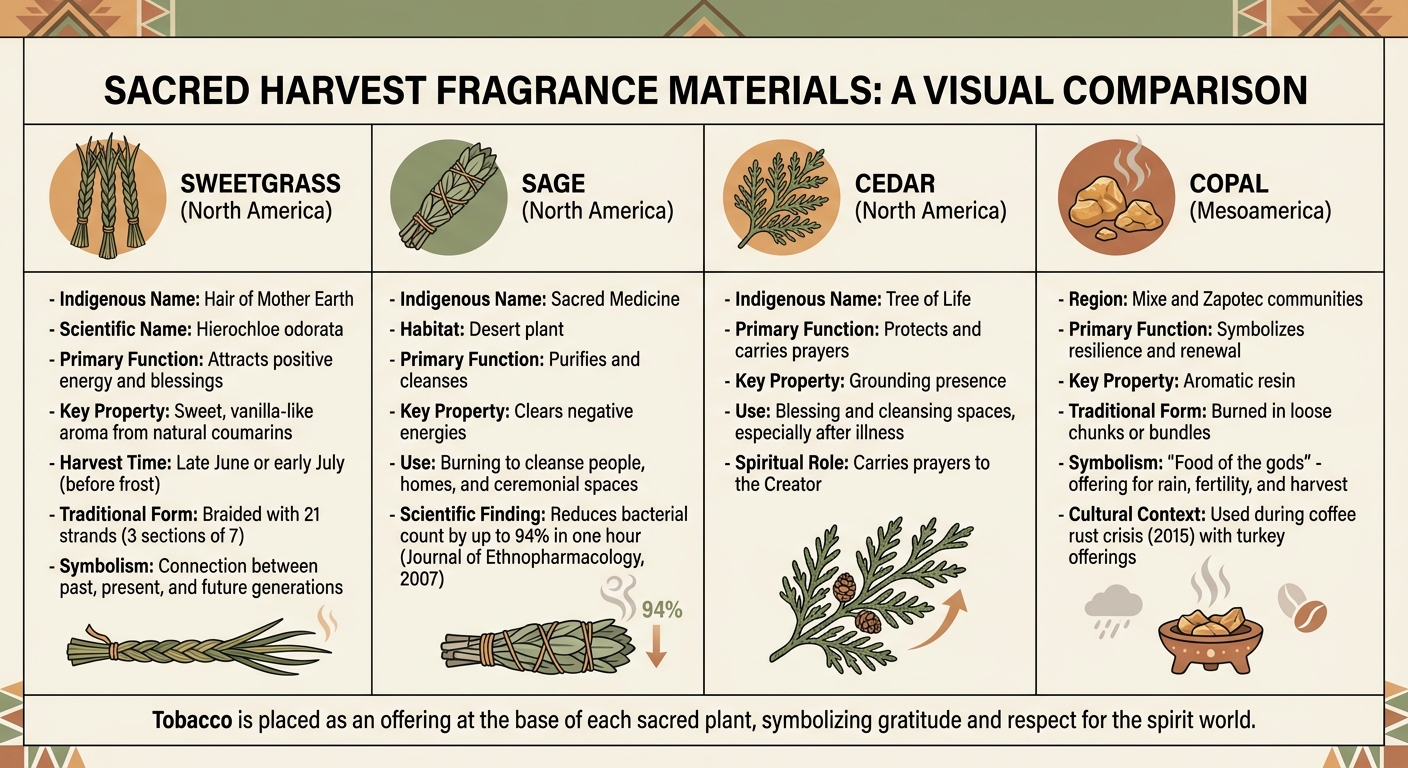
Harvest ceremonies often feature sacred ingredients that deepen the connection between participants, their ancestors, the land, and the spiritual realm. Each ingredient reflects the unique relationship between the community and its local environment.
Sweetgrass, Sage, and Cedar in North American Rites
In North America, many Indigenous groups, including the Anishinaabe, Bode’wad mi, and Odawa, honour the Four Sacred Medicines: tobacco, cedar, sage, and sweetgrass.
Sweetgrass (Hierochloe odorata), often referred to as the "Hair of Mother Earth", is cherished for its sweet, vanilla-like scent, which comes from its natural coumarins. Found in cool, moist climates above 40° north latitude, it is traditionally harvested in late June or early July, before frost can diminish its fragrance. Mary Ritchie explains its significance:
Sweetgrass is the hair of our Mother; separately, each strand is not as strong as the strands are when braided together.
Braided sweetgrass, typically woven with 21 strands, symbolises the connection between past generations, the Seven Sacred Teachings, and future generations. It is used to attract blessings and positive energy.
Sage, a desert plant, is a key tool for purification. Burning sage clears negative energies from people, homes, and ceremonial spaces.
Cedar, known as the "Tree of Life", is valued for its protective qualities and its ability to carry prayers to the Creator. Its grounding nature helps participants feel deeply present during rituals.
Tobacco, placed as an offering at the base of each sacred plant, symbolises gratitude and respect for the spirit world.
| Material | Indigenous Name | Primary Function | Key Property |
|---|---|---|---|
| Sweetgrass | Hair of Mother Earth | Attracts positive energy | Vanilla-like aroma |
| Sage | Sacred Medicine | Purifies | Cleansing properties |
| Cedar | Tree of Life | Protects and carries prayers | Grounding presence |
| Tobacco | Sacred Offering | Facilitates spirit communication | Symbolizes gratitude |
While North American ceremonies often use braided botanicals, Mesoamerican traditions highlight the use of aromatic resins for their transformative properties.
Copal and Aromatic Resins in Mesoamerican Traditions
In Mesoamerican harvest ceremonies, copal resin is a central element. Unlike the braided sweetgrass of North America, copal is burned in loose chunks or formed into bundles. Indigenous groups such as the Mixe and Zapotec incorporate copal into their rituals. For instance, during the 2015 coffee rust crisis that devastated coffee plants in the Sierra Mixe region, communities combined copal smoke with turkey offerings to symbolise resilience.
These rituals are often timed to align with environmental needs. For example, the Mixtec "People of the Rain" undertake annual pilgrimages to sacred hills in May, the region’s hottest and driest month, to request rain. Lucio Jimenez Ocampo, a coffee producer, highlights the importance of these traditions:
These rituals are very important because this is the inheritance that the ancestors left for us.
The scent of burning copal, often accompanied by traditional drinks like tepache, creates a link between the physical harvest and spiritual renewal.
African harvest ceremonies, in turn, rely on indigenous botanicals that reflect their unique ecosystems and cultural rhythms.
Myrrh and Other Fragrances in African Harvest Practices
In African harvest traditions, ingredients such as myrrh play a significant role. These botanicals, chosen for their availability and spiritual significance, mirror the natural and cultural cycles of the region.
As Mexican sociologist Eduardo López Ramiréz observes:
The indigenous worldview has a clear link with natural resources... the environment is a fundamental factor where symbolic aspects are materialised.
Despite their differences, these global practices emphasise a shared belief in the sacred balance of nature, with each ingredient serving as a bridge between the earthly and the spiritual.
How to Prepare Harvest Fragrances
Preparing harvest fragrances is a meaningful process deeply rooted in respect for nature and spiritual awareness. Many Indigenous traditions view this practice as a way to honor the connection between humans and the Earth.
Respectful Harvesting Methods
The methods used to gather fragrance materials play a crucial role in ensuring their ability to regenerate. For instance, when harvesting sweetgrass (Hierochloe odorata), it’s customary to cut the plant instead of uprooting it. This approach allows the plant to regrow and continue supporting future harvests. It reflects a key principle: take only what is necessary, leaving enough for the ecosystem to thrive and sustain future generations.
Before beginning the harvest, it’s common to offer tobacco or say a prayer at the base of the plant. This act acknowledges the plant’s spirit and expresses gratitude for its contribution. In some Mesoamerican traditions, harvesters purify the area with the sound of sea shells before collecting resins or botanicals. This ritual creates a sense of reverence and respect for the materials being gathered.
Once harvested with care, these materials are processed using traditional methods to maintain their spiritual and aromatic integrity.
Braiding, Smudging Bundles, and Storage Techniques
Processing fragrance materials while they are still fresh is essential to preserve their potency and aroma. For example, sweetgrass should be braided immediately after cutting, while the blades are still glossy and pliable. Allowing the grass to dry too much can make it brittle, reducing its effectiveness. Traditional sweetgrass braids are crafted with exactly 21 strands, divided into three sections of seven. The act of braiding is often seen as a form of prayer, symbolizing the unity of mind, body, and spirit.
Other materials, such as copal resin or castoreum, require drying and curing to develop their full scent profile. Resins are typically left to harden naturally, while animal-derived substances are graded with care. Tinctures, created by macerating materials in alcohol at a ratio of one part material to nine parts alcohol, need time to mature. Dan Riegler, founder of Apothecary’s Garden, suggests:
Wait at least 6 months, till the menstruum no longer darkens, and the material no longer lightens in colour - (Some prefer to let the tincture macerate for a year).
Proper storage is key to preserving these creations. Finished products should be kept in cool, dark places to maintain their properties. In some traditions, a few sweetgrass braids are intentionally left to dry and reseed in the wild, ensuring the plant’s ongoing presence in its natural habitat.
How Fragrances Are Applied in Harvest Ceremonies
Fragrances hold a profound role in harvest ceremonies, symbolizing cleansing, protection, and gratitude. They connect the physical and spiritual realms, enriching the ritual experience.
Smudging and Smoke Rituals
Burning sacred herbs is a common practice in many traditions. In North America, for instance, herbs like tobacco, sweetgrass, cedar, and sage are burned to create smoke that carries prayers to the Creator. Participants often fan the smoke over their eyes, ears, and heart as a symbolic gesture to promote clarity, attentive listening, and compassion. This act serves as a way to shed stress and distractions, preparing individuals for the sacred ceremonies ahead.
Each herb used in smudging carries specific purposes. Cedar smoke is associated with blessing and cleansing spaces, especially after illness. Sage is believed to dispel negative energies, while sweetgrass, with its sweet and inviting scent, is thought to attract positive spirits and energies. Interestingly, a 2007 study in the Journal of Ethnopharmacology revealed that smudging with medicinal herbs for an hour could reduce a room’s bacterial count by up to 94%.
While smoke rituals are central, other practices like anointing and personal adornment also play a role in sanctifying spaces.
Personal Anointing and Space Cleansing
Liquid offerings and personal adornments are integral in some traditions. For example, during the Mixe coffee harvest, offerings such as mezcal and tepache are brought to the plantation as a way of seeking the Earth’s permission and protection.
In Chippewa (Ojibwa) culture, sweetgrass holds a special place. Historically, young men wore two braids of sweetgrass around their necks as a fragrant personal adornment. Additionally, sweetgrass was burned during times of hardship, such as before a hunt, to seek spiritual guidance.
To complete the cleansing process, practitioners often direct smoke toward open windows to clear away discord. The embers are then extinguished, and the ashes are returned to the earth - sometimes buried beneath a tree to honor the natural cycle of life.
Your Personal Fragrance Expert Awaits
Take our quick scent quiz to discover authentic designer and niche fragrances matched to your taste — explore them as 2–8ml decants and samples, so you can try each one before committing to a full bottle.
Find Your ScentWhat Fragrances Symbolise in Indigenous Harvest Practices
Fragrances in Indigenous harvest traditions are more than just pleasant scents - they represent renewal, protection, and the strength of community, bridging the physical and spiritual worlds.
Fragrances as Symbols of Renewal and Gratitude
Take sweetgrass, for example. This aromatic plant embodies the connection between land and community, where individual elements come together to create something powerful. In Mohawk and Wabanaki traditions, gatherers show respect to nature by leaving a tobacco offering before collecting plants. This act reflects the principle of giving back to the earth. To ensure sustainability, they harvest sweetgrass by cutting the leaves rather than uprooting the plant, allowing it to regenerate for future use. A Mohawk basket-maker shared:
Using the sweetgrass would keep the baskets strong and alive, and she hoped that the people who bought them would appreciate their significance.
Fragrances also play a role in marking seasonal changes. Sweetgrass, for instance, is best harvested in late June or early July, a time that signals the shift toward preparing for autumn. If harvested after frost, the plant loses much of its aromatic strength.
Beyond renewal, these fragrances carry a deeper purpose - they invite protection and abundance.
Invoking Protection and Abundance
Fragrances often act as spiritual tools, connecting the earthly to the divine. Sweetgrass and copal, when burned, release smoke that carries prayers to the Creator. Their sweet aromas are believed to attract positive energies and "good spirits" to ceremonies. In Mesoamerican traditions, copal resin is viewed as "food of the gods", symbolizing an offering in exchange for rain, fertility, and bountiful harvests.
Chippewa oral histories recount the use of sweetgrass during times of hardship. When faced with potential starvation, they would burn sweetgrass on fires as a plea for abundance.
In Oaxaca’s Sierra Mixe region, coffee producer Lucio Jimenez Ocampo has revived these fragrance-based rituals. Incorporating offerings like turkey, tepache, and mezcal, his ceremonies aim to protect the harvest and the workers. After a devastating coffee rust plague in 2015, these rituals became vital. Ocampo explained:
These rituals are very important because this is the inheritance that the ancestors left for us.
From 2004 to 2021, 16 Zapotec communities also turned to spiritual rituals involving aromatic offerings as part of their fight for water rights. Beatriz Salinas, director of Flor Y Canto, highlighted the broader impact of these practices:
These rituals are crucial in combating climate change because they make people feel at one with nature, thus discouraging environmental destruction.
Their efforts paid off in 2021, when a presidential decree granted these communities control over their water resources. Aromatic rituals, in this case, became a unifying force for environmental and cultural preservation.
Conclusion
Indigenous fragrance practices in harvest rites show that scent serves as a language of spirit. Whether it’s the burning of copal in Oaxaca, the braiding of sweetgrass by Mohawk communities, or the offering of myrrh in African ceremonies, these traditions connect the physical and spiritual worlds. They express gratitude, provide protection, and carry ancestral prayers.
However, their significance extends far beyond the aromas themselves. From the 1500s to the late 19th century, the Catholic Church in Mexico actively suppressed indigenous incense rituals, particularly the burning of copal. Even today, many communities face challenges in openly practicing these traditions due to a long history of discrimination and violence.
This complex history underscores the need for a respectful and thoughtful approach. These practices are deeply spiritual, serving purposes such as limpia (spiritual cleansing), fostering community unity, and caring for the environment. They embody an ancestral legacy preserved through centuries of resilience.
Understanding their historical and cultural context is essential. These rituals are not fleeting trends but sacred practices that demand reverence. They foster a profound connection to nature, encouraging harmony and discouraging environmental harm. For indigenous communities, these traditions remain a living testament to the enduring relationship between nature and culture.
FAQs
How can I learn about these rites without appropriating them?
To approach indigenous fragrance rites with respect, it’s important to focus on their deep cultural and historical roots rather than attempting to replicate them. Invest time in learning through trusted sources such as books, documentaries, or teachings from cultural experts. Always approach these traditions with humility, recognizing their origins and significance, and steer clear of any form of misrepresentation or commercialization. Whenever feasible, consult with or seek permission from indigenous communities to ensure your understanding aligns with and respects their practices.
What are safe smoke-free alternatives to smudging indoors?
Smoke-free approaches to traditional smudging offer thoughtful ways to honor the ritual without burning herbs or resins. These include spritzing natural perfumes into the air, misting pillows with calming sprays, or using diffusers filled with essential oils. These methods preserve the spiritual and cleansing essence of smudging while being gentler on indoor air quality. They’re perfect for cultivating mindful, sacred spaces without introducing smoke.
How can sacred plants like sweetgrass and sage be harvested sustainably?
To responsibly gather sacred plants like sweetgrass and sage, it’s important to honour traditional methods that safeguard both the plants and their surroundings. This means collecting only what you truly need, steering clear of overharvesting, and timing your gathering to align with the plants’ natural cycles - like sweetgrass, which flowers from June to August. Always harvest thoughtfully, ensuring the plants can regrow, and approach the process with gratitude to help preserve these resources for generations to come.