
Heritage of Italian Perfumery: 800 Years of Craft
Italy is one of the two cradles of European perfumery alongside France, and its lineage runs deeper than any other commercial fragrance tradition on the continent. The Officina Profumo — Farmaceutica di Santa Maria Novella in Florence traces a continuous perfumery practice to 1221, when Dominican friars began compounding botanical waters and balms within the convent walls. Eight hundred years later, the same house ships to thirty-six countries, opens flagship boutiques in Tokyo and Manhattan, and books revenue that doubled in the two years following its 2021 acquisition by an Italian holding group, from EUR 46.6M in 2022 to north of EUR 60M in 2023.
Acqua di Parma, founded in 1916 in the Emilian city it is named after, built modern Italian fragrance identity around Mediterranean citrus. Bergamot from Calabria, lemon from Sicily, neroli from the Amalfi coast: the brand's yellow-and-black bottle has become shorthand for the entire "Made in Italy" luxury fragrance category. Acquired by LVMH in 2001, it remains the anchor of Italian designer-luxury at the world's largest luxury group. Find the house's Colonia and Note di Colonia ranges on the Acqua di Parma collection page.
Capri's Carthusia traces formula recipes to 1380 according to brand lore and was commercialised in the twentieth century to capture Amalfi-coast olfactory identity, with sea-spray accords, jasmine grandiflorum, and bitter-orange flower. Xerjoff in Turin, founded only in 2003, is Italy's modern niche-perfumery success story: independent, family-controlled, with estimated annual revenue around EUR 85M in 2025, and one of the few independent ultra-luxury fragrance houses globally that has resisted conglomerate acquisition. The house's Naxos, Erba Pura, and Lira frequently appear in Scento's most-decanted ranks; explore the full lineup on the Xerjoff brand page.
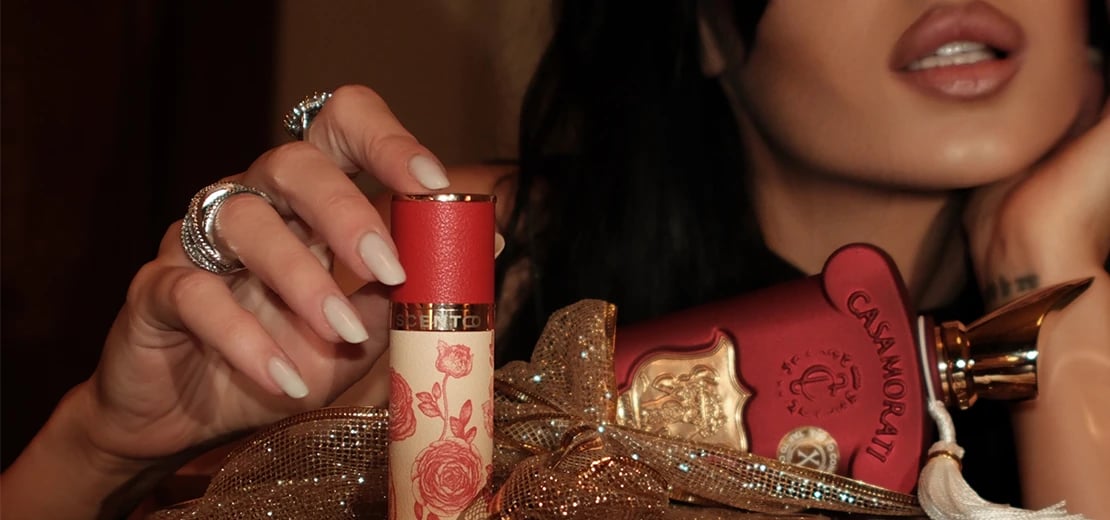
Profumum Roma, Nasomatto and Orto Parisi (both Alessandro Gualtieri projects), Bois 1920, Acqua dell'Elba, Laboratorio Olfattivo, I Profumi di Firenze, Tiziana Terenzi, Casamorati: the Italian niche bench has unusual depth versus comparable European markets. Where France industrialised luxury perfumery into conglomerate-scale houses, Italy preserved artisanal-house identity into the modern luxury era. The result is a higher density of independent niche houses with global export footprints than any other EU market relative to size, and a national fragrance culture in which the boutique perfumeria still functions as a primary retail format. Italy's competitive advantage is, simply put, artisanal lineage at scale.
This 800-year arc is not decorative. It explains why a country with a domestic fragrance market a fraction of France's still ranks as the third-largest perfume exporter in the European Union, why global fragrance growth increasingly travels through Italian artisanal channels, and why Pitti Fragranze in Florence has become the most important European discovery venue for new artistic perfumery. The house structure of the Italian market shapes everything that follows in this analysis.
The geographic concentration of Italian perfumery is itself a structural feature. Florence, Milan, Turin, Rome, Capri, and Bologna each anchor distinct creative ecosystems with their own raw-material relationships, training traditions, and house identities. Unlike France, where Grasse and Paris dominate the supply chain and brand creation respectively, Italy's perfumery is regionally distributed in a pattern closer to the country's broader luxury manufacturing geography. The result is a national fragrance industry less dependent on a single creative axis and more resilient to localised disruption. When Italian niche grows, it grows across multiple cities simultaneously, with Florence and Turin leading the modern niche acceleration and Milan increasingly emerging as a creative-direction hub for new launches.
Italian Fragrance Market Size 2026
The Italian fragrance market in 2025 sits in a band between $1.46 billion and $2.23 billion in retail value, with the spread reflecting methodology choices: B2C retail valuations cluster around the lower end, while full perfume-value-chain measurements push toward the upper end. Scento's analysis converges on roughly EUR 2.0 to 2.1 billion in domestic retail value for 2025, with the broader cosmetics basket reaching EUR 16.55 billion in 2024 (+9.1% year-on-year) and alcoholic perfumery within that basket generating EUR 2.5 billion-plus in 2024 at +26.3% year-on-year, the standout category in the entire Italian beauty industry.
The forecast trajectory is steady rather than spectacular. Independent market modelling places Italian fragrance retail at approximately $2.71 billion by 2030, an implied CAGR of 3.3%. Premium fragrances dominated 65.2% of revenue share in 2024, a structurally higher premium tilt than the European median. Within premium, Eau de Parfum is the dominant format and the fastest-growing concentration. Scento's best-selling Italian-house ranks reflect the same EDP-heavy mix.
Two sub-segment dynamics matter more than the headline. The Italian luxury-perfume sub-segment was sized at $357M in 2024 and is forecast to reach $596M by 2033 at a 5.82% CAGR, a meaningful acceleration above the broader market. The Italian niche/artistic-perfumery sub-segment, valued at approximately EUR 450M in domestic retail terms for 2025, has grown roughly 10% annually for 2023 and 2024 with similar momentum expected for 2025 and into 2026. Niche has shown a near-textbook anti-cyclical pattern in Italy, holding revenue growth even when broader cosmetic categories softened in 2023. The country's standalone niche-fragrance trajectory points to $0.25 billion in 2025 expanding to $0.48 billion by 2034 at a 7.44% CAGR, more than double the rate of the broader Italian fragrance market.
The broader 2025 cosmetics-sector forecast for Italy points to +6.9% growth in Scento's analysis, with perfumery sustaining double-digit momentum. Per-capita Italian fragrance spend lands near $25 per person in 2025 on a B2C retail basis, comparable to Germany, lower than France and the UK on per-capita prestige spend, and above Iberian and CEE averages. The framing that captures Italy correctly is the production-and-consumption sandwich: Italy is simultaneously a top-three EU fragrance consumer and a top-three EU exporter, a position only France matches at scale. Browse the full Italian and international perfume catalogue to see the depth of houses available within this market.
Top Italian Houses: Designer and Niche Made in Italy
The Italian fragrance landscape splits cleanly into three tiers: industrial-luxury designer houses operating at conglomerate scale, an unusually dense bench of independent niche/artistic-perfumery houses, and an emerging tier of post-2020 launches concentrated around Florence, Milan, and Bologna creative ecosystems. Scento's curatorial perspective treats all three as load-bearing for the Italian market identity.
At the designer and mainstream-luxury end, Acqua di Parma remains the Italian flagship within LVMH and the citrus — Mediterranean reference for the country. Estimated brand revenue sits in the high EUR 200M range, though LVMH does not break out individual brand revenue separately. Bvlgari, the Roman heritage jewellery house, runs a major fragrance arm under LVMH spanning Pour Femme, Aqva, and the ultra-luxury Le Gemme line. Bottega Veneta, Kering-owned, has revived its fragrance line under recent licensing partnerships. Salvatore Ferragamo, Florence-rooted, retains a fashion-house fragrance under license. Tom Ford, although not Italian-founded, is extensively manufactured in Italy and acts as a major designer-tier presence in the Italian market.
Italy's true differentiator is the niche bench. Xerjoff, with approximately EUR 85M annual revenue and twenty-three years of operation, is the most-exported Italian niche house globally; Naxos, More Than Words, Erba Pura, Ouverture, and Lira are the recognisable anchor compositions. Officina Profumo — Farmaceutica di Santa Maria Novella ran EUR 46.6M in revenue in 2022 and exceeded EUR 60M in 2023, sales effectively doubling in two years following its 2021 acquisition. Carthusia, the Capri-based artisanal house, anchors Mediterranean botanical perfumery. Profumum Roma, the Roman atelier, specialises in concentrated extraits with a gourmand and oriental focus. Nasomatto and Orto Parisi remain the most conceptual Italian niche projects under Alessandro Gualtieri's direction. Bois 1920, Laboratorio Olfattivo, I Profumi di Firenze, Acqua dell'Elba, Mancera (which operates from Italy and France), Tiziana Terenzi, and Casamorati round out a niche bench unmatched at this density anywhere in the EU.
The emerging tier is not a footnote. A wave of independent Italian launches has surfaced from Florence, Milan, and Bologna creative ecosystems through 2024 and 2025. Pitti Fragranze, the Florence trade fair, hosted 230 brands at its 2025 edition, with 75% of exhibitors international, but the gravitational centre of European artistic perfumery remains Italian. Forty per cent of artisanal-perfumery operators surveyed in 2025 reported strong revenue growth versus 2024. Fifty-three per cent expect strong growth in 2026. None expect contractions. The international panel ranks Germany, Italy, and Spain as the three fastest-growing European markets for artistic perfumery, with Poland, Romania, and Hungary as the top emerging-tier markets, and France ranking only fifth: a striking reordering of the conventional European fragrance hierarchy.
The bench depth shows up directly in Scento's niche perfumery curation, where Italian houses occupy a disproportionate share of the most-decanted ranks. Buyers exploring Italian niche through decants before committing to a full bottle is the structural pattern, not the exception.
Italian niche economics also benefit from a less promotional culture than mainstream-designer fragrance. Italian niche houses rarely run aggressive seasonal discounting, and the buyer relationship that develops between a Roman or Florentine perfumeria and its repeat clients is closer to a fine-wine retailer's relationship with its connoisseur base than to a department-store fragrance counter's transactional pattern. The pricing stability that emerges from this culture protects Italian niche margins through consumer-confidence cycles, and it explains why Italian niche houses have been able to invest in international expansion without the gross-margin compression that has affected mass-designer fragrance during the 2024 to 2025 inflationary period.
Buyer Behavior: How Italians Buy Fragrance in 2026
Italian fragrance buying in 2026 is shaped by three converging dynamics: a structurally diverse channel mix, a high-engagement buyer profile, and a cultural framing that treats fragrance as personal craft rather than seasonal accessory.
The 2024 Italian cosmetics channel mix is unusually broad: mass-market 42% share, traditional perfumery boutiques 19.3%, pharmacies 17%, e-commerce 8.6% (nearly doubled since 2019), salon/hairdresser 5.1%, herbal channels 3.3%, direct sales 3%, and aesthetic centres 1.9%. The traditional Italian perfumeria, the independent family-run scent-specialist storefront, remains a structural feature of the market in a way that has no European peer outside France. Within niche and artistic perfumery, specialist perfumeries account for 45% of distribution among 36% of operators surveyed, and 40% of sales for a similar share. This high specialist-channel weight is unique to Italy and France within Europe.
Italy lags Germany and the UK on overall e-commerce share but is closing the gap fastest among major EU markets. Notino reports Italy as its third-largest market at 9% of group turnover for 2024, behind Poland at 16% and Czech Republic at 12%. Italian buyers are increasingly comfortable purchasing fragrance online, a shift accelerated by the pandemic and now structural. Female fragrance consumption in Italy reached EUR 953M in 2024 (+10.9% year-on-year); male fragrance reached EUR 570M-plus (+13.6% year-on-year), the faster-growing sub-segment for the third consecutive year. Eau de Parfum dominates revenue share, with extrait and parfum concentrations over-represented in the Italian niche segment versus the broader market average.
Based on Scento's analysis of 1,886 Italian fragrance buyers between October 2024 and April 2026, niche-house penetration is significantly higher than the European average. Italian buyers index disproportionately on artistic perfumery and intense extrait concentrations, and the country shows higher repeat-purchase rates on second-and-third-bottle decant trials than the European median, consistent with the cultural pattern of fragrance treated as a personal-style commitment rather than a seasonal accessory. Scento's Find My Scent quiz reflects the same deep-buyer profile: Italian quiz takers self-identify with niche or extrait outputs at higher rates than the European median.
The cultural frame matters. Italian buyer behavior reflects two converging dynamics. The first is sprezzatura, the cultural prizing of effortless, considered self-presentation, which positions fragrance as essential personal craft. The second is the inheritance of family fragrance habits: Italian buyers report multi-generational household fragrance routines at higher rates than the European average. The fragrance one wore as a teenager in a Roman or Milanese household often becomes the signature one returns to in adulthood, sometimes through the same boutique that supplied the family for two generations. Italy is, in cultural terms, a deep-buyer market rather than a casual-buyer market, and the data confirms it. Bergamot, jasmine, and sandalwood recur disproportionately in Italian-buyer wardrobes versus the European median.
Italy as Global Export Power
Italian perfume exports reached approximately $2.27 to $2.30 billion in 2023, with volumes climbing 18% year-on-year to 57,000 tons. Italy's perfume exports grew at a 6.6% average annual rate over the decade 2013 to 2023, with the most rapid expansion in 2022 (+23%) and 2023 (+46% in value): a steeper growth curve than any other major EU exporter through the post — COVID expansion phase.
The average Italian export price reached $47,095 per ton in 2024, among the highest globally, sitting just behind France and a hair above the EU average of $47,339 per ton. By comparison, Spain exports at roughly $41,000 per ton and Poland at $24,000 per ton. The price differential reflects Italy's positioning at the artisanal-luxury end of the global fragrance market: when the world buys Italian fragrance, it is paying for niche, designer-luxury, and heritage houses, not mass-market contract production.
Top destinations for 2023 Italian perfume exports: the United States at $393M (the largest single destination, +95% year-on-year), Germany at $259M, the UAE at $162M, Hong Kong at $120M, Spain at $112M, the UK at $103M, France at $93M, Singapore at $82M, the Netherlands at $81M, Mexico at $64M, and Poland at $43M. The United States is now the gravitational centre of Italian fragrance export demand, and the Asian luxury corridor (Hong Kong, Singapore, plus growing volumes into mainland China and Japan) is the second-largest geographic block. The broader Italian cosmetics, toiletries and essential-oil export bill reached $9.12 billion in 2024.
Italy is now the third-largest perfume exporter in the EU by value, behind France ($6.9B) and Spain ($5.0B), and ahead of Germany. Perfume exports represent roughly 25% of Italy's total cosmetics export bill, and the share is rising. The average Italian export price commands a premium that reflects the country's positioning at the artisanal-luxury end of the global fragrance market. When an Italian buyer chooses Acqua di Parma, Xerjoff, Bvlgari, or Santa Maria Novella, they are participating in one of Italy's most successful global cultural exports. The same boutique-fragrance economy that sustains 230-plus exhibitors at Pitti Fragranze is the engine producing the brands that sit on shelves in New York, Dubai, and Tokyo. Browse the full Bvlgari catalogue to see how Roman heritage scales globally.
The export-volume mix is itself revealing. Italy's $2.27 billion in 2023 perfume exports split disproportionately into the luxury and prestige tiers compared with Spain's mass-and-mid-tier-weighted export profile. Italian-export fragrance reaches consumers via department stores, niche boutiques, and brand-owned monobrand storefronts globally, with relatively limited volume passing through duty-free or mass-channel distribution. The premium-channel concentration of Italian export demand means the country's $47,095 per ton average export price is not just a number; it reflects a structural choice by Italian houses to compete at the upper end of the global fragrance market rather than to chase volume at lower margins. The strategy has held through three decades of EU integration and continues to define Italy's fragrance-industry positioning into 2026.
Italian Niche Fragrance: The Anti — Cyclical Segment
The Italian niche/artistic-perfumery market sits at approximately EUR 450M in domestic retail value for 2025, with roughly 10% annual growth across 2023 and 2024 and similar momentum expected for 2025 and into 2026. The European niche/artistic-perfumery market overall is estimated at approximately EUR 5 billion at retail; Italy's domestic share is therefore roughly 9% of the European total against a population share of 13%, an underweight that reflects pricing constraints rather than buyer interest. Italy's standalone niche-fragrance market reached $0.25 billion in 2025 and is projected to grow to $0.48 billion by 2034 at a 7.44% CAGR, more than double the rate of the broader Italian fragrance market.
The anti-cyclical pattern is the most analytically interesting feature. In 2023, a soft year for general consumer goods across the EU, Italian artistic perfumery still grew approximately 10%. In 2024, growth held at 10.6%. The segment retained momentum because buyers self-select for the category: they are committed enthusiasts, not casual purchasers, and the segment is structurally less promotional, so value perception remains stable across consumer-confidence cycles. Niche buyers do not switch out of the category in response to short-term macroeconomic stress; they delay incremental purchases, then resume.
The distribution structure matters too. Seventy-six per cent of artistic-perfumery operators say specialist perfumery boutiques remain the primary channel. Direct distribution, through brand-owned monobrand stores, is gaining share, particularly among independent brands. Online direct-to-consumer is rising fastest. Operators expect e-commerce to drive the next phase of niche-segment growth, with implications that ripple through how Italian niche houses will reach buyers through the back half of the decade. For a deeper view of how Italian niche fits within the global picture, the 2026 niche perfume statistics report sets the European context.
The buyer-side implication is the structural argument for trying Italian niche through decants before committing to full bottles. Italian extraits frequently land at EUR 350 to 800 for 50ml; equivalent decant economics at EUR 2 to 4 per ml place a 5ml trial at EUR 10 to 20, well within discretionary range. Browse Scento's decant sample range and scent quiz for an Italian-niche entry path that sidesteps the full-bottle commitment.
Pricing, VAT, and Imported Fragrance Costs in Italy
Italian VAT on fragrance sits at 22% (the standard rate), higher than France (20%), Germany (19%), and most CEE markets except Hungary. All retail prices in Italy include VAT. The structural effect is that Italian shelf prices on imported fragrance are roughly 2 to 3 percentage points higher than equivalent French shelf prices and 3 percentage points higher than German shelf prices, all else equal.
The average Italian retail price for a 100ml EDP ranges from EUR 60 to 80 for designer mainstream, EUR 180 to 280 for luxury, and EUR 350 to 800-plus for niche/extrait. Italian-produced niche typically retails 10 to 20% lower domestically than equivalent French or Middle Eastern niche due to import-cost differentials and local manufacturing economics: an Italian niche house producing in Tuscany pays no cross-border duties, no extra logistics layer, and benefits from raw-material proximity to Mediterranean botanicals. The arithmetic flows directly to the shelf.
Per-millilitre decant economics show why the format works. A 100ml luxury bottle at EUR 280 implies EUR 2.80 per ml; a 5ml decant at EUR 15 implies EUR 3.00 per ml: near-parity, because shipping, cap, atomiser, and labour amortise less efficiently at small sizes. This is the universal economic logic of the decant model, and the small premium over full-bottle per-ml pricing buys access without the EUR 280 commitment. Browse Scento's 2ml, 5ml, and 8ml decant range to see the practical pricing in action.
The 2025 to 2026 botanical-extract import duties have added 8 to 12% logistics cost on raw materials sourced outside the EU, particularly Persian Gulf oud, Indian sandalwood, and Madagascar vanilla. Italian niche houses are partially insulated by sourcing many ingredients from the Mediterranean basin, with citrus from Calabria and Sicily, jasmine grandiflorum from Tuscany, rosa damascena from Tuscany, and helichrysum from Sardinia all landing inside the EU customs union. Extrait launches will reflect rising material costs through 2026, particularly for compositions that lean on imported oud, vanilla, or Indian sandalwood. Oud-forward launches and vanilla-led compositions are most exposed.
2030 Outlook for Italian Perfumery
The Italian domestic fragrance market is forecast to reach EUR 2.4 to 2.7 billion at retail by 2030, an implied 3.3% CAGR. The niche segment is forecast to reach EUR 600 to 650M, growing 8 to 10% annually, faster than designer-mainstream. Italian perfume exports are likely to exceed $3 billion by 2027 if current momentum holds, breaking the implicit cap that defined Italy's export profile pre-2022.
Five drivers shape Italian fragrance growth through 2030. First, niche export expansion: Xerjoff, Santa Maria Novella, Carthusia, and a wave of emerging houses gain US and Asia footprint. Second, male-fragrance growth: the third consecutive double-digit year continues a structural shift in buyer behavior across age cohorts. Third, younger Italian buyers: Gen Z and younger Millennials over-index on niche and artistic per surveys versus older buyers' designer preference, an inversion of the historical pattern. Fourth, Mediterranean botanical sourcing: Italy's supply-chain advantage as luxury houses globally seek "natural" and traceable ingredients gives Italian production an unusual moat. Fifth, specialist-perfumery resilience: the perfumeria boutique format is one of the few European retail formats actually gaining share against e-commerce in fragrance specifically.
Two risks balance the outlook. Pitti Fragranze exhibitor data shows niche-segment optimism may be approaching a peak; if 53% predicting strong growth turns out to be over-extrapolation, 2027 could underperform consensus. Italian VAT and inflation dynamics could compress mid-tier designer-fragrance volumes if real wages don't rise commensurately. Italian buyers historically defer fragrance purchases before reducing them, but the deferral period in past cycles was short; in a sustained downturn, the dynamic could break.
Italy's fragrance market enters 2026 as the European industry's artisanal-niche stronghold and a quiet export juggernaut. The niche segment is growing at 7 to 10% annually, export momentum is unlikely to slow in the near term, and the country's structural mix of designer-luxury, artisanal heritage, and emerging niche launches is unmatched at this density anywhere in the EU. The Italian fragrance economy is, in 2026, more diverse, more confident, and more globally relevant than at any point in its modern history. Explore the depth of Italian houses on the main perfume catalogue or the niche perfumery selection.
For buyers planning to build an Italian-anchored fragrance wardrobe through 2026, the practical sequencing is clear. Acqua di Parma's Colonia or Note di Colonia provides the citrus — Mediterranean foundation that anchors modern Italian designer-luxury identity. Xerjoff's Erba Pura or Naxos delivers the niche-luxury experience that defines modern Italian artistic perfumery, with its trademark gourmand-citrus opulence and Mediterranean depth. Bvlgari's Le Gemme line carries the Roman heritage at the ultra-luxury end of the spectrum, with its jewellery-house DNA visible in the bottle craft and the precious-resin compositions. A Profumum Roma extrait, a Tiziana Terenzi composition, or an Orto Parisi exploration adds depth at the conceptual-niche end of the wardrobe, each operating with its own creative logic. Layered together, the wardrobe represents the full breadth of Italian olfactory tradition, from the citrus-coast lightness of the Amalfi and the white-flower brightness of Capri to the resinous incense of Roman atelier tradition and the smoky, conceptual depth of Turin's modern niche scene. Decant trials at 2ml, 5ml, and 8ml sizes provide the structural alternative to full-bottle commitments, particularly for the niche-and-extrait tier where individual bottles run EUR 280 to 800-plus and where multi-house exploration would otherwise require thousands of euros in single-purchase commitment. Italy's fragrance economy in 2026 is built for this kind of considered, multi-house exploration, and the buyer who treats Italian perfumery as a curated wardrobe rather than a single-bottle purchase captures the country's cultural and olfactory range fully, across all eight centuries of its perfumery tradition.
This analysis is based on Scento's review of the Italian fragrance market, October 2025 – April 2026. A detailed methodology is available to press on request at [email protected].