
In 2026, the way people buy perfume has changed dramatically. Here’s what you need to know:
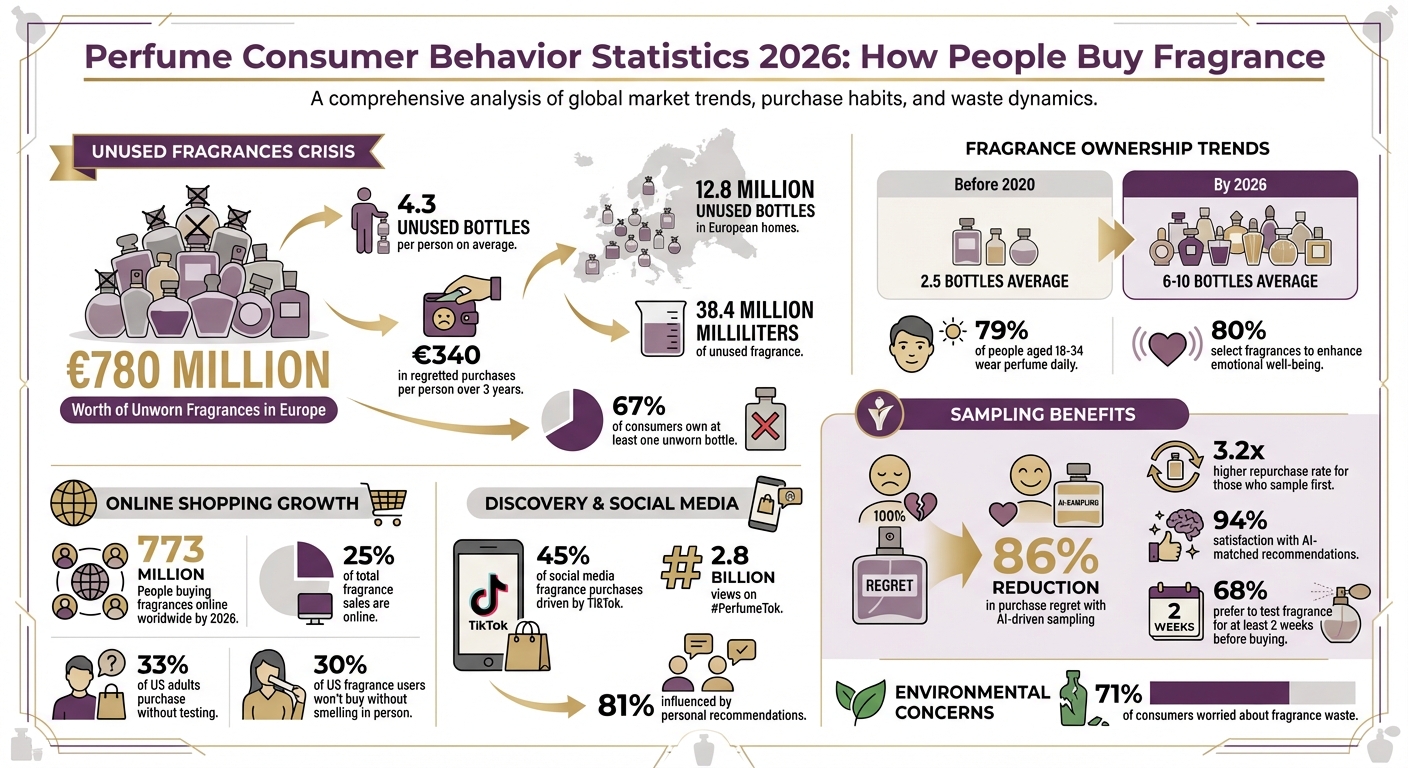
- Unused Perfumes: European consumers are holding onto €780 million worth of unworn fragrances. On average, individuals own 4.3 unused bottles, leading to €340 in regretted purchases over three years.
- Fragrance Wardrobes: Instead of sticking to one "signature scent", people are building collections (6–10 bottles on average) to suit different moods, routines, and occasions.
- Blind Buying Issues: 67% of buyers regret at least one fragrance purchase, highlighting the risks of buying without testing.
- Sampling Benefits: Sampling reduces purchase regret by 86% and boosts repurchase rates by 3.2 times. AI-driven tools and discovery sets are helping consumers make smarter choices.
- Digital Discovery: Platforms like TikTok and Instagram are now key for finding new scents, with hashtags like #PerfumeTok reaching billions of views.
The future of fragrance shopping lies in testing before buying. Sampling services and AI tools bridge the gap between online convenience and the sensory experience of perfume, saving money and reducing waste.
Perfume Consumer Behavior Statistics 2026: Key Insights on Fragrance Purchasing Trends
5 Stages of Perfume Collecting | My Fragrance Collection Journey Overconsumption Shopping Addiction
Perfume Purchase Statistics for 2026
By 2026, a staggering 773 million people worldwide will buy fragrances online, making up 25% of total sales. In the U.S. alone, 33% of adults will purchase perfume without ever testing the scent beforehand - a trend reshaping the fragrance industry.
Blind Buying: Purchase Regret Rates
Blind buying often leads to disappointment. In fact, 67% of consumers report owning at least one unworn bottle, with the average person having 4.3 unused bottles - a loss of about €340 in value. Across Europe, this adds up to 38.4 million milliliters of unused fragrance. However, the rise of AI-driven sampling has proven to reduce regret rates by 86%. This shift has encouraged consumers to experiment more, leading to the growth of diverse fragrance collections.
How Many Fragrances Does the Average Person Own?
Fragrance ownership has seen a sharp increase. Before 2020, people typically owned around 2.5 bottles. By 2026, that number has jumped to 6–10 bottles, reflecting a move away from the idea of a single "signature scent" to a more flexible, wardrobe-like approach to fragrance.
"The era of the signature scent, one perfume worn faithfully for a lifetime, is fading. We are seeing a massive shift toward fragrance wardrobing." — Lynn King, Founder and CCO, Fleurit Parfums
This trend is particularly noticeable among younger consumers. A striking 79% of individuals aged 18 to 34 wear perfume daily, and 80% of all consumers now select fragrances to enhance their emotional well-being.
How People Discover New Fragrances
To minimize the risks of blind buying, consumers are turning to innovative testing methods. In the U.S., TikTok plays a massive role, driving 45% of social media fragrance purchases. The hashtag #PerfumeTok has been viewed an astonishing 2.8 billion times. At the same time, personal recommendations influence 81% of fragrance purchase decisions.
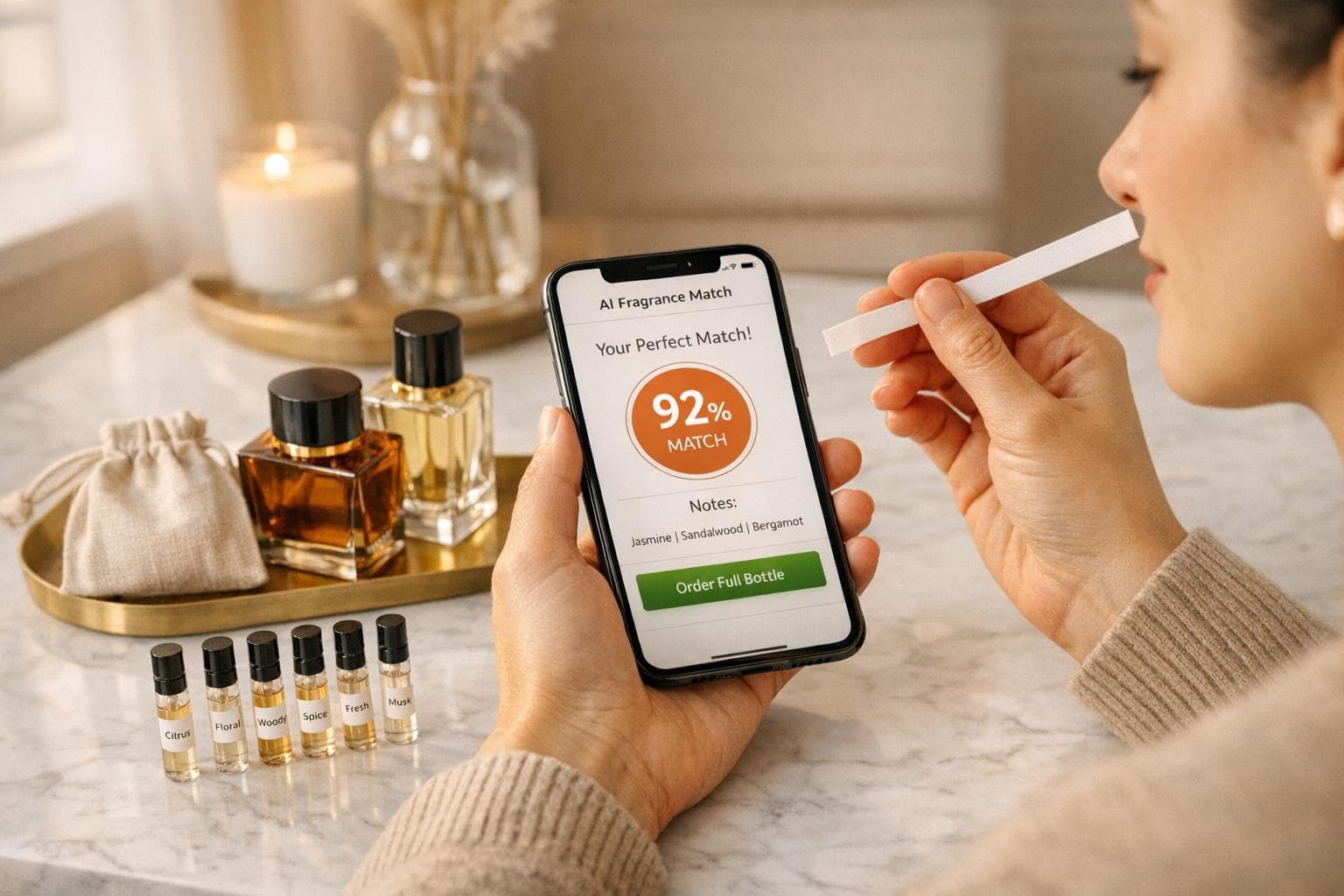
Sampling services have also become a core part of the discovery process. What began as a niche offering has now evolved into a mainstream method, with AI-driven tools mapping individual scent preferences and reducing the financial risk of trying new perfumes. Many brands now offer value-packed discovery sets - like four 10ml bottles priced similarly to a single 30ml bottle - to encourage exploration before consumers commit to full-sized bottles.
The message is clear: while consumers crave variety, they also need better ways to evaluate fragrances before making a purchase. The key challenge for the industry lies in bridging the gap between the convenience of online shopping and the sensory experience that perfumes inherently offer.
The Shift to Testing Before Buying
As online shopping grows, so does the need for a sensory connection in purchasing decisions. The days of blindly buying full-sized fragrance bottles are fading, with modern shoppers leaning toward discovery and extended testing before committing to a purchase. This trend is evident in consumer behavior and supported by proprietary data.
Data from Scento‘s Fragrance Profiling Quiz
Scento’s fragrance profiling quiz, completed by 75,000 European consumers, highlights this shift. The data reveals that 68% prefer to test a fragrance for at least two weeks before deciding on a full bottle. This extended trial period helps consumers evaluate how a fragrance interacts with their skin, changes throughout the day, and fits into their daily life.
Sampling first has proven benefits. Consumers who test fragrances before purchasing show a 3.2x higher repurchase rate, with 94% expressing satisfaction with AI-matched recommendations. In contrast, only 67% of blind buyers avoid ending up with at least one unused bottle. These findings emphasize how testing minimizes uncertainty, as discussed further in the context of reducing purchase regret.
How Sampling Reduces Purchase Regret
Testing fragrances over time allows consumers to uncover scent details that in-store sampling often misses. Fragrances react differently to individual body chemistry, meaning a scent that smells pleasant on a tester card might evolve unexpectedly on the skin.
The financial impact is just as compelling. AI-driven sampling has been shown to reduce purchase regret by 86% compared to blind buying. For consumers who previously spent an average of €340 on regretted purchases over three years, sampling offers a safer way to explore new scents without wasting money on full-sized bottles they may never finish.
"The €780 million in fragrance waste across Europe isn’t just a consumer problem - it’s an environmental and economic crisis. Our data proves that sampling before purchasing isn’t a luxury - it’s essential." — Scento Newsroom
Sampling bridges the gap between the convenience of online shopping and the sensory experience of perfume. By allowing consumers to test fragrances in real-world conditions, it gives them the confidence to invest in a full-sized bottle they’ll genuinely enjoy.
Your Personal Fragrance Expert Awaits
Join an exclusive community of fragrance connoisseurs. Each month, receive expertly curated selections from over 900+ brands, delivered in elegant 8ml crystal vials. Your personal fragrance journey, meticulously crafted.
Try Your First MonthCommon Purchase Problems and Sampling Solutions
The earlier discussion on purchase regrets sheds light on a major flaw in the traditional fragrance buying process: it often forces consumers into expensive and uncertain decisions. The financial and emotional strain of blind buying is evident, especially when European consumers are left with a significant number of unused fragrances. This highlights why the blind buying model often fails to meet consumer needs.
Why Blind Buying Falls Short
Blind buying pushes consumers to make costly choices without the chance to properly experience the scent. With full-sized fragrances priced between €90 and €300+, buyers are left guessing how a scent will interact with their skin or evolve over time. It’s no surprise that 30% of fragrance users in the US avoid purchasing scents they haven’t smelled in person. This reveals a clear gap between the convenience of online shopping and the sensory assurance that buyers seek.
"Roughly 30% of fragrance users in the US say they would not buy a fragrance they haven’t smelled in person, underscoring the challenges of online selling."
- Clare Hennigan, Senior Beauty and Personal Care Analyst, Mintel
Beyond personal frustration, this issue contributes to environmental concerns. 71% of consumers are worried about the waste generated by unused fragrances and their packaging. A joint survey conducted by Scento and RIFM between November 2024 and January 2025 revealed that 12.8 million bottles of designer and niche fragrances sit unused in European homes. These numbers illustrate the environmental burden of blind buying, making the case for sampling as a smarter, more sustainable alternative.
Sampling: A Smarter Way to Explore Fragrances
Sampling changes how people discover fragrances by offering variety and reducing financial risk. Instead of committing €90–€300 to a single bottle, consumers can explore multiple scents through affordable sample vials. This method allows for building a "fragrance wardrobe" without the hefty price tag that often limits experimentation.
The benefits of sampling are clear. AI-driven sampling reduces purchase regret by 86% compared to blind buying. Consumers who sample first are also 3.2 times more likely to repurchase full-size bottles. Sampling provides an opportunity to test fragrances in real-life situations - different weather conditions, activities, and times of day - giving a more accurate sense of a scent’s longevity and sillage than a quick in-store test ever could.
Conclusion: The Future of Fragrance Purchasing
Blind buying is leaving consumers with shelves full of unused fragrances, translating to an estimated €780 million in wasted purchases. On average, 67% of buyers end up with 4.3 unworn bottles, equating to about €340 worth of unused products over a three-year period. This trend is driving a growing preference for testing fragrances before committing to a full bottle.
A November 2025 survey of 1,247 European consumers revealed that AI-powered sampling significantly reduces buyer regret - by 86% - and increases repurchase rates by 3.2 times compared to blind buying. As discussed earlier, sampling is fundamentally changing how people approach fragrance purchases, fostering greater confidence and satisfaction.
Modern fragrance enthusiasts are curating "fragrance wardrobes" that reflect their evolving identities and lifestyles. Sampling offers a practical and cost-effective way to experience scents in everyday settings before making a larger investment.
"Modern consumers don’t live that way – our identities, preferences, and daily rituals are fluid. Scento’s platform moves beyond traditional retail models to offer olfactory preference mapping, seasonal intelligence, and a discovery-first approach to luxury fragrances."
- Sebastian Dobrincu, Co — Founder and CEO of Scento
The future of fragrance purchasing is centered on informed choices, allowing consumers to avoid costly mistakes and build collections they genuinely enjoy and use. This shift represents a move away from risky blind buys toward a more thoughtful and personalized approach.
FAQs
How does AI-powered sampling help prevent perfume purchase regret?
AI-powered sampling is changing the way people shop for perfumes by providing personalized scent recommendations and the chance to test fragrances before committing to a full bottle. It gives buyers the opportunity to see how a scent aligns with their preferences and interacts with their body chemistry over time, reducing the chances of disappointment.
This ‘try-before-you-buy’ model, supported by AI tools, helps shoppers make more confident and informed choices. It tackles common challenges like blind purchases and fragrances that don’t meet expectations, making the buying process smoother and more satisfying.
What are the advantages of owning multiple fragrances instead of sticking to one signature scent?
Owning multiple fragrances gives you the freedom to align your scent with various occasions, seasons, or even your mood. It’s a way to reflect your personal style as it evolves, tapping into the growing desire for customization and a deeper emotional connection with your fragrance choices.
Building a fragrance wardrobe also helps avoid the common pitfalls of blind buying - something many online shoppers can relate to. In fact, studies indicate that 68% of people prefer to test a fragrance for at least two weeks before committing to a full-sized bottle. Sampling first allows you to identify scents that genuinely resonate with you, making your collection feel thoughtfully chosen and perfectly suited to your lifestyle.
How does social media impact how people discover and buy fragrances?
Social media has become a game-changer in how people discover and shop for fragrances. Platforms like TikTok and Instagram bring scents to life through viral videos, engaging reviews, and creative storytelling. Influencers and everyday users often introduce fresh brands or niche perfumes, sparking curiosity and influencing buying decisions.
Another trend gaining traction is the preference for sampling before buying. Shoppers are increasingly looking for affordable ways to test fragrances - like discovery sets or individual samples - before committing to a full bottle. This approach helps avoid the disappointment of blind purchases that don’t match expectations, making sampling a practical and appealing choice for many.
The 68/47/42/39 Pattern: How European Fragrance Buyers Actually Behave
Scento's review of European buyer behavior identifies four dominant signals — 68% urban daily, 47% longevity-led, 42% natural-preference, 39% digital-influenced — that together describe the modern fragrance shopper. The pattern is consistent across the 19 European markets we track, and the four signals stack rather than substitute: the buyer who scores high on three or more of them is over-represented in our highest-conversion subscriber cohort.
68% urban daily. Urban European consumers now wear fragrance as part of their daily routine, with roughly 69% considering scent essential to personal care. Urban populations alone contribute approximately 61% of total category usage. The implication for buyers is precise: longevity and sillage matter most when you are commuting, at-desk, and in-meeting. Lighter EDT-class formulations that fade by lunchtime do not survive contact with this behavior pattern.
47% prioritise longevity. Demand for long-lasting formulations is up approximately 48% over baseline. Higher concentrations win on this axis — parfum at 20–40% aromatic load delivers more wear hours per spray than EDP at 15–20%, which beats EDT at 5–15%. Per-wear cost falls as concentration rises, even when sticker price climbs. The structural advantage of higher-concentration fragrance over lighter formulations has rewired the EDP-versus — EDT category split decisively over the last three years.
42% prefer natural ingredients. Roughly 37% of buyer preference now leans natural or organic at baseline; the larger 42% figure captures the cohort that "actively considers" naturals before purchasing. Skin-sensitivity concerns, ingredient transparency, and the clean-beauty halo effect drive this — and the buyers who screen for naturals also screen for refillable formats and ESG-credentialed sourcing.
39% influenced by digital marketing. Social media now influences approximately 47% of fragrance purchase decisions among younger buyers; the 39% figure is the all-ages average. The pattern is asymmetric: Gen Z over 60%, Boomers under 20%. The digital-influence number is rising on both ends, but Gen Z is pulling the curve.
The four signals do not operate in isolation — they stack. The buyer who wants long-lasting and natural and was discovered via short-form video is over-represented in Scento's order data. Scento's analysis shows that buyers exhibiting three or more of these four behavioral signals convert from sample to full-bottle at substantially above-baseline rates. For buyers building a wardrobe across these dimensions, browse the full Scento catalog or start with discovery-led trial via 2ml decants — the format that lets each behavioral signal be tested before commitment.
The Wardrobe Mindset: Why Buyers Are Abandoning Signature Scents
Scento's analysis confirms what European fragrance buyers have been telling us for two years: the "one signature scent" era is closing. Approximately 22% of UK fragrance users now own five or more fragrances, and that cohort is no longer the exception — it is the trajectory. The wardrobe metaphor has displaced the signature-scent metaphor, and the language shift is the leading indicator of the buying shift.
The wardrobe mindset works the same way clothing curation works. Consumers now build a fragrance rotation by mood, occasion, and season — a citrus-aquatic for summer commuting, a gourmand-amber for weekend dinners, a smoky-leather for autumn evenings, a clean-musk for office days. Each scent does a different job. The buyer who tries to make one fragrance do all jobs ends up either compromising on every occasion or running through the bottle so fast that it costs more than the wardrobe alternative.
Layering is the next stage. In Europe specifically, 22%+ of women buyers report wearing two scents simultaneously to create a personal signature — citrus over amber, vanilla over leather, musk under floral. Houses like Maison Margiela Replica, with its memory-anchored compositions, have built entire propositions around layering — buyers stack Coffee Break under By the Fireplace and create a private scent that no off-the-shelf bottle delivers. The layering trend is structurally adjacent to the wardrobe trend; it is what happens when a buyer who already curates a wardrobe starts mixing within the rotation.
Across Scento's European subscriber base, the average active buyer holds between five and ten fragrances at any one time — a range that did not exist in our 2022 cohort, where the modal active buyer owned two. The shift in two years has been pronounced. The implication for brands is also pronounced: "scent wardrobing" rewards trial-friendly formats — decants, discovery sets, layering pairs — and structurally disadvantages the legacy 100ml prestige bottle. The houses that build sample programs and discovery-set propositions capture the wardrobe; the houses that hold to a 100ml-only catalog watch their share migrate.
For buyers building a wardrobe, the entry point is structured discovery. Explore Scento's note library to map the building blocks of the wardrobe; or run the AI scent quiz to compress the discovery window from months to minutes.
Sampling Has Become a Decision — Engine, Not a Trial
Scento's analysis identifies sampling as the new center of gravity in fragrance commerce — not the discovery hobby it was a decade ago, but the primary decision-making tool. Approximately 60% of fragrance shoppers now test scents before high-value purchases; over 70% of niche-fragrance buyers prefer digital engagement before purchase; and 78% of Gen Z buyers start their fragrance journey with travel-size formats. The sample is no longer an afterthought to a purchase — it is the purchase, with the bottle as a downstream consequence.
The decision-engine reframe is mathematical. A 2ml decant is not a marketing freebie; it is a 60-day evaluation window. The buyer wears the fragrance through real situations — workdays, dates, dinners, commutes — and gathers the kind of data that an in-store five-second sniff cannot deliver: how it interacts with their skin chemistry, how long it lasts, whether it draws compliments, whether it ages well over the wear-arc, whether it survives weather and clothing. After 60 days the bottle decision is grounded in evidence, not in an in-store hope.
Discovery sets reinforce the decision-engine reframe. Sample sets are increasingly priced equivalent to a full bottle — €60 for ten 2ml samples versus €60 for one 50ml bottle — and consumers rationalize this. The set buys variety and reduced regret; the bottle buys volume and one shot at being right. For first-time entries into a niche house, the set is the rational choice. For confirmed favorites, the bottle is. The choice is not symmetric.
The conversion math validates the structural shift. When a sample is the decision tool, sample-to-bottle conversion routinely exceeds 25% — multiples above the blind-buy conversion in traditional retail. Scento's order data shows that subscribers who sample at least four fragrances within their first three months are dramatically more likely to convert to a long-tail full-bottle purchase than buyers who try one fragrance and decide. Variety inside the trial window deepens conversion at the bottle window — exactly the opposite of the legacy retail intuition.
For buyers who want to try the wedge, browse Scento's 2ml decant catalog, run the personalised sample quiz, or start with a sample of Byredo — a textbook niche house with a strong sample-led trial pattern across the European cohort.
Mood — Driven Buying: How Wellness Reshaped the Fragrance Category
Scento's analysis tracks a structural shift: fragrance is no longer purely an aesthetic accessory. It is a mood tool, a wellness format, and increasingly an emotional ritual. Approximately 80% of fragrance users say scent is helpful for lifting or enhancing mood; roughly 42% of fragrance and beauty purchases are now motivated by wellness benefits; and the broader fragrance market is treating scent as functional — sleep, focus, calm — not just aesthetic.
The mood economy shapes purchase timing. Gourmand-and-comfort blends dominate when buyers self-treat — the cold January week, the post-holiday slump, the deadline week. Fresh-and-aquatic blends spike during peak-stress windows like Q1 — the mental-health correlation is consistent year-on-year. The buyer who picks up a vanilla-amber comfort scent in February is making the same psychological move as the buyer who picks up an essential-oil diffuser. Fragrance has moved into the same emotional-regulation toolkit.
Layering for mood is the natural extension. Consumers stack a "calm" base — sandalwood-anchored scents, lavender, and musk-led blends — under a "lift" top of citrus or neroli to architect emotional state through scent. The technique mirrors aromatherapy, but with perfumery sophistication; the calm-anchor lasts through the day while the lift-top refreshes on demand. This is wardrobe behavior in service of mood architecture, and it is the reason why the wardrobe trend and the mood-buying trend are reinforcing each other.
The wellness halo reinforces the trend at the formulation level. Clean-fragrance growth at approximately 9.5% CAGR for natural and organic compositions maps cleanly onto buyers who frame fragrance as self-care. The houses positioning around wellness — Jo Malone London with its single-note simplicity and Diptyque with its meditative-domestic Parisian aesthetic — capture this segment at higher rates than houses positioning around overt luxury or seduction. The implication is that scent now competes with mindfulness apps, journaling routines, and wellness rituals for the same mental-wellbeing budget — and the houses that read this signal correctly will compound through 2027 and beyond.
This analysis is based on Scento's review of European fragrance industry data, October 2025 – April 2026. A detailed methodology is available to press on request at [email protected].