Perfume has evolved from ancient rituals to a €52 billion industry, reflecting societal and technological shifts. This timeline covers key milestones from the 1900s to today, highlighting advances like synthetic molecules, iconic launches (e.g., Chanel No. 5), the rise of niche brands, and modern trends like gender-neutral scents and eco-conscious practices. Here’s a quick overview of perfume’s journey:
- Early 1900s: Synthetic scents made perfumes accessible, with innovations like coumarin and aldehydes redefining fragrance creation.
- 1920s-1940s: Chanel No. 5 revolutionised luxury perfumery; fashion houses like Dior linked couture with fragrance.
- 1950s-1960s: Post-war growth brought affordable perfumes and expanded men’s product lines.
- 1970s-1990s: Bold scents of the ‘80s shifted to minimalist, unisex fragrances in the ‘90s, with gourmands like Angel gaining traction.
- 2000s — Today: Niche brands focus on personalisation, ethical sourcing, and sampling methods like decants to reduce waste.
Perfume remains a blend of artistry and science, evolving with consumer values and technological advancements. Dive into the full timeline to explore its transformation.
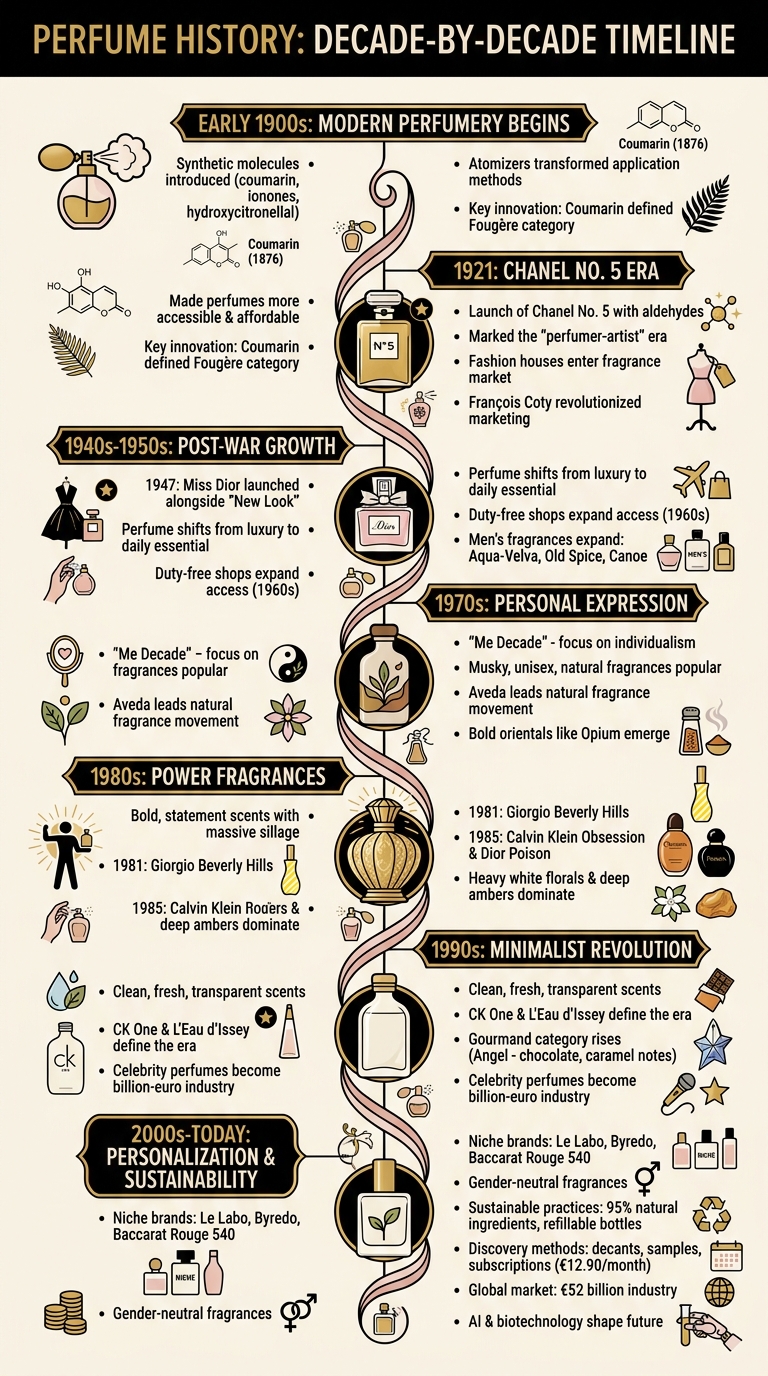
Perfume History Timeline: Evolution from 1900s to Today
100 YEARS OF PERFUME | Iconic Fragrance Releases | Part 1 (1920–1979)
The Early 1900s: Modern Perfumery Begins
The early 20th century marked a revolutionary period for the perfume industry. Advances in chemistry led to the creation of synthetic molecules that could replicate and even extend the range of natural scents. This innovation made fragrances more accessible, as the cost of producing synthetic ingredients like vanillin and heliotropin was significantly lower. Perfume, once a luxury reserved for the elite, became a product with mass-market appeal. These breakthroughs allowed perfumers to craft scent profiles that were previously impossible to achieve.
The Rise of Synthetic Scents
The introduction of synthetic compounds like coumarin, ionones, hydroxycitronellal, and aliphatic aldehydes opened up entirely new possibilities in fragrance creation. These molecules enabled the development of distinct scent families, from the hay-like warmth of Fougère to fresh, clean, and soapy notes. They also improved the longevity of perfumes with innovations such as nitro musks.
Coumarin, which debuted in 1876, was instrumental in defining the Fougère category with its rich, tobacco-like aroma. Ionones made it feasible to recreate the elusive scent of violets, while hydroxycitronellal, introduced in 1905, captured the delicate essence of lily-of-the-valley - an aroma that natural extraction methods couldn’t achieve. Around the same time, atomisers transformed how perfumes were applied, offering a fine mist that was both practical and refreshing.
Chanel No. 5: A New Era of Luxury
Synthetic ingredients took centre stage in 1921 with the launch of Chanel No. 5. This iconic fragrance incorporated aldehydes to create a sparkling, abstract composition that didn’t aim to mimic any specific flower. Chanel No. 5 marked a turning point, proving that synthetics could enhance a perfume’s sophistication rather than diminish it. It also ushered in the "perfumer-artist" era, where creativity and innovation flourished.
Fashion Meets Fragrance
Around the same time, François Coty revolutionised the industry by blending natural and synthetic ingredients while employing innovative marketing strategies to make perfumes more accessible. Fashion houses quickly saw the potential of fragrances to extend their brand identity, transforming scent into a multisensory expression of elegance and individuality. As Scent Company explained:
A drop of scent could be used to convey elegance, modernity or independence.
Established names like Guerlain had already laid the groundwork, but the collaboration between designer-artists and raw material suppliers led to the emergence of major fragrance houses like Givaudan, IFF, and Firmenich. These developments not only shaped luxury perfumery but also influenced the broader market, creating a rich and diverse olfactory landscape that set the stage for modern perfumery.
Mid-1900s: Post — War Growth and New Markets
The years following World War II brought notable changes to the fragrance industry. Despite the challenges of wartime restrictions, perfume houses adapted with resilience, creating "character fragrances" that reflected the distinctive styles of designers. Building on earlier advancements in synthetic ingredients, this era saw perfumery evolve with expanded markets and improved production techniques. Perfume shifted from being a rare luxury to an integral part of daily life, mirroring the resurgence of fashion and elegance during this period.
Perfume Meets Haute Couture: Miss Dior
One of the most iconic examples of the link between haute couture and fragrance was Christian Dior‘s launch of Miss Dior in 1947. Designed to complement Dior’s ultra-feminine "New Look", the fragrance combined floral and citrus notes, embodying the elegance and glamour of the time. This move not only highlighted the influence of couture but also introduced the idea of accessible luxury, a trend that would shape the industry for decades. Fashion houses like Dior, Nina Ricci, and Chanel used fragrances to evoke images of seduction and Hollywood-inspired romance, bringing high fashion closer to the middle class.
By the 1950s, this democratization of luxury gained momentum as ready-to-wear fashion became more widespread. The introduction of duty-free shops in the 1960s further expanded access, enabling travelers to purchase brands like Guerlain, Hermès, and Lanvin at reduced prices.
Men’s Fragrances Expand in the 1950s and 1960s
The post-war era also marked a turning point for men’s fragrances. As grooming habits evolved, so did the demand for sophisticated scented products. By the early 1950s, brands like Aqua — Velva, Seaforth!, Old Spice, and Canoe had become household names. At the same time, a new wave of elegant masculine Eaux de Toilette emerged, featuring notes like vetiver and lavender. These fragrances established a clear distinction between traditional aftershaves and refined men’s perfumes.
New Production Methods Transform Perfumery
Advancements in synthetic scent production, combined with industrial manufacturing, revolutionized the perfume industry. These innovations significantly reduced production costs, making fragrances more affordable. Industrial-scale manufacturing also enabled mass production of designer bottles, further lowering prices. As the National Museum of American History explains:
The development of synthetic scents and new scent extraction technologies made perfumes less expensive to produce and purchase. As a result, perfume became less of a luxury item restricted only to wealthy buyers.
Standardized packaging and widespread distribution through department stores made high-quality scents accessible to a much broader audience. These mid-century advancements set the stage for the bold and experimental fragrances that would define the late 20th century.
Your Personal Fragrance Expert Awaits
Take our quick scent quiz to discover authentic designer and niche fragrances matched to your taste — explore them as 2–8ml decants and samples, so you can try each one before committing to a full bottle.
Find Your ScentLate 1900s: Cultural Change and Bold Scents
The late 20th century was a time of transformation, and fragrance evolved in step with shifting views on wealth, gender, and personal identity. From the introspective individualism of the 1970s to the indulgent extravagance of the 1980s and the pared-down simplicity of the 1990s, perfumes mirrored the cultural zeitgeist of each decade.
The 1970s: Personal Expression Through Scent
The 1970s marked a departure from collective activism, giving rise to a focus on individuality. As Sue Phillips put it:
The 1970’s were called the Me Decade. It was a trend-laden, fad happy decade and people did as they pleased.
This shift toward self-expression changed the way fragrances were both marketed and worn. With more women entering the workforce and gaining autonomy through new reproductive rights, perfumes became a symbol of independence. Advertisements began celebrating the "emancipated woman", with scents like Charlie epitomizing a confident, modern lifestyle.
Fashion magazines also reflected this cultural pivot. Valerie Steele noted:
The arbiters of fashion risked being dismissed as ‘fashion fascists’ if they dared tell women what was ‘in’ or ‘out.’ As a result, fashion journalists quickly adopted a new language of ‘freedom’ and ‘choice’.
By the end of the decade, beauty sections in luxury publications had grown to rival fashion spreads, underscoring the era’s embrace of personal style. Musky, unisex, and natural fragrances gained popularity, with brands like Aveda leading the charge. Meanwhile, bold orientals like Opium hinted at the dramatic, statement-making scents that would define the 1980s.
The 1980s: Bold Power Fragrances
The 1980s were all about excess, and fragrances became symbols of status - big, bold, and impossible to ignore. These so-called "power fragrances" were designed to exude decadence, often featuring massive sillage that could fill a room. Glamorous TV shows like Dynasty and Dallas helped popularize this trend. Giorgio Beverly Hills, launched in 1981, became the poster child for this movement, with its potent scent even leading some restaurants to request patrons not to wear it.
Two major launches in 1985 cemented the decade’s love for drama: Calvin Klein Obsession and Dior Poison. Poison leaned into a "black-widow" aesthetic with its sultry black satin and lace campaigns, while Obsession took a more stripped-back, monochromatic approach. As Suzanna, a perfume reviewer, observed:
The 1980s were the last decade when perfume could stand in for personality, as something to hide behind, to put on or to take off like a mask.
Heavy white florals like tuberose and jasmine, along with deep, spicy ambers, dominated the era, perfectly complementing the bold fashion trends of the time. This period of unapologetic opulence set the stage for the minimalist wave of the 1990s.
The 1990s: Clean, Fresh Scents for Youth
As the extravagance of the 1980s faded, the 1990s embraced a backlash against excess. Economic challenges and a cultural shift toward minimalism ushered in a new era of transparent, airy fragrances. Sue Phillips captured the essence of the decade:
The 90’s became lighter, watery, transparent and unisex.
Fragrances like CK One and L’Eau d’Issey embodied this fresh aesthetic, appealing especially to younger generations who preferred effortless, understated style over the opulence of previous years.
The 1990s also saw the rise of the gourmand category, led by Thierry Mugler‘s Angel, which introduced edible notes like chocolate, caramel, and candy floss. Marketing strategies became more targeted, aligning scents with specific lifestyles and personalities. Celebrity-endorsed perfumes, pioneered by Elizabeth Taylor in 1987, expanded into a billion-euro industry. This decade proved how quickly fragrance trends could adapt to cultural shifts, paving the way for the personalized scents of the 21st century.
The 2000s to Today: Personalisation and New Discovery Methods
The 21st century has reshaped the world of perfumery, moving away from cookie-cutter offerings and mass-market appeal. Instead, the focus now leans heavily on individuality, meaningful storytelling, and a more mindful approach to consumption. This shift has steered the industry toward personalisation and authenticity, leaving behind the era of celebrity-driven scents.
Niche Perfumery and Independent Brands
Independent brands like Le Labo and Byredo have been instrumental in this transformation, introducing gender-neutral fragrances and embracing artistic freedom. By producing in small batches, these brands have been able to use high-quality ingredients such as Oud, elevating their creations to a more luxurious level. A standout example is Baccarat Rouge 540, which has gained immense popularity despite its premium price tag. This trend highlights a broader shift in consumer preferences: fragrances are now seen as a means of self-expression rather than just a status marker.
Sustainability and Responsible Sourcing
Environmental awareness has become a cornerstone of modern perfumery. Many brands are turning to organic farming, fair-trade practices, and cutting-edge biotechnology to create lab-grown alternatives to rare natural ingredients. Guerlain, for instance, introduced Rosa Rossa in April 2025, a fragrance crafted with up to 95% naturally derived ingredients and alcohol sourced from responsibly farmed beetroot. Animal-derived substances like ambergris and civet musk have largely been replaced with vegan, cruelty-free alternatives.
Packaging innovations are also reducing waste, with refillable bottles, biodegradable materials, and minimalist designs becoming the norm. Some brands are even adopting "slow perfumery" by producing made-to-order batches, cutting down on overproduction. These eco-conscious practices not only reflect changing consumer values but also pave the way for new and thoughtful methods of discovering fragrances.
Fragrance Discovery Through Decants and Samples
The traditional approach of purchasing full-sized bottles - often priced above €300 - has been challenged by the rise of sampling and decanting. Since many consumers rarely finish entire bottles, discovery sets and decants have emerged as practical alternatives. These allow buyers to test a fragrance’s dry-down and longevity over several days, something a quick spritz at a store counter simply can’t replicate.
In March 2024, Elysian Parfum launched a "Discovery Offer", where customers purchasing a discovery set received a €55 voucher to use toward a 50ml or 100ml bottle from the same collection. This approach not only reduces the risk of disappointment but also bridges the gap between sampling and committing to a full-sized purchase.
Scento has taken this concept further with curated 8ml decants of authentic designer fragrances, offering around 120 sprays per vial. Their collection spans over 1,000 fragrances in 2ml, 5ml, and 8ml formats, making luxury and niche scents more accessible. Additionally, a monthly subscription priced at €12.90 per perfume allows customers to explore a variety of options, helping them build a versatile fragrance wardrobe without the need to settle on a single signature scent. This model not only makes high-end perfumery more approachable across Europe but also aligns with sustainability efforts by significantly reducing waste.
Perfume’s Continued Evolution
Perfume as Art and Science
Perfumery has always been a fascinating blend of creative imagination and technical expertise. From its roots in sacred rituals to the modern era shaped by synthetic advancements, it stands as a perfect example of the intersection between art and science.
"Right from the earliest days of scientific chemistry up to the present time, perfumes have substantially contributed to the development of organic chemistry as regards methods, systematic classification, and theory." — Leopold Ružička, 1939 Nobel Laureate for Chemistry
Today, perfumers continue to balance artistic vision with scientific accuracy. They rely on structured scent pyramids - top, heart, and base notes - to create balanced and captivating compositions. Techniques such as steam distillation and the creation of captive molecules have expanded the possibilities of fragrance creation. For instance, the sheer scale of production - thousands of kilograms of flowers required to produce just one kilogram of essential oil - illustrates why premium fragrances often come with higher price tags.
The Future of Perfumery
The rich heritage of perfumery is now a foundation for an exciting future. Innovations today are steering the industry towards sustainability, personalisation, and cutting-edge technology. Lab-grown ingredients and bio-engineered aroma molecules are stepping in for rare natural materials, ensuring ethical sourcing while maintaining high-quality standards. The rise of gender-neutral fragrances reflects a shift towards individuality and away from traditional marketing categories.
Technology is also reshaping the craft. AI tools are helping perfumers predict trends and design complex molecular structures. Meanwhile, digital platforms - from TikTok-driven trends to curated decant services - are revolutionising how consumers discover scents, moving beyond the traditional department store experience. At the same time, there’s growing demand for ingredient transparency and ethical practices, driving brands to adopt refillable bottles and eco-conscious packaging.
These changes highlight perfume’s ability to evolve alongside cultural and technological shifts. Once a marker of status, fragrance now serves as a deeply personal medium for self-expression and memory-making. As the €52 billion global fragrance market continues to transform, one thing remains unchanged: perfume’s unmatched power to evoke emotions and preserve moments in time.
FAQs
Why did synthetic molecules change perfume so much?
Synthetic molecules changed the world of perfumery by making it possible to craft scents that nature alone couldn’t provide. They opened the door to more intricate and enduring fragrances while ensuring consistency in quality. Yet, their introduction wasn’t without controversy. Some synthetic compounds have been linked to pollution and potential health issues, like skin irritation, sparking debates about their environmental and personal safety impacts. This shift not only reshaped the fragrance industry but also brought it under closer examination.
How did perfume trends shift from the 1970s to the 1990s?
Perfume trends from the 1970s to the 1990s mirrored the evolving cultural landscape. The 1970s celebrated boldness with spicy and woody fragrances, reflecting a spirit of individuality and freedom. The 1980s, on the other hand, leaned into extravagance, with rich, layered scents combining floral and citrus notes to capture the era’s love for luxury. By the 1990s, simplicity became the focus, with clean, fresh, and natural fragrances gaining popularity. This decade also saw the emergence of niche perfumery, offering more personalised and distinctive scent options.
How do decants help you choose a perfume and reduce waste?
Decants offer a practical way to explore perfumes without the commitment of purchasing a full bottle. By trying a smaller amount, you can see how a fragrance interacts with your skin and aligns with your personal taste. This approach not only saves money but also helps minimise waste, as you avoid leaving larger bottles unused. It’s a thoughtful way to enjoy scents while ensuring you only invest in those that genuinely resonate with you.