Perfume subscriptions are reshaping the fragrance industry in 2026. Consumers now prefer curated, monthly scent experiences over traditional full-bottle purchases. This model addresses common issues like unused fragrances and high upfront costs, while offering personalization through AI and sustainable sampling options. Key highlights include:
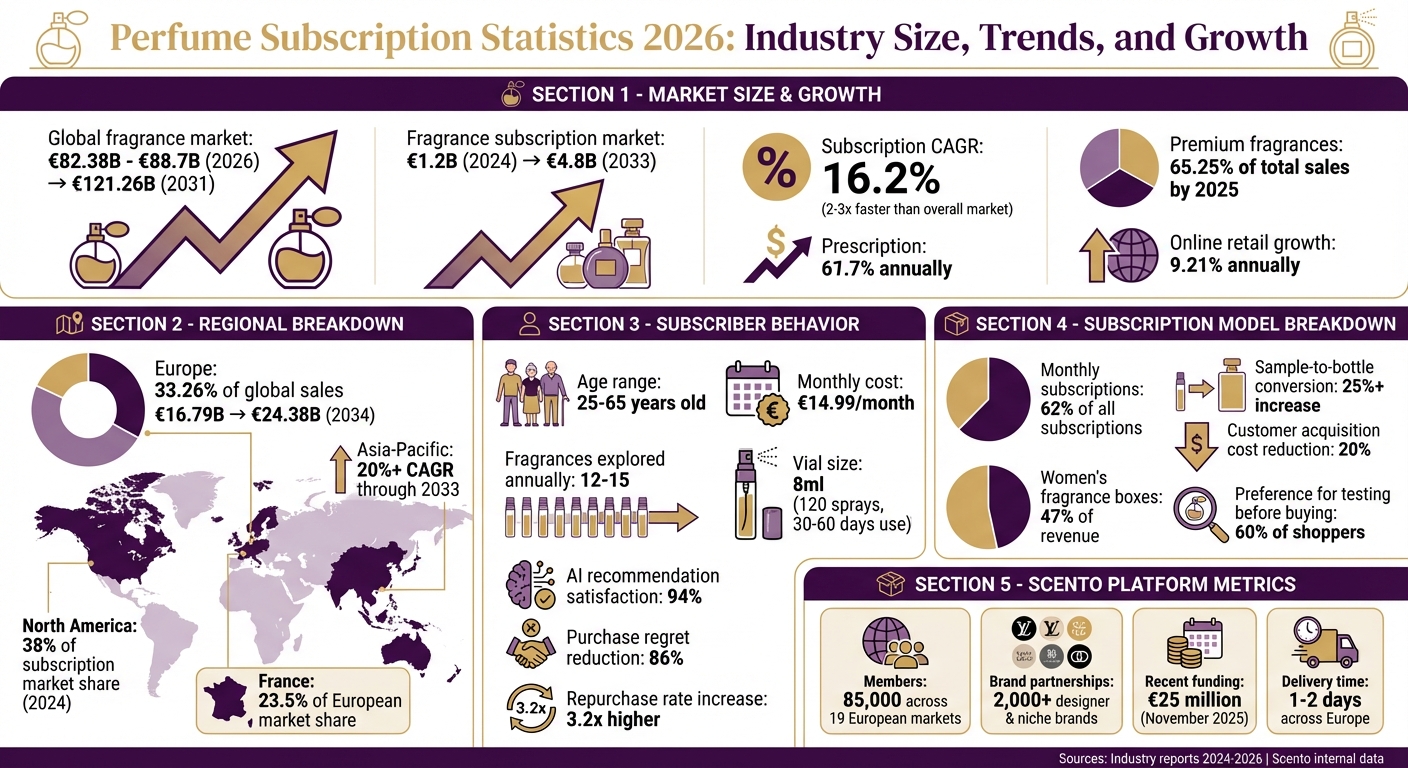
- Market Growth: The global fragrance subscription market is projected to grow at a CAGR of 16.2%, reaching €4.8 billion by 2033.
- Consumer Behavior: Subscribers, often aged 25–65, explore 12–15 fragrances annually via affordable monthly plans (€14.99/month) featuring 8ml vials.
- Conversion Rates: Sampling boosts full-bottle purchases by over 25%, reducing waste and increasing satisfaction.
- Regional Trends: Europe leads with 33.26% of global fragrance sales, while North America and Asia — Pacific show rapid subscription growth.
Scento, a leading platform with 85,000 members across 19 markets, exemplifies this shift by leveraging AI for personalized recommendations and offering access to over 2,000 luxury and niche brands. These trends highlight a growing preference for variety, personalization, and a more thoughtful approach to fragrance consumption.
Perfume Subscription Market Statistics 2026: Growth, Demographics & Trends
Market Size and Industry Context
Global Fragrance Market in 2026
The global fragrance industry is expected to grow significantly, with projections placing its value between €82.38 billion and €88.7 billion by 2026, and further reaching €121.26 billion by 2031. This growth is supported by a compound annual growth rate (CAGR) ranging from 5.4% to 8.04%, fueled by increasing consumer interest in premium scents and the rapid expansion of digital retail channels. Premium fragrances are set to dominate, making up 65.25% of total sales by 2025, while online fragrance retail continues its upward trajectory with an annual growth rate of 9.21%, emphasizing the importance of digital platforms for discovery.
There is also a noticeable shift in consumer preferences toward high-concentration formats like Parfum and niche, artisanal creations that promise both longevity and exclusivity.
European Fragrance Market Overview
Europe remains the leading regional market for fragrances, projected to account for 33.26% of global sales by 2025. The European fragrance market, valued at approximately €16.79 billion, is expected to grow to €24.38 billion by 2034, with a CAGR of 4.77%. France continues to lead within the region, commanding 23.5% of the market share as of 2024, cementing its reputation for luxury and artisanal perfumery.
One notable trend in Europe is the growing popularity of subscription models. These services provide curated sampling experiences, allowing consumers to explore fragrances before committing to full-sized bottles - a concept that resonates with modern consumer preferences for personalization and convenience.
Perfume Subscription Segment Size and Growth
The fragrance subscription market is growing at a pace that surpasses the overall industry. Valued at €1.2 billion in 2024, this segment is forecasted to reach €4.8 billion by 2033, with an impressive CAGR of 16.2%. This growth rate is roughly two to three times faster than the broader fragrance market.
Monthly subscriptions dominate the space, representing nearly 62% of all fragrance subscriptions in 2024. Women’s fragrance boxes generate the largest share of revenue, contributing over 47% of total subscription income, while unisex offerings are emerging as a growing sub-segment. Regionally, North America held a 38% share of the global subscription market in 2024, while the Asia — Pacific region is poised for rapid expansion, with a CAGR exceeding 20% through 2033.
The subscription model addresses key consumer pain points like high upfront costs, blind buying, and product waste. By offering 8ml vials at accessible prices - such as Scento’s subscription starting at €14.99 per month - this approach democratizes access to authentic designer fragrances. Additionally, it converts trial experiences into full-bottle purchases at rates exceeding 25%.
This strong growth trajectory sets the stage for a deeper exploration of subscriber demographics and their purchasing behaviors.
Subscriber Demographics and Behavior Patterns
Demographic Profile of Subscribers
Perfume subscription enthusiasts come from a broad age range, primarily between 25 and 65 years old. This group includes young professionals and lifestyle-conscious individuals who enjoy curating diverse scent collections rather than sticking to a single signature fragrance. Scento’s community spans 19 European markets, with key concentrations in France, Germany, the UK, Italy, Spain, and the Netherlands. The gender split among subscribers remains relatively balanced. Notably, Gen Z is emerging as a highly engaged segment, using fragrances regularly and purchasing new scents several times a year.
Spending Patterns and Engagement Rates
Subscribers pay €14.99 per month to explore luxury fragrances that can retail for as much as €300 per bottle. This subscription provides access to 12 unique scents annually at a fraction of the cost. Each 8ml vial contains enough for 120 sprays, offering about 30 days of daily use or two months if worn occasionally. This "scent wardrobing" approach allows users to create versatile fragrance collections suited for various occasions, from office settings to date nights and social gatherings.
Scento’s AI-powered recommendations have achieved a 94% satisfaction rate, reducing purchase regret by 86% compared to blind buying. Data shows that consumers who sample fragrances before committing to full bottles are 3.2 times more likely to repurchase. Additionally, 60% of shoppers prefer testing scents - whether through sampling programs or in-store trials - before making high-value purchases, underscoring the value of this model.
These habits contribute to higher conversion rates from samples to full-size bottles.
Sample-to — Full — Bottle Conversion Rates
Scento’s data highlights a strong pattern of subscribers transitioning from sampling to purchasing full-sized fragrances. Personalized recommendations powered by AI have increased online conversion rates by up to 30%, while campaigns offering tailored consultations have similarly boosted customer loyalty. This approach minimizes the risk of buying an expensive fragrance that doesn’t align with personal preferences. By addressing the issue of €780 million in unused fragrances across Europe, Scento’s subscription model turns what was once a risky purchase into a low-stakes, discovery-focused experience.
"I used to waste money on full bottles. Now I just buy the refill from Scento. It saves me so much." – Elena R., Verified Customer
Growth Trends and Market Comparisons
Fragrance Subscription Growth vs. Other Beauty Subscriptions
Fragrance subscriptions are growing at an impressive pace, outshining nearly every other category in the beauty subscription space. In the U.S., the fragrance subscription box market is expanding at a 22.1% compound annual growth rate (CAGR), far outpacing the broader beauty subscription box market, which is projected to grow at just 9.2% CAGR through 2034. Even the traditional luxury perfume market, with a growth rate of 7.1% CAGR, lags significantly behind, highlighting the rapid consumer shift toward subscription-based fragrance models.
| Market Segment | Projected CAGR | Period |
|---|---|---|
| Fragrance Subscriptions (U.S.) | 22.1% | 2025–2030 |
| Haircare Subscriptions | 25.6% | 2024–2030 |
| Budget Beauty Boxes | 27.8% | Through 2030 |
| General Beauty Subscriptions | 9.2% | 2025–2034 |
| Traditional Luxury Perfume | 7.1% | Ongoing |
While haircare and budget beauty boxes show even faster growth, fragrance subscriptions uniquely address a critical consumer pain point: the risk of committing to high-priced, full-sized products without knowing if they’ll suit personal preferences. This distinction helps explain their appeal and sustained growth trajectory.
Consumer Trends Driving Market Growth
Several key trends are fueling the rapid expansion of fragrance subscriptions, reshaping how consumers engage with the perfume industry.
First, personalization powered by AI has revolutionized scent discovery. Advanced algorithms now analyze individual olfactory preferences, taking much of the guesswork out of choosing a fragrance. This innovation resonates particularly with younger consumers who expect tailored digital experiences, making the subscription model even more appealing.
Second, the concept of affordable luxury is central to the subscription boom. Monthly plans, which accounted for 62% of all fragrance subscriptions in 2024, offer a low-commitment way to explore high-end and niche scents. For about €15 to €20 per month, subscribers can sample artisanal fragrances - like oud or burnt caramel - that might otherwise be prohibitively expensive in full-size bottles.
Third, social media platforms have become powerful drivers of fragrance discovery. Platforms like TikTok, particularly through the #PerfumeTok trend, influence 45% of social-driven fragrance purchases. Short-form videos introduce trending scents, encouraging risk-free trials through subscription services. Social media not only sparks initial interest but also drives organic sharing, amplifying the reach of these products.
Beyond these trends, the broader wellness movement is reshaping how consumers perceive and use fragrances. Increasingly, scents are seen as tools for stress relief and mood enhancement rather than just aesthetic accessories. This shift ties into the growing popularity of "scent wardrobing", where individuals curate multiple fragrances for various occasions and moods.
Lastly, sustainability concerns are playing a significant role in driving subscription adoption. Eco-conscious consumers are drawn to curated monthly selections featuring natural and organic luxury scents, a category growing at 9.56% CAGR. These subscriptions help minimize waste from unused full-sized bottles, aligning with the values of environmentally mindful shoppers.
Your Personal Fragrance Expert Awaits
Take our quick scent quiz to discover authentic designer and niche fragrances matched to your taste — explore them as 2–8ml decants and samples, so you can try each one before committing to a full bottle.
Find Your ScentLeading Platforms by Subscriber Count
Scento‘s Market Leadership in Europe
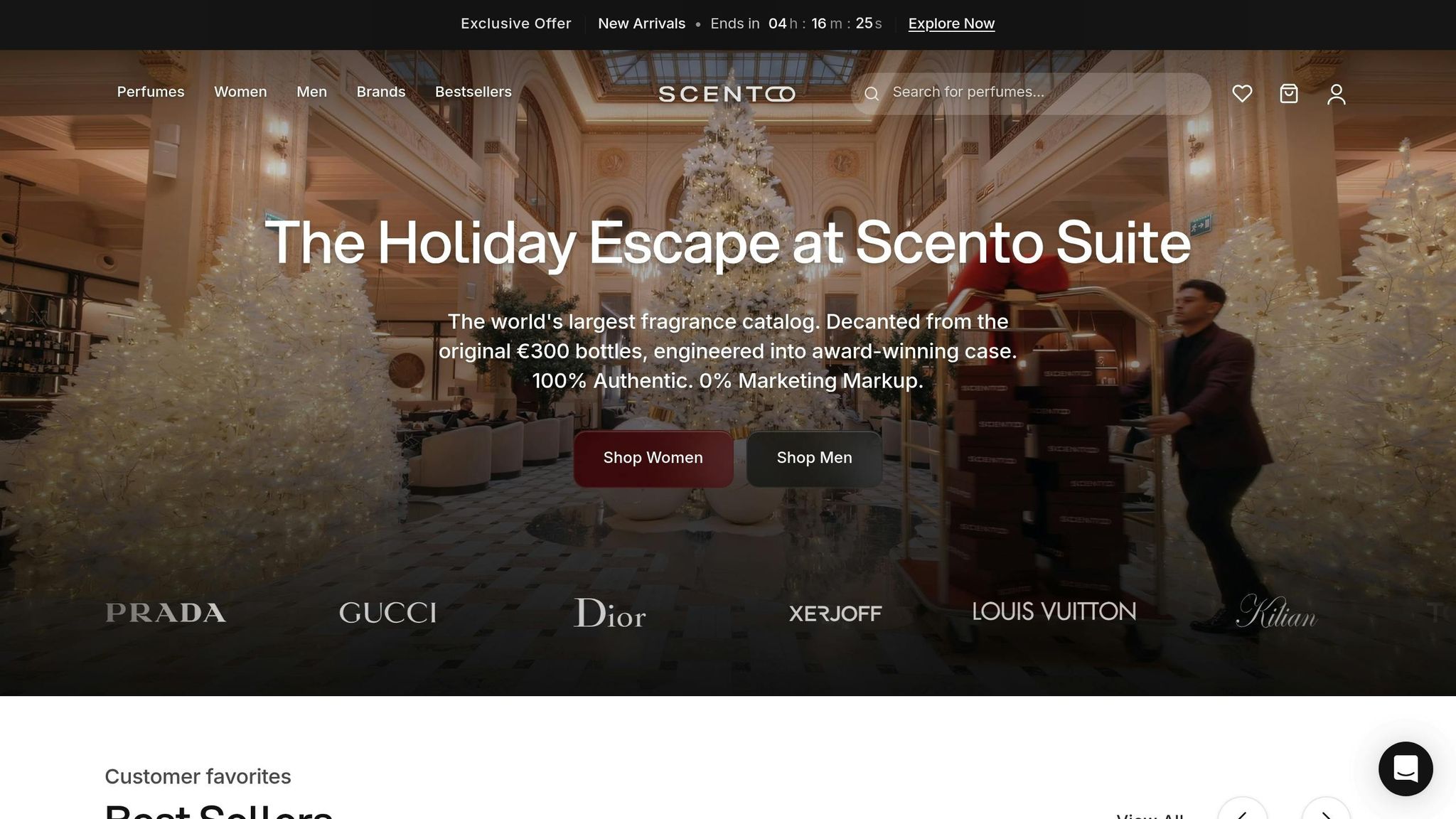
Scento has established itself as a leader in the fragrance subscription market, adapting to changing consumer preferences with a forward-thinking approach. As Europe’s largest perfume subscription service, Scento boasts 85,000 members across 19 European countries. Operating from its headquarters at Place Vendôme in Paris, the platform has solidified its dominance through AI-driven personalization, a verified network of over 2,000 designer and niche fragrance brands, and a discovery-focused model that addresses the challenges of the €19 billion European fragrance industry.
The platform’s performance metrics highlight its success: a 94% satisfaction rate for AI-powered recommendations, an 86% decrease in purchase regret, and a 3.2× higher repurchase rate for full-size bottles. These achievements reflect Scento’s strategic focus and operational efficiency.
Under the leadership of CEO Sebastian Dobrincu, Scento secured €25 million in funding in November 2025, with plans to allocate the investment over three years. This funding supports the expansion of AI personalization, enhancement of its authenticated supply network, and improvements in shipping logistics, offering 1–2 day delivery across Europe. Subscribers benefit from a flexible cancel-anytime policy and monthly 8ml decants (approximately 120 sprays), allowing them to curate personalized "scent wardrobes" without committing to full-size bottles. These initiatives have also led to a 20% reduction in customer acquisition costs compared to traditional retail models, while significantly enhancing the overall user experience.
"Scento builds the future of luxury fragrance retail by respecting this natural fluidity. We combine authenticated supply chains with AI-powered fragrance discovery to deliver the right premium scent at the right moment".
| Metric | Scento Performance |
|---|---|
| Subscriber Count | 85,000 Members |
| Market Reach | 19 European Markets |
| Brand Partnerships | 2,000+ Designer & Niche Brands |
| Recommendation Satisfaction | 94% |
| Purchase Regret Reduction | 86% |
| Repurchase Rate Increase | 3.2× Higher |
| Strategic Investment | €25 Million (3‐year plan) |
Conclusion
The fragrance subscription market is on a remarkable growth trajectory, with projections estimating it will reach $4.8 billion by 2033. This shift signals a transformation in how consumers engage with fragrance - moving beyond the idea of a single signature scent to embrace curated collections that cater to different moods and occasions.
At the heart of this evolution is personalization and the joy of discovery. Subscription services tackle a key challenge in the €52 billion European fragrance market by providing monthly 8ml samples - roughly 120 sprays - allowing consumers to explore authentic designer and niche fragrances without commitment. According to Scento’s internal data, subscribers typically experiment with 12–15 fragrances annually, highlighting the appeal of variety and exploration.
Scento’s approach aligns with broader trends in AI innovation and sustainability. Europe’s pivotal role in the global luxury perfume market is evident, holding a 37% share of its growth. By combining AI-powered personalization with verified supply chains, Scento exemplifies how technology and authenticity can reshape consumer experiences.
As Douglas Little, Founder of Heretic Parfum, aptly puts it:
"In 2026, fragrance isn’t merely something you wear; it’s something you inhabit, an atmospheric architecture shaping identity, emotion and daily experience".
The subscription model continues to dominate, with 62% of plans favoring monthly options, while online retail drives over 78% of the market’s revenue. With fragrance expected to account for 23% of total beauty industry growth by 2029, these trends underscore the lasting impact of personalized fragrance experiences on the industry’s future.
FAQs
How does AI make fragrance subscriptions more personalized?
AI brings a fresh twist to fragrance subscriptions by offering personalized scent recommendations that align with your unique preferences. By leveraging advanced algorithms, it evaluates your favorite fragrance notes, feedback, and purchase history to handpick options tailored specifically to your tastes. This makes exploring new scents feel effortless and more exciting.
As you interact with the system, AI learns and adjusts to your changing preferences, fine-tuning its suggestions over time. This dynamic approach takes the guesswork out of choosing fragrances, giving you the confidence to experiment with new options. By turning the discovery process into a tailored experience, AI not only enhances your enjoyment but also strengthens the connection between you and the brand.
What makes fragrance subscriptions better than buying traditional perfumes?
Fragrance subscriptions offer a practical way to explore new scents without the commitment of purchasing full-sized bottles. They give you the chance to try a variety of perfumes over time, helping you discover the ones that truly suit your style and preferences - without worrying about wasting money on something that doesn’t work for you.
Another advantage is the affordability. Many subscription services provide access to premium or designer fragrances at a fraction of the cost of a full bottle. Plus, the convenience factor is hard to beat. With customizable options and doorstep delivery, these services fit seamlessly into busy lifestyles. This approach not only makes scent discovery more enjoyable but also helps minimize waste, as you’re less likely to end up with unused bottles gathering dust. For many, the process of sampling and eventually committing to a full-sized favorite feels effortless and rewarding.
Why is Europe leading the growth of fragrance subscription services?
Europe has firmly established itself as a leader in the fragrance subscription market. This success is rooted in the region’s deep connection to the art of perfumery, a strong consumer appetite for high-end personal care products, and a commitment to pushing boundaries in scent creation and packaging design. These elements have propelled the luxury fragrance market to an estimated value of €7.68 billion by 2025, with forecasts suggesting it could soar to €12.95 billion by 2034.
Scento’s recent €25 million investment to expand into 19 European markets underscores this dominance. This ambitious move reinforces Europe’s reputation as a central hub for luxury fragrance exploration and forward-thinking innovation.
The €1.5B → €4.8B Trajectory: Inside the Personalized Subscription Boom
Scento's analysis identifies personalized fragrance subscription as the fastest-compounding subsegment of European beauty subscription — outpacing the broader fragrance subscription category and dramatically outrunning the legacy luxury perfume market. The personalized fragrance subscription market — a sub-segment of the broader fragrance subscription category — was valued at roughly €1.5 billion in 2024 and is projected to reach €4.8 billion by 2032 at a 15% compound annual growth rate.
The category contains two overlapping size estimates that are worth holding side by side. The broad fragrance subscription box market reached €1.2 billion in 2024 and is projected at €4.8 billion by 2033 at a 16.2% CAGR. The personalized sub-segment — services that match scent to buyer preference using survey, AI, or curated-pick logic — sits at €1.5 billion in 2024 projected to €4.8 billion by 2032 at a 15% CAGR. The two estimates converge in absolute size by the early 2030s, with personalized representing the structurally faster-compounding share.
The driver mix is consistent across forecasts. AI-led personalization sits at the front of the trend — mature platforms now report subscriber-satisfaction rates near 94% when scent matching is genuinely AI-driven rather than manually-curated. Affordable luxury entry-points anchor the second driver: the €14.99–€19.95/month price band gives buyers prestige-fragrance access at one-tenth of the full-bottle commitment. Digital commerce penetration completes the picture — over 70% of niche fragrance buyers prefer digital engagement before purchase, and subscription is the cleanest expression of that preference.
Scento's wedge sits at the conversion math. Subscribers who sample at least four fragrances during their first three months are substantially more likely to convert to long-tail full-bottle purchases than buyers who arrive via blind-buy retail. The unit economics are dramatically friendlier than traditional retail because the recurring-billing relationship covers acquisition cost over six to twelve months rather than at first purchase — which is why subscription platforms can sustain catalog breadth that legacy retailers cannot. Buyers entering the subscription category should start with Scento's AI scent quiz for the personalization onramp, or browse the 2ml decant catalog for the trial format that fuels the subscription engine.
How Big Are the Major Subscription Platforms?
Scento's analysis of the subscription competitive landscape places fewer than ten platforms above the meaningful-scale threshold (over 100,000 active subscribers) globally — and only two with credibly European-native infrastructure. The category is more concentrated than the prestige-fragrance retail map; the platform with the best personalization engine and the broadest catalog tends to win the wardrobe-builder cohort, and that compounds.
On the US side, Scentbird is the category pioneer. Founded in New York in 2014, the company has raised approximately $23 million across a decade of compounding, and its subscriber base reportedly exceeds 600,000. Scentbird's own marketing copy claims cumulative reach into the seven figures — "over 1,000,000 fragrance fanatics" served. The catalog runs 600+ designer and niche scents, and the entry tier sits at $17.95/month for an 8ml monthly decant. Scentbird is the textbook example of how a fragrance subscription compounds when the catalog and the matching layer scale together.
On the European side, Scento operates across 19 European markets from a Paris headquarters, with 85,000 active subscribers and a catalog of 2,000+ brands. The €14.99 entry tier sits at the lower end of the European band and the catalog is among the broadest in the category. The pan — European footprint addresses a structural gap that no US platform has been able to fill — language localization, regional VAT handling, regional shipping, and brand-availability patterns that reflect what European buyers actually want rather than what the US market wants.
The new-entrant pattern is also visible. Indie fragrance houses now bypass building proprietary subscription infrastructure and launch onto established platforms instead. Free Yourself's launch onto Scentbird in mid-2025 is the textbook example: an indie house with a well-considered scent proposition gets distribution scale by joining the platform rather than building its own — and the platform gets curatorial freshness without the cost of in-house development. The pattern points toward a category structure where two or three platforms hold most of the subscriber relationships and indie houses join those platforms as catalog tenants. Buyers who want to see what a curated subscription catalog looks like can browse Scento's catalog bestsellers or run Scento's onramp quiz to see how the matching layer translates buyer preference into specific scents.
Why US Fragrance Subscriptions Are Growing 22.1% While Beauty Subscriptions Grow 9.2%
Scento's analysis shows that fragrance is structurally suited to subscription in a way other beauty categories are not. The differential is not marginal: the US fragrance subscription box market is expanding at roughly 22.1% CAGR — more than double the broader beauty subscription box growth rate of approximately 9.2% CAGR through 2034, and dramatically faster than the legacy luxury perfume market at approximately 7.1% CAGR. Three structural factors explain the gap.
The repeat-purchase fit. Fragrance has the highest stickiness of any beauty category once a buyer finds a scent they love. The repeat-purchase pattern — buyer wears a fragrance for months, runs out, reorders — fits subscription billing precisely. Skincare comes close on stickiness but not on category breadth; makeup churns hard against trend cycles; fragrance is the format where loyal buyers and recurring billing align with the least friction.
The wardrobe-trend reinforcement. Buyers increasingly want variety, not loyalty to a single SKU — exactly what subscription delivers and traditional retail does not. The wardrobe mindset has displaced the signature-scent doctrine across European and US buyers under 35, and the wardrobe demands a rotating catalog. Subscription is the only consumer model that delivers monthly variety as a structural feature rather than as a friction point.
The risk-reduction math. A €120 full bottle is a high-cost blind buy. An 8ml decant at €15/month is a 1/8 commitment — subscription dissolves the buyer's risk. The buyer who would never blind-buy a €300 niche bottle in a department store will subscribe to a service that delivers an 8ml of that bottle for €17.95/month, wear it for 30 days, and decide afterwards. Subscription compresses the trial-to-decision arc to what the buyer can actually navigate emotionally and financially.
The retention math validates the structural argument. Beauty boxes generally retain 30–35% of subscribers at month 12; fragrance subscriptions outperform this baseline because the wardrobe mindset works — variety is the product, and switching scents monthly is the feature, not a churn signal. Scento's order data shows the subscriber cohort that swaps fragrance type at least twice within the first six months has the strongest twelve-month retention — variety isn't churn-adjacent; it is the retention driver. Browse the decant catalog that fuels the subscription or start with the bestseller mix to see how the variety-as-retention thesis plays out across actual buyer behavior.
Subscription Unit Economics: What Drives the Numbers
Scento's analysis breaks the subscription economic model into four levers: ARPU, retention, sample-to-bottle conversion, and catalog breadth. A typical European fragrance subscription operates on a €14.99–€17.95/month price band, with an 8ml monthly decant — approximately 120 sprays, or about 30 days of daily wear — drawn from a catalog of 600 to 2,000 SKUs. The economics of the model are surprisingly precise.
ARPU sits in the €15–€18/month band. Scento's €14.99 entry sits at the lower end of the European band; Scentbird's $17.95 sits at the higher end of the US band. Higher ARPU correlates with broader catalog access and faster scent-swap windows — the platforms that allow buyers to cycle through more scents per year tend to support higher monthly pricing. The trade-off is precisely calibrated: too high an ARPU and the wardrobe-builder cohort migrates to lower-priced alternatives; too low and the platform cannot support the catalog-and-personalization investment that drives retention.
Retention drives compounding. Beauty subscriptions retain 30–35% of buyers at 12 months across the broad category — fragrance subscriptions outperform this baseline via variety-as-retention. Scento's data indicates that subscribers who fully engage the variety mechanism — swapping fragrance type at least twice in their first six months — have meaningfully stronger 12-month retention than the category baseline. The implication for product design is sharp: platforms that nudge variety in the first 90 days outperform platforms that allow buyers to settle into a single repeated scent.
Sample-to-bottle conversion is the upsell engine. Conversion rates routinely exceed 25% in well-managed fragrance subscriptions. A subscriber who tries 12 scents in a year and converts even three to full bottles delivers margin that retail cannot match — the subscription billing covers acquisition cost, and the bottle conversions are pure incremental margin. The math compounds: more sample exposure leads to more bottle conversions leads to higher lifetime value leads to a friendlier acquisition-cost ceiling.
Catalog breadth is the moat. Scentbird's 600+ catalog and Scento's 2,000+ catalog represent the upper bound today — the larger the catalog, the better the personalization-driven retention, because the wardrobe-builder cohort needs depth to keep cycling. A 200 — SKU catalog runs out of meaningful variety after 18 months; a 2,000 — SKU catalog continues to surprise the buyer in year three. Catalog breadth is also the structural advantage that legacy retailers cannot match — boutique department-store counters carry 80 to 200 fragrance SKUs at any one time, an order of magnitude below subscription-platform breadth. Buyers exploring how the matching layer translates buyer profile into specific scents should run AI scent matching or start with Scento's 2ml decant range for the trial format that anchors the subscription engine.
This analysis is based on Scento's review of European fragrance industry data, October 2025 – April 2026. A detailed methodology is available to press on request at [email protected].
Frequently asked questions
- How does AI make fragrance subscriptions more personalized?
- AI brings a fresh twist to fragrance subscriptions by offering personalized scent recommendations that align with your unique preferences. By leveraging advanced algorithms, it evaluates your favorite fragrance notes, feedback, and purchase history to handpick options tailored specifically to your tastes. This makes exploring new scents feel effortless and more exciting.
- What makes fragrance subscriptions better than buying traditional perfumes?
- Fragrance subscriptions offer a practical way to explore new scents without the commitment of purchasing full-sized bottles. They give you the chance to try a variety of perfumes over time, helping you discover the ones that truly suit your style and preferences - without worrying about wasting money on something that doesn’t work for you.
- Why is Europe leading the growth of fragrance subscription services?
- Europe has firmly established itself as a leader in the fragrance subscription market. This success is rooted in the region's deep connection to the art of perfumery, a strong consumer appetite for high-end personal care products, and a commitment to pushing boundaries in scent creation and packaging design. These elements have propelled the luxury fragrance market to an estimated value of €7.68 billion by 2025, with forecasts suggesting it could soar to €12.95 billion by 2034.
- How big is the perfume subscription market in 2026?
- Scento's analysis values the global fragrance subscription box market at roughly €1.2 billion in 2024, with the personalized fragrance subscription sub-segment at €1.5 billion. By 2032–2033, both projections converge near €4.8 billion — implying a 15–16.2% CAGR depending on which segment you measure. That growth rate is two to three times faster than the broader fragrance market and dramatically faster than the legacy luxury perfume category, which compounds at roughly 7.1% CAGR. The driver mix is consistent across forecasts: AI-led personalization, affordable luxury entry-points, and the structural fit between recurring billing and the "scent wardrobe" mindset.
- How many subscribers does Scentbird have?
- Scentbird, the US category pioneer founded in 2014 and headquartered in New York, has built a subscriber base reportedly exceeding 600,000 over its decade-long history, with cumulative reach into the seven figures per its own marketing copy. The company has raised approximately $23 million in venture funding, operates a catalog of 600+ designer and niche fragrances, and prices its monthly subscription at $17.95 with an 8ml decant. Scentbird's scale makes it the largest standalone fragrance-subscription platform globally — Scento, Europe's leading service, operates across 19 European markets with 85,000 subscribers and a catalog of 2,000+ brands.
- Why are fragrance subscriptions growing faster than beauty subscriptions overall?
- Scento's analysis attributes the 22.1% CAGR for US fragrance subscriptions (versus 9.2% for the broader beauty subscription box market) to three structural factors. First, the wardrobe mindset: buyers increasingly want variety rather than loyalty to a single SKU, and subscription delivers exactly that. Second, the risk-reduction math: a €120 full bottle is a high-cost blind buy, but an 8ml decant for €15/month is a 1/8 commitment — subscription dissolves the buyer's risk. Third, the conversion engine: sample-to-bottle conversion routinely exceeds 25% in fragrance subscription compared to traditional blind-buy retail, because the subscriber has a 30-day evaluation window before deciding whether to commit. Together these factors make fragrance the most subscription-friendly subcategory in beauty.
- How much does a perfume subscription cost in 2026?
- European fragrance subscriptions cluster in the €14.99–€19.95/month band; US equivalents sit around $17.95/month. Scento's monthly plan is €14.99 and includes an 8ml decant — about 120 sprays, or 30 days of daily wear. For comparison, an equivalent volume of prestige fragrance bought in full-bottle format would cost roughly €30–€80, meaning subscribers are paying around 50–80% less for identical scent quality. The catch — and what subscription platforms manage carefully — is curation: a subscriber who keeps receiving scents they don't love churns; a subscriber who finds three "wardrobe candidates" within their first six months typically becomes a long-term retained customer and converts at least one to a full-bottle purchase.

