Your fragrance is a personal reflection of who you are, but preferences and lifestyles evolve. Over time, even your favorite scent may feel out of place due to changes in environment, seasons, or simply because you’ve grown used to it. Here’s how to refresh your scent game:
- Evaluate your current fragrance: Check its longevity, projection, and how it changes throughout the day. Does it still align with your lifestyle and environment?
- Understand fragrance layers: Learn how top, heart, and base notes affect a scent’s journey on your skin.
- Test before committing: Use perfume decants or samples to try new fragrances without buying full bottles. Test on your skin and give each scent time to develop.
- Build a fragrance wardrobe: Instead of one signature scent, curate 3-5 options for different moods, seasons, or occasions.
Your Personal Fragrance Expert Awaits
Take our quick scent quiz to discover authentic designer and niche fragrances matched to your taste — explore them as 2ml, 5ml, 8ml & 30ml decants and samples, so you can try each one before committing to a full bottle.
Find Your ScentStep 1: Review Your Current Fragrance
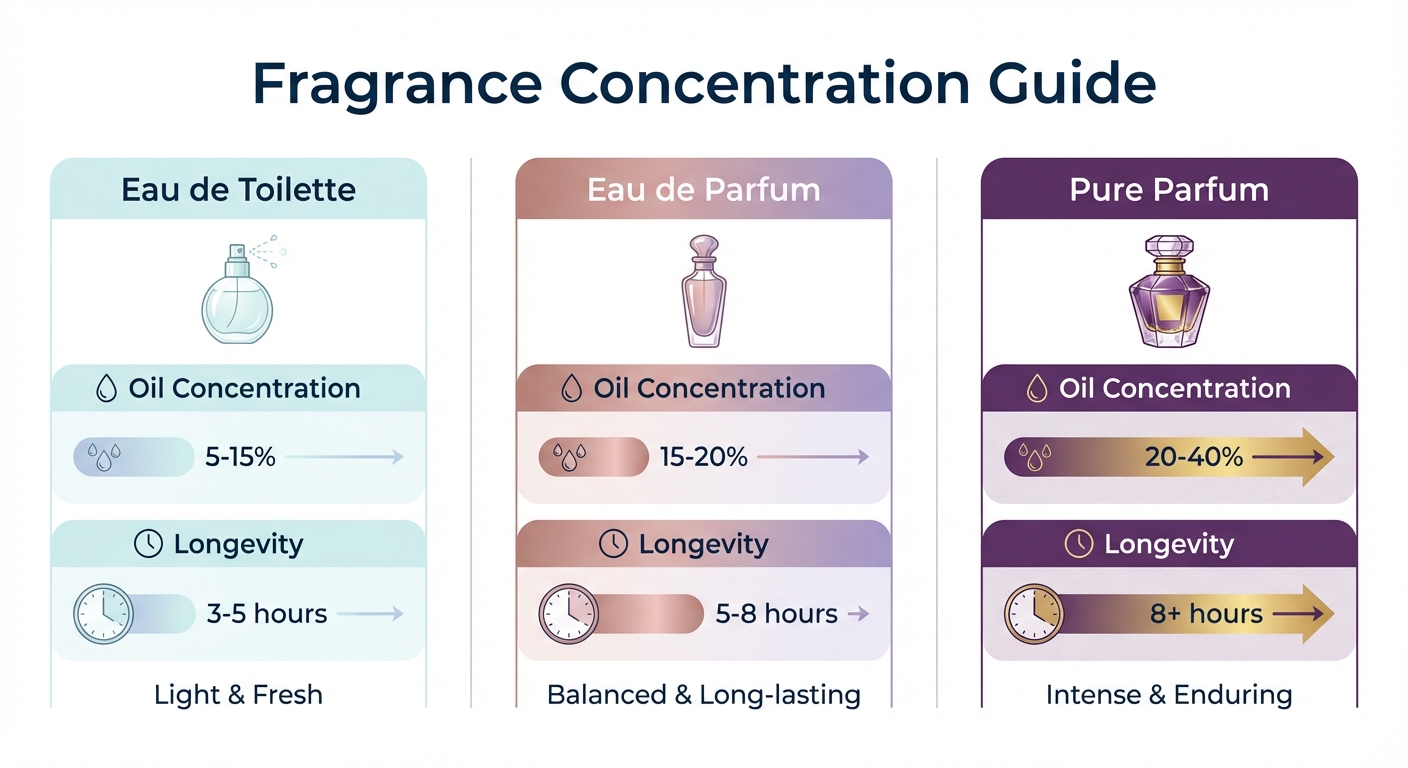
Fragrance Concentration Types: Longevity and Oil Content Comparison
Begin by taking a closer look at your current signature scent. While it might have been a great fit in the past, changes in your lifestyle, surroundings, or personal style could mean it’s time to reconsider if it still represents you.
Next, evaluate how well your fragrance performs and evolves throughout the day to determine if it still meets your needs.
Check How Long It Lasts and How Far It Projects
Examine the longevity and projection of your fragrance, as these depend heavily on its concentration. Here’s a quick breakdown:
- Eau de Toilette (5–15% oil): Lasts 3–5 hours
- Eau de Parfum (15–20%): Lasts 5–8 hours
- Pure Parfum (20–40%): Lasts 8+ hours
To test your fragrance, apply it in the morning and check its presence at intervals - after 3, 6, and 9 hours. If you find yourself needing frequent reapplications or if others can’t detect it during close conversations, it might not have the staying power you prefer. Also, think about your environment: a lighter, fresher scent might work better for close office settings, while a more intense formula may suit an active or outdoor lifestyle.
Track How the Scent Changes Throughout the Day
Fragrances evolve over time, so the initial scent isn’t the whole picture. They typically unfold in three stages:
- Top notes: The first impression, which fades in about 30 minutes.
- Heart notes: Develop after 1–2 hours, giving the fragrance its main character.
- Base notes: Appear within 30 minutes to an hour, creating the lasting impression.
"Top notes are important, because they make a welcoming introduction, while base notes are important as they create the lasting memory." — Roja Dove, Perfumer
Pay attention to how your fragrance develops throughout the day. Does a fresh opening transition into a dry-down that feels too heavy or overpowering? Observing these changes can help you decide if the scent remains enjoyable as it matures.
Factor in Your Skin Type and Daily Routine
Your skin type and daily activities also play a big role in how a fragrance performs. Natural factors like pH, moisture levels, and oils in your skin can affect how long a scent lasts. For example, oily skin tends to hold onto fragrance longer, while dry skin may cause perfume to fade faster, potentially requiring more frequent application or a higher concentration.
Your daily routine is another important consideration. Spending a lot of time outdoors, especially in warm or humid conditions, can make fragrances evaporate more quickly due to increased body heat and sweat. Make sure your scent matches your lifestyle - whether it’s a vibrant, refreshing fragrance for active days or a subtle, cozy aroma for quieter moments.
"Each fragrance interacts with your body’s natural oils and pH levels in different ways." — Pairfum
Always test fragrances directly on your skin rather than on paper strips. This allows you to see how they interact with your unique chemistry. Give each scent at least 4–6 hours to reveal its full evolution before deciding if it still deserves a place in your collection.
Step 2: Learn the Layers of a Fragrance
Understanding how a fragrance is built helps you appreciate its journey on your skin. Most fragrances evolve through three distinct layers—which you can decode using a notes finder—each revealing a new facet over time. This structure offers a roadmap for discovering scents that resonate with your personal style.
| Layer | Longevity | Common Examples | Purpose |
|---|---|---|---|
| Top Notes | 5–15 minutes | Citrus, bergamot, lemon, sage, herbs | Makes the first impression; light and fleeting |
| Heart Notes | 20 minutes – 1 hour | Lavender, sandalwood, rose, spices | Represents the core identity of the fragrance |
| Base Notes | Several hours | Vanilla, patchouli, musk, amber, oud | Provides depth and ensures lasting impact |
Top Notes: The First Impression
Top notes are the opening act of any fragrance. These are the light, airy components - like citrus, bergamot, or fresh herbs - that greet your senses immediately after you spray. They’re designed to captivate but are fleeting, lasting only 5 to 15 minutes before fading. While the top notes create an initial impression, they shouldn’t be the sole reason to choose a fragrance. Give it a moment - about 45 to 60 seconds - for the alcohol to evaporate before making any judgments.
Heart Notes: The Core Identity
Once the top notes fade, the heart notes take center stage. These are the medium-weight ingredients that define the fragrance’s character, lasting anywhere from 20 minutes to an hour. Think of lavender, spices, or sandalwood - these notes form the heart of the scent. As perfumer Kilian Hennessy puts it:
"The customer’s attention will be driven for sure by the top notes, simply because they are the ones he or she will smell first. But the heart and dry down notes are actually more important as they are the true signature of the scent".
Base Notes: The Long-Lasting Finish
Base notes are the final, enduring layer of a fragrance. These heavier molecules - like vanilla, patchouli, musk, amber, or oud - anchor the scent, giving it depth and longevity that can last for hours. This is the part of the fragrance that stays with you throughout the day, making it essential to your overall experience. To truly appreciate the base notes, give them about 30 to 60 minutes to fully develop on your skin.
Step 3: Try New Fragrances Without Buying Full Bottles
Jumping straight into purchasing a full-sized bottle of perfume can be risky - and expensive. Luxury fragrances often exceed €1,000, while even mid-range designer options typically start at €100 or more. Instead, take a more practical route: experiment with samples and decants. This lets you experience how a fragrance interacts with your skin over time before committing to a large purchase. Once you’ve explored fragrance layers and notes, perhaps by using a perfume notes finder, this step allows you to test scents without the hefty financial commitment.
Test Fragrances Properly
When sampling fragrances, apply them to pulse points like your wrists, neck, behind your ears, or inside your elbows. These areas generate warmth, which helps the scent develop fully. Avoid the temptation to rub your wrists together after spraying. As Rodrigo Flores-Roux, Senior Perfumer, explains:
"Take your time, experience no more than three or four fragrances at a time, smell them both on the skin and on paper, avoid rubbing the fragrance, let it evaporate..."
Rubbing interferes with the fragrance’s natural evaporation process, distorting its intended scent profile. Instead, let it sit for about 30 minutes to allow the top notes to fade and the heart notes to shine. Limit yourself to testing three or four fragrances during a single session to avoid overwhelming your senses. To reset your sense of smell between samples, sniff the inside of your arm rather than coffee beans, which can sometimes skew your judgment.
Explore Affordably with Decants
Once you’ve narrowed down your options, decants are an excellent way to experience a fragrance more thoroughly without breaking the bank. They address a key issue in fragrance shopping: you shouldn’t have to spend a small fortune to determine if a scent is right for you. Platforms like Scento provide access to over 1,000 perfumes in 2 ml, 5 ml and 8 ml vials, and a 30 ml bottle decant on most perfumes, tailored to different levels of testing:
| Decant Size | Estimated Sprays per Decant | Best For |
|---|---|---|
| 2ml | 30–40 | Half-day wear and assessing skin chemistry |
| 8ml | 120 | Full-day wear, tracking evolution, and lifestyle fit |
The 2 ml option provides enough sprays for a half-day trial of the opening notes, helping you evaluate how the scent interacts with your skin. The 8ml decant, with approximately 120 sprays, allows for a full-day experience, giving insight into how the fragrance evolves and complements your daily routine. This extended testing is essential because, as Carlos Huber, Fragrance Developer at Arquiste Parfumeur, points out:
"You may like something immediately, but then if you don’t like it within an hour, then it’s not meant to be your signature scent."
Experts recommend sampling at least 15 to 20 fragrances across different scent families before deciding on a signature scent. Decants make this exploration both affordable and practical, ensuring you won’t end up with an expensive bottle you rarely use.
Match Scents to Your Lifestyle
When choosing a new fragrance, think about how it fits into your daily life. A scent should complement your environment and activities. For instance, if you work in a shared office, light and fresh fragrances - like citrus or green notes - are less likely to overwhelm those around you. On the other hand, if you’re frequently outdoors or have an active lifestyle, more concentrated fragrances, such as Eau de Parfum or Pure Parfum, tend to last longer and perform better under heat and movement.
Seasonal changes also matter. Warmer weather accelerates evaporation, making fresh, airy scents ideal for summer, while colder months are perfect for deeper, richer compositions like woody or oriental fragrances. Different occasions also call for different scents: subtle elegance for professional settings versus bold, dramatic notes for evening events.
Start by identifying aromas you already enjoy in your everyday life - maybe it’s the smell of freshly brewed coffee, ocean air, or a garden after rain. These preferences can guide you toward fragrance families that naturally suit your taste. Use decants to test how these scents perform on your skin and throughout your daily routine.
Step 4: Choose Your New Signature Scent
You’re ready to commit to a new signature scent. This step is all about finding a fragrance that truly reflects your personality and becomes a seamless part of your daily life.
Match Your Scent to Your Personality
Think of your fragrance as an extension of who you are, much like your wardrobe. Romano Ricci, Founder and Artistic Director of Juliette Has a Gun, advises:
"Visualize your fragrance as an ‘invisible dress and not as a composition of ingredients,’ and reflect on what you want to express through your scent."
By aligning your fragrance with your personality, you ensure it evolves naturally with your lifestyle. Do you gravitate toward warm, rich notes like oud, leather, or tobacco? Or do you prefer fresh, airy profiles like citrus, tea, or musk? Fragrances generally fall into two main categories — Warm (such as fougère, oriental, and leather) and Fresh (citrus, floral, and aromatic) - with woody and chypre scents often blending elements of both.
Your daily environment also plays a role. For example, if you work in a shared office space, lighter, fresher scents might be more appropriate. On the other hand, if you lead an active lifestyle, fragrances with higher oil concentrations, like Eau de Parfum (15–20% oil) or Pure Parfum (20–30% oil), can perform better under heat and movement. For evening outings or special occasions, bold, complex scents with warm profiles can leave a lasting impression. Even your hobbies can guide your choice - gardeners might be drawn to green or floral notes, while home cooks might appreciate spicy accents like cinnamon or cardamom.
Instead of committing to just one fragrance, consider building a small fragrance wardrobe. Rodrigo Flores-Roux, Senior Perfumer at Givaudan, compares this to choosing your outfit for the day:
"Having a fragrance wardrobe is like your own normal wardrobe: are you in a suit and tie mood today? So let’s spritz X. Is it a leather jacket, boots and jeans kind of day? Let me wear Y."
A versatile collection might include a dependable scent for work, a more daring option for evenings, and something seasonal to match the weather. This approach ensures you’re prepared for any occasion or mood.
Wear It Regularly to Make It Yours
Once you’ve chosen your fragrance, wear it consistently for at least a week. This trial period allows you to see how the scent evolves on your skin and fits into your daily routine. Fragrances interact uniquely with body chemistry, so what smells enticing in a bottle may develop differently throughout the day when worn. A true signature scent is one that feels right at every stage.
Daily wear also helps you gauge how the fragrance performs in different settings - whether it lasts indoors, projects well outdoors, or complements various activities. Pay attention to the reactions of those around you; compliments and positive feedback are often good indicators that you’ve found a scent that resonates with others as much as it does with you. Keeping a simple log of the notes you enjoy and any feedback you receive can help affirm your choice.
For an even more personalized touch, try layering scents. Start with a heavier base, like a scented lotion, and finish with a lighter spray to create a unique blend that’s entirely your own. Whether you stick to a single signature scent or curate a small collection, regular use transforms a fragrance from a mere product into a defining part of your identity.
Conclusion
Reassessing your signature scent doesn’t have to be overwhelming or expensive. Start by revisiting the basics: how does your current fragrance perform in terms of longevity, projection, and how it evolves on your skin? Keep the fragrance pyramid in mind - top notes make the first impression, heart notes reveal the soul of the scent, and base notes linger as the lasting memory.
When exploring new options, test smartly. Stick to sampling 3–4 fragrances at a time, and always try them directly on your skin. This ensures you experience how the scent interacts with your body chemistry, as it can significantly alter a fragrance’s journey.
For a practical way to experiment, try Scento decants, available in 2 ml, 5 ml and 8 ml vials, and a 30 ml bottle decant on most perfumes. These smaller samples let you wear fragrances in everyday scenarios before committing to a full bottle. You’ll get a complete picture of how a fragrance transitions from its vibrant opening notes to its deeper, lingering base over several hours.
Instead of hunting for a single "perfect" scent, consider building a fragrance wardrobe. This could include a reliable daytime scent for work, something daring for evening occasions, and seasonal picks to reflect changing moods or weather.
Take your time. Wear each contender for at least a week, observe how it performs in various environments, and trust your instincts. By following this approach, you’ll discover a scent - or collection of scents - that feels like a natural extension of your personality: a subtle yet powerful way to express who you are.
FAQs
How do I know when my signature scent no longer fits me?
Sometimes, your signature scent doesn’t feel like "you" anymore. Maybe it doesn’t bring that spark of joy it once did, or it no longer matches your style, routine, or surroundings. Life changes - like starting a new job, entering a relationship, or moving to a different climate - can also make a fragrance feel out of place. Plus, your sense of smell can grow accustomed to a scent over time, making it seem less noticeable or exciting.
Why does the same fragrance smell different on my skin than on a test strip?
Fragrances often smell different on your skin than they do on a test strip because of your individual skin chemistry. Elements like your skin’s pH, natural oils, body temperature, diet, and even hormone levels can interact with the fragrance molecules. These factors influence how the scent evolves and how it’s perceived over time.
Which Scento decant size should I try first?
The 8ml Scento decant strikes an ideal balance for fragrance enthusiasts. It’s large enough to truly experience a scent over time, yet compact enough to explore multiple options without committing to a full bottle. This makes it a smart way to sample and start building a well-rounded fragrance wardrobe, perfectly aligning with Scento’s thoughtful approach to helping you discover your signature scent.

