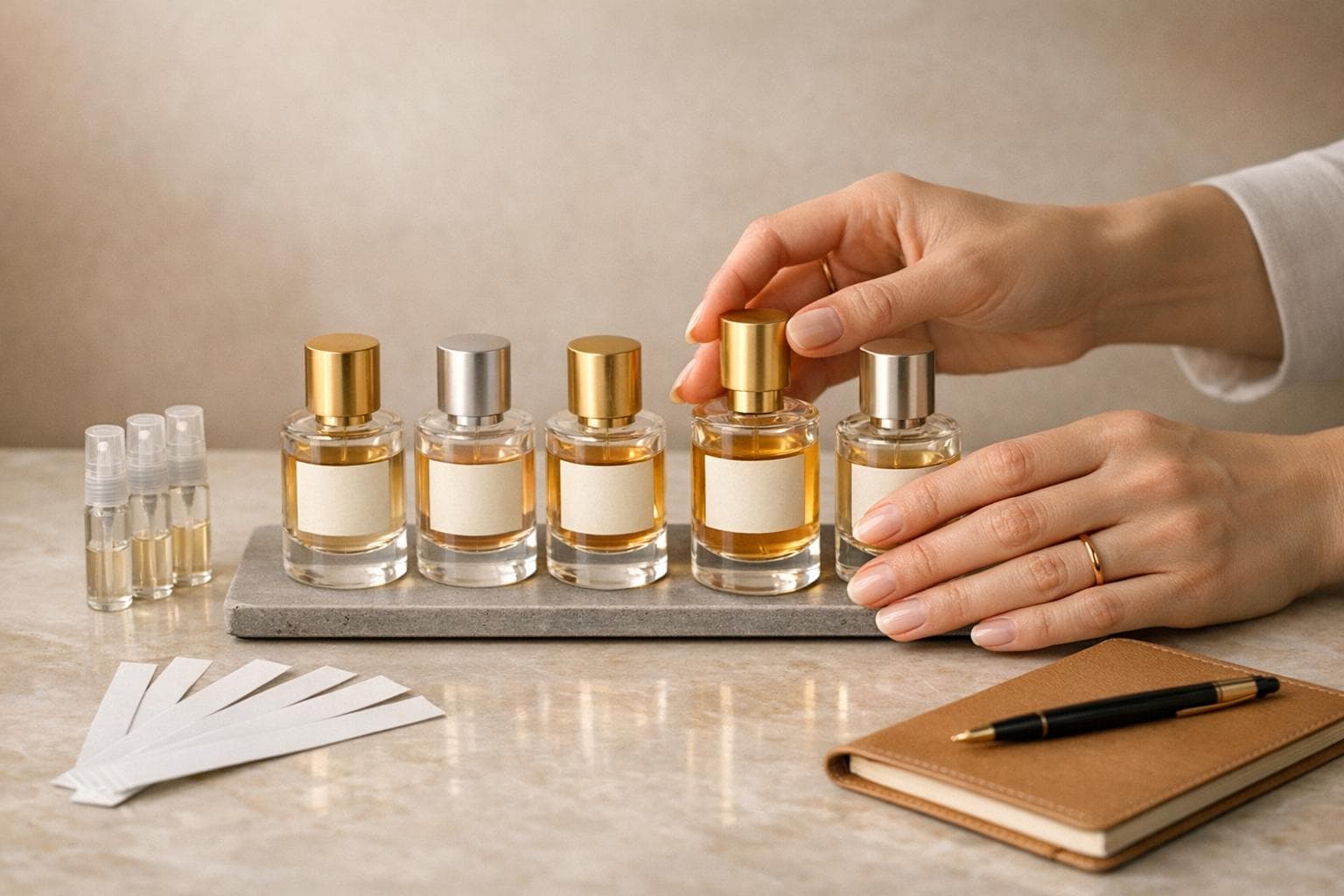
Curating a perfume collection is five steps: identify the families you actually like, test candidates as decants on skin, settle a small core of daily scents, store them out of light and heat, then add seasonally rather than impulsively.
Curating a perfume collection is about finding scents that match your personality, lifestyle, and occasions without overspending or creating waste. Here’s how to build a versatile fragrance wardrobe with minimal risk:
- Identify Your Preferences: Learn fragrance families (floral, woody, amber, etc.), recall scents you’ve enjoyed, and consider your daily routine.
- Test with Decants: Small vials (e.g., 2 ml or 8 ml) are cost-effective for testing how a fragrance works with your skin and fits your life.
- Build a Core Collection: Start with 3–5 scents for different moments - everyday wear, professional settings, evenings, and seasonal picks.
- Store Properly: Keep perfumes in a cool, dark place, away from heat, light, and humidity to preserve their quality.
- Expand Gradually: Use subscriptions or seasonal decants to try new fragrances and update your collection as your preferences evolve.
Organize your collection by season or occasion, and store them correctly to enjoy them for years. Build slowly, ensuring each scent earns its place.
Step 1: Identify Your Scent Preferences
Learn the Main Fragrance Families
Understanding fragrance families is a great starting point. Floral scents, the largest group, include classics like rose, jasmine, and lily. They’re versatile and work well for romantic occasions or everyday wear. Fresh fragrances, with citrus, green, aquatic, or aromatic notes (such as lemon, lavender, or a sea breeze), bring a light, energising feel, perfect for daytime or summer. Woody fragrances feature sandalwood, cedarwood, and patchouli, offering a refined, grounded vibe, often ideal for professional settings or autumn’s cooler days.
For evening events, Amber scents (formerly known as Oriental) stand out with their rich, warm notes like vanilla, spices, and resins. Gourmand, a newer category, is playful and comforting, with notes like chocolate, caramel, and coffee. Meanwhile, Chypre fragrances blend mossy and earthy tones with elements like bergamot and oakmoss, and Fougère offers clean, classic profiles built around lavender and tonka bean.
"Perfume is an invisible signature, a whisper of identity, a delicate symphony that lingers in the air." — Buchart Colbert
Use these categories as a guide to recall and explore the scents that resonate with you.
Think About Perfumes You’ve Enjoyed
Take a moment to reflect on the perfumes you’ve loved in the past. What stood out? Was it the brightness of citrus, the softness of florals, or the depth of woody notes? Organising your past favourites into fragrance families can help you pinpoint your personal preferences. This process also reveals whether you lean toward simple, everyday scents or more daring, intense fragrances for special moments.
Once you have a sense of what you like, think about how these scents fit into your daily routine.
Match Fragrances to Your Daily Life
Your lifestyle plays a big role in choosing the right fragrances. For work or professional environments, go for understated scents with moderate sillage - light woods, powdery florals, or soft musk are excellent options that won’t overpower shared spaces. In contrast, evening outings or date nights call for richer, more alluring profiles like amber, oud, or warm spices. For casual, everyday wear, lighter fragrances such as citrus or green tea are great choices.
Seasonality can also guide your selection. Fresh, aquatic, or fruity scents feel invigorating in spring and summer, while gourmand, spicy, or woody notes bring a sense of warmth and comfort during autumn and winter. Let your fragrance collection reflect your routine, your surroundings, and even your mood.
Step 2: Test with Samples and Decants
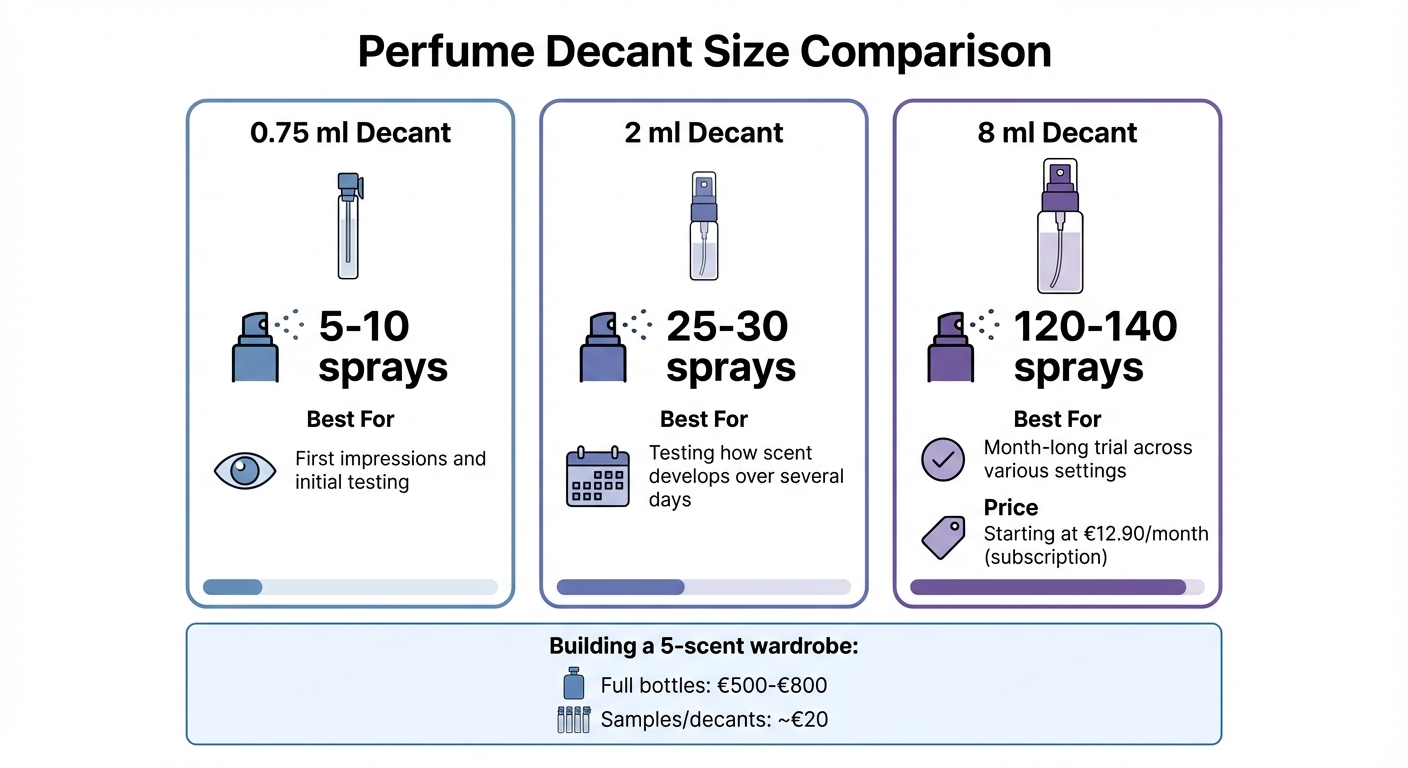
Perfume Decant Sizes Comparison Guide: Spray Counts and Best Uses
Start Small with Decants
Jumping straight into purchasing a full bottle of fragrance can be a costly gamble. Designer perfumes, typically in 50–100 ml bottles, often range between €150 and €300. And there’s no guarantee the scent will work with your skin chemistry or fit into your daily routine. That’s where smaller decants - available in sizes like 2 ml, 5 ml and 8 ml vials, and a 30 ml bottle decant on most perfumes - come in handy. These allow you to explore without the financial risk. To put it in perspective, building a five-scent wardrobe with full-sized bottles could cost €500–€800, while testing those same fragrances with samples might only set you back €20.
Each decant size offers something different. A 2 ml vial gives 25–30 sprays, ideal for testing how the scent develops over several days. Meanwhile, an 8 ml decant delivers 120–140 sprays, enough for a month-long trial to see how it performs in various settings. Brands like Scento make this process accessible across every size.
Take Your Time and Track Your Impressions
Fragrances are not static; they change as they interact with your skin throughout the day. What begins as a bright, citrusy splash may evolve into richer, warmer tones over time. To truly understand a fragrance, wear it in the setting it’s meant for - whether that’s a busy office, a romantic evening, or a laid-back weekend. Think of it this way: wearing one fragrance for all occasions is like wearing the same outfit everywhere - it just doesn’t fit.
Keep a small journal to jot down your thoughts. Note how long the scent lasts (longevity), how far its aroma travels (projection), and how it makes you feel overall. Does it fade too quickly during a long workday? Does it feel too heavy for a warm afternoon? Limiting yourself to testing no more than three fragrances at a time ensures your nose stays sharp and sensitive to each scent’s unique profile.
Explore Subscriptions for Ongoing Discovery
After narrowing down your favourites, restocking your favourite decants keeps your fragrance collection fresh. Scento is a perfume decant and sample retailer, and every product is available for one-time purchase without any subscription. Scento+ is Scento’s optional membership: the monthly fee comes back in full as store credit to spend on any perfume, members get 10% off, a free sample with every order, a free perfume every six months and a birthday gift, and you can pause or cancel anytime. This flexibility lets you adapt your choices to the seasons - lighter citrus notes for summer, richer woody scents for winter. Plus, smaller decants reduce waste, as they’re more likely to be fully used before the fragrance starts to oxidise or your preferences shift. With this approach, you can continue discovering new favourites while building a collection that feels uniquely yours.
Step 3: Create Your Core Collection
After experimenting with decants and jotting down your impressions, it’s time to shape a core fragrance collection that complements all aspects of your lifestyle.
Choose 3–5 Main Scents
Your fragrance wardrobe should include three to five scents that cater to different moments in your life. Start with a fresh, everyday option featuring notes like citrus, green tea, or soft florals - perfect for casual mornings or errands. Add a professional fragrance with refined elements such as cedar, sandalwood, or soft musk, ideal for office settings where subtler scents are appreciated. For evenings, go for something bold and rich - amber, oud, vanilla, or spices work beautifully to leave a memorable impression. Finally, include a seasonal pick: light aquatics for spring and summer, and warm gourmand notes for autumn and winter.
"One scent is never enough because you are never just one thing." – Michel Germain
Switching fragrances keeps things interesting and prevents scent fatigue. Tailor your choices to your routine: for instance, opt for understated scents if you’re in an office environment or lean toward woody notes for outdoor adventures.
Understand Concentrations and Layering
Perfumes come in varying concentrations, each offering a distinct experience:
- Eau de Toilette (EDT): Contains 5–15% fragrance oil, lasting around 3–4 hours. Great for daytime or warmer weather.
- Eau de Parfum (EDP): With 15–20% fragrance oil, it offers 6–8 hours of wear, making it a solid choice for all-day events.
- Parfum (Extrait de Parfum): The richest concentration, with 20–40% fragrance oil, lasting 8–12+ hours. Perfect for special occasions.
Lighter compositions like EDT highlight bright top notes, while EDP reveals deeper, more intricate base notes as it settles. Longevity also depends on your skin type - oily skin holds fragrance longer, whereas dry skin might benefit from richer formulations like EDP or Parfum. As a general guide, apply 4–5 sprays of EDT, 2–3 sprays of EDP, and dab Parfum sparingly on pulse points.
For added creativity, try layering fragrances. Apply one scent to your wrists and another to your neck, allowing them to blend naturally throughout the day. If you want a more unified mix, apply the second fragrance before the first one dries. Alternatively, let the first scent set fully if you’d like it to stand out. You can also enhance an EDT’s longevity by pairing it with a matching scented lotion or a neutral moisturizer.
Compare Decant Sizes
Decants are a practical way to evaluate a fragrance’s performance before committing to a full bottle.
| Decant Size | Approx. Spray Count | Best For |
|---|---|---|
| 2 ml | 20–25 sprays | Quick first impressions and testing on skin |
| 8 ml | ~120 sprays | Extended testing across various occasions |
To make an informed choice, wear a sample over a week in different situations - work, outdoor activities, or evenings - and observe how the fragrance evolves from its top notes to its heart and base. This method ensures that every scent in your core collection earns its place.
Your Personal Fragrance Expert Awaits
Take our quick scent quiz to discover authentic designer and niche fragrances matched to your taste — explore them as 2ml, 5ml, 8ml & 30ml decants and samples, so you can try each one before committing to a full bottle.
Find Your ScentStep 4: Store and Organize Your Collection
Once you’ve built your core collection, the next step is to store and organize it properly. This not only preserves the quality of your fragrances but also makes it easy to choose the perfect scent for any occasion.
Group by Season or Occasion
Arrange your collection by fragrance family, season, or how you plan to use them. For example, keep lighter, refreshing scents like citrus, mint, and soft florals together for spring and summer. Meanwhile, richer options - amber, spices, or oud - are ideal for autumn and winter. You could also organize by purpose: subtle scents for work, bold choices for evenings, or specific picks for special activities. This kind of grouping ensures no bottle gets overlooked and helps you rediscover forgotten favourites.
"When you rotate scents, not only does your environment seem richer, but you also give your senses a chance to truly appreciate the nuances of each composition." – Neo, Neomania Magazine
Display Thoughtfully with Trays or Organizers
Once categorized, consider how you’ll display your fragrances. Keep 5–10 of your most-used bottles in a shaded spot in your bedroom or wardrobe for easy access. For more valuable or rarely used fragrances, opaque boxes are a great choice. Acrylic trays, test tube racks, or decorative organizers are perfect for decants and samples. If you’re a fan of Scento’s stylish atomizers - like Limone di Capri or Rosso Fiore - these can double as both travel-friendly options and design pieces. For larger collections, a cabinet with UV-filter glass or a simple drawer can provide both protection and accessibility.
Protect from Heat and Light
Fragrances are best stored at stable temperatures between 15–20 °C. Heat above 25 °C can speed up chemical reactions, causing perfumes to sour or darken. Ultraviolet rays are particularly damaging, so keep your bottles in their original boxes or opaque containers whenever possible. Avoid bathrooms, as the humidity and fluctuating temperatures can harm your scents. Instead, opt for closets or drawers where conditions are stable. Always replace caps immediately after use to reduce oxygen exposure, and store bottles upright to prevent leaks. Under these ideal conditions, most opened perfumes can last 3–5 years, though natural formulas may remain fresh for only 1–3 years.
Step 5: Grow Your Collection Over Time
Once your collection is organized, the next step is to expand it thoughtfully. Building a fragrance collection is a gradual journey that reflects your evolving tastes, lifestyle, and even the changing seasons. The goal is to ensure that every new addition enhances what you already own.
Explore Seasonal and Limited Releases
Seasonal fragrances are a great way to keep your collection versatile and in tune with the time of year. For colder months like autumn and winter, scents with warm, rich notes - think woody, amber, oriental, or spicy profiles - are ideal. On the other hand, lighter fragrances with citrus, floral, aquatic, or minty notes are perfect for spring and summer. Switching between heavier and lighter options ensures your collection stays balanced year-round. If you’re unsure about committing to a full bottle, decants are a cost-effective way to experiment without the risk.
Regularly Review and Refresh Your Collection
As your preferences shift over time, it’s worth revisiting your collection every few months. Emma South, Fragrance and Lifestyle Expert at Jo Malone London, suggests:
"Take a step back and ask yourself which scents make you feel good or transport you elsewhere".
Evaluate which fragrances still resonate with you, rotate in seasonal favourites, and let go of those that no longer suit your style. If a perfume shows signs of age - such as a change in colour or an off-putting smell - it’s time to say goodbye. For scents you consistently love, consider upgrading from a smaller decant to a larger bottle, but only after you’ve fully experienced it in its smaller format. This regular assessment ensures your collection stays relevant and well-maintained.
Stay Curious with Subscription Services
A monthly subscription can be a simple way to keep exploring without committing to full bottles. Many let you adjust or cancel anytime, making it easy to stay aligned with the current season. As perfumer Elodie Durande from Ffern puts it:
"Always look for fragrances that bring you closer to the current season rather than simply accumulating more perfumes".
Conclusion
Building a personal perfume collection doesn’t mean splurging hundreds of euros on full-sized bottles that might gather dust. Start small, test thoughtfully, and expand as you discover scents that truly align with your skin and lifestyle.
Affordable decants are a great starting point. Scento’s 2 ml option offers 25–30 sprays, enough for testing how a scent develops over several days. Once you’ve found a favourite, an 8 ml decant - delivering about 120–140 sprays - can last for a full month of daily wear. This measured approach not only helps you find the perfect fragrances but also ensures you keep them in top condition.
It’s worth noting that most modern perfumes have a shelf life of just 3 to 5 years once opened. Smaller formats are not only practical but also help avoid waste. Think of your collection as a sensory wardrobe - crafted to reflect your style while adapting to different seasons and occasions. To maintain their quality, store your fragrances in a cool, dark place, away from humidity and direct sunlight.
When building your collection, take your time. Test each fragrance for at least four hours to experience its full journey from top to base notes. Pay attention to how it performs in various settings and conditions. Keeping a scent journal can help you track your impressions, refine your preferences, and avoid costly mistakes.
Your questions, answered
- Is Scento legit?
- Yes. Scento is operated by Scento International LTD, a registered Cyprus company (HE 477410) trading from Paris, founded by Sebastian Dobrincu, whose columns run in Forbes and Entrepreneur. Every bottle it decants passes a 12-point intake authentication — more than 50,000 bottles received and verified since 2021 — and orders ship tracked to 26 European countries with a published returns policy.
- Are Scento decants authentic?
- Yes. Every decant is hand-poured from an original full-sized bottle sourced through authorised European retailers — never a clone, dupe or inspired-by version. The manufacturer's batch code stays with that original bottle and is not printed on Scento decant vials, so a vial without a code is expected.
- How is Scento different from Scentbird or subscription boxes?
- Scentbird's own terms state it delivers only within the United States, Canada or the United Kingdom, and term plans cannot be cancelled before the term ends. Scento ships to 26 European countries and every decant is a one-time purchase; the Scento+ membership is optional.
- How do I know when a decant is worth upgrading to a full bottle?
Testing a fragrance with a decant allows you to see how it interacts with your skin, mood, and daily routine over time. Take note of its longevity, how far its scent radiates (sillage), and how it changes throughout the day. If you find yourself consistently drawn to it, wearing it for various occasions, and reaching for it often, it might be time to invest in a full bottle. Experimenting with different scents can also help refine your preferences.
- How can I test a perfume properly without nose fatigue?
To prevent nose fatigue when testing perfumes, begin with a fresh start by avoiding any scented products beforehand. Rely on blotter strips for your first impressions, and keep the number of scents you test to a minimum - just a few at a time. Allow at least 15–20 minutes between each fragrance to give your nose a break. For a complete understanding of a perfume’s character, assess it at different stages: the initial spray, after 1–2 hours, and during the dry-down phase. This approach ensures you experience its full evolution without overwhelming your senses.
- What’s the easiest way to layer two fragrances without clashing?
To layer fragrances effectively and avoid any clashing, begin with clean, moisturised skin - hydrated skin helps scents last longer and meld better. Apply each fragrance with intention, focusing on key pulse points like wrists or behind the ears. Choose complementary pairings such as fresh and floral or woody and gourmand to create a balanced blend. Before committing fully, test the combination on a small area, like your wrist, to ensure the scents work together seamlessly.

