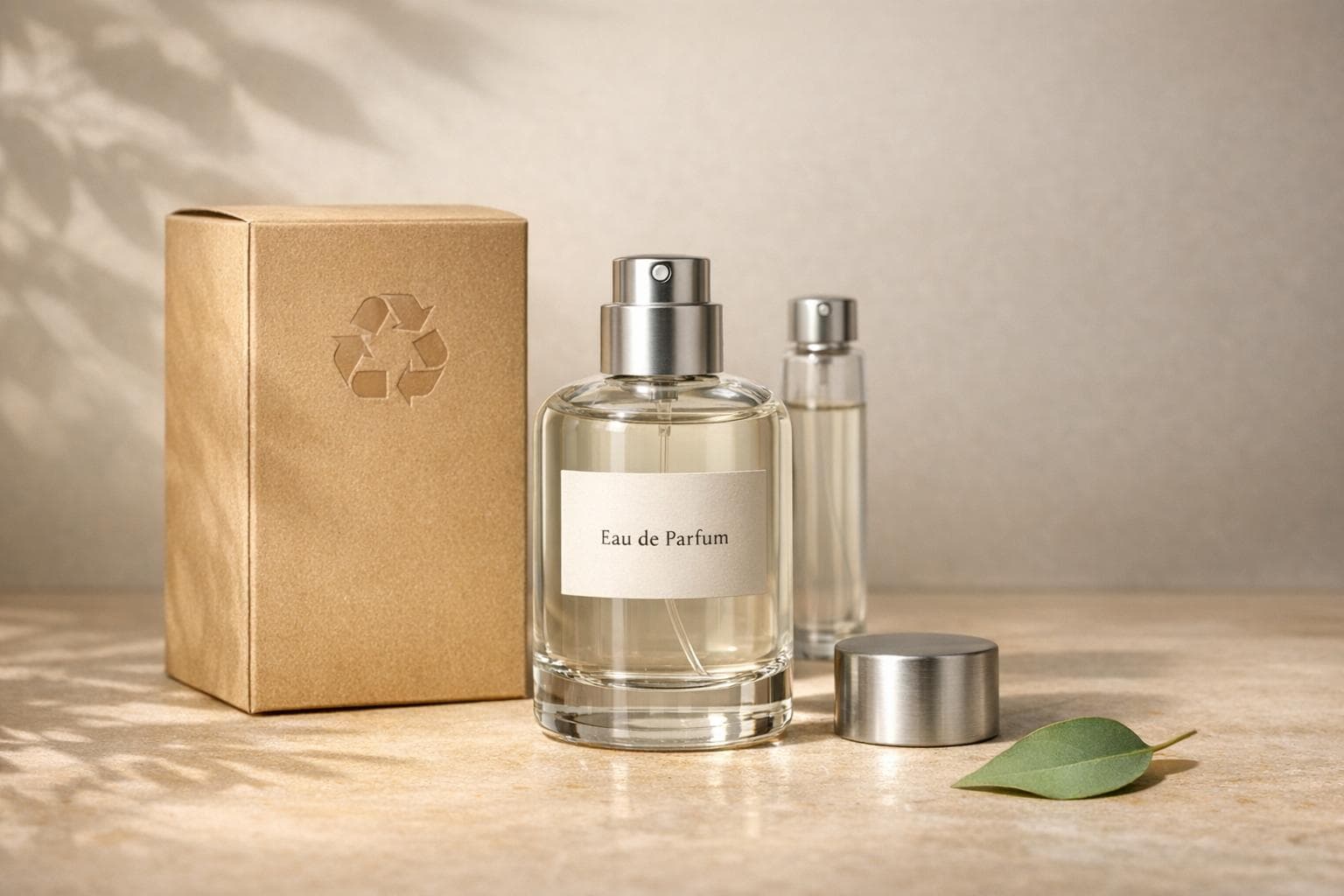
The perfume industry is undergoing a transformation in packaging to address growing concerns about waste and resource use. Heavy glass bottles, plastic pumps, and metallic finishes have long been standard but are now being replaced by designs that focus on reuse, recycling, and reduced environmental impact.
Key changes include:
- Refillable Bottles: Brands like Estée Lauder and Le Labo are offering durable, reusable containers that cut waste and emissions. Refills are also more cost-effective, often priced 30–40% lower than new bottles.
- Eco — Friendly Materials: Use of post-consumer recycled (PCR) glass, bio-based plastics, and recycled aluminum is increasing. Some brands are even using mushroom-based packaging for inserts.
- Simplified Recycling: Monomaterial designs, lightweight bottles, and eco-friendly finishes make recycling easier for consumers. This includes soy-based inks and solvent-free coatings.
- Regulations and Market Growth: EU and U.S. laws are driving the shift, with refillable perfume bottles projected to grow 7% annually through 2033.
These efforts reflect a clear shift toward more responsible, long-lasting packaging solutions that align with consumer values and new legal requirements.
Ecodesign from A to Z: Unlocking Sustainable Innovation in the Perfume Industry
Eco — Friendly Materials in Modern Packaging
The perfume industry is making strides in reducing waste without sacrificing luxury. One standout innovation is the use of post-consumer recycled (PCR) glass, with some manufacturers now achieving up to 85% PCR content while retaining the pristine clarity expected of high-end fragrances. Advanced filtration techniques ensure this recycled glass meets luxury standards.
Caps and pumps are also evolving. Many brands now incorporate 65% PCR polypropylene in tubes, while experimenting with bio-based options like SURLYN or carbon-negative PET derived from wood residues. Recycled aluminum is increasingly popular for caps and solid perfume tins - it’s lightweight, endlessly recyclable, and durable. In a particularly inventive twist, some companies are capturing industrial carbon emissions and converting them into ethanol for use in fragrances, turning waste into a valuable ingredient.
Recycled and Upcycled Materials
The adoption of PCR materials is growing rapidly. Glass bottles made with recycled content not only lower energy requirements for production but also maintain the aesthetic appeal of luxury packaging. Molecular recycling has taken this a step further, producing recycled resins with virgin-quality transparency. This development enables brands to use recycled plastics without compromising on appearance or quality.
Monomaterial designs - where packaging components are made from a single material, such as all-plastic pumps or all-paper boxes - are gaining traction. These designs simplify recycling for consumers by eliminating the need for disassembly. Another practical approach is lightweighting, which involves reducing the thickness of glass bottles. This small adjustment cuts down on raw material use and minimizes shipping emissions, all without requiring any changes in consumer habits.
Biodegradable and Bio — Based Materials
In addition to recycling, brands are exploring materials that decompose naturally or originate from renewable sources. For example, mycelium-based packaging, grown from mushroom roots, provides a compostable alternative to traditional foam inserts and protective padding. This innovative material aligns with growing consumer interest in environmentally friendly solutions. Similarly, compostable options for outer boxes and sleeves are gaining popularity, offering consumers a straightforward way to reduce their environmental impact.
Eco — Friendly Finishes and Inks
Sustainability extends to the finer details of packaging, such as finishes and decorative elements. Traditional metallic accents and synthetic dyes often hinder recycling efforts. To address this, many brands are switching to eco-friendly inks made from soy, vegetables, or water, which reduce volatile organic compounds (VOCs) and simplify recycling. Soy-based monochrome labeling, for instance, has grown by 63% since 2020.
Technological advancements like digital printing and laser engraving are replacing older methods that generate chemical waste and consume large amounts of water. In April 2023, Cartier introduced laser engraving on the aluminum cases of its Santos de Cartier fragrance, eliminating the wastewater associated with traditional chemical etching. Hermès has also pledged to use vegetable-based inks for all fragrance packaging by March 2025, ensuring printed materials are more sustainable and easier to recycle.
Solvent-free UV coatings, now featured on 38% of premium perfume boxes, cut water consumption during manufacturing by 60%. Minimalist labeling - favoring monochrome designs and avoiding laminates that complicate recycling - has become another popular choice. This approach delivers a sleek, modern look while improving recyclability.
For smaller, niche brands, sustainable materials can cost 20% to 30% more than conventional options. However, these investments often result in stronger consumer loyalty and help meet evolving regulatory standards.
Refillable and Reusable Packaging Solutions
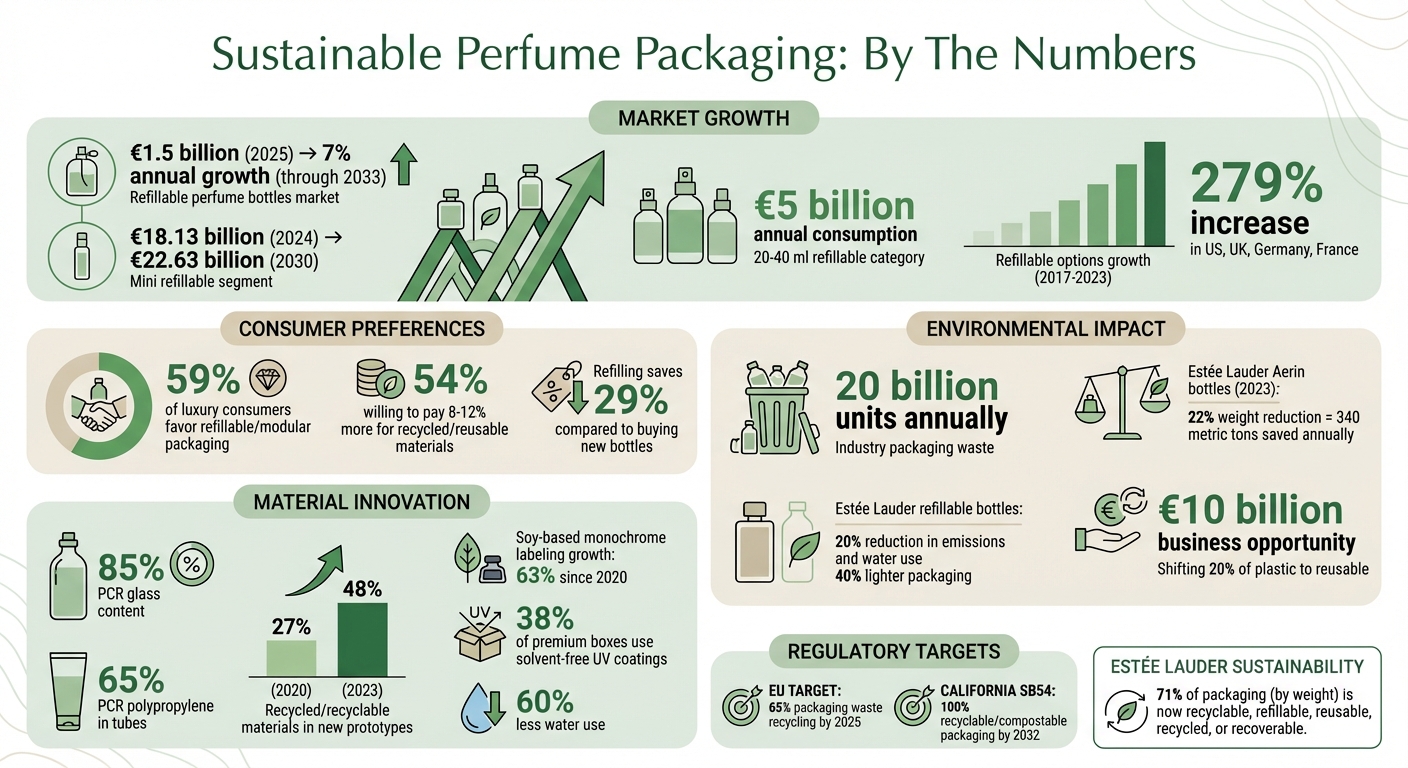
Advances in eco-conscious materials have paved the way for refillable packaging systems that make a meaningful difference in reducing waste. These systems allow consumers to reuse durable containers, cutting down on single-use packaging and lowering overall environmental impact. The global market for refillable perfume bottles was valued at around €1.5 billion in 2025, with an expected annual growth rate of 7% through 2033.
Refillable Bottles in Luxury Fragrances
High-end fragrance brands are reimagining their packaging with longevity in mind. Many now design bottles using robust materials like glass and metal, ensuring they stand up to repeated use. For instance, Estée Lauder’s switch to refillable glass bottles in 2023 reduced both emissions and water consumption by 20%, while also cutting packaging weight by 40%. By fiscal 2024, 71% of the brand’s packaging by weight was recyclable, refillable, reusable, recycled, or recoverable. Similarly, Le Labo offers refill services for 50-ml and larger eau de parfum bottles in the U.S. and U.K., available both in-store and online. These bottles, paired with personalized labels, highlight the enduring charm of their designs.
The mechanics behind refillable systems differ based on functionality and ease of use. Screw-neck designs are simple and budget-friendly but may lead to spills. Direct-to-valve systems, which connect the refill bottle directly to the main bottle’s valve, offer spill-proof convenience and prevent overfilling. Meanwhile, drop-in cartridge systems provide a clean, hassle-free experience by sliding a sealed vial into a permanent outer casing. These innovations not only enhance usability but also deliver clear benefits for both consumers and the planet.
Consumer Benefits of Refillable Systems
Refillable options are cost-effective, with refills generally priced 30–40% lower than purchasing an entirely new bottle. Additional perks, like home refill packs and compact travel atomizers, make these systems even more appealing. For brands, refillable solutions foster long-term customer loyalty by turning one-time buyers into repeat customers while showcasing their commitment to environmental responsibility.
"I think that now more than ever, environmental protection should be close to everyone’s heart."
- Giorgio Armani, Designer
Shifting just 20% of plastic packaging to reusable models could unlock a €10 billion business opportunity. As sustainability takes center stage for consumers, refillable systems offer a practical way to reduce waste while maintaining access to luxurious fragrances.
Your Personal Fragrance Expert Awaits
Take our quick scent quiz to discover authentic designer and niche fragrances matched to your taste — explore them as 2–8ml decants and samples, so you can try each one before committing to a full bottle.
Find Your ScentDesign Changes Supporting Sustainability
Sustainable packaging is proving it can meet the high expectations of fragrance buyers while reducing its impact on the planet. Brands are rethinking every detail to balance eco-conscious choices with a sense of luxury.
Minimalist and Modular Design Trends
Sustainability in design often starts with simplifying materials. Many brands are moving away from unnecessary elements like cellophane wrapping, foam inserts, and multi-layer laminates. Instead, they’re opting for single-material assemblies that are easier for recycling facilities to process. By using mono-material designs with fewer glued joints and standardized bottle necks, consumers can easily separate pumps, caps, and bottles for recycling - no tools required.
Lightweighting is another key trend that reduces material use and cuts shipping emissions. Advances in precision molding allow for thinner glass walls while maintaining durability - a major advantage in the growing e-commerce market. To maintain the premium feel, designers are incorporating weighted caps and crafting closures with satisfying "clicks" that signal quality through touch and sound.
Modular refill systems are also gaining traction. These designs turn bottles into long-lasting pieces, where only the inner cartridge or refillable valve is replaced. This approach elevates packaging to a collectible status, transforming it into a timeless "jewel" for the vanity. The aesthetic leans toward apothecary-inspired minimalism, with clean lines, matte finishes, and thoughtful use of space - trends borrowed from the wellness and skincare industries.
Durable and Recyclable Structures
Material innovation is only part of the story. Engineering advancements are making refillable bottles more reliable and functional. Designs now include silicone or EPDM seals and ultra-fine screw threads to prevent leaks and evaporation, ensuring bottles can handle 20–30 refill cycles without losing performance. These details are crucial, as leakage is one of the main reasons consumers hesitate to adopt refillable systems.
Design for disassembly is another priority. By simplifying pump assemblies and reducing adhesive use, brands are making it easier to break down components for recycling at the end of their life cycle. Some companies are even reimagining fragrance minis (0.3–0.7 fl oz) as modular units that fit into protective cases or dock onto stands at home, allowing users to refill them instead of replacing them entirely.
Refill systems - whether screw-neck, direct-to-valve, or drop-in cartridges - are being refined to balance ease of use, production costs, and the luxurious experience consumers expect. These thoughtful design updates extend the life of products and make recycling more intuitive, proving that sustainability and elegance can go hand in hand.
The Future of Eco — Friendly Perfume Packaging: Market Data
Sustainability Statistics in Perfume Packaging: Market Growth and Environmental Impact
Consumer Preferences and Market Growth
The demand for sustainable packaging in the fragrance industry has moved from being a niche idea to becoming a mainstream expectation. Market data highlights this shift: the global market for refillable perfume bottles reached €1.5 billion in 2025 and is projected to grow at an annual rate of 7% through 2033. Similarly, the mini refillable segment, valued at €18.13 billion in 2024, is expected to climb to €22.63 billion by 2030.
These numbers reflect a growing preference for refillable and modular designs. For instance, 59% of luxury consumers now favor refillable or modular packaging, and 54% are willing to pay 8% to 12% more for products made with recycled or reusable materials. Among frequent travelers, 62% prioritize compact and reusable beauty items, with perfume ranking as one of their top three essentials. The practical benefits are evident, too - refilling a perfume bottle saves consumers about 29% compared to buying a new one.
Regulations are also pushing the industry toward sustainability. The EU has set a target for 65% packaging waste recycling by 2025, while California’s SB54 law mandates 100% recyclable or compostable packaging by 2032. These pressures have driven innovation: recycled or recyclable materials now make up 48% of new luxury fragrance packaging prototypes, a jump from 27% in 2020. For example, in 2023, Estée Lauder reduced the glass weight of its Aerin bottles by 22%, saving 340 metric tons of raw materials annually.
The luxury sector is also redefining refillable packaging as a symbol of sophistication. As LOM Glassworks aptly stated:
"The future of fragrance is permanent, and the new status symbol is the refillable perfume bottle".
Between 2017 and 2023, refillable options in key markets like the US, UK, Germany, and France surged by 279%. Brands are responding with innovative designs - Armani introduced refillable glass bottles for its "My Way" line, while Dior launched a 30 ml size for "Miss Dior" to cater to the demand for portable, high-end options.
How Scento Supports Sustainability Goals
Scento is tackling the waste problem in the fragrance industry head-on. Instead of encouraging consumers to buy €300+ full bottles they might never finish, Scento offers 0.75 ml, 2 ml, and 8 ml decants, aligning with the fastest-growing segment in the market. The 20–40 ml refillable category alone accounts for €5 billion in annual consumption. This focus on travel-friendly, TSA-compliant sizes meets the needs of the 62% of travelers who prioritize compact, reusable beauty products.
Smaller formats also cut down on material waste and shipping emissions. For example, Scento’s 8 ml vials (roughly 0.27 fl oz) provide 120 sprays, giving users enough product to fully experience a fragrance without committing to a full-size bottle that might go unused. This approach addresses the staggering 20 billion units of packaging discarded by the fragrance industry each year, 95% of which is single-use. By gradually adding 30 ml+ bottles to its offerings, Scento allows customers to transition from sampling to building a curated "fragrance wardrobe" without creating unnecessary waste.
Scento’s subscription model further promotes mindful consumption. Instead of impulsively purchasing multiple full bottles, subscribers receive curated monthly selections in reusable atomizers. Popular options include Limone di Capri, Rosso Fiore, Le Moooo, Toile de Jouy, and Blue d’Azur, all of which can be refilled multiple times. This model transforms the traditional one-time purchase into a circular system, extending the life of packaging while giving customers access to over 1,000 designer fragrances. By marrying convenience, sustainability, and luxury, Scento exemplifies how the industry is evolving toward a more responsible future.
Conclusion
The fragrance industry is shifting gears, aligning itself with growing consumer demand and regulatory pushes for sustainability. Refillable bottles are stepping into the spotlight as enduring luxury items - designed to be cherished and reused, not tossed aside after a single use.
Despite these advancements, the sheer scale of waste remains staggering. The mini refillable perfume bottle market is growing quickly, but the industry still churns out over 20 billion units of packaging annually, with 95% discarded after just one use. This underscores the urgent need for change.
Taking meaningful steps toward sustainability doesn’t have to be complicated. Opt for packaging that is Recyclable, Refillable, Reusable, Recycled, or Recoverable. Look for brands that offer take-back programs, where used containers are repurposed into energy or new materials instead of heading to landfills. Additionally, eco-friendly finishes like vegetable-based or water-based inks can make recycling easier compared to metallic alternatives.
The benefits of these efforts go beyond reducing waste. For example, Estée Lauder’s transition to refillable glass packaging cut emissions and water usage by 20% with each refill. As Giorgio Armani aptly put it:
"I think that now more than ever, environmental protection should be close to everyone’s heart".
Smaller, travel-friendly formats also contribute to the cause. They minimize material usage and lower shipping emissions, all while giving consumers the flexibility to explore a variety of scents without committing to full-size bottles they might not finish.
The path forward for fragrance packaging lies in sustainability and circular design. By embracing refillable systems and forward-thinking approaches, brands demonstrate their commitment to a greener future in luxury. Consumers, too, play a pivotal role by supporting refillable packaging, choosing innovative brands, and participating in take-back programs - actions that collectively drive real environmental progress.
FAQs
How can I tell if a perfume bottle is recyclable?
Perfume bottles can often be recycled, especially if they’re made from materials like glass or specific plastics accepted by recycling facilities. To determine if your bottle is recyclable, look for recycling symbols on the packaging. Make sure to remove any non-recyclable components, such as certain caps or decorative labels, before disposal. It’s also a good idea to consult your local recycling rules for clarity on what can and cannot be processed.
What refill system is least likely to leak or spill?
The airless refill system featuring pouch technology offers a highly secure solution against leaks or spills. This design incorporates an airtight, hermetically sealed pouch housed within a glass bottle, keeping the formula safeguarded and reducing the chance of any mess.
Do smaller sizes (like 8 mL) actually reduce packaging waste?
Smaller sizes, like 8 mL, offer an opportunity to cut down on packaging waste by promoting reuse or refills. Brands are increasingly prioritizing refillable and reusable packaging options to limit waste, and compact formats serve as a practical way to support these efforts while reducing the amount of discarded materials.