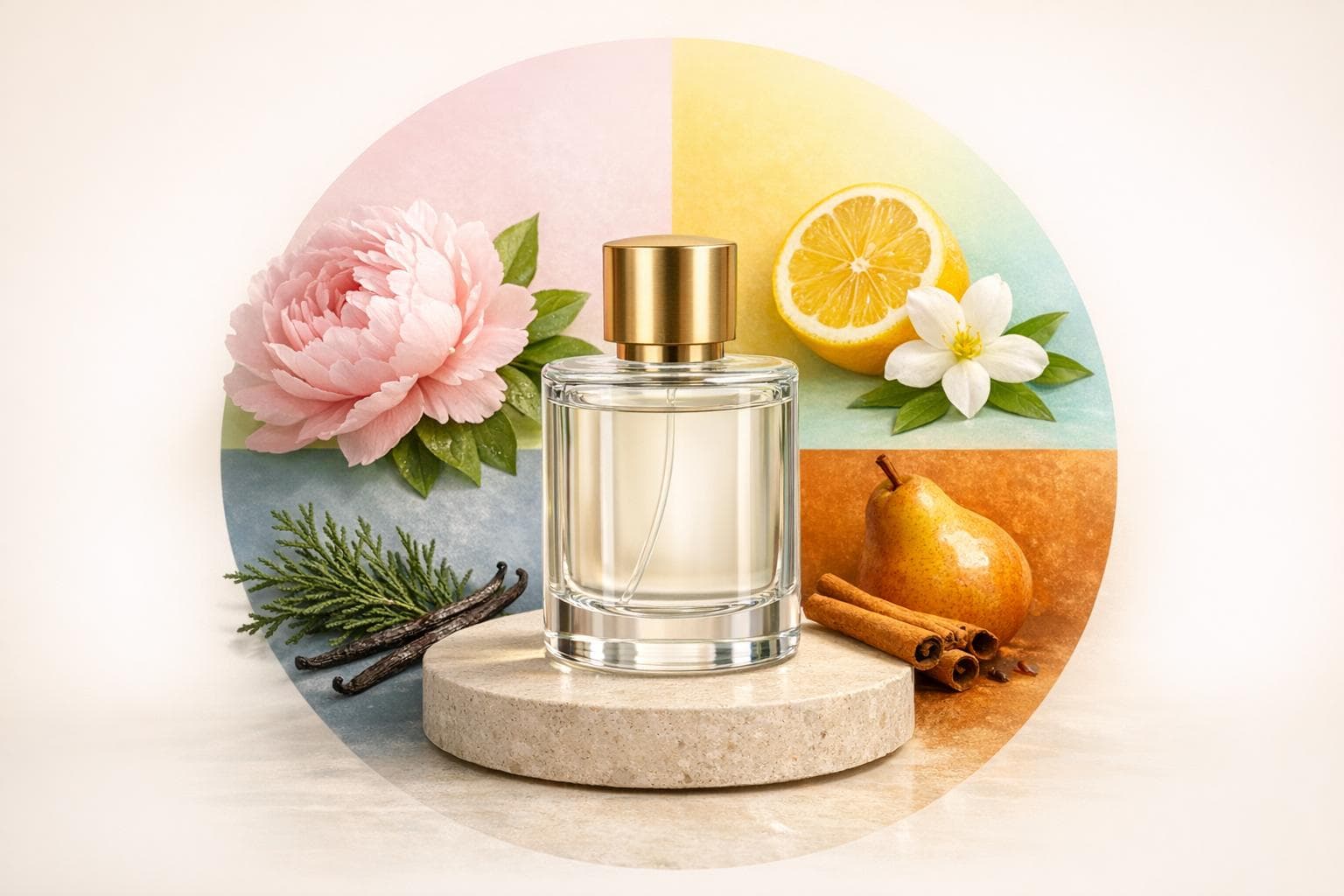
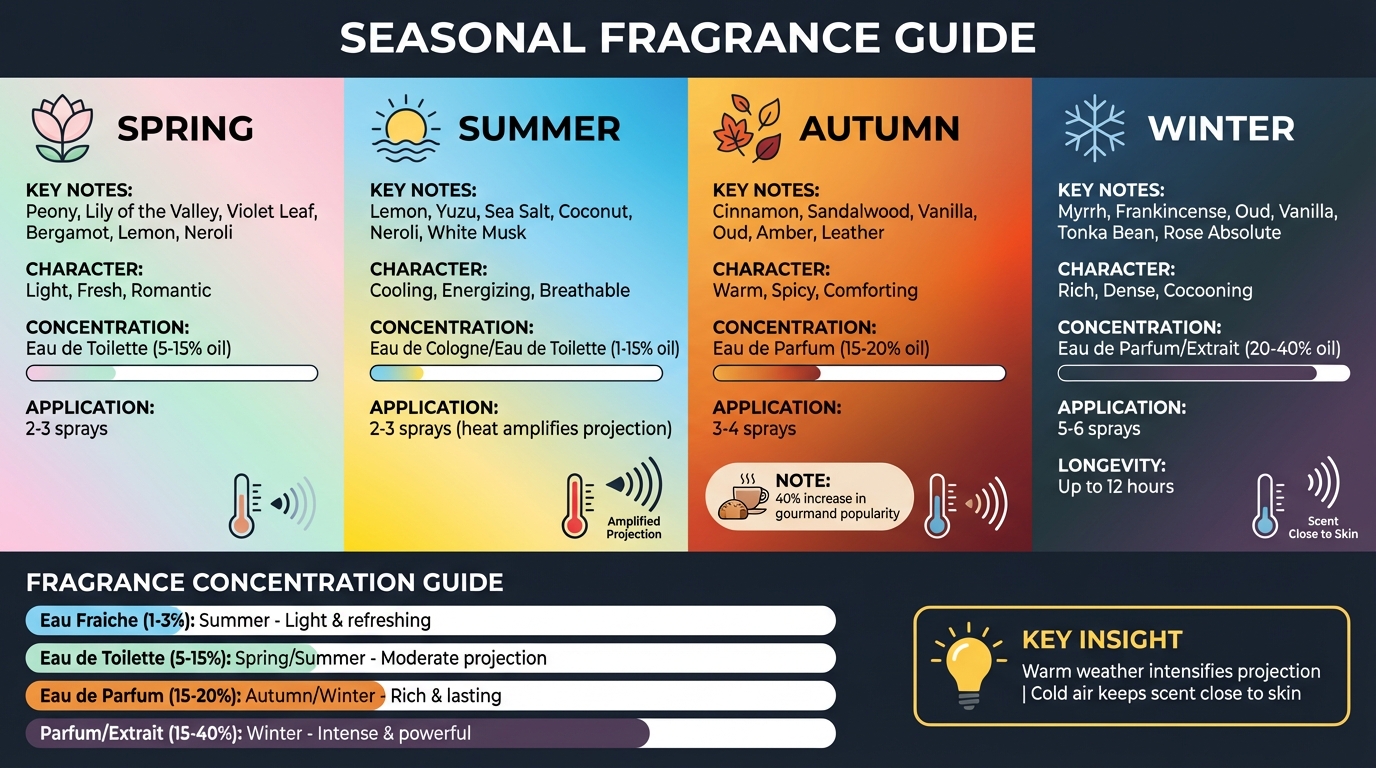
Perfume changes with the seasons, not just in what we choose but how it behaves. Warm weather intensifies fragrance projection, while cold air keeps it close to the skin. Here’s a quick seasonal breakdown:
- Spring: Light florals, green notes, and citrus for daytime freshness. Think peony, violet leaf, and bergamot.
- Summer: Cooling aquatics, tropical fruits, and solar florals like neroli and coconut. Perfect for heat and humidity.
- Autumn: Rich spices, woods, and gourmands such as cinnamon, sandalwood, and vanilla. Warm and comforting.
- Winter: Dense resins, animalic tones, and velvety florals like oud, myrrh, and rose absolute. Long-lasting and cocooning.
Adjust fragrance concentration to the season - lighter Eau de Toilette for summer, richer Eau de Parfum for colder months. Layer scents to transition between seasons or amplify longevity. Keep your fragrance wardrobe simple: 1–2 perfumes per season, tailored to mood and weather.
Seasonal Fragrance Notes Guide: Spring, Summer, Autumn, Winter Perfume Characteristics
Spring Fragrance Notes
Spring fragrances capture the shift from the chill of winter to the inviting warmth of longer days. They weave together florals, greens, and citrus to reflect blooming gardens and fresh air. These light, uplifting compositions are perfect for the season’s extended daylight hours. Let’s dive into the key notes that define spring fragrances and their distinctive appeal.
Key Spring Notes
Spring scents revolve around one core idea: freshness. Florals such as peony, lily of the valley, and freesia bring a soft, romantic charm. Green notes like violet leaf, green tea, basil, and fresh grass add a crisp, natural quality. Meanwhile, citrus notes - think bergamot, lemon, neroli, and mandarin - infuse energy and sparkle. For a finishing touch, aquatic notes like spring rain and morning dew offer a clean, airy feel.
In recent years, the fragrance world has embraced herbaceous blends, combining basil, rosemary, and citrus for a fresh yet grounded profile. This trend reflects a growing emphasis on botanical authenticity and environmentally conscious choices.
| Fragrance Family | Key Spring Notes | Olfactory Character |
|---|---|---|
| Floral | Peony, Lily of the Valley, Rose, Freesia | Romantic, fresh, and delicate |
| Green | Violet Leaf, Green Tea, Basil, Fresh Grass | Verdant, crisp, and natural |
| Citrus | Bergamot, Lemon, Neroli, Mandarin | Sparkling, zesty, and energetic |
| Aquatic | Spring Rain, Morning Dew | Clean, airy, and refreshing |
Why Spring Fragrances Work
These notes are carefully selected to echo the feeling of spring while being practical for daytime wear. As temperatures rise, lighter fragrances project better, while heavier scents can feel overpowering. Spring fragrances are especially suited for occasions like brunches, garden parties, outdoor gatherings, or even casual office settings.
For best results, apply 2–3 sprays to pulse points for a subtle yet noticeable presence as the day warms up. Pairing a floral eau de toilette with a fresh, complementary body lotion can also help you create a layered, personal spring signature.
Summer Fragrance Notes
Summer fragrances are designed to feel radiant and breathable - they aren’t simply diluted versions of winter scents. The warm weather speeds up how fragrance molecules evaporate from your skin, creating a bold initial burst that fades faster. At the same time, humidity can lengthen a scent’s presence, though heavy or sweet notes may become overwhelming in such conditions. This is why summer fragrances focus on light, cooling notes that feel airy and refreshing. Let’s dive into the key note families that define the essence of a summer scent.
The best summer scents complement the weather rather than clash with it. Citrus notes such as lemon, bergamot, yuzu, and lime bring an energising brightness, almost like capturing sunlight in a bottle. Aquatic accords, including sea salt, marine notes, and water lily, evoke the crispness of ocean air and provide an instant cooling effect. Tropical fruits like coconut, pineapple, mango, and watermelon add a fun, sun-soaked vibe without being overly sweet. Solar florals such as neroli, tiare, tuberose, and frangipani bring a dewy, luminous elegance, while light musks and sandalwood offer a soft, warm finish that pairs beautifully with sun-kissed skin.
Key Summer Notes
| Note Category | Key Examples | Mood/Effect |
|---|---|---|
| Citrus | Lemon, Bergamot, Yuzu, Lime, Grapefruit | Energising, zesty, crisp |
| Aquatic | Sea Salt, Marine Accords, Water Lily | Cooling, airy, refreshing |
| Tropical | Coconut, Pineapple, Mango, Watermelon | Exotic, playful, sun-drenched |
| Green | Fig Leaf, Mint, Basil, Green Tea | Earthy, breezy, herbal |
| Solar Floral | Neroli, Tiare, Tuberose, Frangipani | Luminous, romantic, dewy |
| Light Musks | White Musk, Mineral Musk | Clean, skin-like, breathable base |
By understanding these note profiles, you can make more informed choices when selecting your summer fragrance.
Tips for Summer Fragrance Selection
Opt for Eau de Toilette or Eau de Cologne, as their lighter concentrations prevent overwhelming projection in hot weather. Apply your fragrance to cooler pulse points - like the back of your neck or behind your knees - to avoid amplifying it with body heat. Be cautious with citrus-based scents; some ingredients can cause photosensitivity if applied to skin exposed to direct sunlight.
Stick to 2–3 sprays, as heat naturally enhances a scent’s projection. For a soft "scent halo" that drifts with the breeze, try lightly misting your hair. Since summer fragrances tend to fade faster, carry a travel-sized atomiser (2 ml or 8 ml) for touch-ups throughout the day. Allow at least 20 minutes after your initial application for the fragrance to fully develop.
"I used to go through a bottle of perfume every month during summer... Then I learned about pulse point strategy. Game changer." – Ximena, Representative, Perfumes Los Angeles
Autumn Fragrance Notes
Autumn fragrances beautifully reflect the season’s shift from sunny afternoons to brisk mornings. As the air cools, scents develop more slowly, allowing richer, more layered perfumes to shine. These fragrances often evoke the season’s natural elements - think fallen leaves, forest trails, and the textures of wool and leather.
The seasonal change begins in September, when lighter, summery scents like citrus and coconut give way to deeper, more complex profiles featuring oud, amber, and leather. Spices such as cinnamon, clove, cardamom, and nutmeg deliver instant warmth, perfect for crisp autumn days. Meanwhile, woody notes like sandalwood, cedar, oud, and vetiver provide a sense of grounded stability, mirroring the earthy tones of the outdoors. Gourmand notes - vanilla, caramel, praline, and coffee - satisfy cravings for cosy indulgence, with these scents seeing a 40% increase in popularity during the autumn months. Resinous notes like labdanum, benzoin, and amber add depth and perform exceptionally well in cooler air, unlike the lighter florals or aquatic scents of summer. These shifts align perfectly with the idea of using fragrances to reflect and enhance nature’s seasonal rhythm.
Key Autumn Notes
| Note Category | Common Examples | Atmospheric Effect |
|---|---|---|
| Woody | Sandalwood, Cedar, Oud | Grounded sophistication and depth |
| Spicy | Cinnamon, Cardamom, Clove | Inviting warmth and toasty comfort |
| Gourmand | Vanilla, Caramel, Praline | Sweetness and indulgence |
| Atmospheric | Leather, Ink, Smoke | Nostalgia, "Dark Academia", or "Witchy" vibes |
| Fruity | Plum, Fig, Pomegranate | Richness echoing the autumn harvest |
Autumn fragrances also lean into distinct moods that amplify the season’s character. "Dark Academia" perfumes use notes like leather, ink, and paper to evoke old libraries and scholarly pursuits, while "witchy" scents incorporate oakmoss, crushed leaves, and herbal nuances for a raw, untamed vibe. On the other hand, cosy, nostalgic compositions bring in cashmere and fireside elements for a comforting, familiar feel.
"Vanilla, amber, leather, and cocoa feel like the olfactory equivalent of a cosy jumper or a mug of hot chocolate." – Pocket Scents
These notes and moods work together to create fragrances that are not only evocative but also physically and emotionally warming.
How Autumn Scents Create Warmth
The warmth of autumn fragrances isn’t just an emotional response - spicy notes like cinnamon and clove can actually create a warming sensation on the skin. Woody and earthy notes, such as patchouli and oakmoss, mirror the natural changes of the season, evoking images of falling leaves and forest floors. These richer scents pair effortlessly with autumn’s wardrobe staples, like leather jackets, wool coats, and darker fabrics.
Cooler temperatures also affect how fragrances interact with the skin. Dry skin, common in autumn, can alter a perfume’s longevity and evolution. A scent that feels perfect in a warm indoor setting might behave differently in the crisp outdoor air. This is why switching from lighter Eau de Toilette (EDT) to more concentrated Eau de Parfum (EDP) makes sense in autumn. EDP contains 15–20% perfume oil, compared to EDT’s 5–15%, and performs better in cooler weather. To extend your fragrance’s life, apply an unscented moisturiser before spritzing, and consider lightly spraying your scarf or coat lining for a scent that lingers throughout the day.
Your Personal Fragrance Expert Awaits
Take our quick scent quiz to discover authentic designer and niche fragrances matched to your taste — explore them as 2ml, 5ml, 8ml & 30ml decants and samples, so you can try each one before committing to a full bottle.
Find Your ScentWinter Fragrance Notes
During winter, the cold air changes how perfumes behave. It slows the evaporation of fragrance molecules, keeping scents closer to the body. A perfume that might radiate a metre in summer could only project about thirty centimetres in winter. This shift calls for fragrances with rich, layered compositions that rely on heavier base notes like oud, amber, resins, and gourmands. These notes cling to the skin and unfold gradually, sometimes lasting up to twelve hours.
Winter fragrances are all about creating a warm, cocooning effect. Resinous notes such as myrrh, frankincense, benzoin, and labdanum bring a luxurious depth, ensuring the scent doesn’t feel flat. Animalic notes like oud, leather, and musk produce a bold, enveloping presence, with oud standing out for its smoky, sweet complexity. Gourmand notes - think vanilla, tonka bean, chocolate, caramel, and honey - offer a comforting, indulgent appeal. Meanwhile, spices such as cinnamon, cardamom, clove, and saffron add a layer of warmth and texture. Unlike the airy florals of spring, winter leans into lush, velvety blooms like rose absolute, tuberose, and ylang-ylang, which pair seamlessly with darker, resinous bases.
"Winter does not merely change what perfume you should wear - it fundamentally transforms how perfume behaves." – Potion Paris
Key Winter Notes
| Note Category | Examples | Effect |
|---|---|---|
| Resinous | Myrrh, Frankincense, Benzoin, Labdanum | Rich warmth, wraps you in a "scent cocoon" |
| Gourmand | Vanilla, Caramel, Chocolate, Tonka Bean | Sweet, comforting, indulgent |
| Woody | Oud, Sandalwood, Cedar, Patchouli | Deep, grounding, sophisticated |
| Spicy | Cinnamon, Cardamom, Clove, Saffron | Adds warmth and texture |
| Animalic | Leather, Musk, Ambergris, Castoreum | Sensual, bold, and skin-like |
| Dense Floral | Rose Absolute, Tuberose, Ylang-ylang | Romantic, velvety, and opulent |
These rich, dense notes not only create a warming effect but also ensure the fragrance lasts longer in colder weather.
Why Winter Scents Last Longer
Cold air helps base notes linger by slowing down evaporation, but it also tightens pores and leaves skin drier, naturally reducing scent projection. This is where Eau de Parfum (EDP) or Extrait de Parfum come into play. Their higher oil concentrations (20–25%) ensure both longevity and intensity, making them ideal for winter’s dry, chilly conditions.
To get the most out of your winter perfume:
- Apply an unscented moisturiser or body oil before spraying, as dry skin struggles to hold scent molecules.
- Use more sprays than in summer - five to six sprays of EDP is typical compared to two or three in warmer months.
- Focus on pulse points under clothing, like the chest or inner elbows, where body heat can amplify the scent.
- Let natural fibres like wool scarves or cashmere collars absorb the fragrance; they can hold the scent for eight to ten hours.
- Store your perfumes in a cool, dark place. Avoid rapid temperature changes caused by moving between freezing outdoor air and heated interiors, as this can degrade the quality of the fragrance.
Fragrance Concentrations and Seasonal Performance
The temperature outside doesn’t just influence which fragrance notes you gravitate toward - it also plays a big role in how the scent behaves on your skin. Warm weather speeds up evaporation, which helps scent molecules travel further, while colder temperatures slow this process down, keeping the fragrance closer to your skin for longer.
The oil concentration in a fragrance is key to how it performs under these temperature changes. For summer, lighter formulations like Eau Fraiche (1–3% oil) are perfect. For spring or early summer, Eau de Toilette (5–15% oil) strikes a balance. When the chill of winter sets in, opt for richer concentrations like Eau de Parfum (15–20% oil) or Parfum/Extrait (15–40% oil) to ensure the scent holds up against the cold.
Humidity also plays a part. In humid climates, just a few sprays can feel as strong as several more in dry air.
Matching Concentrations to Seasons
Here’s a straightforward guide to help you pick the right fragrance concentration for every season:
For those in-between seasons - early spring and late autumn - keep an eye on the daily temperature swings. For instance, if the day starts at 8°C and climbs to 16°C by midday, stick to a lighter concentration or reduce the number of sprays of your Eau de Parfum to avoid overwhelming those around you. During summer’s peak, consider carrying a small decant for a quick refresh, as heat tends to burn off scent faster. In winter, lighter options like Eau de Toilette might feel too faint once the temperatures drop below 12°C, making Eau de Parfum or Parfum better suited for the season.
| Concentration | Oil % | Best Season | Performance Characteristic |
|---|---|---|---|
| Eau Fraiche | 1–3% | Summer | Light and refreshing, with low projection, ideal for hot days |
| Eau de Toilette | 5–15% | Spring/Summer | Crisp with moderate projection, avoids being overwhelming |
| Eau de Parfum | 15–20% | Autumn/Winter | Richer and more lasting, perfect for cooler temperatures |
| Parfum/Extrait | 15–40% | Winter | Intense and long-lasting, powerful enough for cold weather |
How to Select and Layer Seasonal Fragrances
Finding Your Seasonal Signature
When choosing a fragrance, always test it directly on your skin. Your body chemistry can dramatically affect how heart and base notes develop, especially as seasons change. For spring, lean towards floral or green scents with a touch of citrus. In winter, opt for fragrances with deep resins, animalic tones, or rich woods. During summer, fresh, invigorating scents work well to combat the heat, while spicy or warm notes provide a sense of coziness in colder months. This process isn’t just about the weather - it’s also about finding what suits your mood and lifestyle throughout the year.
Layering Techniques for Seasonal Scents
Once you’ve found a seasonal signature, layering fragrances adds depth and personalisation. Start with your heaviest scent - this could be woody, oriental, or oud-based - as the foundation. According to perfumer Ayala Moriel:
"The one that goes on first would be less noticeable in the beginning of the wear; but would grow over time to reveal itself as the ‘base notes’ of the fragrance".
Keep your combinations straightforward by using single-note fragrances rather than complex blends. Apply each layer with a 2–3 minute gap to let it settle properly. For seasonal transitions, try pairing a light spring floral with richer base notes like warm vanilla, woody musk, or amber to create a bridge into autumn. You can also use complementary body washes or lotions to enhance the harmony and longevity of your chosen scent.
If you’re experimenting or not ready to commit to full bottles, decants are a great option. For example, Scento offers decants in sizes like 2 ml, 5 ml and 8 ml vials, and a 30 ml bottle decant on most perfumes, giving you up to 120 sprays to explore and refine your signature fragrance.
Conclusion
Seasonal fragrance notes offer a way to tailor your perfume choices to the changing environment. Think spring florals, summer aquatics, autumn spices, and winter resins - each bringing a unique harmony to match the season and keep your signature scents feeling fresh.
Temperature and humidity also play a big role in how your fragrance behaves. Warmer weather tends to amplify scent projection, while colder weather can make fragrances feel more subdued. As Emma Lancaster, Senior Perfume Editor, puts it:
"Rotate your perfumes seasonally to keep your scent experience fresh and mood-enhancing".
This perspective not only helps refine your choices but also simplifies the process of building a well-rounded fragrance wardrobe. You don’t need an entire shelf of €300+ bottles to achieve versatility. Start small - 1 or 2 fragrances per season (4–8 in total) - and gradually add transition scents that work between seasons. Scento makes this journey easier with curated decants available in 2 ml, 5 ml and 8 ml vials, and a 30 ml bottle decant on most perfumes. With access to over 1,000 designer fragrances, you can experiment and find out how different notes evolve throughout the year.
FAQs
How do I pick a fragrance for days with big temperature swings?
When selecting fragrances for fluctuating temperatures, aim for scents that strike a balance between freshness and warmth. Compositions featuring citrus or green notes paired with woody or spicy undertones are particularly effective - they shine in both warmer and cooler settings. To keep your scent appealing as the day progresses, consider layering fragrances or choosing lighter concentrations, such as eau de parfums. These approaches help your fragrance adapt seamlessly to changing conditions.
What’s the safest way to wear citrus scents in the sun?
To enjoy citrus fragrances safely in the sun, opt for light, refreshing options and use them sparingly. Citrus notes can heighten photosensitivity, so avoid applying them directly to exposed skin before heading outdoors. Instead, dab a small amount on pulse points or lightly mist your clothing. This way, you can enjoy the lively aroma without risking skin irritation under the sun.
How can I layer perfumes without them clashing?
Layering perfumes can be an art when done right. Start with a base fragrance that you love and build on it with scents that share similar or complementary notes. The key is moderation - apply each scent sparingly to keep the blend from becoming overpowering.
For a balanced result, try combining lighter, fresher notes first, such as citrus or florals, then add richer, deeper tones like woods or ambers. This layering method helps the fragrances work together, creating a smooth and personalised scent that feels cohesive rather than clashing. Experimentation is part of the fun, so don’t be afraid to adjust and refine your combinations!

