When it comes to buying exclusive fragrances, you’ll typically encounter two options: waitlists and pre-orders. Here’s the difference:
- A waitlist lets you express interest without any upfront payment. You’ll get notified when the product is available, but there’s no guarantee you’ll secure it unless you act quickly.
- A pre-order requires full or partial payment upfront, guaranteeing your purchase. However, you may need to wait weeks or months for delivery.
Key Points:
- Waitlist: No payment, no commitment, but no guarantee of availability.
- Pre-order: Payment upfront, purchase secured, but funds are tied up until delivery.
Quick Comparison
| Aspect | Waitlist | Pre-Order |
|---|---|---|
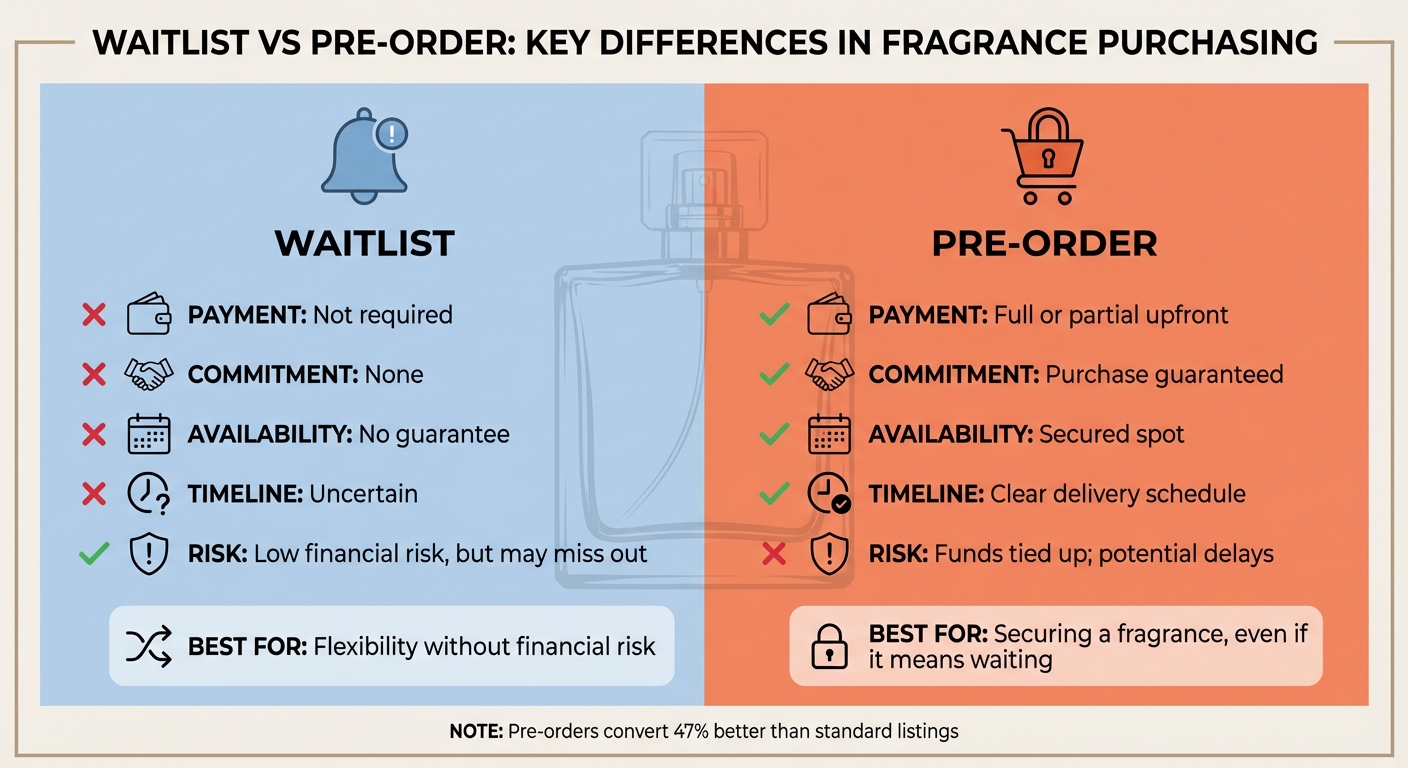
| Payment | Not required | Full or partial upfront |
| Commitment | None | Purchase guaranteed |
| Availability | No guarantee | Secured spot |
| Timeline | Uncertain | Clear delivery schedule |
| Risk | Low financial risk, but may miss out | Funds tied up; potential delays |
Choose a waitlist if you want flexibility without financial risk. Opt for a pre-order if you’re committed to securing a fragrance, even if it means waiting.
Waitlist vs Pre-Order Comparison: Payment, Commitment, and Availability Differences
What is a Waitlist?
In the world of luxury fragrances, a waitlist is essentially a way to reserve your spot for a coveted scent. By signing up with your contact details, you’ll receive a notification as soon as a fragrance becomes available - whether it’s a new launch or a restock. For brands, waitlists serve as a tool to measure interest in exclusive or limited-edition releases, helping them decide how much to produce without risking overstock. For customers, it’s a chance to secure access to rare and sought-after scents.
How Waitlists Work
The process is simple: head to the brand’s website, find the fragrance labeled as "sold out" or "coming soon", and enter your email or phone number. Once the product is available, you’ll get an automated alert, giving you the opportunity to act quickly.
Waitlists also provide brands with valuable insights. For instance, if 5,000 people sign up for a niche fragrance, it signals strong demand, enabling the brand to plan production accordingly. It’s a win-win: customers aren’t obligated to buy, and brands can avoid overproducing. Some platforms even allow you to climb the waitlist by referring friends, adding a social element to the process. This system not only secures customer interest but also offers brands real-time data on demand.
When Brands Use Waitlists for Fragrances
Waitlists are particularly useful for limited-edition launches, small-batch seasonal collections, and restocks of high-demand scents. Take indie brand Ffern as an example - they use waitlists for their seasonal perfumes, creating buzz and maintaining exclusivity while collecting a pool of eager buyers.
This approach is also common in "drop culture", where niche fragrances are released at specific times and sell out almost instantly. A waitlist ensures there’s an engaged audience ready to make a purchase as soon as stock becomes available. Additionally, if a fragrance is still in production or the brand is finalizing quantities, waitlists help gauge interest before committing to large-scale bottling or importing.
What is a Pre-Order?
A pre-order lets you secure a fragrance before it officially hits the shelves. By making an upfront payment or deposit, you guarantee that the brand will ship your bottle as soon as it’s ready. Think of it as a step beyond a waitlist - while a waitlist shows interest, a pre-order locks in your purchase. For fragrance enthusiasts, this is a lifesaver when it comes to snagging limited-edition scents that often sell out in no time. From the brand’s perspective, pre-orders act as a real-time demand tracker, helping them decide how many bottles to produce and avoid overstock or shortages. Now, let’s break down how this process works.
How Pre-Orders Work
The process is simple: head to the brand’s website, choose the fragrance marked for pre-order, and complete your purchase. Most brands require full payment upfront, though some allow partial deposits or offer early-bird discounts. The product page will typically include an estimated shipping date, which could be a few weeks or even months away.
Once your payment is processed, your bottle is reserved from the next production batch. This guarantees your order, even during high-demand periods. Brands often use technology to manage the pre-order experience, setting limits on inventory, sending updates, and providing flexible payment options. According to Submarine, products available for pre-sale tend to convert 47% better than standard listings.
When Brands Use Pre-Orders for Fragrances
Pre-orders are most effective for new launches, limited-edition collections, and custom or made-to-order scents. This system helps brands predict demand, streamline their production, and offer customers early access to exclusive fragrances. It’s a win-win for both sides, ensuring fans don’t miss out and brands operate efficiently.
Waitlist vs Pre-Order: Main Differences
Waitlists and pre-orders serve as two distinct ways to secure exclusive fragrances. While one simply notifies you when a product becomes available, the other guarantees your purchase with a set timeline. Here’s a closer look at how they differ in terms of timing and payment.
Timing and Availability
Waitlists are often used for fragrances that are either sold out or yet to be released. They function as a way to express interest without any commitment. However, the timing is unpredictable - you might be waiting days, weeks, or even months for a notification. This makes it a less certain option for those eager to secure a product.
Pre-orders, on the other hand, come with a defined release schedule. By pre-ordering, you’re committing to buy a fragrance during the pre-launch phase. Your order is then queued for shipment on or around the advertised release date. While you may still face a waiting period, the timeline is much clearer compared to a waitlist.
Payment and Purchase Guarantee
The key difference between waitlists and pre-orders lies in the payment process and the level of certainty they provide.
Joining a waitlist requires no upfront payment. It’s a risk-free way to show interest, and you can remove yourself from the list at any time. However, there’s no assurance that you’ll be able to purchase the fragrance, especially if demand exceeds supply.
With a pre-order, you’re making a financial commitment. Most brands require full payment at the time of pre-order, although some may allow partial deposits or even offer early-bird pricing. This payment secures your spot in the next production batch, ensuring you’ll receive the fragrance even during peak demand. That said, your money is tied up until the product ships, and cancellation policies can be stricter. Potential risks include delays in delivery or adjustments to the release date.
sbb-itb-fb213bc
Waitlist Pros and Cons
Waitlists present a straightforward way to access exclusive fragrances, but they come with their own set of trade-offs for both customers and brands. By weighing the benefits and drawbacks, you can better determine if joining a waitlist aligns with your fragrance-buying goals. Let’s break down the key points for both sides.
For customers, a major perk is the lack of financial commitment. All it takes is an email address - no credit card or upfront payment is necessary. This low-pressure setup makes it easy to sign up without tying up funds. But there’s a downside: uncertainty. Wait times can stretch from days to months, and there’s no guarantee you’ll secure the fragrance if demand exceeds supply. Additionally, allocation methods often limit customer choice, leaving some without their desired product.
From the brand’s perspective, waitlists offer valuable insights. They help gauge demand, prevent overproduction of costly fragrance batches, and serve as a form of market research, especially for smaller, independent brands. The exclusivity factor, often amplified by referral incentives, can also create organic buzz and excitement around a product.
However, there are challenges for brands too. Without upfront payments, cash flow is delayed, and not all waitlist sign-ups translate into sales. In fact, presale models tend to outperform waitlists, with conversion rates 47% higher. On top of that, long waits or unmet expectations can lead to customer dissatisfaction, potentially harming a brand’s reputation - an especially risky issue in the niche fragrance market.
Here’s a quick breakdown of the pros and cons for both customers and brands:
Waitlist Comparison Table
| Aspect | Pros | Cons |
|---|---|---|
| Customer Payment | No upfront payment required; low financial risk | No guarantee of purchase; spot not secured |
| Customer Commitment | Easy email sign-up; no strings attached | Uncertain timelines; risk of missing out |
| Customer Control | Lets you express interest without obligation | Limited customization options; unclear availability timelines |
| Brand Revenue | Builds a targeted email list for future marketing | Delayed cash flow; no immediate income |
| Brand Planning | Helps forecast demand and manage inventory | Risk of poor conversion rates from sign-ups to actual sales |
| Brand Marketing | Boosts exclusivity and organic buzz through referral programs | Long waits and unfulfilled expectations may frustrate customers |
Pre-Order Pros and Cons
Pre-orders are a double-edged sword, offering both benefits and challenges for customers and brands alike. When you pre-order an exclusive fragrance, you’re securing your bottle before production even begins, sidestepping the risk of it selling out. You’ll also get a clear delivery window upfront, which is far more predictable compared to the uncertainty of waitlists. Some brands sweeten the deal with perks like early-bird pricing, special packaging, or unique atomizer designs to reward early adopters. However, these advantages come with financial and sensory risks that are worth considering.
For customers, pre-orders often require full or partial payment upfront, tying up €200–€300 or more for weeks, sometimes months, before the product arrives. Delays caused by production issues, supply chain bottlenecks, or shipping problems can push back delivery dates, and many brands enforce strict cancellation policies, often offering only store credit if you change your mind. When it comes to fragrances, there’s an additional gamble: committing to a scent you’ve never experienced. Without sampling a 2 ml decant first, you could end up with an expensive bottle that doesn’t align with your preferences. These restrictions stand in stark contrast to the flexibility of waitlists, where there’s no financial commitment until you’re ready to buy.
From the brand’s perspective, pre-orders are a valuable tool for revenue generation and production planning. Knowing how many units are pre-ordered allows brands to fine-tune their production runs, minimizing overstock and reducing sellout risks. Data from presale-focused platforms indicates that items available for pre-order can achieve a 47% higher conversion rate compared to standard in-stock products, demonstrating the strong commercial appeal of this model.
That said, pre-orders also come with operational and customer service challenges. Brands must carefully manage suppliers, bottlers, and logistics to meet promised shipping timelines. Delays can lead to chargebacks, negative reviews, and eroded customer trust. Clear communication and detailed policies around refunds, delays, and even formula adjustments are critical to maintaining customer satisfaction. Over-reliance on pre-orders for every product launch can also lead to customer fatigue, especially if long waits and upfront payments become the norm.
Pre-Order Comparison Table
| Aspect | Pros | Cons |
|---|---|---|
| Customer Payment | Secures purchase and reserves unit before sellout | Requires upfront payment; funds locked for extended periods |
| Customer Commitment | Offers clear delivery timelines and avoids drop-day stress | Risk of delays; stricter refund and cancellation policies |
| Customer Control | Early access to limited editions and customization options | Buying without reviews or samples; potential disappointment with unsmelled fragrances |
| Brand Revenue | Generates immediate cash flow; funds production and marketing efforts | High pressure to meet deadlines to avoid chargebacks and reputation issues |
| Brand Planning | Enables accurate demand forecasting and inventory management | Adds operational complexity; requires strong supplier and logistics coordination |
| Brand Marketing | Boosts conversion rates by 47%; builds excitement for new launches | Overuse can lead to customer fatigue; delays may harm trust |
Waitlist or Pre-Order: Which Should You Choose?
The choice between a waitlist and pre-order depends on how urgently you want the product, your comfort with financial commitments, and your willingness to take on potential risks. Neither option is universally better - it’s all about what suits your situation. Here’s a closer look to help you decide.
What to Consider
When it comes to snagging limited-edition fragrances, timing and strategy are everything. If you’re after a scent that’s likely to sell out in a flash, a pre-order ensures you lock in your bottle before it even hits the shelves. This approach eliminates the stress of launch-day website crashes or frantic last-minute decisions. On the other hand, if you’re more casually interested - perhaps waiting for reviews or comparing options - a waitlist keeps you in the loop without requiring an immediate commitment.
Your approach also depends on how much risk you’re willing to take. Waitlists are risk-free since they don’t require upfront payment. Pre-orders, however, often involve paying in advance, which secures your spot but can come with delays or limited refund flexibility. If you’re still on the fence, joining a waitlist is a low-pressure way to monitor availability. But if you’ve already sampled the fragrance and know it’s a must-have, pre-ordering shows you’re ready to commit.
Another factor is how well you know the product. Pre-orders are ideal for fragrances you’re confident about - maybe you’ve tried a decant or a sample and fallen in love. Waitlists, on the other hand, are perfect for staying updated on upcoming launches, seasonal collections, or restocks without feeling tied down. By thinking about these factors, you can decide which approach matches your shopping preferences.
When to Use a Waitlist vs a Pre-Order
- Waitlist: Go for this option if you’re curious but not ready to commit. It’s also a good choice when the launch date is unclear, or if you want to gather reviews and samples before making a decision. Waitlists let you stay informed without any financial obligation.
- Pre-Order: This is the way to go when exclusivity is key, or if you know the item will sell out quickly. Seasonal releases, limited-edition collaborations, or fragrances with customization options often disappear fast, making pre-orders the safer bet to secure your bottle and avoid the stress of launch day chaos.
Conclusion
Waitlists and pre-orders each cater to different shopping preferences when it comes to fragrances. A waitlist allows you to express interest and receive updates without any upfront financial commitment. On the other hand, pre-orders secure your purchase in advance, ensuring early access to limited-edition releases, though this requires upfront payment and may involve waiting for shipping.
When deciding between the two, think about what suits your buying habits. Are you looking for flexibility, or do you prefer the certainty of locking in your purchase? Factors like your budget, how urgently you want the fragrance, and whether you’re already familiar with the scent can guide your choice. For pricier or niche options, starting small - like trying a decant - can help you decide before committing to a full bottle. Lastly, always check the brand’s policies on shipping, cancellations, and refunds to ensure your choice aligns with your expectations for the buying experience.
FAQs
How do I choose between joining a waitlist and placing a pre-order?
When choosing between a waitlist and a pre-order, it all comes down to what matters most to you - availability, timing, or exclusivity.
A waitlist works well for items in high demand or limited releases. It lets you signal your interest without making an immediate commitment, which is ideal if you’re still weighing your options or waiting for more details.
A pre-order, however, is the better choice if you want to lock in your purchase ahead of time. This is especially useful for planned launches where stock is assured, giving you peace of mind that your item is reserved.
If certainty and timing are priorities, go with a pre-order. But if you’re after something rare or exclusive, a waitlist might be the smarter move.
What advantages do waitlists and pre-orders offer to brands?
Waitlists and pre-orders offer brands a clear window into customer demand, helping them plan inventory more effectively and avoid overproduction. By capturing early interest or securing advance payments, brands can bring in revenue upfront, optimize production schedules, and cut down on waste. Beyond the operational benefits, these strategies also build a sense of anticipation and exclusivity, elevating the customer experience.
What are the risks of pre-ordering fragrances?
Pre-ordering fragrances can be a bit of a gamble. There’s always the chance of delayed deliveries, unexpected stock shortages, or even the supplier falling through and being unable to complete your order.
That said, pre-ordering does have its perks - like snagging exclusive or limited-edition scents before they sell out. Just make sure to do your homework and stick to trusted retailers to minimize any hiccups along the way.

